Article Contents:
- Engineering philosophy of staircase railings
- Physics of loads and force distribution
- Material science aspects of design
- Normative requirements and safety standards
- Geometric parameters of railings
- Strength characteristics
- Classification of Mounting Methods
- Threaded connections: standard of reliability
- Dowel Connections: Traditional Elegance
- Self-tapping screws: the balance of simplicity and efficiency
- Technological installation sequence
- Preparation stage: the foundation of quality
- Processing and preparation of elements
- Installing Support Posts
- Specialized mounting techniques
- Fastening to Wooden Treads
- Mounting on metal structures
- Features of working with concrete foundations
- Installing handrails: final stage
- Preparing handrails for installation
- Technology of mounting handrails
- Final Connection Finishing
- Quality Control and Testing
- Visual inspection of the structure
- Load testing
- Typical Errors and Ways to Prevent Them
- Errors in planning and marking
- Technological violations
- Errors in operation
- Modern Trends and Innovations
- Integration of smart technologies
- Ecological Aspects
- Conclusion
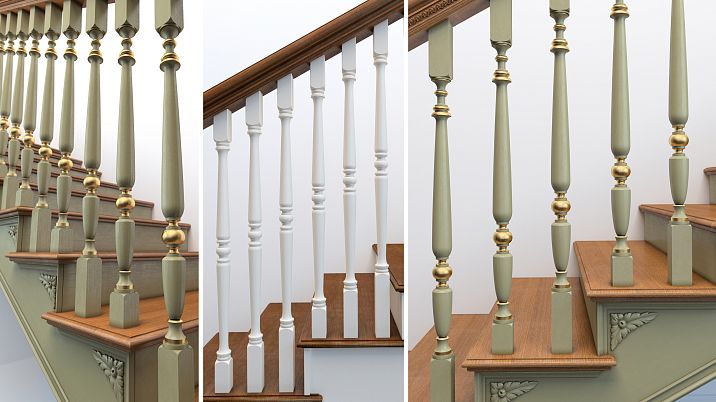
When you climb the stairs and feel a perfectly smooth handrail under your hand, and your gaze glides over a perfectly aligned row of balusters, do you know what titanic work lies behind this apparent simplicity? Installing balusters and handrails is an art that requires not only technical knowledge but also an understanding of the subtleties of working with various materials, knowledge of safety regulations, and mastery of modern mounting technologies.
Each detail of the staircase railing plays its role in creating a unified symphony of strength and beauty. Balusters are not just decorative elements, but the most important structural components that ensure the rigidity of the entire railing system. Handrails, however, serve not only as support for the hand, but also as a connecting link, uniting individual posts into a monolithic structure.
Modern requirements for staircase railings are becoming increasingly stringent. The structure must withstand a horizontal load of no less than 100 kilograms per linear meter — this means that an adult person can lean heavily on the handrails without fear of their destruction. Achieving such strength is possible only through flawless execution of each mounting stage.


Engineering philosophy of staircase railings
Before diving into technical details, it is important to understand the principles of operation of a staircase railing as a single system. This is not simply a set of individual elements — it is a complex engineering structure, where each component interacts with others, creating overall strength and stability.




Physics of loads and force distribution
Staircase railings operate under complex loading conditions. Vertical loads from the structure's own weight combine with horizontal forces from people leaning on the handrails. Dynamic impacts during intensive use of the stairs create additional stresses that must be reliably absorbed by all system elements.
Balusters function as vertical posts, transmitting loads from the handrail to the treads or stringers of the stairs. In doing so, they experience not only compression but also bending from horizontal forces. The most critical points are the connection joints — it is here that maximum stresses arise.
Handrails unite individual balusters into a single system, ensuring the overall rigidity of the railing. A properly designed and installed handrail transforms a row of separate posts into a monolithic structure capable of withstanding significant loads.
Our factory also produces:


Material science aspects of design
The choice of materials for the railing determines not only its appearance but also the mounting technology. Woods of different species have unique properties that must be considered when designing connections.
Hardwood species — oak, beech, ash — provide high strength but require pre-drilling all holes for fasteners. Coniferous species are more workable but tend to crack when improperly fastened.
The moisture content of wood is critically important for the quality of connections. Material with moisture content above 12% will continue to dry after installation, leading to weakened fasteners and gaps.
Get Consultation
Normative Requirements and Safety Standards
Modern construction is governed by strict regulations that define not only the dimensions of railing elements but also requirements for their strength and reliability. Knowledge of these requirements is the foundation of a professional approach to installation.
Geometric parameters of railings
In residential buildings, the height of handrails should be at least 900 millimeters above the stair tread level. For public buildings, this value increases to 1200 millimeters. Such height ensures safe use of the stairs by people of different heights.
The distance between balusters in the clear space should not exceed 150 millimeters. This requirement is aimed at preventing children from falling through the railing. In households with young children, it is recommended to reduce this dimension to 100-120 millimeters.
The handrail width should allow for comfortable grip by an adult's hand. Optimal dimensions are 40-70 millimeters for round rails and 50-80 millimeters for rectangular ones.
Strength characteristics
The horizontal load on the railing is standardized at 100 kg/m for residential buildings and 150 kg/m for public buildings. This load should be applied to the handrail at a height of 900-1200 millimeters above the stair tread level.
The vertical load on the handrail is 100 kg/m and simulates a person leaning on the railing while ascending stairs. The structure must not exhibit residual deformation after the load is removed.
Dynamic tests involve applying an impact load using a soft body of 50 kilograms. The railing must withstand such impact without damage or significant deformation.
Classification of Mounting Methods
There are numerous ways to connect balusters to the stair structure's load-bearing elements and handrails. The choice of a specific method depends on the material of the elements, strength requirements, aesthetic preferences, and project budget.
Threaded connections: the standard of reliability
Using threaded metal bolts provides the strongest and most durable connection for railing elements. This method is especially effective for heavy oak or beech structures where maximum reliability is required.
Bolts with a diameter of 6-8 millimeters are made from stainless steel or galvanized metal to prevent corrosion. The bolt length is calculated to ensure secure anchoring in both connected parts.
The installation technology involves precisely drilling coaxial holes in the baluster and base. The hole diameter must match the bolt thread’s outer diameter to ensure a tight fit.
Dowel Connections: Traditional Elegance
Wooden dowels represent a classic carpentry solution valued for its eco-friendliness and ability to create disassemblable joints. This method is especially popular in restoring historic staircases.
Dowels are made from the same wood species as the main structural elements. The dowel diameter is typically 8-12 millimeters, and the length is 40-60 millimeters depending on the size of the connected parts.
The quality of the dowel joint largely depends on the adhesive used. Modern polyurethane adhesives provide waterproof joints that do not degrade under changes in wood moisture.
Self-tapping screws: a balance of simplicity and efficiency
Construction screws allow creating a sufficiently strong joint with minimal labor. This method is especially popular among beginners due to its simplicity.
Screws with a diameter of 6-8 millimeters and concealed heads provide hidden fastening that does not compromise the structure’s aesthetics. Screw length is selected based on the thickness of the connected elements.
Pre-drilling is necessary for hardwoods. The hole diameter should be 1-2 millimeters smaller than the screw diameter, ensuring secure fixation without risking cracking.
Technological installation sequence
Professional installation of balusters and handrails involves a strictly regulated sequence of operations, where each stage affects the final result’s quality. Violating the technology at any stage may require redoing the entire work.
Preparation stage: the foundation of quality
Work begins with careful inspection of the staircase structure’s readiness for railing installation. All treads must be securely fastened, surfaces leveled and finished. The moisture content of wooden elements must not exceed 12%.
Creating a detailed plan for baluster placement is a critical stage. The distance between posts is calculated according to regulatory requirements and aesthetic considerations. Uniform spacing ensures visual harmony of the structure.
Marking is performed using high-precision measuring tools. A laser level allows creating an ideally level installation line at any distance. Each fastening point is marked with precision to 1 millimeter.
Element Processing and Preparation
Balusters are supplied as blanks requiring final finishing before installation. End-cutting is performed on a circular saw with a fine-toothed disc to achieve a perfectly flat cut without chipping.
All surfaces are sanded in multiple stages with gradually decreasing abrasive grit. Initial processing is done with 120-150 grit paper, and final finishing with 220-320 grit.
Pre-treatment with protective compounds extends the service life of wooden elements. Special attention is given to end surfaces, which are most susceptible to moisture exposure.
Installation of Support Posts
Installation begins with setting up support posts — strong balusters that define the entire railing’s geometry. These elements are installed at the beginning and end of the stair run, as well as at turns.
Support posts are secured to the stair structure’s load-bearing elements using strong bolted connections or chemical anchors. The strength of these joints is critically important for the overall railing stability.
The verticality of support posts is controlled using a level and plumb bob. Deviations exceeding 1 millimeter per meter of height are not permitted and require correction.
Specialized Fastening Techniques
Different structural features of staircases require specific fastening methods. Understanding these features allows selecting the optimal technology for each specific case.
Fastening to wooden treads
Wooden treads offer the greatest opportunities for baluster fastening due to ease of processing and good adhesion to fastening elements. However, stair treads are also susceptible to moisture-induced deformation.
Through-bolted mounting ensures maximum connection reliability. The bolt passes through the entire thickness of the tread and is secured with a wide washer and nut on the opposite side. This connection allows for tightening the fastening if necessary.
Blind mounting on studs is used when access to the underside of the tread is limited. A blind hole is drilled into the tread, and a threaded bushing or stud is installed using adhesive.
Mounting on metal structures
Metal staircases require a special approach to mounting wooden balusters. Different coefficients of thermal expansion of materials create additional stresses at connection joints.
Welded connections provide maximum strength but require corrosion protection. Welded areas are thoroughly cleaned and coated with protective compounds. Wooden elements are fastened to metal brackets using bolts or screws.
Bolted connections allow creating disassemblable structures and compensating for thermal deformations. Using flexible gaskets reduces vibration transmission from the metal frame to wooden elements.
Working with concrete foundations
Concrete staircases present special difficulty for mounting wooden railings. The high strength of concrete allows creating very reliable connections, but requires special fasteners.
Chemical anchors provide the highest strength connection in concrete. A special epoxy-based adhesive creates a monolithic connection with the base. Polymerization time ranges from several hours to a full day.
Spread anchors represent a simpler solution but require precise installation technology. The quality of the connection depends on the density of the concrete and the accuracy of drilling the hole.
Installing handrails: final stage
Installing handrails is the final note in the symphony of baluster and railing assembly. The quality of this work affects not only the appearance of the structure but also its usability.
Handrail Preparation for Installation
Handrails are supplied as straight blanks that must be fitted to the specific staircase. Length is measured from the top ends of installed balusters, accounting for overhangs beyond the end supports.
Handrail ends are mitered at angles ensuring tight fit against support posts or walls. Complex angled joints may be required for spiral staircases.
Routing the groove for the handrail support strip is a responsible operation requiring high precision. The groove depth should be 8-12 millimeters, and the width should match the strip thickness with minimal clearance.
Handrail Mounting Technology
The handrail support strip serves as an intermediate element between balusters and the handrail. It is made from the same wood species and has a thickness of 8-10 millimeters. The strip ensures even load distribution among all balusters.
The strip is fastened to balusters using 25-30 mm screws driven into the ends of the posts. Screw heads are countersunk 2-3 mm and covered with wooden plugs.
The handrail is mounted onto the support strip using carpenter’s glue and screws driven from below the strip. This connection is concealed and provides high strength.
Final connection treatment
After completing the installation, all connections are carefully checked for play and secure fastening. Installation sites of fasteners are masked with wooden plugs if necessary.
Connections are sanded with fine-grit sandpaper (220-320 grit), ensuring smooth surface and preparing it for application of protective-decorative coatings.
Quality control includes checking the geometry of the structure, strength of all connections, absence of surface defects. Each element must meet project specifications.
Quality control and testing
Completion of installation does not mean the end of work. Careful quality control allows identifying and eliminating possible defects before the staircase begins operation.
Visual inspection of the structure
External inspection of all railing elements is performed under good lighting. Checking for chips, scratches, stains, uneven coating. Special attention is paid to connection points.
Geometric control includes checking baluster verticality, handrail horizontal alignment, uniform spacing between elements. Levels, squares, and high-precision measuring rulers are used.
Connection quality is assessed by absence of gaps, play, or squeaking under load. All fasteners must be securely tightened but not over-tightened.
Load testing
Functional tests are conducted by applying standard loads to the handrail. A horizontal force of 100 kilograms is applied to various sections of the railing for 5 minutes.
Dynamic tests include rhythmic loading on the structure at a frequency matching normal walking rhythm. Absence of resonant vibrations indicates correct design and installation.
Usability assessment includes evaluating handrail height, profile, absence of sharp edges or burrs. The handrail should be comfortably graspable by an adult’s hand.
Typical errors and ways to prevent them
Analysis of common installation errors in railings helps avoid problems and ensures high-quality work. Most defects are due to improper technology or insufficient installer qualifications.
Errors in planning and marking
Inaccurate marking is the source of many problems during installation. Deviations in dimensions and angles accumulate and lead to inability to assemble the structure properly. Errors in determining baluster spacing are especially critical.
Insufficient consideration of material properties may lead to problems during operation. Different coefficients of thermal expansion and moisture deformation must be considered when designing connections.
Ignoring regulatory requirements creates risks to user safety. Exceeding allowable baluster spacing or insufficient railing height may lead to accidents.
Technological violations
Using low-quality or inappropriate fasteners reduces the reliability of connections. Saving money on fasteners may lead to serious problems in the future.
Violating wood processing regimes leads to defects. Excessive cutting speed causes chips and tear-outs, while insufficient speed reduces work efficiency.
Failure to observe technological pauses when using glued joints may result in their failure. Each type of adhesive has specific requirements for holding time and polymerization conditions.
Operation Errors
Exceeding calculated loads may lead to guardrail failure. Impact loads are especially dangerous, creating peak stresses several times higher than static loads.
Lack of regular maintenance leads to accumulation of defects and reduced structural reliability. Timely identification and elimination of minor issues prevent serious accidents.
Incorrect use of ladders may also lead to damage. Handrails are not intended for suspending heavy objects or serving as supports during work.
Modern trends and innovations
Advancements in technology and changing aesthetic preferences lead to new guardrail installation methods. Modern solutions combine traditional reliability with innovative approaches.
Integration of smart technologies
Modern stair railings may be equipped with lighting systems, motion sensors, and smart home components. This requires a special approach to wiring and mounting additional equipment.
Wireless load sensors allow real-time monitoring of the structure's condition. Information about exceeding allowable loads is transmitted to the building's central control panel.
Automatic lighting systems improve safety when using stairs at night. LED strips are integrated into handrails or treads, creating soft, directional lighting.
Ecological aspects
Growing demands for ecological safety encourage the use of natural materials and non-hazardous technologies. Water-soluble adhesives replace traditional formulations based on organic solvents.
Certification of wood under FSC and PEFC systems guarantees its origin from sustainably managed forests. This is becoming an important factor for environmentally conscious consumers.
Secondary recycling technologies allow the use of production waste to manufacture fasteners and auxiliary parts.
Conclusion
Professional installation of balusters and handrails is a complex art requiring deep knowledge of materials, understanding of mechanical principles, and mastery of modern technologies. Each railing element must be installed with jewel-like precision, as this affects not only the appearance of the structure but also the safety of people.
Modern technologies open new possibilities for creating unique stair railings, but the fundamentals of craftsmanship remain unchanged. Understanding material properties, mastering traditional carpentry techniques, and attention to detail — these are what distinguish a true professional.
A well-executed railing serves for decades, ensuring safety and delighting the eye with its beauty. Investments in professional installation pay off many times over due to the longevity of the structure and the absence of frequent repairs.
For those striving for perfection in every detail, we recommend studying detailed information about baluster and railing installation, where time-tested methods and modern technological solutions are presented.
Remember: every railing is not just a functional element, but a work of art that must harmoniously integrate into the home's architecture and serve as its decoration for many years.
For many years, STAVROS has been a recognized leader in creating exclusive stair constructions. Our craftsmen possess unique experience and are ready to share the secrets of professional craftsmanship with those who strive to create truly high-quality and beautiful stair railings.