Article Contents:
- Philosophy of wooden architecture in modern execution
- Choosing Wood: The Foundation of Durability
- Technical requirements and regulations
- Tool preparation: professional's arsenal
- Cutting tools and their adjustment
- Measuring instruments and control tools
- Fastening technologies: from classics to innovations
- Joints on wooden dowels
- Metallic fastening systems
- Innovative Hidden Fastening Systems
- Step-by-step installation technology
- Marking and preparatory work
- Drilling holes and preparing joints
- Installing and aligning balusters
- Installing handrails: final touch
- Preparing handrails and baluster supports
- Technology of mounting handrails
- Connecting handrails to support posts
- Final finishing and protective coatings
- Sanding and Surface Preparation
- Protective coatings and decorative finishes
- Quality control and defect elimination
- Inspection operations and measurements
- Typical defects and methods of their elimination
- Modern Trends and Innovations
- Integration of technologies into traditional craftsmanship
- Ecological Aspects of Modern Production
- Economic aspects of professional installation
- Budget planning and cost optimization
- Comparison of different technologies
- Conclusion
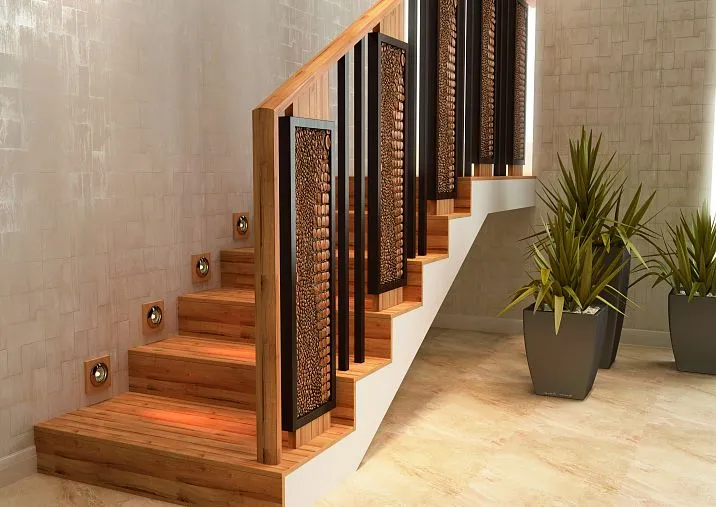
A wooden staircase without elegant balusters and reliable handrails is like a symphony without a finale. Each element of this architectural composition requires flawless execution, where technical skill merges with artistic vision. Installing balusters and handrails from wood Represents the culmination of carpentry art, where every millimeter matters, and each joint must serve for decades.
The process of installing wooden railings combines precise engineering calculations, the sense of proportion of an artist, and the golden hands of a master. Modern technologies have significantly simplified many operations, but the fundamentals of craftsmanship remain unchanged. Quality installation requires understanding the properties of wood, knowledge of various fastening methods, and the ability to work with professional tools.
The success of the entire project is laid down during the planning stage. Correctly selected materials, precisely calculated dimensions, properly chosen fasteners — all this determines not only the appearance of the finished structure but also its durability and safety of use.


Philosophy of wooden architecture in modern execution




Choosing wood: the foundation of durability
Wood is a living material that continues to 'breathe' even after processing. The choice of wood species for balusters and handrails determines not only the aesthetic qualities of the future structure but also its performance characteristics. Each species has unique properties that must be considered during planning.
Oak remains an unmatched material for creating elite stair railings. Its density reaches 700 kg/m³, providing exceptional strength and longevity of structures. Tannins contained in oak wood give it natural resistance to moisture and biological influences. The oak texture with clearly visible annual rings creates an elegant pattern that only improves with age.
Ash attracts builders with its exceptional toughness and elasticity. This species can withstand significant dynamic loads without cracking. Light tones of ash with contrasting texture harmonize beautifully with modern interior solutions. The density of the wood is 650-700 kg/m³, providing excellent strength characteristics.
Beech is characterized by uniform structure and beautiful pinkish hue. Its density reaches 680 kg/m³, comparable to oak. Beech wood is easy to process and retains its shape well after drying. A distinctive feature of beech is its ability to be evenly stained, allowing for the creation of products in any color scheme.
Our factory also produces:


Technical requirements and standards
Modern building codes establish strict requirements for stair railings. The height of handrails should be at least 900 mm for residential buildings and 1200 mm for public buildings. The distance between balusters should not exceed 150 mm in clear span, preventing the possibility of a child slipping through.
Strength characteristics of railings are regulated by special norms. The handrail must withstand a horizontal load of at least 100 kg without residual deformation. Balusters must resist lateral force of 30 kg applied at a height of 900 mm above the step level.
Ergonomic requirements for handrails are based on anthropometric data. The optimal diameter of a round handrail is 40-50 mm, ensuring comfortable grip for most people. Rectangular handrails must have rounded edges with a radius of at least 5 mm to prevent injuries.
Get Consultation
Tool Preparation: The Professional’s Arsenal
Cutting tools and their setup
The quality of installation directly depends on the condition of the tool used. A saw with carbide-tipped teeth provides clean cuts without chipping. The disc diameter must match the thickness of the material being processed — for balusters with a cross-section up to 50 mm, a 250 mm disc is sufficient, while more substantial elements require 300-350 mm.
Milling machines open up wide possibilities for creating grooves, mortises, and decorative profiles. A handheld router with a power of 1200-1500 W handles most tasks in manufacturing stair components. The router bit set should include straight groove bits with diameters of 6, 8, 10, and 12 mm, as well as profile bits for creating decorative elements.
Tool sharpening is a separate art requiring special knowledge and equipment. A properly sharpened router bit leaves a smooth surface that does not require additional finishing. The sharpening angle depends on the material being processed: for soft woods — 15-20 degrees, for hard woods — 25-30 degrees.
Tool sharpening is a separate art requiring special knowledge and equipment. A properly sharpened cutter leaves a smooth surface that does not require additional processing. The sharpening angle depends on the material being processed: for soft woods — 15-20 degrees, for hard woods — 25-30 degrees.
Measuring instruments and control tools
Measurement accuracy is the foundation of quality installation. A laser level ensures the construction of perfectly horizontal and vertical lines at any distance. Modern models with self-leveling functions automatically compensate for minor deviations in the base.
A digital protractor allows measuring and transferring angles with an accuracy of 0.1 degrees. This is especially important when working with non-standard staircases, where angles of inclination may differ from standard values. The protractor’s magnetic base ensures secure fixation on metallic surfaces.
A caliper is indispensable for precise measurements of hole diameters, material thicknesses, and checking fastener dimensions. Digital models with a resolution of 0.01 mm provide maximum measurement accuracy.
A plumb bob remains one of the most reliable tools for checking vertical alignment. Unlike electronic levels, a plumb bob is unaffected by magnetic fields and always indicates true verticality. For indoor use, a plumb bob weighing 200-300 grams is sufficient.
Fastening Technologies: From Classics to Innovations
Connections using wooden dowels
Dowel jointing represents a classic of carpentry craftsmanship. Wooden cylindrical rods with a diameter of 8-12 mm create a strong and aesthetically pleasing connection without visible metal components. The quality of the dowels determines the reliability of the entire structure — they must be made from hardwood with a moisture content not exceeding 8%.
The installation technology requires high precision in drilling holes. A drill guide ensures strict perpendicularity of holes to the surface of the part. The drill bit diameter must exactly match the dowel size — even a 0.1 mm deviation may lead to a weakened connection or wood cracking.
The depth of holes is calculated based on the dowel length and required connection strength. For a 50 mm dowel, the optimal hole depth in the baluster is 30 mm, and in the base — 25 mm. This ensures sufficient gluing surface area while maintaining part integrity.
The quality of the adhesive joint determines the longevity of the entire structure. Modern PVA wood adhesives provide joint strength exceeding the strength of the wood itself. The adhesive must be applied evenly both into the hole and onto the dowel surface. The open time is 3-5 minutes, after which the parts must be connected and secured.
Modern metal fastening systems offer high reliability and the possibility of concealed installation. Threaded rods with a diameter of 8-10 mm provide exceptional joint strength and allow for disassembly of elements without damaging the main structure. Installing balusters on stairs using metal fasteners requires precise adherence to drilling and installation technology.
Stainless steel threaded rods provide maximum connection strength and allow for subsequent adjustment. The rod diameter is selected based on the baluster dimensions: for sections up to 40×40 mm, an M8 rod is sufficient, while for more substantial elements, an M10 or M12 rod is recommended.
The rod length is calculated based on the depth of insertion into the baluster (40-50 mm), the base thickness, and the allowance for the nut with washer (15-20 mm). The thread must be metric with a fine pitch, ensuring more secure fixation in the wood.
The installation technology begins with precise hole drilling. In the baluster, a blind hole is drilled 1 mm smaller in diameter than the rod — this ensures secure thread engagement. In the base, a through hole is drilled 1-2 mm larger in diameter than the rod to allow free passage of the fastener.
Modern industry offers specialized fastening systems designed specifically for installing stair components. These systems combine ease of installation with high reliability and complete invisibility of fastening elements.
Innovative Hidden Fastening Systems
The modern industry offers specialized mounting systems designed specifically for installing stair components. These systems combine ease of installation with high reliability and complete invisibility of mounting elements.
Tubular systems consist of metal sleeves with internal threads that are glued into the base. Balusters are equipped with corresponding threaded elements, ensuring quick and secure connection. Such a system allows for disassembling components if needed, without damaging the structure.
Magnetic fasteners use powerful neodymium magnets to fix balusters. Magnets are embedded in the baluster base and mounting locations, providing secure fixation without mechanical fasteners. Such systems are especially relevant for temporary structures or when frequent disassembly is required.
Step-by-step installation technology
Marking and preparatory work
Quality marking is the foundation of successful installation. The process begins with determining the exact number of balusters and distances between them. Building codes require that the distance between vertical elements does not exceed 150 mm center-to-center, but aesthetic considerations often dictate a denser arrangement.
Distance correction is necessary to ensure even distribution of elements. If the calculated number of balusters does not provide a multiple of the spacing, distances should be adjusted slightly smaller. The outermost balusters should be positioned 50-70 mm from the support posts.
Marking is done using a tape measure and pencil. On each step or stringer, the centers of future balusters are marked. To check the accuracy of marking between the outermost points, a string is stretched and the evenness of distances is verified.
Marking is done with a tape measure and pencil. On each step or on the stringer, the centers of future balusters are marked. To check the accuracy of marking, a string is stretched between the extreme points, and the evenness of distances is verified.
Drilling holes and preparing connections
The accuracy of drilling holes is critically important for connection quality. A drill guide ensures strict perpendicularity of holes to the part’s surface. A homemade drill guide can be made from a piece of hardwood or metal with guide bushings.
The drill bit diameter must exactly match the type of fastener selected. For 10 mm dowels, a 10 mm drill bit is used. For M8 threaded rods, a 7 mm hole is drilled in the baluster and a 9 mm hole in the base.
Drilling depth is controlled by a stop on the drill or a special bushing. Exceeding the calculated depth may weaken the part, while insufficient depth will not ensure a secure connection. A wooden block with a hole of the required depth can be used for control.
Hole quality is checked visually and by touch. The walls should be smooth, without scratches or chips. If defects are detected, the hole should be re-drilled to a larger diameter and the appropriate fastener should be used.
Baluster Installation and Alignment
Installation begins with the placement of the end support posts. These elements serve as the base for aligning all other balusters and must be installed with maximum precision. Verticality is checked using a plumb bob or laser level in two mutually perpendicular planes.
Between installed support posts, a string is stretched at the height of the future railings. This string serves as a guide for aligning the height of all intermediate balusters. The string tension should be sufficient to prevent sagging, but not excessive to avoid deforming the support posts.
The sequence of installing intermediate balusters may vary depending on the chosen fastening method. When using adhesive joints, it is recommended to install all elements simultaneously to ensure even adhesive bonding. Mechanical fasteners allow balusters to be installed sequentially.
Each installed baluster is checked for verticality and alignment with the marking. Minor deviations can be corrected by adjusting the fastening or using shims. Significant deviations require reinstallation of the element.
Railing Installation: Final Touch
Preparation of Rails and Rail Supports
Rails are made from the same material as the balusters to ensure stylistic unity. The rail cross-section is selected based on ergonomic requirements and overall structural proportions. Standard sizes are 40×60 mm or 50×70 mm for rectangular rails, and 40-50 mm diameter for round rails.
The rail support is used to fasten the rail to the balusters and must precisely match the groove in the rail. The thickness of the support is usually 8-10 mm, and its width equals the width of the groove. The material of the support is the same wood species as the main elements.
Rail processing includes milling grooves, sanding, and preliminary finishing. The groove for the rail support is milled on the underside of the rail along its entire length. The groove depth is 12-15 mm, ensuring a secure connection with the support.
The ends of the rails are processed depending on the connection type with the support posts. This may be a simple straight cut, an angled cut, or a complex profile for mating with decorative post elements.
Handrail Mounting Technology
Installation of Wooden Railing Installation begins with mounting the rail support. The support is fastened to the top ends of the balusters with self-tapping screws 40-50 mm long. It is important to ensure strict horizontal alignment of the support using a level, and if necessary, adjust the height of individual balusters.
The support is fastened with two self-tapping screws per baluster to prevent rotation of the elements around their axis. The screws are driven in at a slight angle to each other, enhancing connection reliability. Screw heads should be recessed into the wood by 2-3 mm.
Rail installation is performed after complete mounting of the rail support. The rail is placed groove-side down onto the support and checked for proper fit along its entire length. If necessary, the groove is refined with a chisel or router.
The rail is secured with self-tapping screws driven from below through the rail support. Screw length is chosen so that they penetrate the rail by 15-20 mm, without protruding from the face. Additionally, the joint is reinforced with wood glue applied into the groove.
Connection of Rails to Support Posts
Connection of rails to support posts is the most critical joint in the entire structure. There are several ways to perform this connection, each with its own advantages and application specifics.
The groove connection involves milling a groove in the support post to fit the end of the rail. The groove depth is 20-30 mm, ensuring sufficient bonding area. The connection is reinforced with self-tapping screws or dowels driven through the post into the rail end.
Bolted connection provides maximum strength and allows for disassembly. A through bolt with a diameter of 8-10 mm passes through the post and rail, secured with a nut and wide washer. The bolt head and nut are recessed into the wood and covered with wooden plugs.
Metallic connecting elements are a modern solution for creating disassemblable structures. Special couplings and adapters allow for quick and reliable connection of rails to posts without visible fasteners.
Finishing and protective coatings
Polishing and surface preparation
Quality finishing begins with thorough sanding of all surfaces. The process is carried out in stages, starting with coarse abrasives and gradually moving to finer ones. Initial sanding is performed with 120-150 grit sandpaper to remove processing marks and minor defects.
Intermediate sanding with 220-240 grit abrasive levels the surface and prepares it for final finishing. Special attention is paid to connection areas — there should be no steps, glue buildup, or other irregularities.
Final sanding is performed with 320-400 grit abrasive to achieve a perfectly smooth surface. All movements must be directed along the wood grain — crosswise scratches will become visible after applying a transparent finish.
Dust removal after each sanding stage is critically important for coating quality. Dust is first removed with a vacuum cleaner, then with a sticky cloth or cloth slightly dampened with white spirit. The surface must be absolutely clean before applying the next coating layer.
Protective Coatings and Decorative Finishes
The choice of protective coating depends on operating conditions and aesthetic preferences. For indoor staircases, water-based acrylic lacquers are suitable — they are odorless and dry quickly. Polyurethane lacquers provide higher wear resistance but require good ventilation during application.
Oil-based coatings highlight the natural beauty of wood and create a pleasant-to-touch surface. They are easily repairable for local damage but require more frequent renewal compared to lacquer coatings.
Staining compounds allow changing the color of wood or emphasizing its texture. Water-based stains provide even coloring and do not raise wood fibers. Alcohol-based stains dry quickly but require skill for even application.
Coating application technology includes several stages. The first layer is primer, which equalizes the wood’s absorption capacity and ensures better adhesion of the final coating. After the primer dries, the surface is lightly sanded with 400 grit abrasive.
Quality control and defect elimination
Inspection operations and measurements
After completing the assembly, a comprehensive quality check of the entire structure must be performed. The verticality of balusters is controlled using a plumb bob or laser level with an accuracy of 2 mm per meter of height. Any deviations beyond allowable limits require adjustment or reinstallation of components.
Horizontal alignment of handrails is checked using a construction level at least 1 meter long. The allowable deviation is 2 mm per meter of length. Inspection is performed at multiple points along the entire length of the handrail to detect local deviations.
The uniformity of distances between balusters is controlled using a tape measure. All gaps must be equal within an accuracy of 3 mm. Significant deviations spoil the appearance of the structure and may indicate errors in marking or installation.
Typical defects and methods of their elimination
Typical defects and methods of their elimination
Vertical deviations are corrected by adjusting the fastening or installing compensating shims. When using threaded connections, minor adjustments can be made by changing the depth of bolt insertion.
Deviation from vertical is corrected by adjusting the mounting or by installing compensating shims. When using threaded connections, minor adjustments can be made by changing the depth of bolt insertion.
Gaps in connections between handrails and posts are filled with wooden inserts or wood putty. The color of the filler must exactly match the main material. After drying, the repair area is sanded and coated with a protective finish.
Scratching in connections is usually caused by insufficient rigidity of fastening or friction between parts. Elimination requires disassembling the connection, cleaning the surfaces, and reassembling with lubricant or sealing materials.
Modern trends and innovations
Integration of technologies into traditional craftsmanship
modern technologies have significantly expanded the possibilities of installing wooden stair railingsCNC machines ensure ideal precision in processing parts, while laser measurement systems allow controlling geometry with micrometer accuracy.
3D modeling helps visualize the future structure and identify potential issues during the design phase. Virtual assembly allows optimizing the sequence of installation operations and minimizing errors.
Composite materials based on wood fibers combine the beauty of natural wood with improved performance characteristics. They are resistant to rot, require no regular maintenance, and maintain stable dimensions even with changes in humidity.
Smart monitoring systems allow real-time tracking of the condition of stair structures. Load and vibration sensors embedded in key nodes alert users to the need for preventive maintenance.
Ecological aspects of modern production
Environmental responsibility has become an important factor when selecting materials and technologies. Using certified wood from sustainably managed forests guarantees minimal environmental impact.
Safe adhesives and formaldehyde-free coatings ensure a healthy microclimate in the home. Water-based varnishes and natural resin-based adhesives do not emit harmful substances and are suitable for use in children's rooms.
Energy-efficient production technologies reduce the carbon footprint of products. Using renewable energy sources, optimizing logistics chains, minimizing packaging — all these measures contribute to creating a more eco-friendly product.
Waste disposal programs convert sawdust and shavings into useful products — heating pellets, particleboard, organic fertilizers. A closed production cycle minimizes waste volume.
Economic aspects of professional installation
Budget planning and cost optimization
Cost of balusters and handrails installation consists of several components: materials, tools, fasteners, and labor costs. Proper planning allows optimizing expenses without compromising quality.
Material selection should consider not only initial cost but also durability, maintenance costs, and repairability. Expensive wood species pay for themselves through long service life and minimal operating costs.
Optimizing material cutting reduces waste by 15-20%. Computer programs help calculate the optimal cutting layout, taking into account the dimensions of blanks and required parts.
Investments in quality tools pay off through increased productivity and work quality. Professional tools last for years and enable high-level performance.
Comparison of different technologies
|
Mounting method |
Cost of materials |
Installation complexity |
Reliability |
Possibility of disassembly |
|
Shanks + glue |
Low |
Medium |
High |
Impossible |
|
Threaded rods |
Medium |
High |
MDF with film |
Possible |
|
Self-tapping screws |
Very low |
Low |
Medium |
Possible |
|
Hidden Systems |
High |
Medium |
High |
Possible |
The choice of the optimal method depends on the specific conditions of the project, requirements for reliability, and budget constraints. For premium projects, hidden mounting systems are recommended; for budget projects, traditional methods are advised.
Conclusion
Art installation of wooden balusters and handrails It represents a harmonious blend of technical skill and artistic vision. Each stage of the process — from material selection to final finishing — requires deep knowledge, professional skills, and attention to the finest details.
Modern technologies have significantly expanded the possibilities for craftsmen, but the fundamentals of craftsmanship remain unchanged. Understanding the properties of wood, knowledge of various joining methods, and the ability to work with precision tools — these skills continue to define the quality of the finished work.
Investments in quality materials and professional installation pay off through the longevity and beauty of the finished structure. Properly installed wooden railings serve for decades, maintaining both functionality and aesthetic appeal.
Environmental considerations are becoming increasingly important when selecting materials and technologies. Responsible use of natural resources, application of health-safe materials, and minimization of waste — these principles must be considered at every stage of the work.
The future of the industry is linked to further development of eco-friendly technologies, increased energy efficiency in production, and the creation of even more advanced materials. Integration of digital technologies will enable achieving new levels of precision and quality.
The skill of installing stair railings requires continuous improvement and study of new methods. Each project is unique and presents new challenges, the solutions to which enrich professional experience and expand the craftsman’s capabilities.
Company STAVROS, with its rich experience in woodworking, continues to set the highest quality standards in the industry. The combination of centuries-old craftsmanship traditions with advanced technologies allows creating items that become true works of art. Every STAVROS project is a manifestation of perfection in every detail, the result of meticulous work by skilled masters and a pursuit of absolute quality.