Article Contents:
- Polyurethane as the Material of the Future for Interior Decoration
- Technical Specifications of Polyurethane Molding
- Wooden Baseboard: Classic, Time-Tested
- Varieties of Wooden Baseboards
- Advantages of Natural Wood in Interior Design
- Applications of Molding and Baseboards
- Ceiling Trim and Cornices
- Wall Decor and Panels
- Decorating door and window openings
- Floor Baseboards: More Than Just Trim
- Construction Features and Profiles
- Protective Coating and Finishing
- Selection Rules: How to Avoid Decor Mistakes
- Style Compatibility with Interior
- Proportions and scale
- Color solutions
- Installation technology: from preparation to finishing
- Preparation stage
- Cutting and Fitting Elements
- Installation and Fixing
- Finishing
- Operation and Maintenance of Decorative Elements
- Regular maintenance
- Repair and restoration
- Economic aspects: investment in quality
- Calculating required quantity
- Comparison of Alternatives
- Modern Trends in Decorative Finishing
- Minimalist Luxury
- Contrasting Graphics
- Mix of Textures and Materials
- FAQ: Answers to Popular Questions
- Conclusion

Modern interiors are unthinkable without elegant decorative elements that give a room completeness and nobility.Moldings made of polyurethaneandwooden baseboardThese elements occupy a special place in the arsenal of designers and finishing craftsmen. These elements not only mask technical gaps and joints, but also become full-fledged architectural accents capable of radically transforming the space.


Polyurethane as the Material of the Future for Interior Decoration
Polyurethane has revolutionized the decorative finishing industry, offering the market a material that combines the lightness of foam, the strength of wood, and the water resistance of plastic.Polyurethane ItemsThey are produced by high-precision casting into special molds, where a two-component polymer system forms a dense, homogeneous structure. This technological process allows reproducing the finest details of ornaments, creating elements indistinguishable from classical plaster molding.
The main advantage of polyurethane over traditional materials lies in its remarkable versatility. The material is not afraid of temperature fluctuations, maintains geometric stability under humidity changes, and does not deform over time.Polyurethane moldingsPolyurethane elements weigh 5-7 times less than gypsum analogs, significantly simplifying installation and reducing load on load-bearing structures. At the same time, the material has sufficient density (about 300 kg per cubic meter) to ensure the reliability and longevity of the products.
Polyurethane elements are easily machinable - they can be cut with a regular saw, sanded with sandpaper, and painted with any interior paints. The material does not crumble during sawing, does not crack when fastened, and retains the sharpness of edges and relief for decades. Modern manufacturers add special modifiers to the polyurethane composition, enhancing resistance to ultraviolet radiation and mechanical damage.




Polyurethane moldings are decorative strips of various profiles used to frame walls, ceilings, door and window openings. The standard length of elements is 2 or 2.44 meters, which allows minimizing the number of joints during installation. The profile width ranges from minimalist 2-3 centimeters to large-scale 20-30 centimeters for creating expressive architectural accents.
Moldings made of polyurethanePolyurethane moldings are decorative strips of various profiles used to frame walls, ceilings, door and window openings. The standard length of elements is 2 or 2.44 meters, which allows minimizing the number of joints during installation. The profile width ranges from minimalist 2-3 centimeters to large-scale 20-30 centimeters for creating expressive architectural accents.
The weight of one meter of polyurethane molding rarely exceeds 500 grams, even for the most substantial profiles. This opens the possibility of decorating lightweight partitions, gypsum board structures, and suspended ceilings without the risk of deforming the base. The material's density ensures sufficient rigidity to maintain shape during transportation and installation, while the elements possess slight elasticity, compensating for minor surface irregularities.
Operating temperature rangepolyurethane productsranges from minus 40 to plus 80 degrees Celsius. The material does not emit harmful substances, is environmentally safe, and does not support combustion. Polyurethane is completely inert to biological influences — insects do not infest it, mold and mildew do not develop in it, which is especially important for humid rooms.
The surface of polyurethane moldings has a uniform fine-grained structure, ideally suited for painting. The elements are delivered from the factory in white, ready for final finishing. High-quality polyurethane does not require preliminary priming before painting — paint lays evenly, does not absorb, and does not leave streaks. If necessary,Polyurethane Decorit can be tinted, patinated, covered with gold or silver to create an aged molding effect.
Our factory also produces:


Wooden skirting board: classic, tested over centuries
Wood remains the benchmark material for skirting boards, despite the abundance of modern alternatives.wooden baseboardIt possesses noble texture, natural beauty, and a unique energy of natural material that cannot be reproduced by artificial means. Wooden elements create in the room an atmosphere of coziness, warmth, and respectability, harmoniously combining with parquet, solid wood planks, and engineered flooring.
The production of wooden skirting boards begins with careful selection of wood. Both coniferous species — pine, spruce — and noble hardwoods — oak, beech, ash, walnut — are used. The raw material undergoes multi-stage drying to a moisture content of 8–12 percent, ensuring dimensional stability of the finished product. Dried blanks pass through milling machines, where the profile with grooves for utilities, decorative grooves, and rounded edges is formed.
Get Consultation
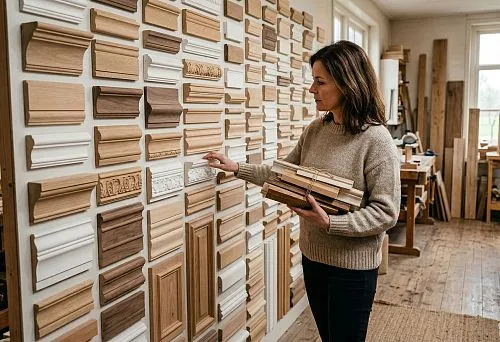
Varieties of wooden skirting boards
Solid wood skirting boards represent an elite product segment, made from a single piece of valuable wood. Such items possess maximum strength, longevity, and expressive texture. Solid skirting boards made of oak or beech serve for several decades, retaining their original appearance and not losing their geometry. The natural grain pattern makes each element unique, adding individuality and character to the interior.
Veneered skirting boards have a base of inexpensive coniferous wood, to which a thin slice (veneer) of valuable wood is glued. This technology allows obtaining a product visually indistinguishable from solid wood, but significantly more affordable. Veneered elements have good dimensional stability, as the multi-layer structure compensates for internal wood stresses. The color palette of veneered skirting boards is extremely wide — from light tones of maple and beech to deep shades of wenge and padauk.
MDF skirting boards represent a budget option for wooden decor. The base is made from pressed fine wood particles, bonded under high pressure. The surface is covered with a protective film imitating wood texture or painted. MDF skirting boards feature ideal geometry, dimensional stability, and moisture resistance. They combine perfectly with laminate and linoleum, offering an affordable price for a quite presentable appearance.
Advantages of natural wood in interior design
Wooden skirting boards possess a unique ability to 'breathe', regulating air humidity in the room. Natural wood absorbs excess moisture during high humidity and releases it back during dry air. This creates a comfortable microclimate, especially important in children's rooms and bedrooms. Wood does not generate static electricity, does not attract dust, and possesses natural antiseptic properties.
The strength of wooden skirting boards allows them to withstand mechanical impacts inevitable during use. Solid elements made of hardwood do not deform from accidental impacts, do not chip when furniture is bumped. If necessary, a wooden skirting board can be repaired — scratches can be filled, the surface can be renewed, damaged areas can be sanded. Such repairability distinctly advantages wood over synthetic materials.
The aesthetic qualities of natural wood are unmatched. The living texture of fibers, the play of tones, natural transitions of shades create visual richness that enriches the interior.wooden baseboardbecomes not just a utilitarian element, but a full-fledged part of the design concept. Properly selected skirting boards highlight the merits of the floor covering, visually lift ceilings, and correct the proportions of the room.
Applications of moldings and skirting boards
The functional purpose of decorative elements goes far beyond simple framing.Moldings made of polyurethaneThey are used for zoning space, creating visual accents, correcting architectural flaws of the room. With their help, you can 'raise' low ceilings, expand narrow rooms, add symmetry to non-standard layouts.
Ceiling trim and cornices
Ceiling moldings solve several tasks at once. They conceal the technological gap between the wall and ceiling, necessary when installing suspended structures. They create a smooth transition between vertical and horizontal planes, visually unifying the interior. Wide profiled cornices visually lift the ceiling, making the room appear more spacious and airy. Behindwith polyurethane moldingsit is possible to hide LED lighting, creating an effect of a floating ceiling or soft diffused lighting.
For classic interiors, cornices with rich ornamentation — plant motifs, geometric patterns, stylized architectural elements — are used. Modern styles tend toward sleek, smooth profiles, where decorative effect is achieved through play of light and shadow on the relief surface. The height of ceiling cornices is selected depending on the room's scale — for standard apartments, profiles 5–10 centimeters are optimal, while for high ceilings, substantial elements 15–25 centimeters tall are suitable.
Wall decoration and panels
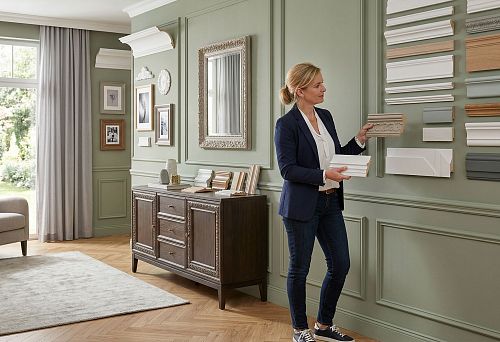
Wall moldings open up boundless creative possibilities. With their help, decorative panels imitating classic boiserie are created. Rectangular frames fromof polyurethane moldingsstructure the wall plane, dividing it into symmetrical sections, each of which can be painted in a contrasting color or covered with wallpaper. This technique adds depth to the interior, creates a play of planes, and gives the room a sense of intimacy and coziness.
Moldings are used to frame mirrors, paintings, televisions, built-in niches. Properly selected framing turns a functional element into a decorative accent that attracts attention. Horizontal moldings placed at the level of chair backs protect walls from damage and simultaneously serve as decorative spatial dividers.Polyurethane Decorit allows recreating the atmosphere of palace interiors in an ordinary city apartment.
Door and window openings trim
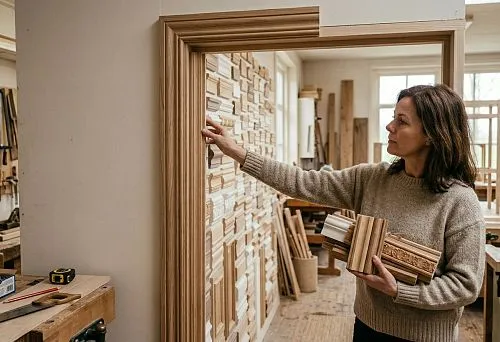
Trimming openings with moldings gives them architectural expressiveness. Molding imitates stone masonry, pilasters, columns. Above door openings, there are gables, consoles, keystone elements — features traditional for classical architecture. Such treatment turns a simple opening into a full-fledged architectural portal, adding monumentality and significance to the interior.polyurethane productsSuch treatment turns a simple opening into a full-fledged architectural portal, adding monumentality and significance to the interior.
Window sills decorated with moldings visually increase the window size, making it a more prominent interior element. A sill framed with decorative profile becomes a full horizontal shelf for placing decor. External framing of window openings creates a sense of depth, especially pronounced when combined with contrasting coloring of sills and walls.
Baseboards: more than just trim
wooden baseboardIt performs critically important functions in interior structure. It protects the lower part of walls from damage during cleaning, hides the deformation gap between flooring and wall, masks installed utilities. Modern baseboards are equipped with cable channels, allowing neatly conceal electrical wires, internet cables, TV antennas.
Constructive features and profiles
Baseboard height is selected depending on ceiling height and room scale. For standard apartments, optimal height is 50-80 millimeters — such elements look proportionate, do not overload space. In rooms with high ceilings, substantial baseboards of 100-150 millimeters height are appropriate, giving the interior a solid feel. Narrow baseboards of 30-40 millimeters are used in minimalist modern interiors, where maximum concealment of structural elements is required.
Baseboard profile can be simple rectangular or complex shaped with decorative grooves, rounded edges, protrusions. Classic profiles replicate architectural orders, including cornice and column base elements. Modern profiles lean toward minimalism — straight lines, minimal relief, clear geometric shapes. An important construction element is the baseboard’s base — it must fit tightly against the wall, compensating for minor surface irregularities.
Protective coating and finishing
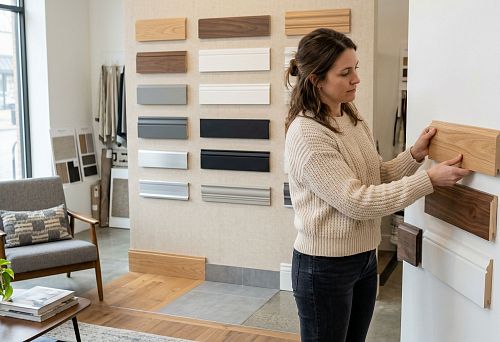
Wooden baseboards are supplied with various finishing options. Baseboards for painting have a smooth sanded surface, ready for any interior paint or varnish. This allows selecting color precisely according to design concept, creating contrast or harmony with flooring and walls. Painted baseboards can be repainted when interior changes, updating their appearance.
Varnished baseboards are coated with transparent protective finish preserving natural wood texture. Varnish protects wood from moisture, dirt, mechanical damage. Gloss level can vary from matte to high-gloss — choice depends on interior style. Matte finishes create impression of naturalness, emphasize natural beauty of wood. Glossy varnishes add elegance, make wood color more saturated.
Toned baseboards are stained with special compositions that change wood tone while preserving texture visibility. Staining allows making inexpensive pine resemble noble oak or exotic wenge. Stains penetrate wood structure, emphasizing annual ring pattern, making it more contrasting. Protective varnish is applied over stain, fixing color and giving product a finished look.
Rules for selection: how not to make a decor mistake
Choosing decorative elements requires consideration of multiple factors — interior style, room proportions, finishing characteristics, project budget.Moldings made of polyurethaneAnd wooden baseboards must harmonize with each other, creating a cohesive composition. Incorrectly chosen elements may ruin design concept, making interior disharmonious.
Style compatibility with interior design
Classic interiors require use of richly decorated moldings with ornaments, plant motifs, complex profiles.Relief DecorationIn classical style, it imitates traditional plasterwork of palaces and mansions. Symmetry, repeating elements, strict hierarchy of decoration — main principles of classical approach. Baseboards are selected substantial, with clear profile, from valuable wood species.
Modern styles — minimalism, high-tech, Scandinavian — require minimalist forms. Moldings are chosen with simple geometric profiles, without ornaments or scrolls. Color palette leans toward monochrome — white, gray, black.wooden baseboardIn modern interior, it can be painted to match wall color, becoming practically invisible, or, conversely, executed in contrasting color, emphasizing space geometry.
Eclectic interiors allow mixing styles, but require refined sense of proportion. Classic moldings can be combined with modern furniture if scale and color of elements are properly chosen. Key to success — presence of unifying element: common color palette, repeating textures, coordinated proportions.
Proportions and Scale
Baseboard height and molding width must correspond to room scale. In small rooms, substantial elements 'consume' space, making room visually even smaller. For small rooms, optimal are narrow moldings (3-7 cm) and low baseboards (5-7 cm). Light tones of elements visually expand space.
In spacious rooms with high ceilings, large decorative elements are appropriate. Wide cornices (15-25 cm) emphasize space scale, making it more imposing. High baseboards (10-15 cm) create solidity, visually 'grounding' interior. Dark tones add intimacy, making large space more cozy.
Important to maintain balance between different decorative elements. If ceiling cornice is substantial and richly decorated, baseboard should be more restrained to avoid overloading interior. Wall moldings are selected medium-sized, intermediate between baseboard and cornice. Such gradation creates visual hierarchy, making composition harmonious.
Color Solutions
Color of decorative elements significantly affects interior perception. Traditional approach implies painting moldings white, contrasting with colored walls. White elements look crisp and graphic, structure space, add freshness to interior. This is universal solution, suitable for most styles.
Paintingpolyurethane productsPainting in wall color creates effect of unified surface with protruding relief. Such technique adds depth, makes decor more subtle and refined. It is ideal for monochrome interiors, where texture play is important rather than color contrast. Moldings become part of room architecture, not superfluous decor.
Contrasting painting — bold solution for modern interiors. Black moldings on white walls, golden elements on dark blue background, copper accents on gray — such combinations create dramatic effect, making interior memorable. Important not to overdo contrast — it should be measured, accentual.
Wooden baseboards are selected either to match flooring (creating unified floor plane), or to match doors and window casings (unifying vertical interior elements). Contrasting baseboards are used less often — they visually separate floor from walls, which may be appropriate in certain stylistic solutions.
Installation technology: from preparation to finish
Quality installation — guarantee of durability and aesthetic appeal of decorative elements. Incorrect installation leads to gaps, element delamination, deformation.Moldings made of polyurethaneRequire care and precision, but with proper installation technology, even non-professionals can handle them.
Preparation Stage
The surface to be mounted must be flat, dry, and free of dust and grease stains. Irregularities exceeding 3-5 millimeters must be leveled with putty. Old wallpaper and peeling paint must be completely removed. If walls are painted with glossy paint, they should be sanded to improve adhesive bond.
Decorative elements must be acclimatized in the room for at least 24 hours before installation. This allows the material to adjust to the room’s temperature and humidity, preventing deformation after mounting. Elements are inspected for defects; minor irregularities are sanded with fine sandpaper if necessary.
Marking is a critical stage. For ceiling cornices, a horizontal line is marked along the room’s perimeter using a laser or water level. For wall moldings, the frame axes are marked, and the symmetry of element placement is checked. During installation,of wooden floor skirting boardmounting points are marked, and the location of hidden utilities is taken into account.
Cutting and fitting of elements
Polyurethane moldings are cut with a fine-toothed hacksaw or a circular saw. To achieve perfect angles, a miter box is used — a device ensuring precise 45-degree cuts. Internal and external angles require different cutting directions — it is important not to mix up the pieces. Before final cutting, it is recommended to make test cuts on short offcuts.
Joints between elements must be perfectly fitted. Even small gaps will be noticeable after painting. If the molding profile has ornamentation, elements are selected so that the pattern aligns at the joint. This requires additional material (5-10 percent), but ensures a flawless appearance.
Wooden baseboards are cut with a circular saw. For internal corners, both boards are beveled at 45 degrees. External corners are also formed from two elements beveled at an angle. In case of complex room geometry, corner angles may need to be adjusted on-site — in this case, one board is installed first, and the next is trimmed to fit it.
Installation and fixation
Polyurethane moldingsMounted using a special adhesive — polyurethane or acrylic. Adhesive is applied to the back of the element with a notched trowel in an even layer. The element is pressed against the surface, aligned with the marking, and held for 20-30 seconds until the adhesive sets. Excess adhesive is immediately wiped away with a damp sponge.
Long elements may require additional temporary fixation during adhesive setting. Painter’s tape, temporary supports, or special clamps are used. Heavy cornices are additionally secured with screws in inconspicuous locations. After the adhesive fully dries (12-24 hours), temporary fixings are removed.
Wooden baseboards are secured with screws, nails, or special clips. Screws are driven through the front surface at 40-60 cm intervals, with heads recessed and masked with wax pencils matching the wood color. Clip mounting is a more modern method, allowing for easy removal without damage. Clips are fixed to the wall, and the baseboard clicks into place.
Final finishing
Joints between elements are filled with acrylic sealant or putty. Material is applied with a rubber trowel, excess immediately wiped away. After drying, joints are sanded with fine sandpaper to a perfectly smooth finish. Well-treated joints become virtually invisible after painting.
Paintingpolyurethane decorPainted with acrylic or latex paint in two to three coats. The first coat is a primer, ensuring even coverage. Subsequent coats are applied only after the previous one is fully dry. Brushes, rollers, or spray guns are used for painting — choice depends on surface texture and area size.
Wooden elements can also be painted or stained after installation. Surface is pre-sanded, dusted, and primed. Paint or stain is applied along the wood grain, ensuring even distribution. Lacquer finish is applied in several thin coats with intermediate sanding.
Maintenance and care of decorative elements
Decorative elements’ longevity depends not only on material quality and installation, but also on proper care.Polyurethane ItemsThey are low-maintenance but require adherence to certain rules. Wooden elements are more demanding, requiring protection from moisture and mechanical damage.
Regular Maintenance
Polyurethane moldings are cleaned of dust with a dry soft cloth or vacuum cleaner with a delicate surface attachment. If necessary, damp cleaning with non-aggressive cleaning agents can be used. Abrasive materials that scratch painted surfaces must be avoided. Stubborn stains are removed with a mild soap solution.
Wooden baseboards are wiped with slightly damp cloth. Excess moisture may cause wood swelling and stains on lacquered surfaces. For lacquered elements, special wood polishes are used to restore shine and create a protective film. Scratches on the surface are filled with wax pencils or retouched with special markers.
Repair and Restoration
Scratches and scratches on polyurethane elements are filled with putty, sanded after drying, and touched up. If an element is severely damaged, it can be replaced — thanks to profile standardization, an identical replacement is easy to find. Detached sections are re-applied with adhesive and pressed until the adhesive sets.
Wooden baseboards with severe damage may also require replacement of individual sections. The damaged section is cut out, and a new element matching the color and texture is installed. Joints are carefully fitted, filled with putty, and then the entire surface is treated with a protective compound.
The appearance of decoration can be updated by repainting. Old paint is removed with solvent or sanding, the surface is primed and repainted. This allows complete change of interior color scheme without replacing decorative elements.wooden baseboardThey can be relacquered after sanding, restoring the original appearance.
Economic Aspects: Investment in Quality
The cost of decorative elements varies widely depending on material, profile complexity, and manufacturer.Moldings made of polyurethanePolyurethane moldings are cheaper than gypsum analogs with comparable appearance. Solid wood baseboards are more expensive than MDF variants, but offer incomparably higher quality and durability.
Calculation of required quantity
To calculate the linear meters of ceiling cornices, the room’s perimeter is measured. An additional 10-15 percent is added for cutting corners and fitting ornamentation. If the room has many corners or complex geometry, the reserve increases to 20 percent. Elements are purchased in multiples of standard length (usually 2 or 2.44 meters).
Wall moldings are calculated by the length of the frames or lines they form. It is important to note that forming rectangular frames requires four separate elements with corner joints. Complex compositions with multiple frames require careful calculation and preliminary layout on a plan.
Baseboards are calculated by the room’s perimeter minus door openings. An additional 10 percent reserve is added for cutting and fitting corners. If installing baseboards with cable channels, additional elements such as connectors, plugs, and internal/external corners must be accounted for.
When choosing decor, it is important to compare different options not only by initial cost but also by total cost of ownership.
Polyurethane moldings are 2-3 times cheaper than gypsum ones with similar decorative quality. They are easier to install, requiring no special skills or tools. Gypsum molding retains an advantage in authenticity for restoration projects and high-end interiors. Foam elements are even cheaper than polyurethane, but they are inferior in strength, relief clarity, and durability.
Solid wood skirting boards are 1.5-2 times more expensive than veneered ones. The difference in durability and repairability justifies the higher price for long-term projects. MDF skirting boards are a budget solution, optimal for temporary housing or short-term renovations. For prestigious projects, the choice is clear — only natural wood of valuable species.
Installation costs account for 30-50 percent of material costs when hiring professionals. DIY installation eliminates this expense entirely but requires time to learn the technique and purchase tools. For small-scale projects, self-installation is economically justified; for large-scale projects, professional work is preferable.
Modern trends in decorative finishing
Interior decor trends are cyclical — classic elements periodically return in new interpretations. The modern approach is characterized by mixing styles and using traditional forms in unexpected combinations.Polyurethane moldingsallows implementing the most daring design ideas thanks to the variety of available profiles.
Minimalist luxury
Modern classicism leans toward simplicity of form while preserving material quality and execution. Moldings are used sparingly — ceiling trim, a few wall frames, accent zones. Ornamentation is simplified to geometric lines, relief becomes less pronounced. The color palette is monochromatic, with soft contrasts.
Wooden elements are selected in light tones — whitewashed oak, light beech, natural ash. Wide skirting boards with a simple rectangular profile create a clear horizontal line structuring the interior. The absence of decorative grooves and chamfers emphasizes clean lines, aligning with minimalist philosophy.
Contrasting graphics
Bold use of contrasting colors — a prominent trend of recent years. Black moldings on white walls create a graphic effect, making the interior dynamic and modern. Gold and brass accents add luxury but require careful dosing.Polyurethane Decoris painted in saturated colors — emerald, sapphire, ruby.
Colored skirting boards — an extravagant solution for creative interiors. Skirting boards painted in the color of accent walls visually extend the vertical line, making the room appear taller. Contrasting skirting boards separate the floor, creating a clear boundary between horizontal and vertical planes.
Mix of textures and materials
Combining polyurethane moldings with wooden skirting boards — a common solution that combines the practicality of synthetic materials with the nobility of natural ones. It is important to select elements that harmonize in scale and style. Painting moldings in a color close to the wood tone creates visual unity despite differing textures.
Combining different wood species within one interior requires a professional approach. Skirting boards made of dark walnut can be paired with doors made of light oak if there is a unifying element — furniture of intermediate tone, textiles repeating both shades.
FAQ: Answers to popular questions
Can polyurethane moldings be used in wet areas?
Yes,Moldings made of polyurethaneare absolutely moisture-resistant and ideal for bathrooms, toilets, and kitchens. The material does not absorb moisture, does not deform, and does not develop mold. For additional protection, it is recommended to use moisture-resistant paints and sealants during installation.
What is the service life of wooden skirting boards?
When properly installed and maintained,wooden baseboardsolid wood skirting boards last 30-50 years or more. Veneered variants last 15-25 years. MDF skirting boards have a lifespan of 10-15 years. Service life depends on the wood species, quality of protective coating, and operating conditions.
Can moldings be installed on uneven walls?
Minor irregularities (up to 5 millimeters) are compensated by the elasticity of the adhesive and flexibility ofpolyurethane products. Significant unevenness requires preliminary surface leveling. An alternative option is using flexible moldings with special construction, capable of following wall curvature.
How to choose molding sizes for low ceilings?
For rooms with ceilings 2.5-2.7 meters high, moldings 5-8 centimeters wide are optimal. Wider elements visually lower the ceiling. Light-colored moldings in the ceiling tone create an effect of continuity, visually raising the room's height.
How do moldings from different manufacturers differ?
Differences lie in polyurethane density, relief clarity, geometric accuracy, and surface quality. Cheap elements may have imperfections, uneven density, and blurred ornamentation. Quality products feature perfectly smooth surfaces, sharp relief, and stable dimensions.
Can polyurethane molding be painted in dark colors?
Yes,Polyurethane moldingscan be painted in any color. Dark shades require thorough surface preparation — all defects will be visible. It is recommended to use primer and apply paint in 2-3 layers for even coverage.
What adhesive is best for installing moldings?
The optimal option is a special polyurethane adhesive or acrylic mounting adhesive such as 'liquid nails'. For heavy elements, two-component polyurethane adhesives with high adhesion are suitable. The adhesive must be compatible with the base material and not contain solvents that degrade polyurethane.
Do wooden baseboards need priming before installation?
Baseboards intended for painting require priming to improve paint adhesion and reveal surface defects. Lacquered and tinted elements are installed without additional treatment. It is recommended to treat the ends of baseboards with a protective compound to prevent moisture absorption.
How to care for lacquered wooden baseboards?
Regular dry cleaning with a soft cloth or vacuum cleaner. Periodically (every 2-3 months), use special wood polishes to restore shine. Avoid excessive humidity, abrasive substances, and aggressive chemicals.
Can polyurethane and plaster elements be combined?
Technically possible, but requires careful selection of profiles and textures. Polyurethane has a smoother surface, while plaster has a characteristic grain. When painted, the difference becomes less noticeable. It is recommended to use the same material within one visible zone.
Conclusion
Decorative interior elements are an investment in comfort, aesthetics, and the longevity of finishes.Moldings made of polyurethaneandwooden baseboardThey transform an ordinary room into a thoughtfully designed, harmonious space where every detail serves its purpose and pleases the eye.
Correct material selection, professional installation, and regular maintenance ensure decades of flawless service for decorative elements. Modern manufacturing technologies make quality decor accessible, opening opportunities to realize the most daring design ideas. From minimalist contemporary interiors to luxurious classical palaces -Polyurethane Itemsand natural wood remain universal tools for creating beauty.
STAVROS Company offers a wide range of decorative elements for any styles and budgets. Professional consultations, quality materials, time-tested solutions — all of this makes realizing design ideas a simple and pleasant process. Create interiors that will delight for many years, choose quality proven over time.