Article Contents:
- Why Molding Works Especially Well in the Bedroom
- What Molding Adds Visually to a Bedroom
- Where Molding Is Most Commonly Used in the Bedroom
- Where to Place Molding in the Bedroom: Precise Spatial Design
- The Wall Behind the Bed: The Main Scenario
- Molding for the Bed Headboard: An Architectural Alternative to a Soft Upholstered Headboard
- Side Walls: Symmetry and Rhythm
- Horizontal Perimeter Molding Around the Room
- Which moldings are suitable for the bedroom: breakdown by types and sizes
- By Profile Width
- By cross-section profile
- By material - briefly
- Moldings for the bedroom in different styles: precise recommendations
- Classic bedroom
- Neoclassical bedroom
- Modern classicism
- Minimalist bedroom with moldings
- Light bedroom with decorative frames
- Moldings or stucco: what to choose for the bedroom
- What is stucco in the context of modern materials
- When stucco is appropriate in the bedroom, and when molding is
- Wall molding in the bedroom
- Moldings or slat panels in the bedroom: an honest comparison
- How they differ
- What is better behind the bed in the bedroom
- Can they be combined
- How not to overload the bedroom with moldings
- Common Mistakes
- How to check if it's not too much
- Moldings in the bedroom and color: how to work correctly with the palette
- Molding matching the wall color
- White molding on a colored wall
- Molding darker than the wall
- White moldings in the bedroom: why it's a classic
- Technical installation details: what you need to know
- What glue and fasteners to use
- How to calculate linear footage
- Corner joints
- Where to buy wall moldings for the bedroom
- What to order with samples
- FAQ: wall moldings for the bedroom
- STAVROS: bedroom moldings — from profile to finished interior
There is a moment in bedroom design when everything is already arranged, everything is chosen, everything is in its place—and yet the feeling that something is missing doesn't go away. The walls stand straight, the color is right, the furniture is good. But the space doesn't 'hold together.' It lacks what designers call architectural assembly—when every surface looks finished, and the room is perceived as a cohesive, thoughtfully considered environment.
This is precisely whatmoldings for the bedroomdo. They don't decorate in the literal sense, but rather assemble. They give walls an internal rhythm—horizontal, vertical, framed. They create a calm relief that doesn't catch the eye but is felt immediately: here, every detail was considered.
Wall moldings in the bedroomare not an 'if there's money left' option; they are a tool. And this tool needs to be understood precisely: where to place them, which profile to choose, how not to overload an intimate space, and how moldings differ from stucco and slatted panels. All of this—in order and without generalities.


Why moldings work especially well in the bedroom
The bedroom is a space with a special emotional demand. It needs tranquility, not impression. Here, decor should create a background, not distract. This is precisely why molding solutions that look appropriate in the living room—rich Baroque cornices, complex composite profiles, multi-tiered panels—often work against the goal in the bedroom.
However, a restrained molding, placed precisely and in the right spot, gives the bedroom exactly what it requires: order, symmetry, and a soft depth of surface. A wall behind the bed with a simple framed system made of a smooth profile is one of the most elegant and simultaneously calming things you can do with an interior.




What moldings give the bedroom visually
First is architectural weight. A blank flat wall is perceived as an unfinished plane. Molding gives it structure: frames break the surface into logical sections, horizontal belts establish the room's proportions by height, headboard framing creates a focal point that the entire interior gravitates towards.
Second is light and shadow. A profile with relief casts a shadow. In a bedroom with soft side lighting (sconces, floor lamps, wall lights), this play becomes especially noticeable: the profile 'comes to life,' the wall gains a tactile sensation—all without a single painting, without a textile accent, without complex design solutions.
Third is a sense of order. Decorative molding for the bedroom works as a 'quiet organizer' of space. Where it's absent, walls seem random. Where it's present, every surface is perceived as intentional.
Our factory also produces:


Where moldings are most commonly used in the bedroom
-
The wall behind the bed headboard is the most popular zone
-
Symmetrical side walls with frame systems
-
Horizontal dividing belt at 90–100 cm level
-
Ceiling cornice molding at the wall-ceiling junction
-
Window opening framing
-
Vanity table or mini-boudoir area
Get Consultation
Where to place moldings in the bedroom: precise work with space
The question 'where to place' is more important than 'what to buy'. Incorrectly placed moldings do not help—they create chaos. Correctly placed ones make the interior readable even with minimal decor.
Wall behind the bed: the main scenario
Molding for the wall behind the bed is the most frequent request and the most obvious scenario. The accent wall at the headboard is what is visible upon entering the bedroom, what the gaze is directed at upon waking, and what defines the character of the entire interior.
Several approaches work here:
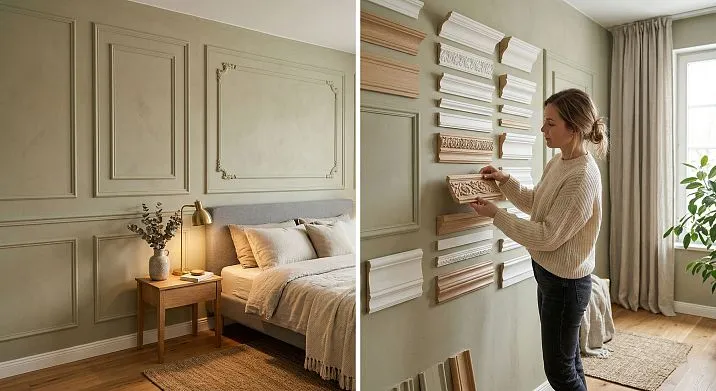
A single frame across the entire width of the bed. The molding forms one large rectangular frame, inside which there can be a different color, wallpaper, or textured plaster. The frame size ranges from the width of the mattress plus 40–60 cm on each side to the width of the entire wall.
A system of vertical frames. Three frames in a row—one above each of the two bedside tables and one central above the headboard. The symmetry here is absolute and very 'calming' for perception.
Horizontal division. The lower part of the wall (up to 90–100 cm) is highlighted with darker paint or a different finish, the upper zone is light. The molding marks the horizontal dividing line. This technique works in modern classic and neoclassical styles.
Vertical profiles above the headboard. Several parallel vertical moldings create a 'coffered' frame effect without cutting into the wall. They provide vertical rhythm and visually raise the ceiling.
Molding for the bed headboard: an architectural replacement for a soft backrest
There is an elegant design technique: instead of a soft headboard, use a molding frame on the wall. This works when the bed has a low profile or when a more 'dry,' strict solution is desired. MDF molding painted to match the wall color, wider and taller than a standard bed headboard—creates an architectural headboard built into the wall.
Variation: woodendecorative moldingmatching other wooden elements in the bedroom—bedside tables, slats, bed frame—creates a material link that unifies the entire space.
Side walls: symmetry and rhythm
The side walls of the bedroom are often left for later. Yet, they form the majority of the visual environment when you are in bed.
The frame system on the side walls should not be complex. Two or three horizontally elongated rectangular frames, repeating the proportions of the wall, are sufficient. For wall moldings in the bedroom here, it's better to choose medium width (25–40 mm) with a simple profile—smooth rectangular or slightly beaded.
Horizontal perimeter molding around the room
One horizontal molding running at the same height along all bedroom walls is the simplest and one of the most effective techniques. Installation height: 90–110 cm (traditional 'dado' at chair level) or 160–180 cm (high molding, dividing the wall roughly in half with standard 2.7 m ceilings).
The molding establishes a horizontal line, often lacking in bedrooms with completely uniform finishes. It visually 'expands' the space and creates an additional architectural line.
Which moldings are suitable for the bedroom: breakdown by types and sizes
There is no single correct molding for a bedroom. There is a correct molding for a specific bedroom—with its dimensions, ceiling height, style, and color palette. Let's break it down by practical parameters.
By profile width
Narrow moldings (10–20 mm) are delicate, almost invisible. They work in minimalist interiors where decor should be barely noticeable. They create a thin outline without pronounced relief. Well-suited for moldings in a small bedroom: they don't 'eat up' space or overwhelm.
Medium moldings (25–50 mm) are the optimal range for most bedroom tasks. They create a distinct frame outline, visible in any lighting, but not dominant in the interior. This is the workhorse of decorative wall design.
Wide moldings (60–100 mm) are for bedrooms with ceilings from 3 m, for large walls, for classical and neoclassical interiors where the profile should be read as an architectural detail, not just a line.
By cross-section profile
Smooth rectangular (fascia) is universal. Works in modern interiors, neoclassical, Scandinavian style. No relief, only a flat surface with clear edges.
Bead or astragal is a soft semicircular section. Light, unobtrusive, suitable for calm interiors. Creates a soft shadow without harsh contrasts.
Ogee is an S-shaped profile with a double curve. A slightly more complex character, referencing classicism. Appropriate in neoclassical bedrooms.
Cyma recta is a classical profile with a concave beginning and convex end. For historical styles: classicism, empire, strict neoclassicism.
Carved composite is for Baroque and Art Deco styles. Use cautiously in a bedroom: such a profile requires a corresponding scale and style for the entire room.
By material — briefly
-
Solid oak/beech — for bedrooms where wood is already present in the floor, furniture, or doors
-
MDF — for white monochrome systems for painting, the most popular choice for modern neoclassicism
-
Polyurethane — if a complex ornamental profile or moisture resistance is needed (relevant for combined bedrooms with bathrooms)
Moldings for the bedroom in different styles: precise recommendations
Interior style — the main filter when choosing a profile. The same molding will look appropriate in a classic bedroom, but foreign in a minimalist one. Let's break it down by styles.
Classic bedroom
Moldings for a classic bedroom— are full-fledged architectural elements, not just decorative strips. Classic requires:
-
Composite profiles with historical sections (ovolo, cavetto, scotia)
-
Large-scale cornices in the ceiling area (60–100 mm and more)
-
Symmetrical boiserie — full wooden paneling of the lower part of walls with a frame system
-
Oak wood molding with dark tinting or under white enamel
Ceiling height in a classic bedroom — from 3 m. It is this space that 'holds' the scale of the complex profile. With standard 2.6–2.7 m, classic needs to be lightened.
Neoclassical bedroom
Neoclassicism is a modern interpretation of the classical language. The same profiles, but cleaner, lighter, without baroque abundance. Moldings for a neoclassical bedroom are:
-
White MDF profiles for painting to match the walls
-
Frame systems with simple rectangular or slightly profiled moldings 30–50 mm
-
Horizontal belt around the perimeter of the room
-
Accent wall behind the bed with 3–5 frames in a row
-
Ceiling cornice profile — lightweight, no more than 50–60 mm
Color — white, warm white, light gray, light cream. Molding matches the wall or slightly contrasts.
Modern classic
Moldings for a modern bedroom in a classical key — restraint with relief. Profile 20–35 mm, geometrically precise, matching the wall tone. Frames of strict proportions: frame width is a multiple of its height in a ratio of 1:1.5–1:2.
Material — MDF for white enamel or wooden molding with neutral tint. No ornament, only the cross-section shape.
Minimalist bedroom with moldings
Minimalism and moldings — this is not a contradiction. It's a subtle task. Molding in a minimalist bedroom should be almost invisible: narrow (10–15 mm), matching the wall color, with a flat cross-section without relief. Frames — one or maximum two on an accent wall, of strict proportions. No cornices, no horizontal belts — only one precise accent.
In such a solution, the molding is felt but not noticed. The wall looks 'more complex' than just a painted plane — but without a single decorative detail that could be called superfluous.
Light bedroom with decorative frames
A light bedroom with white or cream walls — an excellent base for a molding frame system. White molding for a bedroom on a white wall — zero color contrast, pure relief effect. Such a system looks expensive and restrained.
Option with slight contrast: wall color 'linen' or 'warm gray', molding — pure white. Frames are clearly readable but without aggression.
Moldings or plasterwork: what to choose for the bedroom
This is a question that arises for almost everyone thinking about bedroom wall design. And the answer here is not 'one is better than the other,' but 'each has its own zone of proper application.'
What is plasterwork in the context of modern materials
MoldingIn modern interiors, it is primarily polyurethane profiles and decorative elements. Lightweight expanded polyurethane reproduces historical plasterwork profiles with the highest detail: fine scrolls, ornamental bands, composite cornices with multiple levels of relief.
Polyurethanedecorative moldingsThey weigh 2–3 times less than wooden counterparts, are installed only with adhesive, do not require priming for painting, and perform equally well in any room—including areas with high humidity.
When is plasterwork appropriate in the bedroom, and when is molding
Polyurethane plasterwork is suitable if:
-
The bedroom style is Baroque, Rococo, Empire, luxurious Neoclassicism
-
A complex ornamental profile for the ceiling cornice is needed
-
Point decoration is required: rosettes, overlays, cartouches above the headboard
-
The budget does not allow for hand-carved woodwork
Wooden or MDF molding is suitable if:
-
Style — modern classic, restrained neoclassicism, minimalism with decorative elements
-
A frame system on the walls is needed
-
The naturalness of the material is important
-
The task is to create a quiet architectural rhythm without Baroque pomp
Decorative wall moldingand molding can work in tandem: MDF molding frames surround the panels, while polyurethane overlay medallions adorn their centers or corners. This is a classic designer technique used in modern interiors as well.
Wall molding in the bedroom
Molding for wallsin the bedroom requires one main condition — proportional suitability. The bedroom is an intimate space, and excessive ornamentation works against tranquility. Therefore:
-
Ceiling cornice with molded decor — yes, if ceilings are from 3 m
-
Ornamental rosette in the center of the ceiling — yes, as a focal accent
-
Stucco medallion on the wall behind the headboard — yes, if the interior is classic
-
Ornamental friezes on all walls — only if it's truly a Baroque bedroom, not just 'pretty'
Moldings or slatted panels in the bedroom: an honest comparison
This is where we need to be specific. Both tools — molding and slatted panels — work with the bedroom wall, both create texture and rhythm. But they do it in fundamentally different ways.
How they differ
Molding creates a horizontal and framed rhythm. Its geometry is rectangular, framed, horizontal. It speaks of order, symmetry, classicism. A molding system is always framing: the frame emphasizes the center, the horizontal divides the wall into zones.
slatted panels for wallscreate a vertical rhythm. Their language is the rhythmic alternation of slat and shadow, upward movement, natural rhythm. Slatted panels make the wall 'breathable,' adding texture and the warmth of natural wood in a different way — not through profile, but through linear structure.
What is better behind the bed in the bedroom
Both solutions work on the wall behind the headboard, but create a different character for the interior.
Molding behind the bed is a classic, symmetry, architectural order. The frame above the headboard focuses attention, creates a 'niche' for the bed without a physical recess. Works well in light neutral palettes.
Slatted panels behind the bed are warmth, nature, modern character. The vertical rhythm of the slats creates an expressive backdrop, especially if the slats are made of dark oak or ash on a light wall.
The choice is a matter of style.Slatted panels in the bedroom interiorare excellent for Scandinavian, modern, biophilic, and Japanese minimalism. Moldings are for classic, neoclassical, and modern classic styles.
Can they be combined?
Yes, and it's one of the most interesting design moves. The scheme: the lower zone of the wall (up to 90–100 cm) is finished with a slatted panel, the upper zone with a molding frame system. A horizontal molding at the junction of the zones serves as a divider. This solution looks organic in bedrooms in the style of modern classicism — where there is both the warmth of natural wood and architectural rigor.
How to avoid overloading the bedroom with moldings
This is perhaps the most practically important section. Mistakes when working with moldings in the bedroom are common — and they all boil down to one thing: more decor than needed.
Common Mistakes
Too fine a grid of frames. If you break up the wall into many small frames 20–30 cm wide — the wall becomes 'checkered', unsettling. The minimum frame size for a bedroom: width at least 40–50 cm, height at least 60 cm. Better fewer large frames than many small ones.
Moldings on all four walls at once. Full finishing of all surfaces works in living rooms and formal halls. In the bedroom, this creates pressure. The rule: moldings on one or two walls, the rest — neutral.
Too aggressive relief. A wide profile with deep relief in a small bedroom with 2.6 m ceilings works against the space. Rule: for ceilings up to 2.7 m — profile no wider than 40 mm and no deeper than 15 mm.
Contrasting molding color without justification. Dark molding on a light wall is a working technique, but requires a confident design decision. In a bedroom, the contrast must be justified by the entire interior, not applied 'for expressiveness'.
Mixing several different profiles. One type of molding for all elements of the system is a rule for the bedroom. Different profiles are acceptable in complex multi-level systems, but not in calm bedroom decor.
How to check if it's not too much
A simple test: mentally remove the molding. If the room feels normal — then there's no point in installing molding. If the walls seem empty — molding is needed. The task of the profile is not to add decor, but to complete the space. Once it's complete — stop.
Moldings in the bedroom and color: how to work correctly with the palette
Molding matching the wall color
The most restrained and most universal solution. Molding of the same color as the wall — only relief, only play of shadows. This solution suits any style: from minimalism to neoclassicism. It looks especially expressive with side lighting — sconces or wall lamps reveal the relief of the profile, and the wall 'comes to life' in the evening.
White molding on a colored wall
A classic technique: a saturated wall (terracotta, blue-green, khaki, dark blue) and snow-white molding. The frames are clearly legible, create contrast and architectural expressiveness. In the bedroom, this technique works on an accent wall behind the bed — not on all walls at once.
Molding darker than the wall
Molding in 'smoke' or 'graphite' shades on a 'linen' or 'off-white' wall color is a complex but very expressive solution. Suitable for bedrooms with dark furniture where you need to 'ground' the space.
White moldings in the bedroom: why it's a classic
White molding is not a lack of choice, but a precise solution. White profile is compatible with any wall color, any style, and any furniture. It's a neutral architectural note that always works. That's why white moldings for the bedroom are the most popular choice in modern interiors.
Technical installation details: what you need to know
This section is for those who have already made a decision and are thinking about practice.
What glue and fasteners to use
Solid wood molding - installation with finish nails (using a brad nailer) with spot application of glue. Glue - construction acrylic or professional PVA. Nails are countersunk, heads are filled with putty.
MDF molding - similarly. Important: MDF does not like direct contact with moisture during installation; glue should be water-free or fast-drying.
Polyurethane molding - only glue. Mounting acrylic glue or special polyurethane glue. Mechanical fasteners are used only for reliability during the first 24 hours until the glue fully sets.
How to calculate linear footage
For a frame system: the perimeter of each frame (sum of two heights and two widths). Plus 15–20% for 45-degree miter cuts at corners. Plus a reserve stock — at least 5%.
For a horizontal belt: the perimeter of the room. Plus 10% for cutting.
Corner joints
Professional joint — 45-degree miter cut using a miter saw. A butt joint at 90 degrees is acceptable for simple rectangular profiles. For complex composite sections — only 45 degrees: otherwise, the profile pattern won't align.
Where to buy wall moldings for the bedroom
Now — specifically. Understanding the required profile is there. It remains to find the right source.
For wooden and MDF moldings —Buy Wall Moldingin the specialized STAVROS section. Here, profiles made from solid oak and beech, as well as high-density MDF for painting, are collected. Each product — chamber-dried, profile tolerance ±0.1 mm, sanded surface, ready for coating application without additional processing.
For polyurethane moldings with sculpted relief — the sectionMoldingHere you can find profiles ranging from simple frame to complex Baroque cornices, ready for adhesive installation without mechanical fasteners.
For point stucco decor — overlays, medallions, corner elements —Decorative wall moldingThey are compatible with polyurethane molding profiles and allow creating a comprehensive decorative system.
Additionally —molding catalogwith a full range of products: from narrow furniture profiles to wide architectural cornices.
What to order with samples
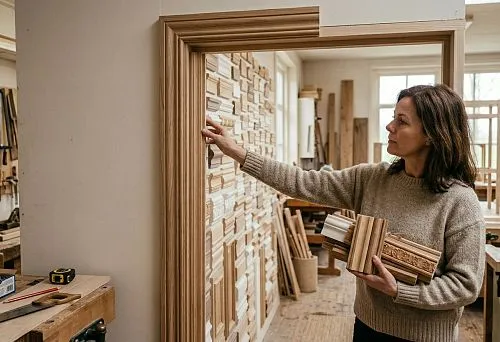
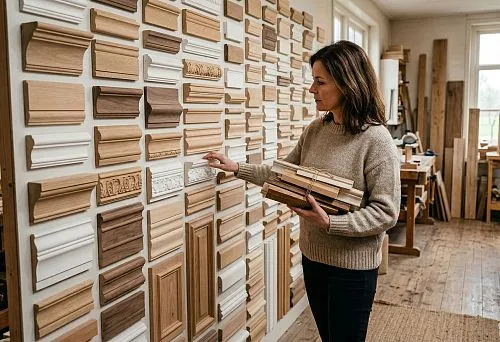
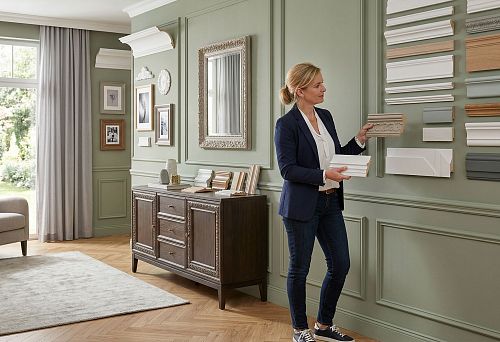
Molding is a product that needs to be seen 'live' before purchasing a batch. A sample allows you to:
-
Assess the accuracy of the profile
-
Check the quality of sanding and surface
-
Place it against existing furniture and determine compatibility by wood species and tone
-
Evaluate the shadow behavior from the profile under real bedroom lighting
Request samples before ordering — this is standard practice for professional procurement.
FAQ: wall moldings for the bedroom
Which moldings to choose for the bedroom?
For the bedroom, restrained medium-width profiles (25–45 mm) with a smooth or soft relief are best suited. For classic and neoclassical styles — wood or MDF in a white system. For baroque style — polyurethane with ornament. Narrow smooth molding — for minimalist solutions.
Are moldings suitable for a small bedroom?
Yes, but with conditions. For moldings in a small bedroom, choose narrow profiles (10–25 mm), do not break the wall into small frames, and limit yourself to one accent wall. A horizontal molding belt in a small room works better than a frame system on all walls.
Where is it better to place moldings in the bedroom?
Priority — the wall behind the bed. This is the main accent zone. The next option is a horizontal belt around the perimeter at a height of 90–110 cm. Side walls with a frame system — for more detailed elaboration.
What is better for the bedroom: moldings or stucco?
Moldings — for modern classic, neoclassical, and restrained interiors. Polyurethane stucco — for baroque and rich classical styles, as well as for complex cornice profiles. Both solutions can be combined: moldings as a frame system, stucco as a point accent.
What's better behind the bed: moldings or slatted panels?
Moldings are for classic, symmetrical, architectural framing. Slatted panels are for modern, Scandinavian, natural styles. Both options work; the choice is determined by the style of the entire interior. They can also be combined: slats at the bottom, molding frames at the top.
Where to buy wall moldings for the bedroom?
Wooden and MDF moldings —Moldings for walls to buyin the STAVROS millwork section. Polyurethane — in the sectionPolyurethane moldings.
Are polyurethane moldings suitable for the bedroom?
Yes. Polyurethane molding in the bedroom is the right choice if you need a complex ornamental profile or if the bedroom is combined with a bathroom. Light weight, installation without fasteners, readiness for painting — all this makes polyurethane convenient and practical.
How to decorate a bedroom wall with moldings yourself?
Start with one accent wall behind the bed. Draw a grid of frames on paper, maintaining proportions. Use a level and pencil for marking. Cut the molding with a 15–20% margin, joints at 45 degrees. Mount with adhesive followed by securing with finishing nails. After drying — fill the joints, prime, paint.
STAVROS: bedroom moldings — from profile to finished interior
A good bedroom starts with the right details. Not with furniture, not with textiles, but with those quiet architectural solutions that create a sense of completeness and peace — before you even enter the room.
STAVROS is a Russian manufacturer of wooden moldings, solid wood and MDF moldings, as well as polyurethane architectural elements. Full production cycle: from chamber drying of solid wood to sanded profiles ready for installation and painting. Wide range of profiles — from narrow furniture profiles of 10 mm to architectural cornices of 100+ mm.
In the STAVROS catalog for the bedroom project:
-
Moldings for walls to buy— wooden and MDF profiles for frame systems and accent walls
-
molding catalog— full range by product type
-
molding from polyurethane— for baroque and classic solutions
-
Molding for walls— point decor for system completion
-
slatted panels for walls— if you need a vertical wooden rhythm instead of molding
STAVROS works with private clients, designers, and construction teams. Samples — upon request. The bedroom you envisioned starts with one right profile.