Article Contents:
- What are wall moldings in living room interior
- How molding differs from general stucco decor
- Where molding works best in the living room
- Where to use moldings in living room interior
- Wall frames: the main technique
- Symmetrical panels: architectural rhythm
- TV zone: molding as architectural framing
- Accent wall behind the sofa
- Fireplace zone
- Which moldings are suitable for the living room
- Smooth profiles: modern architectural style
- Classical relief profiles
- Polyurethane moldings: technological standard
- Paintable moldings to match wall color
- Profiles for light and dark walls
- What's better for the living room: moldings, stucco, or panels
- When to choose moldings specifically
- When stucco is appropriate
- When to incorporate slatted panels
- When the combination of moldings and panels works beautifully
- Wall moldings for classic and modern living rooms
- Classic living room: full decorative register
- Neoclassicism: architecturality through editing
- Modern living room: delicate profile as an architectural hint
- Dark living room: contrast as decorative power
- Calm interior: molding in tone
- Moldings and TV area in the living room
- Molding around the TV area: three scenarios
- Vertical rhythm as a tool
- Lighting in the TV area
- What elements to buy together with moldings for the living room
- Corner decorative inserts
- Stucco decor: ornamental finial
- Polyurethane wall decor: complete system
- Ceiling Cornice
- Wooden moldings for natural interiors
- Mistakes when choosing moldings for the living room
- Too small a profile on a large wall
- Overloaded wall
- Lack of symmetrical logic
- Conflict of moldings and furniture
- Random mixing of moldings and panels
- Where to buy wall moldings for living room interior
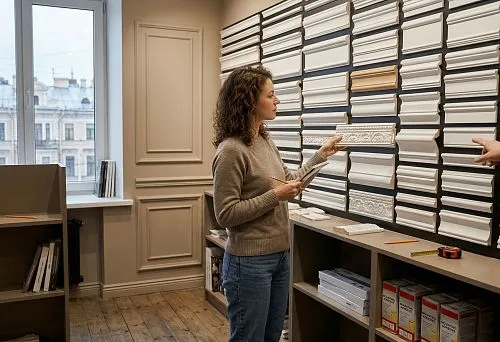
- Polyurethane moldings section — main catalog
- Stucco and overlay section — ornamental layer
- For a living room in a natural style
- For the TV area and accent wall
- FAQ: Answers to popular questions about living room moldings
- Which moldings to choose for living room walls?
- How does molding differ from stucco?
- Can molding be used in the TV area?
- How to combine moldings and slatted panels in the living room?
- Which profiles are best for painting in the living room?
- Are corner outlets needed at the corners of molding frames?
- How to calculate the amount of molding for the living room?
- Which molding to choose for a small living room?
- How to properly install molding on the wall?
- Wall-matching or contrasting molding — what to choose for the living room?
- Can molding be added to finished decor without renovation?
- How does molding interact with classic furniture in the living room?
- About the Company STAVROS
Ask yourself an honest question: why do some living rooms seem complete, filled with architectural meaning — even without expensive furniture and designer lighting — while others, equipped with all of that, remain 'just rooms'? The answer is almost always on the walls. More precisely — in whether they have a decorative system or not.
Wall molding in living room interior— it's not 'something stuck on the wall in classic apartments.' It's a universal tool for creating architectural character in any interior: from strict modern to rich neoclassical. It works through geometry, proportion, and chiaroscuro — and that's precisely why it affects spatial perception more strongly than most decorative techniques.
Under the query 'Wall moldings for the living room' lie three fundamentally different user scenarios. The first — a person wants to create decorative frames on the main accent wall behind the sofa. The second — looking for a solution for the TV zone: how to make the wall with the television an architectural object, not just 'a surface with a screen hanging on it.' The third — wants a full decorative program on all walls: moldings, Molding, cornice, ceiling transition, unified finish.
This article covers all three scenarios. With profile selection by style and scale, with an honest comparison of moldings, stucco, and slatted panels, with an analysis of mistakes and a final practical block. Because a good living room isn't an accident. It's the result of correct decisions.




What are wall moldings in a living room interior
Molding is a decorative linear profile with a specific cross-section. In architectural terms: it is a profiled strip that creates lines on the wall — horizontal, vertical, framing — transforming a flat surface into an architecturally organized plane.




How does molding differ from general stucco decoration
The fundamental difference lies in function. Molding builds geometry: frames, belts, divisions. It works through a repeating linear element — a rail, profile, strip — and creates decoration through order, symmetry, and proportion.
wall moldingStucco decoration consists of volumetric applied elements: rosettes, cartouches, medallions, relief inserts. Their function is an ornamental accent at specific points in space. Stucco does not build a system — it decorates what is already built.
This is precisely why a professional result is always a pair: molding creates the structure →Decorative wall moldingstucco places ornamental accents within this structure. Rosettes in the corners of frames, a cartouche in the center of the decorative field — the classic dual program.
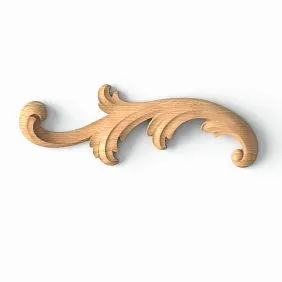
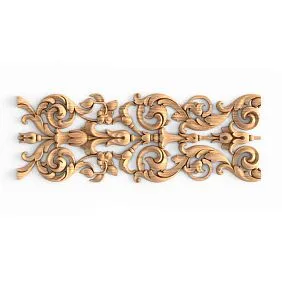
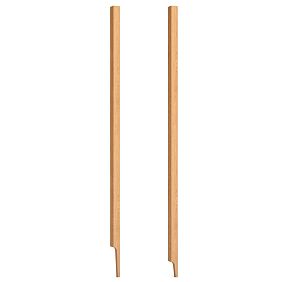
Our factory also produces:





Where does molding work best in a living room
The living room is the only room in an apartment where molding can be deployed as a full decorative system without a sense of excess. It is here that it works across the entire range: from a delicate modern 20 mm profile to a rich classical system with cornice, frames, and stucco.
Three areas of the living room where molding is particularly effective:
-
Main accent wall (behind the sofa) — full frame program, optimal profile scale;
-
TV zone — frame around the screen area, horizontal band, possible combination with slatted panel;
-
Side walls — supporting molding rhythm, less saturated than on the main wall.
Get Consultation
Where to use moldings in the living room interior
Molding — a zoning tool through decor. Each living room zone has its own application logic.
Wall frames: the main technique
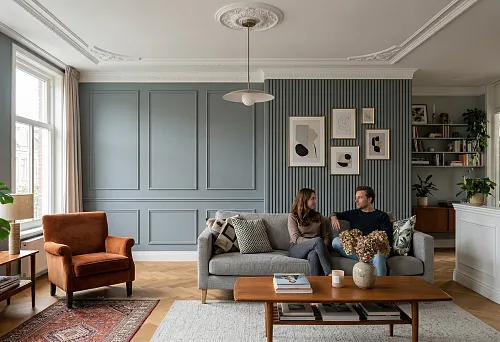
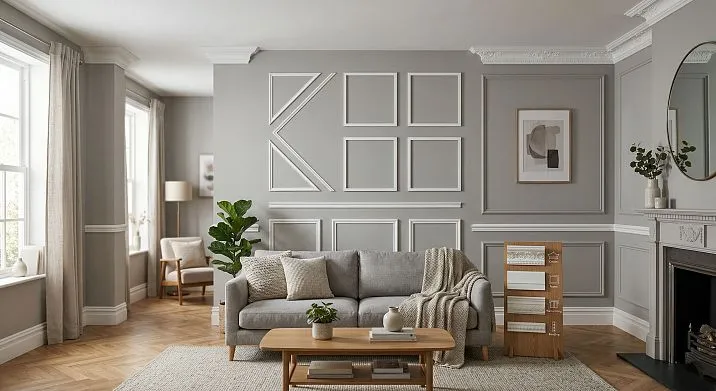
Decorative frames made of molding — a classic and most effective technique for wall decoration in the living room. Rectangular or square contours from the profile, dividing the wall into symmetrical 'fields', create a sense of architectural paneling.
Frame logic: the wall is divided into an even number of fields, the proportions of which are coordinated with the width and height of the room. The frame's indentation from the edges of the wall is uniform on all sides. Between adjacent frames — an equal gap, corresponding to double the indentation from the edge.
Number of frames for a standard living room 4–5 m: 3 vertical rectangles, arranged in one horizontal row — the optimal option. One wide frame in the center + two narrow ones on the sides — for a wall with architectural elements (window, niche, door).
Symmetrical panels: architectural rhythm
A system of molding panels on all walls of the living room is a complete decorative program. In this case, the molding doesn't just 'decorate an accent wall,' but organizes the entire perimeter of the space. The eye, moving around the room, follows a unified rhythmic pattern. This creates a sense of 'architectural completeness'—as in historical interiors.
TV zone: molding as architectural framing
A TV on a white wall is an appliance. A TV within an architectural frame of molding is an element of the interior concept. A rectangular frame of profile around the perimeter of the screen area + a horizontal band at the level of the TV's lower edge is the minimal program that completely changes the perception of the TV wall.
Accent wall behind the sofa
The wall behind the sofa is the most 'responsible' surface in the living room: it is always in the field of view of someone entering, it 'holds' the sofa group, it forms the decorative image of the living room in guests' memory. This is precisely where the molding should work at full strength.
Three scenarios for an accent wall:
-
Clean frames made of molding with monochrome painting—a minimalist but sophisticated result;
-
Frames + corner rosettes made of moldings on walls—a classic program;
-
An outer frame made of molding + a slatted panel inside—a modern combination with vertical rhythm.
Fireplace zone
The fireplace is the architectural focal point of a classic living room. Here, molding acts as an integral frame, integrating the fireplace portal into the overall decorative system of the walls. A horizontal molding band at the level of the mantel shelf's upper plane + vertical frames on the sides — the fireplace becomes part of a unified decorative architecture, not just 'an object standing against a wall'.
Which moldings are suitable for the living room
Choosing a profile is an architectural decision, not merely an aesthetic choice. Width, relief, material — each parameter has its own justification.
Smooth profiles: modern architecturality
A smooth rectangular or trapezoidal profile without ornamentation is the optimal choice for a modern and neutral living room interior. After monochrome painting, it works exclusively through relief and shadow: a sharp edge creates a readable horizontal or vertical line, a beveled facet creates a soft shadow.
Width of a smooth profile for a living room with a ceiling height of 2.6–2.8 m: optimum 35–50 mm. For lower ceilings — 25–35 mm.
Classical relief profiles
Profiles with a historical cross-section — ogee, cyma reversa, scotia, torus with beads — carry a pronounced play of light and shadow. With side lighting, each change in relief height creates its own shadow, and the profile 'comes alive' on the wall.
This is a choice for classic and neoclassical living rooms. Width: 45–80 mm for ceilings up to 3 m. For ceilings above 3 m — 75–110 mm.
An article on how to properly decorate the wall behind a sofa with moldings and plasterwork in the neoclassical style — in the material how to decorate the wall behind a sofa with moldings and plasterwork: there, profiles by width, principles of frame composition, and the logic of choosing corner elements are analyzed in detail.
Polyurethane Moldings: Technological Standard
Polyurethane — the best material formoldings in living room interiorsamong all available on the market. It reproduces any historical relief with an accuracy previously achievable only by a professional plasterer. At the same time, it weighs 15–20 times less than plaster, is installed only with adhesive, and accepts any acrylic paint without prior priming (if factory primer is present).
For the living room, polyurethane profile is the number one choice in 90% of cases. Exception: if the interior is made of natural wood and material consistency is needed — then wooden molding.
Moldings for painting to match the wall color
Profile matching the wall color is one of the most refined techniques. The molding 'disappears' in color, remaining active through shadow. The wall becomes voluminous without a color accent. This is 'invisible architecture': you can see that the space is rich — but the source of this feeling cannot be named at first glance.
Profiles for light and dark walls
| Wall type | Profile type | Effect |
|---|---|---|
| White / light | White molding in matching tone | "Invisible architecture", volume through shadow |
| Light | White molding with subtle contrast | Legible lines, calm structure |
| Dark (graphite, green, blue) | White molding | Contrasting, theatrical effect |
| Dark | Molding matching wall tone | Monochromatic depth, theatrical luxury |
What's better for the living room: moldings, plasterwork, or panels?
This is the key commercial question behind every request for living room wall decor. Let's give an honest, structured answer.
When to choose moldings
Molding is the choice when the task is to organize the geometry of the wall. There is nothing else that does the same thing. Only molding creates frames, belts, and lines on the surface. It doesn't decorate—it architects. If the living room wall is 'empty,' faceless, without structure—molding is needed. Everything else is an addition.
When is plasterwork appropriate?
wall molding for saleIt's needed when the molding geometry is already created and you need to add an ornamental accent at key points. Corner rosettes in the corners of molding frames. A cartouche in the center of the main decorative field. A medallion above the fireplace area.
You can buy ready-made stucco matching the Baroque style. Calculate the quantity: linear meters of cornices and moldings, number of rosettes, pilasters, consoles, corner elements. Add a ten to fifteen percent allowance for trimming.It's from the same series as molding—a guarantee of a uniform finish when painting. Different manufacturers yield different results even with the same paint—due to differences in the density and texture of the polyurethane surface.
When to incorporate slatted panels
Slatted panels in the living room interiorThis is a fundamentally different decorative tool. Slatted panels work through vertical rhythm: parallel vertical lines with equal spacing between the slats. They create depth, movement, and 'breathing' of the surface.
Slatted panels are the choice for a TV wall, an accent wall behind the sofa in a modern or Scandinavian interior, decorative niches. Especially expressive when combined with LED lighting—Slatted panels with lightingcreate a warm, diffused light between the slats that 'enlivens' the wood and makes the evening living room atmosphere indescribable.
A visual photo guide on the application of slatted panels by styles and scenarios — in the articleslatted wall panels photos.
When the combination of moldings and panels works beautifully
Professional technique: molding forms an outer frame → inside the frame, a slatted panel with vertical slats is mounted. After unified painting (or when preserving the natural tone of the slats against a painted molding) — a two-layer decorative system: the frame as architectural framing, the slats as rhythmic texture inside.
Five rules of combination:
-
One dominant element — either the molding accents and the panel supports, or vice versa;
-
Unified finish — painting in one color or a deliberate contrast of natural wood against painted molding;
-
Consistent scale — the profile width and slat spacing are proportional;
-
One accent wall — molding + slats on one, the others — clean or with delicate molding;
-
Lighting is planned before installation.
Wall moldings in classic and modern living rooms
Interior style is an architectural discipline that defines the type of profile as unequivocally as the width of a corridor determines the width of a door.
Classic living room: full decorative register
A classic living room with moldings is a rich, hierarchically structured decorative program. Wide relief profile 60–100 mm. Three-zone wall division: ceiling cornice + wall frames + baseboard strip. Corner rosettes in the corners of frames, a cartouche in the center of the main field.
The entire system is painted in a single color: white, cream, ivory. Maximum chiaroscuro play with side lighting. It is in the classic living room that molding and stucco work in full decorative union.
A classic living room is unthinkable without furniture of the corresponding style. Armchairs with carved legs, sofas with relief armrests, dressers with profiled fronts —classic furniture in the living room interior— and the molding decorative program on the walls work as a single architectural system.
Neoclassicism: architecturality through editing
Neoclassicism is classicism revised through a modern lens. Profile 40–60 mm, smooth or with delicate relief. Simple rectangular frames without corner overlays. Neutral shades — white, light gray, pearl, warm beige. Monochrome painting.
No ornamental excess — only pure geometry, even proportions, a light shadow from the profile edge.Classic furniture for the living roomIn the neoclassical interpretation: forms with historical references but without baroque opulence—precisely such an ensemble perfectly complements the neoclassical molding program on the walls.
Photo examples of classic living room furniture and its combination with wall decor—in the article.classic living room furniture photos.
Modern living room: a delicate profile as an architectural hint
In a modern neutral interior, molding is a supporting, not a dominant element. A narrow smooth profile of 20–35 mm. Strict monochrome painting. One or two accent frames, not a systematic program across all walls.
Molding in a modern living room works as a 'hint of architecture'—barely noticeable but creating a sense of 'thoughtfulness' in the space, which distinguishes a good interior from a merely renovated apartment.
Dark living room: contrast as a decorative force
Dark walls (anthracite, deep green, dark navy, dark chocolate) + white molding—a theatrical, expressive, memorable result. The contrast of the white profile on a dark surface provides maximum readability for each line. The frames are literally drawn on the wall—clearly, confidently, without halftones.
A dark living room with white molding is one of the most 'photographed' and memorable interior solutions of modern times.
Calm interior: molding in tone
Molding in the exact wall color — for those who want structure without a decorative signal. The profile dissolves into the surface by color, remaining active through shadow. The wall 'becomes volumetric' without explanation — a feeling of 'expensive space' without visible decor.
Moldings and TV Zone in the Living Room
The TV zone is one of the most complex decorative tasks in the modern living room. The TV screen is a neutral rectangle that, when turned off, becomes a black 'window to nowhere'. The decor's task is to integrate the television into the architectural context of the wall so that it looks like part of the interior concept, not like a 'hung appliance'.
Molding Around the TV Zone: Three Scenarios
Scenario 1 — Perimeter Frame: a rectangular frame made of molding around the perimeter of the entire TV wall. The television inside this frame is like a painting in a frame. After monochrome painting, the frame creates a feeling of the screen being 'built-in' to the wall's architecture.
Scenario 2 — Horizontal Band: molding in the form of a horizontal line at the height of the screen's lower edge, running the entire width of the TV wall. This is a minimalist option that 'anchors' the television to the wall on a visual level — even without a full frame.
Scenario 3 — Outer Frame + Inner Slatted Panel: the most professional technique. Molding forms an outer decorative frame → inside, a slatted panel with vertical slats is mounted → the television is attached over the panel. A complete breakdown of this solution is in the articleslatted panel for the television: there it is shown in detail how to turn the TV wall into the architectural center of the living room.
Vertical Rhythm as a Tool
Slatted panels behind the television create a vertical rhythm — parallel lines that 'pull' the gaze upward and visually increase the wall's height. In living rooms with ceilings of 2.5–2.6 m, this is an especially valuable technique: vertical slats compensate for the 'groundedness' of the space.
Horizontal molding + vertical slats = complementary decorative logics on one wall. The horizontal organizes, the vertical 'stretches'.
Lighting in the TV zone
LED lighting between vertical slats behind the TV is an atmospheric technique that transforms the TV wall from a decorative object into a luminous one. Warm diffused light between the slats creates a 'halo' around the screen, reduces contrast during viewing, and makes the wall itself a living source of atmosphere in the evening living room.
Detailed breakdown of the technology and visual examples —Slatted panels with lighting: here we consider types of lighting, installation methods, and principles for managing the lighting scenario.
What elements to buy together with moldings for the living room
Molding is the beginning of a decorative program, not its end. A professional result is created by a system of interconnected elements.
Corner decorative inserts
A corner block covers the joint of profiles in the corner of a frame and simultaneously creates an ornamental accent. For a classic program — a relief rosette with an ornament. For neoclassicism — a smooth square block without decoration. The rule is one: the corner element is from the same series as the molding.
Stucco decor: ornamental finale
Buy Molded DecorationIn the form of cartouches and medallions — the final step of a classic decorative program. A cartouche in the center of the main field on an accent wall. A medallion above the fireplace area or above the sofa. A decorative frieze under the ceiling cornice. Each of these elements works only within the context of the created molding geometry.
Polyurethane wall decor: a complete system
Polyurethane wall decor— it's not just classic molding. It includes decorative friezes, relief inserts, overlays for niche decoration, and relief panels. All made of polyurethane, all compatible in material and finish with the molding. Professional principle: one material → a unified result when painted.
Ceiling cornice
A molding program on walls without a ceiling cornice is an 'open from the top' system. A ceiling cornice completes the program, creates the upper architectural frame of the room and the transition from wall to ceiling. A cornice from the same catalog as the molding is a mandatory condition for stylistic unity.
Wooden moldings for natural interiors
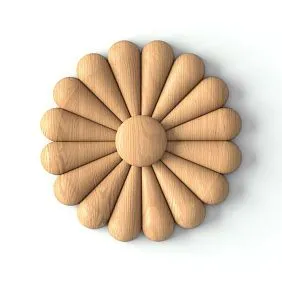
For living rooms with natural wooden furniture, parquet flooring, and textile decor — solid wood molding creates material consistency, which polyurethane replicates in form but not in tactility.Moldings shopSTAVROS offers both options — the choice depends on the specific living room's style.
Mistakes when choosing moldings for the living room
Mistakes in living room decor are always costly. The profile has already been purchased, installed, painted — and only then is it clear that something is fundamentally wrong. To prevent this — study typical scenarios.
Too small a profile on a large wall
A 15 mm wide molding on a living room wall measuring 5 m × 2.7 m — decorative 'noise.' A narrow profile does not create a readable shadow, the frames look like random scratches, not like an architectural program. The minimum readable width for a living room with standard proportions is 35–40 mm.
Overloaded wall
Wide relief molding + corner rosettes + a central cartouche + additional decorative bands + slatted panel inside the frame — in a living room of 18 sq. m with a ceiling of 2.5 m, this creates visual chaos. Each decorative element requires 'air' around it. Overloading with decor produces an anxious impression — regardless of the quality of each individual element.
Lack of symmetrical logic
Frames of different sizes without a system, different molding offsets from edges on different walls, misalignment of frame axes with window and door axes — these errors are perceived intuitively: the space feels 'wrong,' but it's difficult to explain why. Before installation — draw a diagram on graph paper with exact dimensions.
Conflict between moldings and furniture
Rich classical molding with ornamental inserts + minimalist modern furniture without decor = two opposing stylistic languages in one space. The molding must be stylistically coordinated with the living room furniture. Check: visually place a sample of the profile and a sample of the furniture facade side by side—they should 'speak' the same language.
Random mixing of moldings and panels
Classical relief molding + modern thin vertical slats without architectural logic of combination — chaotic space where decor works against itself. Molding and slatted panel combine only when there is clear compositional logic: frame as framing → slats as content.
Where to buy wall moldings for living room interior
Polyurethane moldings section — main catalog
Buy wall moldings for living room interior— section of polyurethane moldings, cornices, and baseboards. Here: all wall profiles — from delicate modern 20 mm to rich classical 120 mm — with factory primer, ready for painting.
Molding and overlay section — ornamental layer
Buy Molded Decoration— corner rosettes, cartouches, medallions, decorative friezes. All made of polyurethane, compatible in material and finish with moldings from the same catalog.
For a living room in a natural style
Buy moldings for the living room— from solid wood — the wooden trim section. Oak, beech, birch profiles for painting, oil, or varnish.
For TV zone and accent wall
Slat panels for TV zone and accent walls — in the slat panels section. Full breakdown of application scenarios — in the article Slatted panels in the living room interior: from idea to practical implementation.
FAQ: Answers to Popular Questions about Living Room Mouldings
Which moldings to choose for living room walls?
Depends on the style. Classic — relief profile 55–100 mm. Neoclassical — smooth or low-relief 40–60 mm. Modern interior — smooth narrow 25–40 mm. With ceilings 2.5–2.7 m — optimum 35–55 mm.
How does molding differ from stucco?
Molding — linear profile creating geometric structure on the wall. Molding — volumetric overlays (rosettes, cartouches) adding ornamental accent. Best result — always their combination.
Can molding be used in the TV zone?
Yes. Molding in the form of a frame around the perimeter of the TV wall or a horizontal band at screen level is one of the best ways to architecturally 'integrate' the television into the living room interior.
How to combine moldings and slatted panels in the living room?
Molding creates an outer frame → slatted panels are mounted inside. After overall painting — a two-layer decorative system. The main points: one dominant element, coordinated scale, unified finish.
Which profiles are better for painting in the living room?
Polyurethane moldings with factory primer are the optimal choice. Acrylic paint in 2 coats with intermediate sanding gives a smooth, professional result.
Are corner rosettes needed at the corners of molding frames?
In a classic program — absolutely. They cover the joint of profiles at 45° and add an ornamental accent. In a modern minimalist version — optional: a smooth corner block without decoration or a 45° joint without an overlay.
How to calculate the amount of molding for the living room?
Perimeter of each frame = (width + height) × 2. Sum of perimeters of all frames + 15% reserve = total linear meters. Standard profile length: 2400 or 3000 mm.
Which molding to choose for a small living room?
Narrow smooth profile 25–35 mm. One accent frame on the main wall instead of a systematic program on all walls. Monochrome painting to match the wall color. This structures the space without visual compression.
How to properly install molding on a wall?
Acrylic mounting adhesive or liquid nails — on a pre-cleaned, primed surface. Profile joints at 45° cut with a miter saw. After installation and drying — joint puttying, sanding, painting in 2 coats.
Matching wall color or contrasting molding — what to choose for a living room?
Matching wall color — for those who want 'invisible architecture,' structure without a color accent. Contrasting molding (especially white on a dark wall) — a theatrical, expressive technique for an accent wall.
Can molding be added to a finished finish without renovation?
Yes. Polyurethane molding is installed with adhesive over an already painted or plastered wall. After installation — touch up joints to match the wall color. Renovation of the entire room is not required.
How do moldings interact with classic furniture in a living room?
Correct:classic furniture in the living room interior+ classic relief molding +Decorative wall molding= a unified architectural system where furniture and wall decor speak the same stylistic language. Violation: modern furniture + classic rich molding = decorative dissonance.
About the company STAVROS
The living room is a stage. This is where life happens, guests are received, memories are created. And it is here that architectural decor unfolds to its full potential: moldings on the walls, stucco in key points, slatted panels on the accent wall, lighting, classic furniture — all these are parts of a single concept.
Buy wall moldings for living room interiormade of polyurethane,Buy Molded Decorationfor classic programs, to selectdecorative stucco on the wallsin a unified series with molding — all this is in the catalog of the company STAVROS.
STAVROS is a manufacturer and supplier of wooden architectural millwork and polyurethane interior decor. Over 500 items: moldings, cornices, baseboards, stucco, overlays, capitals, classic furniture — a complete assortment for creating a decorative system in a living room of any style.
STAVROS works with private customers, architects, and design studios across Russia. Consultation on profile selection, calculation of material quantity, selection of compatible stucco and molding elements — standard service that turns a list of catalog items into an architecturally complete living room. Because the living room is the first thing people see. And STAVROS helps make that first impression — impeccable.