Article Contents:
- Anatomy of an architectural ensemble: from floor to ceiling
- Plinth zone: the foundation of the composition
- Main wall zone: canvas for the composition
- Frieze zone: transition to the ceiling
- Material matters: wood versus alternatives
- Why wood: objective advantages
- Species selection: from economy to premium
- Profiles and styles: from classic to modern
- Classic profiles
- Modern profiles
- Proportions and scale: the mathematics of beauty
- Ceiling height as a basic parameter
- Room area
- Element consistency
- Color solutions: architecture’s palette
- White: classic forever
- Natural Wood
- Dark shades
- Matching wall color
- Installation: from theory to practice
- Surface Preparation
- Marking
- Cutting and joining
- Fastening
- Finishing
- Style solutions: from palaces to lofts
- Classicism and neoclassicism
- Baroque and Rococo
- Provence and Country Style
- Scandinavian minimalism
- Modern style
- Special applications: non-standard solutions
- Door and window framing
- Panel constructions
- Furniture applications
- Maintenance and Durability
- Economics of the question: investment in quality
- Create an architectural ensemble with STAVROS

Interior architecture is a symphony of lines, volumes, and proportions, where each element plays its part in the overall sound of the space.Ceiling and wall moldingsThese are not just decorative strips, but architectural tools that organize space, create hierarchy, and control visual perception.Wooden cornices and skirting boardsThey complete this composition, creating transitions between planes, framing and structuring. When these elements are selected and installed correctly, the interior achieves completeness and professionalism that cannot be faked.
Architectural interior finishingMoldings and cornices — this is an ancient art that originated in antiquity and developed over millennia. Greek and Roman architects developed an order system with strict proportional rules, where each element had its place and significance. These principles remain relevant today — modern designers use the same logic of spatial division, adapting it to current aesthetics and technologies.


Anatomy of architectural ensemble: from floor to ceiling
Classical architecture divides the vertical plane of a room into several horizontal zones, each with its own functions and decorative elements. Understanding this structure is critical for creating a harmonious ensemble.




Plinth zone: the foundation of the composition
The lower third of the wall — the plinth zone — is finished withwith wooden skirting boardsThis is not just a technical detail hiding the junction between the wall and floor.with a classic profile creates a sense of solidity, reliability.It is a full architectural element that sets the scale of the entire composition. Its height is usually 70 to 150 mm, depending on ceiling height and overall concept. In rooms with 2.7–3 meter ceilings, skirting boards 80–100 mm are used. For ceilings 3.5 meters and higher,Wooden floor skirting boardsare 120–150 mm high.
The skirting board profile can be simple — with one or two rounded edges, or complex — with multiple levels, rolls, grooves. The more complex the overall architectural finish, the more detailed the skirting board profile should be. In minimalist interiors, a simple rectangular strip with a slight rounding at the top edge is sufficient. In classical interiors, the skirting board may have 3–5 profile elements, creating a rich play of light and shadow.
Above the skirting board, there is often a panel zone — wooden or wood-imitating coverings 90 to 150 cm high. The upper boundary of the panels is marked by a horizontalwooden molding, called a handrail or dado. It can be a simple rectangular profile or more complex, with a rounded top edge, convenient for hand support.
Our factory also produces:


Main wall zone: canvas for composition
The middle part of the wall — from the top of the panels (or from the skirting board if there are no panels) to the start of the frieze — is the main field where decorative composition unfolds. Here,wall moldings, creating rectangular or square frames — a classic technique of boiserie, originating from French palaces of the 17th–18th centuries.
Interior moldings and profilesWall moldings usually have a symmetrical profile — they are designed to be viewed from different angles. The width of wall moldings ranges from 30 to 80 mm, thickness from 10 to 25 mm. Wider moldings create a more grandiose, imposing effect. Narrow ones — more delicate, refined.
Molding frame placement follows proportion rules. The classical golden ratio (1:1.618) remains an important reference. The height of a rectangular frame relates to its width approximately in this proportion. Distances between frames are equal or multiples of their width. Placement is symmetrical relative to the central axis of the wall or compositionally balanced for asymmetrical solutions.
Get Consultation
Frieze zone: transition to ceiling
The upper part of the wall — the frieze — is located directly under the ceiling. Its height is usually 15–25 cm. The lower boundary of the frieze may be marked by a horizontal molding or remain implicit. The upper boundary isCeiling cornice, the most important and prominent element of the entire system.
wooden corniceThe cornice performs several functions. Visually, it softens the sharp angle between the wall and ceiling, creating a smooth transition. Architecturally, it completes the vertical composition of the wall, acting as a kind of 'architectural point.' Psychologically, the cornice creates a sense of completion and protection of the space — like a roof over one’s head, even on the scale of a room.
The cornice profile is the most complex among all moldings. It may include 5–7 elements — rolls, rounded edges, shelves, coves, gussets. A classical cornice has an overhanging part that projects over the wall, creating a characteristic shadow. This shadow emphasizes the cornice’s volume, making it more expressive.
Material matters: wood versus alternatives
Modern market offersMoldingsmade from different materials — polyurethane, polystyrene, MDF, plaster, wood. Each material has its advantages and limitations, but for creating a truly architectural ensemble, wood remains unmatched.
Why wood: objective advantages
Wooden skirting boards for floorsandcornicespossess unique properties. First — naturalness and eco-friendliness. Wood does not emit harmful substances, creates a healthy microclimate, regulating air humidity. In rooms with wooden finishes, it is easier to breathe, especially noticeable for people sensitive to synthetic materials.
Second — durability. QualityWooden baseboardmade from oak or beech serves for decades, without losing shape or strength. Polyurethane analogs over time yellow, lose elasticity, may sag. Wood ages gracefully, acquiring the patina of time, which only adds to its value.
Third — repairability. Scratches and dents on wooden molding are easily removed by sanding and repainting. A damaged section can be restored without replacing the entire element. With synthetic materials, this is impossible — only complete replacement of the element.
Fourth — prestige. Wood has always been associated with quality and wealth.Wooden cornices and skirting boardsIt speaks of a serious approach to interior design, readiness to invest in quality materials.
Fifth — tactile quality. It is pleasant to touch wood.wooden corniceIt feels warm to the touch, has a pleasant texture. This is especially important for elements frequently touched, for example, handrails.
Choosing species: from economy to premium
Forof wooden moldingsDifferent species are used, each with its own character and price category.
Spruce — the most affordable option. Soft, easy to process, but requires mandatory painting — natural appearance of spruce with knots is not suitable for all interiors. Under paint, spruce moldings look quite respectable and last long. The key — use well-dried wood to avoid deformations.
Linden — an excellent choice for carved elements due to its plasticity. Soft, yet uniform, without pronounced texture. Linden moldings are usually painted, as the natural color of linden — pale yellow — is not particularly expressive.
Oak — a premium species with excellent texture and exceptional strength.Wooden baseboardMade from oak is practically eternal, does not fear moisture and mechanical impacts. The natural oak tone — from light honey to brown — is beautiful on its own, does not require painting. Under oil, oak acquires depth and nobility.
Beech — close in hardness to oak, but has a more uniform, fine-grained structure. Ideal for painted moldings, providing an ideally smooth surface. Beech is slightly cheaper than oak for comparable characteristics.
Ash — strong, with a distinctive texture similar to oak, but more contrasting. Color ranges from cream to light brown. Ash moldings are good in natural finishes, highlighting the beauty of the grain.
Profiles and styles: from classic to modern
Ceiling and wall moldingsDiffer not only in size, but also in profile — the shape of the cross-section. The profile determines the style and visual mass of the element.
Classic profiles
Classic architecture developed a set of standard profiles, each with a name and recognizable shape. A round (or torus) — convex semicircular element. Cavetto — concave quarter of a circle. Gusek (sima) — S-shaped profile combining convexity and concavity. Skoziya (skoziya) — concave-convex profile. Plinth (plinth) — flat horizontal or vertical surface.
Wooden cornicesFor classic interiors, these elements are combined to create complex multi-level profiles. The richer the style, the more complex the cornice. Baroque cornices typically feature 5-7 elements, heavily ornamented with carving. Classicism — more restrained, with 3-5 elements, without excessive decoration. Neoclassicism — simplified versions of classic profiles, adapted to modern aesthetics.
Modern profiles
Modern architecture simplifies classic forms, leaving clean geometry.Wooden moldingsFor modern interiors, they have minimalist profiles — rectangular, trapezoidal, with minimal rounding. But even these simple forms require precise execution — any deviation from geometry is immediately noticeable.
Scandinavian style prefers thin moldings of simple profiles, painted white or light gray. Minimalism uses moldings as sparingly as possible — sometimes only baseboards and a thin ceiling cornice, without wall decoration. Loft may do without moldings altogether or use rough, deliberately simple wooden strips, emphasizing industrial aesthetics.
Proportions and scale: the mathematics of beauty
Correct selection of molding sizes is critical for interior harmony. Too small moldings will disappear into space, too large ones will overwhelm. There are proven proportional relationships.
Ceiling height as a basic parameter
The higher the ceiling, the larger the moldings should be. At a ceiling height of 2.5–2.7 meters (standard Soviet panel houses),wooden baseboardthe skirting board should be 70–80 mm high, and the ceiling cornice should protrude 50–70 mm (distance from the wall to the edge of the cornice). At a height of 3–3.2 meters, the skirting board increases to 100–120 mm, and the cornice to 80–100 mm. At a height of 3.5 meters or more, you can usewide skirting boards120–150 mm and cornices with a protrusion of 100–150 mm.
Room area
In small rooms, large moldings visually reduce the space. In spacious halls, small moldings disappear and do not create the desired architectural effect. For rooms up to 15–18 sq. m, smaller moldings are suitable. For spaces of 25 sq. m and more — medium and large-sized. In huge halls of 50 sq. m, the most massive profiles are appropriate, which would look excessive in a regular apartment.
Element consistency
Wooden cornices and skirting boardsThey should be proportional to each other. The classic rule — the height of the skirting board is approximately half the protrusion of the cornice. If the cornice protrudes 100 mm, the skirting board should be about 50 mm high. Or the height of the skirting board equals the protrusion of the cornice — both 80 mm, for example. Wall moldings are usually thinner than the skirting board — if the skirting board is 100 mm, wall moldings are 40–60 mm wide.
Color solutions: architectural palette
The color of moldings and cornices determines the overall character of the interior no less than their shape.
White: classic forever
WhiteCeiling and wall moldings— an eternal solution that never goes out of fashion. White visually lightens structures, creating a sense of airiness and purity. Especially effective are white moldings on colored or textured walls — they create clear graphics and organize space. For white moldings, the correct shade of white is important — warm cream-white or cool bright white, depending on the overall interior palette.
Natural wood
Preserving the natural color and texture of wood under transparent finish with oil or lacquer — a choice for interiors where naturalness is valued.Wooden baseboardFrom oak or ash with natural finish, it harmonizes beautifully with wooden floors, creating material unity. It is important to coordinate shades — the skirting board should be in the same tone as the floor, or 1–2 tones lighter/darker for a subtle contrast.
Dark shades
Moldings painted in dark colors — wenge, black, dark brown, graphite — create a dramatic effect. They stand out graphically against light walls, creating a clear architectural structure. DarkWooden cornices and skirting boardsvisually heavier than light ones, making the space more grounded and solid.
In the same tone as walls
Moldings painted in the color of the walls create a monochromatic effect, where the form is perceived only through the play of light and shadow on the relief. This is an elegant solution for minimalist interiors, where contrasting graphics are not needed, but architectural detailing of space is desired.
Installation: from theory to practice
Qualityinterior architectural finishingThe appearance of moldings depends 90% on proper installation. A beautiful profile, poorly installed, will irritate the eye. A simple profile, but perfectly installed, looks flawless.
Surface preparation
Walls and ceilings must be perfectly flat, spackled, and primed. Any irregularities will be visible under moldings as gaps. Internal and external angles are especially critical — they must be exactly 90 degrees; otherwise, the junction of moldings at the corners will be problematic.
Marking
Before installation, precise marking of the location of all elements is done. Forwall moldingsa pencil sketch is drawn on the wall — outlines of future frames. Symmetry is checked, and dimensions are aligned. For ceiling cornices, a horizontal line is marked around the perimeter of the room — a laser or water level is used for accuracy.
Cutting and joining
The most critical moment — cutting angles. To join moldings at 90 degrees, each element is cut at 45 degrees. A mitre box or miter saw is used.and paint it to the desired shade — standard practice in modern design. It is important to use special wood finishes that allow the material to breathe.Ready-made options are possible, but fitting will still be required. It is important to precisely set the cutting angle — even a deviation of 1-2 degrees will result in a noticeable gap at the joint.
Internal angles are cut so that the back part of the molding is longer than the front. External angles are the opposite. After cutting, the parts are fitted in place and further refined with a file or sandpaper for perfect alignment.
Fastening
Wooden cornicesThey are attached with adhesive and additionally with self-tapping screws or finishing nails. Adhesive is applied in a zigzag pattern to the back surface of the molding. The element is pressed against the wall and aligned with the marking. It is additionally secured with self-tapping screws spaced 40-50 cm apart. Screw heads are countersunk and then sanded smooth.
Wooden skirting boardsThey are attached similarly. A small amount of adhesive is applied to the ends at joints for airtight connection. Joints must be tight, with no gaps.
Final finishing
After installation, all joints, mounting points, and small gaps are filled with acrylic wood putty. After drying, they are sanded with fine-grit sandpaper. Then the entire surface is primed and painted or coated with oil/varnish. Painting is done in at least two coats for even coverage.
Style solutions: from palaces to lofts
Architectural interior finishingMoldings adapt to any style, but require understanding their specific characteristics.
Classicism and neoclassicism
Strict symmetry, clear proportions, restrained decoration.Ceiling and wall moldingsThey form rectangular frames with proper proportions.wooden corniceMulti-profile, but without excessive ornamentation. Colors are traditional — white, cream, natural wood.Wooden baseboardHigh, proportionally matching the cornice.
Baroque and Rococo
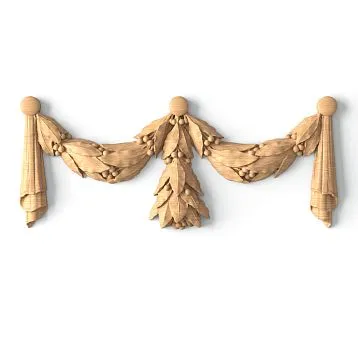
Luxurious, abundant decoration, curved forms. Moldings are complemented bycarved inlays, rosettescartouches.Crown MoldingMore complex profiles with carved consoles. Gilding, patination. Baroque is also characterized byWooden beamson the ceiling, creating a coffered structure.
Provence and country
Cozy, natural, slightly casual. Moldings with simple profiles, often artificially aged.buy wooden skirting boardBetter in light shades — whitewashed oak, faded walnut. Patination, worn effect.wooden baseboards for floorThey can be painted in soft pastel colors.
Scandinavian minimalism
Simplicity, functionality, light tones. Moldings are used minimally — thinSkirtingand modestCornicesimple profiles. Color is white or natural light wood. No wall molding frames — walls are smooth and painted.
Modern style
Minimalist with accents. Moldings are geometrically clear, often contrasting in color with walls.Wooden planksThey can be used instead of traditional moldings, creating a modern interpretation of architectural detailing.
Special applications: non-standard solutions
Wooden moldingsThey are used not only for traditional wall and ceiling decoration.
Door and window trim
Wooden casingsare a special case of moldings. Their profile must match wall moldings and baseboards. In classical interiors, door and window casings are often supplemented with an upper overlay — a pediment, which can be straight, arched, or broken.
Panel constructions
Wooden panelingThin strips that create frames on door panels or wall panels. They are thinner than standard moldings — 10-25 mm wide — but serve a similar architectural division function.
Furniture applications
The same molding profiles are used to finish furniture.Crown Moldingon cabinets, moldings on facades,Baseboardsas baseboards. Using identical profiles in architecture and furniture creates a stylistic unity.
Care and longevity
Wooden baseboards and cornicesWith proper care, they last for decades. Painted surfaces can be wiped with a damp cloth periodically. Natural wood with oil requires reapplication of finish every 2-3 years — reapplying oil to maintain protection and the fresh appearance.
Mechanical damage is repaired locally — the damaged area is sanded, spackled, sanded, and painted. If the damage is severe, you can replace one molding element without touching the others. This is an advantage of the modular systemwooden molding.
Economics of the issue: investment in quality
Buy polyurethane wall moldingsis cheaper than wooden. But if considering the cost of ownership over the long term, wood proves more economical. Polyurethane will need replacing after 10-15 years, when it yellows and loses its appearance.wooden corniceAfter 15 years, it will still look as good as on the day of installation, with minimal maintenance.
apartment with qualityarchitectural finishingmade of natural wood sells for more than a similar one with synthetic materials. This is an investment that pays off.
Create an architectural ensemble with STAVROS
Moldings for walls and wooden cornicesare tools for creating an architecturally detailed, harmonious interior. Properly selected and installed, they transform an ordinary space into one with character, history, and individuality.
Company STAVROS offers a full range ofsolid wood molding — Ceiling Molding, wall moldings, floor skirting boards, Casings, layoutsOver 500 profiles in the catalog — from simple geometric to complex classical. Made from oak, beech, ash, or pine, as you choose.
Our consultants will help you select profiles that perfectly match each other in style and proportions. We will calculate the required material amount, accounting for cutting waste. We will provide samples for evaluation in your interior. We will recommend trusted installers or advise on self-installation.
STAVROS has been working with professional builders, designers, and private clients for over twenty years. We knowinterior architectural finishingfrom A to Z. Our products have been used in hundreds of projects — from private apartments to palace interiors, from country homes to public spaces.
Visit our showroom in Moscow or St. Petersburg. See samples of all profiles, touch different wood species, evaluate the quality of processing. Our specialists will show you ready-made projects, explain nuances of selection and installation, and answer all your questions.
Wooden cornices and skirting boardsfrom STAVROS — is quality proven by time. We work only with well-seasoned wood, use modern equipment for precise processing, and control each batch before shipment. We provide a warranty on our products, assist with returns or replacements if anything doesn’t fit.
Your home deserves architectural beauty that will delight you for decades.Interior moldings and profilesmade of natural wood — is not an expense, but an investment in the quality of life. Contact STAVROS today, and we will help you create the interior of your dreams — harmonious, beautiful, filled with the nobility of natural materials and the craftsmanship of architectural work.