Article Contents:
- What is Doorway Molding and Why is it Needed
- Three Roles of Molding at the Doorway
- When Molding is Essential
- How Molding Differs from Casing: An Honest Breakdown
- Casing — Function Plus Decoration
- Doorway Molding is an Add-on
- Comparison Table
- When Only Casing is Needed
- When molding plus casing is needed
- When only molding is needed
- Where molding is used in door frame design: zones and scenarios
- Interior doorway with a door
- Doorway without a door: molding as the sole framing
- Main entrance to the living room or dining room
- Doorway in the hallway and entryway
- Double and wide doorways
- Which profile to choose for a doorway: types and characteristics
- Smooth rectangular molding (fascia)
- Molding with shaft
- Molding with a heel
- Carved wooden molding for doorways
- Wide molding for large openings
- Composite molding: multiple profiles in a system
- Classic doorway design: molding, pilaster, cornice
- What is a door portal
- Pilaster: vertical accent on the sides of the opening
- Capital: completion of a pilaster
- Wooden cornice: horizontal completion of a portal
- Classic portal design
- Molding for doorways in different interior styles
- Classic style
- Neoclassicism
- Modern classicism
- Restrained modern interior
- Carved door decor
- Molding for openings without doors: portal without a door
- How to avoid mistakes when decorating a doorway with molding
- Mistake 1: profile too small for the scale of the opening
- Mistake 2: too heavy portal for low ceilings
- Mistake 3: inconsistency with baseboard and cornice
- Mistake 4: molding and casing 'in conflict'
- Error 5: incorrect joint angle
- Error 6: ignoring wall thickness
- Where to buy molding and decor for a door opening
- Moldings for door openings: catalog
- Wooden architraves: mandatory section
- Door decor and opening framing as a system
- Architectural elements for a classic portal
- FAQ: molding for door openings — questions and answers
- STAVROS: moldings and decor for door openings — full-cycle production
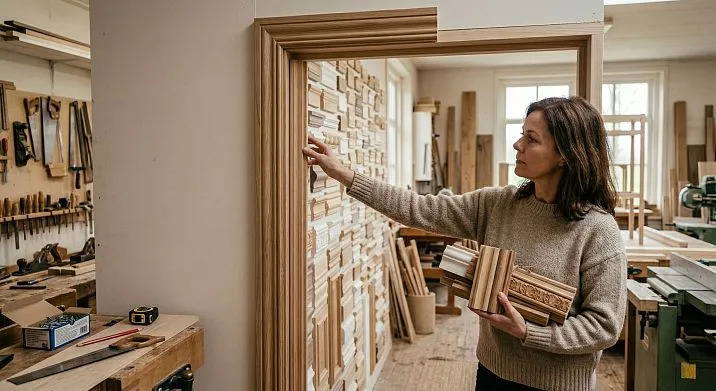
A door opening is a boundary. A boundary between rooms, between zones, between the moods of a space. And how this boundary is designed says more about the interior than any furniture: the finishing of the opening is constantly visible, with every movement through the house.
Paradoxically, it's the doorway that receives the least attention. Walls are chosen carefully, floors are selected deliberately, furniture is picked after much consideration. The doorway? 'We'll put up some trim and call it a day.' Yet, it's precisely here that it's decided whether the interior will look like a random collection of nice things or an architecturally complete environment.
Molding for a doorway— is a tool that transforms a technical rectangle into a spatial accent. It doesn't just cover the gap between the frame and the wall; it creates a frame—with its own character, its own width, its own relief.
But to do it right, you need to understand: molding around a doorway is not always the same asWooden casing. And it's not always better than trim. Sometimes—more powerful. Sometimes—excessive. Let's figure it out for real.



What is doorway molding and why is it needed
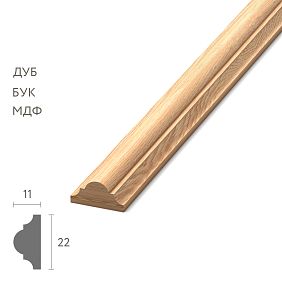
Molding is a linear profile with a shaped cross-section that is mounted on the wall surface along a doorway for decorative purposes. Its task is not structural. It doesn't hold the frame, doesn't seal gaps, doesn't bear loads. Its task is to create a frame.
Framing a doorway in an architectural sense is what turns a hole in a wall into a portal. The difference between a 'hole' and a 'portal' lies in whether the opening has a visual outline that gives it scale, character, and stylistic belonging.
This is exactly what decorative doorway molding does: it turns a technical hole into an architectural element.




Three roles of molding around a doorway
First role: visual frame. Molding creates a defined contour around the opening—a horizontal top profile and two vertical side profiles. This system is called trim or a portal. It makes the opening visible, significant, and 'readable' within the interior.
Second role: decorative accent. Where trim simply covers a gap, molding creates relief. The shadow from the profile, the play of light with side illumination, the defined contour—this is visual value that goes beyond a purely functional solution.
Third role: architectural connection. Molding ties the door opening to other interior elements: cornices along the ceiling, molding frames on the walls, baseboards. When all these profiles are made from the same material and share a system of cross-sections, the interior reads as a unified whole.
Our factory also produces:


When molding is indispensable
There are situations where trim alone is insufficient. If the door opening is a focal point of the room—the central entrance to the living room from the hall, the main doors to a library, the entrance to a master bedroom—simple trim looks disproportionately modest. Here, framing is needed: wide molding, possibly combined with pilasters and a top cornice.
If the interior is executed in a classical or neoclassical style, molding for door opening framing is not an option but a norm. In a historical interior, there is no concept of 'just doors': every opening is architecturally framed.
Get Consultation
How molding differs from trim: an honest breakdown
This is the most frequent question regarding opening framing. And the answer is not as simple as it seems.
Trim: function plus decor
Wooden door architrave—is a profile installed around the perimeter of the door frame from inside the room. Its primary function is to cover the technical gap between the frame and the wall finish. This gap inevitably occurs during door installation: the wall and the frame are different structures, and their connection requires concealment.
A door casing can be either simple (a flat strip without a profile) or decorative—with a shaped cross-section, with carving, with a profiled surface. It is the carved and profiled casing that is the most popular decorative product in the theme of door framing.
Key point: the casing is mounted flush against the frame, partially overlapping it. It is part of the door unit.
Molding for a door opening is an add-on
Molding at a door opening is installed not instead of a casing, but in addition to it—or independently where the opening does not have a frame (an arched opening, an open passage between rooms).
Decorative molding for a door opening is mounted on the wall surface around the opening, creating an extended frame. It can be installed 5–15 cm from the edge of the frame, creating a 'second contour' around the door unit. Or it can run along the very edge of an opening without a frame—in open passages and niches.
Comparison table
| Criterion | Casing | Molding for an opening |
|---|---|---|
| Main function | Close the gap between frame and wall | Decorative framing |
| Installation location | Flush against the frame | On the wall around the opening |
| Application without a door | Rare | Yes, main scenario |
| Width | 50–100 mm | 20–120 mm (depends on the task) |
| Combination with each other | — | Often used together |
| Style | Any | Mostly classic, neoclassic |
When only a door casing is needed
For most standard interior doors in modern apartmentsdoor casing— a complete and sufficient solution. It closes the technical gap, creates a neat outline, and with the right profile choice, looks elegant.
When a door casing is needed: standard interior doors in bedrooms, children's rooms, bathrooms; small spaces; modern or minimalist interiors.
When molding plus door casing is needed
When the opening is architecturally significant — central, main, wide. When the interior is in a classical or neoclassical style. When ceiling height allows for large-scale framing. When you want not just to 'close the gap,' but to create a true portal.
When only molding is needed
In openings without a door and without a frame — open transitions between rooms — there is no door casing by definition. Here, it is precisely themolding on the door openingthat works: it frames the edges of the opening, creates a border, and defines the architectural character of the transition.
Where molding is used in door opening design: zones and scenarios
Interior opening with a door
Classic scenario. The door frame is installed, the door leaf is present. The casing covers the gap on both sides of the wall. Molding is installed on top of or next to the casing — as an extended frame.
"Casing + molding" scheme: the casing fits against the frame (50–70 mm), the molding runs along the wall 5–10 cm from the casing, creating a second, wide outline. With monochrome wall finishing — the molding matches the color, only the relief stands out. With two-color finishing — the molding can serve as a boundary between zones.
Opening without a door: molding as the sole framing
This is the most expressive scenario for using molding around a door opening. An open interior transition without a leaf and frame — an arch, a rectangular opening, a wide niche — lacks a structural casing.
Heremolding for an opening without a dooris installed along the perimeter of the opening itself, creating a frame directly on the wall surface. Three elements: two vertical side pieces and one horizontal top piece. For an arched opening — a curved element is added along the arc.
Such an open portal with molding framing is one of the most popular techniques in modern neoclassical and contemporary classic styles: walls transition without doors, but the transition is architecturally framed.
Grand entrance to the living room or dining room
A door from the hall or corridor into the main room of the house — the living room, dining room, formal study — deserves maximum attention. It is here that molding for door opening decoration transforms into a full-fledged architectural portal.
Such a portal includes:
-
Wide molding frame (80–120 mm)
-
Upper horizontal cornice as a finishing element
-
Possible — pilasters on the sides of the opening
-
Possible — capital as a transition from pilaster to cornice
This solution is typical for mansions, country houses, and apartments with ceilings from 2.9–3 m.
Doorway in the corridor and hallway
The corridor is a transit zone, yet visible upon entering the apartment.Doorway designin the corridor with molding creates a sense of architectural thoughtfulness at first glance.
For the corridor, medium profiles (40–60 mm) are better suited — expressive enough but not overloading the narrow space. Molding in the color of the walls or with minimal contrast.
Double and wide openings
A wide opening — from 1.2 m and wider — with double doors or without them — requires proportional framing. A narrow casing on a wide opening looks disproportionate. Here, a molding 80–100 mm wide is needed, possibly composite: several profiles in a row.
Which profile to choose for a door opening: types and characteristics
Smooth rectangular molding (fascia)
A flat plank with clear straight edges. No ornamentation — only rectilinear geometry. Creates a clear contour without relief shadows.
Application: modern neoclassicism, Scandinavian style, minimalism. Width 25–60 mm. The most neutral and most frequently used type.
Molding with a torus
Semi-circular convex cross-section — one profiled torus. Soft shadow, smooth relief. One of the oldest architectural profiles.
Application: soft classicism, neoclassicism, Provence style. Width 20–60 mm.
Molding with a cavetto
S-shaped profile. Concave lower section and convex upper section (or vice versa). Double shadow - a more complex play of light.
Application: strict neoclassicism, Empire style. Width 30–80 mm. Below 30 mm the S-curve becomes illegible.
Carved wooden molding for a doorway
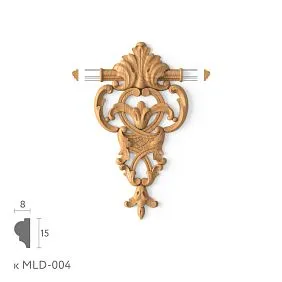
A carved profile is not just a cross-sectional shape, but an ornament. Carving depth 3–10 mm: acanthus leaves, plant scrolls, geometric repeats. Creates expressive relief visible even in diffused light.
CarvedDoor DecorationAnd carved molding for an opening is a separate aesthetic: rich, historical, requiring an appropriate context. For classical and Baroque interiors - an unconditional choice. For contemporary ones - requires caution.
Wide molding for large openings
Profiles 80–120 mm - large-scale architectural elements. Require ceilings from 2.8 m, a wide opening (from 90 cm) and appropriate decorative context. Used in composite cornices around openings or as a single wide profile in monumental framing.
Composite molding: several profiles in a system
For formal openings, a system of several moldings is used: a narrow fascia, next to it a torus, next to it a cyma reversa. Three profiles create a developed framing comparable to an architectural cornice. Total width - 80–150 mm. This is the standard for a classical door portal.
Classical doorway design: molding, pilaster, cornice
This block is for those who want not just a 'beautiful trim', but a true architectural portal. Let's break down how the system works.
What is a door portal
A door portal is an architectural framing of an opening, comprising several elements:
-
Vertical side posts (pilasters or flat pylons)
-
Horizontal top cornice (entablature or simplified cornice)
-
Moldings as profile details of the entire system
-
Possibly — capitals atop the pilasters
Such framing is characteristic of classical architecture and has been present in European residential interiors since the Renaissance era. In modern residential construction, the portal is used in high-end private homes and apartments with corresponding proportions.
Pilaster: vertical accent on the sides of the opening
Pilaster— is a flat vertical column mounted on the wall. Unlike a full column, a pilaster does not bear load: it is decorative. But its architectural effect is immense.
A pilaster in a doorway is installed at a certain distance from the edge of the opening (5–20 cm depending on proportions) and rises from the floor to the upper cornice. It is this element that sets the vertical scale of the portal.
Technical parameters of a pilaster for door application:
-
Width: 80–180 mm depending on the width of the opening and ceiling height
-
Height: from floor to upper cornice
-
Relief: smooth or with flutes (canelures)
-
Material: oak, beech, or MDF for painting
Capital: the finishing element of a pilaster
Capital— this is the crowning part of a pilaster, a visual transition from the vertical post to the horizontal cornice. In classical orders, the capital carries ornamental decor: volutes, acanthus leaves, geometric profiles.
For interior application, capitals are divided into:
-
Ionic (with volutes) — elegant, suitable for neoclassical style
-
Doric (with simple abacus) — strict, for minimalist classicism
-
Corinthian (with acanthus) — rich, for Baroque and high classicism
The capital is mounted on the upper end of the pilaster, under the cornice. Its height is 80–200 mm depending on the height of the pilaster.
Wooden cornice: horizontal completion of the portal
wooden corniceAbove the doorway — a horizontal profile that completes the vertical system of pilasters. It rests on the capitals and creates an architectural 'covering' of the portal.
The cornice above the opening can be:
-
Simple — one wide profile (80–120 mm)
-
Composite — several profiles in a horizontal row forming a developed cornice
The width of the cornice above the door is proportional to the width of the pilaster: with a pilaster width of 120 mm, the cornice is at least 100 mm.
Classical portal diagram
text[CORNICE — horizontal profile above the opening] [CAPITAL] [ DOORWAY ] [CAPITAL] [PILASTER] [ ] [PILASTER] [PILASTER] [ ] [PILASTER]
This entire ensemble — pilasters, capitals, cornice, moldings — creates a door portal. This solution looks monumental and represents the pinnacle of classical door frame design.
Molding for doorways in different interior styles
Classic style
Classicism requires elaborate framing. A single casing is insufficient here — a portal is needed. Molding for a doorway in classical style: wide composite profile (80–120 mm), pilasters on the sides, wooden cornice on top. Material — oak in dark or medium stain or white enamel on MDF.
Ceiling height — from 3 m. With lower ceilings, classicism needs to be simplified.
Neoclassicism
Neoclassicism — a modern adaptation of classicism. The same proportions, but cleaner and lighter. Molding for a doorway in neoclassicism: smooth or slightly profiled profile 40–70 mm. White to match the walls or with minimal contrast.
Pilasters — possible, but in a simplified version: without ornamental capitals. Cornice — light, 60–80 mm.Door designin neoclassicism — is restrained luxury: rich in feel, but without baroque abundance.
Modern classic
Molding for a doorway in a modern classical interior — is a balance between architectural expressiveness and modern restraint. Profile 30–50 mm, smooth or with one soft curve. Without pilasters — just a clear molding frame around the opening.
Color — white, cream, light gray. Always matching the walls: no wood tones in a white interior.
Restrained modern interior
In Scandinavian style, minimalism, and contemporary style, door molding works as a subtle outline, not a decorative accent. Narrow profile 15–25 mm, rectangular cross-section, wall color. It's almost invisible — but its absence is felt.
Carved door decor
Door decorwith carving — an independent aesthetic program. A carved casing with a pattern, carved molding around the perimeter of the opening — this is no longer just a profile, but an artistic piece. Used in interiors with a pronounced character: Russian style, Baroque, Art Deco, individual author's project.
Here, a special place is occupied bywooden door casings with patterns: carved pieces with traditional ornamentation, giving the door opening the character of a historical or authorial statement.
Molding for an opening without a leaf: a portal without a door
An open doorway without a door is an increasingly popular solution in modern apartments. Molding here is the only way to architecturally frame the transition, marking the boundary without closing off the space.
For an open portal without a door, monumental framing works well: a wide molding (60–80 mm) around the entire perimeter of the opening. The contour should be expressive enough—otherwise, the opening simply gets lost.
How to avoid mistakes when framing a door opening with molding
Even experienced finishers make mistakes here. Not because they work carelessly—but because they choose incorrectly.
Mistake 1: the profile is too small for the scale of the opening
A 40 mm casing on a tall 2.4 m opening with a wide 90 cm leaf looks like a random line—it's almost invisible. The width of the profile should be proportional to the width and height of the opening.
Guideline: for a standard opening 80–90 cm wide—a profile of 50–70 mm. For a wide opening from 100 cm—70–100 mm. For a double opening—100–120 mm or composite molding.
Mistake 2: too heavy a portal with low ceilings
A wide pilaster, a massive cornice, heavy moldings—all this creates a sense of monumentality. Monumentality is beautiful with ceilings from 3 m. With standard 2.5 m ceilings, it turns into pressure: the portal 'presses down' the space.
Rule: the total height of the horizontal cornice molding above the door opening should not exceed 8–10% of the wall height from floor to ceiling. With a height of 2.6 m—no more than 210–260 mm total, including the cornice and top molding.
Mistake 3: inconsistency with the baseboard and cornice
Door molding is not a separate component. It must be coordinated with:
-
The baseboard on the floor (same wood species, same stain tone, or same enamel)
-
The cornice molding at the ceiling (same stylistic register)
-
The casings of other doors (same profile type throughout the floor)
If the baseboard is made of light oak and the door opening molding is made of dark oak — this is a conflict. All millwork products in the space should form a material system.
Error 4: molding and casing 'in conflict'
If a 60 mm casing is installed and an additional 80 mm molding is placed over it, the total framing width is 140 mm. This is too much for any standard opening. Either casing or molding — or careful calculation of the total framing width.
Error 5: incorrect joint angle
Door opening molding has three corner joints: two upper ones (between the vertical side and horizontal top profiles) and — if the molding goes down to the floor — two lower corner joints. A 45° joint requires precise profile geometry with a tolerance of no more than 0.1–0.2 mm. With a larger tolerance, the angle will gap or overlap.
This is precisely why wooden profiles from a manufacturer with controlled geometry are not a whim, but a necessity.
Error 6: ignoring wall thickness
Molding is mounted on the wall plane around the opening. For a deep reveal (thick wall), the viewing angle must be considered: the profile should be visible from the room side, not just from the end. For walls with a thickness of 250 mm or more, the reveals are additionally finished or the molding is mounted with an offset from the wall edge.
Where to buy molding and decor for a door opening
Theory is good. Practice is more important. Where to get products, what to look for when choosing a supplier?
Moldings for door openings: catalog
Buy molding for a door opening— means selecting a specific profile from a real catalog with the ability to evaluate the cross-section, width, and surface quality.
When choosing molding for door applications, the key parameters are:
-
Width: 30–100 mm (depends on the opening width)
-
Profile tolerance: no more than ±0.1 mm/m — otherwise, 45° joints will not align
-
Surface: sanded, ready for coating
-
Solid wood moisture content: 8–12%
Wooden architraves: essential section
Buy wooden architravefor a door opening — the first step for most projects. Architraves are present in all living spaces, and their selection precedes the choice of molding.
When selecting an architrave for further combination with molding: the architrave and molding should be of the same wood species and compatible profiles. Smooth architrave + smooth molding — or profiled architrave + profiled molding. Mixing profile styles looks inconsistent.
Door decor and opening framing as a system
Door Decoris not just a set of products, but a solution: how exactly the door opening looks in a specific interior. Carved door decor, patterned architraves, ornamental moldings — these are elements of a unified system.
For carved door opening decoration in folk, classical, or authorial style —Carved wooden decorationin the form of overlay elements allows creating an additional decorative level on top of the main molding.
Architectural elements for a classic portal
For a complete portal, in addition to molding, you need:
-
Pilaster— vertical element on the sides of the opening
-
Capital— crowning detail of the pilaster
-
wooden cornice— horizontal finishing profile
These elements form an ensemble. When ordering, it is important to specify that they are intended for one project: the manufacturer will select the proportions and, if necessary, a unified tinting system.
FAQ: molding for a doorway — questions and answers
What is the difference between molding and casing?
Casing is a profile that covers the gap between the door frame and the wall. Molding is a decorative profile on the wall surface around the opening. Casing is functionally necessary; molding is a decorative superstructure that creates a frame. In classic projects, they work together.
What is better for a doorway: molding or casing?
This is not a question of 'what is better.' It's a question of the task. For a standard interior door in a modern apartment—door casing—is sufficient. For a formal opening in a classic interior—molding is needed, and possibly a portal with pilasters and a cornice.
Is molding suitable for a doorway without a door?
Molding works best precisely for a doorway without a door—that's its primary scenario.molding for an opening without a door—is installed around the perimeter of the open passage, creating an architectural frame without a structural frame.
How to design a doorway in a classic style?
A classic doorway is a portal:pilasters—on the sides,Capitals—at their tops, a horizontal cornice above, molding profiles as a connecting element. The minimum ceiling height for such a solution is 2.8–3 m.
Can molding be combined with a pilaster?
Not only is it possible — it's a classic combination. The pilaster sets the vertical scale, the molding elaborates surface details and transitions. The connecting element is the capital, transitioning into the horizontal cornice. All three elements form a unified portal.
Which profile to choose for an interior doorway?
For a standard interior doorway 80–90 cm wide: a smooth or single-bead profile 40–60 mm. For a wide doorway from 100 cm — 60–80 mm or a composite of two profiles. Material — oak, if there is wooden furniture in the interior; MDF for enamel — for monochrome white solutions.
Where to buy molding for a doorway?
Wooden moldingfor door applications — in the STAVROS catalog.Wooden door architraves— in the architraves section. Door decor and carved elements — in the sectiondoor decoration. Architectural elements for a classical portal — pilasters and capitals — in the corresponding catalogs.
Is carved molding suitable for a modern interior?
Carved molding carries a historical character. In a strictly modern, minimalist interior, it may look alien. But in modern classic, neoclassical, and authorial projects — carvedDoor Decorationcreates a memorable individual accent. Key condition: the carving must harmonize with the rest of the room's decor.
Should both edges of the opening be finished with molding (on both sides of the wall)?
Depends on the construction. If the opening is without a door — molding is installed on both sides of the wall. If with a door frame — the casing covers the gap on both sides, molding is an additional framing on the visible side (or on both, if the opening is two-sided). For walls with a thickness from 200 mm, reveals require separate finishing.
STAVROS: moldings and decor for door openings — full-cycle production
A good door opening is always a system: casing, molding, cornice, possibly — pilaster and capital. And all these elements must be from one source, one material, one production precision. Otherwise, the joints won't align, the tone won't match, and the character of the profiles will tell of different interiors.
STAVROS is a Russian manufacturer of wooden architectural elements and millwork. Full production cycle: own preparation of solid hardwood lumber, kiln drying to 8–12% moisture content, profile milling with a tolerance of ±0.1 mm/m, surface sanding. Each product is ready for coating without additional preparation.
In the STAVROS catalog — a complete set for finishing a door opening of any complexity:
-
Wooden moldings— full range of profiles for framing openings, frame systems, and wall decor
-
Wooden door architraves— functional and decorative framing of the door frame
-
pilastersandCapitals— architectural elements for a classic portal
-
Carved door decor— a complete solution for decorative door and opening finishing
-
Decorative Inserts— carved elements for an additional decorative layer
Doorway finishing is not the final touch. It is one of the first and most important interior decisions. Make it consciously — with the right profile, the right scale, and the right manufacturer.