Article Contents:
- 1. Why it is important to understand the pricing of furniture materials
- 2. Main factors affecting the cost of furniture materials
- 3. Price of different types of materials: overview
- 3.1. Laminated particleboard (MDF)
- 3.2. MDF
- 3.3. Solid wood
- 3.4. Plywood
- 3.5. Veneered fronts
- 3.6. Plastic (HPL/CPL)
- 3.7. Acrylic
- 3.8. Enamel / paint for MDF
- 4.1. Material thickness
- 4.2. Complexity of milling and decoration
- 4.3. Hardware and accessories
- 4.4. Edge banding, end treatment
- 4.5. Brand, country of manufacture
Furniture not only makes our lives more comfortable, but also largely determines the aesthetics of the interior. However, style, durability, and comfort always come at a price — the choice of material significantly affects the final cost of the finished product. In different projects, this can be a decisive factor, as some people need the most affordable option for a dacha or temporary residence, while others prefer durable and exclusive solutions made from solid wood. In this article, we will examine the most common furniture materials, how their prices are formed, and what additional expenses should be considered when purchasing or ordering furniture. The text is extensive (about 2000 words) to help you better navigate this topic.


1. Why it is important to understand the pricing of furniture materials
- Financial Planning
By knowing in advance how much different materials (Laminate, MDF, solid wood, etc.) cost, you will be able to roughly estimate the overall budget for a furniture project, whether it's a kitchen, a wardrobe, or a living room. - Justification of expenses
Quality and price do not always go hand in hand in a strict dependency. Sometimes the 'golden mean' (e.g., quality MDF with film) may prove more reliable and durable than cheap solid wood of dubious origin. - Comparison with design
Considering the price, one can understand which style will be accessible. Classic carved fronts made of solid wood are more expensive, whereas minimalist fronts made of Laminated Particleboard may be much more budget-friendly. - Optimal Choice
Understanding cost helps avoid overpaying for unnecessary 'extras' or, conversely, not saving where it could lead to quick breakdowns.




2. Main factors affecting the cost of furniture materials
- Base type: solid wood, MDF, particleboard, plywood, plastic, metal, glass — each has its own production and raw material procurement costs.
- Quality and brand: globally recognized manufacturers (Egger, Kronospan, FunderMax) charge more for stable quality and wide range of decorative options. Less-known factories may offer lower prices, but with higher risks.
- Processing complexity: some materials (e.g., solid wood, high-grade plywood) require skilled hands and precise equipment. This increases the final product cost.
- Finish coating: veneer, acrylic, enamel, PVC film, laminate, lacquer, etc. — each coating option has its own technology and price.
- Purchase volume: wholesale prices are lower than retail. Manufacturing companies can buy hundreds of particleboard or MDF sheets from suppliers, getting discounts, whereas for private projects the cost is often higher.
- Logistics: transportation and storage (especially for large and heavy sheets) affect the price. The farther the warehouse or the more complex the delivery, the higher the cost.
- Seasonal fluctuations and exchange rates: raw materials, especially imported ones (e.g., exotic veneers), may become more expensive during currency fluctuations.
Our factory also produces:


3. Price of different types of materials: overview
Below is approximate information on pricing (not exact figures, but price levels) and factors determining the final cost.
Get Consultation
3.1. Particleboard (laminate particleboard)
Features: base — wood chips impregnated with resinous adhesives, decorated on top with melamine or laminate film.
● Price segment: the most budget-friendly among panel materials.
● Variations: thickness (16 mm) or thicker (18/25 mm). Some brands release collections with exclusive textures (concrete, stone, exotic wood), slightly increasing the price.
● Main factor: 'emission class' (E1/E0 — safer and slightly more expensive) and 'brand' (Egger, Kronospan, Swiss Krono). Ordinary 'no name' particleboard is cheaper, but may carry quality risks.
Price range: from minimum (for domestic brands) to mid-range (for European collections with special finishes).
3.2. MDF
Briefly: medium-density fiberboard, produced from fine wood fibers under high pressure.
● Price segment: higher than particleboard; mid-to-high.
● Depends on: sheet thickness (thicker = more expensive), finish coating (veneer, PVC film, enamel, acrylic), brand, emission class (E1/E0).
● Applications: kitchen facades, routered doors, decorative panels.
Special note: MDF with exclusive finishes (transparent enamels, complex 3D films) can be quite expensive, approaching solid wood prices.
3.3. Solid wood
Features: solid boards or beams made from oak, beech, ash, pine, etc.
● Price segment: high, especially for hardwoods (oak, walnut), imported (mahogany, teak), or exotic species.
● Factors: rarity of species, wood grade (A, AB, B), drying method (kiln-dried is more expensive than air-dried), presence of certifications (FSC).
● Applications: classic, country, premium projects.
Estimated price: for comparison, solid oak may cost several times more than equivalent volume MDF or particleboard. Each species has its own price level: pine is the cheapest, while teak or walnut are premium.
3.4. Plywood
Description: glued perpendicular layers of veneer (birch, coniferous species). Thickness ranges from 3 to 30 mm.
● Price segment: from low to medium. Depends on grade (E, I, II, III, IV), absence of knots, surface smoothness, and moisture resistance.
● Application: Scandinavian, eco, DIY projects, chair frames, back panels, budget furniture.
● Additional factors: high-grade veneer (birch without knots) may cost more than cheap particleboard, especially for thicknesses 18–24 mm.
3.5. Veneered facades
What it is: a thin layer of natural wood (veneer) is glued onto a base (MDF/plywood).
● Price segment: higher than particleboard and simple PVC film, but cheaper than solid wood. Mid-to-high level.
● Factors: type of veneer (oak, beech cheaper than exotic types like zebrawood), adhesive and lacquer technology, grade.
● Result: almost "like solid wood" in appearance, while the construction is more stable and lighter.
3.6. Plastic (HPL/CPL)
Description: laminating high- or medium-pressure laminate onto a panel (MDF/plywood).
● Price segment: medium to medium-high. HPL is expensive (resistant to physical impacts), CPL is slightly cheaper.
● Application: kitchen facades, countertops, bathrooms (high moisture resistance), office furniture.
● Special variants: gloss (glossy), mat (matte), fantasy textures (stone, metal, concrete) cost more.
3.7. Acrylic
● Essence: an acrylic panel or film is glued onto MDF, creating a mirror gloss (or deep matte).
● Price segment: above average, closer to plastic HPL. Acrylic + MDF is a popular option for modern kitchens.
● Factors: thickness of the acrylic layer, brand (Alvic, AGT, etc.), complexity of edge finishing.
3.8. Enamel / paint on MDF
● Essence: solid wood or MDF facades are sanded, primed, painted/enamelled, and polished.
● Price segment: medium to high, as it requires a painting booth and skilled painters.
● Features: infinite color palette (RAL, NCS), matte or glossy finish possible. Price increases with complex milling.
4. Additional factors affecting final cost
4.1. Material thickness
Thick sheets (18–25 mm) cost more than thin ones (10–16 mm). However, for facades, 16–19 mm is typically used, though solutions for thin doors (12–14 mm) also exist.
4.2. Complexity of milling and decoration
● Simple flat facades are cheaper than relief ones.
● Milled patterns (especially in classic styles) require time and precise equipment.
● Rounded (curved) facades are even more expensive, as presses and technology are specific.
4.3. Hardware and Accessories
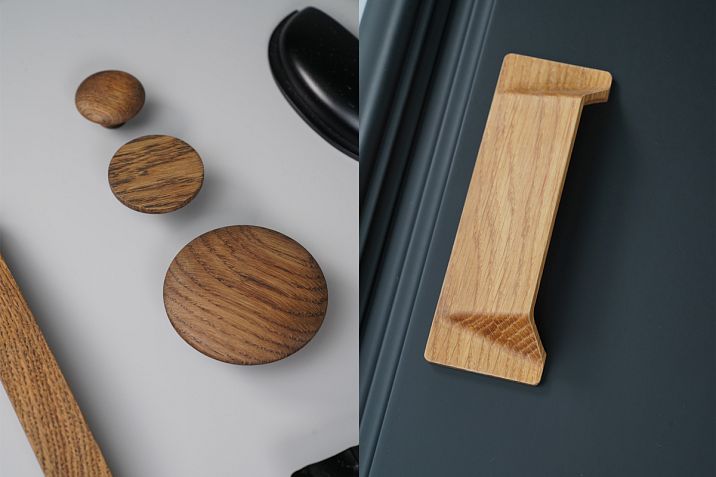
In addition to the material itself, the price increases due to hinges with stoppers, telescopic guides, lifting mechanisms, furniture handles. Sometimes hardware can account for 30–40% of the kitchen set's cost.
4.4. Edge banding, end treatment
For countertops (MDF, Laminated Board), quality edge banding (PVC, ABS, postforming) is important — this also adds to the cost.
4.5. Brand, country of manufacture
● European brands (Egger, Kronospan) are usually more expensive than Russian equivalents.
● Italian or German collections may have unique designs, but they cost more due to logistics and marketing.
5. Approximate price order (very general)
Attention: Below are very approximate price levels; they may vary significantly depending on region, specific store, brand, currency exchange rate, and are not exact figures:
- Laminated Board: the most budget-friendly option. A 16 mm sheet from a domestic manufacturer may cost relatively little, but branded Egger, Kronospan with exclusive decor — more expensive, though still within the lower/mid price range.
- Film-finished MDF fronts: cost is higher than Laminated Board (approximately 20–50%), depending on film type (matte, glossy, patinated).
- HPL Plastic: mid to higher mid-range, especially if complex postforming (rounded edges).
- Acrylic: comparable to plastic, sometimes slightly more expensive due to bright gloss and special material properties.
- Wood veneer: mid to mid-high level — depends on wood species (oak, beech — more affordable, exotic — more expensive).
- Enamel (paint): often above average — facade painting requires complex technology, may be comparable in price to good veneer.
- Solid wood: top price range — different species make a difference. Pine is cheaper, oak is more expensive, walnut or redwood — even higher.
6. Tips for choosing the best price/quality option
- Assess usage conditions
Kitchen, bathroom, or balcony require moisture-resistant solutions — MDF with PVC film, HPL plastic, acrylic. In the living room, veneered facades can be used, which are more fragile to moisture fluctuations. - Think about style
○ Classic, neoclassic: solid wood (expensive) or MDF under enamel, veneer.
○ Minimalism, high-tech: acrylic, plastic, solid color enamel.
○ Scandinavian: plywood, light wood, or Laminated Board 'imitating bleached oak'.
○ Loft: rough texture (Laminated Board 'imitating concrete/brick'), metal, glass.
- Don't skimp on hardware
Even if the facade material is inexpensive, quality hinges and guides will extend the lifespan and improve convenience. - Consider service
Cutting, edge banding, postforming (if rounded edges are needed) also affect the overall budget. - Check certifications
Emission class E1/E0, to avoid getting 'toxic' furniture, especially if it's for a bedroom or children's room.
7. Where to go: stores, warehouses, furniture companies
● Building hypermarkets (Leroy Merlin, Castorama, etc.): sell sheet materials (MDF, particleboard, plywood), sometimes veneer, acrylic facades. Cutting and edge banding are often provided for an additional fee.
● Specialized warehouses: for professionals, wholesale purchases (prices may be lower).
● Furniture companies: offer ready-made "turnkey" solutions. It's easier to compare different materials, hardware, and get installation estimates here.
● Online stores: wide assortment, can order delivery, but it's important to check reviews and reputation.
8. Examples of material combinations for cost-saving or quality improvement
- Laminate body, MDF facades: popular scheme. The body can be made cheaper since it's less visible, while MDF facades with interesting finishes make the look more appealing.
- Laminate + MDF (or aluminum) frame + glass insert: gives a light effect while remaining relatively affordable.
- Veneered facades, laminate inside: looks luxurious on the outside, budget-friendly on the inside.
- Solid wood only in decorative elements (moldings, appliqués), while main surfaces are veneered MDF.
9. Common questions and mistakes when buying facade materials
- Can laminate be used for kitchen facades?
Yes, but note that without milling, only flat surfaces. It's better to choose a reputable brand with good edge banding, and avoid moisture exposure to edges. - Why do some acrylic facades easily scratch?
The quality of the acrylic coating plays a role, plus careless handling. If it's budget acrylic, it may be less resistant to mechanical impacts. - Is it worth paying extra for enamel facades?
If individual color, unlimited shade options, and luxurious effect are important — yes, it's worth it. But consider maintenance and careful use. - Check the uniformity of the pattern, absence of chips at the edges, and the degree of lacquering. If the veneer is too thin (less than 0.3 mm), it is vulnerable to damage.
10. Completion
10. Finishing
The price of furniture material for facades is determined by multiple factors: type of panel (MDF, laminate, solid wood), finish type (PVC film, veneer, enamel, acrylic, plastic), brand level, design complexity, and hardware. 'Optimal' cost varies, as each buyer has their own requirements for durability, moisture resistance, aesthetics, and budget.
For those aiming to save, laminate and film-finished MDF facades are a good choice: they allow creating an attractive appearance at moderate cost. If you desire luxurious classic or 'mid-high' level — veneer and solid wood. For modern high-tech or minimalism — acrylic, plastic, or enamel on MDF. Pay attention to the quality of edges and hardware: often, hinges, handles, and additional mechanisms constitute a significant portion of the cost and determine usability.
Most importantly — choose materials not only based on price, but also according to real usage conditions (kitchen, bathroom, living room), desired style (classic, high-tech, scandi, etc.), and willingness to spend time on maintenance (gloss and solid wood require slightly more attention). This ensures an optimal balance between budget, longevity, and beauty of future furniture.