Article Contents:
- Chapter 1. The Role of Photography in Furniture Design
- 1.1. Why "Furniture Design Photos" Are Important
- Why High-Quality Photos Are Needed
- Trends in Furniture Photography
- 2.1. The Significance of the Facade in the Overall Appearance of Furniture
- 2.2. Variety of Facade Styles
- 2.3. Materials and Technologies for Facades
- 3.1. Why Classic Motifs Never Go Out of Fashion
- 3.2. Combining Classic and Modern Trends
- 3.3. Classic Furniture in Focus
- 4.1. Combining Different Textures and Materials
- 4.2. Geometric Patterns and 3D Reliefs
- 4.3. Color Accents and Non-Standard Finishes
- 4.4. "Smart" Hardware and Lighting
- 5.1. Preparing for the Photo Session
- 5.2. Technical Aspects
- 5.3. Post-Processing and Retouching
- 6.1. Choosing a Catalog Concept
- 6.2. Portfolio for Designers
- 7.1. How to Choose the Perfect Facades for Your Project
- 7.2. Improving Photos Yourself
- 7.3. Creating a Unique Brand Style
- 8.1. 3D Visualization as an Alternative to Real Photography
- 8.2. AR/VR for "Trying On" Furniture
- 9.1. Why Furniture Front Design Continues to Evolve
- 9.2. How to Choose Your Own Style and Photo Concept
- 9.3. Final Recommendations
The world of furniture design is remarkably multifaceted. When we talk about "furniture design photo," we mean not just beautiful images, but also the entire concept underlying the creation of striking, functional, and yet unique interior pieces.
One of the key elements shaping the exterior appearance of furniture, without a doubt, are the fronts. Indeed, the design of furniture fronts often determines the style, character, and "emotional charge" of the future interior — whether it be strict minimalism, luxuriousClassic Furniture or bold eclecticism.
In this article, we will consider:
● Why furniture photography (and design in general) holds such great importance in our time;
● What approaches exist for designing fronts and how they influence the overall perception of the product;
● What trends, materials, and technological techniques are currently leading in the field of furniture design;
● How classic solutions remain relevant and combine with modern technologies;
● What are the secrets of successful furniture photography — from studio setup to post-processing.
This article is large (at least 2000 words), so we will be able to thoroughly explore the topic and share valuable professional insights accumulated over decades of work in design and artistic photography. Let’s embark on our exciting journey into the world of furniture fronts and striking photos!


Chapter 1. The Role of Photography in Furniture Design




1.1. Why "Furniture Design Photo" Is So Important
Today we live in a visually oriented world. Social networks, online stores, digital catalogs — all of this has contributed to the fact that customers first "fall in love" with an interior item through an image, and only then make a purchase decision.
If in the past, the end customer could rely only on a personal meeting with a sample in a showroom, today the selection process often begins online: we browse photos, read descriptions, compare options. That’s why furniture brands and designers pay enormous attention to how their product looks in a frame. This applies not only to advertising brochures, but also to presentations for partners, social media management, participation in design contests, etc.
Why Are High-Quality Photos Needed
- Show details. When creating furniture fronts (carvings, milling, inlays, texture features), it is important to capture them in such a way that the client can examine the beauty and intricacies of the craftsmanship.
- Create an atmosphere. A good photograph can convey the style and idea of an interior. For example,Classic Furniture requires special photography that highlights its elegance and nobility, while minimalist kitchen fronts are better revealed in a bright, clean environment.
- Support the brand. If a furniture company has a certain reputation and concept, photographs are key to forming the necessary associations with potential buyers.
Our factory also produces:


1.2. Trends in Furniture Photography
Considering the modern demand for authenticity and eco-friendliness, photographers increasingly strive to show furniture in "lived-in" interiors with soft, natural lighting. A gentle "warmth" in the image is welcomed, emphasizing the tactile quality of materials.
● Minimal staging. If in the 2000s it was fashionable to photograph furniture against a "glamorous" white background with bright highlights, now the focus has shifted: priority is to show furniture in real conditions, so the client can mentally "try on" it in their own home.
● Emphasis on details. Close-ups of handles, hardware, edges, and joints. Often, collages are made where the main photo shows the entire item, and beside it are detailed fragments.
● Use of color palettes. Developing professional color combinations and demonstrating them — an important trend. These can be neutral backgrounds that highlight the furniture, or conversely, a contrasting setting that emphasizes its style.
Thus, "furniture design photo" has moved from the category of applied visualizations to an independent direction where professionals such as stylists, decorators, photographers, and designers converge. But, of course, the heart of everything is the furniture itself and its expressive facades, which one wishes to showcase in all their glory.
Get Consultation
Chapter 2. Design of Furniture Facades as the Key to Styling
2.1. The Significance of the Facade in the Overall Appearance of Furniture
When we talk about furniture design, the first thing that catches the eye is usually the facade. In the case of wardrobe cabinets, kitchen sets, chests, doors, etc., it is precisely the facade that sets the visual impression. One can consider the facade the "face" of the item.
● Functional significance: the facade protects the internal space (shelves, drawers) and ensures access (opening/closing). At the same time, it is subject to regular contact: handles, hinges, possible impacts and scratches — all of this tests the material quality for durability.
● Aesthetic significance: shape, color, routing, decoration, presence or absence of glass, configuration of handles — all of this forms the style. The facade can be ultra-modern (smooth without hardware, push-to-open), may demonstrate classical decoration with columns and panels, or become a "canvas" for a painted print.
For designers, the facade is a platform for experimentation. Using different technologies (lacquer, paint, patina, veneer, laminate, carving), we achieve various effects, integrating furniture into the overall interior solution.
2.2. Variety of Facade Styles
Monitoring the modern market, we can identify several major stylistic directions influencing facade design. Let's consider the most popular ones:
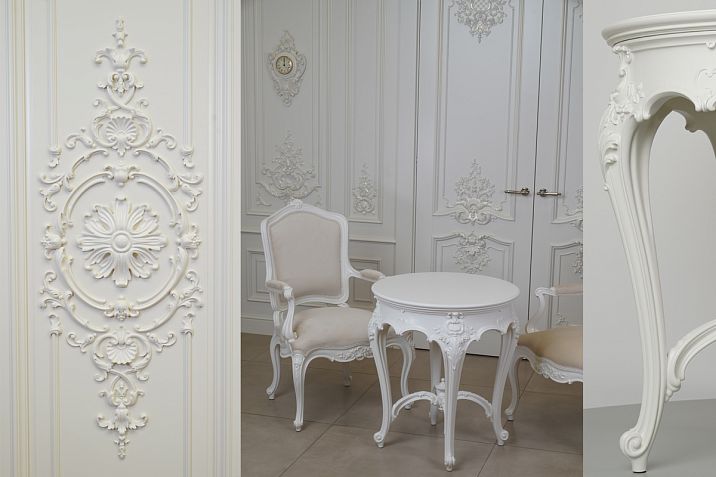
- Classic facades. Here, the emphasis is on elegance, symmetry, carved or routed framing.Classic Furniture May include panels, pilasters, ornamental inserts, glass doors with stained glass. The color palette is usually noble: white, cream, pastel tones, wood textures, golden patinated elements.
- Modern (Art Nouveau). Characterized by smooth lines, floral or plant motifs, often stained glass inserts. Wood may combine with metal and glass. Sometimes inlay is used, giving a refined "pattern" on the facade.
- Modern minimalism. Smooth glossy or matte surfaces without visible handles, wide solid planes. Popular are acrylic, lacquer, or PVC film finishes. Wardrobes and kitchens in high-tech, modern, and Scandinavian concepts often emphasize clean lines and simple geometry.
- Loft, industrial. Here, facades with "raw" textures — imitation of concrete, rusty metal, weathered wood — are appropriate. Sometimes rough wrought iron handles and visible guides are used. It looks brutal, but gives the room a striking character.
- Country, Provence. For rustic and romantic styles — characteristic whitewashed textures, patina, soft pastel shades. Panels may be simpler than in classic styles, but the natural wood structure is emphasized.
- Eclecticism and fusion. Gaining popularity is bold mixing of elements from different eras: classic framed doors with modern handles, glass inserts, combining contrasting colors.
Chapter 3. The Influence of Classicism on Modern Design
The design of furniture facades is not only a matter of the artist's ideas, but also of technological possibilities.
● Solid wood. Timeless "timeless classic". Expensive, requires careful maintenance, but offers warmth and elegance. Often used inclassic furniture or in the country style.
● MDF with coating. The most popular choice for modern built-in furniture. Facades can be covered with PVC film, paint, acrylic, veneer. The presence of routed details facilitates the creation of textures and decoration.
● Plastic, laminate. An inexpensive option, durable and easy to maintain. Glossy or matte surfaces can be bright colors or imitate wood, stone.
● Glass. Can be an insert in a framed facade or a full glass door (especially for display cases, kitchen cabinets). Matte, transparent, colored, mirrored, and stained glass versions are used.
● Metal. Suitable for individual inserts or frames. Used in high-tech and loft styles, where cold, industrial notes are appreciated.
Of course, each material has appropriate processing technologies (routing, sanding, lacquering, laminating, patination). An experienced designer knows how to combine several materials, creating a memorable effect. For example, a wooden framed facade with a central glass insert and brass elements can look absolutely unique.
Chapter 3. The Influence of Classicism on Modern Design
3.1. Why Classic Motifs Never Go Out of Fashion
Classicism is not just history — it is a stable value. For centuries, classical forms and proportions have continued to attract us with their harmony and warmth. Even the most innovative designers often turn to classical elements, seamlessly integrating them into the modern context.
● Stable aesthetics. Proportions and decoration, refined over centuries, are genuinely pleasing to the eye. This is an important psychological comfort factor that buyers may not consciously recognize, yet they are drawn to such items.
● Natural materials.Classic Furniture Often implies a solid wood structure, high-quality fabrics, hand-carved details. In the age of plastic and synthetic materials, items bearing the 'soul' of craftsmanship acquire special value.
● Status. Classic style is associated with aristocracy and luxury. Often, designer sets in classic style become the 'calling card' of a living room, office, or bedroom.
3.2. Combination of classic and modern trends
The modern furniture market develops the direction of 'neoclassicism' or 'updated classicism'. This means retaining general features of classic facades (frame, panels, patina), but tones can be bolder (deep blue, gray, graphite), decoration is simplified, and hardware becomes more minimalist. Solutions with integrated lighting, built-in mechanisms, and hidden handles also appear.
Photographs of such 'eclectic' sets are often seen on the covers of interior design magazines. They combine the coziness and nobility of classic style with the convenience of the modern world. And the main 'feature' is created by the design of the furniture facades: classic lines + current colors and functions.
3.3. Classic furniture in the focus of the lens
Photographing classic sets has its subtleties. Photographers must decide how to convey the depth of carving, the sheen of lacquer, and the texture of wood. On one hand, soft lighting is desirable to highlight the volume and complex geometry of facades. On the other hand, one must not overdo it with lighting to avoid 'bleaching' details.
Some techniques:
● Focus on hardware. Gold-colored handles, expertly applied patina — all of this deserves separate 'macro shots'.
● Context of interior. Classic cabinets or chests look great in spacious halls with noble decor (moldings, fireplace, large windows). This reinforces the idea of luxury.
● Warm color palette. In post-processing, a slight 'warm' tone is often added to emphasize the naturalness of wood and the coziness of the atmosphere.
But do not forget: no matter how beautiful the photograph, the main thing is design harmony. If facades are made with quality and taste, they will 'resonate' in the lens even without complex staging.
Chapter 4. Trends and innovations in furniture facade design
4.1. Combination of different textures and materials
One of the bright trends of recent years — mixing contrasting materials. For example, wood + concrete, metal + glass, MDF + rattan. Such combinations give furniture freshness and emphasize the designer's concept.
● Wood and concrete. In loft interiors, manufacturers make facades with 'concrete' finish (films or enamel with effect). Next to them — inserts of natural wood. The result is brutal, but with a hint of eco-friendliness.
● Metal and glass. In high-tech or minimalist styles: aluminum frames with minimalist glass. Sometimes matte or mirrored glass is used for greater privacy.
● Inserts of textile or faux leather. For some extravagant projects, facades may be partially covered with fabric or leather, giving them an exclusive look.
4.2. Geometric patterns and 3D reliefs
Milled and pressed facades are gaining popularity. Manufacturers offer complex 'three-dimensional' structures capable of changing the perception of furniture at different lighting angles.
● 3D panels. Can be wavy, honeycomb-like, or geometric. Suitable for modern interiors where minimalist forms coexist with bold textural accents.
● Linear milling. Popular are thin parallel grooves, diagonal lines, or 'rhombuses' that look modern and add depth.
● Complex ornaments. Sometimes designers integrate ethnic or art deco motifs, creating a repeating pattern on the facade. Such facades look especially striking in renders.
4.3. Color accents and non-standard finishes
Regarding color palette, white, gray, and black remain bestsellers. But simultaneously, the trend toward bright and deep colors is gaining momentum: dark blue, emerald, burgundy, terracotta.
● Glossy or matte surfaces. Gloss has long led in high-tech style. However, matte is now gaining popularity as it appears more 'calm' and does not require constant polishing to remove fingerprints.
● Soft-touch finishes. Special lacquer coatings creating a velvety surface, pleasant to the touch. This gives facades 'tactile luxury'.
● Patina effect. For lovers of vintage spirit: artificial aging or imparting a 'grained' surface to emphasize the history of the item.
4.4. 'Smart' hardware and lighting
Modern facades often integrate functional features:
● Hidden handles (profiles, slots, push-to-open). This solution supports a minimalist design and removes protruding elements, visually simplifying the facade.
● Built-in lighting. LED strips at the ends of the glass, around the door, or inside cabinets. This is not only aesthetically pleasing but also convenient for everyday use.
● Electric actuators. For lift-up facades, such as in kitchen cabinets, motorized mechanisms controlled by button presses are increasingly used.
When photographing such modern furniture, designers and marketers strive to highlight these 'features' up close, emphasizing the innovative aspect.
Chapter 5. Secrets of Successful Facade and Furniture Photography
5.1. Preparation for the photoshoot
To obtain a high-quality 'furniture design photo,' it is important to follow several rules.
- Clean and prepare the item. The furniture must look flawless: all dust, fingerprints, glue marks, or scratches must be removed.
- Choose the right environment. Background and interior — half the success. If the item is intended to be showcased in a modern style, a minimalist environment is selected. For classic styles — luxurious details, curtains, paintings.
- Set up lighting. For studio shoots, several light sources with softboxes, diffusers, and reflectors are typically used. In interior shots — natural daylight from windows is often combined with additional lighting. The key is to avoid harsh shadows and 'overexposed' textures.
5.2. Technical aspects
● Camera and lens. The higher the quality of the sensor and optics, the better the detail rendering. Wide-angle lenses may distort proportions, so lenses with medium focal length (50 mm, 85 mm) are preferable for 'authentic' shapes.
● White balance. Furniture facades often require accurate color rendition. If white balance is incorrectly set, the color palette may be distorted.
● Depth of field. Usually, it is important that the entire item is in focus, while the background is slightly blurred. For close-ups of hardware, a shallow depth of field can be used to create an artistic effect.
5.3. Post-processing and retouching
After shooting, color and lighting correction is inevitable, along with possible removal of minor defects. Here, balance is key: do not turn the item into a 'painted picture,' preserving realism.
● Color correction. Light adjustment to match the real tone of the facades.
● Artifact removal. Spots, glare, unwanted reflections — all of this is removed or softened in a graphic editor.
● Frame cropping to format. For social media or catalogs, different image proportions may be needed. Sometimes, a collage of multiple angles is created.
Chapter 6. Creating catalogs and portfolios
6.1. Choosing a catalog concept
The commercial success of furniture facades depends directly on how they are presented in photos:
● Styling. You can create a catalog in the style of 'natural' photography, where items are shown in real interiors. Or prefer a more conceptual approach: emphasized minimalism, studio backgrounds, abstract decor.
● Organization. Catalogs are often sorted by collections (classic, modern, loft, etc.) or by furniture type (kitchens, cabinets, living rooms). This helps clients navigate faster.
● Visual consistency. It is important that all photos share a common approach to color, lighting, and composition. This creates the impression of a 'brand-specific style'.
6.2. Portfolio for designers
If you are an independent designer or owner of a small workshop, your portfolio is your showcase and business card.
● Your own projects. Show photos of completed interiors where your furniture is integrated into the overall concept. Include 'before and after' shots for clarity.
● Creation process. Many clients are interested in seeing how ideas are born, drawings are made, and facade production stages unfold. Such photos and video clips build trust.
● Social media work. Instagram, Pinterest, Houzz — popular platforms where furniture design photos are especially valued. Regular publication of high-quality images and stories helps expand your audience.
Chapter 7. Practical Tips for Choosing Facades and Their Photo Presentation
7.1. How to Choose the Perfect Facades for Your Project
- Define the style. Will it beClassic Furniture or modern minimalism? Your personal preferences and the overall room decor play a key role.
- Consider usage. Kitchen facades are exposed to grease, moisture, and temperature fluctuations, while living room facades are not. Therefore, materials and finishes must be selected based on usage conditions.
- Determine your budget. Solid wood and expensive lacquer cost significantly more than laminate or film. Sometimes, the optimal solution is a compromise (veneer, quality PVC film, etc.).
- Texture and color. Think about how the facades will match the walls, floor, and furniture. Photographers often use test renders or samples in "real" settings (color palette, furniture mock-up).
7.2. Improving Photos Yourself
Professional help is not always available. If you are photographing your furniture yourself, here are some useful tips:
● Use natural light. Shoot near a window with diffused daylight to get soft shadows.
● Avoid a "cluttered" background. Furniture should be the main subject. Remove unnecessary items, clutter, and create a neat background.
● Stabilization. Use a tripod or solid support to avoid camera shake and capture sharp details.
● Proper exposure. It’s better to slightly underexpose than to "overexpose". Brightness can be adjusted later during post-processing.
● Shoot details. Close-ups of handles, unusual angles, or decorative elements — these are what will attract attention on social media and your website.
7.3. Creating a Unique Brand Style
If you are a designer or furniture company, plan and define your visual brand code:
● A consistent color palette for photos, logo, and website.
● Specific background (or background elements) for catalogs to ensure photos are recognizable.
● Special angles — for example, take a branded "45-degree angle" shot where hardware and side facade details are visible.
This helps you stand out in the market and creates a sense of professionalism and thoughtful approach in clients' minds.
Chapter 8. The Future of Furniture Design: Digital Technologies and Photorealistic Renders
8.1. 3D Visualization as an Alternative to Real Photography
Modern computer programs (3ds Max, Blender, Cinema 4D, etc.) allow recreating furniture and interiors with such high realism that distinguishing a 3D render from a photo is difficult. This saves resources and time, especially if the furniture has not yet been produced but needs to be shown to the client.
● Pros: no need to transport and assemble furniture; you can change upholstery color, lighting, and decor with one mouse click.
● Cons: requires an experienced 3D artist, and high-quality renders also take time, plus some clients prefer real photos.
8.2. AR/VR for "Trying On" Furniture
Augmented (AR) and virtual (VR) reality technologies are already entering the furniture design sphere. A customer can point their smartphone camera at a room and see how a particular facade will look. Such solutions are being implemented by major companies (IKEA, Leroy Merlin, etc.).
For professional designers and manufacturers, this opens new horizons: there’s no longer a need to rely on "furniture design photos," as the client can themselves "rotate" a 3D model in their own space.
Chapter 9. Conclusion and Inspiration
We’ve traveled a long path, considering:
- The importance of high-quality furniture and facade photography in the modern world;
- Various styles (from classic to high-tech), materials and technologies shaping the appearance of facades;
- Trends (3D relief, material combinations, bright colors, smart hardware) and the significance of classical heritage;
- Photography secrets that allow showcasing furniture facade design in the most compelling way;
- Development prospects — 3D renders, augmented reality, new digital tools.
9.1. Why furniture facade design continues to evolve
● Consumers are becoming increasingly demanding of uniqueness and quality. They need something not just practical, but reflecting their individuality and lifestyle.
● Technological breakthroughs in manufacturing (laser cutting, CNC milling, innovative coatings) provide designers with new opportunities.
● Social networks and online stores stimulate visual competition: whoever presents their product more beautifully and interestingly will attract attention.
9.2. How to choose your style and photo concept
● Analyze the space, functional requirements, budget, and personal preferences.
● Study examples of 'furniture design photography' in catalogs, blogs, Pinterest. Save ideas you like.
● Consult a professional. A good designer or photographer will help bridge your dreams with reality.
● Don't be afraid of unconventional solutions. Try interesting materials and textures, as bold ideas often make interiors unique.
9.3. Final recommendations
● Furniture facade design is a powerful tool for self-expression. Think about the story you want to tell through your piece of furniture?
● Furniture photographs (especially for promotion or portfolios) must be high-quality, considering style, material, and target audience.
● Draw inspiration from renowned designers' projects, but strive to add your own touch to make the furniture look unique.
● Modernity does not negate love forclassic furnitureIt will always remain relevant to lovers of elegance and tradition. Classic facades easily adapt to modern trends if you choose the finish, color, and hardware wisely.
In conclusion, we can say that in the world of furniture design photography, it is not merely illustration, but a full 'emotional showcase' that helps reveal the essence of the product and inspire others to create or purchase beautiful, functional, 'soulful' furniture. Furniture facade design gives furniture its unique character, and a well-executed photograph helps convey this character to the viewer — whether a potential buyer, partner, or simply an admirer of aesthetics.
Remember: furniture is more than just boards and hardware. It is part of our daily life, shaping the atmosphere of the home. And if professional approach, refined taste, and artistic vision underlie its creation, then every photograph, every 'shot' will reflect these qualities and find resonance in people's hearts.