Article Contents:
- Why a unified material base is needed in an interior
- Psychology of perception of natural materials
- Wooden skirting board: the foundation of a visual composition
- Baseboard Height and Room Proportions
- Skirting board profile: from minimalism to classic
- Wood species for baseboards
- Wooden cornice: completing the vertical
- Types of wooden cornices
- Combining cornice and skirting board
- Wooden furniture handles: tactile connection with the interior
- Shapes of furniture handles
- Integrating handles into the overall concept
- Additional wooden products: expanding the set
- Wooden architraves
- Decorative Moldings
- Planks and battens
- Practical aspects: selecting a set
- Uniformity strategy
- Tonal gradation strategy
- Contrast strategy
- Accent strategy
- Installation and mounting: creating unity in practice
- Preparing wooden products
- Installing a wooden skirting board
- Mounting a wooden cornice
- Installing Furniture Handles
- Caring for a set of wooden products
- Regular Cleaning
- Moisture Protection
- Recoating
- Stylistic solutions: sets for different interiors
- Scandinavian Style
- Classic Interior
- Minimalist interior
- Loft Style
- Economic aspects: investment in quality
- Durability
- Restoration possibility
- Impact on property value
- Ecological aspects: responsible choice
- Resource Renewability
- Carbon footprint
- Biodegradability
- Frequently Asked Questions
- Is it possible to combine different types of wood in one set?
- What treatment of wooden products is the most practical?
- Is it necessary to paint wooden products?
- How to determine the quality of wooden products when purchasing?
- Is it possible to install wooden products independently?
- How often should the coating of wooden products be renewed?
- Which baseboard to choose for underfloor heating?
- Is it worth using wooden products in a children's room?
- Conclusion: assembling an interior from details

Have you ever wondered why some interiors are remembered for their integrity, while others seem like a chaotic set of elements? The secret lies in the details that rarely come into focus during the planning stage. We're talking about those components that frame the space, create boundaries, and serve as transitions between planes. Wooden floor baseboards, ceiling cornices, furniture handles on facades—these elements can either destroy harmony or become an invisible thread that ties everything together. Let's figure out how to properly select a set of wooden products so that your interior gains completeness and character.


Why a unified material foundation is needed in an interior
Imagine a room where the baseboards are made of plastic, the cornices are made of polyurethane, and the furniture handles are made of chrome-plated metal. Each element on its own may be of high quality, but together they create visual dissonance. The materials speak different languages: plastic sounds cheap, polyurethane sounds cold, metal sounds aggressive. Where is the focal point for the eye here? Where is the feeling of home?
Now imagine another picture:Furniture Handlesmade of solid oak,Wooden baseboardof the same shade frames the floor, and an elegant cornice made of similar wood runs along the ceiling. Everything is maintained in a unified color scheme, but without monotony. Wood creates a warm atmosphere; its texture is readable at different levels of the room—from floor to ceiling, from large architectural elements to miniature hardware.




Psychology of perception of natural materials
Why is wood so attractive? Neuroscientists have discovered that contact with natural materials activates areas of the brain associated with feelings of safety and comfort. Evolutionarily, we are programmed to perceive wood as a favorable element of the environment. For millions of years, our ancestors lived among trees, used them to build shelters, and warmed themselves by fires.
Modern research confirms: people living in interiors with a lot of wood show lower levels of cortisol—the stress hormone. Tactile contact with a wooden surface slows the heartbeat and reduces blood pressure. Every time you open a drawer with a wooden handle, you receive a micro-dose of natural therapy.
But it's not just about physiology. Wood carries a cultural code. In Russian tradition, a wooden house is a symbol of solidity, warmth, and a family nest. Even in a city apartment, solid wood products create a connection with this archetypal memory. A wooden floor baseboard becomes not just a functional element, but a sign of quality of life and commitment to traditional values.
Our factory also produces:



Wooden baseboard: the foundation of visual composition
A baseboard is the boundary between the vertical wall and the horizontal floor. It seems like a secondary detail, but try to imagine an interior without baseboards. An immediate feeling of incompleteness and carelessness arises. The baseboard completes the composition, creates a clear frame, and protects the lower part of the wall from mechanical damage and dirt.
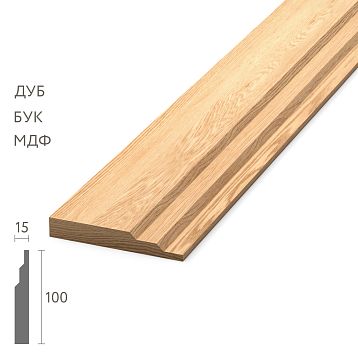
Wooden baseboardperforms these functions with particular nobility. Unlike plastic counterparts, it does not imitate wood—it is wood, with all its texture, warmth, and living energy. Solid oak or beech has a density that ensures durability. A properly installed and treated wooden baseboard serves for decades without losing its qualities.
Get Consultation
Baseboard height and room proportions
Choosing the height of a baseboard is not an arbitrary decision, but a matter of architectural mathematics. For rooms of standard height (2.5-2.7 meters), a height of 70-80 mm is optimal. Such a baseboard is noticeable but does not draw attention to itself. It creates visual support for the walls without disrupting proportions.
In rooms with high ceilings (from 3 meters and above), a wide baseboard—100-120 mm—is appropriate. It balances the vertical scale, making the space more human. Imagine a formal living room with four-meter ceilings and a narrow baseboard—it would simply get lost, and the walls would seem endless. But a wide wooden baseboard creates a noble foundation, visually 'grounding' the room.
For compact spaces (kitchens, hallways, bathrooms), a baseboard with a height of 60-70 mm is suitable. It does not visually steal precious centimeters but performs all necessary functions. An important nuance: if other wooden elements (door frames, moldings) are already present in the room, the baseboard must be proportionate to them. A too-thin baseboard with massive door frames will create imbalance.
Baseboard profile: from minimalism to classic
Modern manufacturers offerbaseboards of various profiles. A straight profile is a laconic form with smooth edges, ideal for minimalist interiors. Such a baseboard has no decorative curves; it is strict and functional. It is chosen for modern spaces where the purity of lines is important.
A profile with a chamfer adds elegance. A slight bevel on the upper edge creates a play of light and shadow, making the baseboard look more refined. This is a universal solution that suits most styles—from Scandinavian to neoclassical.
A figured profile with coves is a choice for classic interiors. Smooth curves, roundings, and decorative grooves refer to traditional architecture. Such a baseboard requires appropriate surroundings: ceiling moldings, classic furniture, thoughtful proportions. It does not tolerate proximity to high-tech appliances or industrial elements.
A high profile (100-120 mm) can combine several elements: a base, a central part with relief, and a finishing strip. This is a true architectural detail that turns the baseboard into an object of contemplation. In formal rooms, halls, and executive offices, such a baseboard creates an atmosphere of solidity.
Wood species for skirting boards
Oak is the benchmark for strength and expressiveness. Its dense structure, pronounced texture with characteristic annual rings, and noble shade make oak baseboards a premium choice. Oak is resistant to moisture (not absolutely, but better than many species), mechanical damage, and abrasion. It can serve for centuries. The only downside is the relatively high price, but it is an investment in durability.
Beech is a more affordable alternative with its own character. Beech wood is lighter than oak, with a fine, uniform texture. It is excellent for processing, allowing for the creation of complex profiles. Beech takes stains easily, accepting any shades—from natural light to deep wenge. This makes it a universal material for various design tasks.
Ash has high elasticity and strength; its texture resembles oak but is more contrasting. Light areas of the wood alternate with dark stripes, creating a dynamic pattern. An ash baseboard is a choice for interiors where the natural expressiveness of the material is valued.
Wooden cornice: completing the vertical
If a baseboard frames the floor, then a cornice completes the walls at the ceiling. This is a mirror element that creates symmetry in the composition. In classical architecture, a cornice is a mandatory component crowning the wall. It visually separates the vertical plane from the horizontal ceiling, creating completeness.
A wooden cornice has special expressiveness. Unlike lightweight polyurethane or polystyrene cornices, it has weight, mass, and presence. It is not an imitation of architecture but a real structural element, even though today it primarily serves a decorative function.
Types of Wooden Cornices
Simple rectangular-section cornice — a minimalist solution for modern interiors. It creates a clear boundary between the wall and ceiling without drawing excessive attention. Such a cornice is often used in Scandinavian interiors, where restraint in form is important.
Profiled cornice with fillets and projections — a classic option that requires a corresponding room style. The complex profile creates a play of light and shadow, adding volume. It can be symmetrical or asymmetrical, with carved elements or smooth.
Cornice with bottom lighting — a modern solution combining traditional form and technology. An LED strip is installed into a special groove in the cornice, creating soft illumination directed at the ceiling or wall. This adds a futuristic touch to the interior without compromising the naturalness of the wood.
Wide cornice (from 90 mm) can serve as a functional element — decorative items can be placed on it if the mounting structure allows. In some historical interiors, cornices were used as shelves for decorative ceramics.
Combination of cornice and baseboard
The ideal scenario is when the cornice and baseboard are made from the same wood species and have similar finishing. This creates a visual frame for the room: the baseboard frames the bottom, the cornice frames the top. The eye glides along this contour, perceiving the space as a whole.
It's important to maintain proportionality. If the baseboard is 100 mm high, the cornice should not be narrow — 70-90 mm would be optimal. If the baseboard is narrow (60 mm), the cornice can be proportionate or slightly wider, but not massive. Disproportion creates a feeling that the room is 'falling' or 'taking off'.
Color solutions can be monochromatic (cornice and baseboard in the same shade) or contrasting (e.g., dark baseboard and light cornice). Contrast adds dynamism but requires caution. It is appropriate in spacious rooms with neutral walls, where wood serves as the main decorative element.
Wooden furniture handles: tactile connection with the interior
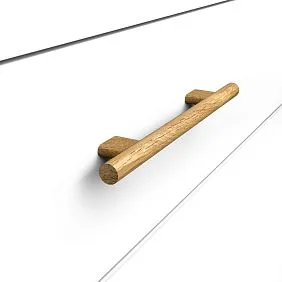
If we contemplate the baseboard and cornice, thenFurniture Handleswe touch them dozens of times a day. This is an element of tactile contact, a point of interaction between a person and furniture. And here wood shows itself in the best way.
A wooden handle is warm — it doesn't cool down like metal or heat up like plastic. It maintains a comfortable temperature, pleasant to the palm. Its texture is not slippery or sticky, but naturally rough, providing a secure grip. Over the years, wooden handles acquire a noble patina from touch, becoming even more attractive.
Forms of furniture handles
Large-diameter round handles (40-60 mm) — an expressive accent. They are especially effective on solid-color matte facades, where the wood texture becomes the main decorative element. The round shape is universal, suitable for any style — from classic to modern.
U-shaped bracket handles — classic furniture hardware. They provide a convenient grip, suitable for heavy doors and frequently used drawers. The bracket length can vary from compact 96 mm to impressive 300 mm for wide facades. A wooden bracket can have a round or rectangular cross-section, smooth or with textured finishing.
Shell handles with smooth rounded edges — the embodiment of ergonomics. Their shape follows the natural curve of the palm, making usage maximally comfortable. Shells are often used on pull-out drawers, where bottom grip is important.
Compact button handles (diameter 25-40 mm) — a solution for lightweight furniture with small doors. They don't draw excessive attention, creating tactile points on the facade surface. In minimalist interiors, such handles emphasize overall restraint.
Oval and rectangular handles — geometry in its pure form. They create a modern look, pair well with laconic baseboards and straight-profile cornices. Horizontal or vertical orientation allows playing with the visual proportions of furniture.
Integration of handles into the overall concept
When furniture handles are made from the same wood species as the baseboard and cornice, material unity of the interior emerges. Oak on the floor (baseboard), oak under the ceiling (cornice), oak in the hands (handles) — this threefold repetition works on a subconscious level, creating a sense of thoughtful space.
It's important to coordinate surface finishing. If the baseboard and cornice are coated with matte varnish, the handles should have similar finishing. If oil is used, emphasizing the natural texture, the handles are treated the same way. Glossy handles against matte millwork will create dissonance.
Color solutions can be tonal (all elements in the same shade) or with gradation (from light handles to darker baseboards). Contrasting solutions (black handles with light baseboards) require caution — they must be justified by the overall concept where contrast is a deliberate technique.
Additional wooden products: expanding the set
A set of wooden products is not limited to baseboards, cornices, and handles. There are many other elements that enhance the unity of the material foundation of the interior.
Wooden architraves
Casingsframe door and window openings, creating a transition between the wall and frame. In Russian tradition, an architrave is not just a functional element, but an object of decorative craftsmanship. Carved architraves adorned houses, becoming the owner's signature.
Modern wooden architraves can be deliberately simple (straight profile for minimalist interiors) or decoratively complex (with carving, fillets, projections for classic styles). When architraves are made from the same wood species as the baseboards and cornices, an effect of architectural unity is created.
It's important to maintain proportions: the width of the architrave should be proportionate to the height of the baseboard. A too-narrow architrave with a wide baseboard will look uncertain. The classic ratio: architrave width is approximately equal to or slightly greater than the baseboard height.
Decorative Moldings
Moldings— these are decorative strips used to create wall panels, frame mirrors, form architectural compositions. In classic interiors, moldings create symmetrical panels dividing the wall into zones.
Wooden moldings possess volume and weight that polyurethane counterparts lack. They create genuine architectural relief. When moldings are coordinated by wood species and finish with baseboards and cornices, the wall transforms into a cohesive composition.
Moldings can also be used on furniture—to create panels, frame constructions on facades. Combined with wooden handles, they enhance material unity.
Planks and beams
Wooden slats have become a popular element in modern interiors. Slat panels on walls, slat partitions, slat ceilings—all of this creates rhythm, visual texture, and interplay of light and shadow. When the slats are made from the same wood species as the main set (baseboards, cornices, handles), they fit organically into the concept.
Blocks are used to create structural elements, frames, and casings. They are less noticeable than decorative items, but their material foundation is also important. Oak blocks in an interior with oak baseboards—this is a consistency that is valued.
Practical aspects: selecting a set
How to assemble a harmonious set of wooden products? There are several strategies, each with its own advantages.
Uniformity strategy
You choose one wood species (e.g., oak) and one type of finish (e.g., oil) for all elements.Floor wooden skirtingoak baseboard, oak cornice,Furniture Handlesoak door casing, oak trim—everything is maintained in a unified key.
Advantages: maximum integrity, absence of visual breaks, calm perception. Disadvantages: risk of monotony, especially in small spaces. To avoid boredom, use variety in forms: baseboard with a shaped profile, simple cornice, round handles and brackets mixed.
Tonal gradation strategy
You use one wood species but in different shades. For example, light beech for the cornice, medium tone for trim, darker for the baseboard, the most saturated for handles. This creates a vertical gradation: from light top to dark bottom.
Advantages: visual depth, interesting play of shades, preservation of material unity. Disadvantages: requires careful selection of tones so that transitions are smooth, not sharp.
Contrast strategy
You consciously create contrast by using light and dark wood. For example, light beech baseboard and cornice, but dark oak handles. Or vice versa: dark oak baseboards and light beech handles.
Advantages: dynamism, expressiveness, ability to accentuate certain elements. Disadvantages: contrast must be stylistically justified; it is not suitable for calm minimalist interiors.
Accent strategy
Main elements (baseboard, cornice, trim) are executed neutrally, while furniture handles become a bright accent. For example, all millwork products from light beech with a matte finish, and handles—from dark oak with pronounced texture.
Advantages: attention concentrates on the furniture, handles become a decorative element. Disadvantages: requires quality furniture capable of 'holding' the accent.
Installation and mounting: creating unity in practice
Proper installation of wooden products is no less important than their selection. Sloppy installation will ruin even the most thoughtfully planned set.
Preparing wooden products
All solid wood products must acclimate in the room before installation. Wood is hygroscopic—it absorbs and releases moisture, reacting to changes in microclimate. If you install a baseboard just brought from a cold warehouse into a warm apartment, it may warp.
Recommended acclimatization period is 3-7 days. Products should be in the room in a horizontal position, in factory packaging or without it, at room temperature. This allows the wood to reach equilibrium moisture content.
Before installation, inspect all products for defects: cracks, knots, unevenness. Quality manufacturers carefully select material, but human error is possible. It's better to discover a problem before installation than after.
Installing wooden baseboard
Installation begins with marking. Determine attachment points considering wall material: for concrete, dowels are required; for drywall, special fasteners; for wooden walls, screws. Fastening spacing is 50-70 cm, but at joints and corners, fasten more frequently.
Corners are the most challenging part. For inside corners, the baseboard is mitered at 45 degrees using a miter saw or miter box. It's important that the cuts are mirror images—the slightest deviation will create a gap. For outside corners, the technique is similar but requires even greater precision.
Joints on straight sections are made at a right angle or at 45 degrees (a beveled joint is less noticeable). After installation, gaps are filled with wood-colored sealant or wood filler. A well-executed joint is practically invisible.
Wooden cornice installation
The cornice is attached to the wall or ceiling (depending on the design) using self-tapping screws hidden within the cornice body or with special adhesive. Adhesive mounting is possible for lightweight cornices with small cross-sections. Massive cornices require mechanical fastening.
Pay special attention to corners. The cornice is cut at a 45-degree angle in corners, just like baseboards. However, there is a nuance: the work must be done near the ceiling, which complicates the task. Use reliable stepladders or scaffolding and ensure good lighting.
If the cornice is intended for lighting, the wiring must be laid before installation. Plan the cable exit points, install the power supply for the LED strip. After installing the cornice, access to the wiring will be difficult.
Installing furniture handles
Furniture handles are attached using screws that pass through the front panel. Marking is a key stage. Use a template to ensure identical placement of handles on all fronts. This is critical for cabinets with many doors and drawers.
Drilling holes for screws requires precision. The hole diameter must match the screw diameter. The drilling depth is calculated so that the screw fully enters the handle but does protrude from the back side.
For heavy doors, use bracket handles with two mounting points—they provide reliability. For light drawers, button handles with a single screw are suitable. It is important not to overtighten the screws during installation—this can split the wooden handle.
Care for a set of wooden products
Solid wood products are durable but require proper care.
Regular cleaning
Dust is the main enemy of wooden surfaces. It not only spoils the appearance but also acts as an abrasive, gradually wearing away the protective coating. Wipe baseboards and cornices with a soft, dry cloth once a week. For hard-to-reach places (profiled cornices), use a soft brush.
Furniture handles that come into contact with hands get dirty faster. Wipe them with a slightly damp cloth, immediately drying them thoroughly. Do not use aggressive cleaning agents—they can damage the coating. Water with a drop of mild soap is sufficient.
Protection from moisture
Wood and moisture are not the best friends. Excessive humidity leads to swelling, warping, and cracking. Maintain a stable humidity of 40-60% in the room. Use humidifiers in winter (when heating dries the air) and dehumidifiers in summer (during damp weather).
If water gets on the baseboard or handle, wipe it off immediately. Prolonged contact with water (e.g., flooding) can lead to irreversible damage. In high-humidity areas (bathrooms, saunas), use products with enhanced moisture-resistant treatment.
Recoating
Over time, the protective coating (varnish, oil) wears away, especially on frequently used handles. The coating needs to be renewed every few years. For oil impregnation, it's simple: clean the surface, lightly sand with fine sandpaper, apply a new layer of oil.
For varnished products, the process is more complex. If the varnish has worn off in places, you need to completely remove the old coating, sand the wood, and apply new varnish. Partial renewal will create unevenness—fresh varnish will differ from the old.
Stylistic solutions: sets for different interiors
Let's consider how to assemble a set of wooden products for various interior styles.
Scandinavian style
Base: light wood (beech, ash) with natural or whitewashed finish.Wooden baseboardBaseboard 70-80 mm high with a straight profile, cornice simple rectangular,Furniture HandlesFurniture handles: round or oval. Everything is kept in light tones, finish matte (oil or matte varnish).
Emphasis on naturalness: the wood grain should be visible, not masked by a thick layer of paint. Forms are laconic, without decorative excesses. This set creates an atmosphere of northern restraint and purity.
Classic interior
Base: dark wood (oak, walnut) with a rich hue. Baseboard 100-120 mm high with a shaped profile, cornice with coves and projections, furniture handles carved or in the form of classic brackets. Finish: glossy varnish, emphasizing the depth of color.
Wide casings with decorative elements. Moldings create panels on the walls. The entire set works to create an atmosphere of nobility, respectability, and connection with historical traditions.
Minimalist Interior
Base: medium-tone wood (beech, oak) with neutral finish. Baseboard 60-70 mm high with a strictly straight profile, cornice minimal or absent (hidden cornice with lighting is used), furniture handles rectangular or round, but as simple as possible.
Color can be natural or painted in gray, graphite, white. The main thing is the absence of decoration, purity of lines, functionality. This set creates a modern space where wood is present as a noble material but does not dominate visually.
Loft style
Base: rough wood with emphasized texture. Baseboard can be made of aged oak with brushing (soft fibers removed with a metal brush, highlighting the grain). Cornice simple or absent altogether. Furniture handles made of dark wood, simple shapes, possibly with metal inserts.
Finish: oil or wax, emphasizing the natural texture. Traces of mechanical processing (saw marks, irregularities) are possible, which in a loft are perceived as a decorative element. The set creates a brutal atmosphere of an industrial space, softened by the naturalness of wood.
Economic Aspects: Investment in Quality
A set of natural wood products is an investment. Initial costs are higher than when using plastic or MDF, but the long-term benefit is obvious.
Durability
A high-quality oak wooden baseboard lasts 30-50 years without loss of functionality. A plastic counterpart begins to fade, crack, and lose its appearance after 5-10 years. Replacing baseboards involves not only the cost of materials but also the work of removing old ones and installing new ones, repairing damaged wall sections.
Solid wood furniture handles outlast the furniture itself. When fronts wear out, the handles can be removed and installed on new furniture. Plastic handles break, metal ones get scratched and lose their coating.
Restoration Possibility
Wooden products can be restored. Scratches are sanded, the finish is renewed, and the color can be changed. Plastic and MDF can only be replaced after damage. This is especially relevant for skirting boards, which are in the risk zone (impact from vacuum cleaners, furniture).
Impact on property value
An interior with quality wooden elements is perceived as premium. When selling or renting, this affects the price. Buyers and tenants are willing to pay more for housing where attention to detail is visible and natural materials are used.
Ecological aspects: responsible choice
By choosing wooden products, you are making an environmentally responsible choice.
Renewable resource
Wood is a renewable resource, unlike oil (the basis for plastic). With proper forestry, felled trees are replaced by new plantings. European wood producers follow sustainable forestry principles certified by FSC or PEFC.
Carbon footprint
The production of wooden products requires less energy than the production of plastic or metal. Wood absorbs carbon dioxide during growth, which remains stored in the products. Thus, a wooden skirting board is not just carbon neutral, but actually has a negative carbon footprint.
Biodegradability
At the end of their service life, wooden products are fully biodegradable, leaving no toxic waste. They can be burned for heat or composted. Plastic products take centuries to decompose, releasing microplastics and toxins.
Frequently asked questions
Can different wood species be combined in one set?
Yes, but it requires a designer's touch. Combining light beech and dark oak creates contrast. It is important that such a decision is stylistically justified. In eclectic interiors, mixing species is acceptable and even welcome. In minimalist ones, it's better to maintain unity.
What is the most practical treatment for wooden products?
For skirting boards and cornices, varnish is optimal — it creates a durable protective coating resistant to wear and moisture. For furniture handles, both varnish and oil are good. Oil creates a more natural look and is easy to renew, but requires regular maintenance. Varnish is more durable, but if damaged, requires complete removal and reapplication.
Is it necessary to paint wooden products?
It's a matter of style. The natural shade of wood is universal and always relevant. Painting allows adapting products to a specific interior color scheme. If you are unsure about the longevity of a color choice, it's better to leave the natural color — it can always be changed later.
How to determine the quality of wooden products when purchasing?
Pay attention to several points: absence of cracks, knots, resin pockets; geometric straightness (the skirting board should not be twisted); quality of surface finish (smoothness, absence of tear-outs); uniformity of coating (if products are treated). Ask about wood moisture content — it should be 8-12%.
Can wooden products be installed independently?
Skirting boards and handles — yes, this is accessible to a person with basic tool skills. You'll need a miter saw (or miter box), drill, and screwdriver. Cornices are more difficult due to working at height and the need for precise corner fitting to the ceiling. If unsure, it's better to invite a professional.
How often should the coating on wooden products be renewed?
Depends on the type of coating and intensity of use. Varnished skirting boards and cornices may not require renewal for 10-15 years. Furniture handles with oil coating are advisable to renew every 2-3 years. Signs of needing renewal are surface dulling, dryness, loss of protective properties.
Which skirting board to choose for underfloor heating?
Wooden skirting board is compatible with underfloor heating, but two points must be considered: there must be an expansion gap between the skirting board and the floor covering (underfloor heating causes expansion); the skirting board must be attached only to the wall, not to the floor, to avoid hindering thermal deformations.
Is it worth using wooden products in a children's room?
Absolutely. Wood is an environmentally clean material that does not emit harmful substances. It is safe for children. Tactile contact with wooden handles is beneficial for sensory development. The only nuance — choose products with smooth finishing, without sharp edges or splinters.
Conclusion: assembling an interior by detail
An interior is not created in a single moment, but is composed of many decisions; large and small details weave together into a single fabric of space.Furniture Handles, Wooden baseboardSkirting board, cornice — these elements seem secondary against the backdrop of choosing furniture or wall color. But it is precisely they that create that elusive integrity which distinguishes a well-thought-out interior from a random collection of items.
A set of wooden products is an investment in quality of life. Every day, opening a drawer with a wooden handle, you receive tactile pleasure. Every time you look up at a noble solid wood cornice, you feel pride in your home. Every morning, walking through a room with wooden skirting boards, you subconsciously register completeness, neatness, attention to detail.
Natural wood will never go out of style. Trends come and go, but solid oak or beech remains a symbol of quality, reliability, and connection with nature. Decades later, your wooden skirting boards and handles will look just as noble, having acquired only a patina of time that will add to their value.
STAVROS company specializes in creating comprehensive interior solutions from natural wood. The assortment includesskirting boards of various profiles and sizescornices,furniture handles of diverse shapescasings, moldings, and otherssolid wood trim pieces. The use of high-quality oak and beech wood, modern production equipment, and quality control at all stages guarantee the durability and beauty of the products.
When assembling a set for your interior, you get not just functional elements, but components for creating a space with character. A space where the naturalness of materials creates a healthy atmosphere, where thoughtful details speak of your taste, where every touch of a wooden surface reminds you of the right choice.
Choose wood. Choose quality. Choose integrity. And let your home become a place where harmony begins with details and unfolds into the fullness of a comfortable, beautiful, meaningful space.