Article Contents:
- Why Furniture Handles Are So Important
- Functionality and Ergonomics: Comfort in Every Movement
- Aesthetics and Style: How Handles Define Furniture Character
- Durability and Reliability: An Investment in Quality
- Variety of Furniture Handles: How Not to Get Lost in Choosing
- Types of Furniture Handles by Construction and Mounting Method
- Materials Used: From Metal to Glass and Ceramic
- Stylistic solutions: from classic to avant-garde
- Where to Buy Furniture Handles: Overview of Options
- Specialized stores for furniture hardware
- Online Stores: Convenience and Wide Selection
- Hardware and Furniture Hypermarkets
- Furniture Factories and Hardware Manufacturers
- Criteria for Choosing a Reliable Supplier
- How to Choose the Perfect Furniture Handles for Your Interior
- Matching Style of Interior and Furniture
- Practical Aspects: Size, Ergonomics, Ease of Use
- Technical Specifications: Materials, Finishes, Mounting
- Budget Considerations: Price-to-Quality Ratio
- Installing and Replacing Furniture Handles: Practical Guide
- Required Tools and Materials
- Step-by-Step Guide to Installing New Handles
- Replacing Old Handles: Features and Nuances
- Professional Tips: How to Achieve the Perfect Result
- Trends and Innovations in the World of Furniture Handles
- Modern Trends in Furniture Handle Design
- Technological Innovations: "Smart" Handles and New Materials

Have you ever wondered why some interiors look complete and harmonious, while others seem lacking something? The secret often lies in the details, and furniture handles are one of the most important of these details. These small elements can transform the most ordinary furniture, give it character and style, make it comfortable and pleasant to use. But where to buy furniture handleswhich will perfectly complement your interior and last for many years? Let’s explore the variety of these small but significant details and learn how to choose the best.


Why Furniture Handles Are So Important
Furniture handles are not just functional elements for opening doors and drawers. They are accents capable of radically changing the perception of the entire piece of furniture and even the interior as a whole.




Functionality and Ergonomics: Comfort in Every Movement
The primary function of a furniture handle is obvious — to provide a comfortable grip for opening a door or pulling out a drawer. However, behind this simple task lies an entire science of ergonomics.
A properly selected handle should:
- Fit comfortably in the hand, matching the natural position of the wrist. Ergonomic handles have a special curve or texture that ensures a secure grip without unnecessary muscle strain.
- Positioned at an optimal height. For upper cabinets, this is usually the bottom third of the door; for lower cabinets, the top third. This positioning minimizes strain on the wrist and back.
- Have sufficient protrusion from the front panel surface (usually 25–35 mm) to ensure comfortable grip even for large hands or gloved hands (relevant for kitchen furniture).
- Not have sharp edges or burrs that could cause injuries or snag clothing.
Quality furniture handles undergo rigorous ergonomic testing. For example, premium models are tested for ease of use by people of different ages, hand sizes, and even varying physical limitations.
Interesting fact: studies show that properly selected ergonomic handles can reduce joint load by up to 40%, which is especially important for people with arthritis or other musculoskeletal issues.
Our factory also produces:


Aesthetics and style: how handles shape the character of furniture
Furniture handles are like jewelry for furniture. They can:
- Highlight the style of the furniture and interior. Classic brass handles with patina perfectly complement an antique chest, minimalist chrome handles suit a modern kitchen, and wrought iron handles with botanical ornamentation enhance Provence-style furniture.
- Create an accent in a monochromatic interior. Bright ceramic handles on a white facade or contrasting black handles on light wood become expressive focal points that draw attention.
- Unify stylistically different items into a cohesive composition. Using identical handles on different furniture pieces creates a visual connection between them.
- Refresh the appearance of outdated furniture. Replacing handles is the quickest and most economical way to modernize an interior without major investments.
Interior designers often refer to furniture handles as the 'final touch' that completes the composition and sets accents. That is why the question of where to buy furniture handles high quality and original design, becomes so important for creating a harmonious space.
Get Consultation
Durability and reliability: an investment in quality
Furniture handles are subjected to constant mechanical stress and contact with hands, so their quality directly affects the durability and ease of use of the furniture.
Quality handles must:
- Withstand multiple usage cycles. Premium models are tested for over 100,000 opening-closing cycles without loss of functionality or appearance.
- Maintain their original appearance even with intensive use. This is ensured by high-quality coatings (galvanization, powder coating, anodizing) that do not wear off or fade over time.
- Have a secure mounting system that does not loosen during use. Quality handles come with mounting hardware made of tempered steel with anti-corrosion coating.
- Be resistant to household chemicals, moisture, and temperature fluctuations (especially relevant for kitchen and bathroom furniture).
Investing in quality furniture handles is not only an aesthetic concern but also a practical one. Replacing cheap handles that quickly fail will ultimately cost more, not to mention the inconvenience of use and potential damage to the furniture itself.
Variety of furniture handles: how not to get lost in the choice
The modern market offers an incredible variety of furniture handles — from classic to avant-garde, budget to exclusive. Let’s examine the main types and their features.
Types of furniture handles by construction and mounting method
Depending on construction and mounting method, furniture handles are divided into several main types:
- Hooks (or 'hangers') — the most common type of furniture handle. They are mounted to the facade with two screws placed at a certain distance from each other (center-to-center distance). Main characteristics:
- Center-to-center distance: from 16 to 320 mm (most common: 96, 128, 160 mm)
- Hook height: from 10 to 50 mm (affects grip comfort)
- Leg diameter: usually 8–12 mm (affects structural strength)
- Buttons (or "knobs") - compact handles mounted to the front panel with a single screw. Ideal for small drawers where there is no room for a knob. Features:
- Base diameter: from 15 to 50 mm
- Projection height: from 15 to 40 mm
- Screw diameter: usually 4-5 mm
- Inset handles - recessed into the front panel, do not protrude above its surface. They come in:
- Cup-shaped (for sliding doors)
- Rectangular (for pull-out drawers)
- Round or oval
Recess depth is usually 10-15 mm, allowing convenient finger placement for gripping.
- Profiled handles - integrated into the edge of the front panel, creating a minimalist look without protruding elements. They come in:
- End-mounted (mounted on the top edge of the front panel)
- Integrated (embedded into a special groove in the front panel)
- J-shaped (form a grip on the back side of the front panel)
The length of profiled handles is usually equal to the width of the front panel, creating an elegant, cohesive look.
- Furniture push-to-open buttons - not quite handles in the traditional sense, but mechanisms that allow opening fronts by pressing. They are fully concealed inside the furniture and activated by a light press on the front. Features:
- Activation force: 3-5 N
- Rod extension: 15-25 mm
- Service life: 50,000+ open/close cycles
The choice of handle type depends on the furniture style, frequency of use, front panel characteristics, and personal preferences. For example, for kitchen cabinets used daily, convenient knobs are optimal, while elegant buttons may suit a decorative chest in the living room.
Materials: from metal to glass and ceramic
The material of the furniture handle determines not only its appearance but also tactile feel, durability, weight, and cost.
- Metal handles - the most common and practical option:
- Zinc alloy - an affordable material with good casting properties, allowing the creation of handles with complex shapes. Tensile strength: 280-330 MPa. Brinell hardness: 70-100 HB. Usually coated with chrome, nickel, or paint to protect against corrosion.
- Brass - an alloy of copper and zinc, with a noble golden hue and high corrosion resistance. Tensile strength: 300-500 MPa. Hardness: 100-150 HB. Often used for manufacturing classic handles with patina.
- Stainless steel - a strong, hygienic material, ideal for kitchens and bathrooms. Tensile strength: 500-700 MPa. Hardness: 140-200 HB. Resistant to corrosion, scratches, and household chemicals.
- Aluminum - a lightweight metal, allowing the creation of large handles without significant weight increase. Tensile strength: 150-300 MPa. Hardness: 50-100 HB. Often anodized for oxidation protection and to achieve various shades.
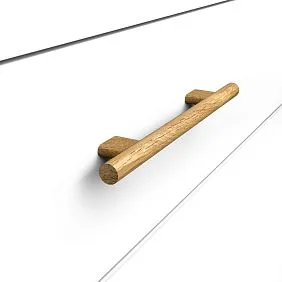
- Wooden handles - create a warm, natural atmosphere:
- Made from various types of wood: oak, beech, walnut, cherry, exotic species
- Can be coated with lacquer, oil, wax, or paint
- Density: from 400 kg/m³ (pine) to 900 kg/m³ (oak)
- Brinell hardness: from 1.5 (pine) to 4.5 (oak)
- Glass and crystal handles — an elegant choice for refined furniture:
- Create a sense of lightness and shine
- Can be transparent, matte, colored, or with internal decorative elements
- Compressive strength: 700–900 MPa (for tempered glass)
- Hardness on the Mohs scale: 5.5–6.5
- Ceramic handles — a unique blend of tradition and modernity:
- Can have hand-painted designs or glaze
- Resistant to fading and chemical exposure
- Compressive strength: 300–500 MPa
- Hardness on the Mohs scale: 7–8
- Plastic handles — lightweight and affordable:
- Wide color palette
- Resistance to moisture and household chemicals
- Tensile strength: 40–60 MPa (for ABS plastic)
- Hardness on Shore D scale: 65–85
- Combined handles — combine the advantages of different materials:
- Metal with leather insert
- Metal with wooden or ceramic insert
- Metal with glass or crystal elements
Material selection depends on interior style, furniture purpose, and budget. For example, lightweight plastic or wooden handles without sharp corners are optimal for children’s furniture, practical metal handles for kitchens, and elegant brass or crystal handles for classic-style bedrooms.
Stylistic Solutions: From Classic to Avant-Garde
Furniture handles play a key role in defining furniture style. Let’s consider what handles are characteristic of different stylistic directions:
- Classic style implies the use of:
- Brass handles with patina
- Items with floral ornament and scrolls
- Buttons with porcelain inserts
- Handles with antique motif imitation
Classic handle sizes are usually substantial: hinges 120–160 mm long, buttons 30–40 mm in diameter. This creates a sense of solidity and luxury.
- Contemporary style (modern) tends toward:
- Chrome or matte steel handles
- Minimalist geometric forms
- Profile integrated handles
- Push-to-open systems (without handles)
Modern handles usually have a minimalist design, clean lines, and neutral colors. Their dimensions are functional: hinges 96-128 mm long, 25-30 mm high.
- Scandinavian style prefers:
- Light-colored wooden handles
- Simple metal handles with matte finish
- Leather hinges
- Minimalist forms with emphasis on naturalness
Scandinavian handles are usually compact and functional: hinges 64-96 mm long, buttons 20-25 mm in diameter.
- Provence and country styles choose:
- Ceramic handles with hand-painted decoration
- Metal handles with aged effect
- Items with botanical motifs
- Wrought elements with patina
Provence-style handles usually have soft, rounded shapes and pastel shades. Sizes are medium: hinges 96-128 mm long, buttons 25-35 mm in diameter.
- Loft and industrial styles prefer:
- Rough metal handles
- Imitations of industrial details
- Aged steel or cast iron
- Minimalist forms with emphasis on functionality
Loft-style handles are usually bulky and rugged: hinges 128-192 mm long, with leg diameter 10-12 mm.
- High-tech prefers:
- Chrome or polished steel handles
- Aluminum Profile Systems
- Integrated facade solutions
- Electronic Opening Systems
High-tech handles are distinguished by their technological sophistication and innovation. Their shapes are dictated by functionality, and their dimensions are optimized for ease of use.
- Eco-style chooses:
- Handles made of unprocessed or minimally processed wood
- Items made from recycled materials
- Natural textures and shades
- Organic shapes inspired by nature
Eco handles usually have irregular, asymmetrical shapes, emphasizing their natural origin. Sizes vary depending on the design.
When choosing, where to buy furniture handles For a specific style, pay attention to specialized stores that offer collections designed by professional designers, taking into account all stylistic nuances.
Where to buy furniture handles: overview of options
When it's time to update furniture hardware, a natural question arises: where to buy furniture handlesWhich will meet all requirements of quality, style, and budget? Let's consider the main options with their advantages and disadvantages.
Specialized furniture hardware stores
Specialized stores are places where a wide variety of furniture hardware from different manufacturers and price categories is available.
Advantages:
- Professional consultation. Specialists will help you select handles perfectly matching your requirements and explain the features of different materials and mechanisms.
- The opportunity to see and "feel" the product before purchasing. This is especially important for furniture handles, where tactile sensations play a key role.
- Availability of samples and catalogs, allowing you to assess how handles will look on furniture of various styles and colors.
- Guarantee of product quality and authenticity. The reputation of a specialized store ensures you receive an original product, not a counterfeit.
- The opportunity to purchase everything needed in one place: handles, fasteners, installation tools.
Disadvantages:
- Prices may be higher than in online stores or at construction markets.
- Limited operating hours, requiring time to travel to the store.
The company "Stavros" offers a wide range furniture handles without coatingwhich can be painted or varnished according to your preferences. This allows creating truly unique elements that perfectly match your interior.
Online stores: convenience and wide selection
Online stores are becoming an increasingly popular place to buy furniture hardware due to convenience and wide selection.
Advantages:
- 24/7 availability. You can choose and order products at any convenient time, without leaving home.
- Wide assortment. Online stores are not limited by store space and can offer thousands of items.
- Convenient search and filtering. You can quickly find handles of the desired size, material, color, and price category.
- Delivery to your home or pickup point, saving your time.
- The opportunity to compare prices among different sellers to find the best offer.
Disadvantages:
- The inability to physically assess the quality and appearance of the product before purchase.
- The risk of receiving a product that does not match the description or photos.
- Delivery waiting time.
Many specialized stores, including "Stavros", have online presences where you can buy furniture handles with delivery. This combines the convenience of online shopping with the reliability of a well-known brand.
Construction and furniture hypermarkets
Large construction and furniture hypermarkets (Leroy Merlin, OBI, IKEA) also offer furniture handles in their assortment.
Advantages:
- Availability. Stores are present in most major cities and often operate without weekends.
- The opportunity to purchase handles along with other items for home repair or furnishing.
- Availability of budget options for those seeking an economical solution.
- Convenient return and exchange conditions if the item does not suit you.
Disadvantages:
- Limited assortment, especially in the premium and designer models segment.
- Not always high-quality consultations on specific issues.
- Standardized approach, few unique solutions.
Discount stores are suitable for purchasing basic models of mass-produced furniture handles, but for finding exclusive or high-quality items, it is better to visit specialized stores.
Furniture factories and hardware manufacturers
Some furniture factories and hardware manufacturers work directly with end consumers, offering their products without intermediaries.
Advantages:
- Guarantee of authenticity and quality of the product from the manufacturer.
- Ability to order non-standard solutions or modifications of existing models.
- Professional technical support and consultations from developers.
- Often lower prices due to the absence of intermediary markup.
Disadvantages:
- Limited assortment (only products of this manufacturer).
- Often work only with wholesale orders or set a minimum order amount.
- Not always convenient location of offices and warehouses.
For large projects (e.g., furnishing an entire house), direct cooperation with manufacturers may be the optimal solution in terms of price and quality.
Criteria for selecting a reliable supplier
Regardless of the fact, where to buy furniture handles - in a physical store or online - it is important to evaluate the supplier's reliability based on the following criteria:
- Reputation and experience. Verified companies with long-standing experience typically value their reputation and offer quality products and services.
- Product range. A wide selection indicates a serious business approach and allows you to choose the optimal solution for your tasks.
- Presence of quality certificates for products. Especially important for functional hardware, as it affects the safety and durability of furniture.
- Warranty and return conditions. A reliable supplier always provides clear warranty obligations and has a transparent return policy.
- Quality of consultations. Professional consultants will help select the optimal solution and provide all necessary technical information.
- Customer reviews. Study reviews on independent platforms to form an objective opinion about the supplier.
- Additional services (delivery, installation, technical support) may become a decisive factor when choosing a supplier.
How to choose the perfect furniture handles for your interior
Choosing furniture handles is not just a technical issue, but an important design decision that can radically change the appearance of furniture and the entire interior.
Matching the style of the interior and furniture
Furniture handles should harmonize with the overall style of the interior and the specific piece of furniture they are installed on.
Tips for Selection:
- Study the features of your interior's style and the types of hardware characteristic of it. For example, classic style features brass handles with patina, while Scandinavian style features simple wooden or metal handles.
- Consider the material and color of the furniture. Handles can either match the furniture (e.g., wooden handles of the same shade as the fronts) or contrast with it (e.g., black metal handles on white furniture).
- Maintain stylistic unity within a single room. Even if the furniture is different, handles of the same style will create a visual connection between the pieces.
- Do not be afraid to experiment with unusual combinations, but do so consciously. For example, vintage handles on modern furniture can create an interesting eclectic look.
Practical aspects: size, ergonomics, ease of use
In addition to aesthetic qualities, furniture handles must be functional and easy to use.
Recommendations:
- Choose handle size proportionally to the size of the furniture. For large cabinets, handles 128-192 mm long are suitable, for small drawers - 64-96 mm or buttons with a diameter of 20-30 mm.
- Consider the frequency of use. For frequently used elements (kitchen cabinets, wardrobes), choose ergonomic handles with a comfortable grip; for rarely used items (decorative chests, display cases), you may prefer design.
- Pay attention to the protrusion of the handle from the front surface. The optimal protrusion for comfortable grip is 25-35 mm.
- Consider the characteristics of users. For children's furniture, choose safe handles without sharp edges; for furniture used by elderly people, choose large handles with a comfortable grip.
- Check the ease of use before purchasing. If possible, "try on" the handle and assess how comfortable it feels in your hand.
Technical parameters: materials, coatings, fasteners
The technical characteristics of furniture handles determine their durability, reliability, and appearance during use.
What to pay attention to:
- The material used must match the operating conditions. For humid areas (kitchen, bathroom), choose moisture-resistant materials: stainless steel, brass with protective coating, quality plastic.
- The quality of the coating affects the longevity of the appearance. Preferred:
- Multi-layer electroplating (chrome, nickel) thickness 12-15 microns
- Powder coating with pre-phosphatization
- Anodizing of aluminum (layer thickness 15-20 microns)
- Quality lacquering of wood (polyurethane or acrylic lacquers)
- The mounting system must ensure secure fixation of the handle. Pay attention to:
- Material of mounting elements (preferably stainless steel)
- Presence of lock washers or nuts to prevent self-unthreading
- Length of mounting screws corresponding to the facade thickness
- Center-to-center distance (for handle brackets) must match existing holes in the facade or allow drilling new ones. Standard center-to-center distances: 16, 32, 64, 96, 128, 160, 192, 224, 256, 320 mm.
Budget considerations: price-to-quality ratio
Furniture handles are available on the market in a wide price range — from budget models for 50-100 rubles to exclusive designer items costing several thousand rubles each.
Budget optimization recommendations:
- Invest in quality for frequently used elements. For kitchen cabinets, entryway furniture, and wardrobes, choose quality handles from reputable manufacturers.
- Save on rarely used elements. For decorative chests, display cases, and seasonal cabinets, you can choose more affordable options.
- Consider restoring old handles instead of buying new ones. Many metal handles can be polished, repainted, or given a patina.
- Look for sales and special offers. Many stores regularly hold promotions during which you can purchase quality handles at significant discounts.
- Compare prices among different sellers. The same model may cost differently in different stores.
- Consider bulk purchasing, especially if you need a large quantity of identical handles. Many suppliers offer discounts when buying 10-20 pieces or more.
Installing and replacing furniture handles: practical guide
Installing or replacing furniture handles is a relatively simple task that can be done yourself with a minimal set of tools and basic skills.
Required Tools and Materials
To successfully install furniture handles, you will need:
Basic tools:
- Drill or screwdriver
- Wood drill bits with diameter 4-5 mm (depending on the diameter of mounting screws)
- Tape measure or ruler for measurements
- Pencil for marking
- Screwdriver (cross or flathead, depending on the type of fastener)
- Template for marking holes (can be made yourself or purchased ready-made)
Additional tools:
- Level for checking horizontal alignment
- Painter’s tape to protect surfaces from accidental scratches
- File for finishing holes if needed
- Center finder for accurately determining the center of the facade
Consumables:
- Mounting screws (usually supplied with handles)
- Mounting anchors for handles (if the facade thickness is less than the screw length)
- Nuts (if holes in the facade are larger than the screw head diameter)
- Wood glue (for fixing dowels)
Step-by-step instructions for installing new handles
Installation of hook handles:
- Determine the position of the handle on the facade. Usually, handles are placed horizontally at the center of the facade and at 1/3 of the height from the top edge for upper cabinets or at 1/3 of the height from the bottom edge for lower cabinets.
- Make markings. Use a template or ruler to accurately determine the position of the holes. The distance between holes should match the center-to-center distance of the handle.
- Protect the surface with painter's tape at drilling locations to avoid scratches.
- Drill holes with a diameter matching the screw diameter (usually 4-5 mm). Drill perpendicular to the facade surface.
- Insert screws from the inside of the facade.
- Thread the handle onto the protruding screws and tighten until it is snug against the facade, but do not over-tighten to avoid damaging the facade or handle.
Installation of button handles:
- Determine the position of the button on the facade (usually centered).
- Mark the hole location.
- Protect the surface with painter's tape.
- Drill a hole with a diameter matching the screw diameter.
- Insert the screw from the inside of the facade.
- Thread the button onto the protruding screw and tighten.
Installation of inset handles:
- Determine the position of the handle on the facade.
- Mark the outline of the cutout using the template (usually included with the handle).
- Drill a hole within the outline to accommodate the jigsaw.
- Cut out the hole along the marked outline using a jigsaw or router.
- Sand the edges of the cutout with sandpaper.
- Insert the handle into the cutout and secure it with screws from the inside of the facade.
Replacing old handles: features and nuances
Replacing old handles has its own features, especially if you are changing the type of handles or their center-to-center distance.
If the new handles have the same center-to-center distance:
- Unscrew the old handles and keep the hardware if it is in good condition and suitable for the new handles.
- Check the condition of the holes. If they are loose or damaged, you can:
- Fill them with wooden dowels or putty and drill again
- Use repair plates that cover the old holes and provide a new surface for mounting
- Install new handles using existing holes.
If the new handles have a different center-to-center distance:
- Remove the old handles.
- Fill the old holes with wooden dowels, spackle, or special plugs.
- After drying, sand the repaired areas until smooth.
- If necessary, repaint or varnish the repaired areas.
- Mark the positions for the new holes.
- Drill the new holes and install the handles as instructed above.
If you are changing the type of handles (e.g., from a knob to a button):
- Remove the old handles.
- Fill all old holes as described above.
- Mark the positions for the new type of handles.
- Drill the new holes and install the handles.
Professional Tips: How to Achieve a Perfect Result
Experienced craftsmen share secrets that will help you achieve a professional result when installing furniture handles:
- Use templates for marking. This is especially important when installing multiple identical handles to ensure uniformity.
- Drill in two stages: first with a small drill bit (2-3 mm) for accuracy, then enlarge the hole to the required diameter.
- Drill from the back of the facade through an already drilled hole to avoid chipping on the front surface.
- Use a drill depth stop to avoid drilling through the facade if not required.
- Check the horizontal and vertical alignment of the handles using a level.
- Do not overtighten the fasteners to avoid damaging the facade or handle. A snug fit without excessive force is sufficient.
- Use special drill bits with torque limiters when working with delicate materials.
- Test the handle after installation: it should rotate freely (for turn handles) or securely lock (for stationary handles).
Trends and Innovations in the World of Furniture Handles
The world of furniture handles is constantly evolving, reflecting general interior design trends and technological innovations. Let's consider what is current today and what awaits us in the future.
Modern Trends in Furniture Handle Design
- Minimalism and Hidden Solutions
The trend toward invisible hardware continues to develop:
- Push-to-open systems
- Handles integrated into the facade profile
- J-shaped handles forming a grip on the back of the facade
- Milled recesses instead of traditional handles
This trend is especially relevant for modern interiors in minimalist, high-tech, and Scandinavian styles.
- Return to craft traditions
Alongside minimalism, a trend toward unique, handcrafted hardware is developing:
- Forged handles with individual design
- Handmade ceramic and glass handles
- Wooden handles with carving or inlay
- Handles with patina and aged effect
This trend reflects the general desire for interior individualization and the value of handcrafted work.
- Material Mixing
Modern handles often combine various materials:
- Metal and wood (e.g., aluminum base with wooden insert)
- Metal and leather (metal handles with leather inserts or wrapping)
- Metal and stone or ceramic (metal base with marble, granite, or ceramic inserts)
- Metal and glass or crystals (metal base with decorative glass elements)
Such combinations allow creating unique textural and color combinations, adding depth and interest to the design.
- Color experiments
If previously furniture handles were predominantly metallic in color, the palette has now significantly expanded:
- Matte black finishes (especially popular in modern interiors)
- Vibrant colored finishes (from pastel to saturated shades)
- Gradient and multi-color solutions
- Bronze-, copper-, or gold-tone finishes in various shades
Colored handles are becoming accent elements that can support the overall interior color scheme or create a striking contrast.
- Ergonomics and inclusive design
Increasing attention is being paid to the usability of furniture handles for all user groups:
- Handles with anti-slip coating
- Ergonomic shapes considering hand anatomy
- Enlarged sizes for easier grip by people with limited mobility
- Tactile indicators for visually impaired users
This trend reflects the general movement toward inclusive design, taking into account the needs of all users.
Technological innovations: "smart" handles and new materials
Technological progress is not bypassing even such seemingly conservative areas as furniture handles:
- "Smart" opening systems
- Electromechanical systems that open facades with a light touch
- Sensory handles that respond to hand proximity
- Opening systems via voice commands
- Integration with "smart home" systems
Such solutions not only add comfort but also allow creating fully handle-free facades while maintaining ease of use.
- Innovative materials
- Bio-composites based on plant fibers and resins
- Recycled plastics with enhanced properties
- Ultra-lightweight aerospace-grade metal alloys
- Antibacterial coatings with silver ions
- Self-cleaning surfaces with nano-coating
These materials are not only eco-friendly but also feature enhanced properties of strength, durability, and hygiene.
- Modular and customizable systems
- Handles with interchangeable decorative elements
- Systems allowing adjustment of handle length to match specific facade
- Handles with adjustable protrusion from facade surface
- Combination elements for creating unique compositions
These solutions allow easily updating the furniture's appearance without fully replacing hardware.
- Integration of Additional Functions
- Handles with built-in LED lighting
- Handles with integrated USB ports for device charging
- Handles with status indication function (e.g., lighting indicating that the cabinet is open)
- Handles with built-in sensors (temperature, humidity)
These innovations add new functions to furniture handles, going beyond traditional purposes.