












































































Article Contents:
- Why wood? Arguments in favor of natural material
- What types of wood are used for handles?
- Types of wooden furniture handles: complete breakdown
- Bracket handles
- Button Handles
- Recessed handles
- Profile and shell handles
- Wooden door handle: selection features
- What is important to consider when choosing a door handle?
- Style and interior
- Wooden handles for the kitchen: selection nuances
- Humidity and Temperature
- Form factor for kitchen fronts
- Color and finish
- How to properly choose a wooden handle: step-by-step guide
- Step 1: Determine the type of mounting
- Step 2: Assess the size of the front
- Step 3: Determine Interior Style
- Step 4: Resolve the coverage issue
- Step 5: Calculate the quantity
- Installation of wooden handles: from theory to practice
- Installation Tools
- Work sequence
- Self-finishing of unpainted handles
- Wooden handles in different interior styles
- Scandinavian Style
- Classic and neoclassic
- Provence and Country Style
- Minimalism and High-Tech
- Eco-style and biophilia
- Care for wooden handles: simple rules for longevity
- Wooden handle price: what affects the cost?
- Collections and models: which handle to choose from the catalog?
- Palmer HL-054 — universal minimalist
- Wave HL-006 — rhythm and movement
- Twist HL-020 — spiral of character
- Button HL-036 and ORB HL-002 — buttons for small forms
- Duet HL-018.1 — for those who love scale
- Heart HL-045 and Star HL-044 — with character
- Where to buy wooden handles: tips for choosing a supplier
- In conclusion: wood as a choice for years to come
- FAQ: Answers to Popular Questions
- About the Company STAVROS
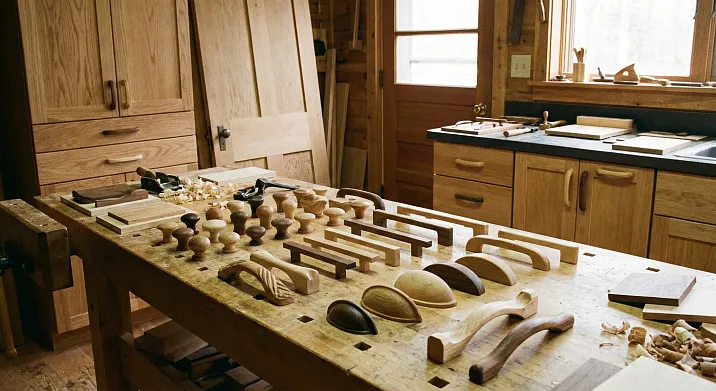
There are details that don't catch the eye at first glance, but they are the ones that decide everything. Not the wall color, not the sofa shape, not the expensive parquet — but the small detail on a cabinet door, on a dresser drawer, on a kitchen cabinet front.Furniture Handles— it's the finishing touch that accents the interior as precisely as a period at the end of a complex sentence. Remove it — and the meaning is lost.
A wooden handle is not just hardware. It's a philosophy. A philosophy of naturalness, warmth, durability, and timeless style. In this article, we'll cover everything: what types of wooden handles exist, how to choose them correctly for kitchens, doors, and furniture, which wood species are best suited, how to install and maintain them. And — most importantly — how to avoid making a mistake in your choice so you won't regret your decision ten years later.


Why wood? Arguments in favor of natural material
The furniture hardware market today offers thousands of options: metal, plastic, glass, ceramic, zinc alloys. And yet, specificallywooden furniture handlesremain consistently in demand — and this is no coincidence.
First, wood is a living material. Touching a natural surface feels different than touching cold metal or faceless plastic. A wooden handle is warm to the touch, it doesn't slip, doesn't burn in the heat, and doesn't feel cold in winter. It's that tactile comfort that can't be conveyed in a description but is immediately felt upon first touch.
Second, wood is eco-friendly. In an era when people are paying more attention to what surrounds them in their homes, a natural material without harmful emissions and synthetic impurities becomes an obvious choice. This is especially important for children's rooms, bedrooms, and kitchen areas — places where people spend most of their time.
Third — aesthetics. The natural texture of wood has its own pattern, which cannot be replicated twice. Each piece is unique.Wooden handlebrings vitality, depth, and that special character to the interior that distinguishes real design from a mere set of furniture.




Which wood species are used for handles?
Not every wood is equally suitable for producing furniture hardware. Here, hardness, uniformity of structure, resistance to wear, and good workability are important. Let's look at the main species:
Beech. This is a classic among furniture woods. Beech is distinguished by high density, fine-grained structure, and excellent workability. Beech handles hold their shape perfectly, don't crack over time, and accept any type of finish well — from enamel to clear varnish. It is most often from beech that handles for kitchens and cabinet furniture are made, where durability is important.
Oak. If beech is reliability, then oak is character. Pronounced natural texture, noble grain pattern, high strength, and load resistance. OakWooden handlesare especially effective under semi-transparent finishes: oil or tinting allows the full beauty of the wood's natural pattern to be revealed. Oak is the choice of those who value aesthetics and don't compromise on quality.
Ash and walnut. Rarer but no less worthy species. Ash is light and dense — ideal for Scandinavian and minimalist styles. Walnut is dark, with a rich pattern — creates a sense of luxury and solidity. Used primarily in designer and custom projects.
Pine. A softer species, suitable for products in rustic, rural, or country style. Easy to work with, it accepts staining and painting well, although it is less resistant to mechanical damage.
When choosing a species, always consider where the handle will be used: for kitchens with high humidity, hard and dense species with quality finishes are preferable; for bedrooms and living rooms, you can allow yourself rarer and more expressive options.
Our factory also produces:




Types of wooden furniture handles: a complete breakdown
Understanding which handle you need means saving time, money, and nerves. The variety of shapes is huge, but it all comes down to a few basic types. Each has its own function, its place in the interior, and its logic of application.
Get Consultation
Pull handles (bail handles)
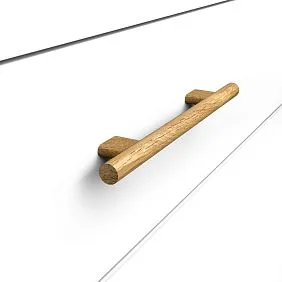
Perhaps the most classic and universal type. U-shaped form, two mounting points, comfortable grip.Wooden long handlesof the bail type — this is the ideal solution for large cabinet fronts and hinged doors. They can be installed both horizontally and vertically, adding flexibility in design.
Long bail handles from 250 to 1050 mm — this is no longer just hardware, it's an architectural accent. They visually lengthen the facade, give furniture a modern look, and make using large cabinets more convenient. Especially relevant for kitchen columns, built-in cabinets in hallways, and wardrobe systems.
Button Handles
Compact and concise — knob handles are good where a large bail would be excessive. Ideal for small drawers, nightstands, and narrow doors.Round wooden handlein the form of a button — this is minimalist classic. One mounting point, no extra geometry, just the essence.
Such handles are especially organic in children's rooms, where there are no sharp protruding corners. They are also good in Scandinavian, Japanese, and eco-style interiors, where every element follows the principle 'less is more'.
Recessed handles
A type that is particularly gaining popularity in modern design.Wooden recessed handles— these are handles that are set into the facade. They do not protrude above the furniture surface, creating a completely smooth, solid plane. This is the perfect solution for modern kitchens in high-tech, minimalist, or fusion styles.
A recessed handle requires more complex installation — a groove must be cut into the facade. But the result is worth it: the furniture acquires an almost sculptural appearance, without unnecessary details and protrusions. Such handles look especially impressive on facades made of natural wood or veneer.
Profile and shell handles
Shell handles — with smooth rounded edges — belong to the type of overlay handles with a recessed grip. Fingers slide under the slightly raised edge of the product — this is both convenient and elegant. Suitable for dressers, bedside tables, writing desks.
Profile handles — elongated, with straight lines — create a sense of clarity and modernity. If you are decorating a kitchen in loft, neoclassical, or contemporary art style, profile handles will help create the desired geometry.
Wooden door handle: selection features
A door handle is an element that works differently than a furniture handle. It is subjected to significantly more intense load: thousands of touches per year, opening and closing, sometimes exposure to moisture. Therefore, the choice ofwooden door handlemust be approached especially responsibly.
What is important to consider when choosing a door handle?
Wood species. For doors, hardwoods — oak and beech — are preferred. They withstand daily use without losing shape and appearance. Softwoods (pine, linden) are acceptable for decorative interior doors, but not for entrance groups.
Type of coating.wooden door handlewithout protective coating will quickly darken, accumulate dirt, and lose appearance. High-quality varnish, oil, or professional enamel are mandatory conditions for durability. The coating should be not only decorative but also functional: protect against moisture, abrasion, and temperature fluctuations.
Shape and ergonomics. A door handle should fit comfortably in the hand. Too thin or, conversely, too massive creates discomfort with frequent use. The ideal diameter of a cylindrical profile is 20–30 mm. Length for a single-leaf door — from 300 mm, for a double-leaf door — depending on the situation.
Installation. For interior and cabinet doors, both brackets with two mounting points and recessed options are suitable. For sliding wardrobes and sliding systems — special profile handles with vertical placement.
Style and interior
A wooden handle on a door is a semantic and aesthetic marker. It speaks about the style of the entire room even before a person crosses the threshold. A laconic beech bracket with a matte finish speaks of minimalism. A dark oak handle with rounded edges — of classic. An asymmetrical geometric shape with transparent oil — of modern eco-design.
It's a small detail with a big voice. And that's why it should be chosen as consciously as a painting on the wall or flooring.
Wooden handles for the kitchen: selection nuances
The kitchen is the most active place in the house. Here, something is constantly being opened, closed, cooked, cleaned. Kitchen hardware should not only look beautiful but also work year after year without fail. Let's figure out how to chooseWooden handlesspecifically for the kitchen space.
Humidity and temperature
In the kitchen — high humidity, steam, temperature fluctuations. Wooden handles for the kitchen must have reliable protective coating. The best option is professional enamel or special varnish with water-resistant properties. Natural oil is also suitable but requires periodic renewal.
Beech handles for the kitchen — the optimal choice in terms of price/quality ratio. Beech is dense, non-porous, accepts any coating well, and does not swell upon contact with moisture if there is high-quality finishing.
Form factor for kitchen facades
Most commonly used in the kitchen:
-
Long horizontal brackets — for upper and lower horizontally opening fronts
-
Medium-length vertical brackets — for columns and tall cabinets
-
Push handles — for compact sections and drawers with small items
-
Recessed handles — for kitchens in minimalist style, where surface cleanliness is important
It is important that all handles in the kitchen are made in a unified style and preferably from the same collection. This creates visual integrity and a sense of professionally executed interior.
Color and finish
buy wooden handlesfor the kitchen can be either in ready-painted form or in natural — for self-finishing. Four universal basic colors: black, white, brown, and clear coating — these are what suit most modern kitchen sets.
Black wooden handles create a clear graphic accent on light fronts — this is one of the most relevant trends in recent years. White ones — blend with the front, creating a monochrome textural play. Natural wood with clear varnish — warm classic that never goes out of style.
How to choose a wooden handle correctly: step-by-step guide
Choosing a handle is not just a matter of taste. It is a matter of functionality, compatibility with furniture, and technical literacy. Here is a step-by-step algorithm that will help you avoid mistakes.
Step 1: Determine the type of mounting
Standard mounting of furniture handles is through, through the front, using metal screws. The distance between mounting points (center-to-center distance) is the key parameter. The most common: 32, 64, 96, 128, 160, 192, 224 mm. Clarify this value in advance so that the new handle fits without modifications.
Recessed handles require milling a groove — this is a separate technological operation, which is better entrusted to a specialist.
Step 2: Assess the size of the front
Small drawer — small push handle or bracket up to 96 mm. Medium front — bracket 128–192 mm. Large cabinet or tall door — long handle from 300 mm.Wooden Handleshould be proportional to the front: too small gets lost, too large overwhelms and disrupts the balance.
Step 3: Determine the interior style
Again — not just 'like'. Specifically the style:
-
Scandinavian minimalism — simple geometric shapes, beech, light tones
-
Classic and neoclassic — brackets with curved profile, oak, dark finishes
-
Loft and industrial — contrasting combinations, dark wood on white fronts
-
Provence and country — shell-shaped handles, warm natural shades
-
High-tech and minimalism — recessed handles or long profile brackets
Step 4: Decide on the finish
Ready-painted handle — convenient and quick. Butunfinished wooden handlesoffer a fundamentally different freedom. You choose the color, type of finish, and degree of gloss yourself. This is especially valuable if your kitchen set or furniture has a non-standard shade that is difficult to match in the catalog.
Step 5: Calculate the quantity
Wooden handle set— this is not just convenience when ordering, but also a guarantee of visual uniformity. Take handles from the same batch or series so that the wood shade is as identical as possible. Count the number of fronts in advance, adding 5–10% reserve in case of mechanical damage during installation.
Installing wooden handles: from theory to practice
Installation is the final stage. It should be done carefully, without rushing. A mistake when drilling a hole will be costly: a new facade is much more expensive than five minutes of careful work.
Tools for installation
-
Electric drill or screwdriver
-
Wood drill bits of suitable diameter (usually 4–5 mm)
-
Template for marking holes
-
Metal screws (typically included in the kit)
-
Pencil, tape measure, spirit level
Work sequence
-
Mark the handle installation location. Use a template — this will save time and prevent mistakes.
-
Drill through holes in the facade from the front side. Use a drill bit slightly smaller in diameter than the screw.
-
Insert the screws from inside the facade. Attach the handle from the outside.
-
Tighten the screws evenly, without overtightening — wood does not like excessive force.
-
Check the handle position with a level.
If installingWooden recessed handles, first rout a groove according to the precise drawing. The depth and width of the groove must exactly match the product parameters.
Self-finishing of unpainted handles
If you purchased handles without a finish, the treatment sequence is as follows:
-
Remove dust from the surface after sanding with a soft cloth or brush
-
Apply primer in an even layer
-
After the primer has completely dried, lightly sand the surface to improve adhesion
-
Apply the finish coating — varnish or enamel in 2 coats with intercoat drying
This technique ensures a smooth, professional finish without drips or unevenness.
Wooden handles in different interior styles
The same handle can look completely different depending on its surroundings. Context is everything. Let's see howwooden furniture handleswork in different styles.
Scandinavian style
Light wood, white facades, simple geometric shapes. Here, a button handle or a short beech bracket with a clear finish creates exactly the atmosphere commonly referred to as 'hygge'. No excess, only function and purity of lines.
Classicism and neoclassicism
In this style, handles can be more ornate — with a curved profile, a darker wood tone. Oak or walnut with a dark stain pairs beautifully with furniture made of natural veneer or solid wood. Bracket handles with decorative posts are a hallmark of classic interiors.
Provence and country
Here, handles with rounded, soft shapes are appropriate — shells, oval buttons, small brackets with warm natural finishes. No sharp corners or strict geometry. Pine or light beech with a milky or cream finish is a perfect match for the style.
Minimalism and High-Tech
Recessed or long profile handles, maximally smooth surfaces, monochrome colors — black, white, natural. Here, the handle should literally disappear, blending with the facade, or, conversely, be a clear contrasting accent.
Eco-style and biophilia
One of the most relevant trends in recent years. Natural materials, organic textures, fluid forms. A wooden handle here is not an addition, but a full-fledged element of the concept. Solid wood handles without a finish or with natural oil — the perfect aesthetic for this direction.
Wooden Handle Care: Simple Rules for Longevity
A wooden handle is not a demanding interior element, but some rules are still worth following.
Regular cleaning. A soft, damp cloth is sufficient. No abrasive cleaners, stiff brushes, or harsh chemicals. Wooden surfaces do not like harsh treatment.
Protection from constant moisture. If the handle is located in the kitchen area near the sink, periodically check the condition of the finish. At the first signs of peeling, renew the protective layer.
Refinishing. If handles are used intensively, it makes sense to renew the finish every few years. This is not difficult and takes minimal time, but restores the original appearance.
Avoid prolonged contact with water. A wooden handle is not metal. A puddle of water left on the surface gradually damages the finish. Wipe dry.
If you follow these simple rules, a wooden handle will last for decades and will look just as dignified as on the day it was installed.
Wooden handle price: what affects the cost?
The question of price is always relevant.Wooden handle pricedepends on several factors that are worth understanding when choosing.
Wood species. Oak handles are traditionally more expensive than beech ones—this is a more valuable wood with more complex processing. Exotic species (walnut, ash) are even more expensive.
Production method. Products made by 3D milling on professional equipment cost more than mass-produced blanks. But the quality of geometry, precision of forms, and surface clarity are fundamentally different.
Quality of sanding. Hand sanding ("Prestige" category) costs more than machine sanding ("Standard"), but provides a perfectly smooth surface without the need for additional work. For products under varnish or oil, this is a fundamentally important parameter.
Presence of finish. Ready-painted handles are more expensive than unpainted ones—due to the cost of professional painting. But they are more convenient for installation: they do not require time for self-finishing.
Size and complexity of shape. Long handles and complex geometric shapes cost more than simple knobs and short pulls.
The STAVROS catalog features models from 400 rubles per unit (models like Proun, Palmer in the minimum size) to 3,050 rubles and above for large exclusive models with hand sanding. This is an honest price range for products made from solid natural wood, manufactured with a high level of quality.
Collections and models: which handle to choose from the catalog?
A rich assortment is wonderful, but sometimes it creates confusion. Let's look at several of the most interesting models to provide a practical guide.
Palmer HL-054 — the universal minimalist
ThisWooden Handlein the form of a pull with a cylindrical profile—the embodiment of conciseness. Four sizes: from 250 to 1050 mm. Suitable both horizontally and vertically. Mounted with metal screws included. Supplied unfinished—for maximum finishing freedom. This is one of the most versatile models in the catalog: suitable for kitchens, cabinets, wardrobes, doors.
Wave HL-006 — rhythm and movement
Curved shape, reminiscent of a wave. Creates a sense of dynamism and liveliness. Suitable for interiors where you want to move away from strict geometry and introduce organic elements. Price — from 830 rubles.
Twist HL-020 — spiral of character
Twisted shape with a pronounced pattern—a handle for those not afraid of bold decisions. Suitable for accent furniture where the handle is part of the design concept.
Button HL-036 and ORB HL-002 — knobs for small forms
Compact, concise, functional.Round wooden handlein the version of a knob or sphere—ideal for cabinets, bedside drawers, children's dressers. Price — from 630 rubles.
Duet HL-018.1 — for those who love scale
Large, impressive handle for large fronts. Double grip, complex geometry, pronounced design character. Price — from 3,050 rubles. This is no longer just hardware; it's a sculptural object on your furniture.
Heart HL-045 and Star HL-044 — with character
Decorative shapes — heart and star — for children's rooms, boutiques, cafes, creative workshops. Sometimes a handle is not a function, but a story. And these models know how to tell stories.
Where to buy wooden handles: tips for choosing a supplier
When buying furniture hardware, it's important to understand: you're not looking at consumable materials that can be replaced in six months. Handles are parts that should work for a long time and look dignified. Therefore, choosing a supplier should be taken seriously.
Several key criteria:
Manufacturing, not reselling. A manufacturer controls quality at every stage — from raw material selection to packaging. A reseller lacks this control.
Stock availability. If you need handles urgently, a supplier with goods in stock is indispensable. Waiting several weeks for a production cycle for a small order is not rational.
Order from one piece. For private clients and small projects, flexibility is important. A minimum order quantity of one unit is a sign of respect for the client.
Delivery across the entire country. Quality hardware should be accessible not only to residents of the capital. A reliable supplier works with transport companies to any region.
Quality guarantee. Products without complaints are an indicator of mature production. Not the quantity of the assortment, but the flawlessness of each item.
In conclusion: wood as a choice for years to come
A wooden furniture handle is an investment in interior quality. Not because it's expensive, but because it lasts a long time, looks good, and carries the warmth of natural material.
Choosing the right handle is a combination of practical knowledge and design flair. Know the parameters of your furniture, understand the interior style, don't skimp on the quality of the wood species and finish — and the result won't disappoint you.
FAQ: Answers to popular questions
Which wood species is best to choose for kitchen handles?
For kitchens, beech and oak are optimal. Beech is dense, non-porous, and holds finishes well. Oak is more expressive in texture and also has high strength. Both options are excellent for high humidity conditions with a quality finish layer.
Can you paint wooden handles yourself?
Yes. Unfinished handles are specifically designed for self-finishing. Sequence: dust removal, priming, sanding, final layer of varnish or enamel in 2 coats. It's not difficult and allows you to achieve a finish of the desired color and texture.
What is the center-to-center distance and how to measure it?
Center-to-center distance is the distance between the centers of two mounting holes of a bracket. Measured from center to center. Before purchasing, measure the existing holes in the facade or clarify the parameter with the furniture manufacturer.
Can wooden handles be used in the bathroom?
With caveats — yes. Provided there is a quality moisture-resistant finish and good ventilation. For constantly damp rooms, a finish based on yacht varnish or polyurethane composition is recommended.
How quickly are handles delivered from stock?
Items available in stock are shipped within 3 business days. If an item is out of stock — the average production time is 5–10 business days. Delivery is carried out by transport companies throughout Russia and CIS countries.
Can handles of non-standard size be ordered?
Yes, with a production run, it is possible to manufacture products according to individual projects and non-standard sizes. Details are clarified with the manager.
Are there handles with a ready-made finish?
Yes. The catalog features four ready-made colors: black, white, brown, and clear finish. This is convenient for those who want to save time and get a result ready for installation.
What is the minimum order?
Orders are accepted from one piece. This is convenient both for private clients and for designers working on individual projects.
What is the difference between 'Standard' and 'Prestige' sanding?
"Standard" — machine sanding with good results at an affordable price. "Prestige" — detailed manual sanding: the surface is absolutely ready for coating application without additional preparation. For products under transparent varnish or oil, "Prestige" is recommended.
Is a design project needed for an order?
For large orders — preferably. For small batches, the manager will help select the required items based on the description. Product drawings can be downloaded from the website.
About the company STAVROS
Behind every wooden handle in the catalog lies a story that began in 2002 in a small creative workshop in St. Petersburg. Two artists — Andrey Ragozin and Evgeny Tsapko — started with carved wooden products and quickly reached a serious level: reconstruction of the Konstantinovsky Palace in Strelna, work with the Hermitage, Alexander Palace, Trinity-Izmailovsky Cathedral, Sheremetev Mansion.
Today STAVROS is a full-cycle manufacturer with showrooms in St. Petersburg and Moscow, a stock program from a single piece, delivery throughout Russia and CIS countries. For over twenty years, the company has been creating products from natural wood with an impeccable level of detail.
STAVROS furniture handles are produced using 3D milling from beech and oak, undergo quality control at every stage, and are supplied with a no-claims guarantee. A wide stock program, flexible ordering conditions, professional consultation — these are not just words, this is the daily practice of a company that does its work with full dedication.
ChoosingFurniture HandlesWith STAVROS, you are not just choosing hardware. You are choosing quality that is immediately visible — and quality that does not disappoint over the years.


