Article Contents:
- Why Furniture Legs Are More Than Just Support
- Functional Value: Not Just Support
- Aesthetic Value: How Legs Change the Perception of Furniture
- Historical Overview: The Evolution of Furniture Legs Through the Centuries
- Variety of Furniture Legs: Materials, Shapes, Styles
- Materials of Manufacture: From Classic to Innovations
- Shapes and Design: From Classic to Avant-Garde
- Stylistic Solutions: Choosing Legs to Match the Interior
- Where to Buy Furniture Legs: Overview of Options
- Specialized Stores: Advantages of a Professional Approach
- Online Stores: Convenience and Wide Selection
- Furniture Factories and Manufacturers
- Construction Hypermarkets and DIY Centers
- Master carpenters and woodworking workshops
- Criteria for Choosing a Reliable Supplier
- Practical Aspects of Choosing and Installing Furniture Legs
- Technical Specifications: What to Pay Attention to When Choosing
- Compatibility with Different Types of Furniture and Floor Coverings
- Tools and materials for installation
- Step-by-Step Guide to Installing Different Types of Legs
- Common Mistakes When Choosing and Installing: How to Avoid Them
- Creative Ideas for Using Furniture Legs
- Updating Old Furniture: Giving Favorite Items a Second Life
- DIY Projects: Creating Unique Furniture Yourself
- Unconventional Uses: From Decoration to Functional Elements
- Conclusion: How Proper Legs Transform Furniture and the Interior

Have you ever wondered why some furniture looks finished and elegant, while others seem lacking something? Why do some sofas and chairs serve for decades, while others quickly lose their shape and appeal? The secret often lies in details we rarely notice, but which play a decisive role in the overall impression and functionality. Furniture legs are exactly such a detail: small, yet incredibly important. But where to buy furniture legsthat not only perform their function but also become a true decoration for your furniture? Let's explore this question and learn how to properly choose this important element for your interior.


Why Furniture Legs Are More Than Just Support
Many consider furniture legs purely functional elements, but this is a deep misconception. These small details can radically change the appearance of furniture, its ergonomics, and even its lifespan.




Functional Value: Not Just Support
Furniture legs perform several important functions, which we rarely think about:
- Protection from moisture and damage. By elevating furniture off the floor, legs create an air gap that protects against accidental spills, condensation, and damp mopping. This is especially important for wooden furniture, which is sensitive to moisture. Just 10-15 cm of height can reduce the risk of damage by 70%.
- Even load distribution. Quality furniture legs distribute the weight of the furniture and any objects or people on it in such a way as to minimize frame deformation. For example, a sofa on properly selected legs can withstand 30% more load without losing its shape.
- Shock absorption and reduced floor load. Modern furniture legs are often equipped with shock-absorbing elements that absorb vibrations and reduce pressure on flooring. This is especially important for parquet and laminate, which can be damaged by point loading.
- Height adjustment and leveling. Many modern models are equipped with adjustment systems that compensate for floor unevenness. Even a small height difference of 2-3 mm can cause furniture to rock, leading to discomfort and premature wear.
- Furniture mobility. Legs with casters or wheels allow easy movement of even heavy items, simplifying cleaning and rearrangement. Modern polyurethane-coated casters can support up to 70-80 kg each without damaging flooring.
Our factory also produces:


Aesthetic value: how legs change the perception of furniture
Visual impact of furniture legs is often underestimated, and for good reason. They are capable of:
- Creating an illusion of lightness and airiness. Tall, slender legs visually "lighten" heavy furniture, making interiors appear more spacious. Studies in visual perception show that furniture on high legs can visually increase room space by 15-20%.
- Highlighting interior style. Carved wooden legs with ornate detailing instantly evoke classic style, conical metal legs suggest mid-century modern, while rough wooden blocks convey Scandinavian or eco styles.
- Creating accents and contrasts. Legs in contrasting color or material to the main furniture can become a striking accent, adding individuality even to the simplest furniture.
- Uniting disparate items into a cohesive ensemble. Using legs of one style across different furniture pieces creates visual harmony and overall interior unity.
- Adding vintage or modern flair. Replacing legs is one of the simplest ways to refresh furniture’s appearance, giving it a more modern or, conversely, vintage look.
Get Consultation
Historical excursion: evolution of furniture legs through centuries
The history of furniture legs is an engaging journey through eras and styles. Their evolution reflects changes in technology, materials, and societal aesthetic preferences.
In ancient Egypt, furniture legs often imitated animal paws, symbolizing strength and power. Ancient Greek furniture stood on elegant carved legs reflecting a pursuit of harmony and proportion. Romans added practicality, creating folding legs for portable furniture.
Medieval European furniture featured heavy, rough legs emphasizing durability and longevity. The Renaissance revived interest in classical forms, adding rich carving and inlays.
Baroque and Rococo brought curved, ornate forms — famous cabriole legs imitating the graceful curves of goat legs. Classicism returned to strict, straight lines and symmetry.
The 19th century, with its industrial revolution, made furniture legs accessible for mass production, while the 20th century brought experimental forms and new materials — from Bauhaus chrome steel to pop-art plastic.
Today we observe remarkable diversity in forms, materials, and technologies, from traditional carved wooden legs to innovative composite constructions with built-in lighting and height adjustment.
Variety of furniture legs: materials, forms, styles
The modern market offers an astonishing variety of furniture legs. Let’s explore what options are available and how to choose the optimal ones for your needs.
Materials of manufacture: from classics to innovations
Material choice for furniture legs determines not only their appearance but also their strength, durability, weight, and compatibility with various flooring types.
Wood — classic and most widely used material. Wooden legs offer several advantages:
- Naturalness and eco-friendliness
- Warmth and tactile comfort
- Wide possibilities for carving and decorative processing
- Ability to stain in any color
- Good compatibility with most flooring types
Various wood species are used for manufacturing wooden legs:
- Oak — distinguished by high strength (Brinell hardness 3.7–4.5), resistance to mechanical damage, and longevity. Density of 700–800 kg/m³ ensures excellent load-bearing capacity.
- Beech - a hard wood (Brinell hardness 3.5-4.0) with uniform structure, well-suited for turning. Density 650-750 kg/m³.
- Ash - a strong, elastic material (Brinell hardness 3.8-4.2) with distinctive texture. Density 650-750 kg/m³.
- Walnut — a noble wood with rich, expressive grain. Brinell hardness 3.4–3.8, density 600–650 kg/m³.
- Pine — an affordable material with distinctive annual ring pattern. Softer than hardwoods (Brinell hardness 1.5–2.5), but with proper treatment, it can last for decades. Density 400–500 kg/m³.
Metal — a modern material that gives furniture an industrial or high-tech look:
- Steel (ordinary, stainless, chrome-plated)
- Aluminum and its alloys
- Brass and bronze
- Cast iron (for vintage styles)
Metal legs differ in high strength (yield strength of steel 370-450 MPa), durability, and variety of finishes - from chrome plating and nickel plating to powder coating and patination.
Plastic and composite materials - a modern solution combining lightness, strength, and variety of forms:
- ABS plastic
- Polypropylene
- Nylon reinforced with fiberglass
- Acrylic
Modern high-tech plastics can imitate wood or metal, while possessing improved characteristics - water resistance, lightness (density 900-1200 kg/m³), and resistance to mechanical damage.
Glass and acrylic - striking materials for modern interiors:
- Tempered glass (bending strength up to 200 MPa)
- Organic glass (acrylic)
- Glass with LED backlighting
Such legs create a 'floating' effect for furniture, visually lightening heavy pieces and adding a modern touch to the interior.
Natural stone - a luxurious solution for premium furniture:
- Marble
- Granite
- Onyx
- Travertine
Stone legs or bases give furniture solidity and status, emphasizing its exclusivity.
Shapes and design: from classic to avant-garde
The shape of furniture legs largely determines the style and character of the furniture:
Classic turned legs - symmetrical, with smooth curves and transitions:
- Cabriole (curved legs in baroque and rococo styles)
- Balusters (resembling balustrades)
- Ovoid (with characteristic widening at the bottom)
- Spiral (with helical threading)
Straight legs - minimalist, geometric forms:
- Conical (narrowing toward the bottom)
- Cylindrical (constant cross-section)
- Square and rectangular
- Trapezoidal
Figurative legs - complex, often asymmetrical forms:
- Zoomorphic (imitating animal paws)
- Anthropomorphic (with elements of human figures)
- Plant motifs
- Abstract forms
Special constructions:
- Legs with wheels (for mobile furniture)
- Adjustable by height
- Folding (for transformable furniture)
- Integrated with storage systems
Stylistic solutions: choose legs to match the interior
Choosing furniture legs should match the overall interior style:
Classic style prefers:
- Elegant turned legs made of dark wood
- Carved elements and decorative details
- Cabriole legs for soft furniture
- Gilded or bronze inlays
Modern style leans toward:
- Minimalist geometric forms
- Metal legs with chrome or matte finish
- Contrasting material combinations
- Minimalist design without unnecessary details
Scandinavian style chooses:
- Simple conical legs made of light wood
- Natural materials and finishes
- Functionality without excess
- Light, visually 'airy' constructions
Industrial style prefers:
- Heavy metal legs
- Rough texture and unfinished surfaces
- Functional elements (adjustment screws, fasteners)
- Weathered or patinated finishes
Eco-style chooses:
- Natural materials (unprocessed wood, stone)
- Organic shapes
- Minimal surface treatment
- Natural colors and textures
Art Deco tends toward:
- Geometric forms with clear lines
- Contrasting material combinations (wood and metal, glass and bronze)
- Exotic wood species
- Decorative metal inlays
Where to buy furniture legs: overview of options
When you have decided on the type, style, and material of furniture legs, a natural question arises: where to buy furniture legswhich will perfectly suit your furniture? Let's consider the main options with their advantages and disadvantages.
Specialized stores: advantages of a professional approach
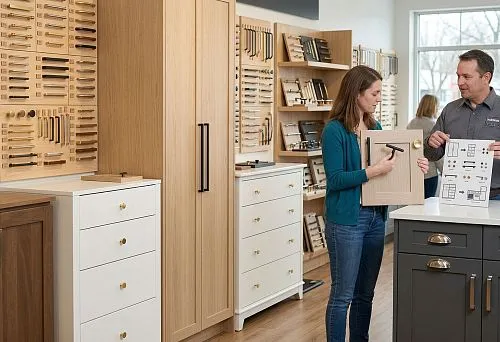
Specialized stores for furniture hardware and fittings offer a wide variety of furniture legs in different types, materials, and designs.
Advantages:
- Professional consultation from specialists
- Opportunity to see and "feel" the product before purchase
- Guarantee of product quality and authenticity
- Availability of a complete range from selected manufacturers
- Opportunity to purchase all necessary fittings and accessories
Disadvantages:
- Prices may be higher than in online stores
- Limited operating hours
- Need to spend time traveling to the store
The company "Stavros" offers a wide range solid wood furniture legs various wood species (oak, beech, ash, pine). Here you will find both classic turned models and modern minimalist options suitable for any interior style.
Online stores: convenience and wide selection
Online stores are becoming an increasingly popular place to buy furniture hardware due to convenience and wide selection.
Advantages:
- The opportunity to make purchases at any time of day
- Delivery to home or pickup point
- Often lower prices due to the absence of costs for maintaining retail spaces
- Convenient search and filtering of products
- Access to reviews from other customers
Disadvantages:
- Inability to physically assess product quality before purchase
- Risk of receiving a product that does not match the description
- Delivery waiting time
Many specialized stores, including "Stavros", have online presences where you can buy furniture legs with delivery. This combines the convenience of online shopping with the reliability of a well-known brand.
Furniture factories and manufacturers
Some furniture factories and manufacturers of fittings offer their products directly to end consumers.
Advantages:
- Manufacturer's quality guarantee
- Opportunity to order non-standard sizes or designs
- Often lower prices due to the absence of intermediaries
- Professional consultation from specialists who know all production nuances
Disadvantages:
- Usually work only with wholesale orders
- May require a minimum order volume
- Office and warehouse locations may not always be convenient
For large projects (e.g., furnishing an entire house), direct cooperation with manufacturers may be the optimal solution in terms of price and quality.
Construction hypermarkets and DIY centers
Large construction and furniture hypermarkets (Leroy Merlin, OBI, IKEA) also offer furniture legs in their assortment.
Advantages:
- Availability (stores are present in most major cities)
- Opportunity to purchase legs along with other items for home repair and furnishing
- Often lower prices on basic models
- Convenient return and exchange conditions
Disadvantages:
- Limited selection, especially in the premium segment
- Not always high-quality consultations
- Standardized approach, few unique solutions
Construction hypermarkets are suitable for purchasing basic, mass-market furniture legs, but for specific or premium solutions, it is better to visit specialized stores.
Master carpenters and woodworking workshops
If you are looking for truly unique handmade furniture legs, consider master carpenters and woodworking workshops.
Advantages:
- Opportunity to create a unique design based on your sketch
- High-quality handcrafted work
- Use of rare wood species and traditional processing techniques
- Individual approach to each order
Disadvantages:
- High cost
- Long production times
- Necessity of preliminary agreement on all details
This option is suitable for those who appreciate uniqueness and are willing to invest in exclusive interior items.
Criteria for selecting a reliable supplier
Regardless of the fact, where to buy furniture legs - in a physical store or online - it is important to evaluate the supplier's reliability based on the following criteria:
- Reputation and experience. Verified companies with long-standing experience typically value their reputation and offer quality products and services.
- Product range. A wide selection indicates a serious business approach and allows you to choose the optimal solution for your tasks.
- Presence of quality certificates for the product. Especially important for legs that will bear significant load.
- Warranty and return conditions. A reliable supplier always provides clear warranty obligations and has a transparent return policy.
- Quality of consultations. Professional consultants will help select the optimal solution and provide all necessary technical information.
- Customer reviews. Study reviews on independent platforms to form an objective opinion about the supplier.
- Additional services (delivery, installation, technical support) may become a decisive factor when choosing a supplier.
Practical aspects of choosing and installing furniture legs
Choosing and installing furniture legs is a process requiring attention to detail and understanding of technical nuances. Let's consider key aspects that will help you make the right choice and ensure quality installation.
Technical parameters: what to pay attention to when choosing
When choosing furniture legs, it is critically important to consider their technical characteristics:
- Load capacity. This parameter determines the weight a leg can support without deformation. To calculate the required load capacity:
- Determine the total weight of the furniture
- Add estimated load (for a bed - weight of mattress and people, for a table - weight of items on it)
- Divide the resulting sum by the number of legs
- Add a safety margin of 20-30%
- For example, for a sofa weighing 60 kg with an estimated load of 200 kg distributed over 4 legs, each leg must have a load capacity of at least (60+200)/4*1.3 = 84.5 kg.
- Height. The optimal height depends on the type of furniture:
- Sofas and chairs: 12-20 cm
- Beds: 15-25 cm
- Tables: 70-76 cm (total table height)
- Chests and sideboards: 8-15 cm
- Material and strength. Different materials have different strengths:
- Hardwood species (oak, beech, ash): high strength, suitable for heavy furniture
- Softwood species (pine, spruce): medium strength, suitable for light furniture
- Metal: very high strength, suitable for any type of furniture
- Plastic: strength depends on the specific type, requires careful selection
- Type of fastening. There are several main types:
- Screw-type (with plate or flange)
- Pin-type (inserted into a hole)
- On a bolt (screwed into the furniture)
- Adhesive-type (for light furniture)
- Additional Features:
- Height adjustment (to compensate for floor unevenness)
- Shock absorbers (to reduce load on the floor)
- Wheels (for mobility)
- Protective pads (to prevent scratches on the floor)
Compatibility with various types of furniture and flooring
Choosing furniture legs should consider both the type of furniture and the characteristics of the flooring:
Compatibility with types of furniture:
- Soft furniture (sofas, chairs) requires legs with high load capacity and secure mounting. Optimal options are wooden or metal legs with screw mounting.
- Beds require especially strong legs capable of withstanding dynamic loads. Recommended are solid wooden or metal legs with reinforced mounting.
- Tables require legs providing stability and capable of withstanding both vertical and horizontal loads. For dining tables, optimal are conical wooden or metal legs with a wide base.
- Cabinets and chests require legs that evenly distribute significant weight. Recommended are wide, low legs or pedestal constructions.
Compatibility with flooring types:
- Wooden floors and parquet are sensitive to point loads and scratches. Recommended are legs with a wide base and soft pads (felt, silicone).
- Laminate is susceptible to compression at load concentration points. Optimal are legs with load-distributing plates or soft pads.
- Tile and stone are resistant to loads but may be damaged during furniture movement. Recommended are legs with protective soft material pads.
- Carpeted floors deform under heavy furniture. Suitable are legs with a wide base or special supports distributing the load.
- Cementitious floors are sensitive to sharp edges. Required are legs with smooth, rounded bases and protective pads.
Tools and materials for installation
For proper installation of furniture legs, you will need:
Basic tools:
- Drill or screwdriver
- Drill bit set for wood and metal
- Screwdrivers (Phillips and flathead)
- Measuring tape and pencil for marking
- Level for checking horizontal alignment
- Hammer with rubber cap
- Hex keys (for some types of fasteners)
Consumables:
- Screws of appropriate size
- Wall anchors (for mounting to walls, if necessary)
- Wood glue (for strengthening joints)
- Silicone or felt pads for floor protection
- Washers and nuts (for some types of fasteners)
- Wooden dowels (for dowel mounting)
Specialized tools (for professional installation):
- Drill guides for drilling precise holes
- End Mill Set for Mortising Mounting Holes
- Torque Wrench for Tightening Force Control
- Laser Level for Accurate Marking
Step-by-Step Installation Guide for Different Types of Legs
Installation process depends on the type of furniture leg mounting. Let's consider the most common options:
Installation of Legs with Screw Mounting (with Plate):
- Flip the furniture over and determine the leg mounting locations.
- Mark the locations of mounting holes.
- Drill pilot holes of the required diameter (usually 2-3 mm).
- Attach the mounting plate and secure it with screws.
- Screw the leg into the plate until it bottoms out.
- Check the secureness of the mounting.
Installation of Legs with Pin (Insert Mounting):
- Determine the leg mounting locations.
- Drill holes of diameter matching the leg pin (usually 8-10 mm).
- Apply a small amount of adhesive into the hole.
- Insert the leg pin into the hole and gently tap it in with a rubber mallet.
- Wipe away excess adhesive with a damp cloth.
- Allow the adhesive to dry according to instructions (usually 24 hours).
Installation of Legs with Bolt (Threaded Mounting):
- Determine the leg mounting locations.
- Drill pilot holes slightly smaller in diameter than the bolt.
- Screw the leg into the prepared hole until it bottoms out.
- Check the secureness of the mounting.
Installation of Legs with T-Nut (for Soft Furniture):
- Flip the furniture over and determine the leg mounting locations.
- Insert T-nuts into the designated holes in the frame.
- Screw the legs into the T-nuts until they bottom out.
- Check the secureness of the mounting.
After installing all legs:
- Flip the furniture over and place it in position.
- Check stability and absence of wobbling.
- If necessary, adjust the leg height to compensate for floor unevenness.
- Install protective caps on the leg bases to prevent damage to flooring.
Typical mistakes when selecting and installing: how to avoid them
Even experienced craftsmen sometimes make mistakes when working with furniture legs. Here are the most common ones and how to avoid them:
Mistakes in selection:
- Insufficient load capacity. Solution: always choose legs with a safety margin (20-30% more than the calculated load).
- Mismatch with furniture and interior style. Solution: before purchasing, make a sketch or use visualization programs to assess how the legs will look on your furniture.
- Ignoring floor covering characteristics. Solution: consider the type of floor and purchase appropriate protective caps.
- Choosing the wrong type of fastening. Solution: consult with specialists and study your furniture's construction before purchasing.
Mistakes in installation:
- Inaccurate marking. Solution: use templates and measuring tools for precise marking.
- Drilling too large holes. Solution: start with smaller diameter holes and gradually increase them if needed.
- Over-tightening fasteners. Solution: do not apply excessive force when tightening; use a torque screwdriver.
- Ignoring the manufacturer's instructions. Solution: carefully read the instructions before installation.
- Uneven load distribution. Solution: install legs symmetrically and at equal distances from each other.
Organizational mistakes:
- Purchasing legs without preliminary measurements. Solution: always measure the furniture and plan the leg placement before purchasing.
- Lack of spare parts. Solution: purchase additional fasteners in case of loss or damage.
- Installing without help. Solution: always get help for large and heavy furniture.
Creative ideas for using furniture legs
Furniture legs are not only a functional element, but also a source of inspiration for creative projects. Let's consider several unconventional ways to use them.
Updating old furniture: a new life for favorite items
Replacing legs is one of the simplest and most effective ways to update the appearance of furniture without major restoration:
- Transforming a sofa or armchair. Replacing standard plastic legs with elegant wooden or metal ones instantly transforms even the simplest sofa. For example, installing conical legs made of dark wood, 15 cm high, on a modern sofa gives it a mid-century modern retro chic touch.
- Updating a dresser or sideboard. Adding tall legs to a low dresser not only changes its appearance but also creates useful space under the furniture for cleaning or storage. An IKEA "Malm" dresser on elegant metal legs 12 cm high looks like a premium designer piece.
- Transforming a coffee table. Replacing short legs with taller ones can turn a coffee table into a full-sized dining or work table. Standard coffee table height is 40-45 cm, dining table height is 75-80 cm.
- Updating kitchen cabinets. Installing decorative legs on lower kitchen cabinets gives the kitchen a lighter, "airy" look and simplifies cleaning under the cabinets. The optimal height for such legs is 10-15 cm.
- Transforming a bed. Replacing built-in supports with decorative legs can radically change the bed's style, and increasing the height makes cleaning easier and improves air circulation under the mattress.
DIY projects: creating unique furniture by yourself
Furniture legs can become the basis for creating original furniture by yourself:
- A table from an old door or countertop. Purchase four identical legs, attach them to the corners of an old door or homemade countertop — and your unique table is ready. For dining tables, use legs 71-76 cm high; for writing tables, 70-75 cm.
- A bench or stool from a thick board. A thick board (4 cm or more) on four decorative legs becomes a stylish bench for the hallway or bedroom. The optimal seat height is 45-50 cm.
- Console from a narrow shelf. A narrow shelf on two or four high legs becomes an elegant console for the hallway or living room. Standard console height is 75-85 cm, depth is 30-40 cm.
- Nightstands from drawers. An old drawer on four legs becomes an original nightstand. Optimal height — at mattress level or slightly above (50-60 cm).
- Plant stand. A small round or square tabletop on three high legs becomes a stylish stand for indoor plants. Height can vary from 50 to 100 cm depending on plant size.
Non-standard applications: from decoration to functional elements
Furniture legs can be used far beyond their direct purpose:
- Hooks and hangers. Wooden legs mounted horizontally on the wall become original hooks for clothes, towels, or ornaments.
- Candle holders. A turned wooden leg with a hole drilled at the top to fit the candle diameter becomes an elegant candle holder.
- Shelf supports. Two identical legs mounted on the wall at the same level can serve as supports for a shelf.
- Pots legs. Small decorative legs attached to a planter lift it above the surface, creating an interesting visual effect and improving drainage.
- Decorative elements. Turned wooden legs can be used as decorative columns in dollhouses, architectural models, or as interior decor elements.
- Lamp bases. A solid wooden leg can become a base for a table lamp or floor lamp.
Conclusion: how proper legs transform furniture and interior
Furniture legs are much more than just functional details. They are elements that define the character, style, and longevity of furniture. Properly chosen legs can turn an ordinary sofa into an elegant interior piece, and a standard table into a designer masterpiece.
When choosing, where to buy furniture legsPay attention not only to price, but also to quality, functionality, aesthetics, and suitability to your specific needs. Investing in quality furniture legs is investing in the comfort, safety, and longevity of your furniture.
The modern market offers an astonishing variety of furniture legs — from classic turned wooden to innovative metal legs with height adjustment and built-in lighting. This allows you to find the perfect solution for any interior style and type of furniture.
Remember that in interior design, as in life, it is the details that determine the quality of the whole. Pay proper attention to choosing furniture legs — and your furniture will delight you with its functionality, reliability, and beauty for many years.
Create furniture that reflects your individuality, matches your lifestyle, and becomes not just a piece of furniture, but a true work of art, where every detail and element plays an irreplaceable role.