












































































Article Contents:
- Selection and Sorting — The Art of Recognizing Quality
- Choosing the Wooden Score
- Technological Revolution in Traditional Craft
- Part One: Preparation Works
- Drying Chamber — First Stage of Transformation
- Selection and Sorting — The Art of Recognizing Quality
- Part Two: Design and Planning
- Digital Modeling — Architecture of the Future
- Design Office of the Furniture Plant
- Part Three: Cutting and Primary Processing
- Cutting Workshop — Birthplace of Details
- Primary Processing — Giving Shape
- Part Four: Precision Mechanical Processing
- CNC Machines — Robot Sculptors
- Hand Finishing — The Human Factor in the Age of Automation
- Part Five: Assembly Operations
- Assembly Conveyor — Symphony of Precision
- Geometric and Functional Control
- Part Six: Final Finishing
- Surface Preparation — Foundation for Quality Coating
- Applying Coatings — Protection and Beauty
- Part Seven: Special Technologies and Decoration
- Wood Carving — Ancient Art in Modern Execution
- Inlay and Marquetry — Wooden Mosaic
- Part Eight: Quality Control and Packaging
- Multi-stage Control — Guarantee of Perfection
- Packaging — Protection on the Way to the Customer
- Part Nine: Ecological Aspects of Production
- Responsible forestry
- Waste Management and Closed Loop
- Tenth Part: Innovations and Industry Future
- Production Digitization — Industry 4.0
- Additive Technologies in Furniture Production
- Eleventh Part: Regional Features and Traditions
- Russian School of Furniture Craftsmanship
- Influence of Global Trends
- Twelfth Part: Economic Aspects
- Optimization of production processes
- Mass Customization
- Thirteenth Part: Human Factor
- Skill and Professionalism
- Knowledge and Tradition Transfer
- Finale: Art Embodied in Wood
Imagine a concert hall where instead of musicians, craftsmen work, and tools are planes, chisels, and modern machines. The melody is not created by sound, but by the movements of skilled hands, transforming rough wood into elegant interior pieces. This is how modern furniture production can be described — it is a true symphony of craftsmanship, where every note matters.


Prelude to the Great Process




Choosing the Wooden Score
Any furniture masterpiece begins with material selection. Wood is a living material, each species possessing its own unique character. Oak sounds powerful and majestic, ash — bright and resilient, walnut — velvety and noble. The master, understanding how furniture is madelike a conductor, knows which wood to choose to create a certain 'sound' for the future item.
Modern solid wood furniture production requires a deep understanding of wood structure. Each tree has its own story — growth rings tell of dry and rainy years, knots testify to battles with wind, and resin pockets preserve memories of frosty winters. An experienced craftsman reads this book of nature, selecting precisely those wood sections that best suit a specific detail of the future item.
Our factory also produces:


Technological Revolution in Traditional Craft
Modern methods of wood preparation and processing differ radically from those used a century ago. If previously the craftsman relied solely on experience and intuition, now scientific analysis methods assist. X-ray scanning allows to look inside the trunk, revealing hidden defects even before sawing. Computer tomography creates a 3D map of each log, helping to optimally plan cutting.
Get Consultation
First Part: Preparation Work
Drying Chamber — First Stage of Transformation
Freshly cut wood contains a large amount of moisture, making it unsuitable for furniture production. The drying process is the first serious test for future material. Modern drying complexes are high-tech installations where each parameter is controlled with mathematical precision.
Temperature, humidity, air circulation speed — all these factors are regulated by complex algorithms developed specifically for each wood species. Technology of Solid Wood Furniture Production requires material with moisture content no more than 8–12%, and achieving this indicator is possible only by strictly following a technological protocol.
Selection and Sorting — Art of Quality Recognition
After drying, each board undergoes careful selection. The master sorter possesses a unique talent — he can assess the quality of the wood, predict its behavior during processing, and determine the best use for each piece with a single glance. This is a true art that cannot be replaced by any machine.
Boards are sorted by multiple criteria: dimensions, surface quality, number and placement of knots, grain direction, color palette. For production of soft furniture one type of wood is used for the frame — another for carved elements — and a third for decorative parts.
Second part: Design and Planning
Digital modeling — architecture of the future
Modern furniture design begins in virtual space. Powerful CAD systems allow creating detailed three-dimensional models of future products, calculating loads, simulating the behavior of structures under various conditions. The designer can change dimensions, proportions, add decorative elements, and the computer instantly shows how this affects the overall appearance of the product.
Understanding that, how furniture is made In modern conditions, it is impossible to design without knowledge of computer technologies. Every detail is calculated down to the millimeter, every connection is checked for strength, and each element is optimized in terms of material consumption.
Design office of the furniture enterprise
Developing a new furniture model is a collective process. Designers create the concept, engineers work out the technical implementation, technologists determine the sequence of operations, economists calculate the cost. Furniture Components Designed with consideration of all requirements for strength, aesthetics, and manufacturability.
Fourth part: Precision mechanical processing
Cutting workshop — the birthplace of parts
The cutting workshop of a modern furniture enterprise resembles an operating room — here sterile cleanliness reigns, every movement is precise, every tool is in its place. Sawing machines operate with jewel-like accuracy, deviation from the specified size should not exceed fractions of a millimeter.
Modern cutting complexes are controlled by a computer that optimizes each cut, minimizing waste and maximizing output of finished parts. The program takes into account the direction of the grain, the location of wood defects, and quality requirements for each part's surface.
Primary processing — shaping
After cutting, parts proceed to the primary processing area. Here, planers, milling, and drilling machines operate, each performing its specific operation. Manufacturing wooden furniture At this stage, special attention is required for surface processing quality — this determines how well adhesive joints will hold and how the finish coating will lie.
Fourth part: Precision mechanical processing
CNC machines — robotic sculptors
CNC machining centers have brought about a true revolution in furniture manufacturing. These amazing machines are capable of performing complex three-dimensional operations, creating parts of any geometric shape, doing so with incredible precision and repeatability.
Multi-spindle drilling and tapping machines can drill dozens of holes for fasteners in mere minutes, maintaining positioning accuracy down to hundredths of a millimeter. Copying and milling machines create complex profiles, repeating the programmed sequence with mathematical precision.
Manual finishing — the human factor in the age of automation
Despite the high level of automation, manual work remains an indispensable part of the furniture manufacturingFinal surface finishing, fitting joints, eliminating minor defects — all of this requires the hands and eyes of a master.
Especially important manual work during production of carved elementsEven the most advanced machines cannot convey the liveliness and soul infused by the master carver into his work.
Fifth Part: Assembly Operations
Assembly Line — Symphony of Precision
Furniture assembly is the culmination of the entire manufacturing process. Here, the quality of all previous operations is checked, defects are identified and eliminated, and the finished product is born. Modern assembly lines are organized according to the principle of flow production, where each worker performs specific operations.
Adhesive joints require special attention. The temperature of the adhesive, the open time, the pressing force — all these parameters are strictly regulated. A poorly executed adhesive joint may lead to the destruction of the product several years after use.
Control of Geometry and Functionality
Each assembled item undergoes careful inspection of geometric parameters. Special tools are used to check straightness, flatness, and surface parallelism. The operation of all movable elements — drawers, doors, transformation mechanisms — is tested.
Sixth Part: Final Finishing
Surface Preparation — Foundation of Quality Coating
The quality of the final coating depends 80% on surface preparation. Sanding is an entire science, where it is important to know which abrasive to use at each stage, how to avoid scratches and burns, and how to achieve perfect surface smoothness.
Modern sanding machines are equipped with dust removal systems and automatic control of the thickness of the removed layer. Furniture Manufacturing Technologies include the use of abrasives of different grits — from coarse for initial processing to ultra-fine for final sanding.
Coating Application — Protection and Beauty
Modern furniture coatings are high-tech systems that not only protect wood but also impart it with special beauty. Polyurethane varnishes, UV-cured coatings, oil-based impregnations — each type of coating has its own specific application features.
Painting booths are equipped with climate control systems, air filtration, and automatic coating application. Spray robots ensure even material application, eliminate human factors, and improve coating quality and consistency.
Seventh Part: Special Technologies and Decoration
Wood Carving — Ancient Art in Modern Execution
Wood carving remains one of the most impressive ways to decorate furniture. Modern masters are skilled in both traditional hand-carving techniques and new methods — laser engraving, CNC milling.
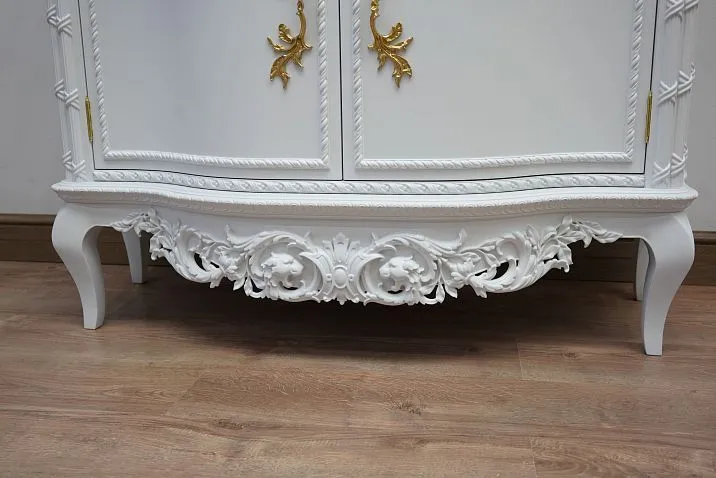
Furniture Components often include carved elements that become true works of art. Each carved element is unique, even if made from the same pattern — the craftsman’s hand always introduces its own adjustments.
Inlay and Marquetry — A Mosaic of Wood
Inlaying with different wood species allows creating real paintings on furniture. Modern laser cutting technologies enable manufacturing of inlay elements with jewel-like precision, creating complex ornaments and images.
Eighth Part: Quality Control and Packaging
Multi-stage Control — Guarantee of Perfection
The quality control system in modern furniture manufacturing includes multiple stages. Incoming raw material inspection, operational control at each production stage, final inspection of finished items — all of this ensures consistently high product quality.
Testing laboratories conduct tests for strength, durability, and ecological safety. Climate chambers simulate various operating conditions, allowing potential problems to be identified before the product reaches the consumer.
Packaging — Protection on the Way to the Customer
Furniture packaging is a separate science. The item must be reliably protected from damage during transport, the packaging must be compact to save space during storage and transport, yet it must also be convenient for the customer to unpack.
Modern packaging materials — corrugated cardboard, polystyrene foam, stretch film — provide reliable protection for furniture. Special vacuum packaging machines remove air from bags, significantly reducing packaging volume.
Ninth Part: Ecological Aspects of Production
Responsible forestry
Modern furniture production cannot be imagined without considering ecological factors. FSC certification guarantees that the wood comes from responsibly managed forests where principles of sustainable forestry are observed.
Production of natural wooden furniture requires special attention to raw material sources. Companies invest in reforestation, support programs for protecting rare tree species, and develop technologies for using fast-growing species.
Waste utilization and closed-loop cycle
Woodworking waste finds application in various industries. Sawdust is used to produce particleboard and biomass pellets. Offcuts are used to manufacture small items and souvenirs. Modern enterprises strive to create waste-free production.
Tenth part: innovations and the future of the industry
Production digitization — Industry 4.0
The concept of 'Industry 4.0' is actively implemented in furniture production. The Internet of Things allows machines to exchange data and optimize production processes in real time. Artificial intelligence analyzes product quality and predicts equipment maintenance needs.
Additive technologies in furniture production
3D printing from wood composites opens new possibilities for creating furniture. This technology allows manufacturing items of complex shapes, impossible to create using traditional methods. Printing enables creating hollow structures that save material while maintaining strength.
Eleventh part: regional characteristics and traditions
Russian school of furniture craftsmanship
Russia possesses the richest traditions of woodworking. Russian masters have always distinguished themselves by a special understanding of wood, the ability to reveal its natural beauty. Russian furniture market today is experiencing a period of active development, combining centuries-old traditions with modern technologies.
Influence of global trends
Globalization has led to the mutual penetration of various furniture traditions. Scandinavian minimalism, Italian elegance, German functionality — all these styles are reflected in modern Russian furniture.
Twelfth part: economic aspects
Production process optimization
Modern understanding furniture manufacturing includes continuous work on optimizing processes. Lean production, 5S system, Kanban — these methods help reduce costs, improve quality, and shorten manufacturing times.
Mass customization
Modern consumers demand individualized approaches. Mass customization technologies allow producing furniture to individual orders without significant cost increases. DIY furniture becomes accessible thanks to design solutions that allow the consumer to participate in the creation process.
Thirteenth part: human factor
Skill and professionalism
Despite automation, the human factor remains decisive in furniture production. The craftsman must understand wood, feel the tools, and see beauty in every movement. Furniture business is impossible without professional personnel.
Knowledge and tradition transfer
Preserving traditional skills and passing them on to the younger generation is an important task for the industry. Corporate universities, masterclasses by experienced artisans, production internships — all of this helps maintain intergenerational continuity.
Final: Art embodied in wood
Understanding the process furniture manufacturing Opens an amazing world where advanced technologies harmoniously blend with ancient craftsmanship traditions. Each item undergoes a complex journey from idea to realization, and at every stage of this journey, professional work is essential.
Modern furniture is not just household items — it is applied art created using advanced technologies and centuries-old craftsmanship traditions. In each piece, the soul of wood, the designer’s talent, and the skill of craftsmen live on.
Quality furniture is designed to serve for generations, delight the eye, create comfort and coziness in the home. It is an investment not only in interior design, but also in quality of life, emotional comfort, and a connection with nature through natural materials.
For many years, the company STAVROS has been a bright example of how traditional craftsmanship can successfully develop under modern conditions. Creating high-quality wooden items, STAVROS continues the best traditions of Russian furniture art, using the most advanced technologies and innovative solutions. Each item from the company is the result of deep understanding of the material, modern production technologies, and boundless love for one’s craft.





