Article Contents:
- Furniture Hardware: The Invisible Hero of Your Interior
- What is Furniture Hardware and Why Is It So Important
- Types of Furniture Hardware: From Essential to Elegant
- Functional Hardware: The Foundation of Reliability and Comfort
- Hinges: Invisible Guardians of Your Cabinets
- Lift Mechanisms: Vertical Measurement of Comfort
- Guides: smooth movement in every drawer
- Decorative Hardware: Accents That Define Character
- Handles: Tactile Pleasure and Visual Accent
- Decorative Appliqués and Mouldings: Finishing Touches
- Furniture Lighting: Functionality and Atmosphere
- Furniture Lighting: Functionality and Atmosphere
- Where to Buy Furniture Hardware in Kirov: Overview of Options
- Specialized Stores: Professional Approach
- Online Purchases: Convenience and Wide Selection
- Construction Markets and DIY Hypermarkets: Accessibility and Mass Availability
- Manufacturers and Distributors: Direct Access to the Source
- Criteria for Choosing Quality Furniture Hardware
- Materials and Technologies: The Foundation of Durability
- Functionality and Ergonomics: Comfort in Every Movement
- Design and Style: Harmony in Every Detail
- Leading Furniture Hardware Brands: Quality Proven Over Time
- European Manufacturers: Innovation and Reliability
- Asian Manufacturers: Balance of Price and Quality
- Russian Manufacturers: Adaptation to Local Conditions
- Trends and Innovations in the World of Furniture Hardware
- Technological Innovations: Smart Hardware for Smart Homes
- Eco-Trends: Sustainable Development in Details
- Design Trends: From Minimalism to Individuality
- Practical Tips: How to Make the Right Choice
- Needs Analysis: Functionality Above All
- Budgeting: Balancing Price and Quality
- Compatibility and Standardization: Technical Nuances
- Consultations with Specialists: Professional Perspective
- Conclusion: Small details with great significance

You ever wonder why one piece of furniture lasts for decades, while another falls apart within a couple of years? Why some cabinets open with a pleasant, barely audible whisper, while others creak and stick? Why some interiors look harmonious down to the smallest details, while others somehow lack something essential? The answer is simple yet complex: it all comes down to furniture hardware—the small, yet critically important elements that determine the functionality, durability, and aesthetics of your furniture.
Kirov – a city with rich furniture traditions, where quality and practicality have always been especially valued. Here, in the heart of the Vyatka region, the question of where to buy furniture hardware in Kirovtakes on special importance for master carpenters, professional furniture makers, and ordinary residents striving to create a cozy and functional interior.


Furniture hardware: the invisible hero of your interior




What is furniture hardware and why is it so important
Furniture hardware is a complex of functional and decorative elements that ensure the operability of furniture and define its appearance. It is somewhat like the 'nervous system' and 'skeleton' of any interior item, from a simple nightstand to a complex modular structure.
Functional hardware includes:
- Hinges of various types and configurations
- Guides for drawers
- Lift mechanisms
- Drawer systems
- Support elements (legs, casters, adjustable feet)
- Fastening elements (conformers, eccentric knobs, brackets)
- Furniture locks and latches
Decorative hardware includes:
- Handles and knobs
- Decorative appliqués
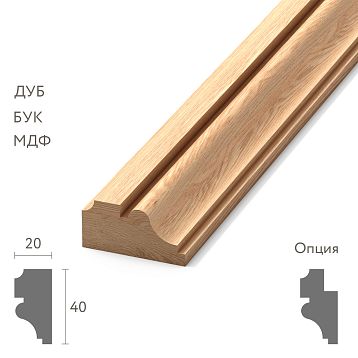
- Profiles and moldings
- Furniture lighting
- Decorative grilles and stained glass elements
The value of quality hardware is hard to overestimate. It determines not only the appearance of furniture, but also its functionality, ease of use, durability, and safety. Imagine a cabinet with doors that stick, a chest of drawers with falling-out drawers, or a kitchen set with flimsy hinges—such furniture quickly turns from a source of joy into a constant irritant.
Our factory also produces:


The history of furniture hardware: from antiquity to the present day
The history of furniture hardware spans millennia and is closely linked to the evolution of furniture art. Even in ancient Egypt, decorative inlays made of gold, ivory, and semi-precious stones were used to embellish furniture. In the ancient world, the first metal hinges and locks appeared.
The Middle Ages brought massive wrought iron hinges and locks, which were not only functional elements but also works of art. The Renaissance enriched furniture hardware with exquisite bronze handles and inlays with floral ornamentation.
The Industrial Revolution of the 19th century brought a revolution in furniture hardware production, making it more accessible and diverse. Standardized hinges, locks, and handles emerged, which could be produced on an industrial scale.
The 20th century brought new materials (aluminum, stainless steel, plastic) and technologies that enabled the creation of more functional and ergonomic hardware. Latch closers, soft-close systems, and full-extension drawer mechanisms appeared.
Today, furniture hardware is a high-tech industry where innovative materials, computer modeling, and robotic production are used. Modern hardware may include electronic components, integrate into 'smart home' systems, and provide unprecedented levels of comfort and functionality.
Get Consultation
Types of furniture hardware: from essential to exquisite
Functional hardware: the foundation of reliability and comfort
Hinges: the unseen guardians of your cabinets
Hinges are pivot mechanisms that enable opening and closing doors. The modern market offers a vast variety of hinges, each designed to solve specific tasks:
- Surface-mounted hinges – installed on the front side of furniture, often used in vintage and retro models.
- Half-surface hinges – used when the door partially overlaps the cabinet body.
- Inset hinges – used when the door fully fits into the cabinet body.
- Corner hinges – special constructions for corner cabinets.
- Soft-close hinges (with closer) – ensure smooth and silent closing.
- Push-to-open hinges – allow opening doors with a light press.
When choosing hinges, it is important to consider not only the type of construction, but also the weight of the door, frequency of use, and aesthetic requirements. Quality hinges from reputable manufacturers withstand up to 200,000 opening/closing cycles, ensuring approximately 20 years of flawless operation under intensive use.
Guides: smooth movement in every drawer
Drawer guides – systems ensuring smooth sliding and proper positioning of drawers. Modern guides are true engineering masterpieces, combining strength, reliability, and user comfort:
- Ball-bearing guides – a budget option providing basic functionality.
- Ball-bearing guides – a more advanced system providing smooth operation and withstanding significant loads.
- Hidden guides – installed under the drawer bottom, ensuring an aesthetic appearance.
- Full-extension guides – allow fully extending the drawer, ensuring access to all contents.
- Guides with soft-close – ensure smooth and silent closing.
- Guides with push-to-open system – allow opening drawers with a light press on the front panel.
Modern premium guides can withstand loads up to 80 kg, making them suitable even for industrial furniture. They ensure silent sliding and smooth closing, which is especially important for bedrooms and children’s rooms.
Lift mechanisms: vertical measurement of comfort
Lift mechanisms – innovative systems allowing doors to open upward rather than sideways. They are especially popular in kitchen cabinets, where space-saving is of primary importance:
- Gas-lift mechanisms – provide smooth opening and secure the door in any position.
- Folding mechanisms – allow folding the door like a concertina, saving space.
- Parallel lifters – lift the door parallel to the cabinet body.
- Vertical lifters – lift the door vertically upward.
Modern lift mechanisms are equipped with soft-close systems, adjustable opening force, and electric motors, allowing one-button cabinet opening – ideal for tall cabinets or for people with limited mobility.
Decorative hardware: accents that create character
Handles: tactile pleasure and visual accent
Furniture handles – these are not just functional elements allowing doors and drawers to be opened. They are the most important decorative accents, capable of completely transforming the appearance of furniture and the entire interior. The modern market offers an amazing variety of handles:
- Handle-plates – a classic option, consisting of a curved or straight bar with two mounting points.
- Button handles – compact elements with one mounting point, often used in classic interiors.
- Inset handles – an elegant solution where the handle is recessed into the front panel, not protruding beyond its edges.
- Profiled handles – integrated elements in the front panel construction, creating a minimalist, modern look.
- Handles - rails are long horizontal elements popular in modern kitchens.
Materials for making handles also impress with their variety: metal (brass, stainless steel, aluminum), wood, glass, ceramic, plastic, leather. Each material creates its own unique visual and tactile effect.
Choosing handles is an opportunity to express individuality and emphasize the stylistic direction of the interior. Classic brass handles with patina will perfectly complement furniture in Provence or country style. Chrome minimalist models will highlight the modern character of a high-tech interior. Original designer handles can become true works of art and a central element of the entire composition.
Decorative appliqués and moldings: finishing touches
Decorative appliqués, moldings, cornices, and pilasters are elements that give furniture completeness and stylistic expressiveness. They can be made from various materials - wood, MDF, polyurethane, metal - and have different degrees of decorative detail:
- Classic moldings with floral ornament
- Geometric appliqués for modern interiors
- Carved elements for furniture in ethnic style
- Metallic appliqués for industrial style
These elements allow transforming simple functional furniture into true works of art, highlighting its architectural features and creating a harmonious connection with the overall interior style.
Furniture lighting: functionality and atmosphere
Built-in lighting is not just an additional light source, but a powerful tool for creating atmosphere and emphasizing the merits of the interior:
- Spotlights for cabinets and display cases
- LED strips for illuminating shelves and niches
- Sensory lights for closets and cabinets
- Motion sensor lights for hallways and closets
Modern technologies allow creating lighting systems with adjustable brightness and color temperature, remote control, and integration into smart home systems. This opens new horizons for design solutions and increases furniture functionality.
Where to buy furniture hardware in Kirov: overview of options
Specialized stores: professional approach
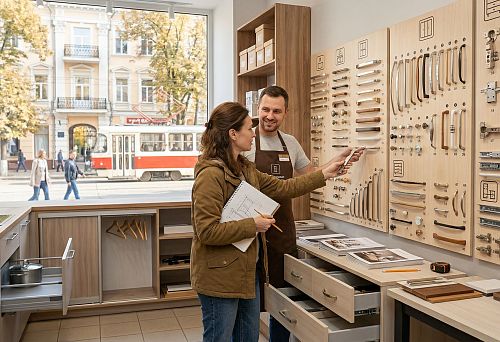
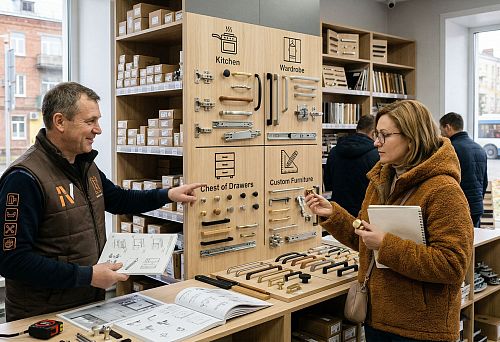
Kirov, as one of the centers of furniture production in Russia, offers wide opportunities for purchasing quality furniture hardware. Specialized stores are places where a broad range of hardware from various manufacturers, styles, and price categories is concentrated.
Advantages of specialized stores:
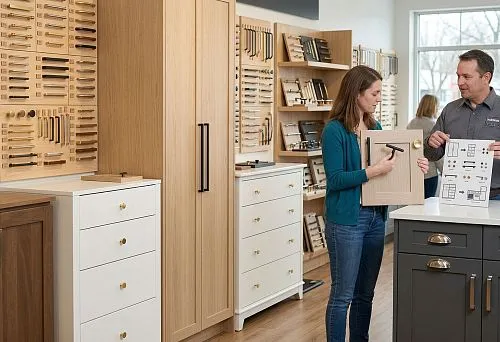
- Ability to see and touch the product before purchasing
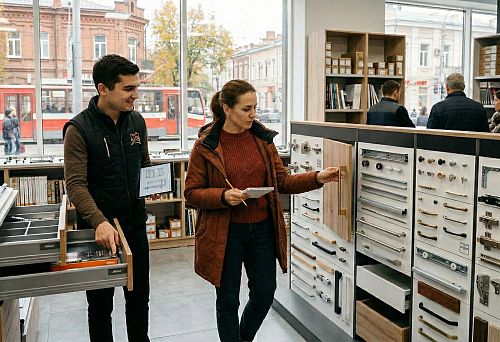
- Professional consultation from specialists
- Availability of samples and demonstration stands
- Ability to purchase everything needed in one place
- Guarantee of product authenticity
In Kirov, several large specialized furniture hardware stores operate, located in different parts of the city. Many of them have a long history and a reputation as reliable suppliers of quality products.
For professionals in the furniture industry and demanding private clients, showrooms of leading hardware manufacturers are of special interest, where the latest collections and innovative solutions are presented. Here, one can not only see the products in action but also obtain comprehensive technical information from the manufacturers' representatives.
Online purchases: convenience and wide selection
Online trading opens new horizons for those who are looking, where to buy furniture hardware in KirovOnline stores offer an enormous selection, convenient search, and the ability to compare different options:
Advantages of online purchases:
- Access to catalogs 24/7 without needing to visit a physical store
- Ability to quickly compare prices and features
- Delivery of the order to your home or pickup point
- Access to reviews from other customers
- Often lower prices due to absence of retail space maintenance costs
When choosing an online store, it is important to pay attention to the seller's reputation, presence of detailed product descriptions and high-quality photos, delivery and return conditions, as well as availability of technical support that can advise on selecting and installing hardware.
Many Kirov furniture hardware stores today develop an omnichannel sales model combining the advantages of offline and online retail. This allows customers to view products in a showroom, receive expert consultation, and then place an order online for home delivery.
Construction markets and DIY hypermarkets: accessibility and mass appeal
Construction markets and large DIY hypermarkets offer a wide range of basic furniture hardware at affordable prices. This is the optimal choice for standard solutions and budget projects:
Advantages of DIY hypermarkets:
- Affordable prices
- Availability of product "here and now"
- Ability to purchase complementary items (tools, fasteners)
- Convenient location in different city districts
- Extended operating hours, often 24/7
Such stores typically offer hardware in the mid-price segment, aimed at mass consumers. It is difficult to find exclusive designer solutions or specialized hardware for non-standard projects, but for most standard tasks, the assortment is quite sufficient.
Manufacturers and distributors: direct access to the source
For professionals in the furniture industry and large projects, the optimal solution may be direct cooperation with furniture hardware manufacturers or their official distributors:
Advantages of working with manufacturers:
- Guarantee of product authenticity
- Access to the full assortment, including novelties and specialized solutions
- Ability to receive technical support from the manufacturer
- Optimal prices without intermediary markups
- Ability to order custom solutions
Many leading furniture hardware manufacturers and local producers operating in Kirov and its region offer quality products adapted to Russian operating conditions.
Criteria for selecting quality furniture hardware
Materials and technologies: the foundation of durability
Material quality is the foundation upon which the durability and reliability of furniture hardware are built. Modern manufacturers use high-tech alloys, composite materials, and innovative coatings, ensuring exceptional performance characteristics:
- Zinc alloys – provide optimal combination of strength, ductility, and corrosion resistance.
- Stainless steel – guarantees maximum strength and resistance to aggressive environments.
- Aluminum alloys – combine lightness with sufficient strength.
- Polymer composites – ensure silent operation and resistance to wear.
Special attention should be paid to coatings that not only protect metal from corrosion but also determine the appearance of the hardware:
- Galvanic coating – provides corrosion protection and decorative effect.
- PVD coating – creates an ultra-thin yet exceptionally strong protective film.
- Powder coating – provides high resistance to mechanical damage.
- Anodizing – creates a protective oxide film on the surface of aluminum.
Quality hardware from leading manufacturers undergoes multi-stage quality control and comes with a manufacturer warranty, often reaching 25 years for premium lines.
Functionality and Ergonomics: Comfort in Every Movement
The functionality of furniture hardware is determined not only by its ability to perform basic tasks, but also by how comfortable and intuitive its use is:
- Smooth operation – absence of jerks and sticking when opening/closing.
- Silence – minimal noise level during operation.
- Opening force – optimal resistance requiring no excessive effort, yet ensuring controlled movement.
- Ease of use – no need for special instructions for basic use.
Modern premium hardware offers additional features that enhance user comfort:
- Damping systems – ensure smooth and silent closing.
- Push-to-open systems – allow opening furniture with a light press, without the need for handles.
- Electric drives – provide automatic opening/closing.
- Multi-dimensional adjustment – allows precise adjustment of facade positioning.
When selecting hardware, it is important to consider its specific usage: for a child's room, safety and protection against pinching fingers will be a priority, for the kitchen – resistance to moisture and temperature fluctuations, for office furniture – ability to withstand intensive use.
Design and style: harmony in every detail
Furniture hardware design should harmoniously match the overall style of the furniture and interior. This does not mean the hardware should be inconspicuous – on the contrary, it can become a striking accent, highlighting the uniqueness of the space:
- Classic style – brass or bronze handles with patina, decorative hinges, carved appliqués.
- Modern style – chrome or matte metallic geometric elements, hidden hinges and guides.
- Scandinavian style – natural materials, minimalist design, light tones.
- Industrial style – rough metallic elements, vintage handles, exposed mechanisms.
- Eco-style – natural materials, organic shapes, natural tones.
When selecting decorative hardware, it is important to consider not only its appearance but also tactile sensations – handles should feel pleasant to the touch, be comfortable to grip, and have no sharp edges or roughness.
Hardware color solutions can either harmonize with the main furniture color, creating a cohesive look, or contrast with it, becoming a striking accent. In modern design, contrasting combinations are popular – black hardware on light furniture, gold elements on dark facades.
Leading furniture hardware brands: quality, time-tested
European manufacturers: innovation and reliability
European furniture hardware manufacturers set quality and innovation standards in the industry. Their products are distinguished by flawless quality, thoughtful design, and high functionality:
Blum (Austria) – one of the world’s leading manufacturers of hinges, lift mechanisms, and drawer systems. Blum’s products feature innovative technologies, flawless quality, and thoughtful ergonomics. The proprietary BLUMOTION systems ensure smooth, quiet closing, while the TIP-ON technology allows opening furniture without handles.
Hettich (Germany) – one of the largest furniture hardware manufacturers with over 125 years of history. The company offers a wide range of hinges, guides, lift mechanisms, and decorative hardware. The InnoTech and ArciTech drawer systems, as well as Sensys hinges with integrated soft-close, have gained particular popularity.
Hafele (Germany) – a company with a rich history, offering comprehensive solutions for furniture and interiors. The product range includes not only traditional hardware but also lighting systems, electronic locks, and storage systems. Hafele is known for its innovative solutions for small spaces and transformable furniture.
Grass (Austria) – a company specializing in the production of high-quality sliding systems and hinges. Grass products are distinguished by elegant design, smooth operation, and durability. The Nova Pro and Vionaro sliding systems, as well as Tiomos hinges, have gained particular popularity.
Asian manufacturers: price and quality balance
Asian furniture hardware manufacturers have made significant quality leaps in recent years, offering products that combine affordable pricing with respectable quality:
FGV (China) – one of the largest furniture hardware manufacturers in Asia, offering a wide range of hinges, guides, and decorative hardware. FGV’s products are known for their good price-to-quality ratio, making them popular among mid-range furniture manufacturers.
GTV (Poland-China) – a company offering a wide range of furniture hardware produced in factories in Poland and China. GTV is known for its innovative solutions in furniture lighting and storage systems. The company’s products combine European design with affordable pricing.
Boyard (Russia-China) – a company offering a wide range of furniture hardware produced in Chinese factories according to Russian technical specifications. Boyard is known for its stylish collections of handles, as well as functional hardware adapted to Russian operating conditions.
Russian manufacturers: adaptation to local conditions
Russian furniture hardware manufacturers are actively developing, offering products adapted to the specifics of the Russian market:
Valmax – one of the largest Russian furniture hardware manufacturers, offering a wide range of hinges, guides, handles, and decorative elements. Valmax products are distinguished by good price-to-quality ratio and adaptation to Russian operating conditions.
TD "Ferum" – a Russian company specializing in the production of furniture handles, hooks, supports, and decorative elements. TD "Ferum" products are distinguished by original design, quality execution, and affordable pricing.
MacMart – a major Russian distributor of furniture hardware, developing its own production. The company offers a wide range of hardware across various price categories, from budget to premium solutions.
Trends and innovations in the world of furniture hardware
Technological novelties: smart hardware for smart homes
Furniture hardware is actively integrated into the smart home ecosystem, offering innovative solutions that enhance comfort and functionality:
Electronic opening systems – mechanisms that allow opening furniture using a remote control, smartphone, or voice commands. Particularly relevant for kitchen cabinets and tall wardrobes.
Biometric locks – systems that grant access to furniture contents via fingerprint, eye retina scan, or facial recognition. Ideal for storing valuables or confidential documents.
Motion-sensor integrated lighting – systems that automatically turn on lighting when a cabinet is opened or approached. These solutions not only enhance user comfort but also contribute to energy savings.
Wireless charging – modules embedded into furniture surfaces that allow charging smartphones and other gadgets without cables. Particularly popular in office furniture and bedside tables.
Ecological trends: sustainable development in details
Ecological awareness is becoming an important factor when choosing furniture hardware:
Use of recycled materials – an increasing number of manufacturers use recycled raw materials to produce hardware, thereby reducing the product’s ecological footprint.
Elimination of harmful coatings – modern technologies enable the creation of protective and decorative coatings without heavy metals or other hazardous substances.
Energy-efficient production – leading manufacturers implement technologies that reduce energy consumption during hardware production.
Biodegradable materials – innovative plant-based polymers are gradually finding application in the production of certain types of hardware.
Design trends: from minimalism to individuality
Furniture hardware design reflects general trends in interior design:
Minimalism and hidden solutions – systems without visible hardware, with integrated handles or push-to-open mechanisms, are gaining popularity.
Return to naturalness – hardware made from natural materials or mimicking them: wood, stone, leather, is trending.
Personalization – demand is growing for unique, customized solutions that reflect the owner’s individuality.
Style mixing – modern designers boldly combine elements of different styles, creating eclectic yet harmonious interiors.
Bright accents – against neutral interiors, hardware often becomes a striking accent, drawing attention and defining the character of the space.
Practical tips: how to make the right choice
Needs analysis: functionality above all
Before embarking on the search for furniture hardware, it is important to clearly define your needs and requirements:
- Determine the intensity of use – for furniture that will be used daily (kitchen cabinets, wardrobes), choose premium-quality hardware with high durability. For rarely used items (seasonal storage, guest furniture), budget-friendly options may be considered.
- Consider the specifics of the room – for humid areas (bathrooms, kitchens), hardware with anti-corrosion coating is required. For children’s rooms, safety and protection against finger pinching are crucial.
- Assess loads – for heavy doors and drawers, use reinforced hardware with appropriate load capacity. Pay attention to technical specifications and manufacturer recommendations.
- Plan ergonomics – placement of handles, height of door lift, degree of drawer extension should ensure maximum comfort of furniture use.
- Consider acoustic comfort – for bedrooms and children’s rooms, quiet operation of hardware is especially important. Systems with closers and dampers ensure smooth and silent closing.
Budgeting: balance of price and quality
Furniture hardware can constitute a significant portion of the furniture cost – from 15% to 40% depending on class and functionality. Proper budgeting will help achieve the optimal balance of price and quality:
- Set priorities – determine which hardware elements are most critical for your project and require investment in quality, and where you can save.
- Invest in functionality – do not economize on hinges, guides, and lifting mechanisms, as their quality directly affects the longevity and comfort of furniture use.
- Seek optimal solutions – many manufacturers offer ranges of different price categories with comparable quality but varying feature sets. Choose what is truly necessary.
- Consider installation costs – complex hardware may require professional installation, increasing overall expenses.
- Consider long-term perspective – quality hardware will last longer and require fewer maintenance and repair costs.
Compatibility and standardization: technical nuances
When selecting furniture hardware, it is important to consider its compatibility with the furniture structure and other components:
- Check dimensions and mounting – ensure the selected hardware matches door thickness, cabinet size, and has appropriate mounting hardware.
- Consider standards – most manufacturers follow certain standards, ensuring interchangeability of components. However, there are proprietary systems requiring use of components from only one manufacturer.
- Check compatibility with materials – some types of hardware require specific materials or panel thicknesses for proper installation.
- Consider adjustability – quality hardware should allow adjustment in multiple planes for precise positioning of doors.
- Think about future upgrades – choose systems that can be modernized or supplemented in the future without full replacement.
Consultations with specialists: professional perspective
Even with a clear understanding of your needs and budget, it is advisable to consult with specialists:
- Interior designers can help select hardware that harmonizes with the overall interior concept and highlights its stylistic features.
- Furniture makers and designers can suggest optimal technical solutions, taking into account the furniture’s construction specifics and expected loads.
- Specialized store consultants have extensive knowledge of product ranges and can suggest alternative options you may not be aware of.
- Manufacturer representatives will provide comprehensive information on technical specifications, warranty obligations, and installation specifics of particular models.
Do not hesitate to ask questions and request demonstrations of hardware operation – this will help make an informed choice and avoid future disappointments.
Conclusion: Small details with great value
Furniture hardware are those small but critically important elements that transform ordinary boards and panels into functional, comfortable, and aesthetically pleasing furniture. This is somewhat like the "nervous system" and "joints" of any interior item, determining its functionality, durability, and comfort of use.
Kirov, with its rich furniture traditions and developed infrastructure, offers wide opportunities for those who ask themselves, where to buy furniture hardware in KirovFrom specialized stores and showrooms to online platforms with home delivery — everyone can find the optimal option that suits their needs, tastes, and budget.
When choosing furniture hardware, it is important to consider not only aesthetic preferences but also functional requirements, technical specifications, and long-term prospects. Quality hardware from reputable manufacturers is an investment in the comfort and longevity of your furniture, which will pay off many times over during its use.
Modern technologies and innovations make furniture hardware increasingly functional, ergonomic, and aesthetically pleasing. Soft-close systems, electronic opening mechanisms, integrated lighting — all of this is not just a fashion trend, but real tools that enhance the quality of life and comfort of using furniture.
Remember: in the world of furniture, as in many other fields, it is the details that determine the quality of the whole. Investing in quality hardware means investing in the comfort, functionality, and aesthetics of your living space for many years to come.