Article Contents:
- Furniture Hardware: The Invisible Hero of Your Interior
- What is Furniture Hardware and Why Is It So Important
- Evolution of Furniture Hardware: From Antiquity to Innovations
- Types of Furniture Hardware: Functional and Decorative
- How to Choose the Perfect Furniture Hardware for Your Project
- Technical Specifications: What to Pay Attention To
- Stylistic Compatibility: How Hardware Affects the Overall Look of Furniture
- Practical Aspects: Ergonomics and Ease of Use
- Budget Considerations: Price-to-Quality Ratio
- Where to Buy Furniture Hardware: Overview of Options
- Specialized Stores: Advantages of a Professional Approach
- Online Stores: Convenience and Wide Selection
- Construction Hypermarkets: Accessibility and Mass Availability
- Manufacturers and Distributors: Direct Path to Quality
- Criteria for Choosing a Reliable Supplier
- Trends and Innovations in the World of Furniture Hardware
- Modern Technologies: "Smart" Hardware for the 21st Century
- Eco-Trends: Sustainable Development in Hardware Production
- Design Solutions: How Hardware Shapes Style
- The Future of Furniture Hardware: What to Expect in the Coming Years
- Practical Tips for Choosing and Installing Furniture Hardware
- How to Properly Select Hardware for Different Types of Furniture
- Tools and Materials: What You'll Need for Installation
- Step-by-Step Instructions for Installing Common Types of Hardware
- Common Mistakes When Choosing and Installing Hardware: How to Avoid Them
- Conclusion: How Hardware Turns Furniture into a Work of Art

Have you ever wondered why one piece of furniture lasts for decades, while another falls apart within a few years? Why some cabinets open with a smooth, silent motion, while others squeak and jam? Why some interiors look complete and harmonious, while others seem somehow unfinished? The answer lies in the details — specifically, in furniture hardware. These small elements play a colossal role in the functionality, durability, and aesthetics of furniture. But where to buy furniture hardwarewhich will not only be beautiful but truly high-quality? Let’s explore this question and learn how to choose hardware that will turn your furniture into a work of art.


Furniture hardware: the invisible hero of your interior
Furniture hardware is like an operating system in a computer: it's not always visible, but it determines how effectively and reliably the entire device will operate. Let's dive into the world of these unnoticed yet incredibly important details.




What is furniture hardware and why is it so important
Furniture hardware is a complex set of special parts and mechanisms that ensure the functionality, reliability, and aesthetic appeal of furniture. This includes hinges and guides, handles and hooks, locks and latches, supports and rollers — all of which make furniture convenient to use and pleasing to the eye.
The value of quality hardware is hard to overestimate:
- Functionality. It is the hardware that determines how a cabinet door will open, a drawer will slide out, or a sofa will transform. The quality of the hardware determines whether using furniture will be a pleasure or a constant struggle with jammed mechanisms.
- Durability. Quality hardware can withstand tens of thousands of opening-closing cycles without losing functionality. For example, premium-grade hinges are tested for 80,000–100,000 cycles, which, with average usage, guarantees more than 20 years of flawless operation.
- Safety. Reliable fasteners, closers, and opening limiters prevent injuries, especially in homes with children.
- Aesthetics. Decorative hardware (handles, hooks, caps) can become a true ornament of furniture, giving it individuality and style.
- Ergonomics. Properly selected hardware makes furniture use maximally convenient, saving your time and energy.
Our factory also produces:


The evolution of furniture hardware: from antiquity to innovations
The history of furniture hardware spans millennia. In ancient Egypt, primitive hinges and locks were used for chests. In the Middle Ages, forged hinges and handles appeared, which were not only functional but also decorative elements.
A true revolution in the world of furniture hardware occurred in the 20th century with the development of mass production and new materials. Standardized mounting systems, adjustable hinges, telescopic guides appeared.
Today we observe a new phase of evolution — the era of "smart" hardware:
- Handle-free opening systems (push-to-open)
- Electric actuators for lifting mechanisms
- Closers with adjustable closing speed
- Sensory opening systems
- Integration with "smart home" systems
Modern high-tech hardware can turn an ordinary cabinet into a true marvel of engineering. For example, there are lifting mechanisms that allow you to easily open a heavy upper cabinet door with one hand, and then smoothly and silently close it.
Get Consultation
Types of furniture hardware: functional and decorative
Furniture hardware can be divided into two major categories: functional and decorative. Let's examine each in detail.
Functional hardware is responsible for the operability of furniture:
- Hinges — ensure door opening and closing. Modern hinges come in many variations:
- Surface-mounted (visible)
- Semi-surface-mounted
- Inset (hidden)
- With a soft-close mechanism
- With a push-to-open system
- Adjustable in three planes
- High-quality hinges are made of steel with anti-corrosion coating and can withstand a load of up to 25-30 kg per pair of hinges.
- Drawer guides - determine how smoothly and quietly drawers will extend. Types include:
- Ball-bearing (mid-range price segment, support up to 30-35 kg)
- Ball-bearing (mid-range price segment, support up to 30-35 kg)
- Telescopic (premium segment, support up to 45-50 kg, ensure full drawer extension)
- Hidden mounting (installed under the drawer base, not visible)
- Lift mechanisms - used for opening upper cabinets. They come in:
- Gas (with pneumatic dampers)
- Spring
- Electric
- Feet and rollers - provide stability and mobility of furniture:
- Adjustable height (to compensate for floor unevenness)
- With locks (to prevent unwanted movement)
- With dampers (to reduce load on the floor)
- Connecting hardware - ensures structural strength:
- Fasteners (furniture screws)
- Excentric clamps
- Angles and plates
- Shanks (wooden or plastic dowels)
Decorative hardware adds individuality and style to furniture:
- Handles and knobs - the most noticeable hardware element that can dramatically change the appearance of furniture. They come in:
- Metallic (brass, steel, aluminum, bronze)
- Wooden
- Ceramic
- Glass
- Plastic
- Combined
- Decorative covers - used to conceal technical elements and decorate furniture:
- Rosettes (covers for hinges)
- Moldings and profiles
- Decorative angles
- End caps
- Furniture nails and tacks are used for both functional and decorative purposes, especially in classic and vintage furniture.
When choosing, where to buy furniture hardwareIt is important to consider both functional requirements and aesthetic preferences. Ideal hardware is not only flawless in operation but also harmoniously integrates into the overall furniture and interior design.
How to choose the ideal furniture hardware for your project
Choosing hardware is not simply a trip to the store for "some handles." It is a responsible process requiring an understanding of technical specifications, stylistic features, and practical nuances.
Technical Specifications: What to Pay Attention To
When selecting functional hardware, it is critically important to pay attention to technical parameters:
- Material of manufacture. Quality hardware is made from:
- Zinc alloy (for hinges, mechanisms)
- Stainless steel (for guides, fasteners)
- Brass (for decorative elements)
- High-strength plastic (for certain elements)
- Avoid hardware made from low-quality alloys that quickly oxidize and lose strength.
- Load capacity. This parameter is especially important for:
- Hinges (typically 15 to 30 kg per pair)
- Guides (15 to 50 kg per pair)
- Lift mechanisms (3 to 20 kg depending on model)
- Supports (30 to 100 kg per support)
- Service life. Quality hardware should withstand:
- Hinges: 40,000 - 100,000 opening/closing cycles
- Guides: 30,000 - 80,000 cycles
- Lift mechanisms: 20,000 - 60,000 cycles
- Adjustability. Modern functional hardware should allow adjustment:
- Hinges: adjustment in three planes (height, depth, width)
- Guides: adjustment for height and facade tilt
- Lift mechanisms: adjustment of opening and closing force
- Additional Features:
- Soft-close dampers for smooth and quiet closing
- Push-to-open systems for opening by pressing
- Synchronizers for simultaneous opening of multiple elements
- Dampers for cushioning impacts
- Coating. Quality coating protects hardware from corrosion and gives it an aesthetic appearance:
- Electroplating (chrome, nickel)
- Powder coating
- Anodizing (for aluminum parts)
- Lacquering
For example, premium hinges have a multi-layer electroplating thickness of 12-15 microns, providing corrosion protection even in high humidity conditions.
Stylistic harmony: how hardware affects the overall look of furniture
Decorative hardware is like jewelry for furniture. It can either accentuate its beauty or completely ruin the stylistic harmony.
Classic style requires:
- Handles made of brass or bronze with patina
- Decorative appliqués with botanical motifs
- Carved rosettes for hinges
- Furniture screws with decorative heads
Modern style prefers:
- Minimalist handles made of chrome-plated metal
- Hidden opening systems (push-to-open)
- No visible fasteners
- Integrated profiled handles
Scandinavian style tends toward:
- Simple wooden or metallic handles
- Natural materials and tones
- Functionality without excess
- Visible but neat fastenings
Industrial style chooses:
- Rough metallic handles
- Visible fastening elements
- Weathered surfaces
- Functionality above decoration
When choosing decorative hardware, it is important to consider not only the style of the furniture but also the overall interior concept. Hardware should harmonize with other decorative elements: lighting fixtures, door handles, plumbing fixtures.
Practical aspects: ergonomics and ease of use
Even the most beautiful hardware will not bring joy if it is inconvenient to use. Ergonomics is a key factor in selection, especially for elements you interact with daily.
Handles should:
- Fit comfortably in the hand
- Lack sharp edges and burrs
- Be positioned at an optimal height (usually 90-110 cm from the floor for cabinets)
- Have sufficient clearance from the facade for easy gripping (minimum 2-3 cm)
Hinges must ensure:
- Sufficient opening angle (usually 95-110°, up to 170° for special cases)
- Smooth operation
- Reliable latching in both open and closed positions
- Silent operation
Guides must guarantee:
- Easy extraction even when the drawer is fully loaded
- Absence of misalignment and binding
- Full or partial extraction depending on the drawer's purpose
- Reliable latching in the closed position
Lift mechanisms must:
- Compensate for the facade's weight to enable easy opening
- Latch the door in any position
- Ensure smooth closing without slamming
- Have limiters to prevent excessive opening
When selecting hardware for specific user groups (elderly, children, people with disabilities), additional ergonomic requirements should be considered. For example, in children's rooms, handles without sharp edges and with finger protection are recommended.
Budget considerations: price-to-quality ratio
Furniture hardware is available on the market in a wide price range—from budget Chinese products to premium European brands. How to find the optimal price-to-quality ratio?
Savings on functional hardware may lead to:
- Premature failure of mechanisms
- Need for frequent adjustment and repair
- Inconvenience in using furniture
- Potential hazards (e.g., shelf collapse due to poor-quality fasteners)
Investing in quality hardware ensures:
- Durability of furniture
- Comfort of Use
- Safety
- Preservation of aesthetic qualities throughout the product's lifespan
The optimal strategy is to invest in quality functional hardware (hinges, guides, lift mechanisms) from reputable manufacturers, while saving on decorative elements if they are not a key design accent.
For example, a set of quality hinges with soft-close mechanisms for a kitchen cabinet may cost 2-3 times more than a budget alternative, but will last 5-7 times longer and provide incomparably higher comfort of use.
Where to buy furniture hardware: overview of options
When you have decided on the type and characteristics of the required hardware, the question arises: where to buy furniture hardware high quality at a reasonable price? Let's consider the main options with their advantages and disadvantages.
Specialized stores: advantages of a professional approach
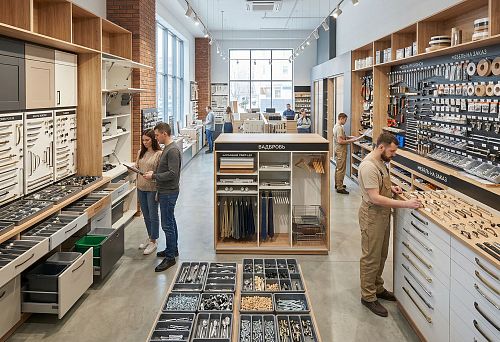
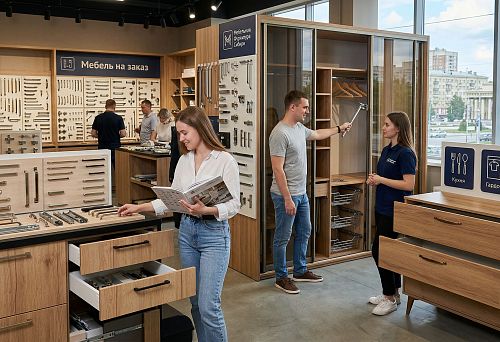
Specialized furniture hardware stores are places where you will find not only a wide selection, but also professional consultation.
Advantages:
- The opportunity to see and "feel" the hardware before purchase
- Consultation with specialists who will help select the optimal option
- Guarantee of product quality and authenticity
- Availability of a complete range from selected manufacturers
- The opportunity to purchase everything needed in one place
Disadvantages:
- Prices may be higher than in online stores
- Limited operating hours
- Need to spend time traveling to the store
The company "Stavros" offers a wide range furniture hardware from leading global manufacturers. Here you will find both functional components (hinges, guides, lifting mechanisms) and decorative hardware (handles, hooks, overlays) in various styles and price categories.
Online stores: convenience and wide selection
Online stores are becoming an increasingly popular place to buy furniture hardware due to convenience and wide selection.
Advantages:
- The opportunity to make purchases at any time of day
- Delivery to home or pickup point
- Often lower prices due to the absence of costs for maintaining retail spaces
- Convenient search and filtering of products
- Access to reviews from other customers
Disadvantages:
- Inability to physically assess product quality before purchase
- Risk of receiving a product that does not match the description
- Delivery waiting time
Many specialized stores, including "Stavros", have online presences where you can buy furniture hardware with delivery. This combines the convenience of online shopping with the reliability of a well-known brand.
Construction hypermarkets: accessibility and mass availability
Large home improvement and furniture hypermarkets (Leroy Merlin, OBI, IKEA) also offer furniture hardware in their selection.
Advantages:
- Availability (stores are present in most major cities)
- The opportunity to purchase hardware along with other repair items
- Often lower prices on basic models
- Convenient return and exchange conditions
Disadvantages:
- Limited selection, especially in the premium segment
- Not always high-quality consultations
- Standardized approach, few unique solutions
Home improvement hypermarkets are suitable for purchasing basic, mass-market hardware, but for specific or premium solutions, it is better to visit specialized stores.
Manufacturers and distributors: direct path to quality
Some manufacturers and official distributors of furniture hardware work directly with end consumers.
Advantages:
- Guarantee of product authenticity
- Often lower prices due to the absence of intermediaries
- Access to the manufacturer's full product range
- Professional technical support
- Ability to order non-standard solutions
Disadvantages:
- Usually work only with wholesale orders
- May require a minimum order volume
- Office and warehouse locations may not always be convenient
For large projects (e.g., furnishing an entire home), direct cooperation with manufacturers or distributors may be the optimal solution in terms of price and quality.
Criteria for selecting a reliable supplier
Regardless of the fact, where to buy furniture hardware - in a physical store or online - it is important to evaluate the supplier's reliability based on the following criteria:
- Reputation and experience. Verified companies with long-standing experience typically value their reputation and offer quality products and services.
- Product range. A wide selection indicates a serious business approach and allows you to choose the optimal solution for your tasks.
- Presence of quality certificates for products. Especially important for functional hardware, as it affects the safety and durability of furniture.
- Warranty and return conditions. A reliable supplier always provides clear warranty obligations and has a transparent return policy.
- Quality of consultations. Professional consultants will help select the optimal solution and provide all necessary technical information.
- Customer reviews. Study reviews on independent platforms to form an objective opinion about the supplier.
- Additional services (delivery, installation, technical support) may become a decisive factor when choosing a supplier.
Trends and innovations in furniture hardware
The world of furniture hardware is not standing still. New technologies, materials, and design solutions are constantly emerging, making furniture even more functional, convenient, and aesthetically pleasing.
Modern technologies: "smart" hardware for the 21st century
Technological progress fundamentally changes the perception of what furniture hardware can be:
- Electromechanical opening systems. Pressing a button or lightly touching the facade - and the door opens smoothly with an electric motor. Such systems are especially relevant for upper kitchen cabinets or wardrobes.
- Integration with "smart home" systems. Modern hardware can be connected to a home management system, allowing:
- To open and close cabinets using voice commands
- To program usage scenarios (e.g., automatic closing of all cabinets before bedtime)
- To receive notifications about un-closed doors or pulled-out drawers
- Biometric access systems. Cabinets and drawers with important contents can be equipped with fingerprint or eye retina scanning locks.
- Built-in lighting. Hardware with built-in LED lighting that activates upon opening makes using cabinets and drawers more convenient and adds an additional decorative effect.
- State monitoring systems. Sensors built into the hardware can track:
- Number of opening/closing cycles to predict maintenance needs
- Load on shelves and drawers to prevent overloading
- Temperature and humidity inside cabinets for protecting contents
These innovations don't just make furniture more convenient—they transform our interaction with it, making it more intuitive and personalized.
Eco-trends: sustainable development in hardware production
Ecological awareness is becoming an important factor when choosing furniture hardware:
- Ecological materials. Manufacturers are increasingly using:
- Recycled metals
- Biodegradable plastics
- Natural materials (wood from certified forests, bamboo, cork)
- Energy-efficient production. Leading companies are adopting technologies that reduce energy consumption and CO2 emissions during hardware production.
- Durability as an ecological factor. High-quality hardware that lasts for decades reduces the need for replacement and, consequently, decreases waste.
- Recyclability. Modern hardware is designed with the possibility of disassembling components for future recycling.
- Eco-certifications (FSC, GREENGUARD, LEED) are becoming an important competitive advantage for hardware manufacturers.
Choosing eco-friendly hardware not only cares for the planet but also creates a healthier environment in your own home.
Design solutions: how hardware shapes style
Decorative hardware is experiencing a true renaissance, becoming a key element of furniture design:
- Minimalism and hidden solutions. The trend toward invisible hardware continues to develop:
- Push-to-open systems
- Handles integrated into the facade
- Hidden hinges and fasteners
- Return to artisan traditions. Alongside minimalism, there is a growing trend toward unique, handcrafted hardware:
- Forged handles and hinges
- Handmade ceramic and glass handles
- Hardware with patina and aged effect
- Material mixing. Modern hardware often combines different materials:
- Metal and wood
- Metal and leather
- Metal and stone or ceramic
- Color experiments. Whereas hardware used to be predominantly metallic, the palette has now significantly expanded:
- Matte black finishes
- Vibrant colored finishes
- Gradient and multi-color solutions
- Finishes 'under bronze', 'under copper', 'under gold'
- Personalization. The ability to create unique hardware according to individual design is becoming increasingly accessible thanks to the development of 3D printing and laser cutting technologies.
Decorative hardware is no longer just a functional element, but a true ornament capable of transforming even the simplest furniture.
The future of furniture hardware: what to expect in the coming years
Technological and social trends are shaping the future of furniture hardware:
- Integration with artificial intelligence. Hardware will "learn" user habits and adapt to them:
- Predicting which cabinet you want to open
- Adaptation of damper force depending on time of day (quieter at night, faster in the morning)
- Warning about the need for maintenance
- Energy independence. Development of micro-energy generation technologies will allow creating hardware that does not require connection to the electrical grid:
- Conversion of kinetic energy from opening/closing into electricity
- Use of solar micropanels
- Highly efficient batteries with long lifespan
- Adaptive materials. Hardware will be made from materials capable of changing their properties:
- Change in stiffness depending on load
- Self-repair after damage
- Adaptation to temperature and humidity
- Biomimicry - creating hardware that mimics natural mechanisms:
- Hinges operating on the principle of joints
- Opening systems mimicking plant movement
- Structures inspired by the structure of mollusk shells or bones
- Virtual and augmented reality in selecting and configuring hardware:
- Ability to "try on" different hardware options for your furniture via an AR app
- Virtual installation and setup instructions
- Visualization of mechanism operation for optimal selection
The future of furniture hardware is a combination of advanced technologies, eco-friendliness, and personalization, making our furniture even more functional, convenient, and durable.
Practical tips for selecting and installing furniture hardware
Now that we've covered the types, characteristics, and trends of furniture hardware, let's move on to practical recommendations for selecting and installing it.
How to properly select hardware for different types of furniture
Each type of furniture has its own characteristics that must be considered when selecting hardware:
Kitchen furniture requires especially reliable and functional hardware:
- Hinges with dampers for silent cabinet door closing
- Full-extension heavy-duty guides (from 30 kg) for dish trays
- Lift mechanisms for upper cabinets
- Moisture-resistant materials and coatings
- Stain-resistant and easy-to-clean handles
Cabinets and wardrobes require:
- Strong hinges for heavy doors
- Quality guides for sliding elements
- Specialized hardware for storage organization (sliding hangers, pants bars, shoe racks)
- Soft-close systems for large doors
- Comfortable handles matching interior style
Children's furniture requires special attention to safety:
- Hinges with opening limiters
- Closers to prevent finger pinching
- Handles without sharp edges or protruding elements
- Reliable fittings designed for active use
- Locks and latches for cabinets containing hazardous contents
Office furniture must be functional and durable:
- Guides with high durability for frequently used drawers
- Central locking systems to protect documents
- Ergonomic handles for comfortable use
- Adjustable legs for compensating floor irregularities
- Cable channels and wire management systems
Bathroom furniture requires moisture resistance:
- Hardware made of stainless steel or with special moisture-resistant coating
- Hinges with enhanced corrosion resistance
- Handles easily cleaned from lime scale
- Adjustable feet to prevent direct contact with wet floors
Tools and materials: what you'll need for installation
The right set of tools and materials is essential for quality installation of furniture hardware:
Basic tools:
- Impact driver with a set of bits
- Drill with wood and metal drill bit set
- Measuring tape and pencil for marking
- Level for checking horizontal and vertical alignment
- Templates for marking hole positions for hinges and handles
- Chisel for fitting mounting locations
- Hammer with rubber cap
- Screwdrivers of various types and sizes
- Hex keys for adjusting mechanisms
Consumables:
- Screws of various sizes and types
- Wall mounting anchors
- Wood glue (for strengthening joints)
- Silicone sealant (for wet areas)
- Wax pencil for masking minor defects
- Sandpaper of various grits
- Painters tape for protecting surfaces during drilling
Specialized tools (for professional installation):
- Router with bit set for cutting hinge recesses
- Drill guides for drilling precise holes
- Suction cups for holding facades during installation
- Laser Level for Accurate Marking
- Torque Wrench for Tightening Force Control
Investments in quality tools pay off in precision, speed of installation, and longevity of the result.
Step-by-step instructions for installing main types of hardware
Let's consider the installation process of the most common types of furniture hardware:
Installation of furniture hinges:
- Mark the position of hinges on the door and cabinet body (usually 100-150 mm from the top and bottom edges).
- Drill the hole for the hinge cup using a special router bit (diameter 35 mm, depth 12-13 mm).
- Secure the hinge cup to the door with self-tapping screws.
- Attach the return plate to the cabinet body.
- Connect the hinge parts and adjust the door position in three planes.
Installing drawer slides:
- Mark the position of guides on the side walls of the cabinet and drawer.
- Attach the guides to the cabinet, ensuring parallelism and equal height on both sides.
- Install the return parts of the guides on the drawer.
- Insert the drawer into the cabinet and check the smooth operation.
- If necessary, adjust the drawer front position.
Installing handles:
- Determine the position of handles on the facades (usually centered or at 1/3 height from the top edge).
- Make markings using a template or ruler.
- Drill holes of the required diameter (usually 4-5 mm).
- Insert screws from the inside of the facade.
- Screw the handle onto the protruding screws and tighten.
Installing lift mechanisms:
- Mark the position of the mechanism on the side wall of the cabinet and the facade.
- Attach the cabinet-side part of the mechanism to the side wall of the cabinet.
- Install the facade-side part of the mechanism onto the door.
- Connect the mechanism parts and test the operation.
- Adjust the opening and closing force according to the weight of the facade.
Common mistakes when selecting and installing hardware: how to avoid them
Even experienced craftsmen sometimes make mistakes when working with furniture hardware. Here are the most common ones and how to avoid them:
Mistakes in selection:
- Mismatch with load capacity. Solution: always choose hardware with a safety margin (20-30% more than the expected load).
- Incompatibility with furniture material. Solution: check with the seller or in the technical documentation to confirm which materials the hardware is intended for.
- Ignoring operating conditions. Solution: consider the characteristics of the room (humidity, temperature, usage intensity).
- Cutting corners on quality. Solution: do not compromise on functional hardware, as it directly affects the longevity of the furniture.
Mistakes in installation:
- Inaccurate marking. Solution: use templates and guides for precise marking.
- Incorrect choice of fasteners. Solution: use fasteners recommended by the hardware manufacturer.
- Over-tightening screws. Solution: do not apply excessive force when tightening; use a torque screwdriver.
- Ignoring instructions. Solution: carefully read the instructions before installation, especially for complex mechanisms.
- Lack of adjustment. Solution: after installation, adjust the position of fronts and mechanisms.
Organizational mistakes:
- Purchasing hardware at the last minute. Solution: plan your purchase in advance to allow time for replacement in case of defects or mismatch.
- Lack of spare parts. Solution: purchase hardware with a 5-10% reserve to account for loss or damage during installation.
- Loss of technical documentation. Solution: keep instructions and warranty cards in a dedicated folder.
Conclusion: how hardware turns furniture into a work of art
Furniture hardware is much more than just functional parts. It is elements that define the character, style, and longevity of furniture. Properly selected hardware can transform an ordinary cabinet into an elegant interior piece, and a standard kitchen into an ergonomic space where every movement brings pleasure.
When choosing, where to buy furniture hardwarePay attention not only to price, but also to quality, functionality, aesthetics, and suitability for your specific needs. Investing in quality hardware is investing in the comfort, safety, and longevity of your furniture.
Modern technologies offer us amazing possibilities: "smart" mechanisms, eco-friendly materials, innovative design solutions. But even the most technologically advanced hardware must meet the main criterion — it must make your life more convenient and pleasant.
Remember that in the world of furniture, as in life, it is the details that determine the quality of the whole. Pay proper attention to hardware selection — and your furniture will delight you with its functionality, reliability, and beauty for many years.
Create furniture that reflects your individuality, matches your lifestyle, and becomes not just a piece of furniture, but a true work of art, where every detail, every hardware element, plays an irreplaceable role.