Article Contents:
- The Nature of Decorativeness: why furniture needs ornaments
- Typology of Decorative Elements: the anatomy of ornamentation
- Carved Overlays: planar decor with volume
- Furniture Legs: sculptural support
- Cornices and Plinths: horizontals that shape the silhouette
- Pilasters and Columns: vertical rhythm
- Moldings and Glazing Bars: thin lines of great significance
- Material Matters: why solid wood is irreplaceable
- Stylistic Grammar: decor as the language of eras
- Classicism: rigor and proportion
- Baroque: Opulence and Dynamism
- Rococo: lightness and asymmetry
- Empire: monumentality and militarism
- Modern: Natural Lines and Asymmetry
- Art Deco: Geometry and Luxury
- Scandinavian Minimalism: Function and Naturalness
- Style Unity: how to create a harmonious ensemble
- Unity of Ornamental Language
- Unity of Proportions and Scale
- Unity of Material and Finish
- Unity of Stylistic Era
- Application Technologies: from idea to implementation
- Installation of Carved Overlays
- Installing Furniture Legs
- Installation of Cornices and Plinths
- Restoration and Renewal: giving old furniture a second life
- Adding Overlays to Smooth Facades
- Replacing Legs: changing the silhouette
- Adding Cornices and Friezes
- Repainting While Preserving Decor
- Custom Manufacturing: when standard doesn't fit
- The Economic Logic of Quality Decor
- Frequently Asked Questions
- Conclusion: the philosophy of integrity from STAVROS
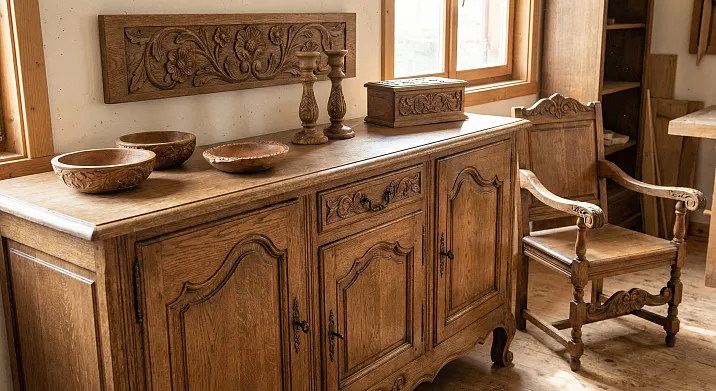
Why do some interiors become memorable while others remain faceless? The secret isn't in expensive materials or square footage. Magic is born from details — those very decorative elements that transform standard furniture into unique works, and ordinary rooms into spaces with character and soul.
Furniture and Decor— is a unified system where each element complements the others.Wooden decorationfrom the array becomes a connecting link, creating visual harmony between different pieces of furniture.decorative elements for furniturework as architectural punctuation — they place accents, create rhythm, and form the stylistic unity of the interior.


The Nature of Decorativeness: Why Furniture Needs Ornaments
Functionality is the foundation of any piece of furniture. A wardrobe stores things, a table serves as a work surface, a dresser organizes space. But why do some items evoke admiration while others remain merely utilitarian objects? The difference lies in decorativeness, which transforms function into an aesthetic experience.
Historicallydecor for furnitureserved as a marker of status and craftsmanship. Carved overlays, turned legs, and paneled fronts demonstrated not just the owner's wealth but also the level of the era's craft art. Each curl was carved by hand, each ornament was thought out as part of a symbolic language.
Modernity has changed technologies but not the human need for beauty. We are still drawn to objects that please the eye, that carry visual richness, that differ from the mass standard. Wooden decorative elements satisfy this need, adding handmade warmth to the world of industrial production.
Psychologically, decor creates an emotional connection with the space. A carved overlay on a dresser front becomes that recognizable element that makes the room feel like one's own. A turned table leg — a detail that catches the eye. A profiled cornice of a furniture wardrobe — a line that structures the vertical of the room. Without these details, the interior remains functional but soulless.




Typology of Decorative Elements: The Anatomy of Ornamentation
The world of furniture decor is diverse and systematic. Each element has its purpose, its area of application, its design features. Understanding typology helps in consciously choosing components to create a harmonious whole.
Our factory also produces:



Carved Overlays: Planar Decor with Volume
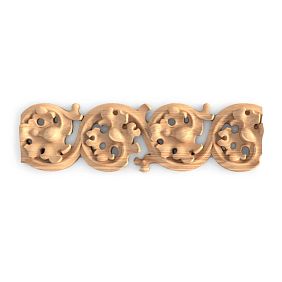
Carved overlay — the most common typewooden decorfor furniture. It is a flat element with a thickness from eight to twenty-five millimeters, on the front surface of which a relief ornament is carved. The overlay is attached to the furniture front with glue, sometimes additionally fixed with finishing nails.
Horizontal overlays of elongated shape are used to decorate the central part of fronts — wardrobe doors, dresser drawers, kitchen unit pediments. Length varies from one hundred fifty to eight hundred millimeters, width — from fifty to one hundred fifty millimeters. The ornament is symmetrical relative to the central axis, with an accent in the middle of the composition.
Vertical overlays are used less frequently, more often in tall narrow elements — pilasters, wall sections between wardrobe doors. They create a vertical rhythm, visually elongate the proportions of the furniture. The ornament is usually floral — stylized vine, acanthus leaf, grape cluster.
Corner overlays cover panel joints, decorate furniture carcass corners, create framing for panels. Shape — quarter circle, sector, fan. Carving concentrates in the wide part, tapering to nothing at the narrow part. Corner elements work in pairs or quadruples, creating symmetrical framing.
Central overlays — compositional accents placed in the geometric center of the front. Shape can be round, oval, diamond-shaped, shield-like. The ornament is the most saturated, multi-level, with deep detailing. This is the culminating point of the decorative program of a furniture piece.
Get Consultation
Furniture Legs: Sculptural Support
Furniture legs— the only decorative element with a critical structural function. They bear the entire weight of the item and its contents, transferring the load to the floor. At the same time, the leg remains one of the main decorative accents defining the furniture's style.
Turned legs are created on a lathe from a cylindrical blank. The cutter removes material, forming a sequence of balls, disks, rings, cones. The classic baluster-like shape includes a base (wide lower part), a body with alternating bulges and constrictions, and a capital (upper part adjacent to the rail or tabletop). Turned legs are universal, combining with classical and modern interiors.
Carved legs — the highest level of furniture decor. From a rectangular block, a volumetric sculptural form is carved by hand or on a CNC machine. Cabriole — an S-shaped curved leg, characteristic of Baroque and Rococo, ending in a stylized animal paw. Such legs create an impression of lightness in massive furniture, visually lighten the structure.
Straight profiled legs — a compromise between decorativeness and manufacturability. A square beam is milled along the edges, creating chamfers, coves, beads. The cross-section remains rectangular, but the play of light and shadow on the profiled edges adds volume. Such legs are suitable for furniture in neoclassical, Art Deco, and modern classic styles.
Tapered legs — narrowing from top to bottom — are typical of Scandinavian furniture from the mid-last century. Minimal decor, emphasis on purity of form and wood quality. A slight outward tilt of the legs creates stability and visual dynamics.
Cornices and Plinths: Horizontals Shaping the Silhouette
Furniture cornice — a profiled strip crowning the upper part of a wardrobe, cabinet, dresser. It creates a transition from the vertical of the carcass to the horizontal, completes the composition, adds architectural quality. The cornice profile can be simple (one or two coves) or complex (multi-step composition of beads, shelves, coves).
The connection between furniture cornice and interior cornice is obvious — they should echo in profile. If ceiling cornices of a certain profile are used in the room, furniture cornices repeat it on a reduced scale. This creates architectural unity, where furniture is perceived as part of the fixed architecture.
Plinth — the lower profiled strip framing the base of case furniture. It covers the technical zone (adjustable supports, cleaning gap), creates a visual support, weighs down the bottom of the composition. The plinth profile often echoes the floor skirting profile, creating a single horizontal line along the room perimeter.
Pilasters and Columns: Vertical Rhythm
Pilaster — a vertical decorative element imitating a flat half-column on a furniture front. Includes a base (lower widened part), a body (shaft with fluting or smooth), and a capital (upper part with carved decor). Pilasters are placed at wardrobe corners, frame the central section of a cabinet, flank a dresser mirror.
Columns — fully volumetric elements of round cross-section, used less frequently due to manufacturing and installation complexity. They protrude beyond the front plane, creating a deep play of light and shadow. Typical for furniture in the Empire style, where architectural motifs dominate.
Moldings and Glazing Bars: Thin Lines of Great Significance
Furniture moldings are narrow profiled strips that create panel framing, delineate zones on the facade, and form frames. Width from ten to forty millimeters, thickness from five to fifteen millimeters. The profile is simple — rounding, chamfer, bead.
Latticework — very thin strips (five to ten millimeters wide), creating a graphic grid on flat facades. They visually break up a large plane, making it less monotonous. Typical for kitchen units, where tall, undecorated facades look boring.
Material matters: why solid wood is irreplaceable
Modern industry offers decorative elements from various materials: polyurethane, coated MDF, plastic, composite materials. Each has advantages — low price, lightness, moisture resistance. But when it comes to true quality and durability, solid wood remains unrivaled.
The strength of solid wood is critical for load-bearing elements — legs, supports, brackets. An oak leg withstands a load of hundreds of kilograms for decades without deformation. A polyurethane or MDF leg under such load will crush, crack, and break. For decorative overlays, strength is less critical but still important — accidental impacts, pressure during cleaning should not leave dents or chips.
The natural texture of wood creates a visual depth unattainable by imitations. Annual rings, medullary rays of oak, the wavy pattern of ash — these details are perceived on a subconscious level. The eye discerns naturalness, even if the consciousness does not formulate the criterion. Interiors with solid wood are warmer, livelier, more noble.
The workability of wood allows for the creation of the most complex forms. Carving in solid wood conveys the finest nuances — flower petals a millimeter thick, interweaving stems, gradations of relief depth. Polyurethane is molded from a ready-made matrix, which is cheaper but deprives it of individuality — all products are identical. Solid wood allows for variation, refinement, and the creation of unique pieces.
The environmental friendliness of wood is critical for living spaces. Solid wood does not emit volatile substances, is hypoallergenic, and safe for children and allergy sufferers. Polyurethane elements when heated (sunlight, heating radiators) can emit chemical compounds. MDF contains formaldehyde resins, although modern grades comply with environmental standards.
The repairability of solid wood is an underrated advantage. A scratch on a carved overlay is sanded and refinished. A chip is restored by gluing in wood and recarving. A damaged polyurethane element must be replaced — repair is impossible or economically impractical.
Stylistic grammar: decor as the language of eras
Shapedecorative elementscommunicates the stylistic affiliation of an interior more accurately than any words. Ornaments, profiles, proportions — this is the grammar of a visual language, understood on an intuitive level.
Classicism: rigor and proportion
Classical decor is based on ancient architectural orders. Symmetry is absolute, proportions are verified according to mathematical ratios. Ornaments: acanthus leaf, palmette, meander, egg-and-dart, rosettes. Carving is of moderate depth, clear, with even edges.
Legs are straight or slightly tapered towards the bottom, with fluting (vertical grooves). Leg capitals are decorated with stylized acanthus. Overlays are central, symmetrical, often with a shield or cartouche in the middle. Cornices are multi-tiered, with a clear rhythm of protruding elements.
Material — oak, walnut, mahogany. Finish — polishing, varnishing to a restrained shine. Gilding is used locally, emphasizing key carving elements. Colors — natural wood tones, white, cream, sometimes saturated — green, burgundy.
Baroque: opulence and dynamism
Baroque decor rejects rigor, reveling in excess. Symmetry is preserved, but the composition is saturated to the limit. Ornaments are multi-layered: acanthus intertwines with ribbons, flowers neighbor fruits, cherubs peek out from scrolls. Carving is deep, volumetric, creating strong contrasts of light and shadow.
Legs are curved — cabriole, S-shaped line, ending in a stylized paw. The leg itself is decorated with carving over the entire surface — leaves, shells, scrolls. Overlays are large, complex, often asymmetrical within a symmetrical frame. Cornices have a large projection, are discontinuous, with the inclusion of sculptural elements.
Material — walnut, oak, linden (for carving). Finish — abundant gilding, sometimes complete gilding of carved elements. Patination emphasizes the relief. Colors — rich, saturated: gold, burgundy, emerald, sapphire.
Rococo: lightness and asymmetry
Rococo — a lighter, capricious version of Baroque. Symmetry is broken, lines become sinuous, ornaments become more intimate. The motif of the rocaille (stylized shell) dominates. Carving is lacy, in places openwork, with thin bridges. Much air, voids — the decor does not completely cover the background.
Legs are curved, but more graceful than Baroque ones. Carving is local — in the upper part, on the curve. Overlays are small, asymmetrical, with swirls and counterweights. Cornices are light, wavy, with a discontinuous profile.
Material — beech, birch, linden. Finish — painting in pastel tones (pink, blue, pistachio) with gilding on the protruding parts of the carving. Much white color. Patina is delicate, subtle.
Empire: monumentality and militarism
Empire returns to classical rigor but enlarges forms, adding imperial pomp. Ornaments: laurel wreaths, military attributes (swords, shields, helmets), Egyptian motifs (sphinxes, lotuses). Carving is clear, graphic.
Legs are straight, powerful, often in the form of herms (tapering downward pillars with a capital). Animal paws as leg endings. Overlays with military symbolism, heraldic elements. Cornices with the inclusion of columns, pilasters.
Material — dark wood, painted black or dark green. Abundant gilding contrasts with the dark background. Bronze overlays complement the wooden ones. Monumentality, heaviness, imperial grandeur.
Art Nouveau: Natural Lines and Asymmetry
Art Nouveau rejects historicism, creates a new language based on natural forms. Lines are smooth, wavy, without right angles. Ornaments are plant-based but stylized — irises, water lilies, vines. Carving is soft, rounded, often flat. Asymmetry of compositions is fundamental.
Legs are curved, but not according to classical canons — freely, organically. The cross-section changes unpredictably. Overlays are elongated, wavy, resembling plant stems or female silhouettes. Cornices are wavy, with smooth transitions in height.
Material — ash, walnut with expressive texture. Toning emphasizes the wood grain. Finish is matte, sometimes waxed. Minimal gilding, emphasis on the natural beauty of wood.
Art Deco: geometry and luxury
Art Deco combines geometric rigor with luxurious materials. Ornaments are geometric: zigzags, steps, sun rays, stylized fountains. Carving is fine, clear, often inlaid with contrasting materials.
Legs are conical or pyramidal, with clear edges. Overlays are geometric — triangles, trapezoids, circles, creating rhythmic compositions. Cornices are stepped, resembling skyscrapers.
Material — exotic woods (rosewood, ebony, zebrawood) or stained wood. Inlay with mother-of-pearl, metal. Lacquering to a mirror shine. Contrasting colors — black with gold, white with silver.
Scandinavian minimalism: function and naturalness
The Scandinavian approach minimizes decor to ultimate functionality.Wooden elementsSimple forms, without carving or decorations. Emphasis on wood quality, precision of processing, purity of lines.
Legs are conical, slightly splayed, round in cross-section. No overlays — facades are smooth, flat. Profiles are minimal — edge rounding, chamfer. Cornices are absent or extremely simplified.
Material — light woods (ash, birch, pine). Finish — colorless oil, preserving the natural color. Matte surface, pleasant to the touch. Honesty of material, rejection of imitations.
Unity of style: how to create a harmonious ensemble
The presencedecorative elementsdoes not in itself guarantee the beauty of an interior. Coordination is critical — all elements must speak the same stylistic language, support a unified concept, resonate with each other.
Unity of ornamental language
If a chest of drawers uses an overlay with an acanthus ornament, it is logical for the table legs in the same room to also have acanthus capitals. If a cabinet cornice includes egg-and-dart ornamentation, door trims can repeat this motif. Repeating ornamental themes create visual rhymes, linking disparate items into a composition.
Literal identity is not important, but stylistic kinship is. Ornaments can vary in size, density, placement, but belong to the same family of motifs. This creates diversity within unity — the interior is not monotonous, but coordinated.
Unity of proportions and scale
Sizefurniture decorative elementsmust correspond to the scale of the object and the room. A large carved overlay on a small nightstand looks absurd — it overwhelms the form, destroys the proportions. Small decor on a massive cabinet gets lost, is not readable from a distance.
Empirical rule: the size of an overlay is approximately one-fifth to one-seventh the size of the decorated surface. For a facade six hundred millimeters wide, an overlay one hundred to one hundred twenty millimeters long is suitable. For a facade one thousand millimeters wide — an overlay two hundred to two hundred fifty millimeters.
Unity of Material and Finish
Coordination of wood species is critical. If oak predominates in the interior (parquet, doors, beams),Furniture and Decorit is logical to also make them from oak. The texture will be recognizable, the color will match after identical staining. Mixing species requires virtuosity — one must balance tones to avoid chaos.
The type of finish must be unified. If some furniture is coated with oil (matte surface), and some with lacquer (gloss), visual dissonance arises. All wooden surfaces in a room are preferably treated with one type of coating. If painting is applied, colors must be coordinated — either identical or controllably contrasting.
Unity of stylistic era
Mixing styles is a risky technique requiring deep understanding. A Baroque carved overlay on a minimalist Scandinavian chest of drawers will create a comical effect. Empire-style legs under a modern glass table — stylistic cacophony.
A safe strategy is to adhere to one era or closely related directions. Classicism combines with Neoclassicism and Empire. Baroque with Rococo. Modernism with Art Nouveau. Scandinavian minimalism with Japanese. Controlled mixing is possible but requires expertise.
Application technologies: from idea to implementation
The presence of qualitydecorative elementsis only the beginning. Correct installation is critical, ensuring reliable fastening, preservation of elements, and visual accuracy.
Installation of carved overlays
Overlays are attached to facades using adhesive, sometimes with additional mechanical fixation. The facade surface is pre-cleaned and degreased. If the facade is painted with enamel, it is lightly sanded for better adhesion. If the facade is made of untreated wood, the area under the overlay is not finished until installation.
Adhesive — woodworking PVA for wood to wood, polyurethane for wood to MDF or painted surfaces. Adhesive is applied to the back surface of the overlay in a thin, even layer. The overlay is applied to the facade, centered, and pressed firmly. It can be fixed with painter's tape or a clamp with a soft pad for a day.
For heavy overlays (over two hundred grams), finishing nails or pins are additionally used. They are driven through the overlay into the facade, countersinking the heads by two millimeters. The holes are filled with furniture wax matching the wood tone. Pins are placed in recesses of the carving where they are less noticeable.
Installing furniture legs
Furniture legsare attached to the furniture body through rails (horizontal frame elements) or directly to the bottom. Connection — via tenon with adhesive, via dowel, via confirmat (furniture screw), via plate.
Tenon joint — traditional woodworking, maximally strong. A tenon (protrusion) of rectangular cross-section is milled on the upper end of the leg. A mortise (recess) exactly matching the tenon is cut in the rail or bottom. The tenon is coated with adhesive, inserted into the mortise, and the joint is tightened. After a day, the adhesive dries, and the joint becomes monolithic.
Dowelled joint is simpler. Holes for wooden pins (dowels) eight to twelve millimeters in diameter are drilled in the leg end and in the body. The dowels are coated with adhesive, inserted into the leg holes, then the leg is placed onto the protruding parts of the dowels in the body. Drilling accuracy is critical — the slightest misalignment of holes will prevent assembly of the joint.
Confirmat fastening is a modern, less aesthetic but quick method. A special screw with a blunt end and coarse thread is screwed through the body into the end of the leg. The screw head remains visible and is covered with a plastic plug. Strength is lower than adhesive joints, but disassembly is easier — it can be dismantled and reinstalled.
Installation of cornices and plinths
Furniture cornices and plinths are attached to the body with screws from the inside (invisible fastening) or with glue and mechanical fixation using finishing nails. The cornice is installed on the top end of the body's side panels, the plinth — on the bottom.
Accuracy of angle cuts is important. On internal corners (room corners, if the furniture is corner) joints are at forty-five degrees or using profile copying. On external corners (protruding corners of bodies) strictly at forty-five degrees from both sides. Any inaccuracy will create a noticeable gap.
After installation, joints, if there are micro-gaps, are filled with wood putty and sanded. Then the entire furniture is coated with a finishing composition — oil, wax, varnish, paint. This ensures color unity and protection.
Restoration and updating: a second life for old furniture
Quality old solid wood furniture is often structurally sound but looks outdated, worn, and out of fashion. Adding or replacing decorative elements can radically transform an item, give it a second life, and fit it into a modern interior.
Adding overlays to smooth fronts
Soviet furniture from the seventies and eighties often had flat fronts without decoration — functional but boring. Adding carved overlays turns such an item into classic furniture. A central overlay on a wardrobe door, four corner overlays on a dresser front — the furniture transforms, acquiring character.
It is important to choose overlays proportional to the front size. Too large will overload, too small will get lost. The ornament should match the desired style. For neoclassicism — restrained floral motifs. For baroque — lush, multi-layered compositions.
Replacing legs: changing the silhouette
Old furniture on low, unremarkable supports is visually heavy and squat. Replacing supports with high carved or turned Legs visually lightens the item, lifts it, and adds elegance. A dresser on cabriole legs looks completely different than on a low plinth.
Structurally, replacement requires body modification. If the furniture stood on a plinth, it is dismantled, the bottom is reinforced, and leg attachment points are created. If there were low legs, they are sawn off, and new ones are installed on the ends of the rails. The height of new legs is determined by ergonomics — the dresser should remain convenient in height.
Adding cornices and friezes
A wardrobe with a flat top looks unfinished. Adding a profiled cornice creates an architectural finish, visually increases height, and adds significance. The cornice is made to the wardrobe's dimensions and mounted on the top end of the body.
A frieze — a decorative strip between the cornice and the main volume — creates an additional decorative belt. It can be smooth, carved, or pierced. The frieze visually separates the cornice, making the upper part of the furniture more complex and interesting.
Repainting while preserving decoration
Old painted furniture loses its appearance over time — paint yellows, cracks, chips. Repainting renews it, but it is important to preserve carved elements and emphasize their relief. Patination technique is ideal: a base color is applied to the entire surface, then contrasting patina (darker or lighter than the base) is rubbed into the recesses of the carving. This emphasizes volume and creates an effect of noble antiquity.
Another technique — two-color painting. The main body is painted in one color (e.g., ivory), decorative elements (overlays, cornice, legs) — in a contrasting color (e.g., graphite gray). This accents the decor, making it the main feature of the composition.
Custom manufacturing: when standard doesn't fit
Manufacturers' catalogs offer hundreds of models decorative elements, but sometimes a unique solution is needed. Restoration of antique furniture with lost elements. Creation of an author's project with original ornament. Non-standard sizes requiring scaling of existing models.
Custom manufacturing begins with a sketch. The client provides a drawing, photograph of a sample, or verbal description. A designer-artist creates a detailed sketch with rendering of all ornament elements, indicating dimensions and scales. The sketch is agreed upon, and adjustments are made.
For carved elements, a 3D model is created in CNC design software. The model is transferred to a CNC milling machine, which cuts the shape from solid wood with high precision. Then a carver manually refines the product — the machine cannot create living, variable carving; it only provides the basic form.
For turned elements, a drawing is created indicating diameters and lengths of all sections. A turner mounts the workpiece in the lathe, forms the profile with cutters, controlling dimensions with a caliper. Manual finishing with files and sanding completes the process.
Custom manufacturing is more expensive than serial production, and timelines are longer (from two weeks to two months depending on complexity), but the result is unique. You get an element that exists in a single copy, exactly matching your vision.
The economic logic of quality decor
decor for furniture made from solid wood is more expensive than polyurethane or MDF analogs. A carved oak overlay costs 1500-4000 rubles depending on size and complexity. A polyurethane one — 300-800 rubles. The difference is significant but justified.
Durability. An oak overlay will last a century without losing its appearance. Polyurethane yellows, becomes brittle, and may peel off after ten to fifteen years. In terms of lifespan, solid wood is cheaper.
Restoration possibility. A damaged wooden element can be repaired — scratches are sanded, chips are restored, and the finish is renewed. A polyurethane element requires replacement if seriously damaged.
Aesthetic value. Solid wood creates a sense of quality, status, and taste. Interiors with wooden decor look more expensive, professional, and unique. This influences the perception of the entire space, the mood of the inhabitants, and the impression on guests.
Eco-friendliness. Solid wood is completely safe, does not emit toxins, and is suitable for children's rooms and bedrooms. Polyurethane may emit volatile compounds, especially in the first months after installation.
Investment value. Furniture with quality wooden decor retains and increases in value over time. Antique furniture with solid wood carving is more expensive than modern furniture. Furniture with polyurethane decor depreciates — after twenty years, it is perceived as outdated and low-quality.
Frequently asked questions
Can carved overlays be added to IKEA furniture?
Yes, it is possible, and it's a popular way to personalize standard furniture. It's important to consider that IKEA carcasses are usually made of laminated chipboard or MDF. Overlays are attached only with adhesive, using polyurethane glue. Mechanical fastening (nails) does not hold well in chipboard. The surface should be lightly sanded before gluing for better adhesion.
How to match the color of decorative elements to existing furniture?
Optimally — order elements from the same wood species and with the same finish. If that's not possible, use stains and tints to adjust the color. It's important to test on samples — the color after tinting and applying the final finish may differ from expectations. A slight difference in shade is acceptable and even adds interest, but the contrast should be controlled.
Will wooden legs support the weight of a heavy chest of drawers?
Yes, if the legs are correctly selected for cross-section and wood species. For a chest of drawers weighing one hundred to one hundred and fifty kilograms with contents, four legs made of oak or beech with a cross-section of fifty by fifty millimeters are sufficient. For heavier furniture, legs with a larger cross-section (seventy by seventy, eighty by eighty millimeters) or an additional central support are required. The quality of the joint is critical — mortise and tenon or dowel joints with glue are more reliable than confirmat screws.
Can decorative elements for furniture be used in damp rooms?
Yes, but enhanced protection is required. The wood should be from durable species (oak, larch). Treatment — multi-layer varnishing with yacht varnish or oil with wax and water-repellent additives. Regular inspection of the coating condition, timely renewal when wear appears. Avoid direct prolonged contact with water.
How to care for carved overlays where dust accumulates?
Regularly remove dust with a soft brush (a makeup brush or artist's brush will do). For deep recesses in the carving, use a vacuum cleaner with a brush attachment on the lowest power. Once a month, wipe with a slightly damp cloth with a drop of mild soap, then dry thoroughly. Every six months, renew the oil finish (if the overlays are oiled) — this refreshes the color and restores protection.
Can unpainted wooden decorative elements be painted?
Absolutely. Unpainted elements are specifically left without a final finish so the client can choose a color to match their interior. The wood is sanded, primed (for oak, a primer that blocks tannins is mandatory), then painted with acrylic enamel or oil paint in two to three coats with intermediate sanding. It can be stained and varnished to preserve the grain.
How much does custom-made carved overlay cost?
The price depends on size, complexity of carving, and wood species. A simple overlay measuring 150×60 millimeters with a simple symmetrical pattern — from five to eight thousand rubles. A complex overlay 300×150 millimeters with multi-level Baroque carving — from twenty to forty thousand rubles. Exclusive hand carving (without CNC) can cost fifty to one hundred thousand rubles for a large element. Lead times — from three weeks to two months.
Conclusion: The Philosophy of Integrity from STAVROS
An interior is like a symphony, where every instrument must sound in harmony with the others.Furniture and Decor— is not a collection of disparate elements, but a unified system where form, material, style, and color work together to create a harmonious whole.Wooden decoration— made of solid wood becomes the connecting thread that unites objects into an ensemble, turning a collection of things into a meaningful space.
Qualitydecorative elements for furniture— is an investment in durability, aesthetics, and comfort. They serve for decades without losing beauty, moreover — acquiring a noble patina of time. They can be restored, renewed, allowing furniture to be adapted to changing tastes and styles. They are eco-friendly, safe, and create a healthy atmosphere in the home.
Choosingfurniture decor— is a creative process requiring a sense of proportion, understanding of styles, and knowledge of materials. A carved overlay on a chest of drawers front must match the size of the front, the style of the interior, and the pattern of other elements. A furniture leg must bear the load, harmonize with the shape of the item, and support the overall style. Every detail matters, every millimeter influences perception.
The company STAVROS has been creatingwooden decorative elements— for professionals and connoisseurs of quality for over twenty years. Specializing in solid wood products has allowed us to accumulate unique expertise, refine technologies, and create a collection of thousands of models covering all stylistic directions — from historical to contemporary.
In production, STAVROS uses select oak and beech wood of European origin, kiln-dried to a moisture content of eight to ten percent. This guarantees the stability of the products, absence of deformation and cracks during use. Each batch of wood undergoes incoming inspection — boards with large knots, resin pockets, and other defects are rejected. Only top-grade furniture material goes into production.
Modern equipment ensures precision and quality of processing. CNC milling machines cut the most complex three-dimensional shapes from digital models with micron accuracy. Lathes create perfectly symmetrical turned elements. Sanding lines bring the surface to a silky smoothness, ready for final finishing. At the same time, hand finishing is preserved — master carvers refine details, giving the carving vitality and individuality.
The STAVROS catalog features over two thousand decorative element items.carved appliqués— hundreds of ornaments in all styles: classic, baroque, rococo, empire, art nouveau, art deco, contemporary geometric motifs.Furniture legs— over a hundred models ranging in height from eighty to two thousand one hundred millimeters, from simple conical to intricate carved cabriole. Cornices, plinths, pilasters, columns, moldings, balusters — a complete set for creating furniture of any complexity and style.
Finishing is done with professional compounds from European manufacturers. Oils and waxes deeply penetrate the wood, highlight the grain, create a matte surface that is pleasant to the touch and resistant to daily use. Varnishes form a durable protective film, resistant to abrasion, moisture, and chemical exposure. Enamels create a flawless painted surface in any color — from classic white to bold custom shades. Custom processing is available per technical specifications — tinting, patination, brushing, gilding.
Custom manufacturing is a separate focus of STAVROS. If a suitable element is not found in the catalog, the company will produce it according to your sketches and dimensions. Design artists will refine the ornament, create a 3D model. Carvers will craft the piece, finishing masters will perfect it. Timing and cost are discussed individually, but quality remains consistently high — each order is executed with the same attention to detail as serial production.
A comprehensive approach allows for complete interior design from a single manufacturer. In addition to furniture decor, STAVROS producesinterior millwork— baseboards, cornices, casings, moldings; staircase elements — balusters, posts, handrails; architectural details — columns, pilasters, consoles, brackets;ready-made furniture— tables, chairs, dressers, cabinets. All products are coordinated by wood species, style, and finishing quality. This creates architectural unity, where each element complements the others, and details come together into a cohesive picture.
Professional consultants will help select optimal solutions for your project. They will calculate the quantity and dimensions of elements. Recommend wood species and finish type. Coordinate the style with your interior. Answer technical questions regarding installation and maintenance. The STAVROS team knows the product thoroughly — many employees have been with the company for decades.
Delivery is organized throughout Russia and CIS countries. Decorative elements are packed in protective materials to prevent damage during transportation. Large orders are palletized with crating. Logistics partners are verified through years of cooperation. Deadlines are met, shipments arrive intact.
Self-pickup is available from warehouses in Moscow and St. Petersburg. Showrooms feature main collections, allowing you to see products in person, assess carving quality, feel the wood grain, compare finish options. This helps make an informed decision and avoid selection errors.
STAVROS prices reflect the actual quality of the products. The company operates as a manufacturer, without intermediaries or trade markups. At the same time, there is no skimping on materials, equipment, staff qualifications, or quality control. The result is an optimal price-to-value ratio. STAVROS products are an investment that pays off over years of flawless service, aesthetic pleasure, and increasing value over time.
Choosingdecorative elements for furniturefrom STAVROS, you choose quality tested by time and thousands of completed projects. This is a solution for those who value natural materials, understand the importance of details, and strive to create interiors with character and individuality. The right decor transforms standard furniture into unique pieces, a typical room into a space with soul, a house into a place you want to live in and return to.