Article Contents:
- Architectural Anatomy: Understanding the Role of Each Element
- Material Selection: The Foundation of Durability
- Master’s Toolkit: Precision in Every Movement
- Measuring Instruments: The Foundation of Accuracy
- Preparation Symphony: Marking as an Art
- Accounting for Geometric Features
- Fastening Technologies: From Classics to Innovations
- Fastening with Threaded Studs: The Benchmark of Reliability
- Connection via Wooden Dowels: Ecology and Tradition
- Through-Fastening Technology: Hidden Strength
- Chemical Anchoring: Technology of the Future
- Installation on Various Bases: Universality of Approaches
- Installation on Wooden Treads
- Fastening to Concrete Bases
- Use of Baluster Supports: Simplification and Reinforcement
- Installation Technology with Baluster Support
- Quality Control: Perfection in Details
- Strength Testing
- Final Finishing: Perfection in Details
- Protective Treatment and Decorative Finishing
- Common Mistakes: Learning from Others’ Experience
- Errors in Choosing Fastening Elements
- Innovative Solutions: Looking Toward the Future
- Digital technologies in production
- Economic Aspects: Investment in Quality
- Life Cycle Analysis
- Features of installation under various conditions
- Working in Confined Conditions
- Installation in High Humidity Conditions
- Conclusion: Craft as a Philosophy of Life
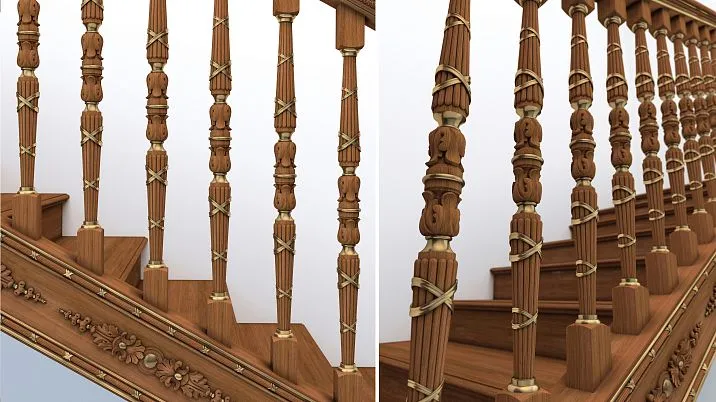
Imagine a staircase without a railing — bare steps receding into emptiness, lacking the completeness that transforms a simple structure into an architectural masterpiece. It is the balusters that give the staircase its character, safety, and unique aesthetic. But how do we turn a set of wooden elements into a harmonious system that will serve for decades?
Installing balusters is not just a technical process, but a true art requiring an understanding of materials, mastery of tools, and a sense of proportion. Each baluster must be placed in its designated position with jewel-like precision, creating rhythm and harmony throughout the entire composition. The quality of installation affects not only the appearance of the staircase but also the safety of those who will use it.


Architectural anatomy: understanding the role of each element
Balusters are vertical supports that connect steps with the handrail, creating a protective barrier and visual completion of the structure. They bear lateral loads that arise when leaning on the handrail and transmit them to the base of the staircase. Each baluster functions as a miniature column, and its installation requires the same meticulous care as constructing an ancient temple.
Properly installed balusters form a unified system where each element complements its neighbor. The distance between them should be not only safe but also aesthetically balanced. Too frequent installation creates a "picket fence" effect, while too sparse an arrangement compromises safety and disrupts proportions.




Material selection: the foundation of durability
The wood for balusters must be flawless — free of knots, cracks, and other defects. The moisture content of the material should not exceed 10-12% for interior staircases. Using inadequately dried wood will result in warping, weakened joints, and gaps in connections.
Hardwoods — oak, ash, beech — provide maximum strength and longevity but require more careful processing. Softwoods — pine, spruce — are easier to work with but less resistant to mechanical stress. Exotic woods combine beauty with exceptional performance characteristics.
Our factory also produces:


The craftsman's toolkit: precision in every movement
Quality baluster installation is impossible without professional tools. An electric drill with a set of drill bits of various diameters, a miter saw for precise trimming, a laser level for checking vertical alignment — each tool plays a crucial role in achieving the ideal result.
Special attention should be paid to the quality of drill bits. Dull or poor-quality bits may split the wood or create uneven holes, leading to weakened connections. Drill bits must be sharp, properly ground, and suitable for the specific wood species.
Get Consultation
Measuring instruments: the foundation of accuracy
A laser level allows creating a perfectly level installation line along the entire length of the staircase. This is especially important when working with long spans, where accumulated errors may result in noticeable deviations. A digital protractor will help accurately determine the trimming angles of balusters according to the staircase's slope.
A caliper is necessary for precise measurement of fastener diameters and corresponding holes. Even a deviation of a fraction of a millimeter can affect the strength of the connection.
Preparation symphony: marking as an art
Correct marking is half the success of the entire project. Start by installing the end support posts, which define the overall geometry of the railing. Between them, a control string or laser line is stretched, along which the positions for intermediate balusters are determined.
The distance between balusters is calculated based on the total span length, the dimensions of the balusters themselves, and safety requirements. The gap between adjacent elements should not exceed 120-150 millimeters to prevent slipping.
Accounting for geometric peculiarities
Every staircase is unique, and marking must account for all its features. Uneven steps, geometric deviations, wall junction characteristics — all of these affect baluster placement. An experienced craftsman always performs control measurements and adjusts the marking based on results.
Special attention is required for marking on staircase turns. Here, balusters must be positioned according to the turn radius, creating a smooth railing line without sharp angles.
Connection technologies: from classics to innovations
Connection using threaded rods: the standard of reliability
The threaded rod method is considered the most reliable and technologically advanced way to install balusters. A central hole is drilled into the end of the baluster to a depth of 60-80 millimeters, into which a metal rod with a diameter of 8-12 millimeters is inserted using epoxy glue.
The protruding part of the rod, 40-50 millimeters long, enters the corresponding hole in the tread or subbaluster. This connection ensures exceptional strength and allows balusters to be removed without damage if necessary.
Epoxy glue creates a monolithic connection between the rod and the wood, eliminating gaps and vibrations. The full curing time is 24-48 hours, after which the connection is ready to bear full load.
Connection using wooden dowels: eco-friendliness and tradition
Wooden dowels are a classic method of connection, proven by centuries of carpentry practice. Dowels are made from hardwoods and have a cylindrical shape with small longitudinal grooves to allow excess glue to escape.
The diameter of dowels is usually 8-10 millimeters, and the length is 40-60 millimeters. In the end of the baluster and in the base, coaxial holes are drilled to a depth of 25-30 millimeters each. The dowel is installed using carpentry glue, ensuring a water-resistant connection.
The advantage of this method is complete eco-friendliness and the ability to create a connection that works in harmony with the wood as it changes moisture content. The disadvantage is the difficulty of disassembly for repair purposes.
Through connection technology: hidden strength
Bolted through connection provides maximum reliability for attaching balusters to the base. The bolt passes through the entire thickness of the tread and enters the end of the baluster to a depth of 40-50 millimeters. The bolt head is embedded into the baluster wood and covered with a wooden plug.
A wide washer and nut are installed on the back side of the step, evenly distributing the load over a large area. This connection withstands significant loads and practically eliminates loosening during operation.
Chemical anchoring: the technology of the future
Modern chemical anchors are two-component compositions that polymerize directly in the hole, creating a bond stronger than the wood itself. The technology involves drilling holes of increased diameter, then introducing the chemical composition and installing the fastening element.
Full polymerization occurs within several hours, after which the connection is ready for use. Chemical anchors ensure even load distribution and eliminate stress concentration.
Mounting on various bases: versatility of approaches
Installation on wooden steps
When attaching balusters to wooden steps, it is necessary to consider the direction of the wood grain and possible seasonal deformations. Mounting perpendicular to the grain is less reliable than along the grain, so orientation of the wood fibers should be considered during marking.
Pre-drilling guide holes is mandatory for hardwoods. The hole diameter should be 80-90% of the fastener diameter, ensuring secure fixation without risk of cracking.
Mounting to concrete bases
Installing balusters on concrete bases requires using special anchor systems. Holes of 12-14 mm diameter are drilled into the concrete to a depth of 80-100 mm. A commercial vacuum cleaner or compressed air blowing is used to remove concrete dust.
Chemical anchors for concrete provide exceptional connection strength. The two-component composition is introduced into the hole using a special gun, followed by installation of a threaded rod. Setting time is 2-4 hours depending on ambient temperature.
Using baluster supports: simplification and reinforcement
A baluster support is a horizontal plank that significantly simplifies installation and increases the rigidity of the entire structure. A plank with a cross-section of 25×50 or 30×60 mm is mounted to the stair base and serves as an intermediate element for installing balusters.
The advantage of a baluster support is the ability to pre-assemble railing sections on a horizontal surface and then install ready-made blocks. This is especially relevant when working with long spans or complex staircase geometry.
Installation technology with baluster supports
The baluster support is marked according to the baluster placement and secured to the base with anchor bolts or self-tapping screws. Guide holes are drilled in the plank for baluster mounting, ensuring precise positioning.
Balusters are mounted to the baluster support using self-tapping screws from below at a 30-40 degree angle. This mounting remains hidden and does not compromise the structure's aesthetics. After installing all balusters on the support, the handrail is mounted.
Quality control: perfection in details
After completing the installation, each baluster is checked for vertical alignment using a level or plumb bob. The allowable deviation should not exceed 1-2 mm per meter of height. All connections are checked for absence of play and strength of fastening.
Special attention is paid to checking distances between balusters. Uneven spacing immediately becomes noticeable and spoils the overall impression of the staircase. Any deviations are corrected by adjusting the position of the elements.
Strength tests
The completed railing is subjected to static load testing. A horizontal force of 100-150 kg is applied to the handrail at the most heavily loaded points. The load is maintained for 5 minutes, after which deformation and loosening of fasteners are checked.
Dynamic tests simulate sudden impact on the handrail. Such loads occur in emergency situations, and the railing must withstand them without failure. Any defects identified during testing must be immediately corrected.
Final finishing: perfection in details
After mechanical installation, all connections undergo final finishing. Locations of fastener installation are carefully sanded and leveled. Wooden plugs covering bolt heads are made from the same wood species, with grain direction preserved.
End surfaces of balusters, most vulnerable to moisture, are treated with special sealants. These compounds penetrate into wood pores and create a reliable barrier against moisture penetration.
Protective treatment and decorative finishing
All wooden elements are treated with antiseptic compounds to protect against biological damage. Modern treatments provide protection for 15-20 years without reapplication.
Final finishing may include staining, varnishing, or painting depending on the design solution. When selecting finishing materials, the intensity of staircase use and requirements for coating durability are considered.
Common mistakes: learning from others' experience
One of the most common mistakes is inaccurate marking of baluster mounting locations. Accumulation of errors leads to uneven gaps and distortion of the railing geometry. To avoid this issue, precise measuring tools must be used and control measurements should be conducted.
Insufficient drilling depth for fasteners is another common error. The depth should be at least 60% of the fastener length to ensure secure fixation.
Errors in selecting fasteners
Using inappropriate fasteners can lead to catastrophic consequences. Metal screws are unsuitable for wood due to different thread pitch. Black screws are prone to corrosion and may loosen over time.
Underestimating the importance of pre-drilling in hardwoods often leads to baluster cracking. The pilot hole diameter must be carefully selected for each type of fastener.
Innovative solutions: looking to the future
Modern technologies open new possibilities for installing balusters. Hidden fastening systems allow creating connections without visible fasteners, significantly improving the structure's aesthetics.
New-generation polymer adhesives provide joint strength exceeding the strength of the wood itself. Epoxy compositions with fillers create virtually invisible seams that do not stand out against the natural material.
Digital technologies in production
CNC machines allow manufacturing balusters with perfect dimensional accuracy. This greatly simplifies installation and improves joint quality. Laser measurement systems provide geometric control accurate to tenths of a millimeter.
3D modeling allows calculating all installation parameters in advance and identifying potential issues during the design phase. Virtual assembly helps optimize the installation technology and minimize material waste.
Economic aspects: investment in quality
Correct baluster installation on stairs — is an investment in the long-term operation of the structure. High-quality materials and professional installation pay off through minimal maintenance and repair costs.
Saving on fasteners may lead to catastrophic consequences. Emergency repair costs are dozens of times higher than the cost of quality initial installation. Moreover, reliable stair railings increase property value.
Life cycle analysis
When planning the budget, it is necessary to consider the total cost of ownership, including initial costs, operating expenses, and disposal costs. Properly installed balusters require virtually no maintenance for 20-30 years.
Using standardized elements simplifies logistics and reduces the likelihood of errors. Standardizing fastener dimensions allows creating warehouse stock and ensures quick replacement when needed.
Features of installation under various conditions
Working in confined spaces
Installing balusters in already finished rooms requires special care and use of specialized tools. Angle drills and compact impact drivers allow working in limited spaces without damaging surrounding surfaces.
Protective films and cardboard protect finished surfaces from contamination and mechanical damage. Industrial vacuum cleaners with HEPA filters ensure a clean work area and protect respiratory organs from wood dust.
Installation in high humidity conditions
Stairs in saunas, steam rooms, and other high-humidity areas require special attention to material selection and installation technology. All metal components must have anti-corrosion coating or be made of stainless steel.
Wood must be pre-treated with deep-penetration moisture-protective compounds. Adhesive joints are made with water-resistant compounds resistant to steam and condensation.
Conclusion: craftsmanship as a philosophy of life
The art of installing balusters is not merely a set of technical skills, but a philosophy of responsibility toward those who will use the stairs. Every joint must be executed as if its safety depends on the most precious people.
Modern technologies open boundless opportunities for creativity, but the foundation remains fundamental principles: understanding the material, respecting traditions, and striving for perfection. Only the combination of deep knowledge with practical experience allows creating masterpieces that will serve generations.
The path to mastery lies through continuous learning and experimentation. Each project is an opportunity to discover something new, refine the technology, find a more elegant solution. This is the beauty of the profession — the endless pursuit of the ideal.
For many years, STAVROS has remained a benchmark of quality in stair construction. Our specialists master all modern installation technologies and continuously refine their skills. Choosing STAVROS means investing in safety, beauty, and longevity, with the guarantee that your staircase will delight the eye and provide absolute reliability for many years.