Article Contents:
- Massiveness as a Style
- Oak Beam — Visual Weight and Stability
- Beech Beam — Moderate Expressiveness
- Planks — Structuring Large Zones
- Oak Laying — Graphic Emphasis
- Wooden Profile — Smooth Transitions
- Skirting Board — Finishing Element
- Compositions with Large Scale
- Massiveness in Different Interior Styles
- Technical Aspects of Using Massive Elements
- Ecological and health-preserving aspects
- Frequently Asked Questions
- Conclusion

Modern design is paradoxical: in an era of weightless structures, glass partitions, and minimalist lightness, the demand for massiveness, for weight, for material presence in space is growing louder.Oak beamIn interior design — this is not a return to antiquity, but a conscious choice for those seeking stability, solidity, and a connection to the natural power of wood. Massive elements create visual anchors in space, points of support for the gaze and psyche, architectural weight that is so lacking in lightened modern interiors.
Why is massiveness returning? Because humans need a material environment that can be felt, sensed for its weight, its presence.Oak timber beamOn the ceiling, massiveWooden baseboardAt the floor, expressiveOak veneerOn the wall — all this creates a sense of reliability, rootedness, home as a fortress protecting from external chaos.



Massiveness as a Style
Massiveness is not just about the size of elements. It is a design philosophy where material is not hidden but displayed, where the thickness of the beam, the texture of wood, the weight of the structure become the main expressive means. Unlike elegance, which is achieved through refinement of forms, massiveness is created through enlargement, strengthening, and emphasizing materiality.
Historical roots of the massive style go back to castle, fortress, and old estate architecture, where structural beams, support columns, and heavy doors were not just functional elements but also symbols of reliability. TodayWood TrimMassive sections in modern interiors perform the same role — creating a sense of fundamentality, durability, solidity.
Modern interpretation of massiveness differs from historical. Today, massive elements are used not as a constructive necessity but as a design solution. Beams on the ceiling may be purely decorative, but their visual weight creates the desired atmosphere.wooden boards and beamsLarge-section elements on the wall do not bear loads, but they structure space, create rhythm, scale.
Massiveness works through contrast. In a modern minimalist interior, where clean planes and emptiness dominate, one massive element — a wooden beam, a beam, a wide skirting board — becomes a powerful accent, a focal point. This contrast between lightness and weight creates visual tension, interest, depth of composition.
Psychologically, massiveness is perceived as protection, reliability, stability. In an unstable, rapidly changing world, an interior with massive wooden elements becomes a refuge, a place where everything is solid, secure, and long-lasting. This is not a trend, but a deep psychological need for material supports.
The scale of massive elements should correspond to the size of the room. In a small room, an overly massive beam may overwhelm the space, making it feel cramped. In a large hall, thin elements will disappear, failing to create the desired effect.Buy oak beamsThe required section — this is a question of precise proportion calculation.
The color of massive elements affects their perception. Dark oak creates maximum visual weight, graphic quality, contrast. Light beech — a softer, warmer massiveness. Natural wood without staining creates organic, natural solidity. The choice depends on the desired atmosphere.
Combining massiveness with other materials expands possibilities. Wood and concrete — industrial loft aesthetics. Wood and glass — contrast of weight and lightness. Wood and metal — alliance of natural and industrial. Wood and stone — archaic power, connection to primal elements. Each combination creates its own imagery.
The texture of massive elements enhances their expressiveness. Roughly sawn beams with visible saw marks, brushed surfaces revealing texture, natural knots and cracks — all of this emphasizes the material's natural origin and its living history. Such texture creates tactile interest, a desire to touch and feel the wood.




Oak beam — visual weight and stability
Oak is the king among species for massive elements. Its dense structure, expressive texture, and ability to bear heavy loads make oak beams ideal for creating a sense of monumentality.Oak beamIt is not just a building material — it is a symbol of strength, durability, and immovability.
The visual weight of oak beams is created by several factors. First, its color — even light oak has a certain saturation, while dark stained oak creates almost black mass. Second, texture — clear growth rings and expressive grain patterns make oak visually dense and full. Third, the very knowledge of oak’s density influences perception — we know oak is heavy, and this knowledge is projected onto visual perception.
Ceiling beams made of oak — a classic approach to creating massiveness. They can be structural, actually supporting the ceiling, or decorative, mounted on an existing ceiling. In both cases, their presence fundamentally changes the perception of space. The room acquires vertical division, rhythm, and architectural structuring.
The placement of beams determines their visual effect. Beams running along the long side of the room emphasize length and elongate the space. Beams across the room divide it into zones, creating a transverse rhythm. Intersecting beams form a coffered ceiling, which creates maximum architectural expressiveness.
The spacing between beams affects the character of the space. Frequent spacing — 1–1.5 meters — creates a dense rhythm, intimacy, and coziness. Sparse spacing — 2.5–3 meters and more — creates a sense of spaciousness, monumentality, and significance. The choice of spacing depends on the room’s size and desired atmosphere.
The cross-section of oak beams for beams typically ranges from 100×100 mm to 200×200 mm and more. The larger the cross-section, the more pronounced the massiveness. In high rooms, large beams are appropriate; in low rooms, more moderate-sized beams are suitable. The proportion of the beam to the room’s height — a key parameter for harmonious composition.
The finishing of oak beams can vary. Smoothly planed and oiled beams create a noble, restrained massiveness. Roughly processed beams with visible marks from a saw or plane create a rustic, brutal atmosphere. Brushed beams with revealed texture — a middle ground, combining expressiveness with elegance.
Color treatment of oak beams expands the range of possibilities. Natural light oak creates a warm, organic massiveness. Oak toned in gray tones — modern, urban. Stained black oak — dramatic, contrasting. The choice depends on the overall color concept of the interior.
Oak support columns — another way to introduce massiveness. Even if structurally unnecessary, their decorative use creates vertical accents, divides space, and creates a sense of reliable structural foundation. Columns can frame doorways, zone open spaces, and support (real or visual) ceiling beams.
Horizontal elements made of oak beams — wall paneling, heavy window sills, countertops — create horizontal massiveness. This is a different effect than vertical elements. Horizontal massiveness creates a sense of solidity, grounding, and connection to the earth. This is especially suitable for ground-level areas of rooms, in relaxation zones.
Our factory also produces:


Beech beam — moderate expressiveness
If oak is maximum expressiveness and visual weight, thenOak timber beamrepresents a more moderate approach to massiveness. Beech is dense and hard, not inferior to oak in strength, but its texture is more subdued, uniform, without clearly defined growth rings. This makes beech beams ideal for interiors where massiveness is needed without excessive ornamentation.
The color of beech — light, with a pink or yellowish tint — creates a warm, cozy atmosphere.Beech beam for lathingFor interior design — choose noble restraint, elegant massiveness without loud ornamentation. This is a choice for modern interiors where clean lines and calm color palettes are important.
Beech ceiling beams create structure without overpowering space. The light tone of beech is less contrasting against white or light ceilings than dark oak, so beech beams are perceived as softer, more delicate. This is suitable for living rooms, bedrooms, children’s rooms, where drama is not needed, but coziness and calm are important.
The texture of beech, upon close inspection, is very interesting — small specks, radial highlights on radial cuts create subtle play of light. This texture works at close distances, creating tactile interest. Beech beams used in accessible zones — framing doors, as railings, window sills — are pleasant to the touch, warm, and alive.
Beech is easy to work with, allowing the creation of elements with complex profiles. Bevels, rounded edges, decorative cuts on beech beams are executed cleaner and more precisely than on oak, with its larger texture. This opens opportunities for creating massive elements with elegant details.
Staining beech expands its color palette. Beech takes stains and toning oils beautifully, allowing shades from light honey to dark chocolate. At the same time, its calm texture does not become busy, preserving noble restraint. Toned beech beams can imitate more exotic species while retaining the advantages of beech’s accessibility and strength.
Combining beech with other materials creates interesting effects. Beech and white walls — Scandinavian lightness with warm accents. Beech and gray concrete — modern urbanism with natural warmth. Beech and glass — union of massiveness and transparency. Beech and metal — industrial aesthetics with organic notes.
Economic feasibility of beech — an important factor. With comparable strength characteristics to oak, beech is usually more affordable. This allows using massive beech elements in greater quantities, creating a rich wooden environment without excessive budgets.Oak timber beam— a sensible choice for large-scale projects.
Vertical beech elements — columns, pilasters, vertical beams — create elegant spatial structuring. The light tone of beech does not divide space as aggressively as dark oak, creating a softer, more comfortable zoning. This is especially important in studio apartments, where functional zones need to be divided while preserving a sense of openness.
Horizontal use of beech beams — as shelves, countertops, framing — demonstrates its practicality. Beech is resistant to wear, does not fear loads, and retains its shape under humidity changes. A massive beech countertop can serve for decades, acquiring noble patina.
Get Consultation
Rafter beams — structuring large zones
When a massive beam is too dominant, but a thin rafter is not expressive enough, an intermediate solution —wooden boards and beamsof medium section, usually from 30×30 to 60×60 mm. These elements are sufficiently massive to create structure, but not so heavy as to overwhelm space.
Lattice strips are ideal for creating grid structures, partitions, decorative panels. They can be arranged vertically, horizontally, diagonally, forming geometric patterns. Such constructions zone space without creating solid walls, preserving visual permeability, air and light circulation.
Vertical strips on the wall create a rhythmic structure that directs the gaze upward. This visually increases the room's height, creating a sense of slenderness and upward movement. The frequency of strip placement determines the rhythm's character: frequent spacing creates a dense, almost solid surface; sparse spacing creates a graphic, minimalist structure.
Horizontal strips create the opposite effect — they expand space, making it more spread out and calm. This is suitable for rooms with excessive height, where a more intimate atmosphere is needed. Horizontal strips are also associated with traditional wooden facades, introducing architectural historicism into the interior.
Crossed strips form lattice structures — trellises — that can be used as decorative panels, partitions, or cabinet facades. The geometry of the lattice — square, rhombic, with variable spacing — creates various visual effects. Such lattices play with light, casting interesting shadows.
Three-dimensional lattice structures made of strips create the maximum architectural effect. These can be volumetric partitions, ceiling structures, or zoning elements. Such structures work through transparency, creating a play between transparency and mass, lightness and weight.
Color solutions for strips determine their role in the interior. Natural wood creates an organic, natural structure. Strips painted to match wall color work more delicately, creating a subtle volumetric texture. Contrasting strips — black on white, white on dark — create maximum graphic impact.
Strip installation can vary. Surface mounting, where strips are attached over the main wall, creates depth and volume. Built-in mounting, where strips are inserted flush into a frame — offers a flatter, yet no less expressive effect. The choice depends on the desired degree of volume.
The functionality of strips is not limited to decoration. Lighting can be placed between them, creating a play of light and shadow. Lattice structures can serve as a base for vertical greenery, where planters are placed between strips. Strips can also support shelves and hooks, creating a functional storage system.
The acoustic properties of lattice structures made of strips improve the sound environment of a room. Wood absorbs sound, and the multiple ribs of the strips break up sound waves, preventing echoes. This is especially valuable in large open spaces, where acoustics are typically problematic.
Oak lattice — graphic emphasis
If the beam creates mass, thenOak veneercreates graphics. Lattice — this is a relatively thin strip, usually with a cross-section from 10×20 to 30×50 mm, which is laid over the surface of walls, doors, furniture, creating a linear structure. Oak lattice, thanks to the expressive texture of oak, creates not just lines, but materially perceptible, textured boundaries.
Geometric panels made of oak lattice — a classic technique for creating structure on flat walls. Rectangles, squares, complex polygons outlined by lattice transform the wall into an architectural composition. Inside the frames, contrasting finishes, wallpaper, or fabric can be used, creating additional texture and color play.
Symmetrical compositions made of lattice create a classic, orderly image. A central axis of symmetry, mirrored panels create a calm, balanced picture. This is suitable for formal rooms, living rooms, offices, where representation and traditional elegance are important.
Asymmetrical compositions made of lattice introduce modernity and dynamism. Panels of different sizes, offset from the center, create visual movement. This approach is suitable for modern minimalist interiors, where classical symmetry may appear outdated.
Vertical lattice creates rhythm, direction upward. Frequent vertical lines visually increase the room's height, creating slenderness and upward movement. This is especially valuable in rooms with low ceilings, where every trick to increase visual height is important.
Horizontal lattice works oppositely — it expands space, creates calmness, horizontality. The classical division of a wall into three zones — plinth, main, and frieze — is realized using horizontal lattices, which separate these zones from each other.
The texture of oak on lattice creates additional visual interest. Expressive growth rings, play of light on fibers make oak lattice not just a geometric line, but a living, natural element. Especially effective is brushed oak lattice, where the texture is maximally revealed.
Color solutions for oak lattice vary from light natural oak to black stained. Light lattice on a light wall works delicately, through play of volume and light. Dark lattice on a light wall creates maximum contrast, graphic impact. Lattice in the same tone as the wall is visible only through volume and shadows.
Connections of lattices at corners require precision. Beveled joints at 45 degrees with perfect texture alignment — a sign of master craftsmanship. Surface-mounted corner elements, sockets simplify installation, simultaneously becoming additional decorative accents.
Combining lattices of different widths creates an element hierarchy. Main frames are marked by wider lattice, internal divisions — by narrower. This play of scales creates richness of composition, visual depth.
Wooden profile — smooth transitions
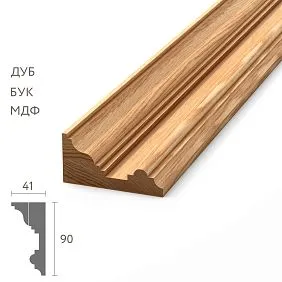
If lattice creates graphic lines, thenProfile made of woodcreates smooth transitions, soft boundaries, volumetric plasticity. Profile — this is an element with a complex cross-section, featuring moldings, curves, grooves. This complexity of form creates rich play of light and shadow, volume, classical plasticity.
Door profiles — frames for door casings — create an architectural frame for the opening. A complex profile with multiple steps, curves transforms a simple rectangular opening into an architectural portal. This is especially important in classical interiors, where the door should not be merely a functional element, but part of the architectural composition.
Ceiling profiles — cornices, moldings — create a transition from wall to ceiling. A complex profile with moldings softens the sharp angle, introducing plasticity, classical elegance. The more complex the profile, the richer the play of light on its surface, the more expressive the element.
Baseboard profiles work similarly, creating a transition from wall to floor. A classic baseboard with an upper molding, central bead, and lower curve — this is a set of elements, each playing its role in the overall plasticity. Such a profile has visual weight, presence, it does not merely cover the joint, but creates an architectural element.
Wall profiles — moldings framing panels, mirrors, paintings — create an additional frame, enhancing the significance of the framed object. The profile is thicker and more expressive than simple lattice, creating a richer, classical aesthetic.
Gradation of profiles from simple to complex allows creating an element hierarchy. Main architectural lines — door frames, ceiling cornices — are executed with complex, expressive profiles. Secondary elements — internal lattices, small frames — are executed with simpler profiles. This hierarchy creates visual order, clarity of composition.
Historical profiles — repeating classical orders, baroque plasticity, Renaissance motifs — create a connection with architectural tradition. Using such profiles in a modern interior — this is a dialogue with history, respect for past craftsmanship, creating space with cultural depth.
Modern profiles — geometrically pure, with minimal ornamentation — create a current aesthetic. A simple rounded profile, a 45-degree bevel, a minimalist step — these elements work in modern interiors where classical opulence is inappropriate.
Combining profiles of different complexity creates richness while maintaining unity. All profiles can be made from the same wood species and color, but differ in the degree of cross-section complexity. This creates visual variety while preserving material uniformity.
Profile finishing affects their expressiveness. A smoothly polished profile creates classic elegance. A patinated profile with dark tones in recesses emphasizes relief, creating an effect of antiquity. A gilded or silvered profile adds luxury and grandeur.
Baseboard — the finishing element
Wooden baseboard— is the final touch, completing the interior composition. Without a baseboard, the space appears unfinished, floating, lacking support. A solid wooden baseboard creates a visual foundation, the base on which "the entire interior stands."
The height of a solid baseboard starts at 10 cm and can reach 20–25 cm in rooms with high ceilings. Such a baseboard is not merely a technical detail covering the junction between wall and floor, but a full architectural element creating a plinth zone. Visually, it lifts the wall, creating a sense of solidity.
The profile of a solid baseboard can vary. A classic profile with an upper molding, central round, and base creates traditional plasticity. A modern profile with straight angles and minimal rounding creates a concise, current aesthetic. The choice depends on the overall interior style.
The color of the baseboard is critically important for the perception of space. A baseboard in the color of the floor visually expands the floor plane, making the room appear more spacious. A baseboard in the color of the walls makes the walls appear taller and slimmer. A contrasting baseboard — dark on light or vice versa — creates a clear boundary, graphic effect.
The material of the baseboard must match the overall material palette of the interior. An oak baseboard in an oak floor interior creates absolute unity. A beech baseboard with oak doors creates a play of tones while preserving a wooden theme. A tinted baseboard allows precise color matching.
Installing a solid baseboard requires professionalism. The baseboard must fit tightly against the wall and floor without gaps. Corners must be perfectly mitered, and profiles must align. Any carelessness is immediately noticeable and spoils the impression of the entire interior.
The functionality of a solid baseboard extends beyond decoration. Cables can run inside the baseboard, allowing wiring to be concealed. Modern baseboards may include built-in cable channels, combining classic aesthetics with contemporary requirements.
Connecting the baseboard to door casings is an important detail. The baseboard may simply butt against the casing, have a special miter, or transition into a unified base with the casing. The latter option creates architectural integrity, the impression that the casing grows out of the baseboard.
Ceiling baseboard — the mirror image of the floor baseboard — creates the upper frame of the space. When both floor and ceiling solid baseboards are present, the room acquires a completed compositional frame. This is especially effective in high, grand spaces.
Decorative elements on the baseboard — carved inserts, appliqués, corner outlets — transform the baseboard into a work of decorative art. In classical interiors, such details create luxury, richness, and a connection to historical tradition.
Compositions with large scale
Creating compositions from massive elements requires understanding of scale, proportions, and visual weights. When all elements are large, it is important not to create overload, chaos, or visual heaviness. The composition must be balanced, where massiveness creates strength, not pressure.
The principle of dominance — in a composition, there must be a main element that sets the tone. This may be a massive beam on the ceiling, a large door portal, or an expressive wall panel. Other elements subordinate to this dominance, complement it, without competing for attention.
The rhythm of massive elements creates the structure of space. Uniform rhythm — beams with equal spacing, columns at equal distances — creates calmness and predictability. Variable rhythm — with changing spacing — creates dynamism and musicality. The choice depends on the desired character of the space.
The contrast between massive and light elements enhances both qualities. A massive wooden beam against a white suspended ceiling appears even more substantial. A glass wall next to a beech column emphasizes the lightness of glass and the monumentality of wood. This play of contrasts creates visual tension and interest.
The color contrast between massive elements and their background determines their visibility. Dark elements on a light background are most noticeable, creating a graphic composition. Light elements on a light background are visible due to volume, play of light and shadow. Elements in the same tone as the background create a subtle, delicate structure.
Spatial depth is created by placing elements on different levels. Ceiling beams, wall panels, floor elements — each level creates its own plane. The interaction of these planes, their intersections, coincidences, or divergences create spatial complexity.
Symmetry and asymmetry in compositions of massive elements create different effects. Symmetrical composition — mirror-placed beams, symmetrical wall panels — creates classical order. Asymmetrical composition — shifted elements, unequal gaps — creates modern freedom.
Scale gradation — using elements of different sizes — creates visual hierarchy. Large beams with a 200×200 mm cross-section may be complemented by 100×100 mm beams and 50×50 mm strips. This gradation creates richness of scale while maintaining material unity.
Functional integration of massive elements increases their value. A beam may carry lighting, a beam may serve as a shelf, a panel may be a handle. When a massive element is not only beautiful but also useful, it is perceived as necessary, not merely decorative.
Seasonal changes in wood must be considered in compositions. Massive elements may slightly change size with humidity changes. Technological gaps, elastic connections, and proper wood treatment allow avoiding deformations and cracks.
Massiveness in different interior styles
Massive wooden elements are universal — they work in the most diverse stylistic contexts, from rustic to modern minimalism. The only thing required is to properly adapt the character of massiveness to a specific style.
In the loft style, massive wooden beams, beams, rough planks create an authentic industrial atmosphere. Unfinished, aged wood with cracks, knots, and traces of old fasteners tells a story. Combining massive wood with brick walls, concrete, and metal structures creates classic loft.
In Scandinavian style, massiveness is used sparingly. Light beech or pine beams on a white background create structure without heaviness. Massive elements in light tones preserve Scandinavian lightness, adding natural warmth and texture.
In classical style, massive elements must have noble finishing. Smoothly planed oak beams, oiled or varnished, complex profiles, decorative details create classic luxury. Symmetry of compositions, order system, historical profile styling — all this is characteristic of classicism.
In chalet style, massiveness reaches its maximum. Large beams, log walls, heavy doors and shutters create the atmosphere of a mountain house. Rough processing, natural wood tones, abundance of wood in all elements — characteristic features of chalet style.
In Japanese style, massiveness is balanced by emptiness. Heavy wooden beams frame empty spaces, creating a frame for emptiness. Dark wood contrasts with light walls, creating a graphic composition. Minimal decoration, maximum expressiveness of the material.
In eco-style, massive wooden elements are a manifesto of ecologicalness. Unprocessed or minimally processed wood, preserving natural texture, knots, irregularities, demonstrates respect for nature. Combination of wood with stone, plants, natural fabrics creates an organic environment.
In modern minimalism, massiveness works through contrast. A few large wooden elements in a maximally clean space create strong accents. Geometric purity of forms, absence of decoration, perfect execution — requirements of minimalism for massive elements.
Technical aspects of using massive elements
Massive wooden elements require a special approach to design and installation. Weight, dimensions, characteristics of wood as a living material — all of this must be considered.
Load-bearing capacity of floors is critical when using massive elements. An oak beam with a 200×200 mm cross-section and 6 meters long weighs about 300 kg. If there are several such beams, the load on the floor is significant. Calculation and consultation with a structural engineer are required.
Fastening of massive elements must be secure and invisible. Hidden brackets, metal bolts embedded in wood, chemical anchors — modern technologies allow safely and aesthetically fastening heavy elements. Visible fasteners can become part of the design in industrial aesthetics.
Humidity of wood for massive elements must be stabilized. Kiln drying to 8-12% humidity is mandatory. Under-dried wood will dry out, leading to cracks, warping, and splitting. Over-dried wood will absorb moisture, also causing deformations.
Treatment of massive elements with protective compounds extends their lifespan. Antiseptics protect against mold, fungi, insects. Fire-retardant compounds increase fire resistance. Finish coatings — oils, waxes, varnishes — protect surfaces from dirt, moisture, and abrasion.
Transportation of massive elements requires care. Long beams, heavy timbers must be transported on specialized vehicles, protected from impacts and scratches. Lifting to upper floors may require special equipment, especially in historic buildings with narrow staircases.
Storage of massive elements until installation must be correct. Horizontal placement with supports at equal intervals prevents sagging. Protection from direct sunlight, precipitation, and sharp temperature changes is mandatory. Acclimatization indoors before installation — several days under future operating conditions — reduces the risk of deformation.
Installation of massive elements requires special tools and expertise. Circular saws with powerful motors, routers for cutouts, lifting equipment for heavy elements — all of this is necessary. Experience working with solid wood is critically important for quality results.
Joining massive elements end-to-end requires special solutions. Lap joint, dowel joint, metal plate connection — each method has its advantages. It is important that joints are strong and inconspicuous or, conversely, become part of the design.
Ecological and health-preserving aspects
Massive wood in interior design is not just aesthetics — it is a contribution to ecologicalness and health of inhabitants. Wood is a renewable material, and its harvesting, when done responsibly, does not harm nature.wooden molding by the meterMade from responsibly harvested timber — this is an eco-friendly choice.
Wood’s carbon footprint is minimal. Wood absorbs CO2 during growth, and this carbon remains bound in wood for decades. Unlike plastics, concrete, and metals, whose production involves massive emissions, wood is a carbon-neutral or even carbon-negative material.
Absence of toxic substances — an important advantage of natural wood. When using safe finish coatings — oils, natural waxes — wooden elements do not emit volatile organic compounds, formaldehyde, or other toxins. This is critically important for people with allergies, asthma, or chemical sensitivities.
Humidity regulation — a unique property of wood. Massive wood absorbs excess moisture when humidity rises and releases it when it falls, stabilizing the microclimate of the room. This creates a more comfortable and healthy environment, especially important in bedrooms and children’s rooms.
Some wood species have antibacterial properties that suppress bacterial growth on surfaces. This is especially pronounced in coniferous species, but broadleaf species also possess certain antimicrobial activity. Wooden surfaces are more hygienic than plastic ones with proper care.
The psychological impact of wood has been studied extensively. Presence of wood in interior design reduces stress, improves mood, enhances cognitive functions. This is linked to the evolutionary connection between humans and nature — we instinctively feel safer and more comfortable in environments with natural materials.
Durability of massive wooden elements makes them a sustainable choice. Unlike short-lived synthetic materials requiring frequent replacement, quality wooden elements serve for decades, often outlasting generations. This reduces resource consumption, waste, and ecological footprint.
The possibility of repairing and restoring wooden elements extends their lifespan. Scratches can be sanded, dull surfaces — refreshed with oil, damaged areas — replaced. Wood forgives mistakes, allows correction and renewal, unlike many modern materials.
Biodegradability of wood at the end of its life cycle means no long-term waste. Wooden elements after dismantling can be recycled, reused, or simply composted, returning to the natural cycle. This closes the ecological loop.
Frequently asked questions
What is the optimal cross-section for ceiling beams in a standard apartment?
For standard apartments with ceiling heights of 2.7–3 m, the optimal beam cross-section is 100×100 or 120×120 mm. This size creates visual massiveness without overpowering the space.Oak beamSuch a cross-section is sufficiently expressive but does not steal visual height from the room. For high ceilings of 3.5 m and above, larger sections like 150×150 or 200×200 mm can be used.
Can oak and beech beams be combined in one interior?
Yes, but it is important to properly match the shades. Light beech pairs well with light oak, creating a warm wooden palette. If the shades contrast, it is better to use the species in different functional zones.Beech beam for lathingFor one zone, use oak; for another, beech — such zoning works organically.
Is special treatment required for large wooden elements in residential spaces?
Antiseptic treatment and finishing coating are required. Antiseptic protects against mold and insects. Finishing coating — oil, wax, or varnish — protects surfaces from dirt and moisture. Fire-retardant treatment is recommended, especially for ceiling elements, but not mandatory in residential spaces.
How often should oil coating on large elements be renewed?
Ceiling beams and high-mounted elements require renewal every 5-7 years.wooden boards and beamsOn walls in inaccessible areas — every 3-5 years. Elements subject to frequent contact — handrails, window sills — require renewal every 2-3 years.
Do large elements affect room acoustics?
Yes, positively. Wooden elements absorb sound, reduce echo, and create a more comfortable acoustic environment. Voluminous profiles and latticed structures made of solid wood beams are especially effective in improving acoustics in large rooms.
What is the minimum budget needed to create an interior with large elements?
The budget depends heavily on the project scale and wood species. For a 20 m² room, the minimum budget for basic large elements (a few beams, wide baseboards, planks) starts at 50-70 thousand rubles using beech. Oak elements increase the budget by 30-50%.
Can large elements be used in small rooms?
Yes, but with caution. In small rooms, it’s better to use large elements locally — one or two beams, wide baseboards, a small panel of planks. Excessiveness in small spaces creates a feeling of confinement. Light wood tones work better in small rooms than dark ones.
How to choose between oak and beech for large elements?
Oak — for maximum expressiveness, traditional aesthetics, durability.oak lumberCreates a classic, solid look. Beech — for restrained elegance, light palette, modern aesthetics. Beech is also more affordable at comparable strength characteristics.
Do large elements require special care?
Care is simple: regular dusting, periodic oil coating renewal, humidity control in the room (optimal 40-60%). Avoid direct water contact and sharp object scratches. With proper care, large elements last for decades.
Can large elements be installed by oneself?
Theoretically possible with carpentry skills and tools. However, installing heavy beams, precise profile cutting, and secure mounting require professional experience. Installation errors can be dangerous (falling poorly secured beams) or ruin aesthetics. It’s better to entrust the work to professionals.
Conclusion
Large wooden elements in modern interiors are not nostalgia for the past, but a current choice for those who value materiality, reliability, and connection to nature.Oak beamandOak timber beamThey create architectural weight, visual supports in space, a sense of stability and longevity.
Correct use of large elements requires understanding of proportions, scale, and balance.wooden boards and beamsThey structure large zones,Oak veneerthey create graphic clarity,Profile made of woodthey ensure smooth transitions, andWooden baseboardthey complete the composition from below, creating a visual foundation.
Large elements are versatile — they work in lofts and classic styles, Scandinavian minimalism and alpine chalets. The only thing that matters is correctly adapting the character of massiveness to a specific style, choosing the right wood species, treatment, and color.
The ecological advantages of natural wood, its ability to improve microclimate, and its positive effect on psychological state make large wooden elements not just a design solution, but a contribution to a healthy living environment. The durability of solid wood, possibility of repair and restoration make such interiors a sustainable choice that will last for decades.
Company STAVROS specializes in producing high-qualitywooden moldingsolid-section elements. We offer a full range of elements for creating interiors with a solid aesthetic: from large beams and beams to profiled planks and wide baseboards. Our production is equipped with modern equipment, ensuring precision in dimensions and high-quality processing.
STAVROS offers products made of oak and beech — species ideally suited for large elements. Oak provides maximum texture expressiveness and durability, while beech offers noble restraint and affordability. We control the entire production cycle: from wood selection and drying to final processing and packaging.
Our specialists will help you select elements of the required cross-section for your project, calculate the necessary amount of material, recommend optimal processing and finishing coatings. We work with private clients as well as design studios, architectural offices, and construction companies.
wooden molding by the meterBeams of various cross-sections, profiled elements, heavy-duty baseboards — the entire necessary assortment is presented in the STAVROS catalog. We offer both standard sizes and custom manufacturing according to individual specifications.
Wood quality is our priority. We use kiln-drying to an optimal moisture content of 8-12%, which guarantees dimensional stability and absence of deformation during use. Treatment with antiseptics and finishing coatings using oils or varnishes are performed according to European quality standards.
Delivery is available throughout Saint Petersburg, Moscow, and all of Russia. We carefully package heavy elements, ensuring protection against damage during transport. Careful handling of materials at every stage — from production to delivery — is our guarantee that you will receive the product in perfect condition.
STAVROS pricing policy is transparent and fair. We offer the optimal price-to-quality ratio, working directly as manufacturers without intermediary markups. Regular promotions and discounts on large orders make our products accessible for large-scale projects.
Consultative support is an essential part of our service. STAVROS managers will help you choose the appropriate wood species, element cross-section, and type of treatment, taking into account the specifics of your project. We share our experience accumulated over years of work, helping you avoid mistakes and achieve the best results.
Choosing STAVROS means choosing a reliable partner in creating interiors with a solid wood aesthetic. We help bring your projects to life, where wood reveals its natural strength, texture, and elegance. STAVROS heavy elements are the foundation of interiors that serve for decades without losing beauty or functionality.
Create spaces with character, history, and soul. Let heavy wooden elements become the foundation of your home, its visual supports, symbols of stability and connection with nature. STAVROS — your reliable partner in the world of natural wood.