Article Contents:
- St. Petersburg Round Molding — The Foundation of Staircase Aesthetics and Safety
- Why Round Profile, Not Square or Oval?
- Wood Species for Round Molding
- St. Petersburg Wooden Balusters — The Vertical Graphics of a Staircase
- Types of Balusters by Manufacturing Method
- Baluster Installation: Spacing and Height
- Store of Very Rare Interior Decor — Where to Find Unique Pieces
- Collector's Series and Author's Designs
- Restoration Decor — Accurate Reproduction of Historical Samples
- Using Round Molding in Interiors Beyond Staircases
- Wall-Mounted Handrails for Safety and Convenience
- Decorative Elements and Furniture Details
- Curtain Rods Made from Round Molding
- The Process of Selection and Purchase at the St. Petersburg Interior Decor Store
- Step 1: Defining interior style
- Step 2: Choosing the Wood Species
- Step 3: Calculating the Amount of Material
- Step 4: Choosing the Finish
- Step 5: Delivery and Storage
- Answers to popular questions
- What Diameter of Round Molding to Choose for a Staircase in a Private House?
- Can Wooden Molding Be Used Outdoors?
- How Much Do Wooden Balusters and Round Molding Cost in St. Petersburg?
- How to Care for Wooden Handrails and Balusters?
- How to Choose the Spacing for Baluster Installation?
- Can Wooden Balusters Be Combined with Metal or Glass Elements?
- How to Order a Custom Baluster Design?
- Conclusion: Quality Tested by Time and Palaces

Where to find elements that turn standard housing into a work of art? Where to find details that architects whisper about, knowing they are the secret ingredient of a project?Interior Decor Shopin St. Petersburg is not just a retail point with shelves of goods; it is a space of possibilities where craftsmanship, traditions, and vision meet. When it comes to round molding for staircases or carved wooden balusters, the choice becomes a strategic decision that defines the character of the entire interior. Wood is not a background but the main protagonist, especially when processed by the hands of professionals trained in palace restoration schools.
St. Petersburg is a city where historical architecture sets the standards of quality. It's impossible to deceive the eye here: people have grown up among palaces, mansions, and grand staircases with stucco and carvings.Interior decor salonin the Northern capital must meet this level, offering not just products, but elements capable of fitting into a context where every detail is visible, every mistake is noticeable. This is why solid wood round handrail and balusters remain unsurpassed: they carry warmth, texture, living matter that cannot be faked with synthetics.



Round handrail SPB — the foundation of staircase aesthetics and safety
Round handrail SPBis a cylindrical profile made of solid wood, used as handrails for stairs, terrace railings, and interior decorative elements. The diameter varies from 30 to 60 millimeters, but the most in-demand size is 50 millimeters — the golden mean, providing a comfortable grip for an adult's palm. This size is not accidental: ergonomic studies have shown that at a 50 mm diameter, the fingers form the most reliable grip without muscle strain, which is critical for safety when moving on stairs.




Why a round profile, and not square or oval?
A round handrail cross-section has no sharp edges that dig into the palm during prolonged contact. Imagine: you're climbing to the third floor, holding onto a square handrail — after a few steps, your palm begins to feel the pressure of the profile's edges. With a round handrail, the contact is even, pressure is distributed across the entire gripping surface. An oval profile is theoretically close to round in comfort, but less versatile: the grip is comfortable only with a certain hand position. A round profile is equally comfortable regardless of the angle of force application — you can grab the handrail from above, from the side, from below, and each time you'll get reliable support.
Production of round handrail is technologically simpler than manufacturing shaped profiles, which positively affects cost and accessibility. Woodturning is an ancient craft, refined over centuries. Modern CNC lathes perform turning with perfect repeatability, creating cylinders of a strictly specified diameter with a tolerance of less than a millimeter. After turning, the handrail is sanded with abrasives of varying grit — from coarse 80 grit to remove tool marks to finishing 320 grit to create a velvety surface.Round trim buy St. Petersburgmeans receiving a product that has passed multi-stage quality control at every stage.
Our factory also produces:


Wood species for round handrail
The choice of wood species determines not only the visual characteristics of the handrail but also its durability, load resistance, and ability to maintain geometry with changes in humidity and temperature.
Oak — the uncompromising classic. Density 700–900 kilograms per cubic meter, Brinell hardness 3.7–3.9 units. An oak handrail doesn't just hold weight — it holds it with dignity, not sagging under a load of 100 kilograms on a one-meter span between fastenings. Oak texture is expressive: large pores, contrasting annual rings, medullary rays creating a characteristic 'silver mirror' pattern on a radial cut. Oak is practically not subject to rot due to high tannin content — tannic substances that nature used as protection from pests. Over time, oak darkens, acquiring a deep brown shade with a noble patina.
Beech — the balance of price and quality. Density 650–750 kilograms, hardness 3.6–3.8 on the Brinell scale, only slightly inferior to oak. Texture is fine-grained, uniform, pinkish hue. Beech processes excellently, holds its shape, and is easily stained and painted. Beech's main advantage is its ability to bend after steaming, allowing for the creation of curved handrail sections without gluing short segments. For stairs with spiral or radius sections, beech handrail is indispensable. Beech cost is 20–30% lower than oak with comparable performance characteristics — an economically advantageous choice for mid-budget projects.
Ash — wood with character. Hardness comparable to oak, but the texture is more dynamic: striped, wavy, with a pronounced annual ring pattern. Ash is strong and elastic, bends better than oak, and doesn't split under impact loads. Color ranges from light gray to yellowish-brown. Ash is suitable for interiors where wood texture is an active design element, where the wood speaks for itself, not requiring additional decoration.
Pine — an affordable option for interior stairs in heated spaces. Density 500–600 kilograms, soft wood, easily scratched, but also easily restored. Pine contains resins that create a characteristic coniferous aroma, pleasant in living spaces. For exterior structures, pine requires thorough treatment with protective compounds — yacht varnish, antiseptics — otherwise the wood darkens and becomes affected by fungus. Pine cost is 3–5 times lower than oak — a choice for budget projects or temporary structures.
Get Consultation
Wooden balusters SPB — the vertical graphics of a staircase
Wooden balusters SPBare the vertical posts of a staircase railing, positioned between the steps and the handrail, creating a safety barrier and simultaneously a decorative rhythm. A baluster is not just a functional element; it's a sculpture that repeats at a certain interval, forming the visual code of the staircase. The shape of the balusters determines whether the staircase will be perceived as classical, modern, rustic, baroque, or minimalist.
Types of balusters by manufacturing method
Turned balusters are manufactured on lathes by rotating a wooden blank and removing excess material with cutting tools. The profile of a turned baluster is symmetrical about the vertical axis: balls, beads, baluster-like forms, waists, flutes. Turned balusters are a classic of staircase design; they suit most interior styles, from classicism to Art Nouveau. Modern CNC lathes allow for the creation of complex profiles with many fine details, reproducing historical samples with millimeter precision.
Carved balusters are manufactured by milling or hand carving: a carved ornament — floral motifs, geometric patterns, figurative compositions — is applied to the surface of a turned blank or block. The carving can be shallow (3–5 millimeters deep) or deep (10–20 millimeters), relief or openwork. Carved balusters are the highest class, for interiors where every detail is a work of art. Their manufacture is labor-intensive, requiring high skill of the carver, so the cost of carved balusters is 3–5 times higher than turned ones.
Milled balusters are created on CNC milling machines, which cut complex three-dimensional forms from massive blanks. Such balusters can have an asymmetrical profile, sculptural elements impossible to achieve on a lathe. Milling allows for the realization of any designer's fantasies, creating balusters of unique forms — from stylized plants to abstract compositions.
Baluster installation: spacing and height
The baluster installation spacing (distance between the centers of adjacent balusters) is regulated by building safety codes. For stairs in residential buildings, the maximum distance between balusters is 150 millimeters (measured by the clear opening, i.e., between the nearest points of adjacent balusters). This requirement is related to child safety: a child should not be able to put their head between the balusters. In practice, a spacing of 100–120 millimeters is more commonly used, providing a denser railing and a rhythmic visual structure.
The height of a baluster depends on the height of the handrail above the steps. The standard handrail height is 900 millimeters from the front edge of the step (vertically). If a step has a thickness of 40 millimeters and the handrail a diameter of 50 millimeters, then the baluster height from the top plane of the step to the bottom surface of the handrail is approximately 835 millimeters.Balusters from wood for sale in SPBmeans receiving products of precise dimensions, taking into account all the constructive nuances of your staircase.
Shop of very rare interior decor — where to find unique items
Shop of very rare interior decoris a place where elements not found in mass production are stored: hand-carved overlays, historical molding profiles recreated from archival drawings, balusters based on 18th–19th-century samples, column capitals with individual ornamentation. The rarity of decor is determined not only by design but also by manufacturing technology: hand carving that takes dozens of hours of a master's work, custom patination creating the effect of a century-old history, the use of rare wood species — Karelian birch, bog oak, walnut.
Collectible series and custom designs
Premium decor manufacturers like STAVROS create collectible series inspired by historical styles: Baroque, Rococo, Empire, Art Nouveau, Art Deco. Each series is a complex of interconnected elements (moldings, overlays, rosettes, capitals, balusters, cornices) executed in a unified stylistic key. Using elements from one collection guarantees interior harmony, where every detail complements another, creating a cohesive picture.
Custom designs are products created from artists' sketches specifically for a particular project. A designer draws a baluster not found in catalogs, a carver brings the sketch to life in wood, and technologists launch the product into production. Such balusters or millwork elements exist as a single piece (or limited series), turning the interior into a unique art object. The cost of custom designs is high, but the result is incomparable to mass-produced items—it's an investment in exclusivity, in something no one else has or will have.
Restoration decor — precise reproduction of historical samples
Restoration of historical buildings requires precise reproduction of lost decorative elements.Wooden balusters in St. PetersburgFor restoration projects, they are manufactured based on measurements of preserved original samples or archival drawings. Craftsmen recreate not only the form but also the technology: using the same tools (hand chisels), the same wood species, and the same surface treatment methods. Restoration decor undergoes examination by restoration councils, which verify compliance with the historical original.
Companies working with cultural heritage sites (the Hermitage, Konstantinovsky Palace, Alexander Palace) accumulate a database of historical profiles and ornaments. This database allows for quick reproduction of elements for private projects where owners want to create an interior in the spirit of a specific era. You can order balusters 'like in the Winter Palace' or moldings 'like in the Derizhablya mansion'—and receive an exact copy indistinguishable from the historical sample.
Application of round millwork in interiors beyond stairs
Round millwork is a versatile material used not only for stair handrails but also for many other tasks in interior and exterior applications.
Wall-mounted handrails for safety and convenience
Wall-mounted handrails are installed along walls in corridors, stair flights, and bathrooms, providing additional support for people with limited mobility, the elderly, and children. The installation height of a wall-mounted handrail is 900 millimeters from floor level. The handrail is attached to the wall via brackets, creating a 40–50 millimeter gap between the handrail and the wall for a comfortable palm grip. A round profile with a diameter of 40–50 millimeters ensures a comfortable hold.
In bathrooms, handrails are installed next to the toilet, bathtub, and shower cabin. For wet areas, wood with moisture-resistant treatment is used—yacht varnish, oil with water-repellent additives. Oak, larch, teak—species resistant to moisture—are suitable for such applications. Metal handrails in bathrooms are cold, slippery when wet—wooden ones are warm, pleasant to the touch, and non-slip.
Decorative elements and furniture components
Round millwork is used in furniture production: table and chair legs, aprons (horizontal crossbars between legs), bed headboards, decorative overlays on cabinet fronts. Round elements create rhythm, graphics, lightness—furniture with round parts looks more elegant than with massive rectangular ones.
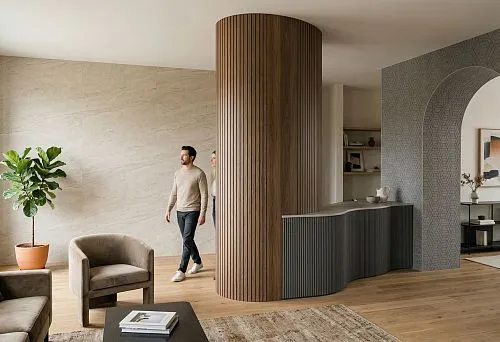
In wall decor, round millwork is used to create three-dimensional compositions: vertical or horizontal slats of varying lengths, installed on the wall, form relief, play of light and shadow. This technique is popular in modern interiors of mid-century, Scandinavian, and eco styles. The slats are painted in contrasting colors or left natural, coated with oil that emphasizes the texture.
Curtain rods made from round millwork
A round wooden curtain rod is a classic solution that never goes out of style. The rod diameter varies from 25 to 50 millimeters depending on the weight of the curtains and the scale of the window. Light tulle curtains are hung on a rod 25–30 millimeters in diameter, heavy drapery fabrics require a rod 40–50 millimeters. The rod is attached to the wall or ceiling via brackets, with decorative finials (balls, cones, stylized figures) installed at the ends.
A wooden curtain rod creates a sense of warmth, solidity, and connection with nature. It harmonizes with wooden furniture, parquet flooring, wooden window and door frames.Wooden cornicesMade from oak, ash, or walnut, they last for decades without losing strength or appearance. Plastic rods are cheaper but look cheap, yellow, and break under the weight of heavy curtains. Metal rods are strong but cold and do not create coziness.
The process of selection and purchase in a St. Petersburg interior decor store
How to choose round millwork and balusters correctly so you don't regret the decision a year later?
Step 1: Define the interior style
The interior style determines the shape of balusters and the type of millwork finish. For a classic interior, turned balusters with traditional profiles (baluster shape, balls, beads) are suitable, handrails made of oak or beech with dark-toned finishes (walnut, mahogany, wenge). For a modern minimalist interior—simple balusters without decoration or even glass railings with a wooden handrail, light wood (whitewashed oak, ash, maple) with clear matte oil. For a rustic style—rough-hewn balusters with emphasized texture, possibly with knots, handrails made of solid wood with minimal processing, an aged effect.
Step 2: Choosing the wood species
The wood species is determined by budget, operating conditions, and aesthetic preferences. Oak—the choice for durability and prestige, suitable for any room, including wet areas. Beech—the choice for a medium budget, excellent value for money, easy to stain. Ash—for interiors where expressive texture is important. Pine—for budget projects or temporary structures.
Step 3: Calculating the material quantity
For round millwork, the total length of the handrail along all sections of the staircase is measured, including straight flights, landings, and turns. A 10% reserve is added to the obtained length for cutting and possible errors. For balusters, the quantity is calculated based on the installation spacing: if the stair flight length is 3 meters and the baluster spacing is 100 millimeters, 30 balusters plus 2–3 spares will be required.
Step 4: Choosing the finish
The finish can be done by the manufacturer (factory) or independently after purchase (if you have the skills). Factory finishing guarantees uniformity of coating, absence of drips, but limits the choice of colors and types of coating. DIY finishing offers freedom of choice but requires time, tools, and skills. For projects with high-quality requirements, factory finishing with professional compounds is recommended.
Step 5: Delivery and storage
Round millwork and balusters are long items requiring careful transportation. The standard length of a millwork piece is 2–4 meters, making transport in a passenger car problematic. Most interior decor stores offer delivery via their own transport or through shipping companies. During delivery, items are packaged in corrugated cardboard and stretch film to protect against scratches and moisture.
Wooden moldings and balusters should be stored in a dry, heated room, horizontally on a flat surface to avoid sagging. Air humidity 40–60%, temperature 18–24 degrees Celsius. Sudden changes in humidity can cause the wood to warp or crack. Before installation, products must acclimate in the installation room for at least 48 hours.
Answers to Popular Questions
What diameter of round molding should I choose for a staircase in a private house?
For residential staircases, a diameter of 50 millimeters is optimal. It provides a comfortable grip for adults and children and meets building safety standards. A 40-millimeter diameter is suitable for decorative railings where the handrail does not bear the main functional load. A 60-millimeter diameter is used for public buildings with high traffic, where increased strength is required.
Yes, but the wood must be treated with a moisture-protective coating (yacht varnish, oil with UV filters) and the coating needs to be renewed every 1–2 years. The best species for outdoor use are larch, oak, teak. Pine and beech darken and rot quickly outdoors. An alternative is thermally modified wood, which has undergone high-temperature treatment that changes its structure and increases moisture resistance.
Yes, but the wood must be treated with a moisture-protective coating (yacht varnish, oil with UV filters) and the coating needs to be renewed every 1–2 years. The best species for outdoor use are larch, oak, teak. Pine and beech outdoors quickly darken and rot. An alternative is thermally treated wood, which has undergone high-temperature processing that changes its structure and increases moisture resistance.
How much do wooden balusters and round molding cost in St. Petersburg?
The cost depends on the wood species, profile complexity, and type of finish. Approximate prices: round molding with a diameter of 50 millimeters made of pine — from 300 rubles per linear meter, beech — from 800 rubles, oak — from 1500 rubles. Turned balusters made of pine — from 150 rubles per piece, beech — from 400 rubles, oak — from 800 rubles. Carved balusters — from 2000 rubles per piece depending on the complexity of the carving.
How to care for wooden handrails and balusters?
Wipe regularly with a dry, soft cloth to remove dust. Avoid wet cleaning with aggressive agents. Renew the coating once a year: if handrails are oiled, apply a fresh coat of oil, let it absorb, and polish. If varnished — assess the condition of the coating and re-varnish if necessary. Avoid direct sunlight, heat sources (radiators), and sudden changes in humidity.
How to choose the spacing for baluster installation?
Building codes require that the distance between balusters (clear spacing) does not exceed 150 millimeters. In practice, a spacing of 100–120 millimeters is used. For visual lightness, the spacing can be increased to 150 millimeters; for a dense railing, it can be reduced to 80–100 millimeters. The baluster spacing affects the visual rhythm of the staircase: frequent spacing creates a dense graphic, while sparse spacing creates airiness and transparency.
Can wooden balusters be combined with metal or glass elements?
Yes, combining materials is a popular design technique. A wooden handrail with metal posts and glass panels creates a modern, light look. Wooden balusters with metal inserts or forged elements add decorative appeal. It is important to maintain stylistic harmony: in modern interiors, metal — stainless steel, chrome, black steel; in classic interiors — bronze, brass, patinated iron.
How to order a custom baluster design?
Contact an interior decor store with a sketch or photo of the desired baluster. Technicians will assess the feasibility of production, calculate the cost and timeline. For complex carved balusters, a 3D model is created, agreed upon with the customer, and a prototype is made. After approving the prototype, production begins. The minimum order quantity for custom orders is usually from 10–20 pieces.
Conclusion: Quality, Tested by Time and Palaces
Why is choosing an interior decor store in St. Petersburg not just a matter of convenience or price, but a matter of trust in craftsmanship? Because St. Petersburg is a city where decor is not a toy, but a responsibility. Here, every project can be near a cultural heritage site, here customers have seen the Hermitage, Peterhof, Tsarskoye Selo — the standards against which everything else is compared. In this context, only those who have passed the test of real projects, who have participated in palace restorations, who understand what precision, durability, and beauty mean, can work.
Round wooden moldings and balusters are not just building materials. They are elements that people touch with their hands daily while climbing stairs. They are details that form a guest's first impression upon entering a home. They are an investment that pays off not financially, but emotionally — through the pleasure of touching warm, smooth wood, through pride in a home where every detail is chosen wisely.
For over twenty-three years, the company STAVROS has been creating wooden decor for interiors that become history. Starting in 2002 as a small creative workshop of two artists, STAVROS has grown from small-scale orders to participating in the reconstruction of the Konstantinovsky Palace in Strelna — a project that revived a residence that has hosted heads of state. This was followed by projects for the Hermitage, Alexander Palace, Trinity-Izmailovsky Cathedral — sites where mistakes are unacceptable, where every element undergoes examination by restoration councils.
Today, STAVROS is a 6000-square-meter production facility in St. Petersburg, a team of 150 professionals, 19 Morbidelli (Italy) CNC machines for precise woodworking, and a database of 3D models for 4000 decor items. But most importantly, it preserves the values of manual labor: final hand sanding, inspection of each product by a master, and an individual approach to every order. Automation does not replace humans but enhances them, allowing the creation of products where machine precision combines with a master's touch.
STAVROS round molding is made from solid oak, beech, or ash, kiln-dried to a moisture content of 8–10%. This moisture level is critical: higher — the wood will dry out after installation, creating gaps and deformations; lower — the wood will absorb moisture from the air and swell. Precise moisture content is the result of technological discipline and control at every stage.
STAVROS balusters — over 50 models in the catalog, from simple turned to complex carved, from classic to modern. Each model is designed considering not only aesthetics but also strength: attachment points are calculated so that the baluster can withstand a horizontal load of at least 100 kilograms without deformation. This is not a formal requirement of standards but real safety for people who will use the staircase for decades.
Finishing is done with professional products: Osmo oils (Germany), Sayerlack varnishes (Italy), Borma Wachs stains (Italy). These brands have been tested for decades in the furniture and woodworking industries, guaranteeing coating durability, abrasion resistance, and color retention. Painting in any color from RAL or NCS catalogs, patination, aging effects — any solutions required by the design project are possible.
STAVROS's large stock program allows for receiving standard products (popular baluster models, round molding with diameters of 40 and 50 millimeters) within 3 business days. For non-standard products or products with custom finishes, production time is 5–10 business days. For complex exclusive projects with hand carving — from 2 weeks to 2 months, depending on volume and complexity.
Delivery within St. Petersburg and the Leningrad region is carried out by STAVROS's own transport or partner transport companies. Delivery cost within the Ring Road ranges from 800 to 2000 rubles depending on volume and district; outside the Ring Road — individual calculation. Delivery across Russia — via transport companies SDEK, DPD, PEK, Delovye Linii. Products are carefully packaged in corrugated cardboard, stretch film; for fragile elements, rigid substrates are used to prevent damage during transportation.
STAVROS offers a 5-year warranty against manufacturing defects: cracking from improper drying, warping, rotting from insufficient treatment. This is not a formal document but real responsibility: if within five years a product exhibits a defect related to manufacturing, it will be replaced free of charge.
STAVROS showrooms in St. Petersburg and Moscow are open for visits: here you can see samples of all baluster models, touch different wood species, compare finish options, and receive specialist consultations. For complex projects, an on-site visit by a consultant, measurement, project development, and cost estimate are possible. Contacts: phone 8 (800) 555-46-75, website stavros.ru.
Choosing STAVROS means choosing not just a decor manufacturer, but a partner who accompanies the project from idea to realization, who guarantees quality tested by palaces, who creates products that serve not for years, but for generations. It is a choice in favor of wood that breathes, ages nobly, and becomes part of family history. It is a choice in favor of craftsmanship that has not disappeared in the era of mass production but has been preserved, adapted, and made accessible.