Article Contents:
- Evolution of Wooden Stairs and Columns: From Antiquity to the Present Day
- Historical Roots of Wooden Architecture
- Revival of Traditions in Modern Design
- Unique Advantages of Wooden Stairs and Columns
- Aesthetic Perfection of Natural Material
- Ecological Aspects and Impact on Room Microclimate
- Acoustic Properties and Energy Efficiency
- Technical Specifications and Structural Features
- Types of Wooden Stairs and Their Structural Solutions
- Types of Wooden Columns and Their Architectural Features
- Technical Requirements and Safety Standards
- Process of Creating Wooden Stairs and Columns
- From Design to Installation: Stages of Work
- Modern Wood Processing Technologies
- Unique Finishing Technologies
- Stylistic solutions and design ideas
- Classic Styles: From Baroque to Empire
- Modern trends: from minimalism to eco-style
- Integrating Wooden Elements into Various Interior Concepts
- Practical Aspects of Selection and Use
- How to Choose the Perfect Staircase for Your Home
- Selecting Optimal Columns for Various Architectural Tasks
- Maintenance and care of wooden structures
- Investment Appeal of Wooden Architectural Elements
- Impact on property value
- Long-Term Economic Efficiency
- Ecological Aspect and Sustainable Development

Imagine: you enter a home where every interior detail tells its own story. Your gaze involuntarily rises, following the graceful curves of the wooden staircase, which, like a sculpture, floats in space. It is supported by majestic columns, whose flawless proportions create a sense of classical harmony and solidity. These are not just functional elements — they are works of art, transforming the space, filling it with the nobility and warmth of natural wood.
Wooden Stairs and Columns These are not just structural elements, but true architectural dominants capable of completely transforming the appearance of any room. In this article, we will immerse ourselves in the wonderful world of wooden architecture, reveal the secrets of creating truly impressive interiors, and explain how to make the right choice that will delight you for years.



Evolution of Wooden Stairs and Columns: From Antiquity to the Present Day




Historical Roots of Wooden Architecture
The history of wooden architectural elements spans millennia. Even in ancient Egypt and Mesopotamia, masters created remarkable wooden structures, astonishing for their strength and elegance. Cedar and acacia columns adorned pharaohs' palaces, while intricately carved staircases connected various levels of temple complexes.
In ancient Greece, wooden columns gradually gave way to stone, but it was the wooden prototypes that laid the foundations of classical architectural orders. Interestingly, even the famous fluting — vertical grooves on the column shaft — originally appeared in wooden structures as a functional element, improving rainwater runoff.
Medieval Europe gifted the world with Gothic wooden staircases, featuring delicate balustrades and carved newels. Masters of that time created true masterpieces, using only hand tools and passing down their secrets from generation to generation. Spiral staircases of castles and cathedrals still astonish with their engineering ingenuity and artistic perfection.
Russian wooden architecture developed along its own unique path. Rich traditions of wood carving found expression in unique staircases and supporting column-like posts, adorned with intricate carvings. Each region had its own distinctive motifs and techniques, creating an unmistakable architectural language.
Our factory also produces:


Revival of traditions in modern design
Today we witness a true renaissance of wooden architecture. Modern designers and architects rediscover the beauty and practicality wooden column staircases, integrating them into the most daring and innovative projects.
What is especially valuable is that today traditional woodworking techniques combine with advanced technologies. Computer modeling allows creating complex structures, while modern CNC equipment ensures perfect precision. At the same time, the final touches are still applied by master craftsmen who preserve and develop centuries-old traditions.
The ecological trend also contributes to the return of wood to leading positions in architecture and design. Conscious consumption, the desire to use renewable materials, and the wish to create a healthy living environment make wooden structures especially attractive to modern people.
It is interesting to observe how classical forms are reinterpreted in the context of modern aesthetics. Minimalist staircases with clean lines coexist with richly decorated columns in the neo-baroque style. Eclecticism and bold experiments with form allow creating unique spaces that reflect the owners' individuality.
Get Consultation
Unique advantages of wooden staircases and columns
Aesthetic perfection of natural material
Wood is a material with an unmistakable character. Each species has its unique grain pattern, color palette, and texture. This allows creating truly unique items, without exact copies.
Oak, with its expressive texture and warm honey tone, is ideal for classic interiors. Its dense structure ensures exceptional strength and durability of structures. Oak staircases and columns can withstand significant loads while maintaining an impeccable appearance for decades.
Ash attracts with its light tone and elegant grain pattern. It is easy to work with, allowing the creation of complex carved elements. At the same time, ash has high strength and elasticity, making it an ideal material for staircase treads.
Walnut, with its deep chocolate tone, creates an atmosphere of luxury and refinement. Walnut staircases and columns become true works of art, attracting attention and evoking admiration.
Spruce and larch are more democratic options, yet they possess excellent aesthetic qualities. Their light wood with expressive growth rings fits perfectly into Scandinavian and eco styles.
It is important to note that wood is a material that 'lives' and changes over time. The noble patina that appears on the surface after years only adds character and depth to the items. This is a fundamental difference from artificial materials, which simply wear out and lose appeal over time.
Ecological properties and influence on room microclimate
In an era of growing concern about ecological issues, wooden structures become especially relevant. Wood is a renewable resource, and when managed responsibly, its use does not harm the environment.
Moreover, Wooden Stairs and Columns they possess a unique ability to improve room microclimate. They naturally regulate humidity, absorbing excess and releasing it when deficient. This creates more comfortable living conditions and may be especially important for people suffering from allergies or respiratory diseases.
Wooden structures also have excellent thermal insulation properties. Touching wooden railings or columns is always pleasant — they do not feel cold like metal or stone. This creates a sense of coziness and comfort, especially in cold weather.
Natural wood possesses antiseptic properties due to the phytoncides it contains. Some species, such as larch or cedar, release beneficial essential oils that may have a positive effect on the respiratory system.
Acoustic properties and energy efficiency
Little-known but important fact: wooden structures have excellent acoustic properties. They do not create unpleasant echoes and contribute to forming a comfortable sound environment in rooms. This is especially important for large spaces with high ceilings, where acoustic problems can be quite noticeable.
Wooden staircases are significantly quieter in operation compared to metal or concrete ones. When properly installed, they do not creak or produce resonant sounds during walking. To achieve maximum acoustic comfort, special damping pads and fasteners are used, minimizing vibration transmission.
In terms of energy efficiency, massive wooden elements function as thermal accumulators. They absorb heat and gradually release it, contributing to more even temperature distribution in rooms. This may lead to reduced heating and air conditioning costs.
Technical characteristics and structural features
Types of wooden staircases and their structural solutions
The modern market offers various types of wooden staircases, each with its own features and advantages.
Straight staircases are the most common and practical option. They can be straight, L-shaped, or U-shaped depending on room layout. Such staircases are convenient to use and suitable for daily use by all family members, including children and elderly people. The width of the tread is usually 90 to 120 cm, ensuring comfortable movement.
Helical staircases attract with their compactness and aesthetics. They occupy minimal space and become a true interior decoration. However, it should be noted that such staircases are less convenient for daily use, especially when moving large items. The diameter of a helical staircase can vary from 110 to 200 cm depending on available space and comfort requirements.
Modular staircases are a modern solution allowing quick assembly of the structure from pre-fabricated elements. They are especially popular during renovation of existing spaces, where speed of installation and minimization of construction work are crucial. Modular systems offer various finishing and configuration options, allowing adaptation to any interior.
Combined staircases combine elements of different types, for example, straight sections may transition into helical ones. Such solutions allow optimal space usage and create unique design objects.
In terms of construction, wooden staircases can be:
- On stringers (side load-bearing beams)
- On stringers (side elements into which steps are set)
- On newels (special metal fittings creating a 'floating' staircase effect)
- Balustrade-mounted (attached only on one side to the wall)
Each option has its advantages and limitations that must be considered during design.
Types of wooden columns and their architectural features
Wooden columns, like staircases, are presented in a wide variety of forms and styles.
Classical columns follow the traditions of ancient orders: Doric, Ionic, Corinthian. They have clearly defined parts: base, shaft, and capital. The proportions of such columns are strictly calculated and conform to classical canons. The height of a column is usually 8-10 times its shaft diameter, creating a sense of lightness and upward aspiration.
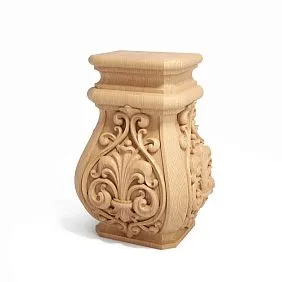
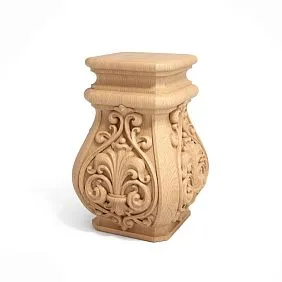
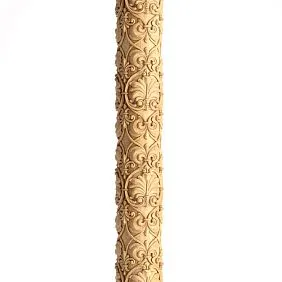
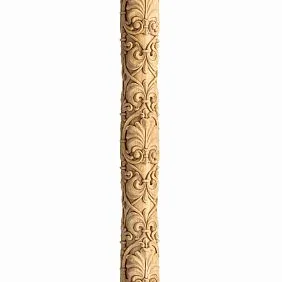
Carved columns differ with rich decoration, which may include floral motifs, geometric patterns, or narrative compositions. Such columns become true works of art and central elements of interior design. Carving may be either relief (projecting above the surface) or counter-relief (recessed).
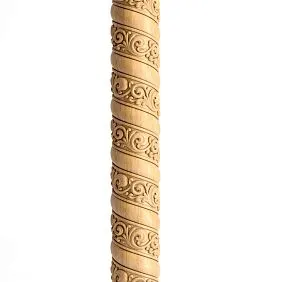
Twisted columns, with their spiral shape, create a dynamic, memorable image. They look especially effective in Baroque and Neoclassical interiors. Manufacturing such columns requires high craftsmanship and special equipment.
Pilasters are flat columns projecting from the plane of the wall. They can be used as independent decorative elements or in combination with full columns. Pilasters are often used for visual division of space and creation of architectural rhythm.
From a structural standpoint, wooden columns may be:
- Solid (carved from a single log)
- Glued (composed of several glued blanks)
- Hollow (with an internal cavity for weight reduction or for running utilities)
- Composite (assembled from several elements)
Glued columns have increased resistance to deformation and allow creating large-diameter items without risk of cracking. They are especially recommended for rooms with variable humidity.
Technical requirements and safety norms
Wooden Stairs and Columns must comply with strict technical requirements ensuring their safety and durability.
For staircases, key parameters are:
- Angle of inclination (optimally 30-35 degrees)
- Step width (from 25 to 32 cm)
- Riser height (from 15 to 20 cm)
- Handrail height (90-100 cm)
- Distance between balusters (no more than 12 cm for children’s safety)
It is important to follow the rule of walkability, expressed by the formula: 2h + b = 60-64 cm, where h is the riser height and b is the tread width. This ensures comfortable and safe movement.
For load-bearing columns, the allowable load is calculated taking into account the wood species, column diameter, and height. Safety factors are applied, guaranteeing the structure’s safety even under extreme loads.
All wooden elements must be treated with fire- and bioprotective compounds meeting modern ecological standards. This ensures safe operation and long-term durability of structures.
Process of creating wooden staircases and columns
From design to installation: stages of work
Creating quality wooden staircases and columns is a complex multi-stage process requiring a professional approach at every stage.
Design begins with careful measurements of the room and analysis of the space's features. Modern technologies allow creating three-dimensional models of future structures, enabling the client to visualize how the finished product will look in the interior. At this stage, all technical parameters are defined: dimensions, configuration, type of construction, wood species, and finish selection.
Material preparation includes selecting high-quality wood with optimal moisture content (8-12%). The material undergoes drying in specialized chambers, preventing deformation in the future. Then, blanks are sorted by color and texture to ensure the aesthetic integrity of the finished product.
Manufacturing of elements is carried out on modern CNC equipment, ensuring high precision. Complex decorative elements may be crafted by hand by master carpenters. Each detail undergoes careful sanding to achieve a perfectly smooth surface.
Pre-assembly is performed in the workshop to check the accuracy of all connections and the overall geometry of the structure. This allows identifying and eliminating possible defects before installation on-site.
Final finishing includes applying protective and decorative coatings. This may be a transparent lacquer preserving the natural beauty of wood, tinting agents altering the color, or opaque paints. Modern coatings provide not only an aesthetic appearance but also reliable protection against moisture, UV radiation, and mechanical damage.
Installation is performed by qualified specialists using professional tools. Special attention is paid to the reliability of fastening load-bearing elements and assembly accuracy. Special damping materials are used to minimize squeaks.
Final fine-tuning is conducted after installation and includes eliminating any minor defects that may have occurred during transportation or installation, as well as final polishing of surfaces.
Modern wood processing technologies
Modern production of wooden staircases and columns combines traditional woodworking methods with innovative technologies.
Laser cutting allows creating intricate lace-like elements with micron-level precision. This technology is especially valuable for manufacturing decorative inserts and overlays.
5-axis CNC milling machines can reproduce complex three-dimensional shapes, including twisted columns and ornamental balusters. Computer-controlled programming ensures perfect repeatability of elements.
High-pressure gluing technology allows creating glued constructions of exceptional strength and stability. Such items are not prone to deformation under changes in humidity and temperature.
Vacuum impregnation ensures deep penetration of protective compounds into the wood structure, significantly extending the service life of items, especially those used in humid conditions.
3D scanning is used to create accurate copies of historical elements during restoration work or to integrate new constructions into existing historical interiors.
Unique finishing technologies
Finishing wooden staircases and columns is an art requiring deep knowledge of the properties of various wood species and masterful skills in applying coatings.
Patination creates an effect of noble antiquity, highlighting the wood texture and giving the item character and depth. This technique is especially in demand when creating interiors in classical or vintage styles.
Crackle is a technique of creating controlled cracks in lacquer coatings, imitating natural aging. It gives items a unique character and vintage charm.
Multi-layer tinting allows achieving complex, deep shades impossible with single-tone dyes. Each layer is applied manually with intermediate polishing, creating an effect of depth and volume.
The 'rubbing' technique involves applying a contrasting underlayer followed by partial removal of the top coating. This creates an eye-catching two-tone pattern that emphasizes the relief of carved elements.
Gilding is a traditional technique where extremely thin sheets of gold or its imitation are applied to prepared surfaces. This finish gives items a luxurious, solemn appearance and looks especially striking on column capitals and staircase decorative elements.
Stylistic solutions and design ideas
Classical styles: from Baroque to Empire
Classical styles offer a rich arsenal of solutions for interior design wooden column staircases, each with its own distinctive features and characteristics.
Baroque is characterized by opulence, dynamic forms, and abundant decoration. Staircases in this style often have complex curved shapes, richly ornamented balusters, and massive carved handrails. Baroque columns are characterized by twisted forms, complex capitals with plant motifs, and gilded elements. The color palette usually includes deep, saturated tones: dark walnut, redwood, black wood with gilded accents.
Rococo is a lighter, more elegant style preferring asymmetrical forms and light tones. Rococo staircases feature delicate, lace-like balusters and handrails with the characteristic "rocaille" ornament. Columns in this style are more slender, with refined capitals often decorated with floral, shell, and scroll motifs. Light-colored woods such as maple, beech, and birch are preferred, which can be tinted in pastel shades or covered with white paint with patina.
Neoclassicism returns to the strictness and symmetry of ancient forms. Staircases of this style feature clear lines, geometric regularity, and restrained decoration. Neoclassical columns strictly follow ancient orders with their precise proportions and characteristic elements. The color palette is restrained: natural wood tones, white, cream, light gray.
Empire is an imperial style, majestic and monumental. Empire staircases are wide, with smooth curves and massive handrails. Decorative motifs include military and triumphal themes: laurel wreaths, eagles, lions. Columns are massive, often with gilded Corinthian capitals. The color palette includes deep, saturated tones: dark red, emerald green, blue, complemented by abundant gilding.
Modern trends: from minimalism to eco-style
Modern design offers a fresh perspective on traditional elements, adapting them to current aesthetic trends and lifestyles.
Minimalism favors clean lines, absence of decoration, and functionality. Minimalist staircases often feature console construction with 'floating' steps and glass or rope railings. Columns, if present, have a simple cylindrical shape without capitals or bases. The color palette is restrained: light-toned natural wood, white, gray, black.
Loft combines industrial aesthetics with the warmth of natural materials. Loft-style staircases often combine wood with metal: wooden treads on a metal frame, metal railings with wooden handrails. Columns can be either wooden or metallic, often intentionally rough and "industrial" in finish. Characteristic use of aged wood with visible signs of time: cracks, wear, traces of old paint.
Scandinavian style values naturalness, functionality, and bright spaces. Staircases in Scandinavian style usually have simple forms, light tones, and minimal decoration. Characteristic use of light-colored woods: birch, pine, spruce, often with white tinting or staining. Columns, if present, have simple forms and light finishes.
Eco-style emphasizes the naturalness of materials and their minimal processing. Staircases and columns in this style often retain the natural wood grain, including bark, knots, and other natural features. Popular use of solid wood with minimal processing: only sanding and coating with transparent oils or waxes, highlighting the natural beauty of the material.
Integration of wooden elements into various interior design concepts
Thoughtful integration of wooden staircases and columns into the overall interior concept requires understanding the principles of harmonious material, form, and color combinations.
Color harmony is achieved by coordinating the wood tone with the overall interior color palette. This does not necessarily mean complete matching — often, a contrasting combination looks more effective, for example, a dark staircase in a light interior or vice versa. It is important that the chosen wood tone complements other elements: furniture, flooring, doors.
Stylistic unity implies that the form and decoration of wooden elements correspond to the overall interior style. However, modern design allows eclectic solutions, such as when a classical column becomes an accent element in a minimalist space. The key point is conscious awareness of such contrast and its harmonious integration into the overall composition.
Scaling is an important aspect, especially for columns. Their size must correspond to the proportions of the room. In small spaces, massive columns may create a sense of confinement, while in spacious halls, too thin columns will appear disproportionate.
Functional zoning using wooden elements allows elegantly dividing space without erecting walls. Columns can mark the boundary between the living room and dining room, while a staircase can naturally separate public and private zones of the home.
Lighting plays a key role in perceiving wooden elements. Properly selected lighting highlights the wood texture, reveals carving details, and creates play of light and shadow. For staircases, it is important to ensure not only decorative but also functional lighting, guaranteeing safe movement.
Practical aspects of selection and operation
How to choose the ideal staircase for your home
Choosing a staircase is a responsible decision that must consider numerous factors: from practical to aesthetic.
Space analysis is the first and most important step. It is necessary to accurately measure the available area and the height between floors. This will determine possible staircase types: for limited space, spiral or compact turn designs are suitable, while spacious rooms can consider wide straight staircases.
Intensity of use affects the choice of construction and materials. For the main staircase, which will be used daily, comfort and durability are important. Steps should be wide enough (at least 25 cm), and the rise should be comfortable (slope angle 30-35 degrees). For auxiliary staircases, such as those leading to the attic or basement, requirements may be less strict.
Safety is a critically important aspect, especially in homes with children or elderly people. The staircase should have secure handrails, non-slip step surfaces, and adequate lighting. The distance between balusters should not exceed 12 cm to prevent risk to small children.
The style and design of the staircase should harmonize with the overall interior of the home. It is important to consider not only the current design but also possible future changes, since a staircase is a long-lasting element rarely replaced.
Budget determines the choice of materials, complexity of construction, and level of finishing. The cost of a wooden staircase can vary widely depending on the wood species, type of construction, complexity of carving, and other factors. It is important to find an optimal balance between quality and cost, without compromising on safety and durability.
Choosing optimal columns for various architectural tasks
Columns in modern interiors can serve both structural and purely decorative functions. The choice of the optimal solution depends on the specific architectural task.
Load-bearing columns must be designed to withstand the appropriate load. Strong wood species (oak, larch) or glued constructions are selected to ensure necessary strength. The diameter and height of such columns are determined by engineering calculations taking into account load and safety factors.
Decorative columns offer more freedom in choosing shape, size, and finish. They can be hollow, reducing their weight and cost. A wider range of wood species can be used for decorative columns, including exotic varieties with distinctive textures.
Columns for zoning spaces usually have medium height (up to the ceiling or slightly below) and can be combined with other elements: arches, decorative partitions, built-in shelves. They effectively divide space while maintaining visual continuity between zones.
Facade columns must be resistant to atmospheric influences. Wood species with high natural resistance to moisture (larch, oak) are selected, or special treatments and protective coatings are applied. It is also important to consider the architectural style of the building and surrounding structures.
Columns for restoration projects require a special approach. Often, it is necessary to recreate historical elements with maximum accuracy, using traditional technologies and materials. In such cases, collaboration with experienced restorers and architectural historians is essential.
Maintenance and care of wooden structures
Proper care of wooden staircases columns significantly extends their service life and maintains an attractive appearance.
Regular cleaning should be performed using gentle means specifically designed for wooden surfaces. Aggressive chemicals may damage protective coatings and the wood itself. For dust removal, it is better to use a soft dry cloth or special microfiber cloths.
Maintaining optimal microclimate in the room is critically important for wooden structures. Sudden fluctuations in humidity and temperature may cause wood deformation. Recommended relative air humidity is 40-60%, and temperature is 18-24°C. In particularly dry rooms, humidifiers may be required.
Protection from sunlight is necessary to prevent fading and degradation of wood. Direct sunlight may gradually change the color of wood and deteriorate protective coatings. For windows through which intense sunlight reaches wooden elements, it is recommended to use curtains, blinds, or special UV-filtering films.
Periodic renewal of protective coatings is necessary to maintain protective properties and aesthetic appearance. The frequency of renewal depends on the type of coating, intensity of use, and environmental conditions. On average, varnish on a staircase in a residential home should be renewed every 3-5 years.
Timely repair of minor damage prevents it from developing into serious problems. Scratches, chips, and cracks should be addressed as soon as possible, using special wax pencils, wood putty, or other suitable materials.
Professional maintenance is recommended periodically to assess the condition of structures and perform complex restoration and renewal work. Specialists can identify hidden problems at an early stage and propose optimal solutions for their elimination.
Investment attractiveness of wooden architectural elements
Impact on property value
Quality Wooden Stairs and Columns are not merely functional elements, but also a significant investment asset capable of substantially increasing property value.
Market real estate statistics show that homes with high-quality wooden architectural elements sell, on average, 15-20% higher than similar properties with standard solutions. This is especially true in the premium segment, where unique designer staircases and columns can become a key factor in purchase decisions.
The uniqueness and individuality provided by wooden architectural elements make real estate more attractive to potential buyers. In an era of standardized solutions and mass production, the value of handcrafted work and natural materials continues to grow.
The longevity of high-quality wooden structures means that this investment will contribute to increasing your property's value for decades. Unlike trendy but short-lived solutions, classic wooden elements never go out of style and never lose their appeal.
The ecological aspect also plays an increasingly important role in evaluating real estate. Modern buyers are willing to pay more for homes that use natural, eco-friendly materials. Wooden staircases and columns fully align with this trend.
Long-term economic efficiency
Investments in high-quality wooden architectural elements pay off not only at the time of selling real estate, but also during the period of use.
The longevity of high-quality wooden structures means there is no need to replace them for many decades. With proper care, a wooden staircase or column can last over 100 years, making them more economically efficient in the long term compared to cheaper but less durable alternatives.
Repairability is another important advantage. Unlike many modern materials, wooden elements can be restored and renovated, extending their service life and preserving initial investments.
The energy efficiency of wooden structures also contributes to their economic efficiency. Wood has excellent insulating properties, which can help reduce heating and air conditioning costs.
The psychological comfort provided by natural materials is difficult to quantify in monetary terms, but it undoubtedly enhances the quality of life. Pleasant tactile sensations, the natural beauty of wood, its ability to create a cozy atmosphere — all these factors make investments in wooden architectural elements justified from the standpoint of improving living comfort.
Ecological aspect and sustainable development
In the context of growing attention to ecological and sustainable development issues, wooden architectural elements acquire additional value.
Renewability of the resource is one of the key advantages of wood. With responsible forestry practices, where new trees are planted in place of harvested ones, wood becomes practically an inexhaustible resource.
The carbon footprint of wooden products is significantly lower than that of metal, plastic, or concrete equivalents. Moreover, wooden structures serve as a kind of 'carbon sink,' storing carbon that was absorbed by trees during their growth.
The energy consumption required to produce wooden products is also significantly lower compared to alternative materials. Processing wood requires less energy than producing metal or synthetic materials.
End-of-life safety is another important ecological aspect. At the end of their service life, wooden products can be recycled or used as biomass fuel, without creating disposal problems typical of many modern materials.
FSC (Forest Stewardship Council) certification and similar systems allow consumers to be confident that the wood for their staircases and columns comes from responsibly managed forests. This is an important factor for environmentally conscious customers.