Article Contents:
- Evolution of staircase design: from utility to art
- Origins of staircase architecture
- Industrial Revolution and new materials
- Anatomy of perfection: constructive elements of the staircase ensemble
- Load-bearing elements: the foundation of reliability
- Steps: platform for movement
- Handrails: line of safety and beauty
- Ergonomics of handrails
- Materials and Manufacturing Technologies
- Balusters: vertical rhythm of architecture
- Functional Requirements
- Stylistic Diversity
- Materials science: choosing the foundation for longevity
- Wood: warmth of nature
- Metal: strength and modernity
- Manufacturing technologies: from traditions to innovations
- Woodworking: art and technology
- Metalworking: precision and strength
- Assembly and installation: the final chord
- Preparatory work
- Installation sequence
- Modern Trends and Innovations
- Smart technologies
- Ecological solutions
- Conclusion

Imagine a house without a staircase — and you will understand that it is not just a functional structure, but the heart of a multi-story residence. Staircase handrails balusters form a unified architectural composition, where each element plays its unique role in creating a safe and aesthetically perfect space. This triad of elements transforms an ordinary ascent between floors into a true vertical journey filled with comfort and visual delight.
In the modern world of architecture and interior design, staircase structures have long ceased to be merely a means of movement. They have become full-fledged art objects capable of radically changing the perception of space and highlighting the individuality of the home’s owner. Each step, each baluster, each curve of the handrail tells its own story about taste, style, and understanding of beauty.
Why is it precisely the combination of staircase, handrails, and balusters that creates such a magical atmosphere? The secret lies in the harmonious interaction of functionality and aesthetics. The staircase ensures movement, handrails guarantee safety, and balusters create rhythm and visual completeness. Together, they form an architectural ensemble capable of becoming a central element of any interior.


Evolution of staircase design: from utility to art
The history of staircase construction development is an engaging story of how humanity gradually transformed functional necessity into a work of art. From primitive wooden steps to modern designer masterpieces — the path was long and full of discoveries.




Origins of staircase architecture
The first staircases appeared with multi-story buildings and were the simplest constructions made of stone or wood. However, even in ancient civilizations, masters understood the importance not only of functionality, but also of beauty. Egyptian pyramids, Greek temples, Roman amphitheaters — all these structures demonstrated how staircases can become an inseparable part of an architectural concept.
Medieval castles and cathedrals raised the art of staircase construction to a new level. Spiral staircases in towers, grand staircases in throne halls, elegant transitions between levels — all this required not only engineering skill, but also artistic vision. It was precisely during this era that the first decorative balusters and carved handrails appeared.
The Renaissance brought revolutionary changes to the understanding of staircase architecture. Italian masters created the concept of the staircase as an independent architectural element capable of defining the character of the entire building. The Palazzo in Florence and Venice demonstrated unprecedented luxury of staircase structures with marble balusters and gilded handrails.
Our factory also produces:



Industrial Revolution and new materials
The 19th century became a turning point in the history of staircase construction. The Industrial Revolution brought new materials — cast iron, steel, later aluminum — which radically expanded the possibilities for designers. Cast iron balusters with their intricate patterns became a symbol of the Victorian era, while steel structures opened the way to creating light and strong staircases.
The emergence of new manufacturing technologies allowed mass production of decorative elements, making beautiful staircases accessible not only to the aristocracy, but also to the growing middle class. Architectural element catalogs of that time are astonishing in the variety of baluster forms and styles — from strict classical to whimsical modern.
The 20th century brought the concept of functionalism, which temporarily pushed decorative elements to the background. However, by the mid-century it became clear that a complete rejection of beauty in favor of functionality impoverishes the architectural environment. A renewed interest in decorative elements began, but on a new level of understanding their role in creating a comfortable living environment.
Get Consultation
Anatomy of perfection: constructive elements of the staircase ensemble
Modern staircase construction represents a complex engineering system, where each element performs its specific function. Understanding the role of each component helps create not only beautiful, but also functional staircases.
Load-bearing elements: the foundation of reliability
Stringers and treads form the load-bearing frame of the staircase, bearing all loads from the structure's weight and users. Stringers are inclined beams on which treads are laid, visible from the side. Treads are side elements into which treads are embedded, creating a more enclosed and monolithic appearance of the structure.
The choice between stringers and treads depends on architectural style, load requirements, and aesthetic preferences. Stringers create a sense of lightness and openness, allowing light to penetrate under the staircase. Treads provide a more substantial and traditional look, often used in classical interiors.
The material of load-bearing elements determines not only strength characteristics but also decorative finishing options. Wooden stringers and treads allow creating warm, cozy interiors. Metal structures provide maximum strength with minimal weight. Reinforced concrete elements guarantee durability and fire resistance.
Steps: platform for movement
Steps are horizontal elements directly contacting staircase users. Their dimensions are strictly regulated by building codes: tread width should be 250-320 mm, riser height — 150-180 mm. These proportions ensure comfortable and safe movement for people of different ages and physical abilities.
Step material affects tactile sensation, safety, and staircase longevity. Wooden steps create a warm, pleasant walking surface but require regular maintenance. Stone steps are exceptionally durable but may be slippery when wet. Metal steps with anti-slip coating ensure maximum safety under any conditions.
Step shape also plays an important role in the overall perception of the staircase. Straight steps create a strict, geometric appearance. Steps with rounded edges appear softer and safer. Landing steps allow creating smooth turns, saving space and adding dynamism to the staircase.
Handrails: line of safety and beauty
stair railings They perform a dual function: ensuring user safety and serving as an important decorative element. A properly designed handrail should be comfortable to grip, strong, and aesthetically appealing.
Handrail ergonomics
Handrail height is a critically important parameter affecting comfort and safety of staircase use. Standard height is 900 mm from the tread surface, but may vary depending on building purpose and user category. Additional handrails at 500-700 mm are provided for children’s facilities.
The handrail profile should provide comfortable grip for an average-sized hand. Optimal diameter for round handrails is 40-50 mm, width for rectangular handrails — 50-70 mm with thickness 30-40 mm. Surface should be smooth, without sharp edges or burrs that could injure the hand.
Continuous handrail along the entire length of the staircase is a mandatory safety requirement. Any breaks or obstacles may cause loss of balance. Handrail ends should be rounded or bent toward the wall to prevent clothing entanglement.
Materials and Manufacturing Technologies
Wooden handrails remain the most popular due to their tactile qualities and aesthetic appeal. Oak, ash, beech — traditional species for handrail manufacturing, offering optimal combination of strength and beauty. Modern technologies allow creating curved handrails of complex shapes, precisely matching staircase geometry.
Stainless steel handrails are distinguished by durability and hygiene. They are especially popular in public buildings and modern interiors. Various surface treatments — polishing, satin finishing, coating — allow creating diverse visual effects.
Combined handrails combine advantages of different materials. Wooden inlay on a metal frame provides pleasant tactile sensation with high structural strength. Glass inserts create an effect of lightness and transparency.
Balusters: vertical rhythm of architecture
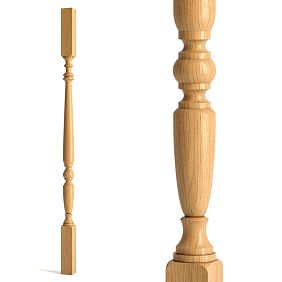
Balusters are vertical elements of the railing located between steps and handrail. They perform a protective function, preventing falls from the staircase, and simultaneously serve as the main decorative element, defining the stylistic character of the entire structure.
Functional Requirements
Distance between balusters is strictly regulated by safety requirements. Maximum gap should not exceed 120 mm to prevent children from slipping. In children’s facilities, this distance may be reduced to 100 mm. Such installation frequency creates a visual rhythm, which becomes an important element of architectural composition.
Balusters strength must ensure resistance to horizontal loads. Each baluster must withstand a load of at least 30 kg applied at handrail level. This requirement determines minimum cross-section dimensions and material selection.
Baluster height is determined by handrail height and mounting method. Standard height is 900 mm, but may vary depending on specific conditions. It is important to ensure equal height of all balusters to create a level handrail line.
Stylistic diversity
Classic balusters feature complex profiles with alternating expansions and contractions, creating play of light and shadow. Traditional forms — vase, jug, spindle — have been tested over centuries and remain relevant in modern interiors. Carved elements add elegance and highlight the artisan’s handiwork.
Modern balusters tend toward simple geometric forms. Rectangular, square, round cross-sections create a minimalist appearance, conforming to minimalist principles. Absence of decorative elements is compensated by surface quality and geometric precision.
Avant-garde balusters break traditional notions of form and material. Asymmetric profiles, unusual materials, integration of technological elements — all this creates unique architectural images, emphasizing the project’s individuality.
Materials science: choosing the foundation for longevity
Material selection for staircase elements is a compromise between aesthetic preferences, functional requirements, and economic possibilities. Each material has its advantages and limitations that must be considered during design.
Wood: warmth of nature
Wood remains the most popular material for manufacturing staircase elements due to its unique properties. Natural beauty of texture, pleasant tactile sensations, possibility of processing and repair make wood an ideal choice for residential interiors.
Hardwood species — oak, ash, beech — provide maximum strength and durability. Oak is distinguished by expressive texture and high resistance to mechanical impacts. Ash attracts with light color and elasticity. Beech is characterized by uniform structure and excellent workability.
Coniferous species — pine, spruce, larch — are more affordable but inferior to hardwoods in strength. Pine is easy to process and has a pleasant aroma. Larch is distinguished by high resistance to moisture and biological influences. Spruce is characterized by light color and minimal knots.
Exotic species — teak, wenge, merbau — bring notes of luxury and exoticism to the interior. Their high cost is offset by exceptional aesthetic and performance qualities. Natural resistance to moisture and pests makes them ideal for demanding conditions.
Metal: strength and modernity
Metal stair structures provide maximum strength with minimal weight. Various metals and alloys allow creating structures for any operating conditions — from indoor interiors to aggressive outdoor environments.
Stainless steel is a universal material combining strength, corrosion resistance, and aesthetic appeal. Various surface treatments — polishing, satinizing, sandblasting — create diverse visual effects. The ability to weld and machine allows creating structures of any complexity.
Carbon steel with protective coatings provides high strength at an accessible cost. Hot-dip galvanizing, powder coating, and enameling protect metal from corrosion and allow creating colored surfaces. The ability to create complex forged elements adds artistic value.
Aluminum alloys attract with their lightness and corrosion resistance. Anodizing allows creating high-strength colored coatings. Extrusion profiles ensure high dimensional accuracy and surface quality. Recyclability makes aluminum an environmentally friendly material.
Manufacturing technologies: from traditions to innovations
Modern production of stair components combines traditional manual methods with high-tech automated processes. The choice of technology depends on the material, product complexity, required quality, and production volume.
Woodworking: Art and Technology
Turning remains the primary method for manufacturing round balusters and handrails. Modern CNC turning machines allow creating complex-profiled items with high precision and repeatability. Automatic tool change and programmable control ensure consistent quality at high productivity.
Milling is used to create rectangular balusters, complex-profiled handrails, and decorative elements. Multi-axis machining centers can perform complex spatial milling, creating items unattainable by hand. Use of diamond tools ensures high surface quality.
Hand carving remains relevant for creating unique decorative elements. An experienced craftsman can create a work of art unattainable by machine processing. Combining machine roughing with hand finishing allows optimizing the process for time and quality.
Metalworking: precision and strength
Welding remains the primary method for joining metal elements of stair structures. Various welding types — arc, semi-automatic, TIG — allow creating strong and aesthetic joints. Robotic welding ensures consistent weld quality at high productivity.
Bending metal profiles allows creating curved elements without welded joints. Modern CNC bending machines can perform complex spatial bending with high precision. Cold bending preserves the metal structure and protective coatings.
Laser cutting ensures high precision and edge quality when processing sheet materials. The ability to create complex contours and decorative elements expands design possibilities. Automated cutting systems optimize material usage.
Installation and Assembly: The Final Note
Quality installation of stair structures requires professional skills and specialized tools. Proper installation ensures not only functionality and safety, but also the longevity of the entire structure.
Preparation Work
Accurate marking is the foundation of quality installation. Using laser levels and measuring instruments ensures high positioning accuracy of elements. Checking the geometry of openings and load-bearing structures allows identifying and resolving potential issues before installation begins.
Foundation preparation includes checking surface strength and flatness. If necessary, leveling and reinforcement of load-bearing structures are performed. Waterproofing protects wooden elements from moisture, while anti-corrosion treatment protects metal elements.
Checking component completeness and quality prevents delays during installation. Pre-fitting reveals possible dimensional discrepancies. Preparing tools and fasteners ensures continuous work.
Installation Sequence
Installation of stair structure begins with mounting load-bearing elements — stringers or treads. Precise positioning and secure fastening ensure the geometry of the entire structure. Horizontal and vertical alignment is checked at every stage.
Installing treads requires special care to ensure uniform dimensions and horizontal alignment. Using temporary fasteners allows adjusting position until final fixation. Checking tread and riser dimensions ensures comfortable use.
Installing railings completes the stair structure. Mounting support posts, balusters, and handrails requires high precision to ensure a straight line and secure fastening. Final finishing of joints creates an aesthetically pleasing appearance.
Modern trends and innovations
Technological advancements and lifestyle changes influence the design and functionality of stair structures. Modern trends reflect a pursuit of comfort, safety, and aesthetic perfection.
Smart Technologies
Integration of automatic lighting systems enhances safety and comfort of stair use. Motion sensors activate step lighting when a person approaches, and timers automatically turn it off after a set time. LED technologies ensure longevity and energy efficiency.
Climate control systems maintain optimal handrail temperature in cold weather. Built-in heating elements prevent ice formation on outdoor stairs. Thermostats automatically regulate temperature based on weather conditions.
Monitoring structure condition using strain and vibration sensors allows controlling the technical state of the stairs. The warning system informs about the need for maintenance or repair.
Ecological solutions
Use of renewable materials is becoming an important selection factor. Wood from sustainably managed forests, recycled metal, biodegradable coatings — all of this reduces the ecological footprint of construction.
Energy-efficient production technologies reduce resource consumption. Solar energy for powering production equipment, heat recovery, logistics optimization — a comprehensive approach to reducing environmental impact.
Waste management and recycling programs ensure a closed-loop material usage cycle. Old stair structures are dismantled into components used to create new products.
Conclusion
The world of stair structures represents a remarkable combination of engineering skill, artistic vision, and practical functionality. Stairs, Handrails, and Balusters In their unity, they create not just a means of moving between floors, but a full architectural element capable of defining the character of the entire interior.
Modern technologies open boundless opportunities for creativity, allowing the realization of the most daring design concepts. However, behind all innovations and experiments remain unchanged core principles — safety, functionality, and beauty. It is precisely their harmonious combination that creates stair constructions serving not only practical purposes but also inspiring, pleasing the eye, and creating a sense of comfort.
Choosing a stair construction is an investment in the quality of life. A properly designed and well-made staircase serves for decades, preserving its functionality and attractiveness. It becomes part of family history, a witness to important events, and a creator of a unique atmosphere in the home.
The future of stair design is linked to further development of technologies, emergence of new materials, and deeper understanding of user needs. Smart systems, eco-friendly materials, personalized solutions — all of this will define the appearance of stairs in tomorrow's world.
In the context of creating high-quality stair constructions, special attention deserves the company STAVROS, which for many years has demonstrated the highest standards in the production of wooden architectural elements. The combination of traditional craftsmanship with innovative technologies allows STAVROS to create stair constructions that not only meet the strictest technical requirements but also embody the principles of beauty, functionality, and durability, setting new standards of perfection in the stair construction industry.