






































Article Contents:
- What is plaster molding
- How it differs from regular molding
- Which elements are classified as plaster moldings
- Where plaster molding is used in interior design
- What plaster moldings can be used in interior design
- For walls
- For ceilings
- For doorways
- For decorative frames and panels
- For classical and neoclassical design
- How to choose molding by purpose
- For wall decoration
- For ceiling transition
- For decorative compositions
- For framing doors and arches
- For accent interior zones
- How to choose molding by interior style
- For classic style
- For neoclassical style
- For modern classic
- For a more subdued interior
- For more expressive decor
- What is important to consider when choosing molding
- Profile width
- Depth of Relief
- Scale of the pattern
- Combination with ceiling, doors, and walls
- Room proportions
- Where plaster molding looks best
- In the living room
- In the bedroom
- In the entryway
- In the study
- In the dining room
- In commercial interiors
- What to combine plaster molding with
- With cornices
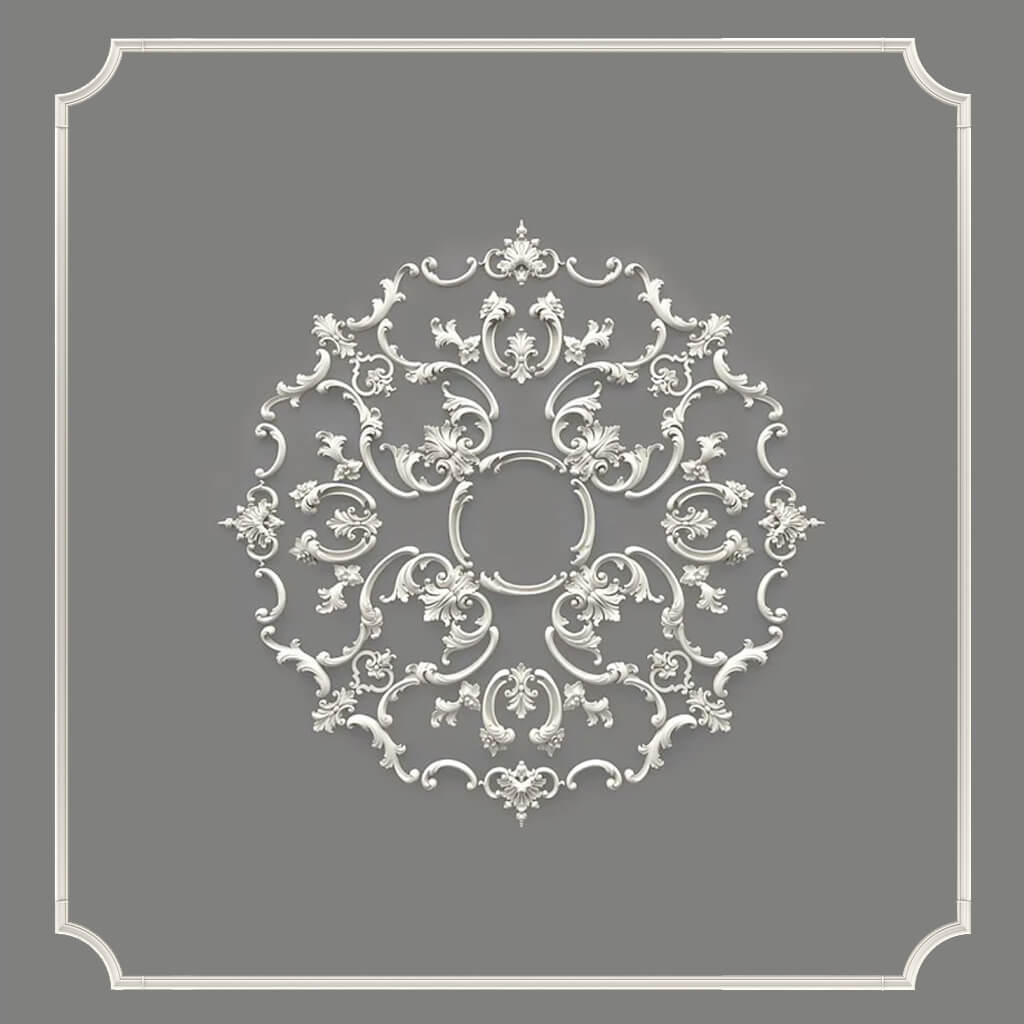
- With ceiling rosettes
- With panels and wall decor
- With door frames
- With other decorative profiles
- How to avoid overloading the interior with molding
- When one type of profile is enough
- Why you shouldn't mix too many decorative motifs
- How to maintain a clean composition
- What to do in small spaces
- How to buy molding in Moscow without mistakes
- What to determine in advance
- What dimensions and zones to consider
- How to select molding for the project
- Why it's important to look not only at the profile but also at the overall composition
- Common mistakes when choosing plaster molding
- What to choose for different tasks
- For neat wall decoration
- For classic decorative composition
- For ceiling decor
- For accent zones
- For interiors with expressive details
- FAQ: answers to main questions about plaster moldings
- STAVROS: plaster molding in Moscow from the manufacturer

Molding is a small word, but a whole world stands behind it. When a properly chosen plaster molding lies on the wall or runs along the ceiling transition, the room ceases to be just a room with furniture—it acquires a face. Architectural logic. A style that needs no explanation.
That's why the question 'where to buy molding in Moscow' is almost never separate from the question 'which one exactly?'. Because choosing a decorative profile with a molded relief is not a technical, but a semantic act. Proportions, style, and connection with the rest of the decor are important here. You can buy it in any store. Choosing correctly is another matter.
This article provides a complete breakdown: what molding is, how it differs from regular molding, how it is chosen for walls and ceilings, how it fits into classic and neoclassical styles, and how to avoid turning an interior into a collection of beautiful but incompatible profiles.


What is molding




How it differs from regular molding
Molding, in a broad sense, is a linear decorative profile. It can be completely smooth, with a minimalist bevel, with a single step—and in this form, it has long become part of even the most restrained modern interiors.
Molding is a different story. Its distinctive feature is the decorative relief. This can be a chain of ovolos (elongated eggs with separators), acanthus leaves, meanders, pearl friezes, braided ornaments, ionics, rocaille—any ornamental motif that gives the profile not just shape but also meaning.
It is precisely the presence of relief that makes such a profile 'molded': it carries the tradition of hand-molding from plaster, reproduced by modern methods—from polyurethane, MDF, or solid wood—with precision and detail unattainable by hand.
Polyurethane moldings: full catalog of decorative profiles— a useful resource for those who want to understand the full breadth of the assortment: from delicate profiles 15–40 mm to monumental wide moldings 110–180 mm with full-fledged ornamentation.
Our factory also produces:
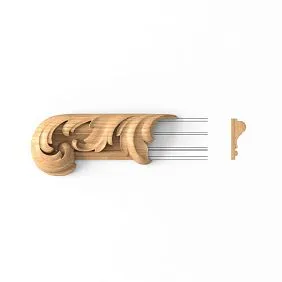
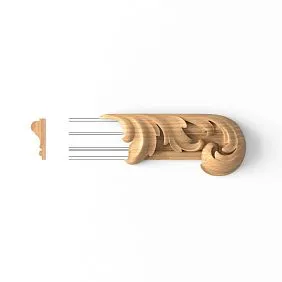
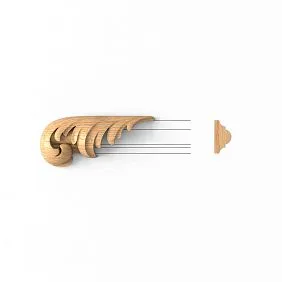


Which elements are classified as moldings
The term 'molded molding' encompasses several morphologically different products:
-
Ornamented running profiles — strips with a repeating relief motif along their entire length. This is the most common form.
-
Profiles with decorative overlays — smooth or semi-smooth molding with molded inserts (e.g., a flower, medallion, ornamental corner element).
-
Complete sets — molding plus overlays for creating framed panels with a decorative accent.
-
Corner molded elements — special overlays for the internal and external corners of frames, which avoid mitering at 45° and simultaneously add an ornamental accent.
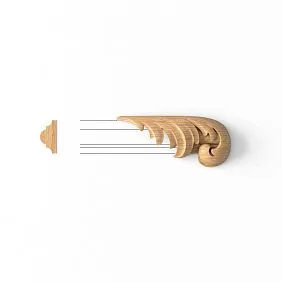
Decor for moldings — 'Modern' collectionin the STAVROS catalog — an example of how molded overlays transform an ordinary profile into an expressive decorative solution.
Get Consultation
Where molded molding is used in interiors
The scope of application for molded molding in interiors is much broader than many think. It is most often seen at the ceiling transition — but this is just one of its functions. Here is a complete list of places where it works:
-
Wall/ceiling transition — serves as a cornice or an additional profile on top of a cornice.
-
Horizontal wall divider — dado line at a height of 90–110 cm from the floor.
-
Frame systems on walls — molded molding forms a frame contour with an ornament.
-
Door and window trims — molded profile as a casing or as part of a portal.
-
Furniture fronts — applied moldings with ornament on cabinet doors.
-
Decorative panels — molding as a frame for a relief or fabric insert.
-
Ceiling cornices — additional lines on the ceiling to create a coffered grid.
What molded moldings can be used in interior design
For walls
Wall moldings with molded relief are divided into two large groups: frame and strip.
Frame — a profile from which closed rectangles are formed on the wall plane. The width of such moldings is usually 30–80 mm. The molded relief here is an ornament along the entire length or corner inserts with a decorative motif. The richer the ornament — the more luxurious the frame looks.
Strip — the profile runs horizontally or vertically as a divider or accent line. The ornament here creates a rhythm along the entire wall — the effect of a border or frieze.
Polyurethane wall decor— a section of the STAVROS website featuring wall-mounted plaster elements: from simple profiles to complete accent panel sets.
For ceilings
On ceilings, plaster molding serves two roles.
First, as a cornice—a wide profile with ornamentation at the wall/ceiling transition. This is the most noticeable element: it’s visible immediately from any point in the room. For this purpose, profiles 80–200 mm with moderately rich relief are chosen.
Second, as a ceiling molding—a thinner ornamented profile laid on the ceiling itself, at a distance from the cornice, creating an inner frame. This is a technique from opulent classical interiors, where the ceiling is a separate decorative plane.
Trending solutions for ceilings: rosettes and moldings— an article on how moldings work in tandem with rosettes to create complete ceiling decor.
For doorways
A doorway framed with plaster molding is no longer just a functional opening in the wall. It’s an architectural accent. A plaster casing gives the door expressiveness, visually enhances its importance in the space, and creates a sense of solidity and thoughtfulness.
For door frames, profiles 50–120 mm are used—depending on the height of the opening and the ceiling height. The ornament is chosen to harmonize with the rest of the decor in the room.
For decorative frames and panels
Molding as a frame is one of the most popular techniques in recent years. A system of rectangles with an ornamental contour is created on the wall. Inside each frame, the color or texture differs from the background. The result is a structured, 'expensive-looking' wall without significant investment.
CPU-1-4 set of decorative molding from the 'Neoclassic' series— an example of a ready-made set: 35 mm wide molding plus decorative overlays. A system where everything is already selected and compatible.
For classic and neoclassical design
In classic style, decorative molding works to its full potential: acanthus-type ornament, egg-and-dart chain, rocaille curls—all are appropriate and organic. The profile is wide, the relief is deep, the ornament is rich.
In neoclassicism, the same principle applies but in a different register. The ornament is more restrained: geometric meander, pearl frieze, simple stepped molding. The relief is low. The width is moderate. All this works subtly but convincingly.
How to choose decorative molding by purpose
For wall decoration
Key parameters when choosing molding for a wall:
-
Profile width: for frames — 30–70 mm; for horizontal dividers — 40–80 mm; for vertical posts — 25–50 mm.
-
Relief depth: for restrained design — 3–8 mm; for accent — 10–20 mm.
-
Ornament style: geometric — for modern and neoclassical; floral — for classical.
Rule: wall molding should have relief proportionate to the frame scale. Wide frame (60×120 cm) — molding 50–70 mm. Small frame (40×60 cm) — molding 30–40 mm.
For ceiling transition
For wall/ceiling transition, choose a profile with an ornament that 'looks' downward — meaning the relief is on the lower and front parts of the profile. With side lighting, such molding casts a shadow that enhances the decorative effect.
Width guideline:cornice is selected based on ceiling height— profile height in centimeters is roughly equal to ceiling height in meters multiplied by two. For a 3 m ceiling — cornice about 6 cm. For 4 m — about 8 cm. Molding in this role can be slightly wider due to relief.
For decorative compositions
Molding as a frame is always a composition. Therefore, the system is important: all frames of the same size or proportional sizes, identical spacing between them, symmetrical arrangement on the wall.
Mixing different molding widths on one wall is not recommended: even with similar patterns, it creates a sense of chaos.
For framing doors and arches
Door framing with molding is built on the 'U' principle: two vertical posts plus a horizontal lintel. For arches, the same profile is bent along the radius. Most polyurethane moldings allow bending: soft polyurethane can be heated with a hairdryer and shaped as needed.
Polyurethane molding MLDPU-027U-1 for arch decoration— a special semicircular profile created specifically for curved surfaces.
For accent interior zones
An accent wall is where molding can work to its full potential. Here, richer ornamentation, wider profiles, and more complex framing systems are permissible. The main rule: there is only one accent zone. If everything is 'accented,' then nothing is.
How to choose molding according to interior style
For classic style
Classical style is the native home of molding. Here, the following are appropriate:
-
profiles with acanthus ornament;
-
ovules and darts chains;
-
friezes with leaves and scrolls;
-
широкие многоступенчатые карнизы с орнаментальным фризом.
Size — from medium to large. Relief — expressive, deep. Interaction with light — one of the main tools of expressiveness.
For neoclassical style
Neoclassicism speaks the language of classicism, but quieter. Here:
-
meander and Greek key;
-
pearl frieze;
-
simple stepped ogee;
-
geometric repeating motifs.
Profile — from thin to medium. Ornament — clear, regular. Color — matching or with minimal contrast.
For modern classic
Modern classic is a very relevant demand in the Moscow interior decor market. Molding is used here in a targeted manner: one frame system on an accent wall, a cornice with moderate ornamentation, possibly a door frame.
Polyurethane moldings and rosettes as practical accents— a good starting point for understanding how modern classic decor works in real interiors.
For a more subdued interior
If you want minimal decoration — choose profiles with soft, unobtrusive ornamentation: for example, a light pearl frieze or a small stepped beading with one decorative groove. Such molding is visible up close but does not dominate the space. Exactly what is needed for a bedroom or study.
For more expressive decor
If the interior requires richness and character — look for ornamentation that works with falling light: deep acanthus leaves, rocaille curls, chains with three-dimensional details. Such molding turns a wall into an architectural object.
What is important to consider when choosing decorative molding
Profile width
Width — the first and main parameter. Correspondence table:
| Task | Recommended width |
|---|---|
| Thin frame line | 20–35 mm |
| Standard frame system | 40–70 mm |
| Horizontal dado divider | 50–90 mm |
| Cornice for ceilings up to 3 m | 60–100 mm |
| Cornice for ceilings 3–4 m | 100–180 mm |
| Cornice for ceilings above 4 m | 180+ mm |
| Door framing | 60–120 mm |
Relief Depth
The depth of the ornament determines how much the molding 'works' under lighting. With a relief depth of 3–5 mm, it creates a soft play of shadow—suitable for bedrooms and studies. At 10–20 mm, it becomes an expressive accent with clear shadows. For living rooms and halls, 8–15 mm is optimal.
Scale of the ornament
The ornament should be proportionate to the width of the profile. A large acanthus leaf on a 30 mm molding is a dissonance. A small pearl frieze on a 150 mm profile will be lost and look pitiful. Ornament and profile are a proportionate pair.
Combination with ceiling, doors, and walls
Plaster molding does not work in isolation. It is always part of a system. Several compatibility rules:
-
the ornamental motif of the molding should be coordinated with the cornice;
-
the profile on the doors should be from the same series as the wall frames;
-
the ceiling rosette should be in the same style as the cornice.
Ceiling rosettes and moldings: unity of polyurethane and wood— how different materials create a coordinated system in one interior.
Room proportions
Proportions dictate scale. In a room with an area of 12 m² and a ceiling of 2.7 m, any molding wider than 50 mm will be 'heavy'. In a hall with an area of 50 m² and a ceiling of 4 m, a 40 mm molding simply won't be perceived. The scale of the room is the first criterion for choosing the width and ornamental richness of the profile.
Where plaster molding looks best
In the living room
The living room is the center of the living space, and it is here that plaster molding reveals itself to the maximum. Recommended scenario:
-
cornice with ornament along the ceiling perimeter;
-
frame system made of molding on an accent wall (behind the sofa or in the TV area);
-
ceiling rosette in the center with matching ornament;
-
baseboard, compatible in profile with the cornice.
Moldings, cornices and rosettes made of STAVROS polyurethane— wide selection of profiles for a living room of any scale.
In the bedroom
The bedroom requires restraint. Molding works here in a targeted way: a frame behind the headboard of the bed is a strong and delicate accent. The cornice is thin, without overload. The ornament is soft, floral or geometric.
It is not worth making a complex frame system on all walls of the bedroom: this visually 'occupies' the space and interferes with rest.
In the hallway
The hallway sets the tone for the entire interior. It is here that molding works as a 'statement': a cornice at the ceiling plus a molded frame for a mirror or doorway — and the hallway immediately makes an impression.
How to choose polyurethane moldings for an interior design project— a useful article for those who want to systematically approach selecting decor for the entire apartment.
In the study
A study demands dignity and seriousness. Wooden moldings are the optimal choice: the warmth of natural material, quality profile, and a sense of solidity.Wooden moldings for walls and ceilings— a catalog of products made from solid oak, beech, and MDF for painting. In a study with bookshelves and dark furniture, wooden decorative molding is an organic and appropriate solution.
In the dining room
The dining room is a space for ceremonial meals. Here, decorative molding of medium saturation is appropriate: a cornice plus a horizontal divider on the walls. The focus is on the chandelier and its rosette, not on the walls themselves.
In commercial interiors
Restaurant, boutique, hotel lobby—here, decorative molding is part of the 'package' of positioning. It creates an environment perceived as expensive, thoughtful, and status-oriented. For commercial interiors, consistency is especially important: all elements from one manufacturer, in one style.
What to combine decorative molding with
With cornices
Molding and cornice are a pair that should be chosen together. If the cornice is ornamented, the molding on the walls should be more restrained (so as not to compete). If the cornice is smooth, the molding can carry all the decorative emphasis. The hierarchy rule: one element is main, the others are supporting.
With ceiling rosettes
Rosette, cornice, and plaster molding in a frame system form a complete decorative system for ceilings and walls. There should be a stylistic dialogue between the rosette and cornice: similar character of ornamentation, coordinated scale of relief.
Ceiling rosettes in the STAVROS assortment— from 300 to 1500+ mm in diameter, for any room and any style.
With panels and wall decor
Plaster molding as a frame around a decorative panel is a classic of classics. Inside the frame can be: a smooth painted surface of another shade, a fabric insert, decorative plaster, wallpaper. The molding here is an artistic frame for the 'painting' on the wall.
With door trims
Plaster molding on walls and plaster door casing form a unified system. The profile should belong to the same stylistic family. A break here is very noticeable: the door and wall 'speak different languages,' and the interior loses integrity.
Wooden moldings and baseboards for furniture, walls, and ceilings— for those building a unified system with wooden elements.
With other decorative profiles
In a complex classical interior, plaster molding can be combined with a frieze, rustication, rocaille, and corner brackets. It's important to follow the principle: each element in its place and role. Molding is structural. A rosette is the central accent. A frieze is a horizontal boundary. A bracket is a vertical accent. No competition for attention.
How not to overload an interior with plaster molding
Overload is one of the main concerns for buyers. And this concern is justified: poorly chosen plaster decor makes an interior heavy, old-fashioned, and tiresome. Let's examine how to avoid this.
When one type of profile is enough
In most modern interiors, one type of plaster molding is sufficient: a cornice with ornamentation around the perimeter of the ceiling — and that's enough. Adding frames on walls, friezes, and overlays is only worth it when the first element is already installed and the interior 'asks' for more.
Why you shouldn't mix too many decorative motifs
Two different ornaments in one room is a conflict. An acanthus leaf on the cornice and a meander on the wall moldings don't create eclecticism — they create confusion. One room — one ornamental language.
How to maintain a clean composition
Rule of pure composition: the more complex an individual element, the simpler its surroundings should be. A rich stucco molding on an accent wall—and clean, smooth surfaces on the sides. An ornamented cornice—and calm walls without frames. An accent works only in silence.
What to do in small spaces
In small spaces (up to 15–18 m²), choose stucco molding of minimal scale: profile 25–40 mm, relief depth up to 6 mm, ornament small and regular. Only one type of element—for example, only a cornice. Or only frames on one wall. Not both at once.
How to buy stucco molding in Moscow without mistakes
What to determine in advance
Before opening the catalog—answer these questions:
-
For which rooms is molding needed?
-
What interior style?
-
What is the ceiling height?
-
What task does the molding solve: cornice, wall frames, door framing?
-
Which material is preferred: polyurethane, MDF, solid wood?
-
What is the budget for all the decor?
Only after answering these questions does it make sense to look at specific profiles.
What dimensions and zones need to be considered
Required measurements:
-
ceiling height in all rooms;
-
perimeter of each room (for linear footage);
-
width and height of door openings (for framing);
-
dimensions of accent walls (for calculating frame systems).
How to select molding for the project
Professional approach: first, determine the style and system—what elements, where, and at what scale. Then—search for specific profiles for that system. Not the other way around.
Decorative Polyurethane Molding: Catalog, Types, Buy— full range overview with prices: from 840 rubles for a simple profile to complex ornamented cornices.
Why it's important to look not only at the profile but also at the overall composition
The most beautiful molding in the catalog can be a mistake in a specific interior. Always consider the context: how will this molding look paired with your cornice? With your doors? With your baseboard? Decor works in a system, not in isolation.
Common mistakes when choosing decorative molding
This is not theory—these are real mistakes that are made regularly.
Confusing decorative and standard molding. A smooth profile and an ornamented one are different tools for different tasks. The first is for a modern minimalist interior. The second is for a classical or neoclassical one.
Choosing too bold an ornament for a small room. Deep acanthus relief in a 12 m² room creates a feeling of crampedness. In a small space, the ornament should be subtle and regular.
Not taking ceiling height into account. A 180 mm cornice with a 2.7 m ceiling is a proportion disaster.
Buying molding separately from the rest of the decor. The cornice is bought, the baseboard is bought, then they look for molding—and the profiles don't match.
Mixing different ornament styles. Meander and rocaille in the same room is not eclecticism, but a design failure.
They create a composition that is too fragmented. Small frames, frequent vertical posts, numerous horizontal lines — the wall 'falls apart' into small fragments.
They fail to consider the proportions of the room. Tall pilasters in a low-ceilinged space; wide frames in a narrow room — scale is always paramount.
What to choose for different tasks
For neat wall decoration
A thin plaster molding 30–40 mm with a soft pattern in a frame system on one accent wall. Everything in one color — or with a slight tonal contrast. Minimalism with character.
For a classic decorative composition
A full system: cornice with ornament + frames with a medium plaster profile + corner overlays + horizontal divider. For the ceiling — a rosette with a coordinated ornament.
For ceiling decor
A cornice with an ornament around the perimeter is the foundation. If desired — an additional molding on the ceiling, parallel to the cornice, to create a 'coffered' effect. A rosette in the center.
For accent zones
A wider profile 60–100 mm with a rich ornament. Large-format frames. Possibly — decorative overlays inside the frames. The main thing — only on one wall.
For interiors with expressive details
Plaster molding combined with brackets, pilasters, and door portals. Elements are selected from a single series. The ornament is coordinated across all surfaces. This is already a full-fledged classic interior.
FAQ: answers to main questions about plaster moldings
What is plaster molding?
It is a decorative linear profile with ornamental relief. It differs from smooth molding by having a repeating decorative motif — floral, geometric, or mixed.
How does plaster molding differ from regular molding?
By the presence of relief ornamentation. Regular molding has a simple geometric profile. Plaster molding additionally carries a decorative pattern that creates a play of shadow and indicates the interior style.
Where is plaster molding used in interiors?
On walls (framing systems, horizontal dividers), on ceilings (cornice, molding), on doors (trims, portals), on furniture (decorative overlays), in arches and openings.
Which plaster molding is best to choose for walls?
Depends on the style. For classic — a profile with acanthus or floral ornament, width 50–90 mm. For neoclassical — a geometric frieze, 30–60 mm. For modern classic — a restrained profile 35–50 mm with moderate relief.
Is plaster molding suitable for an apartment?
Yes. Polyurethane profiles are lightweight and installed without special equipment. With the right scale choice, they work perfectly in apartments of any size.
Can plaster molding be used in neoclassical style?
Yes — neoclassical is actually one of the main styles for using restrained plaster decor. The key is to choose a profile with geometric, not floral, ornament.
What does plaster molding pair best with?
With a cornice from the same stylistic family, with a ceiling rosette of a similar character, with door architraves from the same series. One style — one manufacturer — one system.
How to avoid overloading the interior with plaster profile?
One ornamental motif for the entire room. Decor only in priority zones. Profile size — proportionate to the room. Accent — one and only one.
Where to buy plaster molding in Moscow?
Directly from the manufacturer STAVROS — full range in the catalog at stavros.ru with real prices starting from 840 rubles per item.
How to choose molding to fit room dimensions?
Cornice width in centimeters ≈ ceiling height in meters × 2. For wall frames, molding width is 1/15 of the frame width. Relief depth — the smaller the room, the shallower it should be.
STAVROS: plaster molding in Moscow from the manufacturer
For those who wantto buy plaster molding in Moscowwith confidence in quality, correct selection, and fair price — STAVROS is a manufacturer with a full range of decorative profiles and years of experience in the interior decor market.
STAVROS offers:polyurethane molding by the linear meterfrom 860 rubles,Solid wood moldings and baseboardsfor studies and classic interiors,molded decor for moldings — corner and ornamental overlaysfor creating framing systems,rosettes and cornicesfor full-fledged ceiling decor.
Own production, European raw materials. Over 4,000 items in the catalog. Minimum order — from one item. Warehouses in Moscow and St. Petersburg. Delivery across all of Russia.
Full catalog and selection:www.stavros.ru