Article Contents:
- Polyurethane: the material of the future serving beauty
- Typology of decorative polyurethane elements
- Ceiling moldings: elegant transitions
- Ceiling rosettes: central accents of space
- Cornices and moldings: architectural expressiveness
- Stylistic solutions in ceiling decoration
- Classic elegance
- Baroque opulence
- Modern minimalism
- Neoclassical interpretation
- Technical aspects of installation and operation
- Preparation stage
- Adhesive technologies
- Finishing
- Integration with modern technologies
- Hidden utilities
- LED Lighting
- Color solutions and decorative techniques
- Traditional approaches
- Modern trends
- Economic Aspects of the Project
- Cost analysis
- Long-Term Economic Efficiency
- Psychology of perceiving ceiling decoration
- Emotional Impact
- Functional psychology
- Regional application specifics
- Climate factors
- Logistical Advantages
- Trends in development and prospects
- Technological Innovations
- Integration of smart technologies
The art of creating the ideal interior begins not with the floor and not with the walls — it is born under the ceiling vaults, where each detail plays its unique melody in the overall architectural symphony. Polyurethane moldings on the ceiling represent a revolutionary solution in the world of decorative art, where classical beauty meets advanced technologies of the 21st century.
What makes a modern home truly special? Not room sizes and not furniture cost, but those barely perceptible details that create a unique atmosphere. Polyurethane ceiling moldings are the language of refined taste, the signature by which architectural genius signs its works.
The modern era has gifted us materials that masters of past centuries dreamed of. Polyurethane combines the lightness of a pen with the strength of stone, the plasticity of clay with the durability of metal. It is a chameleon-like material capable of taking any form and embodying the boldest designer fantasies.




Polyurethane: the material of the future serving beauty
The revolution in the production of decorative elements began with the advent of polyurethane — a synthetic polymer that overturned perceptions of the possibilities of decorative art. The density of the material is only 500-700 kg/m³, which is seven times lighter than natural stone, while its bending strength reaches 45 MPa — a figure unattainable for traditional plaster.
The chemical structure of polyurethane ensures exceptional resistance to external influences. The material is not afraid of temperature fluctuations from -45°C to +85°C, does not degrade under ultraviolet radiation, and retains its original dimensions when humidity changes from 10% to 90%. These characteristics make polyurethane ceiling products a universal solution for any climatic conditions.
High-pressure injection technology allows reproducing the finest details with precision down to 0.1 mm. Every vein of the leaf, every swirl of the ornament is transferred with filigree clarity, unattainable by handwork. The surface of finished products does not require additional processing — it is inherently perfectly smooth and ready for final finishing.
The ecological safety of polyurethane is confirmed by international certificates. The material does not emit formaldehyde, contains no heavy metals, and is safe for use in children's facilities. Its hypoallergenic nature makes it an ideal choice for people with sensitive respiratory systems.




Typology of decorative polyurethane elements
Our factory also produces:


Ceiling moldings: elegant transitions
Polyurethane ceiling moldings create a smooth architectural transition between wall and ceiling, visually increasing the room's height and giving the interior a sense of completion. The modern molding size range covers profiles from 20 mm to 250 mm in height, allowing for optimal solutions for any room scale.
Classic profiles reproduce the canons of European architecture — from strict Doric order to lavish Corinthian style. Modern interpretations offer minimalist geometric forms, perfectly fitting into the concept of contemporary design. Profiles with integrated channels for hidden LED lighting are especially popular.
Flexible moldings allow decorating curved surfaces, creating arched openings and complex geometric compositions. The bending radius can reach 30 cm without risk of cracks or deformations. This opens boundless opportunities for creative design in non-standardly planned rooms.
Get Consultation
Ceiling rosettes: central accents of space
Ceiling rosettes are circular or oval decorative compositions traditionally placed in the center of the ceiling around the main light source. The diameter of modern rosettes ranges from 15 cm for compact rooms to 150 cm for spacious halls and lobbies.
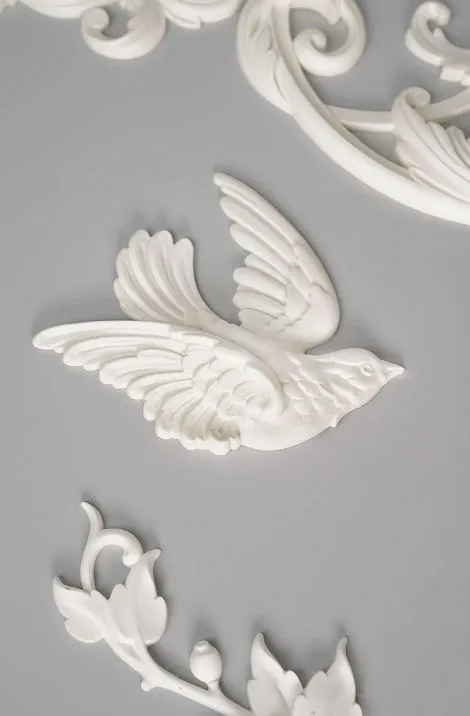
Ornamental richness Polyurethane moldings on the ceiling is impressive in its variety of styles and motifs. Classic rosettes reproduce vegetal ornamentation — acanthus leaves, roses, grapevines, laurel wreaths. Baroque models are distinguished by their lavishness and multi-level compositions. Modern interpretations offer geometric patterns, abstract compositions, and stylized natural motifs.
Modular systems allow creating complex multi-element compositions. The central rosette can be supplemented with concentric rings, radial elements, or corner inserts. This approach enables adapting the decor to specific room dimensions and design intent.
Crown mouldings and mouldings: architectural expressiveness
Decorative polyurethane crown mouldings serve as horizontal accents, dividing the ceiling plane into functional zones. Their profiles can be simple — semi-circular or rectangular — or complex — with multi-level ornamentation and rich detailing.
Mouldings are used to create framed compositions, space zoning, and visual boundaries. Thin profiles 10-15 mm wide are suitable for delicate decoration, while bulky elements up to 100 mm wide create expressive architectural accents.
Corner elements and joint details ensure flawless installation. Internal and external angles, T-joints, end caps — a complete hardware set turns installation into a simple and quick process.
Stylistic solutions in ceiling decoration
Classic elegance
Classic style in ceiling decoration requires strict proportional relationships and the use of canonical ornamental motifs. Polyurethane moldings on the ceiling In a classic execution, they reproduce samples of European palaces from the 17th-18th centuries, adapted to the scale of modern residential interiors.
The composition's base is the central rosette, whose size is calculated according to the golden section rule — the diameter should be approximately 1/8 of the room's larger side. The framing is created by ceiling skirting with a classic profile, often supplemented by corner rosettes or cartouches.
The color palette is traditionally maintained in white tones with possible gold accents. Gilding highlights protruding ornamental elements, creating a luxurious play of reflections. Patination adds noble antiquity, emphasizing the historical continuity of the style.
Baroque opulence
Baroque requires maximum decorative saturation and theatrical effect. Large multi-level rosettes with diameters of 80-120 cm, massive crown mouldings with rich stucco, complex compositions made of multiple elements — these are characteristic features of this style.
Polyurethane ceiling items in Baroque style feature deep relief and abundance of decorative details. Plant motifs intertwine with geometric elements, creating complex ornamental compositions. Asymmetric details within the overall symmetry of the composition add dynamism and liveliness to the decor.
Color solutions can be traditional — white with gold — or bold — contrasting combinations, colored stucco, imitation of precious materials. Especially effective is the multi-layer painting technique using metallic pigments.
Modern minimalism
A minimalist approach to ceiling decoration is based on the principle 'less is more'. Simple geometric forms, concise profiles, absence of excessive ornamentation — these are the foundations of modern style.
Rosettes in minimalist execution are simple circles or squares with minimal relief. Skirting boards feature clean lines and strict proportions. The color solution is usually monochromatic — white, grey, or contrasting black-and-white combinations.
This approach allows highlighting the architectural merits of the space without overloading it with decorative elements. Polyurethane decorative crown mouldings in minimalist execution serve more functional purposes — concealing technical seams and creating clean transition lines.
Neoclassical Interpretation
Neoclassicism represents a modern interpretation of classical canons, taking into account the specifics of contemporary lifestyle. Traditional ornamental motifs are simplified and stylized, and the size of elements is increased to match the scale of modern rooms.
Polyurethane moldings on the ceiling In neoclassical style, they combine the recognizability of classical forms with the minimalism of modern design. The color palette expands through the use of noble greys, beige, and pastel tones.
Technical aspects of installation and operation
Preparation Stage
The quality of installation depends 70% on proper preparation of the base. The ceiling must be perfectly level — allowable deviations should not exceed 2 mm per meter of length. The surface is cleaned of dust, grease, and remnants of old coatings.
Priming the surface with an acrylic deep-penetration primer improves adhesive bond and prevents stains on the stucco. The primer drying time is 4-6 hours depending on temperature and air humidity.
Ceiling marking is a critically important stage determining the quality of the final result. The center of the room is at the intersection of diagonals, from which the entire composition is built. Using a laser level guarantees precise marking and perfect horizontal alignment of elements.
Adhesive technologies
Modern polyurethane-based mounting adhesives provide reliable bonding of decorative elements to any type of base. The setting time is 10-15 minutes, allowing adjustment of element positions during installation.
Adhesive is applied with a notched trowel in an even layer 2-3 mm thick. Special attention is paid to the edges of elements — this is where detachment most often occurs. Polyurethane ceiling items are pressed evenly across the entire contact area.
For large elements, additional mechanical fastening may be required. Special concealed-head screws are used, which are masked with putty and painted to match the stucco tone after installation.
Final finishing
After completing the installation, all joints and connection points are filled with acrylic putty. The material does not shrink and is easily processed with sandpaper. Quality joint filling is the guarantee of invisible connections in the finished composition.
Priming before painting ensures even paint distribution and prevents stains. For polyurethane surfaces, special adhesive primers are used, improving the adhesion of paint and varnish materials.
Painting is done with high-quality water-dispersible paints in two layers. The first layer is applied perpendicular to the relief, the second — along the main lines of the ornament. This technique ensures even coverage and emphasizes the decor's three-dimensionality.
Integration with modern technologies
Hidden utilities
Polyurethane decorative crown mouldings with built-in cable channels allow concealing electrical wiring, internet cables, and other utilities. Removable covers provide access to wires when servicing or upgrading the system.
Integration of air conditioning and ventilation systems becomes unnoticed thanks to special decorative grilles executed in the same style as the main stucco elements. Air diffusers are masked with ornamental covers, preserving functionality while achieving full aesthetic integration.
Fire safety systems — smoke detectors, sprinklers, alarm systems — can be concealed behind specially designed decorative elements. Quick-release covers ensure unimpeded operation of safety systems.
LED lighting
Integration of LED technologies in Polyurethane moldings on the ceiling opens new possibilities for creating lighting effects. LED strips placed in special grooves of cornices create the effect of a floating ceiling or soft contour lighting.
RGB systems allow changing the lighting color depending on the time of day, mood, or festive calendar. Control is performed via mobile applications or integration into "smart home" systems.
Spotlights built into sockets create accent lighting for ornamental elements. Directed light highlights the relief of the decor, creating an effective play of light and shadow.
Color solutions and decorative techniques
Traditional approaches
The classic color solution — white moldings with gold accents — remains popular due to its versatility and elegance. Gold is applied in various ways: from traditional leaf gold to modern metallic paints and gilding.
Patination creates an effect of noble antiquity. The technique involves applying dark paint into the recesses of the relief, followed by partial removal from raised parts. This emphasizes the ornament's volume and creates a sense of historical value.
Silvering imparts an aristocratic coolness and modern elegance to interiors. Silver moldings look especially striking in interiors dominated by cool tones and chrome details.
Modern trends
Colored moldings are one of the most vibrant trends in modern design. Polyurethane ceiling elements can be painted in any color, from pastels to vibrant shades. Contrasting solutions create expressive accents and highlight architectural details.
Gradient transitions and ombre effects create smooth color transitions. Such techniques require high craftsmanship, but the result exceeds all expectations. Gradients look especially effective on large rosettes and long cornices.
Imitation of natural materials — marble, wood, stone — is achieved using special decorative techniques. Multi-layer paint application with various tools allows creating incredibly realistic textures.
Economic aspects of the project
Cost Analysis
Initial investment in high-quality polyurethane ceiling moldings is justified by the material's durability and aesthetic qualities. The cost per square meter of finished decor varies depending on the complexity of the ornament and the size of the elements.
Installation work accounts for 40-60% of material costs. Installation complexity depends on ceiling height, architectural features of the room, and required finish quality. Professional installation guarantees the longevity and aesthetic perfection of the result.
The service life of high-quality polyurethane moldings is 25-30 years without the need for replacement or major repairs. This makes investments economically justified even at a high initial cost.
Long-term economic efficiency
The service life of quality polyurethane molding is 25-30 years without the need for replacement or major repairs. This makes the investment economically justified even at a high initial cost.
The ability to repaint multiple times allows updating the interior without replacing decorative elements. Modern paints retain color vibrancy for up to 10 years, after which the surface can be refreshed or the color scheme radically changed.
The increase in property market value with high-quality decor is 10-20%. This transforms molding expenses from costs into investments that not only pay off but also generate profit upon property sale.
Psychology of ceiling decoration perception
Emotional Impact
A beautifully decorated ceiling exerts a powerful psychological effect on a person. Polyurethane moldings on the ceiling They create a sense of coziness, safety, and stability. Harmonious proportions and elegant ornaments contribute to relaxation and improved mood.
The central rosette serves as a visual anchor, organizing space and creating psychological comfort. The absence of a clearly defined center may cause subconscious unease, especially in large rooms.
The quality of decoration affects residents' self-esteem and social status. A beautiful interior increases life satisfaction and pride in one's home. Guests entering such a space inevitably raise their opinion of the homeowners.
Functional psychology
Properly designed ceiling decoration can correct layout shortcomings and improve space functionality. Horizontal elements visually expand the room, while vertical elements increase ceiling height.
Color solutions affect activity and productivity. Warm tones stimulate communication and create a cozy atmosphere, while cool tones promote concentration and mental activity. Neutral colors are versatile and suitable for multifunctional spaces.
Regional application specifics
Climate factors
Polyurethane moldings demonstrate excellent resistance to various climatic conditions. In northern regions, the material does not crack at low temperatures, while in southern regions, it does not deform under heat. Marine climate has no negative effect on polyurethane.
Seismic activity in some regions requires special attention to mounting methods. The elasticity of polyurethane and strength of adhesive joints ensure the preservation of decoration even during minor building movements.
Local architectural features dictate stylistic choices. In city historical centers, classical forms are preferred, while in modern districts, minimalist solutions are favored.
Logistical advantages
The lightness of polyurethane products significantly simplifies transportation to remote regions. Standard packaging protects elements from damage during long-distance delivery by any transport mode.
The compact packaging allows optimizing logistics costs. The complete decoration set for a 20-square-meter room fits on one standard pallet.
Trends and prospects
Technological Innovations
3D printing opens new possibilities for creating unique decorative elements. Custom projects based on original sketches are becoming increasingly accessible thanks to the development of additive technologies.
New polyurethane formulations have improved characteristics — increased elasticity, UV resistance, antibacterial properties. Bio-degradable polymers based on renewable resources represent the future of eco-friendly decoration.
Nanotechnologies allow creating self-cleaning surfaces that require almost no maintenance. Photocatalytic coatings break down organic contaminants under the influence of light.
Integration of smart technologies
The future of molded decoration is linked to the integration of intelligent systems. Built-in sensors can monitor temperature, humidity, air quality, and automatically regulate the room's microclimate.
Wireless technologies allow hiding various devices — from Wi-Fi routers to mobile device charging stations — within decorative elements. This creates technologically advanced interiors without compromising aesthetics.
Augmented reality can transform static decoration into interactive surfaces. Using special applications, ornaments can come alive, telling stories or providing information about the room.
The world of ceiling decoration is experiencing a golden age, when classical beauty finds new embodiment in modern materials and technologies. Polyurethane molding is a bridge between the past and the future, tradition and innovation, dream and reality. Every element installed on the ceiling becomes part of the home’s personal story, a witness to joyful events and cozy evenings with family.
Choosing quality molding means investing not only in the beauty of space, but also in personal well-being, creating an environment that inspires, calms, and brings daily joy from simply being at home. This is an investment in quality of life, repaid every day with new emotions and a sense of harmony.
STAVROS is a recognized leader in producing high-quality polyurethane molding, embodying the best traditions of decorative art and modern technologies. The long experience of artisans, strict quality control, and continuous innovations allow STAVROS to create products that become the foundation for dream interiors. Choosing STAVROS means choosing reliability, beauty, and the guarantee that your home will become a true work of art, where every detail contributes to creating an atmosphere of harmony and elegance.