Article Contents:
- Physics of moisture: why some materials deteriorate while others survive
- Hygroscopicity: the ability to absorb water
- Biological damage: mold and fungus
- Thermal deformation: expansion and contraction
- Polyurethane: the king of wet rooms
- Water absorption: less than 0.1% in 24 hours
- Chemical inertness: resistance to cleaning agents
- Lightweight: Installation Without Structural Reinforcement
- Durability: 30-50 years without deterioration
- Wood in wet rooms: is it possible?
- Wood species: resistant and non-resistant
- Protective treatment: yacht varnish and oil-wax
- Limitations: where wood is impractical
- Comparison table: polyurethane vs wood in wet rooms
- Aesthetic comparison: when choice is determined by style
- Polyurethane: universal imitation
- Wood: warmth and authenticity
- Combining: the best of two worlds
- Installation: technological differences
- Polyurethane installation: quick and simple
- Wood installation: more complex and slower
- Ecological Safety
- Polyurethane: synthetic without toxins
- Wood: naturalness with caveats
- Economics: cost of ownership
- Polyurethane: low initial price, zero maintenance
- Wood: high initial price, periodic maintenance
- Frequently Asked Questions
- Can polyurethane molding be installed in a sauna?
- Will wood in the bathroom darken over time?
- How to clean polyurethane molding in the kitchen from grease?
- Can polyurethane molding in the bathroom be painted after installation?
- Which wood is better for a bathroom: oak or larch?
- How long will a wooden baseboard last in a bathroom?
- Conclusion: choosing by priorities
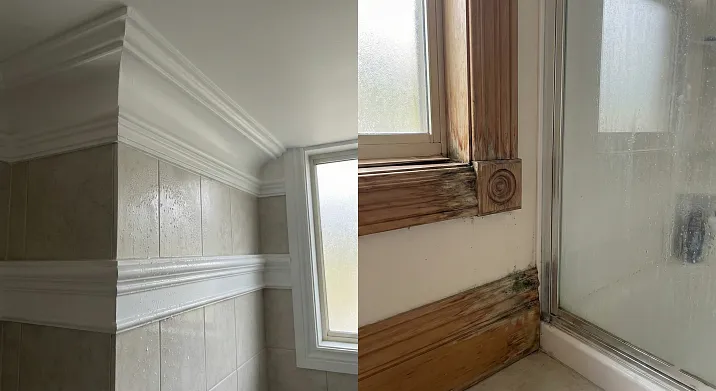
A bathroom with classic cornices, a kitchen with elegant moldings, a pool with columns — an owner's dream, a builder's nightmare. Traditionallydecorative elementsfor interiors were made from plaster orwood. Plaster absorbs moisture, swells, cracks, and becomes covered with mold. Wood without special treatment rots, warps, and darkens from fungus. Wet rooms remained a zone closed to architectural decor for a long time — either expensive special treatment or giving up decoration.Polyurethane moldingschanged the rules of the game: the material is completely moisture-resistant, requires no protection, installs quickly, and is reasonably priced. But does this mean wood has lost? Let's examine in detail: when polyurethane is the only solution, when wood remains preferable, and how to combine materials for optimal results.


The physics of moisture: why some materials deteriorate, others survive
Humidity is not an abstract concept, but a specific physical process: water molecules penetrate the material's structure, alter its properties, and trigger chemical and biological reactions.




Hygroscopicity: the ability to absorb water
A hygroscopic material (plaster, wood, paper) contains a porous structure, with pores connected by capillaries — microscopic channels. Water penetrates the pores through capillary action (attraction of water molecules to capillary walls), the material swells (volume increases by 3-15% depending on the material). Upon drying, water evaporates, volume decreases, but not to the original — internal stresses, cracks, and deformations remain.
A hydrophobic material (polyurethane, polystyrene, epoxy resin) has a closed molecular structure without pores or with closed pores (not interconnected). Water does not penetrate inside, it rolls off the surface. The material does not swell, does not deform, and maintains stability.
Our factory also produces:

Biological damage: mold and fungus
Mold and fungus are microorganisms that reproduce by spores. For growth they require:
Moisture (relative humidity above 60%).
An organic substrate (material that can be decomposed — cellulose, starch, proteins).
Temperature 15-30°C (room temperature is ideal).
Plaster is not an organic material, but it absorbs moisture, creating a damp environment. Mold spores landing on plaster germinate, spread, and form black or green spots. Mold destroys plaster mechanically (mycelium grows into pores) and chemically (releases acids that decompose the binding substance).
Wood is an organic material consisting of cellulose, lignin, and hemicellulose. It is ideal food for fungi. Wet wood (moisture content above 20%) inevitably becomes affected by mold, fungus, and bacteria. The wood darkens (bluish tint — fungal staining), softens (rot — decomposition of cellulose), and crumbles.
Polyurethane is a synthetic polymer containing no organic substances suitable for microorganism nutrition. Mold and fungus do not grow on polyurethane — there is nothing to feed on. Even if spores settle on the surface, they do not germinate and are washed away during cleaning.
Get Consultation
Thermal deformations: expansion and contraction
Materials expand when heated and contract when cooled. The coefficient of thermal expansion (CTE) shows how much the material's size changes with a 1°C temperature change.
Wood has a CTE of 3-8×10⁻⁶ 1/°C along the grain, 30-60×10⁻⁶ 1/°C across the grain (anisotropy — different expansion in different directions). This means: a baseboard 2.4 meters long, with a temperature change of 20°C (e.g., 18°C in winter, 38°C in summer with an open window on the sunny side) lengthens by 1.4-4.6 mm along and can deform across. If the baseboard is rigidly fixed, it warps and cracks.
Polyurethane has a CTE of 50-80×10⁻⁶ 1/°C (higher than wood), but it is isotropic (the same in all directions) and elastic.elements such as casings and decorative appliqués. They help draw attention to windows, emphasizing their shape and size.expand uniformly, compensate for changes without forming cracks, thanks to the material's elasticity (they do not break but bend slightly).
Plaster has a CTE of 12×10⁻⁶ 1/°C (lower than wood and polyurethane), but it is brittle. Thermal expansion leads to microcracks that accumulate, enlarge, and destroy the molding.
Polyurethane: the king of wet rooms
Polyurethane moldingswas developed by chemists as a material resistant to extreme conditions. Initially, polyurethane was used in industry (pipe insulation, seals, protective coatings), then moved into construction and interior design.
Water absorption: less than 0.1% in 24 hours
Standard water absorption test: a material sample is weighed, immersed in water for 24 hours, removed, wiped, and weighed again. The mass difference is the amount of absorbed water.
Polyurethane exhibits water absorption of less than 0.1%(some manufacturers claim 0.05%). This means: a cornice weighing 1 kg will absorb less than 1 gram of water during 24 hours of complete immersion. Practically zero.
For comparison: plaster - 5-10% (50-100 grams per 1 kg), untreated wood - 30-60% (300-600 grams). A difference of hundreds of times.
Practical significance:polyurethane moldingscan be installed in a shower cabin, where it is constantly splashed with water - it will not swell, deform, or fall off. Try that with wood - in a month you'll see mold and peeling.
Chemical inertness: resistance to cleaning agents
Bathrooms and kitchens are cleaned with aggressive cleaning agents - chlorine-containing bleaches, alkaline degreasers, acidic limescale removers. These substances destroy many materials.
Polyurethane is chemically inert. Household cleaning agents (pH 2-12) do not damage it. You can washPolyurethane Decorwith any agents (except organic solvents - acetone, white spirit, which soften polyurethane). Chlorine, alkali, ammonia, hydrogen peroxide - are safe.
Wood with a varnish coating withstands mild cleaning agents (pH 6-8), but aggressive ones (chlorine, alkali) destroy the varnish, penetrate the wood, and darken it. Wood with an oil coating is even less resistant - the oil is washed out by alkaline agents after several cleaning cycles.
Plaster dissolves in acids (citric acid, vinegar), softens in alkalis. Plaster moldings can only be wiped with a slightly damp cloth and neutral soap.
Lightweight: installation without structural reinforcement
A polyurethane cornice 2 meters long weighs 0.5-1.5 kg(depends on the profile size). A similar plaster one - 8-12 kg, wooden - 3-5 kg.
In wet rooms (bathrooms, kitchens), ceilings and walls are often lined with drywall, tiles, plastic panels - surfaces are weak, cannot withstand heavy loads. A plaster cornice requires anchor fastening (through drywall into concrete or brick) - difficult, expensive, risk of damaging hidden utilities (pipes, wiring). A wooden cornice also requires strong fastening (screws into the load-bearing structure).
A polyurethane cornice is glued with special adhesive(polyurethane mounting adhesive or liquid nails) directly onto drywall or tiles. The adhesive is applied in a zigzag pattern on the back side, the cornice is pressed against the ceiling/wall for 30-60 seconds, held by the adhesive's adhesion. No dowels, screws, or anchors are needed. Installation in a 2x3 meter bathroom takes 1-2 hours (a single craftsman, without an assistant).
Durability: 30-50 years without deterioration
Polyurethane is a polymer resistant to UV radiation (does not degrade in sunlight, unlike polystyrene), thermal aging (does not become brittle over time), biological attack (does not rot, does not mold). The service life ofpolyurethane moldings in wet rooms is 30-50 years(comparable to the room's renovation cycle - when tiles, plumbing are replaced, the decor is changed simply because it's outdated, not because it deteriorated).
Plaster moldings in a wet room - 3-7 years (begins to crack, fall off, become moldy).
Untreated wood - 5-10 years (darkens, deforms, rots).
Wood with yacht varnish or oil-wax for wet rooms - 15-20 years (more expensive, requires periodic coating renewal every 3-5 years).
Wood in wet rooms: is it possible?
Wooden itemstraditionally avoided installing in wet rooms. But modern processing and protection technologies make it possible - under certain conditions.
Wood species: resistant and non-resistant
Not all wood species react to humidity equally.
Moisture-resistant:
Teak (tropical wood, contains natural oils that repel water - used in shipbuilding, yachts, decks). Moisture resistance is natural, does not require special treatment. Disadvantage - expensive (price 5-10 times higher than oak).
Larch (coniferous species, grows in cold regions - Siberia, Far East). Wood is dense, resinous, the resin preserves and protects from rot. Larch piles in Venice have stood for 800 years underwater. Disadvantage - hard, difficult to process.
Oak (hardwood, contains tannins — tanning agents, antiseptic properties). Moisture resistance is good, but requires coating. Darkens with prolonged contact with water (bog oak).
Moderately resistant:
Beech (hard hardwood, hygroscopic — actively absorbs moisture). Requires mandatory protection with water-repellent compounds. Without protection, it deforms in 1-2 years in a humid environment.
Ash (hard hardwood, dense, but hygroscopic). Similar to beech.
Non-resistant (not recommended for wet rooms even with protection):
Pine, spruce (coniferous, soft, resinous, but porous — absorb moisture quickly, rot).
Birch (hardwood, soft, hygroscopic — molds within a month in humidity).
Linden (soft, porous — used in saunas, but there it's periodic humidity with drying, not constant).
Fordecorative wooden elements in wet roomsoak and larch are preferable, with budget — teak (but this is rare in mass production).
Protective treatment: yacht varnish and oil-wax
Wood in a humid environment must be protected with a coating that blocks water penetration.
Yacht varnish — specialized polyurethane or alkyd-urethane varnish, developed for shipbuilding (protects decks, masts, steering wheels from seawater, sun, temperature fluctuations). Contains UV filters, fungicides (antifungal additives), plasticizers (elasticity — varnish does not crack when wood deforms).
Application technology: wood is sanded (P180-P220), primed (deep penetration primer), 3-5 layers of yacht varnish are applied with intermediate sanding (P320 — removal of raised fibers). Coating thickness — 150-250 microns. Such a coating is waterproof, withstands direct contact with water, lasts 10-15 years.
Disadvantages: expensive (yacht varnish costs 1500-3000 rubles per liter vs. 300-500 for regular), labor-intensive (5 layers — 5 days of work including drying), hides texture (thick varnish film makes wood look like plastic).
Oil-wax for wet rooms — a mixture of natural oils (linseed, tung) with wax (beeswax, carnauba) and water-repellent additives (paraffin, silicones). Penetrates wood by 2-4 mm, seals pores, creates a hydrophobic surface.
Advantages: preserves wood texture and tactile feel, easy to apply (with a brush or pad), easy to renew (every 2-3 years — apply a new layer without dismantling).
Disadvantages: water resistance is lower than yacht varnish (oil slows water absorption but does not block completely), requires regular renewal.
Limitations: where wood is impractical
Even with protection, wood has limitations in wet rooms:
Shower cabin (direct contact with hot water, steam, constant humidity 80-100%). Even yacht varnish will not withstand — after 2-3 years the coating will begin to peel, water will penetrate the wood. Polyurethane is ideal here.
Area around the bathtub (water splashes, steam). Wood is possible, but risky. If splashes occur regularly — polyurethane is better.
Kitchen backsplash (above stove and sink — grease, hot steam, splashes). Wood is not recommended (grease absorbs, darkens, difficult to remove). Polyurethane or tile.
Areas of minimal water contact (ceiling cornices in the bathroom, baseboards away from bathtub/shower, wall moldings). Wood with yacht varnish is possible — humidity is elevated, but no direct contact.
Comparative table: polyurethane vs. wood in wet rooms
| Criterion | Polyurethane | Wood (with protection) |
|---|---|---|
| Water absorption | <0.1% per 24 hours | 2-5% (with yacht varnish) |
| Mold resistance | Absolute (does not grow) | Medium (fungicide treatment required) |
| Weight | 0.5-1.5 kg/linear meter (cornice) | 3-5 kg/linear meter (oak) |
| Installation | On adhesive, 1-2 hours | On self-tapping screws/anchors, 3-4 hours |
| Material Price | 300-800 RUB/linear meter | 1200-2500 RUB/linear meter (oak) |
| Protective treatment price | Not required | 500-1000 RUB/linear meter (yacht varnish, 5 coats) |
| Service life | 30-50 years | 15-20 years (with coating renewal) |
| Tactile | Smooth, neutral | Warm, textured |
| Ecological | Synthetic material | Natural material |
| Paintability | Yes, any paint | Yes, but difficult over varnish |
Aesthetic comparison: when choice is determined by style
Practicality is not the only criterion. Appearance, tactile feel, and room atmosphere are also important.
Polyurethane: universal imitation
ModernPolyurethane moldingsis manufactured in molds that reproduce any ornament with micron precision. It can imitate plaster stucco (classical rosettes, cornices with dentils, modillions), wood carving (floral ornaments, geometric patterns), even stone (rusticated panels, column capitals).
The surface is smooth, uniform, without material texture. This is an advantage (no random wood defects like knots or grain irregularities) and a limitation (no living texture that wood provides).
Painting:polyurethane is painted with acrylic paintsin any color. You can create white classical stucco (matte white enamel), gilded (gold paint or gold leaf), patinated (dark paint in recesses), colored (matching walls or contrasting).
Stylistic versatility: polyurethane suits classical interiors (imitation of palace plaster stucco), neoclassical (concise profiles), art deco (geometric ornaments), modern classic (minimalist cornices).
Wood: warmth and authenticity
Decorative elements made of solid woodhave a unique texture — annual ring patterns, shade variations, slight non-uniformity. This is a living material, each element is individual.
Tactile feel: wood is warm (thermal conductivity 5-10 times lower than polyurethane), pleasant to touch. If there is a wooden cornice in the bathroom, an accidental touch feels comfortable. Polyurethane is neutral, not cold, but not warm either.
Scent: natural wood (especially coniferous — larch, pine) has an aroma. In a humid environment (after a shower, when humidity is 70-80%) the aroma intensifies — creates a sauna, spa atmosphere. Polyurethane is odorless.
Stylistic specificity: wood is perfect for interiors where naturalness is important — eco-style, Scandinavian, Scandi-boho, Japanese minimalism, rustic, country. In classic interiors, wood is suitable for panels, moldings, baseboards (imitation of wooden palace paneling). In modern minimalist ones — a warm accent.
Sometimes the optimal solution is to combine both species in one piece or set. Oak legs provide strength and longevity to the supporting structure, while beech elements - bent details of backs, armrests, decorative inserts. Such a combination provides maximum functionality at controlled costs. The key is to ensure color harmony through staining or painting.
You don't have to choose just one. Materials can be combined according to humidity zones.
High humidity (shower area, above the bathtub, kitchen backsplash) —Polyurethane.
Moderate humidity (ceiling cornices in the bathroom, baseboards away from water) — wood with protection.
Example: a Scandinavian-style bathroom. Ceiling cornice — oak coated with yacht varnish (creates a warm accent, visible but not in contact with water). Floor baseboard — polyurethane painted to look like wood (risk zone — floor is wet after shower, polyurethane is not afraid of it). Wall moldings away from the bathtub — wood (aesthetics + safety).
Result: a visually cohesive wooden interior, but with the practicality of polyurethane where it's critical.
Installation: technical differences
Polyurethane installation: quick and easy
Installing polyurethane moldingdoes not require special skills, accessible to a DIYer.
Surface preparation: wall/ceiling must be level (irregularities no more than 2-3 mm), clean (free of dust, grease — critical for bathrooms and kitchens), dry. Primer is mandatory (improves adhesive bond).
Marking: a laser level projects a horizontal/vertical line along which the element is aligned.
Applying adhesive: polyurethane mounting adhesive (Orac Decofix Pro, Europlast) or liquid nails (Moment Montazh, Tytan) are applied in a zigzag pattern to the back of the element.
Installation: the element is pressed against the wall/ceiling along the marked line, held for 30-60 seconds (adhesive sets), painter's tape can be used for fixation until the adhesive fully cures (4-6 hours).
Sealing joints: joints between elements are filled with acrylic sealant (white or paintable), smoothed with a wet finger. After drying, the joints are invisible.
Painting (optional): 24 hours after installation, polyurethane can be painted with acrylic paint (2 coats with intermediate drying).
Installation time for a cornice around a 2×3 m bathroom (10 meters) — 1.5-2 hours for a DIYer, 40-60 minutes for a professional.
Wood installation: more complex and slower
Wooden elements are heavier and require mechanical fastening.
Preparation: similar to polyurethane, but additionally — wood acclimatization (the element is kept in the room for 48-72 hours so the wood adjusts to the room's humidity and doesn't warp after installation).
Marking: laser level + marking fastener positions (screws are driven through the element into the wall).
Pre-drilling: holes for screws are drilled in the wooden element (diameter slightly smaller than the screw to prevent wood from cracking when screwed). The holes are countersunk (widened at the surface so the screw head is flush or recessed).
Fastening: the element is placed against the wall, screws are driven through the holes into the wall (if the wall is brick or concrete — holes for anchors are pre-drilled). Fastening spacing — 40-60 cm.
Concealing fasteners: holes with screws are filled with wood filler (color matched to the wood), sanded after drying. Or covered with decorative plugs (wooden dowels).
Finishing: if the element wasn't factory-varnished, a protective coating (yacht varnish, oil-wax) is applied after installation.
Installation time for a wooden cornice around the same bathroom — 3-4 hours for a professional, 5-6 hours for a DIYer.
Oak skirting boards are an indispensable element of classic interior styles. In the English style, oak skirting boards with rich carving emphasize the aristocracy and solidity of the space. Dark wood tones harmonize beautifully with traditional materials — natural stone, leather, bronze.
Polyurethane: synthetic material without toxins
Polyurethane is a polymer synthesized from organic compounds (isocyanates, polyols). Chemical reagents are used in the production process. This scares eco-activists.
But: after polymerization (curing), polyurethane becomes inert. It does not emit volatile organic compounds (VOCs), formaldehyde, or phenols. Certified for use in residential spaces, including children's rooms. Hygienic certificates (Rospotrebnadzor) confirm safety.
The only point: when cutting or sanding polyurethane, dust is generated (fine polymer particles). Inhaling the dust is undesirable (mechanical irritation of the respiratory tract). Work should be done with a respirator or with a vacuum.
Wood: Naturalness with Caveats
Wood is a natural material, eco-friendly by default. However:
Wood is treated with protective compounds (varnishes, oils, antiseptics). If cheap solvent-based coatings (alkyd, nitrocellulose lacquers) are used, they emit VOCs (volatile organic compounds - toluene, xylene, acetone) in the first weeks after application. This is harmful, especially in enclosed spaces (a bathroom without a window).
Solution: use water-based coatings (acrylic varnishes, Osmo oils, Biofa) - they are eco-friendly and do not emit toxins.
Some wood species contain allergens (for example, coniferous essential oils can cause allergies in sensitive individuals). But this is rare.
Conclusion: the eco-friendliness of wood depends on the coating. With the right coating, wood is more eco-friendly than polyurethane (natural material vs synthetic). With a cheap coating - the opposite.
Economics: Cost of Ownership
Initial price is not the only indicator. The cost of ownership is important: material cost + installation + maintenance over the entire service life.
Polyurethane: low initial price, zero maintenance
Polyurethane cornice 2 meters long - 600-1200 rubles (depends on profile complexity).
Adhesive - 300-500 rubles per tube (enough for 10-15 meters).
Installation by yourself (free) or by a professional (200-300 rub/linear meter).
Maintenance - zero (wiping with a damp cloth once a month doesn't count).
Total for 10 meters of cornice (bathroom 2×3 m): material 3000-6000 rubles, installation 2000-3000 rubles (if by a professional). Total 5000-9000 rubles. Service life 30-50 years.
Cost of ownership (per year): 100-300 rubles/year.
Wood: high initial price, periodic maintenance
Wooden cornice (oak) 2 meters long - 2400-5000 rubles.
Yacht varnish 5 coats (if not applied at the factory) - 1000-1500 rubles per cornice (labor + material).
Fasteners (screws, dowels) - 200 rubles.
Installation by a professional - 400-600 rub/linear meter.
Maintenance - coating renewal every 5-7 years (sanding + varnish, 500-800 rub/linear meter).
Total for 10 meters: material 12000-25000 rubles, installation 4000-6000 rubles, maintenance every 5 years 5000-8000 rubles. Service life 15-20 years.
Over 20 years: initial costs 16000-31000 rubles + 3 renewal cycles 15000-24000 rubles = 31000-55000 rubles.
Cost of ownership: 1550-2750 rubles/year.
Difference: polyurethane is 5-15 times cheaper over the entire service life.
Frequently asked questions
Can polyurethane molding be installed in a sauna?
Yes, but with temperature limitations. Polyurethane withstands temperatures up to +80°C briefly (up to +60°C continuously). In a Finnish sauna (temperature 80-100°C) polyurethane can soften. In an infrared sauna (50-60°C) or hammam (Turkish bath, 40-50°C) - excellent.
Will wood in the bathroom darken over time?
Depends on the species and coating. Oak with yacht varnish retains its color for 10-15 years. Without coating or with oil - darkens from moisture in 2-3 years (especially in areas of direct contact with water). Larch naturally darkens (silver-gray patina) - this is normal, not a defect.
How to clean polyurethane molding in the kitchen from grease?
With any household degreaser (Fairy, Cif, Mr.Proper). Apply to a sponge, wipe, rinse with water, dry with a cloth. Polyurethane does not absorb grease and cleans easily.
Can polyurethane molding in the bathroom be painted after installation?
Yes. Let the adhesive dry for 24 hours, prime with acrylic primer, paint with acrylic paint (2 coats). Use paint for wet areas (Tikkurila Luja, Dulux Realife Kitchen & Bathroom).
Which wood is better for the bathroom: oak or larch?
Larch is more moisture-resistant (natural resin protects), cheaper. Oak is more noble (texture, color), more prestigious. Functionally, with yacht varnish, they are equivalent. The choice is aesthetics and budget.
How long will a wooden baseboard last in the bathroom?
With yacht varnish and periodic renewal (every 5 years) — 15-20 years. Without coating — 3-5 years (will start to rot, turn black). With oil-wax — 10-12 years (requires renewal every 2-3 years).
Conclusion: choose based on priorities
Polyurethane moldingsandwooden decorative elements— not competitors, but tools for different tasks.
Choose polyurethane if:
High-humidity area (shower, zone near the bathtub, kitchen backsplash).
Budget is limited (polyurethane is 2-5 times cheaper).
Installation speed is important (polyurethane can be glued in 1-2 hours).
Frequent cleaning with detergents is planned (polyurethane is chemically resistant).
Painting in a non-standard color is needed (polyurethane paints easily).
Choose wood if:
Area with moderate humidity (ceiling cornices, baseboards away from water).
Naturalness and eco-friendliness are important (wood is a natural material).
The interior requires warm tactility and aroma (wood is warm, has a scent).
Budget allows (wood is more expensive but more prestigious).
Interior style is eco, Scandinavian, rustic (wood is authentic for these styles).
Combine if you want the best of both worlds: polyurethane in risk zones, wood for aesthetics and atmosphere.
Company STAVROS manufactures and suppliespolyurethane moldingandDecorative elements made of solid woodfor wet and dry areas. The assortmentpolyurethane productsincludes over 200 models of cornices, baseboards, moldings, rosettes, columns — from classic to modern profiles. The wooden catalog features over 150 profiles made of oak, beech, ash with various finishes — oil, varnish, tinting.
For wet areas, STAVROS recommendspolyurethane cornices and baseboards— 10-year warranty, water absorption less than 0.1%, absolute resistance to mold. The material is certified for use in residential premises (hygienic report, fire safety certificate).
Logistics is organized across Russia — delivery to Moscow and St. Petersburg in 1-3 days, to regions — 3-7 days. Packaging protects elements during transportation. Consultations on selection, calculation of required quantity, installation recommendations — free of charge.
Create interiors where practicality and aesthetics do not contradict each other.Wall molding in the bathroom made of polyurethanewill last for decades without compromises.Wooden itemsin moderately humid zones will add warmth and naturalness. STAVROS offers both solutions — choose according to your project needs.