Article Contents:
- Why Polyurethane Molding is Chosen in Moscow
- Why Polyurethane Decor is Convenient for Apartments, Houses, and Commercial Spaces
- Why This Material is in Demand for Walls, Ceilings, and Facades
- When Polyurethane Molding is Especially Appropriate
- What Polyurethane Molding Can Be Bought in Moscow
- Moldings for Walls and Decorative Panels
- Cornices for Ceilings and Wall-Ceiling Junctions
- Ceiling Rosettes for Chandeliers and Light Fixtures
- Baseboards and finishing elements
- Overlays, decorative inserts and accent details
- Polyurethane facade molding
- Where Polyurethane Molding is Used
- For walls in living room, bedroom, hallway and study
- For ceiling in classic and modern interiors
- For private house facade and architectural accents
- For zoning and visual complexity of interior
- How to choose polyurethane molding before purchase
- By room type
- By interior style
- By room scale and ceiling height
- By purpose: accent, framing, rhythm, composition completion
- By the combination of several elements with each other
- Polyurethane moldings: price in Moscow and what it depends on
- Why the price depends on the type of product
- What affects the cost: size, relief, shape, profile complexity
- Why some elements cost more than others
- When it's more advantageous to choose simple forms, and when decorative accent elements
- Why you can't evaluate cost based on just one product
- What affects the price of polyurethane moldings the most
- Product category
- Size and length of the element
- Complexity of decorative pattern
- Purpose: interior or exterior
- Order volume
- How to buy polyurethane molding in Moscow without making a mistake
- First define the task, don't just choose from photos
- Check dimensions and proportions
- Immediately select compatible elements
- Consider the installation location
- Look not only at the price but also at the final visual result
- How to understand if the price for polyurethane molding is justified
- When overpaying really makes sense
- When to choose more concise decor
- Why a cheap element isn't always more advantageous in a finished interior
- What's more important than price: proportions, appropriateness, and compatibility
- What mistakes are most often made when choosing and purchasing
- Choosing decor without reference to the room
- Looking only at the price
- Taking too small or too massive a profile
- Not considering combination with ceiling, walls, openings, and furniture
- Mixing too many decorative scenarios in one room
- What to choose for different tasks: purchase scenarios
- If you need wall molding
- If you need ceiling decor
- If you need an accent element
- If moderate price is important
- If you need a more expressive result
- Checklist before buying polyurethane molding in Moscow
- FAQ: Answers to Popular Questions
- Where to buy polyurethane moldings in Moscow?
- How much does polyurethane molding cost in Moscow?
- What determines the price of polyurethane molding?
- What to choose for walls: molding or decorative frame?
- Is polyurethane molding suitable for ceilings?
- Can it be used on the facade?
- What to choose on a limited budget?
- How to understand which elements go together?
- What's more important when buying: price, size, or style?
- How to choose molding for a specific interior?
- Conclusion

There are questions that arise immediately as soon as a person starts thinking seriously about interior design. Where to buy polyurethane molding in Moscow? How much does it cost? What determines the price and how to avoid overpaying? How does one element differ from another? Why did a neighbor buy 'cheaper' moldings and was dissatisfied, while another invested twice as much and got a completely different result?
This article is not about polyurethane as an abstract material. It's about conscious purchasing. About how to choose polyurethane molding in Moscow, understand the price range, avoid mistakes with scale, and get an interior that will please for years, not irritate every time you look at it.
Let's go in order.


Why polyurethane molding is chosen in Moscow




Why polyurethane decor is convenient for apartments, houses, and commercial spaces
Moscow is a fast-paced market. Here, renovations don't drag on for years, and the client wants results quickly, beautifully, and without headaches. This precisely explains the steady demand forpolyurethane molding: it is installed in hours, does not require expensive surface preparation, and does not load the structure.
For an apartment, polyurethane decor is an opportunity to get a classic or neoclassical interior without plasterwork. For a country house — to decorate the facade without hiring a team of plasterers. For a commercial space — to quickly create the desired visual image without downtime.
Add to this moisture resistance (kitchen, bathroom, pool — no restrictions), durability with minimal care, and a wide price range — and it becomes clear why this material has so firmly entered the Moscow market.
Our factory also produces:


Why this material is in demand for walls, ceilings, and facades
Polyurethane decor is not tied to a single application scenario — and this fundamentally distinguishes it from most finishing materials. Today you buyceiling decor, tomorrow you selectWall Decor, and in a year you update the facade of your country house. One material, one selection logic, predictable quality of the result.
It is this versatility that makes polyurethane molding convenient for designers and architects: you can work within a single assortment without switching between different suppliers and installation technologies.
Get Consultation
When polyurethane molding is especially appropriate
There are tasks where polyurethane beats competitors without reservations:
-
High humidity (bathroom, kitchen, pool) — gypsum is not applicable here without expensive protection.
-
Quick deadlines — installation without reinforcement and complex preparation.
-
Large areas — the lightness of the material reduces the load on structures.
-
Budget lower than handmade gypsum stucco with comparable visual effect.
-
Facade work in the mid-price category.
What polyurethane stucco can be bought in Moscow
Before talking about price — you need to understand what exactly you are paying for. The range of polyurethane decor covers several completely different categories of products, each of which solves its own task.
Moldings for walls and decorative panels
Moldings made of polyurethane— these are profiled slats used to assemble frame panels, horizontal belts, and door/window surrounds. It's usually with moldings that work with a wall begins: they create structure, rhythm, and a sense of completeness.
Molding widths range from 20 to 200 mm. Narrow profiles are suitable for minimalist interiors and small rooms. Wide ones are for grand halls, high ceilings, Baroque and classical solutions. Flexible moldings allow working with arches and curved surfaces.
Cornices for ceilings and wall-to-ceiling joints
Polyurethane Crown Molding— one of the key elements of any molding system. They frame the transition between wall and ceiling, conceal joints, and create a visual 'frame' for the ceiling space.
The effect of a well-chosen cornice is disproportionate to its cost: a well-executed horizontal line at the ceiling visually raises the room's height by 20–40 centimeters. This technique is especially impressive with hidden lighting — light directed behind the cornice creates a soft, diffused glow that brings the ceiling to life.
Ceiling rosettes for chandeliers and light fixtures
Polyurethane ceiling rosettes— a decorative medallion mounted in the center of the ceiling under a chandelier. Diameter ranges from 150 to 800 mm and more. The ornament covers the full stylistic spectrum: from strict geometric concentric circles for modern interiors to lush Baroque reliefs with acanthus leaves and floral scrolls.
A ceiling rosette is an accent. A single element can completely change the perception of a ceiling, making it a focal point.
Baseboards and finishing elements
Polyurethane Baseboardsserve a dual function: they conceal the joint between floor and wall and establish the rhythm for the lower part of the room. Height ranges from 50 to 150 mm. For classic style — a high, profiled baseboard. For modern interiors — a laconic one with clean geometry.
The baseboard completes the interior composition from below — just as the cornice completes it from above. Together they create a 'framing' of the space.
Overlays, decorative inserts and accent details
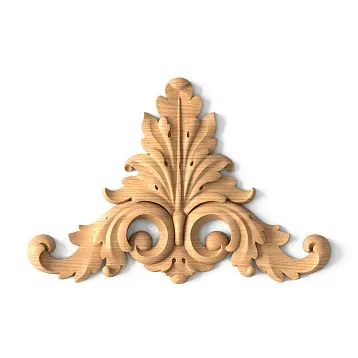
Polyurethane appliqués— individual decorative elements: corner rosettes, medallions, cartouches, floral inserts, acanthus leaves. They are installed to complete framed panels, create accents on walls, and decorate furniture fronts and doors.
It is the overlays that add 'jewelry-like' quality to the stucco system. Without corner ornaments, a molding frame remains just a frame. With them — it transforms into a classic architectural detail.
Polyurethane facade stucco
For facades, special elements with increased resistance to ultraviolet light, frost, and precipitation are used: cornices, window surrounds, pilasters, corner overlays, decorative belts. Polyurethane maintains its geometry and does not crack in temperatures from −60 to +80°C — this is crucial for the Moscow climate with its sharp seasonal fluctuations.
Where is polyurethane stucco used?
For walls in the living room, bedroom, hallway, and study
Polyurethane wall decor— the most diverse and variable scenario. Framed panels, horizontal belts, vertical moldings, decorative accents above furniture zones — all these are tools that transform a flat white surface into an architecturally rich space.
In the living room, stucco on the walls creates a sense of representativeness. In the bedroom — coziness and intimacy. In the hallway — the first impression that sets the tone for the rest of the interior. In the study — strictness and structure.
For ceilings in classic and contemporary interiors
A cornice around the perimeter, a rosette in the center, a decorative belt or coffered frames — each of these elements works independently and even more powerfully as a system.polyurethane ceiling decorallows for implementing interiors of any complexity — from minimalist modern to lavish Baroque.
Important nuance: ceiling decor is perceived from a distance, so the relief must be expressive. It is in this context that the detailing of polyurethane molding is revealed to the fullest — with proper lighting, the relief creates a volumetric play of shadows that no photograph can convey.
For the facade of a private house and architectural accents
A private house in the Moscow region with polyurethane cornices, pilasters, and window surrounds looks like an architectural object — not like a standard catalog building. At the same time, the cost of polyurethane facade decor is incomparably lower than stone molding or carved stone.
For zoning and visually complicating the interior
Moldings as a zoning tool — this is a technique that professional designers have long and willingly used. Vertical slats divide the wall into rhythmic sections. A horizontal belt divides the room's height into two registers. Frame panels highlight an accent zone without physical partitions.
Polyurethane trimis especially convenient in this context: flexible profiles allow for creating zoning of any configuration — including on curved surfaces.
How to choose polyurethane molding before purchase
By room type
Start not with a 'pretty picture,' but with the function of the room. A bedroom requires one approach, a living room — another, a bathroom — a third. In the bedroom, decor should create coziness, not overload the space. In the living room, it can be more expressive — this is a representative area. In the bathroom, moisture resistance and conciseness are important.
By interior style
Three most common stylistic scenarios:
Classic and Baroque — wide cornices with rich relief, rosettes with floral ornamentation, molding panels with corner overlays, pilasters. The richer the decor — the more organic.
Neoclassicism — clean profiles, geometric ornamentation, restrained rosettes. Balance between decorativeness and modernity.
Modern interior and minimalism — a thin cornice as a structural element, one compact rosette, a laconic baseboard. Moldings should not dominate — they create a light architectural context.
Based on room scale and ceiling height
This is the most common source of errors. The rule is simple: the scale of the decor should correspond to the scale of the room.
| Room | Crown Molding | Rosette | Skirting board |
|---|---|---|---|
| Up to 20 sq.m, ceiling up to 2.7 m | Narrow, 30–60 mm | Up to 250 mm | 50–70 mm |
| 20–40 sq.m, ceiling 2.7–3 m | Medium, 60–100 mm | 300–500 mm | 80–100 mm |
| From 40 sq.m, ceiling from 3 m | Wide, 100–200 mm | 500–800 mm | 100–150 mm |
By purpose: accent, framing, rhythm, composition completion
Ask yourself: what exactly do I want to achieve?
-
Accent → ceiling rosette, decorative panel.
-
Framing → moldings, cornices.
-
Rhythm → repeating molding sections, trim.
-
Completion → baseboard, corner elements.
By combination of several elements with each other
Cornice, molding, and rosette in the same room should follow the same stylistic logic. A rough profile combined with a delicate one in a single room creates chaos even with expensive materials. Immediately select compatible elements—this saves both money and nerves.
polyurethane rosettes—both ceiling and wall-mounted—should be chosen in the context of the entire decor, not in isolation.
Polyurethane molding: price in Moscow and what it depends on
Now we've reached the question that interests everyone. How much does polyurethane molding cost in Moscow? The answer, as is often the case in interior design, is 'it depends.' But let's break down this dependency specifically and without fluff.
Why the price depends on the type of product
Molding per linear meter, cornice per meter, rosette per piece, overlay per piece—these are completely different units. You can't compare 'expensive' and 'cheap' without understanding exactly what you're buying.
A cornice for 4 meters of perimeter is linear footage. A ceiling rosette with a diameter of 600 mm is a piece product of complex casting. A corner overlay is a small element with high detailing. The pricing for each type is fundamentally different.
What affects the cost: size, relief, shape, complexity of the profile
Five main factors that form the price:
-
Size—a linear meter of narrow molding at 30 mm is cheaper than wide molding at 150 mm, all else being equal.
-
Relief complexity – a smooth profile is simpler to produce than one with a floral ornament.
-
Type of shape – rectilinear elements are cheaper than curved ones; individual decorative elements (rosettes, overlays) are more expensive than linear molding.
-
Purpose – facade decor with additional protective treatment is more expensive than interior decor.
-
Order volume – with a large order, the cost per unit decreases.
Why some elements cost more than others
A ceiling rosette with a diameter of 500 mm and a classic floral ornament costs more than a simple cornice not because it is 'more beautiful,' but because:
-
the mold is more complex;
-
more material is used;
-
manufacturing precision is higher;
-
storage and transportation without damaging the relief are more difficult.
This is objective production logic, not a marketing markup.
When it's more advantageous to choose simple forms, and when decorative accent elements
A simple profile is the right choice for background decor: a long cornice along the perimeter of a large room, neutral moldings for framed panels, a concise baseboard. There's no point in overpaying for complex relief here — it simply won't be readable from a distance.
A decorative accent element justifies a higher price where it is truly in focus: a ceiling rosette under the central chandelier, corner overlays on a framed panel in the sofa area, a cartouche above the mantel shelf.
Why you can't evaluate cost based on just one item
A mistake many make: they compare prices on individual elements without considering the full estimate. A cornice at 1200 rubles per linear meter seems expensive — until you calculate that about 20,000 rubles will go for the 16-meter perimeter of the living room, and the result will completely transform the perception of the ceiling. This is not an expense — it's an investment in the visual capital of the interior.
What affects the price of polyurethane molding the most
Product category
Comparative table by element types:
| Element type | Where it is used | What affects the price | Who it suits |
|---|---|---|---|
| Molding | Walls, trims | Width, relief, flexibility | For everyone: for frames, zoning |
| Cornice | Ceiling, wall/ceiling joint | Profile width, relief type | Any interior |
| Ceiling rosette | Ceiling center for chandelier | Diameter, ornament, detailing | Classic, neoclassic |
| Overlay | Furniture, frames, accents | Size, ornament type | System addition |
| Baseboard | Floor and wall joint | Height, profile | Any interior |
| Facade decor | External walls, windows | Protection type, shape complexity | Country houses |
Size and length of the element
Direct correlation: bigger — more expensive. A wide cornice costs more than a narrow one. A 600 mm rosette is more expensive than a 200 mm one. This is no secret, but many forget to account for it when calculating the budget.
Complexity of the decorative pattern
Geometric ornament is simpler to produce than floral. Abstract relief is simpler than figurative. A smooth profile is the cheapest. This doesn't mean simple decor is worse — in a number of styles it is more appropriate than complex decor.
Purpose: interior or facade
Facade elements are manufactured with atmospheric resistance in mind, which affects their cost. For interiors, there is no need to overpay for a facade version — choose the appropriate category.
Order volume
When fully furnishing an apartment or country house, it makes sense to discuss bulk order terms. Purchasing molding, rosettes, and overlays simultaneously is more cost-effective than buying individual elements at different times.
How to buy polyurethane molding in Moscow and not make a mistake
First define the task, don't just choose based on photos
A photo doesn't convey the scale. What looks like an elegant, thin rail on screen can turn out to be a massive profile 12 centimeters wide in reality. Never buy 'by the picture' — check the dimensions in the product description or request samples.
Check the dimensions and proportions
Take measurements before placing your order: wall lengths, ceiling perimeter, room height, opening widths, chandelier diameter or location. Without this data, any choice is just guessing.
Immediately select compatible elements
A systematic approach saves more in the end than it seems. A cornice, molding, rosette, and baseboard selected as a unified whole yield a result incomparably stronger than a set of randomly chosen beautiful elements.
Consider the installation location
Is the rosette installed before the chandelier mounting location is determined? Then a mounting block is needed. Are cornices installed before a stretch ceiling? Then they are mounted around the perimeter before stretching the fabric. All these are technical nuances that are important to consider in advance.
Look not only at the price, but also at the final visual result
Cheaper is not always more cost-effective. A narrow cornice in a tall room will look helpless, even if it costs half as much as one of the appropriate scale. The result is measured not in rubles at the purchase stage, but in the impression at the usage stage.
How to understand if the price for polyurethane molding is justified
When overpaying really makes sense
Overpaying is justified in three cases:
-
The element is in the focus of attention (central rosette, main accent wall, entrance hall).
-
You are working with a classic or baroque style, where the richness of relief is part of the concept.
-
You are choosing facade decor, where durability directly depends on the quality of the product.
When it's better to choose more laconic decor
For background decor — long cornices, moldings, neutral baseboards — a laconic profile is preferable both aesthetically and financially. Complex relief in the role of 'background' simply isn't perceived — and money is wasted.
Why a cheap element isn't always more advantageous in a finished interior
If you bought cheap moldings with unclear geometry and then realized they look 'like a Soviet baseboard' — you didn't save money. You spent money on material and labor, and then you'll spend more on redoing it. The quality of relief and accuracy of geometry are not an option, but a basic requirement for molding.
What's more important than price: proportions, appropriateness, and compatibility
Professional principle: the right element in its place always looks better than the wrong one, even if the latter cost three times as much. Proportionality, stylistic appropriateness, and compatibility with the rest of the interior are more important than any price category.
What mistakes are most often made when choosing and purchasing
An honest conversation about what goes wrong is more useful than another list of the material's advantages.
Choosing decor without reference to the room
This is mistake number one. 'Looks beautiful in a photo' and 'looks beautiful in my room' are completely different things. Size, ceiling height, furniture style, color scheme—all of this must be taken into account.
Looking only at the price
The 'buy cheaper' strategy in molding works against the buyer. A low price often means unclear relief, poor geometry, a porous surface that doesn't take paint well. The result—rework costs more than the savings.
Choosing a profile that is too small or too massive
A thin molding gets lost in a spacious hall. A wide cornice overwhelms a small room. Scale is a key selection parameter.
Not considering the combination with the ceiling, walls, openings, and furniture
Molding is part of an interior system, not a standalone object. It should work with furniture, textiles, lighting, and wall color. Choosing it out of context risks disharmony.
They mix too many decorative scenarios in one room.
Frame panels + cornice + rosette + ceiling moldings + decorative wall belts — this is overkill even for a classic interior. Choose 2–3 elements and work them out well, not 7–8 elements superficially.
What to choose for different tasks: purchase scenarios
If you need wall molding
Start with moldings and trim. Create frame panels on an accent wall. Add corner overlays for finishing. This kit gives maximum visual effect with relatively modest costs.
If you need ceiling decor
Basic kit — cornice around the perimeter and a central rosette. If the ceiling is high — the cornice can be more massive, the rosette — larger in diameter. If the ceiling is low — take a narrow cornice and a compact rosette or even manage with just a cornice.
If you need an accent element
One expressive element—a ceiling rosette, a decorative wall panel, a cartouche above an opening—sometimes does more for an interior than a full set of background details.
If moderate price is important
Choose simple profiles in the correct scale. A well-chosen, concise cornice and a precise ceiling rosette of modest diameter will give a pleasant result without significant investment.
If a more expressive result is needed
Invest in detailing where it is visible: an accent rosette, corner overlays for a framed panel, a cornice with a rich profile on a high wall. The rest can be background — this creates a beneficial contrast.
Checklist before purchasing polyurethane molding in Moscow
Before placing an order, go through this list:
-
For which zone is the decor needed (wall, ceiling, facade, furniture)?
-
What are the room dimensions (wall length, perimeter)?
-
What is the ceiling height?
-
What is the interior style (classic, neoclassical, modern)?
-
Accent or neutral background?
-
Single element or system (cornice + molding + rosette)?
-
What matters more: price or expressiveness of the result?
-
Are there compatible elements in one collection?
-
Is a 10–15% allowance for trimming and defects accounted for?
-
Is the delivery method or pickup determined?
FAQ: Answers to popular questions
Where to buy polyurethane molding in Moscow?
The STAVROS catalog features a full range of polyurethane decor: moldings, cornices, baseboards, ceiling and wall rosettes, overlays, trim. Online ordering, delivery in Moscow, and specialist consultation for selection are available.
How much does polyurethane molding cost in Moscow?
Price depends on product type, size, relief complexity, and purpose. Narrow trim profiles start from several hundred rubles per meter. Medium-profile cornices range from 1000 to 4000 rubles for 2 meters. Ceiling rosettes range from several hundred rubles for compact diameters to several thousand for large ceremonial models.
What determines the price of polyurethane molding?
Five main factors: product type, size, ornament complexity, purpose (interior or facade), order volume. Complex relief of large diameter is always more expensive than a simple profile of small width.
What is better to choose for walls: molding or a decorative frame?
Molding is a profiled strip from which frames are assembled. A decorative frame is a ready-made structure made of moldings. If you have time for independent panel assembly — buy moldings and adjust to the desired proportions. If you want a quick result — look at ready-made solutions.
Is polyurethane molding suitable for ceilings?
Yes, it is one of the best materials for ceiling decor: lightweight (does not load the structure), does not require reinforcement, mounted with adhesive. Cornices and rosettes made of polyurethane are a standard solution for most interiors.
Can it be used on exterior facades?
Yes, provided you choose elements designated for exterior use. Polyurethane is resistant to temperature fluctuations, precipitation, and ultraviolet light. For Moscow's climate, this is a proven solution.
What to choose on a limited budget?
On a limited budget, it is better to do less, but proportionally and correctly. One cornice of the correct profile and one compact rosette in good scale will give a better result than an overloaded molding system made of cheap, low-quality elements.
How to understand which elements go together?
A reliable method is to choose elements from the same collection or from the same manufacturer within the same stylistic direction. If in any doubt, consult a specialist before purchase, not after installation.
What is more important when buying: price, size, or style?
All three parameters are important, but priority depends on the task. Size is the basic criterion: incorrect scale cannot be corrected by price or the beauty of the ornament. Style is the second criterion: mismatch with the interior is immediately noticeable. Price is the third: it should correspond to the result, not set a benchmark for choosing 'anything at all'.
How to select molding for a specific interior?
Take measurements, determine the style, choose 2-3 types of elements, select them from one collection. Use the checklist from this article. For complex projects, request a specialist consultation.
Conclusion
To buy polyurethane molding in Moscow means making a choice not between 'cheap' and 'expensive', but between 'correct' and 'incorrect'. The right element in the right place and at the right scale always looks better than an incorrectly selected one, no matter how much it costs.
The price of polyurethane molding depends on five factors: product type, size, complexity of the ornament, purpose, and order volume. Understanding this logic allows you to build a budget not by random purchases, but systematically — investing in accents and saving on the background.
The best result is always achieved through an integrated approach: cornice, molding, rosette, and baseboard, selected as a unified system, create an interior, not a set of parts.
STAVROS Company is a leading supplier of polyurethane decorative molding on the Russian market. The catalog covers the full range of products: moldings, cornices, ceiling and wall rosettes, baseboards, overlays, trim, brackets, and capitals. The collections are developed for all style directions — from classic to contemporary minimalism. STAVROS provides professional consultation on selection, calculation of material quantity, and installation technology. Works with both private buyers and designers, architects, and construction companies. Delivery throughout Moscow and all of Russia.