Article Contents:
- What is polyurethane molding and why is it chosen for interiors
- Where is polyurethane molding used in interiors
- Which styles does polyurethane molding suit
- Why polyurethane decor is in demand in apartments, houses, and commercial spaces
- What types of polyurethane molding can be purchased in the Moscow region
- Wall Decor
- Ceiling decor
- Moldings
- Cornices
- Baseboards
- Ceiling Rosettes
- Inlays and Decorative Elements
- Molding and rosettes
- How to determine which element you need
- If you need to decorate walls
- If you need to accentuate the ceiling
- If you need to design the transition between wall and ceiling
- If you need an accent around a chandelier
- If you need to design the bottom of a wall
- If you need a decorative element for furniture, panels, or portals
- How to choose polyurethane molding for a room
- living room
- for the bedroom
- For the hallway
- For Kitchen
- For Office
- For the staircase area
- For Country Houses
- How to choose molding according to interior style
- Neoclassicism
- Classic
- Modern Interior
- Art Deco
- Restrained interior without overload
- How to choose dimensions: what to look at before ordering
- Ceiling Height
- Room area
- Profile width and thickness
- Scale of the pattern
- Ratio of decor and furniture
- How not to make the interior visually heavy
- What to choose: molding, cornice, baseboard, overlay, or rosette
- How to order polyurethane molding in the Moscow region without mistakes
- Step 1. Determine the application area
- Step 2. Select product type
- Step 3. Check the dimensions
- Step 4. Select the style and ornament
- Step 5. Clarify availability, delivery, and order composition
- Common mistakes when choosing polyurethane molding
- Too large a profile for a small room
- Mixing incompatible decor styles
- Ignoring ceiling height
- Selection by photo only, without size verification
- Purchase of only one central element without connectors
- Lack of docking and installation plan
- Is polyurethane molding suitable for the Moscow region
- How to combine different elements in one project
- Cornice + rosette
- Molding + wall decor
- Baseboard + molding
- Overlays + panels or portals
- How to assemble an interior without visual noise
- FAQ: answers to popular questions about polyurethane molding in the Moscow region
- What is included in the concept of 'polyurethane molding'?
- What is better to choose for walls: moldings or overlays?
- What is installed on the ceiling: cornice or rosette?
- Is polyurethane molding suitable for an apartment in the Moscow region?
- How to choose molding for low ceilings?
- Can moldings, cornices, and baseboards be combined in one interior?
- How to select a decorative rosette for a chandelier?
- What is best for an accent wall?
- How to avoid mistakes with molding dimensions?
- What to order first: individual elements or a set for the room?
- Conclusion
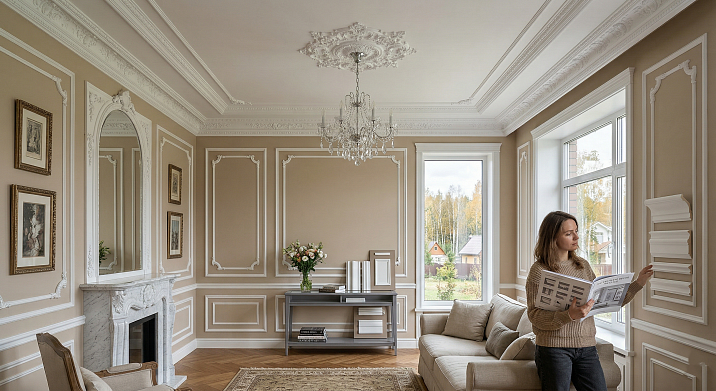
Polyurethane moldings in the Moscow region are in demand today for apartments, country houses, townhouses, and design projects—anywhere people want to create a striking interior without a cumbersome construction process. Users typically aren't just looking for 'decor,' but specific solutions: moldings for framed wall panels, cornices for ceiling design, baseboards for a clean bottom line, ceiling rosettes for chandeliers, and decorative overlays for pinpoint accents.
That's why the right approach is to start not from the category 'I like moldings,' but from the task: what exactly needs to be emphasized, in which room, with what ceiling height, and in what style. Then the choice becomes predictable, and the result—cohesive. In the catalogPolyurethane moldingsSTAVROS features all key categories: wall and ceiling decor, moldings, cornices, baseboards, ceiling rosettes, overlays, trim, and rosettes—making the selection as convenient and focused as possible.
Quick task guide:
-
Decorate walls and create framed panels →Wall Decor
-
Emphasize the ceiling and room perimeter →ceiling decor
-
Define the profile at the wall-ceiling joint →Cornices for the ceiling
-
Finish the bottom line of walls →Baseboards for interiors
-
Create an accent around the chandelier →ceiling rosettes
-
Add a local decorative element →Decorative Inserts
-
Create rhythm and complement the composition →Polyurethane trimandpolyurethane rosettes


What is polyurethane molding and why is it chosen for interiors
If you've heard of molding before, your first association is likely heavy plaster bas-reliefs in Stalinist skyscrapers or luxurious palace cornices. Beautiful, but expensive, heavy, and impractical. Polyurethane molding is a fundamentally different story.
Polyurethane is a synthetic material with a density of 150 to 420 kg/m³, providing an ideal balance between strength and weight. Products made from it meticulously replicate the plasticity of classic molded decor, while weighing many times less than plaster and not requiring reinforced fastening or specialized crews. Installation is done with polyurethane adhesive, and the entire surface is easily painted with acrylic paints—in any color, with a patina effect or gilding.
This solution is particularly relevant for the Moscow region. Temperature fluctuations between summer and winter here are significant, country houses are often heated irregularly, and apartments in the Moscow suburbs frequently have non-standard layouts. Polyurethane decor is resistant to a temperature range from -60 to +80°C, moisture-resistant, does not rot, does not develop mold—and yet retains its shape and geometry for decades.




Where is polyurethane molding used in interiors
The range of applications—from the living room to the stairwell. Polyurethane molded decor is used in situations where interior accent, room geometry, and visual zoning of space are important.
-
Wall decoration: framed panels, moldings, pilasters, accent walls, decorative inserts
-
Ceiling decor: cornices, trim, ceiling rosettes, coffered solutions, light niches
-
Wall-to-ceiling transition: profile cornices and combined perimeter elements
-
Wall base line: baseboards with different profiles — from minimalist to elaborate classical
-
Furniture and portals: decorative overlays for doors, cabinet fronts, fireplace portals
Each of these tasks is solved through a specific catalog section — and this is the key principle of informed selection.Wall Decor— for vertical surfaces,ceiling decor— for horizontal surfaces,Polyurethane moldings— for frame solutions,Crown Molding— for the perimeter,Baseboards— for the wall base line.
Our factory also produces:


Which styles suit polyurethane molding
A common misconception is that molding is only appropriate in classic or neoclassical styles. In practice, polyurethane decor works in a wide range of styles; you just need to choose the right profile and scale.
-
Neoclassicism – restrained ornamentation, pure geometry, medium-thickness cornices, symmetrical molding frames, moderately large rosettes
-
Classicism – developed profiles, richer ornamentation, lush cornices, large rosettes with floral and plant motifs
-
Modern interior and minimalism – smooth profiles without ornamentation, thin cornices, concise baseboards, playing only on geometry and light
-
Art Deco – geometric ornamentation, contrasting paint on decor, vertical accents, strict lines combined with expressive elements
-
Restrained interior without overload – one or two elements in the space, smooth cornice + thin moldings + neat baseboard
Get Consultation
Why polyurethane decor is in demand in apartments, houses, and commercial spaces
Three main reasons why polyurethane molding is chosen more often than any alternative material.
First – practicality. The products are moisture-resistant, impact-resistant, withstand wet cleaning, and do not deform with temperature fluctuations. For country houses in the Moscow region with intermittent heating, this is critical: no cracks, peeling, or changes in geometry.
Second – ease of installation. Polyurethane decor can be installed independently, adhesive is readily available, and the weight of the products allows working without an assistant. This results in significant savings on finishing work.
Third – aesthetics. Clear relief, detailed ornamentation, the ability to paint in any shade or apply a patina effect – polyurethane molding decor is visually indistinguishable from plaster, but is more affordable and lasts longer.
What types of polyurethane moldings can be purchased in the Moscow region?
The STAVROS catalog is organized by purpose, allowing you to immediately navigate to the required section based on your task, rather than browsing the entire assortment sequentially. Let's examine each category in detail.
Wall decor
SectionWall Decor— this is an assortment for decorating vertical surfaces: moldings, decorative panels, pilasters, overlays, wall rosettes. Here, solutions are concentrated for creating framed panels, accent walls, and wall rhythmic compositions.
The collections in the section cover several stylistic directions: 'Neoclassic', 'Versailles', 'Japandi', 'Botanical Garden', 'Summer Garden', 'Peterhof', 'Tsarskoye Selo', and others — which allows for precise alignment with the style of a specific project. Frame moldings vary in width from 20 to 200 mm, and panels are available in different textures — geometric, botanical, classic, and contemporary.
Wall decor is used for the following tasks:
-
Creating framed panels around the TV area, mirrors, paintings, fireplace portals
-
Accent wall behind the bed headboard or behind the sofa in the living room
-
Decorative zoning of open-plan layouts without partitions
-
Wall vertical rhythms with pilasters along the perimeter
Ceiling decor
In the sectionceiling decor— collects elements for horizontal planes: ceiling cornices, trim, rosettes, coffered profiles, decorative inserts. Here you can find solutions both for simple perimeter ceiling decoration and for constructing complex multi-level ceiling compositions.
Ceiling decor solves several tasks simultaneously: it structures the space from above, conceals technical joints, creates a frame for lighting, and forms a central focal point—the medallion for the chandelier. For country houses in the Moscow region with high ceilings, this is particularly advantageous: spacious living rooms and halls require a large-scale ceiling solution.
Moldings are linear profiles used to create framed compositions, zone walls, and frame openings. They come in various widths (from 20 to 150 mm) and relief complexity — from smooth to richly decorated.
Polyurethane moldings— the most universal type of elements in the catalog. These are profiled strips used on walls, ceilings, and in transitional zones.
Why molding is valuable as an element:
-
Creates frames—from simple rectangular to complex polygonal panels
-
Divides the wall into horizontal zones—top, middle, and bottom
-
Frames door and window openings, niches, arches
-
Establishes rhythm and a modular grid, giving walls architectural character
Smooth moldings work in modern and restrained interiors, profiled ones with ornamentation—in neoclassical and classic styles. When choosing, it's important to consider not only style but also width: in small rooms of Moscow region apartments, thin profiles are appropriate; in spacious halls of country houses—developed ones with pronounced relief.
Crown mouldings
SectionCornices for the ceiling— these are profiles for cleanly finishing the joint between wall and ceiling. The cornice is one of the most readable elements of an interior: it sets the tone, defines the style, and at the same time solves a practical task—concealing an uneven joint.
In a good interior, the cornice works subtly, creating a sense of completeness. In an expressive classical interior, it becomes an independent element with a rich profile, noticeable from any point in the room. A modern interior benefits from a smooth profile without ornamentation—thin but distinct.
Additional cornice functionality: inside the hollow cornice, you can hide lighting cables, creating a soft light niche without visible wires. This technique is popular in design projects in the Moscow region — and polyurethane cornices are perfect for it.
Baseboards
Baseboards for interiorsPolyurethane skirting boards are the bottom line of any wall composition. The skirting board unites walls and floors, protects the lower part of walls from mechanical damage, and completes the decorative design of the room.
A rule often ignored: the height of the skirting board should match the scale of the room. In a small apartment in the Moscow region, a tall, massive skirting board will visually 'cut' the ceiling and make the room appear lower. For standard apartments with ceilings of 2.5–2.7 m, neat skirting boards with a height of 70–100 mm are suitable; for spacious houses with ceilings of 3 m and above — from 120 to 200 mm and more.
Polyurethane skirting boards withstand wet cleaning, are impact-resistant, and do not deform with humidity fluctuations — relevant for kitchens, hallways, and bathrooms.
Ceiling Rosettes
Sectionceiling rosettesCeiling rosettes are the central element of the ceiling decorative composition. The rosette accentuates the chandelier, fixes the gaze at the desired point on the ceiling, and sets the mood of the entire room.
The size of the rosette is selected based on two parameters: the size of the chandelier and the area of the room. A simple rule: the diameter of the rosette should be comparable to or slightly larger than the diameter of the chandelier. In small rooms of Moscow region apartments with ceilings up to 2.7 m, a large rosette will feel oppressive — choose compact models. In spacious living rooms of country houses with ceiling heights of 3 m and above, rosettes with a diameter from 50 to 80 cm are justified.
The ornament of the rosette should match the style of the cornice and moldings — otherwise, the ceiling will look like it's assembled from pieces of different puzzles.
Overlays and decorative elements
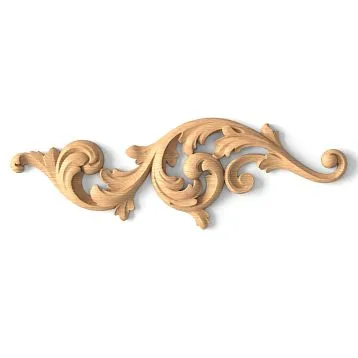
Decorative InsertsOverlays are a local accent where a point detail is needed, not a linear profile. They are used to decorate furniture facades, door panels, fireplace portals, and decorative niches.
Overlays allow you to update old furniture, giving it a 'classical' or 'baroque' character without replacing the body. They are also used in complex wall panels as an additional decorative layer over moldings — to create multi-level relief. Sizes range from 30 mm to 300 mm: you can build small ornamental accents or large central compositions.
Molding and rosettes
In the sectionPolyurethane trimLinear additional profiles have been collected — supplementary elements that help bring the interior composition to a logical conclusion: fill transitions, create additional horizontal rhythms, and place accents.
Sectionpolyurethane rosettesWider than ceiling application: here are elements for walls, furniture, panels, and portals. A small wall rosette can become an accent in the center of a wall panel or a decorative element on a furniture facade.
How to understand which element is right for you
Before moving to the catalog, ask yourself one question: what exactly do you want to do — decorate a wall, highlight a ceiling, create an accent around a chandelier, or add a decorative element to furniture? The answer will immediately point you to the right section.
If you need to decorate walls
Starting point —Wall Decor. Here you choose:
-
Moldings — for frames, horizontal division, panels around a TV or mirror
-
Decorative panels — for creating a textured accent wall
-
Overlays and rosettes — for point accents in the center of a panel
Practical scheme: moldings form a frame → inside the frame, the wall is painted in a contrasting shade or covered with wallpaper → at intersections, corner or decorative elements are placed. The result is a professional wall composition without expensive finishing work.
If you need to emphasize the ceiling
Task: ceiling. Main tool:ceiling decor + Crown Molding + ceiling rosettes.
Scheme: cornice around the perimeter → geometry or frames on the ceiling plane (optional) → rosette at the central point. This three-part approach works in any style — from minimalism to classic, only the profile of the elements differs.
If you need to design the transition between wall and ceiling
Here the main element is the cornice. Choose the profile based on the ceiling height and room area. The cornice can be complemented with a molding on the wall slightly below — creating a two-level transition characteristic of neoclassicism.
If you need an accent around the chandelier
Onlyceiling rosettes. Diameter — according to the size of the chandelier: slightly larger than the base diameter. Important: the rosette's ornament must match the style of the cornice and moldings, otherwise the ceiling will lose its integrity.
If you need to design the lower part of the wall
Baseboards— for classic with a developed profile, for modern interiors — smooth. Height is selected based on the ceiling: standard 70–100 mm for apartments, from 120 mm and above — for houses with high ceilings.
If you need a decorative element for furniture, panel, or portal
Decorative Insertsandpolyurethane rosettesOverlays change the character of furniture without replacing it — just glue ornamental elements onto the fronts and paint them the desired color. This is the most economical way to update the interior without renovation.
How to choose polyurethane molding for a room
For the living room
The living room is the main hall of an apartment or house, where molding works most expressively. Larger elements are justified here: an elaborate cornice, a ceiling rosette of medium or large diameter, frame moldings on an accent wall.
Scenario for a typical living room in the Moscow region (area 20–30 m², ceiling height 2.7 m): cornice around the perimeter of the ceiling + a rosette 40–50 cm in diameter under the chandelier + frame panels made of moldings on the wall behind the sofa or TV. A baseboard around the perimeter completes the composition. All elements are kept in a single profile — this is the key to a cohesive result.
For the bedroom
In the bedroom, molding works softer and more restrained. The main accent is the wall behind the headboard. Moldings that create frames or panels, which can be complemented with decorative inserts or overlays, work well here.
The cornice in the bedroom should be neat, with a simple profile — so as not to create visual heaviness. A rosette is appropriate if there is a chandelier: choose a compact model that matches the area of the room.
For the hallway
Hallways in most apartments in the Moscow region are small, and the main thing here is not to overload. Optimal: a thin cornice along the ceiling + a neat baseboard + possibly one or two moldings for vertical rhythm on the walls. The decor creates a sense of completeness without weighing down the space.
For Kitchen
Polyurethane molding in the kitchen is a non-obvious but justified solution. The material is moisture-resistant, withstands cleaning, and does not react to steam. A cornice around the perimeter of the kitchen, neat baseboards, small decorative elements away from the work area — all this adds an interior character to the kitchen without risking the material.
For an office
The study is a space where decor works through status and concentration. Frame panels made of moldings on the walls, a cornice with a slightly more expressive profile, high baseboards — the combination creates the atmosphere of a classic study, suitable both in a country house and in a city apartment.
For the staircase area
Stairwells and landings require vertical rhythm and wall protection. Moldings and panels on the lower part of walls along the staircase, baseboards and cornices on landings are a standard and effective solution for two-story country houses in the Moscow region.
For a country house
Country houses in the Moscow region often have higher ceilings than city apartments—from 2.8 to 3.5 m and above. This opens up complete freedom for large cornices, tall baseboards, grand ceiling rosettes, and rich wall panels. Polyurethane decor will withstand intermittent heating, temperature fluctuations, and humidity—while maintaining its shape and color without additional maintenance.
How to choose molding according to interior style
Neoclassicism
Neoclassicism is the most popular style for polyurethane molding in the Moscow region. Here, symmetry, moderate ornamentation, and precise proportions are important.
The correct set for neoclassicism:
-
Cornices with a clean, uncluttered profile
-
Moldings for wall panels—medium width
-
Ceiling rosette with a readable but restrained ornament
-
Tall baseboards with a pronounced but not lavish profile
Color in neoclassicism—predominantly white or cream decor on light walls, sometimes with slight patina-like tinting.
Classic
Classical interiors allow for richer decor. Here, cornices with developed multi-step profiles, large rosettes with floral ornaments, moldings with relief, and high baseboards with pronounced profiles are appropriate. The general principle is richness without chaos: all elements should belong to the same decorative family.
Modern interior
Modern interiors work with stucco through minimalism. Smooth profiles without ornamentation, thin cornices, neat baseboards, at most a few frames made of concise moldings. The decor here does not stand out—it structures the space, creates shadow and light, and defines geometry.
Art Deco
Art Deco in interiors is built on contrast and geometry. Moldings with angular ornamentation, contrasting paint on decor (white on a dark wall or gold on black), strict vertical accents—all of this is realized through polyurethane decor. A ceiling rosette in Art Deco can be painted in a metallic shade, adding depth.
Restrained interior without overload
If the goal is to add character to the interior without overloading it with stucco, work on the principle of 'one or two elements, but precisely.' A thin cornice around the perimeter + a neat baseboard—this is enough to make the space more cohesive and expressive. More can be added gradually.
How to choose sizes: what to look at before ordering
Choosing based on a beautiful photo is the most common mistake. A photo does not convey the real scale, and what looks elegant in a large hall will appear heavy and oppressive in a small room.
Ceiling height
This is the main parameter. The rule is simple:
-
Ceiling up to 2.7 m — thin cornices (up to 60–80 mm), compact baseboards (70–100 mm), small rosettes
-
Ceiling 2.7–3 m — medium profiles, cornices up to 100–120 mm, baseboards up to 120 mm, rosettes up to 40–50 cm
-
Ceilings from 3 m — large cornices from 120 mm and above, high baseboards, rosettes from 50 cm and larger
Room area
The smaller the room, the more modest the scale of the stucco decor. A small room of 12–15 m² will lose its sense of airiness with large profiles. However, in a spacious living room of a country house, a concise thin cornice will simply go unnoticed.
Profile width and thickness
The profile of a cornice, molding, or baseboard is the volume it adds to the space. Not only visually, but literally: a wide cornice overhang in a narrow corridor creates a physical sensation of narrowing.
Scale of the ornament
Small ornament details are only readable up close — from a distance of 3–5 meters, it will blend into texture. Large ornament is noticeable from a distance, but in a small room, it looks intrusive. Choose the scale of the pattern proportionally to the room dimensions.
Ratio of decor and furniture
Stucco should not compete with furniture for attention. In interiors with expressive furniture, more restrained profiles are chosen. In minimalist spaces with simple furniture, the decor can be slightly richer — it takes on the role of the main artistic statement.
How to avoid making the interior visually heavy
-
Do not use a large cornice, high baseboard, and large rosette simultaneously in a room with a ceiling up to 2.7 m
-
Maintain a unified stylistic direction for all elements — the ornament of the cornice, baseboard, and rosette should be from the same decorative family
-
Work through rhythm and geometry: one or two accents in a space are stronger than five or six details of different scales
What to choose: molding, cornice, baseboard, overlay, or rosette
| Task | Element | Catalog section |
|---|---|---|
| Frames, panels, rhythm on walls | Polyurethane moldings | Moldings |
| Line at the wall and ceiling junction | Cornices for the ceiling | Cornices |
| Lower line of walls, protection and finishing | Baseboards for interiors | Baseboards |
| Central ceiling point, chandelier | ceiling rosettes | Ceiling rosettes |
| Local accent, furniture, portal | Decorative Inserts | Overlays |
| Wall accent detail | polyurethane rosettes | Rosettes |
| Linear extension profiles | Polyurethane trim | Molding |
How to order polyurethane molding in the Moscow region without mistakes
The process of choosing polyurethane molding boils down to five sequential steps — and if you follow them in order, there will be no mistakes.
Step 1. Determine the application area
First, answer the question: where exactly? Wall, ceiling, wall-ceiling transition, lower wall line, furniture, portal? This is not an abstract question — the choice of a specific catalog section depends on it. For walls, it's Wall Decor, for ceilings — ceiling decor, for perimeter — Crown MoldingandBaseboards.
Step 2. Choose the product type
Within the required area, choose the type: molding, cornice, baseboard, rosette, overlay, trim. The table above helps quickly match the task with the element. You can open several sections simultaneously and compare: often there are several options for one task.
Step 3. Check dimensions
Measure the room: ceiling height, room perimeter, wall width or a specific section. Check the profile dimensions in the product card: width, height, projection. Correlate with the space. If the ceiling is 2.6 m, a cornice 150 mm wide is already excessive.
Step 4. Choose a style and pattern
Match the selected elements with the interior style. Note: the cornice, baseboard, moldings, and rosette should belong to the same stylistic family. Mixing classic scrolls on the cornice with geometric molding and an Art Deco rosette will create a sense of randomness.
Step 5. Clarify availability, delivery, and order composition
When placing an order for the Moscow region, STAVROS delivers polyurethane products to the regions, including throughout the Moscow region — to Krasnogorsk, Odintsovo, Korolyov, Khimki, Balashikha, Domodedovo, and other cities and towns in the region. Clarify the order composition in advance: it's better to take a little extra than to purchase a separate batch later.
Common mistakes when choosing polyurethane molding
Mistakes in choosing decor repeat from project to project. Knowing about them in advance will help you avoid costly reworks.
Too large a profile for a small room
This is mistake number one. A massive cornice in a 12–15 m² room with a 2.6 m ceiling does not decorate — it overwhelms. The photograph from the catalog is taken in a large space, and what looks elegant there will appear like a canopy over your head in your room. Always start with ceiling height and area, then choose the profile.
Mixing incompatible decor styles
Mixing classic cornices with lavish swirls and minimalist moldings in a modern style on the same walls is a common mistake. The result is an interior without a stylistic core, where each element exists on its own. Choose elements from the same collection or stick to a single stylistic direction.
Ignoring ceiling height
A 200 mm high skirting board with a 2.5 m ceiling leaves only half the wall as the active zone. A cornice with a 100 mm projection in a narrow corridor literally reduces the passageway. Ceiling height is a starting parameter, not a secondary detail.
Choosing based only on a photo, without checking dimensions
A catalog photo does not convey the real scale. An 80 cm diameter ceiling medallion looks appropriate in a large hall, but in a 14 m² room it will occupy half the ceiling. Always check the dimensions in the product card and overlay them onto the real dimensions of your room.
Buying only one central element without connecting pieces
A ceiling medallion on an empty ceiling without a cornice, moldings without skirting boards, an accent wall without a connection to the ceiling — all this creates an impression of an unfinished interior. Decorative elements work in a system: cornice + medallion, moldings + skirting board, wall panels + ceiling profile.
Lack of a joining and installation plan
Before purchasing, it's worth sketching a layout of the elements and thinking through corners, joints, and transitions. Moldings are joined at 45-degree angles on corners — this requires precise cutting. A cornice around the perimeter of a room with non-standard angles will require additional corner pieces. Planning at the selection stage will save both time and material.
Is polyurethane stucco suitable for the Moscow region?
The answer is unequivocal: yes, and for several compelling reasons.
For city apartments — ease of installation, light weight, ability to work in conditions of limited height and area.Polyurethane moldingsInstalls without reinforced anchors or a special crew — just adhesive and basic skills are enough.
For cottages and townhouses — resistance to temperature and humidity fluctuations, which is critical for properties with intermittent heating. Polyurethane won't crack in frost or deform when heated — an important property for suburban properties in the Moscow region.
For design projects — wide range of collections, precise detailing, possibility of painting and patination, convenient catalog navigation. A designer can select elements from one collection for walls and ceilings, creating a cohesive decorative solution.
For commercial properties — durability, resistance to mechanical impact and wet cleaning, possibility of repainting when changing concepts. Offices, hotels, restaurants, and showrooms in the Moscow region actively use polyurethane molded decor for exactly these reasons.
For projects with regional delivery — STAVROS organizes delivery of polyurethane products throughout the Moscow region, solving the logistics challenge for buyers from the Moscow suburbs.
How to combine different elements in one project
Comprehensive interior design using polyurethane decor is not a random set of beautiful details, but a deliberate system. Let's consider working combinations.
Cornice + rosette
A classic ceiling pairing. The cornice defines the perimeter line and fixes height proportions: how much 'clean' ceiling remains. The rosette in the center creates a visual focal point. Both elements should belong to the same stylistic direction — smooth cornice + minimalist rosette for modern interiors, profiled cornice + ornamented rosette for classic and neoclassical styles.
Molding + wall decor
Moldings form frames—panels on walls. Inside the frame, you can apply a decorative element: an overlay, a wall rosette, or a decorative insert. Together, they create a multi-level wall composition with depth and relief.
Baseboard + Molding
Linking the lower and middle parts of the wall. The baseboard finishes the wall at the bottom, while the molding—a horizontal divider—marks the transition between the lower and upper zones. This is the basic scheme of classic wall design, characteristic of neoclassicism and traditional European interiors.
Overlays + Panels or Portals
If the interior features a fireplace portal, decorative panels, or built-in cabinets—Decorative Inserts—helps unite the furniture group with the overall wall decor. Several overlays of the same pattern, repeated on the portal and nearby door trims, create the effect of a designed ensemble.
How to Assemble an Interior Without Visual Noise
The main principle: one style—one family of decor—consistent scale. If you choose neoclassicism, take cornices, baseboards, moldings, and rosettes from one collection or at least from the same stylistic direction. The scale gradually increases from small elements (overlays, corner details) to large ones (cornice, rosette)—smoothly, without abrupt jumps. Then the interior reads as a unified statement, not as a showroom of decorative material.
FAQ: Answers to Popular Questions About Polyurethane Molding in the Moscow Region
What is included in the concept of 'polyurethane molding'?
Polyurethane molding is a broad group of decorative items made from synthetic polyurethane that mimic the plasticity of classic stucco decor. It includes moldings, cornices, baseboards, ceiling rosettes, overlays, panels, pilasters, trim, and other elements. The full range is available in the section Polyurethane moldings.
What is better to choose for walls: moldings or overlays?
Moldings are for linear solutions: frames, panels, horizontal zoning. Overlays are for point details and local accents. In a full-fledged wall composition, they are often used together: moldings create the structure, overlays add a decorative accent inside the frames. Choose moldings in the section Wall Decor, appliqués - in section Decorative Inserts.
What is installed on the ceiling: a cornice or a rosette?
Ideally, both elements together. The cornice frames the perimeter and the joint between the ceiling and the wall, the rosette creates a central accent around the chandelier. If the budget or task is limited, prioritize the cornice: it provides the maximum effect of completeness. Cornices are available in the section Cornices for the ceiling, rosettes are in the section ceiling rosettes.
Is polyurethane molding suitable for an apartment in the Moscow region?
Yes, and it is one of the best choices for apartments. Light weight, easy installation, moisture resistance, resistance to temperature fluctuations—all this makes polyurethane decor convenient for urban apartments in the Moscow region. Installation can be done independently using polyurethane adhesive.
How to choose molding for low ceilings?
Three rules: thin profile, laconic ornament, small rosette diameter. For ceilings up to 2.6 m, cornices with a height of up to 60–70 mm, baseboards up to 80–100 mm, and rosettes with a diameter of up to 30–35 cm are suitable. Thin moldings for frames on walls visually 'raise' the space, creating a vertical rhythm.
Can moldings, cornices, and baseboards be combined in one interior?
Yes, you can and should—this combination creates a cohesive decorative solution. The cornice is the transition between wall and ceiling, moldings provide rhythm and structure to walls, and the baseboard finishes the bottom line. The main condition: all three elements must belong to the same stylistic family. You can see compatible solutions in the sections Moldings, Crown MoldingandBaseboards.
How to choose a decorative rosette for a chandelier?
The diameter of the rosette should be comparable to or slightly larger than the diameter of the chandelier's base. If the chandelier has a 20 cm base—a 30–40 cm rosette. If the chandelier is large—a rosette from 50 cm and above. The pattern is selected to match the style of the cornice and moldings. The entire assortment is in the section ceiling rosettes.
What is best for an accent wall?
The best solution for an accent wall is frame panels made of moldings with decorative elements inside. Moldings create structure; inside the frames, you can use contrasting paint or wallpaper. An additional accent—wall rosettes or overlays. All of this is in the section Wall Decor.
How not to make mistakes with the dimensions of moldings?
Before ordering, measure three parameters: ceiling height, room perimeter, and the area of the surface to be decorated. Then compare with the profile dimensions in the product card: width, height, projection. Add 10–15% extra for trimming. If in doubt—order a slightly smaller product: in small spaces, a compact profile always looks better than an overloaded one.
What to order first: individual elements or a set for the room?
If the project is clear—order a set right away: cornice, baseboard, moldings, rosette. Elements from the same collection will be compatible in style and profile. If you're experimenting—start with the cornice: it provides the maximum visual effect and serves as the base from which the remaining elements are chosen.
Conclusion
Polyurethane molded decor in the Moscow region is not just 'finishing' today, but a full-fledged design tool that allows creating interiors with character: from a minimalist modern apartment to a classic country house with rich decor.
If you are just starting to choose and want to get into the topic — open the general sectionPolyurethane moldingsand look at the catalog structure: it is organized by tasks, not alphabetically. If the task is already clearly defined — go directly to the desired category:Wall Decor, ceiling decor, Crown Molding, Baseboards, Moldings, ceiling rosettes, applique, Trimorpolyurethane rosettes.
STAVROS is a professional manufacturer and supplier of polyurethane molded decor with a wide range for interiors of any complexity. The catalog presents solutions for residential and commercial properties in the Moscow region and all of Russia: from classic collections with rich ornamentation to modern laconic profiles. STAVROS delivers throughout the Moscow region and offers convenient navigation through catalog sections, so you can find the right element by task, style, and size — without unnecessary effort and mistakes.