












































































Article Contents:
- Kazan: The Capital of Tatarstan as the Design Center of the Volga Region
- Restoration of historical interiors
- Business-Class New Buildings
- Private Houses in the Suburbs
- Where to Buy in Kazan: Showrooms and Direct Delivery
- Samara: An Industrial Center with Classical Ambitions
- Restoration of Stalinist and Empire-Style Buildings
- Private Housing Construction on the Volga
- Logistics: Delivery from Moscow to Samara
- Prices in Samara: Comparing Local and Moscow Rates
- Nizhny Novgorod: Historical Center and Modern Districts
- Demand for Historical Stylization
- New Residential Districts on the Strelka and Embankments
- Manufacturer Representatives and Direct Purchases
- Rostov-on-Don and Voronezh: Southern Markets for Molding
- Rostov-on-Don: Mediterranean Influences
- Voronezh: Classicism and Modernism
- Comparative Table of Regional Prices
- Logistical Nuances: How to Transport Molding Intact
- Packaging: Manufacturer Responsibility
- Choosing a Transport Company
- Receiving and Checking the Cargo
- Frequently Asked Questions
- Conclusion: Regional Market and Direct Access to the Manufacturer
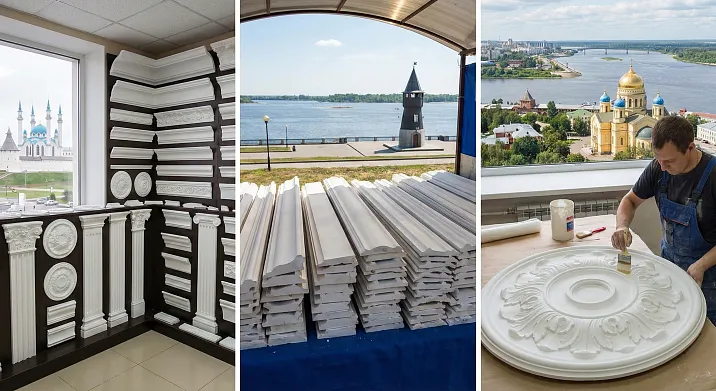
The Volga Region is an area with a rich architectural history, where 19th-century mansions coexist with modern new buildings, merchant estates are restored into cultural centers, and apartments in Stalinist buildings are transformed into lofts and neoclassical apartments.Polyurethane Molding Kazanbecomes a tool for transforming interiors—from restoring historical decor to creating modern classics. The three largest cities in the region—Kazan, Samara, Nizhny Novgorod—form their own markets for decorative materials, where demand, supply, prices, and logistics have regional specifics. Understanding these specifics is critical for a buyer planning to decorate an interior with molding: where to buy quality products at affordable prices, how to deliver them, who will install them, and which collections are popular here?
Moscow and St. Petersburg manufacturers have long mastered regional markets, but physical presence is limited. Showrooms are not available in all cities, showrooms are selectively represented, and the main sales channel is the internet with delivery by transport companies. This creates both opportunities (access to the full range of capital brands) and barriers (inability to see samples in person, risks when delivering fragile elements, dependence on transport companies).Polyurethane Molding Samaraand other regional markets are formed under conditions of balance between local dealers (limited assortment, inflated prices, but fast delivery and the possibility of inspection) and direct purchases from manufacturers (full assortment, lower prices, but delivery times and transportation risks). Let's examine each city in detail.

Kazan: The Capital of Tatarstan as the Design Center of the Volga Region
Kazan is a city with a population of one and a half million, the administrative and cultural center of the Volga Region. Its architectural heritage is diverse: from Tatar mosques to Orthodox churches, from merchant mansions to Soviet constructivism, from the historic center to new business-class residential complexes on the banks of the Kazanka River. Demand forpolyurethane stucco in Kazanis formed by several segments.




Restoration of historical interiors
The central part of Kazan is saturated with buildings from the late nineteenth to early twentieth century. Merchant mansions, apartment buildings, estates — many are privately owned, being restored by owners or developers for housing, offices, hotels. Original plaster stucco is often lost or damaged — due to Soviet-era redevelopments, leaks, and careless use. Restoring plaster stucco is expensive (handwork by master plasterers, mold making, a lengthy process) and not always justified (in spaces with variable humidity, heating, vibration, plaster will deteriorate again).
Polyurethane stucco solves the problem: the profile of lost cornices is recreated from surviving fragments (manufacturers produce copies of historical profiles), rosettes, moldings, and door surrounds are installed. Polyurethane is not afraid of moisture (relevant for ground floors of old buildings with capillary water suction from the foundation), does not crack from vibration (tram lines run near many historic quarters), and is easily painted any color (recreating historical polychromy or modern adaptation to white monochrome).
Kazan's restoration workshops, specializing in historic interiors, actively use polyurethane. Orders are formed for specific projects — original profiles are measured, analogs are selected from manufacturer catalogs, or custom manufacturing is ordered. Volumes are large — restoring a mansion requires hundreds of meters of cornices, dozens of rosettes, hundreds of overlays. Price is not the main factor (restoration budgets are large); accuracy in reproducing historical forms is critical.
Our factory also produces:


New business-class construction
Kazan is actively building. New residential complexes in Gorki, the Privolzhsky district, near the Kremlin are positioned as elite housing. Apartments are handed over with finished interiors, but often basic — white walls, stretch ceilings, standard flooring. Buyers finish the interiors to their taste, hiring designers.
Kazan designers readily work with polyurethane stucco — quickly transforming standard spaces into neoclassical, Art Deco, or modern classic styles. Cornices ten to fifteen centimeters high visually raise the ceilings (standard height is 2.70 meters, feels low). Wall moldings create panels, visually divide planes, add graphics. Rosettes for chandeliers turn the ceiling into a focal point. Door surrounds with portals add solemnity.
Demand for simple neoclassical profiles (without excessive ornamentation, restrained, elegant) is high. Kazan buyers prefer moderation — not baroque opulence, not rococo playfulness, but strict classicism with light floral motifs. White monochrome solutions are popular — stucco is painted white to match ceilings and walls, standing out only through relief.
Get Consultation
Private houses in the suburbs
Around Kazan, cottage communities are being built — Derbyshki, Salmachi, Borisoglebskoye, Zaymishche. Houses are 200-500 square meters, ceiling heights three to four meters, formal living rooms, double-height halls.Polyurethane Molding Samaraand the Kazan market intersect here — owners seek monumental solutions, large cornices (twenty to thirty centimeters high), wide moldings, voluminous rosettes (eighty to one hundred twenty centimeters in diameter), portals with columns and pediments.
Style preferences are diverse. Classicism (symmetry, columns, pediments) is popular among middle-aged owners (forty to sixty years old) building family nests. Modern and Art Deco attract young owners (thirty to forty-five years old) who value elegance without historical heaviness. Baroque and Empire are rare — perceived as excessive, pretentious.
Where to buy in Kazan: showrooms and direct delivery
There are few physical stucco stores in Kazan. Large construction hypermarkets (Leroy Merlin, Castorama) have decor departments, but the assortment is limited to budget items — simple baseboards, basic cornices five to eight centimeters wide, standard rosettes thirty to fifty centimeters in diameter. Price segment — two hundred to five hundred rubles per linear meter of cornice, eight hundred to two thousand for a rosette. Brands — Orac Decor, Decomaster, local Chinese manufacturers. Quality is average (polyurethane density 140-180 kg/m³, shallow relief), sufficient for budget renovation, insufficient for a quality interior.
Specialized decor showrooms in Kazan are few. They operate as dealers for Moscow manufacturers — have samples of main collections, catalogs, consultants. Assortment is wider than hypermarkets (five hundred to eight hundred items versus one hundred), but narrower than the manufacturer's full factory range (two to three thousand items). Prices are fifteen to twenty-five percent higher than in Moscow (dealer markup plus logistics to Kazan plus showroom maintenance). Advantage — the ability to see and touch samples, get consultation, pick up goods on the day of order (if in stock).
Direct delivery from manufacturers in Moscow is the main channel for serious orders. The buyer visits the manufacturer's website, selects from the full assortment, places an order, pays (50-100% prepayment), the manufacturer ships to a transport company, the TC delivers to Kazan (three to five days), notifies of arrival, the buyer picks up from the TC warehouse or orders courier delivery to the address.
Prices with direct delivery are factory prices, without dealer markups. Savings are significant: a cornice costing 1,200 rubles per meter in a Kazan showroom costs 800 from the manufacturer, plus delivery of 100 rubles per meter (for example), total 900 — saving 300 rubles per meter. On an order of fifty meters of cornices, savings are 15,000 rubles. On a full apartment decor (cornices, moldings, rosettes, trims) savings are thirty to sixty thousand — substantial.
The risk of direct delivery is the inability to inspect before purchase, dependence on packaging quality and the TC's care. Polyurethane is durable, but thin elements (leaves, curls) can break during rough loading/unloading. Manufacturers pack carefully (corrugated cardboard, bubble wrap, stretch film, rigid padding), but the human factor of TC loaders is not controlled. Damage statistics are low (one to three percent of orders), but it happens. Solution — cargo insurance (TCs offer the option, cost one to two percent of declared cargo value) or ordering with a surplus (buy five percent more — surplus is useful for installation or future repairs).
Samara: An Industrial Center with Classical Ambitions
Samara is a city of over a million, a major industrial center, historically linked to aviation, cosmonautics, and mechanical engineering. Its architectural face is Stalinist Empire (Lenin Avenue is built up with monumental buildings from the 1930s-50s), merchant mansions (Samara was a wealthy merchant city in the nineteenth century), modern business centers and residential complexes.Polyurethane stucco Nizhny Novgorodand the Samara market are similar in structure — industrial cities with Soviet heritage, active restoration of historic buildings, construction of new elite quarters.
Restoration of Stalin-era buildings and Empire style
Apartments in Stalin-era buildings in Samara are valued — high ceilings (three to 3.20 meters), large rooms, thick walls, central location. Buyers restore them, returning historical aesthetics or creating modern interiors in an Empire style.
Original stucco in Stalin-era buildings was simple — smooth cornices, rosettes with minimal ornamentation, strictness corresponding to the era's ideology. Polyurethane analogs are easy to find — Empire collections from manufacturers include profiles from the 1930s-50s. Samara designers often enhance historicism — adding richer stucco (rosettes with laurel wreaths, cornices with dentils, moldings with military trophies), creating a parade effect that Stalin-era builders planned but did not implement due to budget constraints.
Private housing construction on the Volga
Samara stands on the Volga, suburbs stretch along the shore. Cottage communities with river views are prestigious real estate. Houses are built on a grand scale — panoramic windows, terraces, balconies, double-height living rooms.Polyurethane Molding Samarais used here for facade and interior decoration.
Facade molding — cornices, window surrounds, pilasters, rustication — creates architectural expressiveness. Polyurethane for facades has increased density (200-240 kg/m³), is resistant to ultraviolet light, frost, and moisture. It is painted with facade paints and lasts 20-30 years without losing its appearance. Samara cottages are often decorated in neoclassical or Mediterranean style — white facades with contrasting plinths, framed windows, entrance portals with columns.
Interior molding in such houses is monumental — cornices 20-30 cm high, rosettes 1-1.5 meters in diameter, door portals with architraves and pediments, wall panels made of moldings. Style — classicism, neoclassicism, less often baroque. White and cream tones, patination (artificial aging for an antique effect), gilding of accents (column capitals, centers of rosettes) are popular.
Logistics: delivery from Moscow to Samara
Distance Moscow-Samara — 1000 km, travel time by road transport 20-24 hours. Major transport companies (SDEK, PEK, Delovye Linii, KIT) operate daily flights, pick up cargo in Moscow, transport it to Samara, and deliver it to the TC's warehouse in the city. Delivery time — 4-6 days from the moment the cargo is handed over to the TC.
Delivery cost depends on weight and volume. Polyurethane molding is lightweight (a 10 cm wide cornice weighs 500-700 grams per meter), but bulky (2-meter long strips are packed in boxes measuring 210×20×15 cm). TCs calculate volumetric weight — the package volume in cubic meters is multiplied by a coefficient (usually 250-300), resulting in a calculated weight in kilograms. The actual and calculated weights are compared, the greater value is taken and multiplied by the TC's tariff per kilogram for the distance.
Calculation example: order — fifty meters of cornice 10 cm wide. Actual weight — fifty meters × 0.6 kg/m = 30 kg. Packaging — twenty-five boxes of two meters each, box size 210×20×15 cm = 0.063 m³, total volume 25 × 0.063 = 1.575 m³. Volumetric weight = 1.575 × 300 = 472 kg. We take the volumetric weight (greater than actual). SDEK tariff Moscow-Samara — about twelve rubles per kilogram. Total 472 × 12 = 5664 rubles. With the cornice cost of eight hundred rubles per meter (fifty meters = 40000 rubles), delivery — fourteen percent of the product cost. Acceptable.
Alternative — consolidated cargo (delivery through logistics aggregators that select consolidated cargo from private carriers). Cheaper by twenty-forty percent, but deadlines are less predictable (three-ten days), risk of damage is higher (less quality control of transportation).
Prices in Samara: comparison of local and Moscow
Local decor stores in Samara (construction hypermarkets, specialized salons) sell polyurethane molding with a markup of twenty-thirty-five percent on Moscow prices. Reasons: small wholesale purchases from Moscow dealers (no direct contracts with manufacturers), logistics to Samara, maintenance of retail space, staff salaries, profit.
Price examples (February 2026):
| Element type | Moscow price | Price in Samara (local store) | Difference |
|---|---|---|---|
| Simple cornice 8 cm | 450 rub/m | 600 rub/m | +33% |
| Cornice with ornament 12 cm | 850 rub/m | 1100 rub/m | +29% |
| Rosette diameter 50 cm | 1800 rub | 2400 rub | +33% |
| Molding 5 cm | 280 rub/m | 370 rub/m | +32% |
| Door architrave 10 cm | 520 rub/m | 680 rub/m | +31% |
When ordering for forty-fifty thousand rubles (decoration for an apartment of seventy-eighty square meters), the overpayment in a local store will be twelve-fifteen thousand. Delivery from Moscow costs three-five thousand. Savings seven-ten thousand. But in a local store, you get the product today, see it in person, and can return defective items. When ordering from Moscow, you wait a week, the product is only by photo, return is problematic (sending it back — paying for delivery again).
The decision depends on priorities. If urgent, a small volume is needed (ten to fifteen meters of cornice for one room), and the ability to inspect is important — a local store is justified. If decorating the entire house, budget matters, and there is time — ordering from Moscow is more advantageous.
Nizhny Novgorod: Historical Center and Modern Districts
Nizhny Novgorod is a city with a population of one million two hundred thousand, one of the oldest cities in Russia (founded in 1221). The historical center (Kremlin, Bolshaya Pokrovskaya Street, merchant quarters) preserves architecture from the eighteenth and nineteenth centuries. Active restoration is transforming historical buildings into museums, hotels, restaurants, and residences.Polyurethane Molding Nizhny Novgorodis used in these projects as a more practical alternative to plaster.
Demand for Historical Stylization
Owners of apartments in historical buildings in Nizhny Novgorod value authenticity. During renovation, they strive to preserve or recreate the historical appearance of interiors.Polyurethane stucco Nizhny Novgorodis used to reproduce lost elements — cornices with authentic profiles, rosettes with period ornaments, moldings, trims.
Manufacturers offer collections of historical molding — profiles copied from eighteenth and nineteenth-century samples from museum and archival sources. The buyer selects a profile corresponding to the building's era and orders the required quantity. Installation is performed by restoration teams skilled in techniques for old buildings (uneven walls, crumbling plaster, corner irregularities).
New Residential Districts on the Strelka and Embankments
Nizhny Novgorod is developing — new residential complexes on the Strelka (the confluence of the Oka and Volga rivers), on the Nizhne-Volzhskaya embankment, and in the Sormovsky district. Business-class apartments with river views, high ceilings, panoramic windows.Polyurethane Molding Nizhny Novgorodis actively used by designers to create elegant interiors.
Neoclassical solutions are popular — restrained cornices, molding panels on walls, mirror and TV trims, interior door portals. The style of Nizhny Novgorod interiors is elegant moderation without excess. Color palette — white, beige, gray, light pastel tones. Gilding and patination are rare (perceived as old-fashioned), preference is given to monochrome.
Manufacturer Representatives and Direct Purchases
Representative offices of several Moscow molding manufacturers operate in Nizhny Novgorod. A representative office is not a full-fledged showroom but an office with a manager and catalogs. The buyer visits, views samples of main collections (twenty to thirty items physically, the rest in the catalog), places an order. The representative office forwards the order to production in Moscow, the factory manufactures (if not in stock — lead time two to seven days), ships to a transport company, the goods arrive in Nizhny Novgorod. Time from order to receipt — seven to fourteen days.
Prices through a representative office are intermediate between a local store and a direct purchase from the factory. Markup ten to fifteen percent (lower than dealer twenty to thirty-five percent in a store, but higher than factory zero with a direct order). Advantage — consultation with a specialist, assistance in selection, guarantee of defect replacement.
Direct purchase through the manufacturer's online store is available to everyone. The buyer visits the website, selects, orders, pays. Factory prices. Delivery by SDEK or PEK to Nizhny Novgorod — four to six days, cost depends on order volume (from two to eight thousand rubles for apartment decor). Risk — as in the case of Samara — absence of inspection before purchase, dependence on the transport company.
Rostov-on-Don and Voronezh: Southern Molding Markets
Polyurethane Molding in RostovandVoronezh Polyurethane Moldingform separate market niches. Rostov is a city of over a million, the center of the Southern Federal District, a trading city with high construction activity. Voronezh is a major industrial and scientific center, a city with a developed cultural environment.
Rostov-on-Don: Mediterranean Influences
Rostov's climate is milder than the central zone — warm summers, mild winters. Architecture gravitates towards southern motifs — light facades, large windows, terraces, balconies.Polyurethane Molding in Rostovis used for facade decor in Mediterranean and neoclassical styles. Cornices, window trims, balustrades, columns, rusticated stones are popular.
Interior molding in Rostov apartments and houses — neoclassical and contemporary. Cornices are simple (without excessive ornamentation), moldings for zoning, rosettes for chandeliers. Light colors — white, cream, beige, matching the overall lightness of southern interiors.
Logistics from Moscow to Rostov — one thousand one hundred kilometers, delivery five to seven days, cost comparable to Samara and Nizhny Novgorod. Local decor stores have a basic assortment, specialized orders go directly to manufacturers.
Voronezh: Classicism and Modernism
Voronezh Polyurethane Moldingis in demand in historical center restoration projects (many buildings destroyed in the war are being restored) and in new elite residential complexes. Voronezh designers work in a wide stylistic range — from strict classicism to contemporary minimalism with classical accents.
Demand for molding is stable — the city is growing, developing, purchasing power allows investment in quality finishing. Delivery from Moscow (five hundred kilometers) is faster — three to five days, cheaper (shorter distance). Local dealers compete with direct supplies, maintaining markups at fifteen to twenty percent (lower than in the Volga region).
Comparative Regional Price Table
For clarity, let's compare prices for standard items in Moscow (factory), Kazan, Samara, Nizhny Novgorod, Rostov, Voronezh (local stores), including delivery when purchasing directly from the manufacturer.
| Position | Moscow (factory) | Kazan (store) | Samara (store) | N.Novgorod (store) | Rostov (store) | Voronezh (store) | Moscow + delivery to region |
|---|---|---|---|---|---|---|---|
| Cornice 10 cm, 1 m | 550 р | 750 р | 720 р | 700 р | 730 р | 680 р | 550 + ~100 rub = 650 rub |
| Cornice 15 cm, 1 m | 950 р | 1300 р | 1250 р | 1200 р | 1280 р | 1150 р | 950 + ~150 rub = 1100 rub |
| Rosette 60 cm | 2200 р | 3000 р | 2900 р | 2800 р | 2950 р | 2700 р | 2200 + ~200 rub = 2400 rub |
| Molding 6 cm, 1 m | 350 р | 480 р | 460 р | 450 р | 470 р | 430 р | 350 + ~70 rub = 420 rub |
| Casing 12 cm, 1 m | 620 р | 850 р | 820 р | 800 р | 830 р | 750 р | 620 + ~120 rub = 740 rub |
Conclusions: direct purchase from the manufacturer with delivery is cheaper than buying in regional stores by ten to twenty-five percent. Savings increase with order volume. Voronezh has the lowest local prices (proximity to Moscow, competition), Kazan has the highest (distance, less competition).
Logistical nuances: how to deliver molding intact
Delivery of fragile long goods is a critical point. Polyurethane is durable, but thin decorative elements (curls, leaves, thin moldings) break during careless loading.
Packaging: manufacturer's responsibility
Manufacturers pack carefully. Two-meter long cornices are placed in corrugated cardboard boxes, ends are protected with foam inserts, boxes are sealed with tape. Rosettes are packed individually - bubble wrap, cardboard box sized to fit, filler (foam, air cushions). Overlays and small decor are packed in bags, bags are placed in a common box with dividers.
Packaging adds weight and volume - the calculated volumetric weight increases by twenty to thirty percent relative to cargo without packaging. This is included in the delivery cost.
Choosing a transport company
Not all transport companies are the same. SDEK specializes in parcels and small cargo - more careful with fragile items, but more expensive. PEK and Business Lines handle large cargo - cheaper, but handling is rougher. For molding, SDEK or courier services with a "Fragile" label are recommended.
Cargo insurance is an option that increases delivery cost by one to three percent of the declared value. In case of damage, the transport company compensates the full cost of the goods. Without insurance, compensation is limited (usually one hundred rubles per kilogram of cargo weight - ridiculously low compared to actual cost).
Receiving and checking cargo
When receiving cargo at the transport company's warehouse, demand to open the packaging for inspection. The buyer's right by law. If damage is found (broken elements, cracks, dents in boxes), draw up an act with the transport company representative on the spot. The act is the basis for a claim against the transport company (if cargo is insured) or against the manufacturer (if damage occurred before transfer to the transport company, e.g., during packaging).
Refusing inspection at the carrier's warehouse is a risk. If you bring it home, open it, and find a defect, it's impossible to prove the damage occurred during transit rather than at home. Neither the carrier nor the manufacturer will accept the claim.
Frequently asked questions
Is it cheaper to buy molding in Moscow and pick it up yourself or order delivery to the region?
If you live in Kazan, Samara, or Nizhny Novgorod, a trip to Moscow for molding is questionable savings. A train or plane ticket (round trip) costs three to eight thousand rubles. Car rental or baggage fees (cornices are long, won't fit in carry-on) are additional expenses and complications. Time — at least one day (round trip), often two (with an overnight stay). Carrier delivery — three to eight thousand rubles, they'll bring it to your door, professionally packaged. Delivery is more cost-effective.
Exception — if you're going to Moscow for other reasons (business trip, vacation, visiting), you can combine it with a purchase. But the dimensions of molding are a problem — a two-meter cornice won't fit in a suitcase, you'll have to register it as oversized baggage or transport it by car.
Can molding be returned if it doesn't match in color or size?
Under consumer protection law, a product of proper quality (without defects) can be returned within fourteen days if it doesn't suit in form, dimensions, or color. However, the seller is only obligated to accept unused goods in original packaging with preserved presentation.
The problem with molding — long cornices and large elements are difficult to return without damage. If you opened the packaging, tried it, decided it doesn't fit — repackaging it to preserve presentation is challenging. The manufacturer may refuse the return, citing packaging violation.
Solution — accurately determine sizes, colors, profiles before ordering. Use online visualizers on manufacturers' websites (upload a photo of your room, overlay molding options, see the result), order samples (many manufacturers send profile samples for a symbolic fee or free — a fifteen to twenty centimeter piece of cornice to assess relief and color).
How to find a molding installer in your city?
Molding manufacturers often have lists of recommended installers in regions — craftsmen who have undergone training, work with quality. Request the list from the manufacturer's manager when ordering.
Alternative — search through construction portals (Avito, Profi.ru), check reviews, work portfolios. Ask interior designers — they work with verified installers.
Installation cost in regions is lower than in Moscow. Moscow — installing a linear meter of cornice costs three hundred to six hundred rubles (depends on profile complexity). Regions — two hundred to four hundred. Installing a rosette — one thousand to two thousand five hundred in Moscow, seven hundred to one and a half thousand in regions.
How long from order to installation of molding in an apartment in Kazan?
Scenario: ordering from a Moscow manufacturer with delivery to Kazan.
Day 1 — placing the order on the website, payment.
Day 2-3 — order processing by the manufacturer, picking from warehouse (if items are in stock) or production (if made to order — plus five to seven days).
Day 4 — handover of cargo to the transport company.
Day 5-9 — transportation Moscow-Kazan (four to five days).
Day 10 — notification of arrival at the carrier's warehouse in Kazan, receiving the cargo.
Day 11 — installer's visit, measurements (if not done in advance), surface preparation (cleaning, priming).
Day 12-14 — installation (cornices around the perimeter of a seventy-square-meter apartment — one to two days, plus rosettes, moldings — another day).
Day 15 — painting (if required — molding is often supplied white primed, painted to match wall color or left white).
Total from order to finished result — fifteen to twenty days. If production is made to order — plus a week. If the installer is busy (peak season April-September) — plus a week of waiting.
Does the quality of molding in regions differ from Moscow's?
No, if you buy from the same manufacturer. The manufacturer is one (factory in Moscow or Moscow region), the products are identical — what's sold in Moscow is shipped to regions. The difference may be in the assortment of local stores (more limited than the factory's), but the quality of a specific model is identical.
If you buy in a regional store products from local small producers (there are workshops in some cities casting molding artisanally) — quality may be lower. Polyurethane density is lower (they save), relief is unclear (molds are worn), geometry is inaccurate (strips are crooked, joints don't align). Such products are thirty to fifty percent cheaper than branded ones, but there are more problems during installation and operation.
Conclusion: regional market and direct access to the manufacturer
Marketspolyurethane molding Kazan, polyurethane molding Samara, polyurethane moldings Nizhny Novgoroddevelop in conditions of balance between local convenience (bought today, saw, touched) and economic feasibility (ordered directly, saved twenty-thirty percent). Online commerce erases geographical boundaries — a buyer from Kazan has access to the same assortment as a Muscovite, the difference only in delivery times and cost. This democratizes the market, reduces regional markups, forces local dealers to compete not only with each other but also with direct supplies.
Polyurethane Molding in RostovandVoronezh Polyurethane Moldingshow the same dynamics — southern cities are actively building, restoring historical centers, demand for quality decor is growing. Logistics are well-established, transport companies ensure reliable delivery, insurance minimizes risks. The buyer chooses a strategy based on priorities: speed (local store), savings (direct order), assortment (full manufacturer catalog online).
Company STAVROS has been working with all regions of Russia since 2007. Over two thousand orders annually are shipped to cities of the Volga region — Kazan, Samara, Nizhny Novgorod, Ulyanovsk, Saratov, Penza, as well as to Rostov-on-Don, Voronezh, Krasnodar and other regional centers. STAVROS delivery geography covers over three hundred cities in Russia and CIS countries. Regardless of the buyer's location, service quality remains unchanged — the same consultation support, the same guarantees, the same thorough packaging and quality control before shipment.
STAVROS assortment — over two and a half thousand items of polyurethane moldings. Cornices from basic (height five centimeters, simple profile, price three hundred fifty rubles per meter) to monumental (height thirty-five centimeters, rich ornamentation, price three thousand per meter). Rosettes from compact (diameter twenty centimeters, price eight hundred rubles) to palatial (diameter one hundred eighty centimeters, price twenty-five thousand). Moldings, trims, pilasters, columns, brackets, overlays — full range of elements for creating interiors of any complexity and style.
STAVROS production technology — free pouring of high-density foamed polyurethane (180-240 kg/m³) into silicone molds. Each mold is made from a master model, hand-carved or printed on a high-resolution 3D printer. This ensures clarity of relief, dimensional accuracy, repeatability of details. Ornament depth reaches five centimeters on Baroque elements — the relief is visible from afar, creates dramatic play of light and shadow. Surface is primed with white acrylic primer — ready for painting with any interior paints without additional preparation.
STAVROS logistics are organized through partnership with leading transport companies — SDEK (optimal for small and medium orders, door-to-door delivery), PEK and Business Lines (for large orders, delivery to the TC warehouse in the recipient's city with possibility of pickup or courier order). Packaging — professional, multi-layered: corrugated cardboard, bubble wrap, stretch film, rigid spacers for fragile elements, "Fragile" marking on each box. Percentage of goods damaged during transportation — less than two percent (statistics for 2025), confirming the effectiveness of the packaging system and TC selection.
Delivery cost is calculated automatically when placing an order on the STAVROS website — enter the delivery address, the system shows TC options, terms, cost. Full transparency — no hidden surcharges, price is final. For orders over fifty thousand rubles — delivery within Russia is free (promotion runs periodically, check with managers). For regular customers, designers, construction companies — individual conditions, volume discounts, payment deferrals.
STAVROS consultation support is available at all stages. Before ordering — assistance in selecting profiles, calculating required quantity (provide room dimensions, manager calculates linear meters of cornices, moldings, number of rosettes, overlays), selection of stylistically coordinated elements (cornice, rosette, moldings from one collection create a harmonious ensemble). During delivery — tracking the shipment, notification of arrival, assistance in resolving issues with TC. After receipt — installation recommendations (video instructions, text guides), selection of installers in your city (lists of verified teams in most regional centers), consultations on painting and maintenance.
STAVROS guarantee — replacement of defective elements without limitations. Found a defect (crack, chip, deformation, size discrepancy) — photograph, send to manager, receive a replacement. Defective item is shipped at manufacturer's expense. Warranty period — twelve months from purchase date, but in practice claims are accepted later as well, if the defect is manufacturing-related (not operational).
Choosing STAVROS, a buyer from Kazan, Samara, Nizhny Novgorod, Rostov, Voronezh or any other Russian city gets the same conditions as a Muscovite or Petersburger: full assortment, factory prices, professional consultation, reliable delivery, quality guarantee. Geography is not a barrier — distance is compensated by efficient logistics, regional remoteness does not mean limited choice or inflated prices. STAVROS makes quality polyurethane moldings accessible everywhere, turning any interior — from an apartment in a Kazan new-build to a mansion on the Volga bank in Samara, from a historical apartment in the Nizhny Novgorod Kremlin to a cottage in a Rostov suburb — into a space where classical aesthetics combine with modern comfort, where every decorative element works to create a harmonious, complete, inspiring living environment.
Polyurethane moldings in Kazan, Samara and Nizhny Novgorod: market overview | Company Stavros


