Article Contents:
- Molecular architecture of perfection
- Chemical inertness and ecological safety
- Production technologies of the new generation
- Aesthetic universe: styles and directions
- Baroque theatricality and dynamism
- Classic Heritage in Modern Interpretation
- The art of proper selection: harmony of sizes and styles
- Modern Interpretations and Avant-Garde Solutions
- Proportional relationships and architectural logic
- Stylistic compatibility and design logic
- Color solutions and decorative finishes
- Installation technologies: from preparation to perfection
- Preparation: the foundation of quality results
- Fastening technologies for various types of elements
- Operational characteristics: quality for decades
- Features of Working with Different Types of Ceilings
- Climate resistance of the material
- Mechanical strength and resistance to loads
- Durability and stability of properties
- Economic efficiency: beauty without extra cost
- Comparative analysis of costs for different materials
- Hidden economic advantages
- Practical tips for maintenance and care
- Impact on property value
- Regular cleaning and maintaining appearance
- Repairing minor damages
- Updating decorative finishes
- Conclusion: choice of professionals and admirers of beauty
- Conclusion: choice of professionals and admirers of beauty
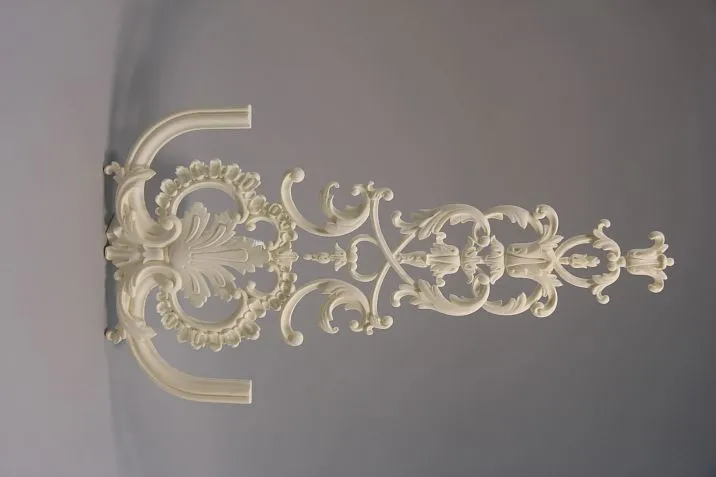
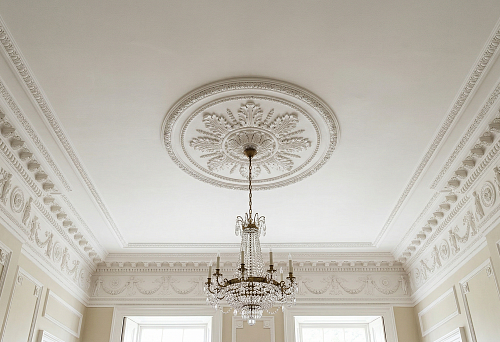
The moment of turning on the light in a beautifully decorated room is a moment of true magic. But what transforms an ordinary chandelier into the focal point of the entire space? What creates that very atmosphere of elegance that makes you pause and look at the ceiling? Polyurethane moldings on the ceiling under the chandelier has become the key element of modern design, transforming a light source from a utilitarian object into a work of art.
Imagine an evening in a home where every detail is thought out to the smallest detail. The chandelier light doesn't just illuminate the space—it dances in the curves of the ceiling rose, creating a remarkable play of light and shadow. Each swirl of ornamentation comes alive, telling a story of beauty and perfection.
In an era of mass production and standardization, when most interiors resemble each other like twins, the appearance of elements of classical beauty becomes an act of creative rebellion. This is the choice of people who refuse to accept blandness and strive to create a space worthy of their dreams.


Polyurethane Revolution: When Science Serves Beauty




Molecular Architecture of Perfection
Modern Polyurethane moldings on the ceiling under the chandelier This is the result of complex scientific developments in polymer chemistry. Behind the apparent simplicity of the finished product lies a unique molecular structure, where each polymer chain is linked with multiple cross-links to adjacent chains.
The density of polyurethane is only 600-750 kg/m³, which is three times lighter than traditional plaster. At the same time, its compressive strength reaches 75 MPa—a figure comparable to high-quality concrete. The material retains elasticity, allowing it to deform under load and return to its original shape without cracking.
The coefficient of thermal expansion of polyurethane is only 0.08 mm/m per 10°C. This means that when seasonal temperature fluctuations occur from -20°C to +30°C, an element 1 meter in size will change its dimensions by only 0.4 mm—a value practically imperceptible to the human eye.
Our factory also produces:


Chemical Inertness and Ecological Safety
Resistance to aggressive environments is ensured by a special formulation. The material does not react with acids, alkalis, alcohols, and other household chemicals. The pH of finished products is 6.8-7.2, which is close to neutral and eliminates corrosion of metal fasteners.
UV stabilizers based on benzotriazoles and HALS ( Hindered Amine Light Stabilizers) protect against destructive effects of sunlight. These molecular shields absorb ultraviolet rays in the 280-400 nm range, converting them into harmless heat.
Water absorption is less than 1.8% by volume within 24 hours—15-20 times less than that of plaster. This is critically important for ceiling decoration, especially in rooms with high humidity or sharp temperature fluctuations.
Get Consultation
Production Technologies of the New Generation
Creating a master model begins with the work of sculptors-artists, who manually refine every detail of the future product. Modern CAD systems allow creating precise 3D models with mathematical accuracy, but final adjustments are always performed by a human.
Silicone molds are made from two-component RTV silicones (Room Temperature Vulcanizing) with hardness of 25-30 Shore A. This hardness ensures perfect transfer of the finest details while maintaining sufficient elasticity for multiple uses.
The casting process occurs under strictly controlled parameters: component temperature 18-22°C, air humidity 45-65%, mixing time 45-60 seconds. Any deviation from the technology may lead to structural defects in the material.
Aesthetic Universe: Styles and Directions
Classic Heritage in Modern Interpretation
Ancient architecture gave the world a system of proportions whose relevance has not diminished over millennia. Corinthian capitals with lush acanthus leaves, Doric fluting, Ionic volutes—all these elements find new embodiment in polyurethane ceiling roses.
The mathematical precision of classical proportions is preserved in full. The golden ratio (1:1.618), lying at the foundation of ancient orders, is naturally perceived by the human eye as ideal harmony. Modern technologies allow reproducing these proportions with accuracy down to 0.1 mm.
Ancient vegetal motifs carry deep symbolic meaning, still relevant today. The grapevine symbolizes abundance and vitality, oak leaves—resilience and longevity, laurel branches—victory and glory. In ceiling decoration, these symbols create an atmosphere of solemnity and nobility.
Baroque Theatricality and Dynamism
Baroque astonishes with its ability to create a sense of movement in static material. Complex scrolls and counter-scrolls, asymmetrical compositions, rich interplay of light and shadow transform the ceiling rose into a theatrical decoration.
Rococo motifs with their elegant asymmetrical scrolls create an atmosphere of the Age of Enlightenment. Stylized seashells, interwoven ribbons, floral garlands transform the polyurethane stucco on the ceiling under the chandelier into a precious interior ornament.
Modern decorative coating technologies allow imitating any historical materials. Patinated bronze, aged gold, marble with natural veins — all this is achievable using special paints and application techniques.
Modern interpretations and avant-garde solutions
21st-century Neoclassicism adapts traditional forms to modern aesthetic requirements. Simplification of details, enlargement of main elements, adaptation of proportions to modern interiors make classicism relevant for a new generation.
Minimalist interpretations of classical forms respond to trends toward functional simplicity. Concise profiles, clear geometric shapes, absence of excessive detailing characterize this approach to decoration.
Eclectic solutions allow combining elements of various historical styles into a single composition. This requires a deep understanding of stylistic patterns but enables creating unique, authorial interiors.
The Art of Proper Selection: Harmony of Sizes and Styles
Proportional Relationships and Architectural Logic
The selection of ceiling rose size is governed by strict proportional laws. The diameter of the element should be 1/7-1/9 of the room's width for square rooms and 1/10-1/12 of the longer side for rectangular rooms. These ratios have been developed over centuries of architectural practice.
Ceiling height critically affects the perception of decorative elements. In rooms with standard 2.7 m ceilings, optimal socket diameters are 300-500 mm. At a height of 3.5 m, elements up to 700 mm in diameter can be used, and in rooms with ceilings higher than 4 m — up to 1000 mm and more.
The ratio of socket size to chandelier should ensure visual harmony. The socket may be equal to the chandelier’s diameter or exceed it by 20-30%, but should not be significantly smaller than the light fixture.
Stylistic compatibility and design logic
Polyurethane moldings on the ceiling under the chandelier Should blend organically into the overall stylistic concept of the interior. Classical sockets with floral ornamentation are ideal for traditional and neoclassical interiors.
Geometric sockets with clear lines and minimal decoration are suitable for modern interiors. Concentric circles, radial lines, strict geometric patterns create a sense of order and rationality.
Thematic sockets require a special approach to integration into the interior. Maritime motifs for Mediterranean style, ethnic ornaments for exotic interiors, industrial elements for lofts — each choice must be justified by the overall concept.
Color solutions and decorative finishes
Classic white remains a universal solution for ceiling decoration. It highlights relief, creates expressive play of light and shadow, visually increases room height, and harmonizes with any interior solutions.
Colored finishes require a professional approach to color coordination. The socket’s color should harmonize with other interior elements, creating a harmonious color symphony. Contrasting solutions are used to create dramatic accents.
Metallic finishes — gold, silver, bronze, copper — give the socket a luxurious appearance. Various patination techniques allow creating effects of noble aging, emphasizing the historical authenticity of classical forms.
Installation technologies: from preparation to perfection
Preparation: the foundation of quality result
Quality of installation depends on 85% on the correctness of preparatory work. The ceiling surface must be perfectly flat, dry, cleaned from dust, grease, and peeling coatings. Moisture content of the base must not exceed 4%.
Marking is performed using high-precision measuring tools. The center of the socket must precisely coincide with the chandelier’s mounting point. To ensure symmetry, laser plane builders and cross levels are used.
Electrical installation must be completed before installing decorative elements. Wires are laid in protective conduits or cable channels, connection points are carefully insulated and marked.
Technologies for mounting various types of elements
Adhesive mounting is suitable for most standard sockets up to 600 mm in diameter. Special mounting adhesives based on polyurethane or acrylic are used, ensuring chemical compatibility with the material of the item.
Mechanical mounting is used for large elements weighing more than 2 kg. Self-tapping screws with a diameter of 4-6 mm are screwed into the ceiling base through the socket, and screw heads are carefully masked with putty or decorative caps.
Combined mounting combines the advantages of both methods. Adhesive ensures even contact across the entire surface, while mechanical fastening takes the main loads and prevents peeling.
Features of working with different types of ceilings
Mounting on concrete bases requires preliminary drilling of holes and installation of anchors. Impact drills with diamond-tipped drills of 6-8 mm diameter are used. Drilling depth must exceed anchor length by 10-15 mm.
Gypsum board ceilings require special attention to load distribution. For light elements, butterfly anchors are used; for heavy elements — through-fastening to the load-bearing frame via gypsum board.
Tensioned ceilings require special technology. The socket is mounted to the base ceiling before installing the fabric, then a hole is cut in the film and framed with a special ring.
Operational characteristics: quality for decades
Climate resistance of the material
Polyurethane products demonstrate outstanding stability over a wide temperature range from -50°C to +85°C. This guarantees reliable operation in any climate zone in Russia, from Arctic regions to southern areas.
Water resistance of the material allows using decor in rooms with high humidity. Water absorption coefficient less than 2% prevents deformation even under prolonged exposure to humid air.
Freeze resistance is confirmed by 500 freeze-thaw cycles without loss of strength characteristics. This is especially important for decor in unheated or periodically heated rooms.
Mechanical strength and resistance to loads
Impact resistance of polyurethane is 4-6 times higher than similar gypsum values. The material absorbs impact energy through elastic deformation, which is especially important for ceiling decor in areas subject to mechanical impacts.
Fatigue resistance ensures longevity under cyclic loads. Vibrations from transportation, wind effects on buildings, and temperature deformations of structures do not affect the integrity of decorative elements.
The tensile strength is 25-35 MPa, allowing the use of large-sized elements without the risk of destruction under their own weight or external loads.
Durability and stability of properties
The projected service life of quality polyurethane elements is 30-40 years under proper operating conditions. During this period, traditional materials may require 2-3 full replacement cycles.
Color stability is ensured by special UV stabilizers. Even under intense lighting, elements retain their original shade throughout the entire service life.
The anti-static properties of the surface prevent dust and contamination buildup. This is especially important for ceiling decoration, where mechanical cleaning is difficult.
Economic efficiency: beauty without extra cost
Comparative analysis of costs for different materials
Polyurethane moldings on the ceiling under the chandelier At comparable detail quality, it is 2-4 times cheaper than gypsum analogs. Meanwhile, polyurethane products surpass gypsum in most operational characteristics.
Natural materials — wood, stone, metal — are undoubtedly more prestigious, but their cost may be 8-15 times higher. Additionally, they require special care, regular maintenance, and protection from adverse effects.
Transportation costs for polyurethane items are minimal due to their low weight. A 80 cm diameter rose can be easily transported in a regular passenger car, whereas a similar gypsum item would require heavy transport.
Hidden economic advantages
Ease of installation allows significant savings on labor. Installing a standard rose can be done by one person in 2-3 hours, whereas installing a gypsum analog requires a team of specialists.
Minimal operational costs make polyurethane molding a profitable long-term investment. The material does not require special care, periodic impregnation, protective coatings, or restoration.
The ability to repaint multiple times allows updating the interior without replacing decorative elements. This is especially important in commercial spaces, where design concepts may change every 5-7 years.
Impact on property value
Quality decorative finishing increases property market value by 18-28% depending on the market segment. In the premium segment, the impact of decoration on price may be even more significant.
The rental attractiveness of spaces with unique design is significantly higher. Owners can set rental rates 25-40% above market rates for uniquely decorated properties.
Properties with quality decoration sell 2.5-3 times faster than average market rates. Buyers are more willing to make decisions quickly when a ready-made design solution is available.
Practical tips for care and maintenance
Regular cleaning and maintaining appearance
The smooth polyurethane surface does not accumulate dust in significant amounts. Regular cleaning requires wiping with slightly damp microfiber cloth. Cleaning frequency depends on the intensity of space usage.
For removing stubborn stains, weak solutions of neutral cleaning agents can be used. Abrasive cleaning agents, solvents, or aggressive chemicals are not recommended.
Special attention should be paid to areas around heat sources. Although polyurethane is heat-resistant, prolonged exposure to high temperatures may cause color change or deformation.
Repairing minor damages
Scratches and minor chips can be easily repaired using special repair compounds. Polyurethane putties provide ideal adhesion to the base material and, after drying, are practically indistinguishable from it.
The repair technology includes cleaning the damaged area, applying repair compound with slight excess, sanding after full drying, and final painting to match the base coating.
More serious damage requires professional intervention. It may involve gluing fragments or complete replacement of damaged areas while preserving the overall composition integrity.
Updating decorative coatings
Polyurethane has excellent adhesion to most lacquer and paint materials. Before painting, the surface is lightly sanded with fine abrasive paper P320-P400 to achieve optimal roughness.
Priming with special polymer-based primers ensures even coating and paint savings. Primer drying time is 4-6 hours under normal conditions.
Painting is done with high-quality water-based paints in 2-3 thin coats. Short-pile rollers ensure even coverage, while brushes are used for detailed work on complex relief areas.
Conclusion: Choice of Professionals and Enthusiasts of Beauty
In a world where beauty becomes increasingly accessible thanks to modern technologies, the choice of quality materials and reliable suppliers determines the success of any interior project. Polyurethane molding on the ceiling under a chandelier has become the solution that harmoniously combines classic aesthetics with the practicality of modern life.
Every day, thousands of people make the decision to invest in the beauty of their homes, choosing elements that transform ordinary rooms into works of art. This is not a luxury for the chosen few, but an accessible opportunity for anyone who understands the value of quality design.
Modern production and processing technologies for polyurethane have reached such a level of perfection that they allow the realization of the most daring design ideas without compromising on quality and durability. This material serves not for years, but for decades, delighting the eye and creating an atmosphere of comfort.
Investing in quality ceiling decor is an investment in the quality of life. Every time you turn on the chandelier and watch as light plays across the curves of the ceiling rose, you receive an aesthetic pleasure that cannot be measured in monetary terms.
Choosing modern materials and proven manufacturers is the choice of people who value their time and understand the importance of the result. It is the decision of those who are ready to invest in creating a space worthy of their ambitions and life principles.
STAVROS embodies the best traditions of Russian entrepreneurship, enriched by European quality standards and advanced technological solutions. Decades of experience in architectural decor, proprietary high-tech production, strict quality control at every stage of manufacturing, and impeccable customer service have made STAVROS an undisputed industry leader and a reliable partner for thousands of satisfied clients across the country. Every STAVROS product is created with a deep understanding of its role in the overall interior concept, where every detail, every element, and every lighting nuance matters. Choosing STAVROS means choosing not just quality products, but a philosophy of perfection that transforms an ordinary home into a dream space. Trust the experience of true professionals at STAVROS and discover the incredible world of boundless possibilities, where classic beauty harmoniously combines with modern comfort, creating interiors worthy of the most discerning connoisseurs of beauty.