












































































Article Contents:
- What is decorative molding and why is it needed
- Architectural Function of Molding
- Decorative Function: Ornament and Style
- Connection with Furniture: Unified Style
- Types of Decorative Molding for Interiors
- Rosettes: Center of Ceiling Composition
- Brackets and consoles: functional decor
- Pilasters: vertical wall articulation
- Moldings and Cornices: Horizontal Division
- Friezes and Coffers: Filling Planes
- Classic Furniture: The Foundation of a Palace Interior
- Signs of Classic Furniture
- Types of Classic Furniture for Palace Interiors
- How Molding Enhances the Impression of Furniture
- Echo of Ornaments
- Framing Furniture with Molding
- Scale coordination
- Rules for Molding Scale in Small Spaces
- Size of Molding Elements for Standard Ceilings
- Density of Decor: How Much Molding is Enough
- Color Solution: Light Molding Expands Space
- Combining Molding and Furniture: Compositional Techniques
- Symmetry: Foundation of Classical Composition
- Hierarchy: Primary and Secondary
- Accents: Points of Visual Attraction
- Practical Examples of Room Design
- Living Room: Grandeur in 20 Square Meters
- Bedroom: Intimate Luxury
- Dining Room: The Splendor of Feasting
- Mistakes in Creating a Palace Interior
- Overloaded with decoration
- Scale Disproportion
- Stylistic Inconsistency
- Incorrect Furniture Arrangement
- STAVROS Company: Molding and Classic Furniture for Palace Interiors
- STAVROS Molding Assortment
- STAVROS Classic Furniture
- Comprehensive Design Service
- Quality of Materials and Craftsmanship
- Installation and Guarantees
- Frequently Asked Questions about Molding and Classic Furniture
- Can molding be installed in an apartment with low ceilings?
- How much does it cost to decorate a room with molding?
- How to Care for Moldings?
- Can polyurethane molding be combined with modern furniture?
- Is symmetry mandatory in a classic interior?
- Which molding style to choose: Baroque, Classicism, Neoclassical?
- Should I hire a designer or can I do it myself?
- Can molding be used in the kitchen, bathroom?
- How long does it take to create a palace interior?
- Where to see examples of STAVROS palace interiors?
- Conclusion: a palace begins with details
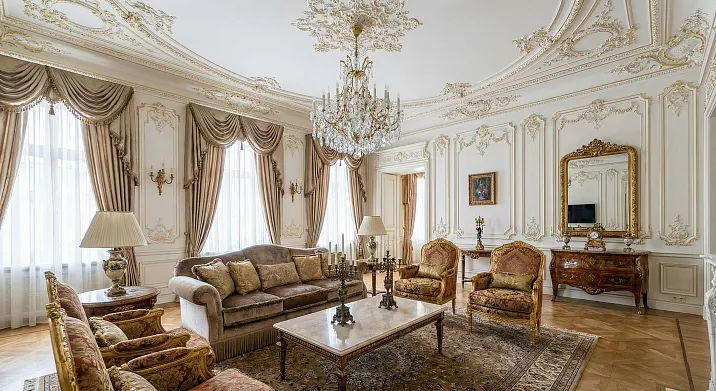
Why do some apartments look like temporary housing, while others resemble pages from an album of European palaces? Because a palace is not about square footage or ceiling height. It is a system of decorative elements that create hierarchy, ornament density, and architectural logic. Ceiling molding frames the chandelier, wall consoles support shelves, pilasters divide the plane into verticals. Together, they form an environment that accommodates furniture—not ordinary, but classic, with carving, gilding, curved legs.
Decorative stuccotransforms empty walls into architectural planes with rhythm, structure, meaning. Ceiling rosettes focus the gaze, brackets create functional support points, pilasters frame zones. Without molding,Classic Furniturelooks disjointed, disconnected from the space. With molding, furniture becomes part of an architectural whole, where every element speaks the same language of forms.
Creating a palace interior in an ordinary apartment requires knowledge of proportions, decor density, and composition laws. You cannot simply glue molding everywhere and place carved furniture—it will result in overloaded chaos. You need to understand scale: what size rosette suits a 2.7-meter ceiling, what width molding won't overwhelm the wall, how much decor is enough to create palace-like grandeur without crowding.


What is decorative molding and why is it needed
Molding—volumetric decorative elements on walls, ceilings, openings, imitating hand-molded plaster or stone carving. Historically, molding was made by master plasterers from gypsum or alabaster, hand-formed, and attached with lime mortar. TodayCeiling moldingsis produced from polyurethane—a lightweight, durable polymer that accurately reproduces details of historical samples but is installed more easily, quickly, and cheaply.




Architectural function of molding
Molding creates divisions, separates planes into zones, sets rhythm, hierarchy. A blank wall is monotonous, boring, visually heavy. A wall with moldings divided into panels is structured, interesting, readable. A ceiling without decor is just a white plane overhead. A ceiling with perimeter cornices, a central rosette, coffers—an architectural element, the fifth wall of the interior.
Molding sets the scale of a room. Large molding (cornices 15-20 cm high, rosettes 80-100 cm in diameter) visually enlarges space, makes it monumental, ceremonial. Small molding (cornices 5-8 cm, rosettes 40-50 cm) suits small rooms, creates refinement without overwhelming.
Our factory also produces:


Decorative function: ornament and style
Molding carries ornament—floral (acanthus leaves, grapevines, roses), geometric (meanders, rosettes, diamonds), narrative (cupids, masks, garlands). Ornament defines style: classical (symmetrical, restrained, with acanthus), Baroque (opulent, dynamic, with scrolls), Rococo (light, asymmetrical, with shells).
Relief Decorationcreates visual richness without increasing the number of objects. A room may have minimal furniture, but if walls and ceilings are decorated with molding, the interior looks rich, palatial. Molding fills space not physically (it is flat, barely protruding) but visually—the eye moves along the relief, reads details, becomes saturated.
Get Consultation
Connection with furniture: unified style
Molding and furniture should speak the same language of forms. If walls have classical molding with acanthus leaves, furniture should also be classical—with acanthus carving on chair backs, cabinet cornices. If molding is Baroque (opulent, with scrolls),baroque furniturewith curved legs, gilding, rich upholstery will complement it.
Dissonance arises when molding and furniture are from different eras, styles. Empire molding (strict, geometric, with military symbolism) and Rococo furniture (light, playful, with asymmetry) conflict. Molding should be a background for furniture, enhancing it, not competing.
Types of decorative molding for interiors
Molding is diverse: dozens of element types, hundreds of forms, thousands of combination options. Main types used in classic interiors: rosettes, brackets, consoles, pilasters, moldings, cornices, friezes, coffers. Each type performs its function, occupies its place in the composition.
Sockets: the center of the ceiling composition
A rosette is a round or oval molding element installed on the ceiling at the point where a chandelier is mounted. The rosette frames the chandelier, creates a visual focal point, and accentuates the center of the room. Without a rosette, the chandelier hangs on a bare ceiling, the mounting is visible, and it looks cheap. With a rosette, the chandelier becomes part of the architectural composition, its base is hidden, and the rosette's decoration echoes that of the chandelier.
The size of a rosette depends on the ceiling height and room size. The rule: the rosette's diameter should be 1/5 to 1/3 of the room's diagonal. For a room 4x5 meters with a 6.4-meter diagonal, the rosette diameter would be 130-210 cm. But this is the maximum; for standard apartments (ceiling height 2.7 m), the optimal diameter is 60-80 cm.
Rosette ornamentation: classical (symmetrical, with acanthus leaves, laurel wreaths, roses), Baroque (opulent, with scrolls, cupids, garlands), Neoclassical (restrained, geometric, with meanders, beads). The rosette should echo the wall moldings and cornices, creating a unified style.
Brackets and consoles: functional decor
A bracket is a protruding element on a wall that supports a shelf, cornice, or light fixture. A console is a large bracket, often with carving, used as a decorative support. Brackets can be functional (actually bearing weight) or decorative (creating the illusion of support but carrying no load).
Polyurethane bracketsThey are installed under shelves (visually supporting them, creating an architectural look), under cornices (in classical architecture, the cornice rests on brackets—modillions; in interiors, this is reproduced decoratively), and in corners (corner brackets linking walls and ceiling).
Bracket shapes: S-shaped (volute, classical form, smooth, elegant), triangular (simple, geometric, for minimalist classicism), carved (with ornamentation—acanthus, roses, scrolls—for opulent interiors). The bracket size is proportional to the load (or the illusion of load): a large bracket under a heavy cornice, a small one under a thin shelf.
Consoles are used in pairs: two consoles on either side of a fireplace, mirror, or door create symmetry and solemnity. Vases, sculptures, candelabras are placed on consoles—the console turns an object into an exhibit, elevated and highlighted.
Pilasters: Vertical Wall Articulation
A pilaster is a flat, vertical half-column projecting 2-5 cm from a wall, imitating a load-bearing structure. A pilaster has a base (foundation at the bottom), a shaft (vertical part, smooth or fluted—with grooves), and a capital (crowning part at the top, with carving—Ionic, Corinthian, Composite).
Pilasters divide a wall into vertical sections, creating rhythm and architectural structure. Two pilasters on either side of a sofa frame the seating area, turning the wall behind the sofa into an architectural portal. Four pilasters along a long wall divide it into three panels, each of which can be decorated differently (central one with a mirror, side ones with paintings).
Pilaster height: from floor to ceiling (full pilaster, creating a colonnade) or partial (from floor to 2/3 of the wall height, more restrained). Full pilasters are monumental, suitable for high ceilings (3 meters and above), formal rooms (living rooms, halls). Partial pilasters are more elegant, suitable for standard ceilings, living rooms (bedrooms, studies).
The pilaster shaft can be smooth (for minimalist classicism) or fluted (with vertical grooves, as on ancient columns, for opulence, historical authenticity). The capital defines the order: Doric (simple capital with a square abacus), Ionic (with volutes—scrolls), Corinthian (with acanthus leaves, the most opulent).
Moldings and cornices: horizontal articulation
A molding is a narrow applied strip (width 3-10 cm) with a profile (relief), used for framing panels, doors, windows, mirrors. A cornice is a wide molding (height 8-20 cm) installed at the junction of wall and ceiling, creating a horizontal boundary.
Moldings on walls form panels: rectangular sections framed by moldings, creating structure. The classic scheme: the lower part of the wall (up to a height of 100-120 cm) is divided by moldings into panels, with patterned wallpaper or contrasting paint inside the panels. The upper part of the wall (above the panels) is smooth or has one large central panel (for a painting, mirror, TV).
Cornices separate walls from the ceiling, visually raising the ceiling (especially if the cornice is white like the ceiling, and the walls are colored). The cornice creates a finishing touch; without it, the room looks unfinished. Cornice profile: simple (quarter-round, for minimalism), medium (cavetto+bead, for Neoclassicism), complex (multi-stepped with carving, for classicism, Baroque).
Friezes and coffers: filling planes
A frieze is a horizontal band of molding with ornamentation (floral, geometric, narrative), running under a cornice, above doors, along walls. The frieze fills the space between the cornice and the wall, creates an additional decorative layer, and enriches the composition.
Frieze ornamentation: meander (broken line, Greek ornament, strict, geometric), acanthus (stylized leaves, classical ornament, smooth, floral), garlands (flowers, fruits, ribbons, Baroque ornament, opulent, solemn). The frieze should be contrasting (relief on a smooth wall) or colored (gilded, patinated on a white background).
Coffers are recessed square or rectangular sections on a ceiling, framed by moldings, forming a grid. Coffers create volume and structure, turning a flat ceiling into an architectural object. Coffers require high ceilings (minimum 3 meters, preferably 3.5-4), otherwise the ceiling seems heavy and oppressive.
Inside coffers, there can be contrasting paint (coffers dark beige, moldings white), painting (ornament, sky, grisaille), or relief rosettes (a small rosette in the center of each coffer, creating rhythm).
Classical furniture: the foundation of a palace interior
Moldings without furniture are empty decoration, a theater stage without actors.Classic FurnitureFurniture fills the space, organizes it functionally, and creates focal points for the eye. A sofa becomes a throne, a chest of drawers a treasure chest, a wardrobe an architectural structure. In a palace interior, furniture is not just comfortable; it is representative, demonstrating status, taste, and cultural belonging.
Signs of classical furniture
Carving is the main feature. Carving can be hand-carved (expensive, unique, for exclusive projects) or machine-made (CNC milling, more accessible, repeatable). Carving motifs: acanthus leaves (classical motif, opulent, recognizable), roses (Baroque, Rococo, romantic), grapevines (abundance, fertility), geometry (rosettes, meanders, strict classicism).
Curved forms—cabriole legs (S-shaped, widening at the knee, tapering at the foot), wavy armrests, convex fronts (bombé—on chests, cabinets). Curvature creates dynamism and plasticity, opposite to the rigidity of minimalism.
Gilding—gilding of carved elements (hand-applied with gold leaf or imitation leaf, or gold paint). Gilding accents the carving, making it precious, regal. Fully gilded furniture (entire frame gold)—Baroque, Rococo, palaces. Partially gilded (only the carving, the rest wood or paint)—restrained classicism, Neoclassicism.
Upholstery with noble fabrics—velvet, silk, jacquard with patterns. Colors: burgundy, emerald, sapphire, gold. Upholstery often features button tufting (capitonné)—diamonds formed by buttons recessed into the fabric, creating relief and luxury.
Types of classical furniture for a palace interior
Sofa—the central piece in a living room. A classical sofa is large (length 2.2-2.5 meters), with a high back (90-110 cm from the seat), carved armrests, and curved legs. The back can be straight (strict classicism) or wavy (Baroque, Rococo). Upholstery is opulent, with button tufting or patterns.
Armchairs — paired (two armchairs symmetrically on either side of the sofa, fireplace, window). Armchair with a high back (throne, creating status) or with a low one (bergère, intimate, cozy). Carved armrests, curved legs, upholstery coordinated with the sofa (same color or contrasting, but from the same fabric collection).
Chest of drawers — a low, wide cabinet with drawers, the central piece of a bedroom or living room. A classic chest of drawers has convex fronts (bombé), carved overlays on the drawers, a marble top, curved legs. A mirror, candelabra, vases are placed on the chest of drawers — it becomes an altar of beauty.
Cabinet — monumental, tall (220-240 cm), with a cornice on top, carved pilasters at the corners, glazed doors (for dishes, books, collections). In a palace interior, a cabinet is not a utilitarian storage unit, but an architectural object, dominating the wall, organizing the space.
Table — dining (large, for 6-8-12 persons, with carved legs, solid wood or marble top) or writing (in a study, with carved aprons, leather inlay, drawers with bronze handles). A classic table is massive, stable, representative.
How moldings enhance the impression of furniture
Furniture in an empty room gets lost, even if it is carved, gilded, luxurious. Moldings create context, background, an environment in which the furniture is revealed. Moldings frame the furniture, echo its decor, create visual connections that turn a set of objects into an ensemble.
Echo of ornaments
Acanthus leaves on a pilaster capital echo the acanthus leaves on a carved armchair back. The eye, gliding along the wall, sees a pilaster with acanthus, moves to the armchair, sees the same motif — and reads the connection. The armchair is not placed by this wall by chance, it is part of a composition where the pilaster and the armchair speak the same language.
A ceiling rosette with a rose pattern, an armchair with rose-patterned upholstery — a visual rhyme. The rosette is large (80 cm diameter), the armchair is small (110 cm height), but the pattern is the same. The scale is different, the motif is unified. This creates coherence without monotony.
A meander on the frieze under the cornice echoes the meander on the carved cornice of the cabinet. The frieze is horizontal, the cabinet cornice is horizontal — both at eye level (frieze under the ceiling, cabinet cornice at 220 cm height). Parallel horizontals with the same ornament create rhythm, structure, architectural quality.
Framing furniture with moldings
Two pilasters on either side of the sofa create a portal, a frame, an architectural setting. A sofa without pilasters is just a sofa against a wall. A sofa between pilasters is a throne in a portal, a central object, highlighted, accentuated. Pilasters focus attention on the sofa, making it the compositional center.
Moldings on the wall form a panel behind the chest of drawers. The chest of drawers stands exactly in the center of the panel, symmetrically. The panel frames the chest of drawers like a picture frame. Inside the panel, wallpaper with a pattern or paint in a contrasting color creates a background against which the chest of drawers stands out. Without the panel, the chest of drawers simply stands against the wall; with the panel, it is integrated into the architecture.
Corbels above the cabinet (decorative, non-load-bearing) create the illusion that the cabinet supports the ceiling. A cabinet without corbels is furniture; with corbels, it is an architectural element, a column, a load-bearing structure (visually). Corbels turn the cabinet from an object into part of the building.
Scale coordination
Large moldings require large furniture. Pilasters 2.5 meters high, cornices 15 cm high, a rosette 100 cm in diameter — monumental furniture suits this: a sofa 2.5 meters long, a cabinet 240 cm high, a table for 12 persons. Small furniture (armchairs, poufs, coffee tables) will get lost against large moldings and will look toy-like.
Small moldings (cornices 8 cm, moldings 4 cm, a small rosette 50 cm) combine with elegant furniture: armchairs with slender legs, console tables, small chests of drawers. Large, massive furniture will overwhelm small moldings and will look coarse, disproportionate.
Proportionality is the law of palace interiors. Everything must be proportionate: moldings to furniture, furniture to the room, the room to the person. Disproportion (small moldings + large furniture, or large moldings + small furniture) destroys harmony, creates visual discomfort.
Rules for the scale of moldings in small spaces
Palaces are spacious: halls 50-100 square meters, ceilings 4-6 meters. Standard apartments are small: rooms 15-25 square meters, ceilings 2.7 meters. Transferring palace moldings directly to an apartment is impossible — it will result in overload, heaviness, claustrophobia. Adaptation is needed: reducing the scale, lowering the density of decor, selectivity of elements.
Size of molding elements for standard ceilings
Ceiling 2.7 meters — standard for most apartments (Khrushchyovka, Brezhnevka, typical panel buildings). For such ceilings, optimal molding sizes are:
Cornice: height 8-12 cm. A cornice 15-20 cm (palace scale) will visually lower the ceiling, make the room squat. A cornice 8-12 cm creates a border without oppression, visually even raises the ceiling (especially if white, like the ceiling).
Rosette: diameter 50-70 cm. A rosette 100 cm (palace) on a 2.7-meter ceiling will be overwhelming, occupy a quarter of the ceiling, create heaviness. A rosette 50-70 cm centers the chandelier, creates an accent without overload.
Moldings for panels: width 3-5 cm. Moldings 8-10 cm (palace) in a small room will eat up space, the panels inside will be tiny. Moldings 3-5 cm create structure without visual heaviness.
Pilasters: height from floor to cornice (2.6 meters with a 2.7-meter ceiling), width 8-12 cm, projection from the wall 2-3 cm. Pilasters wider than 15 cm in a small room will eat up space, will seem like columns, not decor.
Density of decor: how much molding is enough
Palaces are overloaded with decor: moldings everywhere — on the ceiling, walls, doors, windows, furniture. The density of decor creates opulence, luxury, but requires space. In a small room, such density will suffocate, create tightness, visual noise.
Rule for small spaces: 50-70% of surfaces are decorated, 30-50% remain smooth (give the eye a rest, create balance). What is decorated:
Ceiling: cornice around the perimeter + rosette in the center. The rest of the ceiling is smooth, white or with light coloring. Coffers, friezes, additional rosettes in corners — only for rooms from 30 square meters with ceilings from 3 meters.
Walls: one wall (accent, usually behind the sofa, bed, table) is decorated with panels made of moldings, possibly with pilasters. The other walls are smooth or with minimal decor (only cornice at the top, baseboard at the bottom). Four walls with panels — only for large rooms (from 25 square meters).
Doors and windows: decorative trims (carved or with moldings) on interior doors. Windows with curtain cornices (wooden carved or with molded brackets). Sandriks (applied pediments above doors, windows) — only for high ceilings (from 3 meters).
Color solution: light stucco expands the space
White stucco on a white or light background (walls beige, cream, light gray) creates lightness, airiness, visually expands the space. Stucco is read through relief (light and shadow), not through color contrast. This is optimal for small rooms.
Contrasting stucco (white on dark walls, gilded on colored ones) is visually heavier, more accentual, suitable for spacious rooms. In a small room, contrast can be point-like: gilding only on pilaster capitals, only on the center of the rosette, the rest of the stucco is white.
Painting stucco the same color as the walls (walls gray, stucco gray) hides the decor, leaving only the relief. This is a technique for very small rooms, where visible stucco would create overload, and relief without color provides structure without heaviness.
Combination of stucco and furniture: compositional techniques
A palace interior is not a chaos of luxury, but a strict composition where every element is in its place. Stucco and furniture are arranged according to the laws of symmetry, hierarchy, and accents.
Symmetry: the foundation of classical composition
Classicism loves symmetry: mirror reflection of elements relative to an axis. The axis runs through the center of the room (usually vertically — from the entrance to the opposite wall). Relative to the axis are arranged:
Stucco: if there are two pilasters, then symmetrically (on the sides of the sofa, window, door). If there are brackets, then in pairs (two brackets to the right and left of the mirror, fireplace). The ceiling rosette is strictly centered (above the center of the room or above the dining table, chandelier).
Furniture: sofa centered on the wall (axis runs through its middle), two armchairs symmetrically on either side. Table centered in the room, chairs arranged symmetrically around it. Dresser centered on the wall, two lamps symmetrically on either side of it.
Symmetry creates order, calmness, solemnity. Asymmetry (elements placed arbitrarily) creates dynamism, modernity, but destroys the palace-like quality. Palace = symmetry.
Hierarchy: primary and secondary
In a palace interior, there is a main element (compositional center) and secondary ones (supporting the main one, not competing with it). The main element:
In the living room: the sofa (the largest piece of furniture) or the fireplace (if present). Stucco highlights the main element: pilasters frame the sofa, a rosette on the ceiling above the sofa area, a panel of moldings behind the sofa.
In the bedroom: the bed (the main piece). The bed headboard is decorated with stucco: moldings form a headboard panel, possibly with soft upholstery inside. Nightstands (secondary) on the sides of the bed, symmetrical, identical.
In the dining room: the dining table (main). Above the table, a chandelier with a rosette (large, accent). The walls around the table can be decorated with panels, but they are background, not dominant.
Secondary elements are smaller, simpler, more restrained than the main one. A sofa is carved and gilded (main), armchairs are carved without gilding (secondary). Pilasters on the sides of the sofa are large with Corinthian capitals (main), moldings on other walls are small and simple (secondary).
Accents: focal points
An accent is an element that attracts attention, highlighted by color, size, or position. In a palace interior, accents are few (1-3 per room), clearly placed, and coordinated.
Stucco as an accent: a rosette on the ceiling (large, carved, possibly gilded) — accent number one. Pilasters framing the sofa — accent number two. The rest of the stucco (cornices, moldings) is background, not accent.
Furniture as an accent: the sofa (large, carved, with bright upholstery) — the main accent. The dresser (with a marble top, carved fronts) — the second accent. The rest of the furniture (armchairs, chairs, tables) is supporting, not drawing attention.
Accents must be coordinated in style. A Baroque rosette (lush, with cupids) and a Baroque sofa (curved, gilded). A Neoclassical rosette (restrained, geometric) and a Neoclassical sofa (straight, with minimal carving). Dissonance of accents (Baroque rosette, minimalist sofa) destroys integrity.
Practical examples of room decoration
Theory without practice is abstract. Let's consider specific schemes for decorating different rooms with stucco and classic furniture in a typical apartment (ceiling 2.7 m, room 18-25 square meters).
Living room: formality in 20 square meters
Room 4x5 meters (20 square meters), ceiling 2.7 meters. Task: create a palace living room without overloading the space.
Ceiling: cornice around the perimeter 10 cm high, profile ovolo+bead, white. Rosette in the center 60 cm in diameter, classic ornament (acanthus leaves), white. The rest of the ceiling is smooth white.
Walls: one wall (behind the sofa, 5 meters long) is accent. Two pilasters on the sides of the sofa (distance between them 2.5 meters, pilaster width 10 cm, height from floor to cornice 2.6 meters). Capitals Corinthian, shafts smooth. Between the pilasters on the wall, a panel of moldings (molding 4 cm wide, forming a rectangle 2.3x1.5 meters). Inside the panel, wallpaper with a classic pattern (damask, light beige). The other walls are smooth, painted light gray.
Furniture: sofa 2.2 meters long, placed centered between the pilasters. Back straight 90 cm high, carved armrests, cabriole legs. Upholstery emerald velvet, without tufting (to avoid overload). Two armchairs symmetrically on the sides of the sofa (not flush, at a distance of 50 cm). Armchairs with low backs (bergères), carved legs, upholstery light beige (contrast with the sofa). Coffee table in front of the sofa (1.2x0.7 meters), tabletop glass, base carved and gilded.
Result: the living room looks formal but not cramped. Stucco is concentrated on one wall (creates an accent, does not overload). Furniture is large but not overwhelming (sofa 2.2 meters in a 5-meter room — proportional). Colors are restrained (beige, gray, emerald, white, gold pointwise).
Bedroom: Intimate luxury
Room 4x4 meters (16 square meters), ceiling 2.7 meters. Task: to create luxury, but intimate, not formal.
Ceiling: cornice around the perimeter 8 cm high, simple profile (quarter-round), white. Ceiling medallion above the bed (not in the center of the room, but above the center of the bed) 50 cm in diameter, simple ornament (geometric, medallion), white. The rest of the ceiling is smooth, painted light beige (not white — a white ceiling in a bedroom is too cold).
Walls: the wall behind the bed is an accent wall. Bed headboard 1.8 meters wide, 1.4 meters high, upholstered (dusty pink velvet upholstery, with diamond tufting). Around the headboard, a panel of moldings (3 cm molding forming a 2.0x1.6 meter rectangle, 10 cm wider and taller than the headboard). Molding white, the wall inside the panel and outside is painted light gray (monochrome, the panel is only readable due to the relief of the molding). The remaining walls are smooth light gray.
Furniture: bed 1.8x2.0 meters (standard double size), headboard upholstered and carved (headboard frame wooden carved gilded, with upholstery inside). Bed frame wooden carved, cabriole legs, ivory finish. Two nightstands on either side of the bed (symmetrically), small (50x40 cm), carved, ivory finish, light marble tops. Dresser opposite the bed (length 1.2 meters, height 90 cm), carved fronts, ivory finish, marble top. On the dresser, a tabletop mirror in a carved gilded frame.
Result: the bedroom is luxurious but not overloaded. Molding is minimal (only cornice, a small medallion, panel behind the headboard). Furniture is elegant (not massive, like in a living room), carving is present but restrained. Colors are warm, soft (gray, beige, dusty pink, ivory, gold as accents).
Dining room: the celebration of feasting
Room 4x5 meters (20 square meters), ceiling 2.7 meters. Task: to create solemnity, formality, suitable for receptions.
Ceiling: cornice around the perimeter 12 cm high, complex profile (cavetto+ovolo+fillet), white. Medallion in the center (above the table) 70 cm in diameter, lush ornament (garlands, roses), white with gold accents (gilding on protruding elements of the ornament). The rest of the ceiling is smooth white.
Walls: all four walls are decorated with panels. The lower part of the wall (from the floor to a height of 1.2 meters) is framed with moldings (5 cm molding), inside the panels wallpaper with a pattern (dark blue damask on light beige). The upper part of the wall (above 1.2 meters to the cornice) is smooth, painted light beige. The corners of the room (four corners) are accentuated with consoles (at a height of 2 meters from the floor, consoles carved gilded, S-shaped). Vases with flowers are placed on the consoles.
Furniture: dining table in the center of the room, extendable (folded size 1.8x1.0 meters for 6 persons, extended 2.4x1.0 for 8 persons). Tabletop wood (oak stained walnut), legs carved cabriole. Eight chairs around the table, backs high straight with a carved cartouche at the top, seats upholstered (dark blue velvet upholstery, coordinated with the wallpaper in the panels). Sideboard along one wall (length 2.0 meters, height 2.2 meters), lower part closed with carved doors, upper part glazed (behind glass: plates, glasses, vases). Sideboard cornice carved gilded (echoes the consoles in the corners).
Result: the dining room is solemn, suitable for receptions. Molding is lush (large cornice, carved medallion with gilding, consoles) but not overwhelming (panels only on the lower part of the walls, upper part smooth). Furniture is monumental (table for 8 persons, sideboard 2.2 meters high) but proportional to the room. Colors are saturated (dark blue, walnut, gold) but balanced by the light beige background.
Mistakes when creating a palace interior
A palace interior requires taste, a sense of proportion, knowledge of the rules. Mistakes turn luxury into kitsch, a palace into an antique shop.
Over-decorated
The most common mistake: the desire to cram all possible molding and all possible carved furniture into one room. Result: visual noise, heaviness, nausea. The eye has nowhere to rest, everywhere there is ornament, carving, gilding. This is not a palace, it's a warehouse of decor.
Rule: 50-70% of surfaces are decorated, 30-50% are smooth. If walls are decorated with panels, the ceiling should be simpler (only cornice and medallion, without coffers, friezes). If the ceiling is decorated with coffers, the walls should be more restrained. If furniture is lush (carved, gilded, with diamond tufting), the molding should be simpler.
Disproportion of scale
Large palace molding (20 cm cornice, 100 cm medallion, 20 cm wide pilasters) in a small room (16-20 square meters, 2.7 meter ceiling) is overwhelming, creates claustrophobia. Or small molding (5 cm cornice, 40 cm medallion) in a large room (40 square meters, 3.5 meter ceiling) gets lost, looks pitiful.
Rule: the size of the molding is proportional to the space. Ceiling 2.7 meters — cornice 8-12 cm, medallion 50-70 cm. Ceiling 3.5 meters — cornice 12-18 cm, medallion 80-120 cm. Measure the space, select molding to its scale, not to an abstract desire for 'more luxury'.
Stylistic inconsistency
Baroque molding (lush, with cupids, garlands) and Empire furniture (strict, geometric, with military symbolism) conflict. Or Neoclassical molding (restrained, with meanders) and Rococo furniture (playful, asymmetrical, with shells) do not go together.
Rule: molding and furniture from one style (or from neighboring, compatible styles: Baroque+Rococo, Neoclassical+Classicism). Do not mix opposites (Baroque+Minimalism, Rococo+Constructivism). If unsure about the style, choose neutral classicism (symmetrical ornament, acanthus leaves, restrained carving) — it is universal, combines with most classical styles.
Incorrect furniture arrangement
Furniture is arranged arbitrarily, not coordinated with the molding. Pilasters on the wall, but the sofa is not placed between them, but to the side. Medallion on the ceiling in the center of the room, but the chandelier is not hanging under the medallion, but in a corner. Panel of moldings on the wall, but the painting is not hung in the center of the panel, but to the side of it.
Rule: furniture and molding are coordinated. If pilasters frame a zone, furniture (sofa, bed, table) is placed strictly in the center between the pilasters. If there is a panel on the wall, an object (painting, mirror, TV) is placed exactly in the center of the panel. Medallion under the chandelier, not in an arbitrary place.
Company STAVROS: molding and classic furniture for palace interiors
Creating a palace interior requires quality materials, precise execution, professional design. Company STAVROS offers a full range of elements for classic interiors: molding on the ceilingmade of polyurethane,classic furniture made of solid wood, design and installation services.
STAVROS molding assortment
STAVROS offers polyurethane molding of European quality: over 500 items of elements, from simple cornices to carved medallions and pilasters. The catalog includes:
Ceiling medallions: diameters from 30 cm to 120 cm, classic ornaments (acanthus, laurel, roses), Baroque (garlands, cupids, scrolls), Neoclassical (meanders, beads, geometry). Medallions are ready for installation, primed, can be painted with any paint.
Ceiling cornices: height from 5 cm to 25 cm, profiles from simple (quarter-round) to complex (multi-step carved). Cornices are lightweight (polyurethane weighs 5-10 times less than plaster), mounted with adhesive, do not require ceiling reinforcement.
Wall moldings: width from 2 cm to 15 cm, profiles diverse (smooth, carved, with ornament). Moldings are used for panels, framing doors, windows, mirrors, paintings.
Pilasters and half-columns: height from 1.5 meters to 3 meters, width from 8 cm to 25 cm. Pilasters are smooth or fluted, with Doric, Ionic, or Corinthian capitals. Bases and capitals are sold separately (you can assemble a pilaster of the required height from modular elements).
Brackets and corbels: sizes from 10x10 cm (small decorative) to 40x50 cm (large functional). Shapes are S-shaped, triangular, carved. Brackets are used under shelves, cornices, in corners.
All STAVROS molding elements are made of dense polyurethane (density 200-250 kg/m³), do not crumble, do not deform, last for decades. The surface is primed (ready for painting), details are clear (reproduced with an accuracy of 0.1 mm).
STAVROS Classic Furniture
STAVROS producesclassic furnituremade of solid wood (oak, beech, ash) with hand carving, traditional joinery techniques, authentic finishing. Furniture collections:
Living rooms: sofas, armchairs, coffee tables, cabinets, display cabinets, consoles. Styles: classic (restrained carving, straight forms), Baroque (curved legs, lavish carving, gilding), neoclassical (laconic, with antique motifs).
Bedrooms: beds with soft carved headboards, nightstands, dressers, vanities, wardrobes. Furniture is elegant (not massive like living room furniture), carving is present but restrained, colors are warm (ivory, light walnut, patinated beige).
Dining rooms: dining tables (extendable, for 6-12 persons), chairs with soft seats and carved backs, sideboards, china cabinets, dish display cabinets. Furniture is monumental, representative, suitable for receptions.
Studies: writing desks with carved aprons and leather inserts, office chairs (tall, with armrests, leather upholstery), bookcases (tall, with glazed doors, carved cornices).
All STAVROS furniture is made to order (not serial production, but individual for the project). The client chooses a model from the catalog (or provides a sketch), chooses the wood species, finish (natural wood, staining, painting, patination, gilding), upholstery fabric. STAVROS manufactures the furniture (lead time 6-10 weeks), delivers, and installs.
Comprehensive design service
STAVROS offers a palace interior design service: a designer visits the site, takes measurements of the rooms, discusses the client's wishes (style, color scheme, budget), creates a 3D visualization of the future interior with molding and furniture.
Design includes:
Selection of molding: cornices, rosettes, moldings, pilasters — sizes, profiles, ornaments, coordinated with the scale of the room, interior style.
Selection of furniture: sofas, armchairs, tables, cabinets — models, sizes, finishes, upholstery, coordinated with the molding, proportional to the room.
Layout: furniture layout plan, tying molding to the architecture (where pilasters, where panels, where rosettes), lighting schemes (where chandeliers, sconces, floor lamps).
Estimate: calculation of the cost of molding, furniture, installation, finishing. The client sees the full project cost before work begins, no hidden costs.
After project approval, STAVROS manufactures the molding and furniture, purchases finishing materials, performs molding installation, furniture installation, final finishing (painting of molding, patination, gilding). The client receives a turnkey finished interior, without having to search for contractors, coordinate deliveries, control quality — STAVROS does everything.
Material and Craft Quality
STAVROS uses polyurethane from European manufacturers (density 200-250 kg/m³, eco-friendly, non-toxic, certified). Molds for polyurethane casting are made from historical samples (casts from 18th-19th century palace plaster molding), details are reproduced with museum accuracy.
STAVROS furniture is made from solid oak, beech, ash — strong, durable species that do not deform or crack. Carving is done on CNC machines (accuracy up to 0.1 mm) with subsequent manual finishing (the master removes tool marks, sands, emphasizes details).
Continuing the article:
Furniture finishing: staining with penetrating stains (preserving wood grain), painting with enamels (opaque paints from Italian manufacturer Sayerlack), patination (darkening carving recesses with special compounds, creating an aged effect), gilding (with gold leaf or imitation gold foil, applied with mordant).
Each product undergoes quality control: geometry is checked (absence of deformations, warping), carving quality (clarity of details, absence of chips), finish uniformity (color consistency, absence of drips, stains). Only after passing control is the product shipped to the client.
Installation and guarantees
STAVROS performs molding installation with its own team of installers (no external contractors are involved — everything is under the company's control). Installation includes:
Marking: determining installation locations of elements (rosettes, pilasters, panels) according to the project, tying to the room's architecture (windows, doors, furniture).
Surface preparation: leveling walls and ceilings (if needed), priming (for better adhesive adhesion).
Element installation: gluing molding with polyurethane adhesive (fast-setting, strong), additional fixation with screws (for large elements — pilasters, corbels).
Seam filling: puttying seams between elements (corners, joints), sanding (creating an invisible transition), priming.
Final finishing: painting the molding in the chosen color (white, cream, gray, colored), patination (if needed), gilding of accents (if needed).
After installation, STAVROS provides a warranty: 2 years on molding (against peeling, seam cracking), 3 years on furniture (against body deformations, hardware failures, finish peeling). During the warranty period, STAVROS fixes defects free of charge (if caused by manufacturing defects or installation errors, not improper use).
Frequently Asked Questions about Moldings and Classic Furniture
Can moldings be installed in an apartment with low ceilings?
Yes, but you need to choose small-scale moldings. For a 2.7-meter ceiling: cornice height 8-10 cm, rosette diameter 50-60 cm, molding width 3-4 cm. Avoid large, ornate moldings (they will visually lower the ceiling). The color of the molding should be white or match the ceiling color (visually raises the ceiling). Use partial pilasters (not the full height of the wall, but up to 2/3), or avoid them in favor of moldings.
How much does it cost to decorate a room with moldings?
Depends on the area, density of decoration, and complexity of elements. Approximately for a 20 square meter room, 2.7 m ceiling:
Minimal decoration (cornice around the perimeter + rosette): materials 15,000-25,000 rubles, installation 10,000-15,000 rubles. Total 25,000-40,000 rubles.
Medium decoration (cornice + rosette + molding panels on one wall): materials 35,000-50,000 rubles, installation 20,000-30,000 rubles. Total 55,000-80,000 rubles.
Full decoration (cornice + rosette + panels on all walls + pilasters): materials 60,000-90,000 rubles, installation 35,000-50,000 rubles. Total 95,000-140,000 rubles.
STAVROS prices for 2026. Include materials (polyurethane moldings, glue, putty, paint), installation, and finishing.
How to care for stucco?
Polyurethane moldings are low-maintenance: wipe with a dry or slightly damp cloth (to remove dust), avoid abrasive cleaners (they scratch the painted surface). If the molding is painted, you can refresh the paint every 5-7 years (repaint the same color). If the molding has gilding, the gilding requires no care (does not tarnish, does not oxidize), only dusting.
Avoid mechanical damage: do not hit the molding (polyurethane is durable, but can chip under strong impact), do not hang heavy objects on decorative brackets (they are not load-bearing and cannot support more than 2-3 kg).
Can polyurethane moldings be combined with modern furniture?
Technically yes, but stylistically it's difficult. Moldings are a classic element; they require classic furniture (carved, with traditional forms). Modern furniture (minimalist, straight-lined, without decoration) conflicts with ornate moldings. The result is eclecticism, requiring virtuoso taste to avoid sliding into kitsch.
Compromise: minimalist moldings (simple cornices, smooth moldings without ornament, avoiding rosettes, pilasters) + modern furniture with a hint of classicism (curved legs, tufted upholstery, but overall restrained form). This is the light neoclassical style — classic elements in measured doses, without overload.
Is symmetry mandatory in a classic interior?
Not mandatory, but desirable. Symmetry is the foundation of classic composition, creating order, solemnity, and calm. Asymmetry is possible (and even welcomed in Rococo, where playfulness is more important than strictness), but requires skill: asymmetry must be balanced (visually equilibrated), not chaotic.
For beginners, symmetry is recommended: easier to design, easier to implement, harder to make mistakes. Experienced designers can play with asymmetry, creating dynamism and modernity while preserving classic elements.
Which molding style to choose: Baroque, Classicism, Neoclassicism?
Depends on the furniture, room size, and personal preferences.
Baroque (ornate moldings with scrolls, cupids, garlands) requires spacious rooms (from 25 square meters, ceilings from 3 meters), pairs withBaroque furniture (curved, gilded, luxurious). Baroque is for those who love opulence, theatricality, and are not afraid of being accused of excess.
Classicism (restrained moldings with symmetrical ornament, acanthus leaves, geometry) is universal, suitable for rooms of any size, pairs with classic furniture (straight, with carving, but not overloaded). Classicism is for those who value order, proportionality, and timeless values.
Neoclassicism (minimalist moldings, simple profiles, modest ornament) is suitable for small rooms (15-20 square meters, 2.7 m ceiling), pairs with modern classic furniture (restrained, with a nod to tradition, but not copying history). Neoclassicism is for those who want classicism, but without overload, with an eye on modernity.
Should I hire a designer or can I do it myself?
You can do it yourself if you have a sense of proportion, knowledge of styles, and understanding of composition. Risk: mistakes (incorrect molding scale, disproportion with furniture, stylistic mismatch, overload) are costly (moldings are already glued, furniture is bought, redoing is expensive).
A designer insures against mistakes: designs the interior as a whole (moldings + furniture + finishes + lighting), creates a visualization (client sees the result before implementation), coordinates elements (everything matches, nothing stands out). Cost of STAVROS designer services: from 2,000 rubles per square meter (includes measurements, design, visualization, estimate). For a 20-square-meter room — 40,000 rubles. This is 10-15% of the cost of moldings and furniture, pays off by avoiding mistakes, saving time, and guaranteeing results.
Can moldings be used in the kitchen, bathroom?
Polyurethane moldings are not afraid of moisture (unlike plaster), so technically yes. But stylistically:
Kitchen: moldings are appropriate in a classic kitchen (with solid wood fronts, carved cornices, marble countertops). Moldings on the ceiling (cornice, small rosette above the dining area), possibly moldings on walls (framing the backsplash, panels). Avoid moldings near the stove (grease settles on the relief, hard to clean).
Bathroom: moldings are appropriate in a spacious bathroom (from 8-10 square meters) of classic style (with marble, bronze plumbing, mirrors in carved frames). Moldings around the mirror (moldings forming a frame), cornice around the ceiling perimeter (visually raises the ceiling). After installation, coat the moldings with moisture-resistant paint (acrylic, latex), providing protection and easy cleaning.
In typical small kitchens and bathrooms (4-6 square meters), stucco is impractical: it will consume space and create visual overload.
How long does it take to create a palace-style interior?
Depends on the scope of work:
Design: 2-3 weeks (measurements, project development, visualization, client approval).
Stucco production: 1-2 weeks (standard elements from the STAVROS catalog are in stock, shipped in 1-3 days; custom pieces are made to order in 1-2 weeks).
Furniture production: 6-10 weeks (furniture is custom-made, not mass-produced, requiring time for carpentry, carving, finishing, drying).
Stucco installation: 1-2 weeks for a 60-80 square meter apartment (installation, joint sealing, painting).
Furniture installation: 1-2 days (delivery, assembly, placement).
Total: from contract signing to project completion, 8-12 weeks. This is the optimal timeframe ensuring quality (rushing leads to defects). If deadlines are critical (moving, an event), STAVROS can expedite furniture production (20-30% rush fee), but it cannot be reduced below 6 weeks (technological processes—wood drying, varnish curing—require time).
Where can I see examples of STAVROS palace-style interiors?
On the STAVROS website (stavros.ru) in the 'Portfolio' section, you'll find completed projects: photos of interiors with stucco and classic furniture, descriptions of used elements, areas, timelines, and costs.
In STAVROS showrooms (Moscow, St. Petersburg), samples of stucco are displayed (you can look, touch, assess casting quality, ornament detail) and furniture samples (full-size sofas, armchairs, tables, dressers—you can sit, assess comfort, upholstery quality, carving).
You can order an on-site designer visit: the designer will bring catalogs (with photos, dimensions, prices of stucco and furniture elements), show finishing samples (stains, enamels, patina, gilding), discuss the project, and answer questions. The visit is free (within Moscow and St. Petersburg).
Conclusion: a palace begins with details
A palace-style interior is not luxury for luxury's sake. It is a system whereDecorative stuccocreates the architectural framework,Classic Furniturefills it with content, and together they form an environment that is pleasant to live in, that inspires, refines, and elevates.
A ceiling rosette is not just a circle around a chandelier. It is the center of the composition, a focal point organizing the entire room. Pilasters on walls are not just decorative strips. They are verticals dividing space, creating rhythm and architectural structure.Relief Decorationturns empty planes into architectural objects that are readable, structured, and meaningful.
Classic Furniturewithout stucco loses its impact, looks random, disconnected from the space. Stucco without furniture is an empty decoration, a theater without actors. Together they create an ensemble where stucco is the stage, furniture is the main characters, and you are the director organizing the performance.
Creating a palace-style interior in a standard apartment is possible. You don't need high ceilings (2.7 meters is enough), you don't need huge areas (18-25 square meters per room is sufficient). You need knowledge of the rules: stucco scale is proportional to the room, decorative density is moderate (50-70% of surfaces decorated, 30-50% smooth), stucco and furniture styles are coordinated, arrangement is symmetrical.
The company STAVROS helps create palace-style interiors in standard apartments: offersmolding on the ceilingand walls of small and medium scale (adapted for standard 2.7 m ceilings), producesclassic furnitureproportional to small spaces (2.2-meter sofas, 1.2-meter dressers, tables for 6-8 people), designs interiors holistically (stucco + furniture + finishes coordinated, balanced).
STAVROS has been operating since 2005 (over 20 years in the market), has completed hundreds of projects (from apartments to country houses, restaurants, hotels), has its own production (stucco, furniture, joinery), its own designers (no freelancers, everything under company control), its own installers (installation quality guaranteed).
Contact STAVROS for a consultation: a designer will discuss your wishes (style, budget, timeline), measure the rooms, show examples of completed projects, and calculate a preliminary cost. The consultation is free and non-binding. After the consultation, you will understand if a palace-style interior is possible in your apartment, how much it costs, and how long it will take.
A palace is not a place, but a state of mind. When you enter a room and see that every element is in place, that the stucco echoes the carvings on the furniture, that proportions are observed, that nothing is superfluous and nothing is lacking—that is a palace. Small, in a standard apartment, but real. Because it is created according to the rules, with understanding, with love for details.
STAVROS creates such palaces. Start with a consultation—and in a few months, your apartment will turn into a space where it's pleasant not only to live but also to host guests who will enter and exclaim: 'How beautiful it is here! Like a palace!' And that is not a polite compliment. It is a statement of fact: you live in a palace. Even if it's small. But a palace.


