






































Article Contents:
- What is a ceiling rosette and what types of ceiling molding exist
- Ceiling rosette: the center around which everything is built
- Ceiling cornices: the boundary that changes everything
- Ceiling moldings: geometry overhead
- Additional decorative elements
- How to choose a ceiling rosette for a chandelier: five criteria
- By chandelier diameter
- By room area
- By ceiling height
- By interior style
- Restrained or ornamental: how to make a choice
- Ceiling Molding by Room Type: What Fits Where
- Living Room
- Bedroom
- Dining Room
- Entry Hall
- Office
- For an Apartment and a Country House: What's the Difference
- How to Choose Ceiling Decor Based on Ceiling Height: A Detailed Breakdown
- Low Ceilings: Up to 2.7 Meters
- Standard Height: 2.7–3.2 Meters
- High Ceilings: From 3.5 Meters and Above
- Ceiling Molding to Match Interior Style: From Baroque to Modern Classic
- Classic Interior
- Neoclassicism
- Modern classicism
- Art Deco
- Restrained Modern Interior with a Decorative Accent
- Rosette, Cornice, or Full Composition: How to Make a Decision
- When a Luminous Rosette is Enough
- When only a cornice is needed
- When to build a full ceiling system
- How to assemble harmonious ceiling decor: a scheme
- How to choose the size of ceiling molding: table and logic
- Ceiling molding material: why the choice is obvious
- Typical mistakes when choosing a rosette and ceiling molding
- How to buy a rosette and ceiling molding in Moscow: step-by-step algorithm
- What to choose together with ceiling molding: a system, not a coincidence
- About the Company STAVROS
- FAQ: Answers to Popular Questions
There is one detail in the interior that everyone notices—even those who can't explain why the room seems expensive, solemn, and complete. It's the ceiling. Or more precisely—what happens on it. Or doesn't happen.
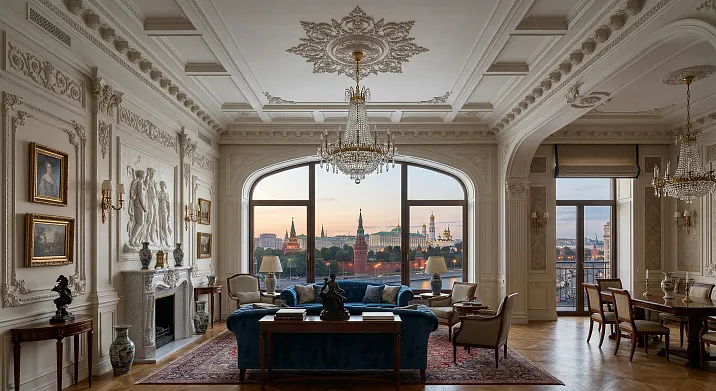
An empty white ceiling is just a ceiling. A ceiling with a cornice, a chandelier rosette, and a well-thought-out composition—that's already architecture. And the difference between these two states is defined by a few dozen centimeters of polyurethane relief, properly selected and skillfully installed.
Plaster rosette in MoscowToday, it is not a reminiscence of 18th-century palace interiors. It is a living tool of modern design: from neoclassicism to restrained contemporary classic, from a modest one-room apartment to a country mansion with ceilings up to four meters high. But for it to work—you need to understand how to choose it. And that is exactly what this entire article is about.


What is a plaster rosette and what types of ceiling moldings exist in general
Let's start with the main thing. Before choosing—you need to understand what exactly you are working with.Ceiling moldingis not a single element, but an entire system of decorative products, each of which plays its own role in the overall ceiling composition. Rosette, cornice, molding, frieze, coffer—each has its own function, its own place, and its own logic of application.




Plaster rosette: the center around which everything is built
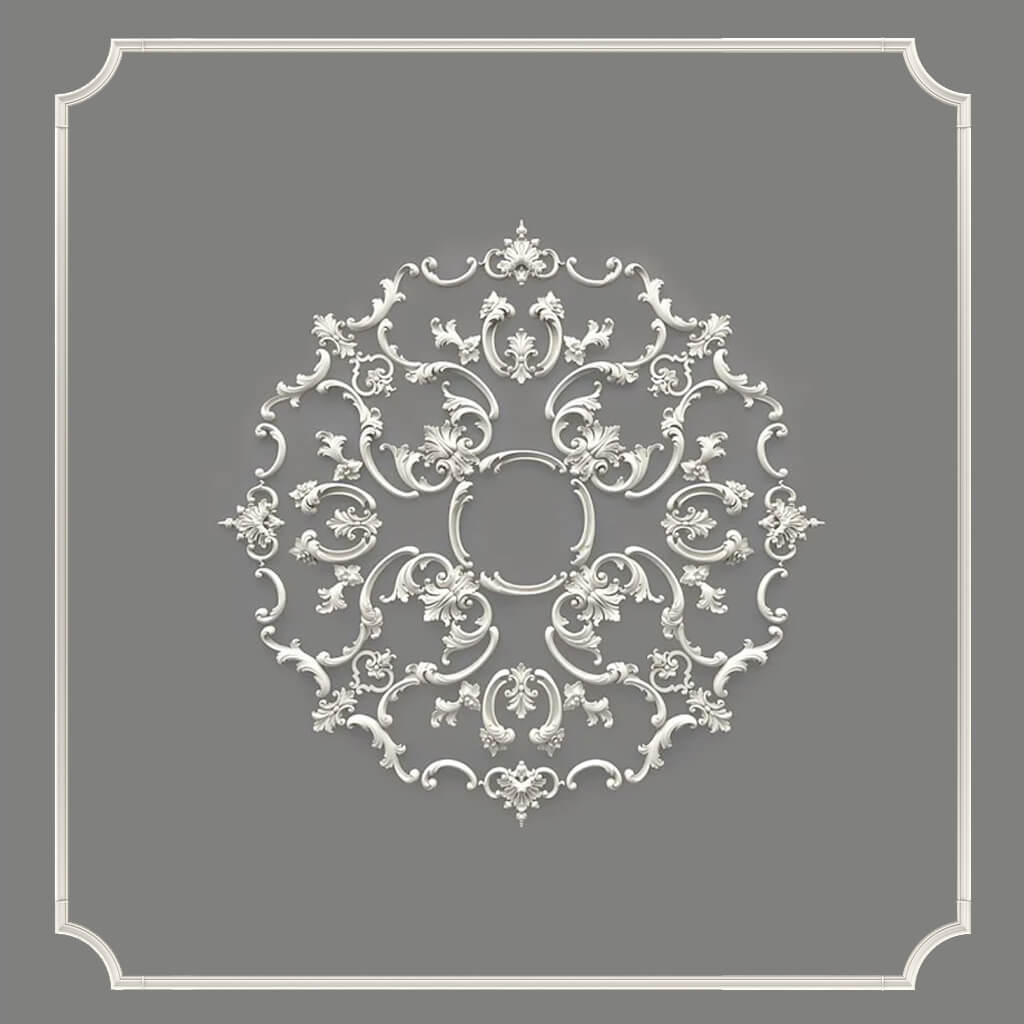
Plaster rosetteis a round or polygonal decorative element that is installed on the ceiling in the center of the room or at the point where the chandelier is suspended. It solves several tasks at once, and all of them are equally important.
The first and most practical—the rosette conceals the point where the electrical cable exits. Where without it there would be a gaping hole in the plaster or a visible junction box, after installing the rosette—there is a flawless decorative element, intentionally drawing the eye.
Second, it creates a visual center for the ceiling. Every room has an optical axis of symmetry, and the rosette fixes this point, making it explicit and meaningful. A chandelier hanging in the center without a rosette looks random. The same chandelier framed by a relief ornament looks like the final chord of a carefully constructed composition.
Third, the lighting effect. The light or white surface of the rosette acts as a soft reflector: the relief creates a play of shadows and highlights when the lighting is on, and the ceiling ceases to be flat and lifeless.
Diametersceiling roserange from 150 mm — for compact and laconic solutions — to 1000 mm and more, as in the case of the CPU-066 product measuring 1345×1345 mm, designed for representative spaces with high ceilings. Choosing the diameter is one of the key questions, which we will return to in detail.
Our factory also produces:



Ceiling cornices: the boundary that changes everything
A ceiling cornice is a profiled product that is mounted along the perimeter of the ceiling at the point where it meets the wall. Its role is hard to overestimate: it is the cornice that visually completes the space, creates a 'frame' around the ceiling, and removes the rough technical joint between the two planes.
A well-chosen cornice can visually raise the ceiling — if it is narrow, painted to match the ceiling, and has a smooth profile. Or, conversely, create a sense of heavy solemnity — if it is wide, multi-level, with a rich ornament. It all depends on the height of the room and the stylistic concept.
The cornice and rosette together form the basic ceiling system. This is the minimal set with which any classic interior ceiling begins.
Get Consultation
Ceiling moldings: geometry overhead
Ceiling moldingsare decorative profiled strips that create geometric frames, rectangular coffers, or accent lines directly on the ceiling plane. Unlike a cornice, they are not on the perimeter but in the central zone.
Ceiling moldings create multi-level architecture overhead: a rectangular frame around the rosette, a coffered system of several nested rectangles, frieze bands—all these are ways to give the ceiling depth, structure, and rhythm.
Additional decorative elements
Ceiling decor also includes corner elements for molding joints, ornamental inserts for accents, decorative brackets, and consoles. All of them work as 'punctuation marks' in the decorative text of the ceiling—without them, the phrase is written but not completed.
How to choose a plaster rosette for a chandelier: five criteria
This is the most frequent and most important question. Buying a rosette is easy—buying the right rosette requires understanding several fundamental parameters.
Based on chandelier diameter
There should be correct proportional relationships between the rosette and the chandelier. If the chandelier is large—the rosette cannot be smaller than its upper part, otherwise it creates a feeling that the light fixture 'ate' the decor. If the chandelier is small—the rosette should not overwhelm it with its scale.
Practical rule: the diameter of the rosette should be one and a half to two times larger than the diameter of the upper part of the chandelier (shade, base). At the same time, the lower limit of the rosette diameter for a standard room is 350–400 mm. Smaller than that—the element gets lost.
Based on room area
The area of the room is the main parameter for determining the scale of the rosette. There is a simple working formula: rosette diameter in centimeters ≈ 2.5–3 cm per each square meter of room area. For example:
-
Room 12–16 m² — rosette diameter 30–40 cm
-
Room 20–25 m² — ceiling rosette diameter 45–60 cm
-
Room 30–40 m² — ceiling rosette diameter 65–100 cm
-
Grand hall 50+ m² — ceiling rosette from 100 cm and larger
These figures are a guideline, not a strict standard. The final decision is also influenced by ceiling height and pattern density.
By ceiling height
Ceiling height changes everything. With a ceiling of 2.5–2.7 m, a large rosette with deep relief creates a sense of overhang and visually 'presses down' on the space. With a ceiling of 3.5–4 m, a small rosette gets lost and looks inappropriately modest.
For low ceilings (up to 2.7 m) — rosettes with a diameter of 300–500 mm with shallow relief, painted to match the ceiling color.Ceiling molding for such roomsshould be resolved as delicately as possible: cornice narrow — 60–80 mm, rosette restrained, ceiling moldings — optional.
For ceilings 3.0–3.5 m — rosettes 500–800 mm, cornice 100–150 mm, a frame system of moldings around the rosette is possible.
For high ceilings from 4 m — possibilities open up for large ornamental rosettes, wide multi-level cornices, and branched coffered systems.
By interior style
The rosette ornament should speak the same language as the entire interior. A lush Baroque pattern with acanthus leaves is classic or Baroque. A strict radial ornament is Art Deco. A calm geometric motif is modern classic or neoclassical. A concise ring with a simple profile is minimalism with an accent.
You cannot place a rosette with curls in a geometrically strict modern interior—the decor will feel 'alien,' and its presence will only highlight the mismatch.
Restrained or ornamental: how to make a choice
If you are hesitating between two options—a richer one and a calmer one—in most cases, the correct choice will be the more restrained one. An interior with slightly less decor than desired looks better than an overloaded one. An ornamental rosette is difficult to 'remove' if it turns out to be too active. A simple one can be complemented later.
Ceiling molding by room type: what suits where
The living room ceiling and the bedroom ceiling are fundamentally different tasks. Let's examine each room honestly and in detail.
Living Room
The living room is the flagship of any interior. It is here that the decor can and should be most expressive.Buy ceiling moldingFor the living room means creating a full-fledged ceiling system, not limiting yourself to a single element.
Optimal scheme for the living room:
-
cornice around the perimeter—100–160 mm wide depending on the ceiling height
-
Central ceiling medallion — proportionate to the room's area
-
If desired — moldings creating a rectangular frame around the medallion or a coffered system
Important: avoid overloading. If both the cornice is elaborate, and the medallion is large, and there's a complex coffered system on the ceiling — the ceiling becomes visually 'heavy'. The rule of one main focal point applies here in full force.
Bedroom
Bedroom — a place for rest, and ceiling decor here should create an atmosphere of coziness, not formality. Options: either only a medallion for the chandelier (without a cornice), or only a delicate cornice along the perimeter (without a medallion), or both elements, but in a restrained execution.
Medallion for the bedroom — small, with a soft pattern. For a bed 160–180 cm — a medallion with a diameter of 350–500 mm, if it is located above it, or 500–700 mm in the center of a standard room.
A separate technique: in a bedroom with low ceilings, you can forgo the medallion in favor of a light cornice along the perimeter — and the ceiling will visually 'rise'.
Dining Room
Dining room — a space where the central object is the dining table, and above it — the chandelier. It is this zone that requires emphasis, and a medallion above the table solves the task perfectly. It fixes the position of the light fixture, marks the center of the dining space, creates solemnity without pomp.
Size of the medallion for the dining room: aim for the table diameter multiplied by 0.5–0.7. A table with a diameter of 120 cm — a medallion 60–80 cm.
Entryway
In the hallway, the ceiling is often low and the area is limited. Here the decor should be as delicate as possible. A narrow cornice matching the ceiling color — that's enough. A medallion is appropriate only if the ceiling height allows, and if the chandelier in the hallway is a meaningful focal point of the design.
Office
Study — a space for concentration. Strict moldings, a crisp cornice, possibly — a small medallion for the central work light fixture. No baroque ornamentation. Geometry, precision, conciseness.
For apartments and country houses: what's the difference
In a city apartment, the main limitations are ceiling height and area. Priority: delicacy, proportionality, correct proportions.
In a country house, the possibilities are wider: high ceilings, large areas, formal spaces. HerePlaster rosette in Moscowand in the suburbs — these are already large-format solutions with rich ornamentation, wide cornices, coffered systems.
How to choose ceiling decor according to ceiling height: a detailed breakdown
Ceiling height is the supporting structure of the entire solution. Literally everything depends on it: rosette diameter, cornice width, relief depth, ornament saturation.
Low ceilings: up to 2.7 meters
This is the most common case in standard apartments. And here the main task is not to overload. Every extra centimeter of relief, every excessive element works against the space.
What to do:
-
cornice no wider than 70–90 mm, painted to match the ceiling color
-
socket with a diameter of 350–500 mm with shallow (5–10 mm) relief
-
it's better to avoid friezes and coffers
-
ceiling moldings — only if there is sufficient height at the junction area
What not to do:
-
install a cornice with a pronounced overhanging profile
-
choose a socket with a diameter over 600 mm
-
use an ornament with relief depth over 15 mm — it visually 'lowers' the ceiling
Standard height: 2.7–3.2 meters
Comfortable range where full ceiling decor is available. Here, a socket + cornice system is possible, and if desired — moldings around the central area.
Working parameters:
-
cornice 90–130 mm
-
rosette 450–700 mm
-
relief 10–18 mm
-
ceiling moldings — for room area from 20 m²
High ceilings: from 3.5 meters and above
The full arsenal is revealed. Large rosettes with rich ornamentation, wide multi-level cornices, complex coffered systems, frieze bands — all of this is appropriate and works to create a formal space.
Parameters:
-
cornice from 150 mm and above
-
rosette from 700 mm to 1300 mm (as in product CPU-066)
-
relief 15–25 mm and more
-
coffers, friezes — for a complete system if desired
Ceiling molding to match interior style: from Baroque to modern classicism
Style is not fashion. It is the language spoken by space. And molding must speak the same language as everything around it.
Classic interior
Classicism is symmetry, hierarchy, richness of detail, and order logic.Ceiling stucco in MoscowFor a classic interior, this is a rich ornament with plant motifs: acanthus leaf, laurel branch, volute curls. The rosette is large, with multi-level relief. The cornice is wide, with shelves, profile breaks, and a decorative frieze.
In a classic interior, the ceiling is one of the main 'statements'. It is not a background; it is a participant.
Neoclassicism
Neoclassicism takes the best from classicism and cuts off excesses. Here, ornament is present, but it is neater, more restrained, cleaner. Geometric motifs prevail over plant ones. The cornice profile is complex but without Baroque overload. The rosette has a clear pattern, clear structure, and moderate saturation.
Neoclassicism is a style for those who appreciate beauty but do not want to live in a museum.
Modern classic
The most in-demand style today. HerePlaster rosetteis a subtle accent, not a dominant. A simple radial ornament or geometric spiral. The cornice is laconic, with a clean profile. Ceiling moldings—if present—form a rectangular frame, nothing more.
The principle of modern classicism: every element is justified, everything superfluous is removed.
Art Deco
Geometry and tension style. Art Deco uses radial, jagged, stepped ornaments. An Art Deco rosette features clear angular motifs, without soft plant forms. The cornice is stepped, horizontal. The color of the decor can be not only white but also gold, silver, graphite — this is acceptable in Art Deco.
Restrained modern interior with a decorative accent
Even in a minimalist space without obvious historical stylization, a correctly chosen rosette works as an elegant gesture. A ring of a simple profile with a diameter of 400–500 mm around a chandelier in a modern apartment is not 'molding like in grandpa's house.' It is a precise, conscious choice of modern design.
Rosette, cornice, or a full composition: how to make a decision
One of the most practical questions: what exactly to choose? Only a rosette? Only a cornice? Or assemble a full system?
When a single molded rosette is enough
If the room is small, the ceiling is low, and the decorative budget is limited — one rosette under the chandelier is enough to make the ceiling meaningful. The rosette fixes the center, frames the light fixture, and gives the space coziness without excessive decor.
A good option for: bedrooms, small living rooms, dining rooms with one central chandelier.
When only a cornice is needed
If the chandelier is non-standard (track, built-in lighting, several spotlights) — a rosette is not needed. But a cornice around the perimeter will complete the space and visually connect the ceiling with the walls. This is especially relevant for modern interiors with stretch ceilings or when there is no central light fixture on the ceiling at all.
When to build a full ceiling system
If the room area is from 25 m² and the ceiling height is from 3 m — it makes sense to consider a system: cornice + rosette, possibly with moldings around the center. This is especially relevant for living rooms, dining rooms, studies, and formal halls.
Buy a plaster rosette in Moscowand select a cornice from the same collection for it — means getting a coordinated result, not a set of random elements.
How to assemble harmonious ceiling decor: a scheme
Professional workflow scheme:
-
Central accent — rosette. Determine the diameter and ornament.
-
Perimeter — cornice. Select the width and style in accordance with the rosette.
-
Frame around the center — if needed: moldings create a rectangular or square framing contour at a distance of 60–80 cm from the rosette.
-
Details — corner elements for moldings, ornamental inserts at nodal points.
All elements are from the same stylistic family. The cornice is slightly richer than the moldings, the rosette is richer than the cornice — that is the principle of hierarchy.
How to choose the size of ceiling molding: table and logic
Size matters — and in this case, it's measurable, specific, and fundamental.
| Ceiling Height | Cornice width | Socket diameter | Depth of relief |
|---|---|---|---|
| up to 2.7 m | 60–90 mm | 300–500 mm | 5–10 mm |
| 2.7–3.2 m | 90–130 mm | 450–700 mm | 10–15 mm |
| 3.2–4.0 m | 130–180 mm | 600–900 mm | 15–20 mm |
| Above 4.0 m | 180 mm and more | 800–1300+ mm | 20–25 mm |
The diameter of the rosette relative to the room area is another criterion:
| Room area | Recommended rosette diameter |
|---|---|
| 10–15 m² | 300–400 mm |
| 16–22 m² | 400–550 mm |
| 23–30 m² | 550–750 mm |
| 31–45 m² | 700–1000 mm |
| 46 m² and more | 900–1300+ mm |
Why is relief depth important? Because it determines how expressive an element looks under given lighting. A rosette with deep relief (20+ mm) in a room with diffused lighting gets 'muted'—no shadows appear, the ornament is not readable. A rosette with 8–12 mm relief under directed chandelier light will create a beautiful play of shadows.
Ceiling molding material: why the choice is obvious
To talk about ceiling decor materials in 2026 is first and foremost to talk about polyurethane. And here's why.
Polyurethane ceiling molding— is not a compromise, not a replacement for 'real' molding. It is a modern professional standard with a number of fundamental advantages:
Lightness. A 600 mm diameter ceiling rosette made of polyurethane weighs 600–900 g. The same rosette made of plaster—5–8 kg. The difference determines not only installation convenience but also the requirements for the ceiling base.
Shape precision. Professional polyurethane products are manufactured in high-precision molds from handcrafted master models. Each ornamental element is reproduced accurately and consistently—from the first item in the batch to the last.
Installation convenience. Polyurethane is glued with mounting adhesive, cut with a regular saw, and easily adjusted to any angle. Installing a rosette takes 15–30 minutes, installing a cornice around the perimeter of a room—several hours.
Paint-ready surface. All polyurethane products can be painted with water-based paints in any color. The traditional option is white to match the ceiling. But other solutions are also possible: gold, silver, cream, gray.
Stability. Unlike plaster, polyurethane does not crumble, does not develop hairline cracks from vibration, and does not absorb moisture.
An important point when choosing: not all polyurethane products are the same. Cheap polyurethane produces a blurry, 'soapy' relief without clear shapes. Professional polyurethane is precise, with sharp ornament boundaries, correct surface roughness, and stable dimensions.
Typical mistakes when choosing a ceiling rosette and ceiling molding
Professionals see the same mistakes over and over again. It's better to know about them before purchasing.
Mistake 1. A rosette that is too large for a small room. A 700 mm rosette in a 12 m² room is not palatial splendor, it's a visual mistake. The ceiling 'lowers,' the space shrinks. Scale is paramount.
Mistake 2. A rosette that is too small for a large chandelier. The opposite problem. A small rosette cannot visually 'hold' a heavy chandelier — it creates the feeling that the decor was left unfinished.
Mistake 3. An active ornament for a low ceiling. Deep relief with a rich baroque ornament on a 2.5 m ceiling visually lowers it even further. For such rooms — a thin profile, a soft ornament, painting to match the tone.
Mistake 4. Inconsistency with the interior style. A rosette with swirls in a loft or minimalist interior is not a 'highlight,' it's a mismatch. The decor should speak the language of the interior.
Mistake 5. Lack of connection between the cornice and the rosette. If the cornice is from one collection and the rosette from another — they 'don't hear' each other. The ceiling system should be unified in style.
Mistake 6. Choosing only by photo. The photo in the catalog lies about the size. A beautiful rosette in the picture may turn out to be too small or too large. Always check the real dimensions in millimeters.
Mistake 7. Overloading the ceiling. If the ceiling has a large rosette + a wide cornice + a complex coffered system + a frieze — the ceiling becomes 'shouting.' One main accent, everything else is support.
Mistake 8. Not calculating the quantity of linear elements in advance. Cornices and moldings are linear products. When ordering, add 10–15% extra for corner trimming and to compensate for installation errors.
Mistake 9. Forgetting about light. Plasterwork lives in light. Before choosing a rosette, consider: what will the chandelier be like? Is it directional light? Diffused? This determines how deep the relief should be.
Mistake 10. Ordering elements in different batches. Even from the same manufacturer, different batches may vary slightly in color and surface texture. Order the entire set at once.
How to buy a plaster rosette and ceiling molding in Moscow: a step-by-step algorithm
A proper purchase is not 'come, choose what you like, take it.' It's a small project that takes a few hours but saves months of regret.
Step 1. Determine the room. Living room, bedroom, dining room, hallway? This immediately narrows down the selection corridor.
Step 2. Take ceiling measurements. Height, area, location of the central point for the chandelier suspension. Everything in millimeters.
Step 3. Determine what exactly is needed. Just a rosette? Cornice + rosette? A full system with moldings?
Step 4. Choose a style. Classic, neoclassical, modern classic, art deco? The style determines the type of ornament and the richness of the relief.
Step 5. Select specific products. Use the size charts above as a guide.Explore the ceiling decor catalog— with real photos and precise product dimensions in millimeters.
Step 6. Check compatibility. The cornice and rosette should be in the same style. If moldings are added, they should be from the same form system.
Step 7. Calculate the quantity. For the rosette — one piece (or several, if zoning). For the cornice — the perimeter of the room plus 10–15% extra. For moldings — according to the layout scheme.
Step 8. Order as a set. All elements — in one order, one batch.
What to choose together with ceiling molding: a system, not randomness
Ceiling moldingsworks most effectively in combination with other interior elements. What makes sense to choose together:
-
wall moldings— wall frame systems should be coordinated in style with the ceiling decor. If the ceiling has a classic pattern, the wall moldings should be from the same collection or a similar style.
-
Floor skirting boards — finishing the space from below. In an interior with molding, the skirting cannot be a simple straight profile — it must have a decorative relief coordinated with the cornice.
-
Decor for doorways — door frames, decorative overlays. If the ceiling is decorated with molding, the door portal logically should be in the same style.
-
Decorative coffers — for country houses with high ceilings. A coffered system made of moldings transforms a flat ceiling into a multi-level architectural structure.
-
Friezes — horizontal decorative bands between the cornice and the main ceiling plane. Used in formal spaces with ceiling heights from 3.5 m.
About the company STAVROS
The ceiling discussed in this article becomes a reality thanks to specific products from a specific manufacturer. And here it is impossible not to mention STAVROS.
STAVROS — a Russian factory of decorative products made of polyurethane and wood with a 24-year history. Over these years, the company has become a recognized professional standard in the field of interior and furniture decoration — with its own production, strict quality control, and a huge warehouse program ensuring shipment of even a single item.
Every rosette, every cornice, every STAVROS molding is made from a handmade master model. This is not digital processing, not casting in standard molds — it is sculptural precision, reproduced in thousands of copies without loss of quality.
The STAVROS range covers ceiling rosettes from 150 mm to 1300+ mm, cornices from 50 to 200+ mm, moldings from more than 50 collections, decorative overlays for furniture and doors. All decor is paintable with water-based paints, and everything comes with installation documentation.
Delivery — throughout Russia. Consultation — for any project, regardless of its scale: from one rosette for a bedroom to outfitting a multi-apartment residential building.
FAQ: Answers to popular questions
What is a plaster rosette and why is it needed on the ceiling?
A plaster rosette is a decorative element of round or polygonal shape, installed on the ceiling at the point where the chandelier is suspended. It conceals the cable outlet, creates a visual center for the ceiling, and forms a lighting accent when the light is on. This is both a practical and aesthetic solution.
How to choose a rosette for a chandelier?
The diameter of the rosette should be 1.5–2 times larger than the diameter of the upper part of the chandelier. At the same time, base it on the room area: 2.5–3 cm of diameter for each square meter of area. The style of the rosette's ornament should match the style of the interior.
What is better to choose: a ceiling rosette or a cornice?
This is not an either/or choice. A rosette and a cornice serve different functions: the rosette accentuates the center of the ceiling, the cornice finishes its perimeter. If you need to choose one — for a chandelier, the rosette is more important; for a sense of spatial completeness — the cornice.
Is ceiling molding suitable for low ceilings?
Yes, with the correct choice of scale. For ceilings up to 2.7 m — a narrow cornice 60–80 mm in the color of the ceiling, a small rosette with shallow relief. Properly selected molding will not 'lower' the ceiling but will give it a neat finish.
Can a rosette be used in a modern interior?
It can and should be — if you choose the right style of ornament. A simple geometric or radial rosette fits perfectly into modern classic, neoclassical, and art deco. The main thing is not to place a lush baroque ornament in a minimalist space.
What size ceiling rosette to choose?
Use the formula: diameter in centimeters = 2.5–3 × area in m². For a 20 m² room — a rosette 50–60 cm. For a 30 m² room — 65–80 cm. For large spaces from 40 m² — from 90 cm and larger.
How to combine a rosette, cornice, and moldings?
A unified stylistic family is the main rule. The cornice is richer than the moldings, the rosette is an accent element. When composing a ceiling system, use products from the same collection or a close stylistic register. Do not mix baroque ornament with strict geometry.
Does ceiling molding need painting?
Most professional polyurethane products are supplied white—ready for finishing. Painting is recommended: it covers joints with putty, gives the surface a uniform color with the ceiling, and improves adhesion for subsequent painting. Water-based compositions are used.
What is better for a living room: just a rosette or full ceiling decor?
Depends on the area and ceiling height. For a living room of 20–25 m² with a 2.7 m ceiling—rosette + cornice. For a living room of 30+ m² with a 3 m or higher ceiling—a full system with a rosette, cornice, and, if desired, moldings. A rosette alone is justified in small spaces or with non-standard lighting.
Where to buy a plaster rosette in Moscow?
Buy ceiling plasterwork in Moscow—rosettes, cornices, moldings, and the full set of ceiling decor—can be purchased from the manufacturer STAVROS. Own production, wide range, delivery across Russia. Consultation on selection—free of charge.