Article Contents:
- Anthropology of beauty: why humans are drawn to carved wood
- Genetic memory of material
- Psychophysics of relief perception
- Technological poetry: from wood to masterpiece
- Material selection: choosing worthy materials
- Technological chain of transformations
- Anatomy of styles: from Byzantine gold to Scandinavian minimalism
- Classical orders: architectural grammar
- Gothic expression: reaching towards the sky
- Baroque theatricality: art as illusion
- Rococo: art of enjoyment
- Modern: Nature as Teacher
- Art Deco: geometry of luxury
- Functional aesthetics: beauty serving practicality
- Furniture alchemy: transforming the ordinary into the beautiful
- Architectural dramaturgy: creating space
- Material science: physics and chemistry of beauty
- Anatomy of wood: understanding structure
- Humidity: critical parameter
- Protective coatings: chemistry of longevity
- Ergonomics of beauty: influence of decor on humans
- Humidity parameters
- Color psychology of wood
- Tactile sensations
- Regional schools: geography of craftsmanship
- Russian traditions: from paganism to Orthodoxy
- European schools: from Romanesque to modernism
- Eastern Traditions: Philosophy in Ornament
- Technological innovations: the future of ancient craftsmanship
- Digital technologies in carving
- Production automation
- New materials and coatings
- Economics of investing in beauty
- Capitalization of aesthetics
- ROI of cultural investments
- Support for traditional crafts
- Buyer's practical guide
- Selection algorithm
- Budget Planning
- Logistics and installation
- Care and preservation: the art of prolonging life
- Preventive maintenance
- Restoration and repair
- Conclusion: investment in eternal values
In a world where standardization absorbs individuality, choosing to buy carved wooden decor becomes an act of creative resistance against blandness. Each carved element is a letter from the past to the future, a message from the master to future generations, a philosophy of beauty embodied in living material.
When the first rays of sunlight touch the relief surface of the carved inlay, a spectacle of light and shadow is born. In this dance of forms lies the secret of decorative art's effect on the human soul. But what lies behind the decision to purchase carved decor? What secrets does wood hold? How to choose elements that will delight generations?


Anthropology of beauty: why humans are drawn to carved wood




Genetic memory of the material
Wood is a material with a biography. Each annual ring tells of endured seasons, droughts and rainy years, of the struggle for a place under the sun. When the craftsman takes up the chisel, he does not merely process the material — he releases the story contained within it.
Carved wooden inlays carry this living memory. Touching them, we subconsciously feel a connection with nature, which is so necessary for urban dwellers. This is not mysticism, but the reality of our evolutionary heritage.
Our factory also produces:


Psychophysics of relief perception
Scientific research proves: relief surfaces activate special brain zones responsible for emotional perception. Smooth surfaces seem cold and alien to us, while carved elements create a sense of warmth and closeness.
Palmar tactile receptors contain more than 17,000 nerve endings. Each touch on a carved surface generates a unique combination of signals, creating a rich palette of sensations inaccessible when touching smooth materials.
Get Consultation
Technological poetry: from wood to masterpiece
Material selection: choosing worthy pieces
The process of creating quality carved decor begins long before the first chisel strike. In sawmill warehouses, experienced specialists select boards, analyzing grain direction, structural density, and absence of hidden defects.
Oak — the aristocrat among species. Its density reaches 720 kg/m³, enabling the creation of details of jewel-like precision. Tannins in oak wood provide natural protection against pests and fungi. Carved rosettes made from oak wood can retain line clarity for centuries.
Beech attracts craftsmen with its pliability and uniformity. The absence of a pronounced texture makes it an ideal canvas for complex ornaments. At the same time, its strength characteristics allow creating delicate, intricate elements without risk of breakage.
Ash surprises with the contrast of its texture. Light and dark stripes create a natural decorative effect, which craftsmen skillfully use in compositions. The high viscosity of the wood allows creating elements of complex spatial forms.
Technological transformation chain
Modern production of carved decor is a symphony where each tool plays its part. It all begins with drying chambers, where the wood's moisture is brought to optimal 8-12%. This is a critically important stage — improperly dried wood may warp even after the item is made.
The next stage is cutting. Here, the direction of the grain, placement of knots, and natural stresses in the material are taken into account. An experienced craftsman sees hidden potential and possible problems in every blank.
CNC processing ensures mathematical precision of basic forms. Modern milling centers can operate at up to 40,000 rpm with positioning accuracy of 0.01 mm. This allows creating elements of any complexity with perfect repeatability.
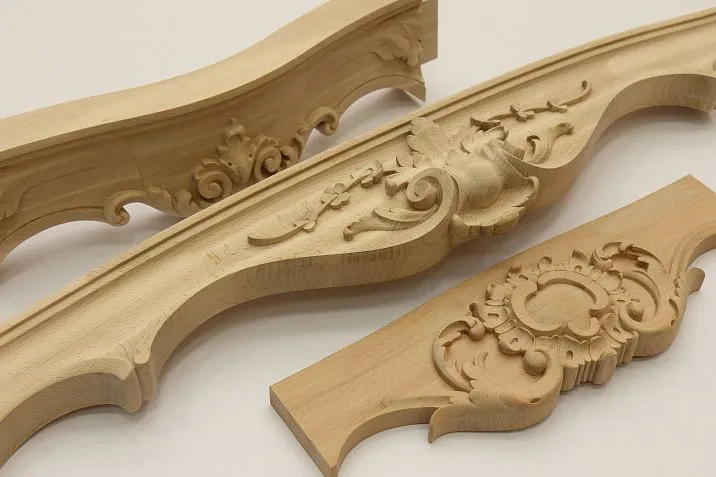
But true magic begins at the hand-finishing stage. The master carver takes up chisels — tools whose shape has not changed for millennia. Each strike is precise, every movement intentional. It is here that the dead machine precision comes alive, acquiring soul.
Anatomy of styles: from Byzantine gold to Scandinavian minimalism
Classical orders: architectural grammar
Ancient architectural orders are not merely historical artifacts, but a living system of proportions tested over millennia. Carved capitals of the Doric order embody masculine simplicity. The absence of decorative excess highlights constructive logic, creating a sense of reliability and solidity.
The Ionic order brings femininity and elegance to architecture. Characteristic volutes of the capital resemble curls of hair or ram’s horns — ancient symbols of fertility and vital energy. In modern interiors, Ionic motifs create an atmosphere of refinement and cultural continuity.
The Corinthian order is the apogee of decorative richness in antiquity. Acanthus leaves winding around the capital symbolize the triumph of life over death, the eternal spring of spirit. Such elements transform an ordinary room into a temple of beauty.
Gothic expression: reaching toward the sky
The Gothic style brought vertical aspirations and delicate lightness to architecture. Decorative panels in solid wood in the Gothic style impress with the complexity of geometric constructions. Every line submits to a single logic of movement upward, toward the transcendent.
Trifurcations, four-petal flowers, rosette windows — these motifs carry deep symbolic meaning. Three petals of a trifurcation symbolize the Trinity, four petals — the four cardinal directions, the material world. Gothic ornaments transform an interior into a book of symbols.
Baroque theatricality: art as illusion
Baroque is a style of total art, where architecture, sculpture, and painting merge into a unified whole. Carved brackets from the Baroque period are not merely supports, but sculptural compositions telling stories.
Favorite Baroque motifs — cherubs, cartouches, acanthus leaves — create a sense of movement and dynamism. It seems as if the ornament lives its own life, twisting and pulsing. This is an art of illusion, transforming a flat surface into a three-dimensional composition.
Rococo: art of enjoyment
Rococo refined Baroque ornamentation to exquisite delicacy. Asymmetric shells, interwoven ribbons, stylized flowers create an atmosphere of the Age of Gallantry. Carved wooden balusters in the Rococo style transform a staircase into a piece of jewelery art.
Rococo color palette — soft pastel tones, gold, mother-of-pearl sheens. This is the style of boudoirs and salons, intimate spaces where every detail matters.
Modern: nature as teacher
The Modern style brought to decorative art a cult of nature. Stylized plants, insects, sea waves — all of this finds embodiment in carved wooden moldings. Modernism rejected historical stylizations, creating its own language of forms.
A distinctive feature of Modernism is the absence of straight lines. All contours are fluid, organic, reminiscent of natural forms. This creates a sense of unity with the surrounding world, harmony between man and nature.
Art Deco: geometry of luxury
Art Deco combined luxury with industrial aesthetics. Geometric forms stylized as machine parts create a sense of dynamism and progress. Carved cornices in the Art Deco style often imitate sun rays, lightning, zigzags — symbols of energy and speed.
Art Deco materials — precious wood species, metal inlays, contrasting texture combinations. This is the style of the jazz age, cocktail parties, and skyscrapers.
Functional aesthetics: beauty serving practicality
Furniture alchemy: transforming the mundane into the beautiful
Furniture appliqués — the most accessible way to introduce elements of high art into an interior. A simple chest adorned with carved elements instantly acquires the status of an antique piece. This is not deception, but the magic of craftsmanship capable of transforming any surface.
Kitchen facades with carved appliqués create an atmosphere of a family hearth. Botanical motifs — grapevines, wheat stalks, oak leaves — symbolize abundance and fertility. Such a kitchen ceases to be merely a place for food preparation — it becomes the heart of the home.
Bedroom furniture requires a special approach. Here, Baroque opulence or Gothic expression is inappropriate. Soft, flowing lines of Modernism, gentle botanical motifs create an atmosphere of calm and tranquility. A carved headboard becomes a work of art, with which one wishes to greet every morning.
Architectural dramaturgy: creating space
Carved elements can radically alter the perception of space. Capitals transform functional supports into architectural dominants. Properly placed columns create rhythm, organize movement, guide the gaze.
Ceiling rosettes do not merely conceal light fixture mounting points — they become compositional centers of rooms. Multi-level rosettes create a dome effect, visually increasing ceiling height. Especially effective are rosettes with backlighting, creating play of light and shadow.
Staircase elements transform vertical communication into an aesthetic experience. Each step reveals a new perspective for appreciating the carving. Balusters can tell a story — from simple forms at the bottom to complex compositions at the top, symbolizing ascent from the material to the spiritual.
Material science: physics and chemistry of beauty
Anatomy of wood: understanding structure
Wood is not merely a construction material, but a complex biological structure. Understanding its peculiarities is critically important for creating durable decor.
The sapwood — the outer, younger part of the trunk — is lighter in color and less dense. The heartwood — the central part — is darker and stronger due to the accumulation of tannins. When creating carved decor, these characteristics are taken into account to achieve maximum strength and aesthetic effect.
Annual rings create a unique wood grain pattern. In fast-growing species, rings are wide; in slow-growing species, they are narrow. This characteristic affects the processing technology and the final appearance of the product.
Ray parenchyma — radial structures extending from the center to the bark — creates a characteristic "medullary ray" on radial sections. In oak, these structures are especially developed, forming the famous "oak ray."
Moisture: critical parameter
Wood moisture is a key factor determining the stability of the finished product. Freshly cut wood contains up to 60% moisture. As it dries, shrinkage occurs, which may lead to cracks and deformations.
Technical drying reduces moisture to 8–12% — the optimal level for furniture production. This process must be gradual and controlled. Forced drying may cause internal stresses that manifest even after the item is manufactured.
Modern drying chambers allow precise control of temperature, humidity, and air flow speed. The process may take from several days to several weeks depending on the species and thickness of the material.
Protective coatings: chemistry of longevity
Modern protective coatings are the result of complex chemical developments. They must protect wood from moisture, ultraviolet radiation, pests, while preserving its natural beauty.
Oil-based coatings penetrate deeply into wood, creating protection from within. They highlight the natural grain, imparting a noble matte sheen. Especially effective are tung and linseed oils, which form a durable polymer film.
Varnish coatings create a surface protective film. Modern polyurethane varnishes have high wear resistance, do not yellow over time, and are resistant to chemical exposure. Acrylic varnishes dry quickly, have no odor, and are suitable for residential spaces.
Waxes are used for final finishing. They create a silky surface, pleasant to the touch. Carnauba wax, derived from palm trees, provides the highest quality coating.
Ergonomics of beauty: influence of decoration on people
Psychology of form perception
Different types of ornamentation affect the human psyche differently. Circular forms are associated with the sun, fullness, harmony. They create a sense of calm and security. Rosettes with circular motifs are ideal for bedrooms and relaxation areas.
Vertical lines direct the gaze upward, creating a sense of growth and development. Gothic motifs, with their upward reach toward the sky, activate spiritual centers, promoting contemplation and meditation.
Horizontal lines create a sense of stability and calm. They slow eye movement, promoting relaxation. Classical friezes with horizontally developed ornamentation are ideal for living rooms and libraries.
Diagonals introduce dynamism and movement into the composition. Baroque scrolls, with their complex curves, activate imagination and stimulate creative thinking.
Color psychology of wood
The color of wood has a powerful effect on emotional state. Light-colored species — birch, maple, beech — create a sense of purity and freshness. They visually expand space and are suitable for small rooms.
Dark species — oak, walnut, wenge — create a sense of solidity and respectability. They emphasize the owner’s status and are suitable for formal spaces.
Reddish tones — cherry, mahogany — are associated with warmth and coziness. They create an intimate atmosphere, suitable for bedrooms and living rooms.
Yellow tones — pine, spruce — evoke the sun and summer. They uplift mood and are suitable for children’s rooms and kitchens.
Tactile sensations
Touching carved surfaces activates tactile receptors, creating a rich palette of sensations. The smoothness of polished protrusions contrasts with the depth of incised lines. This interplay of textures creates an additional channel for perceiving beauty.
Thermal sensations also play an important role. Wood always feels warm to the touch, unlike metal or stone. This creates a sense of comfort and homey coziness.
Regional schools: geography of craftsmanship
Russian traditions: from paganism to Orthodoxy
Russian wood carving has a thousand-year history. Pagan motifs — sun disks, phoenix birds, tree of life — naturally intertwined with Christian symbolism.
Northern school of carving is distinguished by monumentality and expressiveness. The harsh nature taught artisans to create concise yet powerful images. Arkhangelsk and Vologda carvers are renowned for their skill working with coniferous species, creating true masterpieces.
Central Russia gave the world the icon of the Virgin Mary — a special type of relief carving. Modern masters adapt traditional techniques to create interior sculptures.
Gorodets wood painting introduced vibrant floral motifs into carving. Roses, kupavkas, daisies executed by Gorodets masters impress with their cheerfulness and optimism.
European schools: from Romanesque to modern
German school of carving is distinguished by technical precision and functionality. German masters were the first to apply mechanized tools, achieving perfect repeatability of elements.
The Italian school brought a special artistic flair to carving. The influence of great Renaissance sculptors is felt in every element. Italian ornaments are characterized by plasticity and vividness.
The French school of decoration leans toward elegance and refinement. French masters created numerous classical ornamental motifs used around the world.
The English school brought practicality and restraint to carving. English ornaments are distinguished by noble simplicity and functionality.
Eastern traditions: philosophy in ornament
Chinese carving impresses with the complexity and multi-layered compositions. Traditional motifs — dragons, phoenixes, clouds — create dynamic, movement-filled compositions. Each element carries symbolic meaning, and the entire composition represents a philosophical text.
Japanese aesthetics lean toward minimalism and perfection of detail. The principle of 'wabi-sabi' — beauty in imperfection — is manifested in emphasizing the natural characteristics of the material.
Indian carving is distinguished by incredible detail and richness of symbolism. Mandalas, lotuses, images of deities create a sacred atmosphere, conducive to meditation and spiritual purification.
Technological innovations: the future of ancient craftsmanship
Digital technologies in carving
Modern CAD systems allow creating the most complex three-dimensional ornament models. Parametric modeling enables quickly adapting basic shapes to specific dimensions and requirements.
Virtual reality opens new possibilities for presenting projects. Clients can 'enter' a virtual interior and assess how carved elements will appear at real scale.
Artificial intelligence is beginning to be used to create new ornamental motifs. Neural networks trained on thousands of historical samples can generate original compositions in a specified style.
Production automation
Modern robotic complexes are capable of performing the most complex carving operations. Multi-axis manipulators ensure processing of details of any spatial configuration.
Machine vision systems control processing quality in real time. Any deviations from specified parameters are immediately corrected.
Adaptive algorithms take into account the specific characteristics of each blank — hardness, grain direction, presence of knots. This allows optimizing processing modes for each item.
New materials and coatings
Advancements in polymer chemistry have led to the creation of fundamentally new protective coatings. Nanocomposite compositions provide unprecedented protection against all types of exposure.
Self-healing coatings can seal minor scratches under heat. This extends the lifespan of items and preserves their original appearance.
Antibacterial additives in coatings make carved decoration hygienic, safe for use in medical and children's facilities.
Economics of investing in beauty
Capitalization of aesthetics
Quality carved decoration is not an expense, but an investment. Real estate with unique interior solutions is always valued higher than standard properties. Appraisal experts note: the presence of quality carved decoration can increase the property's value by 15-30%.
Antique carved elements only increase in value over time. Works by renowned masters become collectible items, and their value rises faster than inflation.
ROI of cultural investments
Return on investment in carved decoration cannot be measured solely by financial indicators. Beautiful surroundings improve quality of life, enhance mood, and stimulate creative activity.
Children raised in an environment of beauty have a more developed aesthetic sense, learn better, and exhibit greater creative abilities. This is a long-term investment in the family's future.
Support for traditional crafts
By purchasing quality carved decoration, we support traditional crafts and preserve cultural heritage. In the era of globalization, this is especially important for preserving national identity.
Developing craft workshops creates jobs and contributes to regional development. This is socially responsible investment.
Practical buyer's guide
Carving Selection Algorithm
When selecting carved decoration, it is important to consider many factors. Stylistic compatibility is the first and most important criterion. The decoration should naturally fit into the overall interior concept, complement it, rather than contradict it.
Proportional scale is also critically important. Large elements in a small room will create a feeling of confinement, while small elements in a large space will disappear. The golden rule: the size of the decorative element must correspond to the scale of the room and surrounding objects.
The quality of the material and finish is the guarantee of the decoration's longevity. The wood must be properly dried and free of hidden defects. The surface must be perfectly sanded, and the coating must be even, without streaks or pooling.
Budget planning
The cost of carved decoration varies widely depending on the material, complexity, and size. Simple birch inlays may cost from 500 rubles, while exclusive oak panels can cost tens of thousands.
When planning a budget, it is important to consider not only the cost of the elements themselves, but also associated expenses: delivery, installation, surface preparation. A comprehensive approach will help avoid unpleasant surprises.
Logistics and installation
Carved decoration requires special care during transportation. Elements must be securely packed and protected from impacts and moisture. It is better to entrust delivery to specialized companies with experience handling fragile goods.
Installation of carved decoration — a responsible operation requiring professional skills. Incorrect installation can damage even the highest-quality elements. It is better to entrust this work to specialists.
Care and preservation: the art of extending life
Preventive Maintenance
Carved decoration requires regular but simple maintenance. Weekly dusting with a soft brush or microfiber cloth is the main procedure. It is important not to allow dirt to accumulate in the recesses of the carving.
Periodic treatment with protective compounds extends the service life of the decoration. The frequency of treatment depends on the conditions of use: in residential spaces, once a year is sufficient, in spaces with higher humidity — more frequently.
Minor damage to oak balusters can be repaired yourself using special wax pencils or wood putty. It is important to select the material to match the wood tone precisely for an undetectable repair.
Local damage to carved decoration can be repaired without replacing the entire element. Modern restoration technologies allow restoring even severely damaged areas.
The method of local wood insertion allows replacing a damaged area with a fragment of the same species. Special adhesive compounds ensure a bond strength exceeding the strength of the wood itself.
To restore lost carving fragments, special plastic compounds based on wood flour are used. After hardening, they are treated like regular wood and painted to the desired tone.
— is a choice in favor of eternal values. In a world where everything becomes disposable, quality wood carving remains a symbol of solidity and intergenerational continuity.
Solution to buy carved wooden decor Each carved element is a message to the future. A message that beauty matters, craftsmanship is valuable, and traditions must live on. Choosing carved decoration means investing not only in our homes, but also in culture, art, and the future of artisanal traditions.
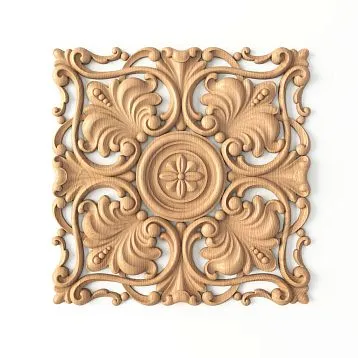
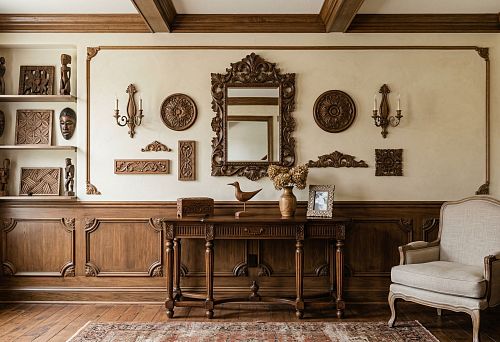
Wooden inlays, carved wooden rosettes, solid wood decorative panels, carved wooden balusters — each of these elements can transform a space, endowing it with character and individuality. The key is to make the right choice, consider all nuances, and entrust the work to professionals.
Carved wooden inlays, carved wooden rosettes, decorative solid wood panels, carved wooden balusters — each of these elements can transform the space, imbue it with character and individuality. The key is to make the right choice, consider all nuances, and entrust the work to professionals.
Modern technologies allow creating carved elements of unprecedented complexity and beauty. At the same time, the essence — the soul of craftsmanship, the warmth of human hands creating beauty — is preserved. This makes each item unique and irreplaceable.
139.12 $ р.