Article Contents:
- Buy floor skirting boards: where to start choosing and why it's more important than it seems
- Which floor skirting boards are most often bought: a complete overview of categories
- Solid wood floor skirting boards
- MDF floor skirting
- High floor skirting
- White floor skirting
- Wide wooden baseboard
- Skirting for painting
- Buy wooden floor skirting: when solid wood is the only right choice
- Natural Wood Flooring: Parquet, Solid Board, Engineered Board
- Classical and Neoclassical Interior
- Renovation with a 25–30 Year Lifespan in Mind
- House with wooden interiors
- When You Crave Uniqueness
- MDF Floor Skirting: A Sober Look at Strengths and Limitations
- How to Choose Skirting by Height, Width, and Color: A Practical Guide
- Height: The Rule of Proportions
- Width: Decorative or Neutral
- Color: Three Working Strategies
- Profile: Geometry as a Style Marker
- Which Skirting to Buy for a Specific Floor Covering
- Buy skirting board for laminate
- Buy skirting board for parquet and engineered board
- Buy skirting board for quartz vinyl
- Buy skirting board for tile and porcelain stoneware
- Buy skirting board for wooden floor (solid board, parquet board)
- Which skirting board to buy to match interior style
- Classic and neoclassic
- Modern minimalist interior
- Scandinavian Style
- Loft and Industrial Style
- Apartment in a modern residential building
- Country house
- Mistakes when buying floor skirting board: list from a practitioner
- Choosing based only on price
- Incorrect height relative to ceiling
- Conflict with door architraves
- Rich profile in functional rooms
- Attaching skirting board to flooring
- Different skirting boards in adjacent open-plan rooms
- Buying individual cards instead of a category
- Where to buy floor skirting boards: from the right choice to the right order
- About the Company STAVROS
- FAQ: answers to popular questions about buying floor skirting boards

Every time a renovation ends, the same moment arrives: the floor is laid, the walls are painted, the furniture is arranged—and suddenly your gaze falls downward. Where the wall meets the floor, a gap yawns, or a cheap plastic profile bought at the last minute 'just to cover it' lies there. And the entire expensive renovation stares back at you precisely from there—from below, at skirting board level.
This is no exaggeration. A correctly chosen and properly installed skirting board is the final touch that either completes the interior or betrays it. And that is precisely whybuy floor skirting boardsrequires just as much thought as choosing flooring or doors.
This article provides a complete practical breakdown: materials, parameters, styles, combinations with specific floor coverings, and honest answers to questions that arise with every purchase. Plus — whereto buy wooden baseboardgood quality and not waste time.





Buying floor skirting boards: where to start your selection and why it's more important than it seems
Most people choose skirting boards as an afterthought: everything else is bought, and it remains to find something suitable in color. It is precisely in this logic that the cause of most unsuccessful results lies.
A floor skirting board performs several functions at once — and none of them is secondary.
Structural. Floating coverings — laminate, parquet, engineered wood, quartz vinyl — require an expansion gap at the wall. With changes in temperature and humidity, the covering expands and contracts. This gap cannot be sealed: it needs to be decoratively covered. A floor skirting board is the only correct way to do this.
Architectural. The lower horizontal line of a room is one of the key organizing lines of an interior. It sets the scale, creates a visual 'base' for the space, and delineates the vertical of the wall and the horizontal of the floor. A correctly chosen skirting board makes a room legible.
Protective. The lower part of the wall near the floor is a zone of increased mechanical load: wet cleaning, chair legs, moving furniture. The skirting board protects the plaster and finish from damage.
Aesthetic. The skirting board is an element of a unified wooden interior system together with door architraves, cornices, and moldings. When all the details are coordinated, the interior gives an impression of being expensive even on a moderate budget.
Material is the first and most fundamental choice. Everything else—height, color, profile—is secondary to it.




Which floor skirting boards are most commonly purchased: a complete overview of categories
The market offers several fundamentally different categories. Let's examine each one—honestly, without unnecessary marketing.
Our factory also produces:

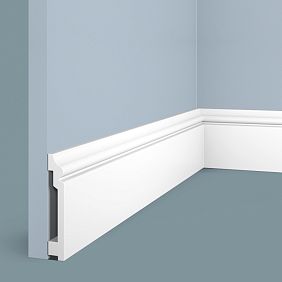
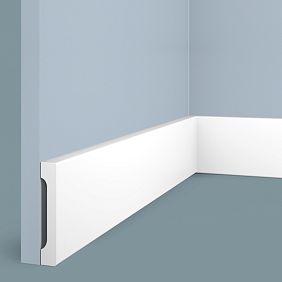
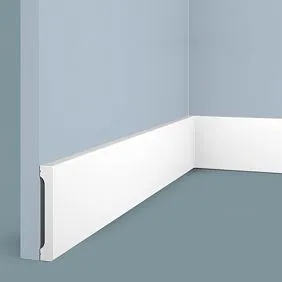
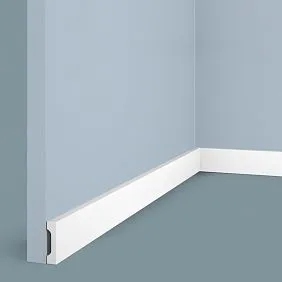
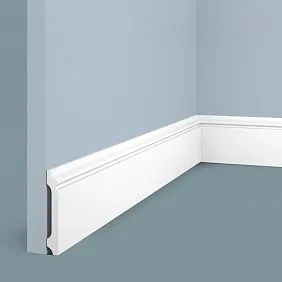
Solid wood floor skirting boards
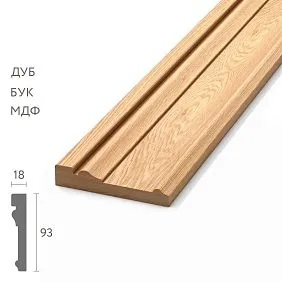
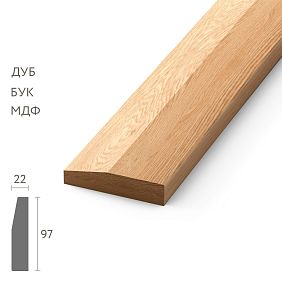
Wooden baseboardmade of oak or beech—the top tier in the hierarchy of floor skirting boards. A natural material with a density of 620–760 kg/m³, precise milling, a hard surface that withstands mechanical loads for decades. The main advantage over any engineered material is the possibility of restoration: after 15–20 years, a solid wood skirting board can be sanded, repainted, or tinted to a new color during interior restyling.
Oak is the most popular choice. Hardness on the Janka scale is 3.5–4.0 kN, pronounced wood grain pattern, good resistance to mechanical impacts. Beech is slightly softer, with a uniform fine-pored structure, ideal for painting in any color.
Get Consultation
MDF floor skirting board
MDF Skirting Board—an engineered board of high density 750–850 kg/m³ with even geometry, a good surface for painting, and an affordable price. For modern light interiors with white walls—a practical and popular choice. There is one limitation: the ends swell when wet, the surface is fragile at corners, and restoration is impossible.
Tall floor skirting board
A skirting board with a height from 100 mm is a separate category. It creates a powerful architectural horizontal line at the floor, especially relevant in rooms with ceilings from 2.8–3.0 meters. In classical and neoclassical interiors, a tall skirting board is not an option, but part of the style code.
White floor skirting board
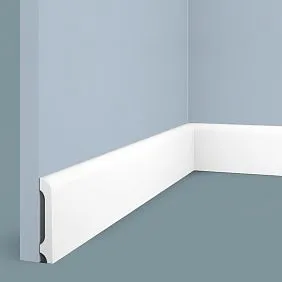
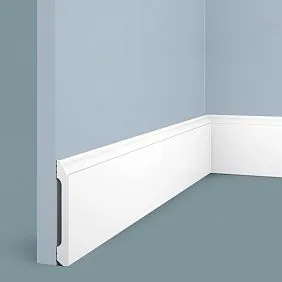
White skirting board is the most popular choice for modern apartments. Made from beech under white enamel or MDF with factory white coating. Works with any color of floor and walls, visually enlarges space in small rooms.
Wide wooden skirting board
Skirting board 80–120 mm wide is an architectural decorative element. In classic interiors with high ceilings, wideFloor wooden skirtingwith a shaped profile is the lower cornice of the wall, an element of the decorative system.
Skirting board for painting
Skirting board made of beech or MDF with prepared primed surface — for those who want to exactly match the interior color. Allows using any acrylic enamel and coordinating the skirting board with the color of doors, moldings, furniture.
Buy wooden floor skirting board: when solid wood is the only correct choice
There are a number of situations in whichto buy wooden baseboardis not a matter of preference, but a matter of common sense. Let's examine each such case.
Natural wooden floor: parquet, solid board, engineered board
When the floor is made of natural wood, the baseboard can only be wooden. This is a law of interior logic that makes no sense to break. Oak parquet with an MDF baseboard is a visually noticeable dissonance that reveals cost-cutting at the finish of an expensive renovation.
The key parameter when choosing a wooden baseboard for parquet is the stain. It should be in the same color range as the floor, but not necessarily identical. A close shade, a similar stain character—and the baseboard becomes part of the unified wooden world of the floor.
For engineered board with an oak top layer—a wooden baseboard made of oak. For ash board—a baseboard made of ash or beech in a neutral stain. Matching the wood species or at least the character of the grain is what gives a sense of organic unity.
Classic and neoclassical interior
Classicism does not tolerate replacing natural with engineered. In an interior with oak doors, parquet, molded cornices, and wooden casings—a solid wood baseboard. Period.wooden baseboards for floorwith an expressive classical profile—a bead, a quarter-round, a cove—create the lower architectural line that holds the entire space together.
In neoclassicism—the same rule, but the profile is more laconic. A wooden baseboard with a neat relief in white or cream enamel—this is neoclassicism in its modern interpretation.
Renovation calculated for 25–30 years
If the renovation is done 'for a lifetime'—only wood. In 20 years, an oak baseboard can be sanded and repainted, its stain changed during a restyling, and integrated into a new interior context. MDF does not offer this option—only complete replacement.
House with wooden interiors
In a country house—log, made of glued laminated timber, frame with wooden finishing—a wooden baseboard is the only organic solution. Natural wood on all planes: floors, walls, ceiling, baseboards—a unified living system that no engineered material can replace.
When you want uniqueness
Each solid wood skirting board is unique. The oak texture is individual, the grain pattern is unrepeatable, and the tinting gives the surface a lively character. MDF is always the same. This is not a drawback, it's a property: some need predictability, others need a living texture.
MDF floor skirting: a sober look at strengths and limitations
Floor MDF skirting boardoccupies a large market share — and there are good reasons for that. Not because it's better than wood, but because in specific situations it is truly optimal.
When MDF skirting is the right choice:
White minimalist interior with laminate or luxury vinyl tile. Here, MDF under white enamel provides a smooth, geometrically precise line without unnecessary details. Exactly what Scandinavian or modern style needs.
Large volume on a moderate budget. MDF is 2–3 times cheaper than oak with a similar profile geometry. For an 80–100 sq. m apartment with a simple modern interior — a reasonable saving without noticeable visual compromise.
When precise color customization is needed.A white MDF baseboard creates visual continuity with white door casings, white ceiling cornices, and white window frames. When all architectural details are executed in the same color, they form a unified system, a spatial framework that connects disparate elements — floor, walls, ceiling, furniture — into an integral composition. This technique is fundamental to Scandinavian design, where white architectural decor creates a light shell within which the most diverse colors and textures can coexist.in factory finish or primed for painting — it's an exact match with the color of walls, doors, furniture. No other material provides such accuracy at a comparable price.
When MDF is not the best choice:
In the hallway and kitchen with intensive wet cleaning. MDF ends swell with systematic wetting — they need to be sealed with silicone, and still, moisture resistance is inferior to oak.
In areas with high mechanical stress on baseboards: corridors with children and pets, zones with furniture on wheels. MDF crumbles at corners upon impact.
With parquet and engineered wood flooring. Here MDF loses visually — and this is not an opinion, but a fact: users with an eye for interiors notice the material mismatch.
How to choose baseboard by height, width, and color: a practical guide
Height: the rule of proportions
Baseboard height is not an arbitrary choice. It is always determined by ceiling height. Violating proportions is immediately noticeable.
| Ceiling Height | Optimal baseboard height |
|---|---|
| Up to 2.5 m | 60–70 mm |
| 2.5–2.7 m | 70–80 mm |
| 2.7–3.0 m | 80–100 mm |
| 3.0–3.5 m | 100–120 mm |
| over 3.5 m | from 120 mm |
A baseboard that is too low in a tall room gets lost — it's not visible from a standing person's eye level, the lower line of the space becomes blurred. One that is too high in a low room visually 'lowers' the ceiling and creates a feeling of pressure.
Width: decorative or neutral
Baseboard width is the scale of its decorative presence. A narrow baseboard 50–60 mm is a neutral solution that does not claim a decorative role. A wide one 100–120 mm is an architectural element that requires space to work.
Rule:buy wide wooden baseboardis appropriate in spacious rooms with rich decorative context. In a small apartment it will look heavy.
Color: Three Working Strategies
To match the floor. The skirting board is chosen to match the color of the floor covering. Honey-toned oak parquet—an oak skirting board in a similar tint. Visual effect: the floor and skirting board merge into a single horizontal plane, walls 'grow' from the floor.
To match the wall. The skirting board is painted or selected in the color of the wall. Visual effect: the skirting board 'disappears,' walls appear taller, space feels more spacious. Popular in minimalist interiors.
To match the doors. The skirting board is coordinated with the color of the door architraves, creating a unified framing system for the interior. A classic and most professional approach—one that designers use in serious projects.
White skirting board. A universal neutral option that works with almost any combination. But 'universal' does not mean 'best'—in a classic interior with dark parquet, a white skirting board creates an intentional contrast that requires thoughtful application.
Profile: Geometry as a Style Marker
Smooth straight. Modern minimalism, Scandinavian style, high-tech, loft. No decorations, only geometry.
With a bevel. Light relief without active decor. A universal transitional option between modern and classic.
Classic shaped. Ovolos, torus, scotias. For classic, neoclassical, Empire styles. The depth of shadow on the profile under side lighting gives a lively plasticity to the architectural element.
Which skirting board to buy for a specific floor covering
This is the most practical section of the article. A specific floor — a specific recommendation.
Buy a skirting board for laminate flooring
Laminate is the most common flooring, and the choice of skirting board for it is determined by two factors: color and technical installation requirements.
Technique: the skirting board is attached exclusively to the wall, not to the laminate. There is a 3–5 mm gap between the lower edge of the skirting board and the surface of the laminate, which allows the flooring to expand freely. If the skirting board is pressed against the laminate — after a season, the flooring will swell or crack near the wall.
Color: for light oak laminate — a wooden beech skirting board in a natural tint or white. For dark — wooden in a similar dark tint or also white as an intentional contrast. For gray — neutral white or wood with a gray tint.
Buy a skirting board for parquet and engineered board
Here the recommendation is unequivocal: onlywooden baseboards for floorfrom the same or a similar species. Oak parquet — oak skirting board. Solid ash board — skirting board made of beech or ash in a similar tint.
Feature of parquet: it is especially sensitive to changes in humidity and temperature. The expansion gap at the walls for a parquet floor is a mandatory structural element, which is covered only by the skirting board. No sealant, no skirting board attached to the parquet.
Buy a skirting board for quartz vinyl
Quartz vinyl is a waterproof, warm, durable flooring that is capturing an increasing market share today. For quartz vinyl with a wood imitation — a wooden skirting board in a similar tone. For neutral gray or concrete — white MDF or beech wood under a neutral enamel.
With floating quartz vinyl installation — a 8–10 mm gap at the walls, covered by the skirting board. With adhesive installation — the gap is smaller, but a skirting board is still needed for a neat finish.
Buy skirting board for tile and porcelain stoneware
Tile is a rigid adhesive flooring without an expansion gap. The function of the skirting board here is purely decorative: to cover the joint and protect the lower part of the wall.
In the kitchen and hallway with tile — white MDF skirting board or beech wood under white enamel. The lower end of the skirting board — on the tile (not under it), sealing the lower seam with silicone is mandatory.
Buy skirting board for wooden floor (solid board, engineered board)
Wooden floor — wooden skirting board. This is a rule, the violation of which is immediately noticeable. The materials must be organically connected: a unified nature, similar processing character, coordinated toning.
Which skirting board to buy for the interior style
Classicism and neoclassicism
Classic interior requires a rich wooden skirting board with an expressive figured profile. Oak or beech in a walnut, honey oak, or white enamel tone — depending on the overall color scheme. High skirting board 100–120 mm with deep profile relief.
In neoclassical — the same material, a more laconic profile. Wooden skirting board made of beech under white enamel or in a natural light tone. Clean geometry with minimal relief.
Required context: in a classic interior, the baseboard is part of the wooden decor system. Nearby elements are mademoldings, cornices, and baseboardsfrom the same wood species,wooden corniceat the top andWooden trimacross all elements. When everything is coordinated, the interior sounds like an orchestra, not a collection of random noises.
Modern minimalist interior
Here, two approaches are used.
First: a smooth white baseboard matching the walls. It 'dissolves' into the lower part of the wall, the floor line becomes invisible—the space appears taller.
Second: a wooden baseboard in a natural tone. A warm accent near the floor that adds a sense of life and natural warmth to the minimalist space.
Profile: smooth or with a bevel. No coves, no decorations.
Scandinavian style
Light floor, white walls, natural materials. A white baseboard made of beech or MDF, neat, without excessive relief. Or a wooden one in a natural light tone—pine, spruce, light oak—that supports the natural aesthetic of the interior.
Loft and industrial style
In a loft, floor skirting is often intentionally minimal or practically unnoticeable. Dark metal or wood in a dark finish (wenge, stained oak) — to create contrast with light walls. Smooth profile, no decoration.
Apartment in a modern residential building
For a standard apartment with ceilings 2.5–2.7 meters high, laminate or quartz vinyl flooring, and neutral finishes — the optimal choice iswide wooden baseboard70–80 mm of beech in white enamel or a natural light tone. This is a universal solution that works with most modern interiors.
Country house
In a house, there is more space and, as a rule, higher ceilings. Wooden skirting made of oak, 100–120 mm, with a pronounced relief profile — classic or transitional. In a house, the systematicity of wooden details is especially important:Wooden moldingon doors, wooden architraves, skirting made from the same wood species — this is what makes a country house a real home, not just a large apartment outside the city.
Mistakes when buying floor skirting: a list from a practitioner
These mistakes occur regularly — and each one is frustrating because they are easily avoidable.
Choosing based on price alone
This is the most destructive logic in construction and finishing. Cheap skirting made of thin MDF with a non-durable coating in the hallway is money spent twice: on purchase and installation, and then on replacement after two years. Wooden skirting made of oak is more expensive, but under the right conditions, it lasts 30–50 years and allows for restoration.
Incorrect height relative to the ceiling
Already covered in the table above, but let's repeat the principle: skirting board height should be proportional to ceiling height. This is not an aesthetic preference—it's an architectural law.
Conflict with door architraves
Door architraves and skirting boards should be made of the same material, with the same tint, and from the same stylistic group of profiles. A dark classic skirting board with white smooth architraves is a style conflict that is immediately noticeable. When skirting boards and architraves are not coordinated, the interior looks unfinished.
Ornate profile in functional rooms
A figured profile with deep grooves in the hallway or kitchen is a trap for dust and dirt. A smooth or minimally relief skirting board for the kitchen and hallway is not a compromise—it's the correct technical solution.
Attaching skirting board to flooring
One of the most technically harmful installation mistakes. Skirting board is attached only to the wall. If attached to the floor, during seasonal movement of the covering, the skirting board will either tear off or the covering will buckle.
Different skirting boards in adjacent open-plan rooms
In open spaces where the kitchen transitions to the living room or the hallway to the corridor, different skirting boards in adjacent zones create a visual break. A uniform skirting board around the entire perimeter of the open zone is a rule, not an option.
Buying individual cards instead of a category
If you need skirting boards for the entire apartment — order from the category assortment, where uniformity of tinting and profile is guaranteed throughout the entire volume. Different batches of the same 'type' may vary in color and geometry.
Where to buy floor skirting boards: from the right choice to the right order
So, the material is chosen, the parameters are determined. How and where to order correctly?
Buy floor skirting boardyou can at a construction hypermarket — quickly, but with a limited assortment. Several standard profiles, basic tinting, no consultation on compatibility with a specific interior.
From a specialized manufacturer with its own production — this is the right path for a serious project. Here the fullcatalog of floor skirting boardsfrom different species and tinting is available, the possibility to order a non-standard profile, coordinate the skirting board with other wooden interior details in a unified system.
An important practical point:buy wooden floor skirting boardsDelivery across Russia is the standard for professional manufacturers. Moldings are packed in bundles and withstand transportation well when storage conditions are observed.
How to calculate the volume: perimeter of the room minus the width of door openings, plus 10% reserve for cutting and fitting corner joints. For a 4×5 meter room with one 90 cm door: (4+5+4+5) = 18 m − 0.9 m = 17.1 m × 1.1 = ~19 linear meters.
buy floor skirtingIt's best to order from the manufacturer who provides samples for comparison with flooring and doors — this guarantees that the tint will match before installation, not after.
About the company STAVROS
STAVROS — Russian production of wooden architectural moldings from solid oak and beech for residential and commercial interiors. Founded in Saint Petersburg in 2002.
Over more than twenty years, STAVROS has completed projects at sites of federal cultural heritage significance: Konstantinovsky Palace in Strelna, Alexander Palace, interiors of the Hermitage. This is not an advertising narrative — it's a production biography, every page of which is confirmed by real projects.
STAVROS's in-house production encompasses a complete woodworking cycle: chamber drying of raw materials to 8–12% moisture content, precision milling with a tolerance of ±0.1 mm, and multi-stage quality control for each batch. A wide range of floor skirting profiles—from minimalist modern to opulent classic—available in natural tint and for painting.
Showrooms in Saint Petersburg and Moscow, partner programs for designers and architects, production of custom profiles according to individual drawings. Delivery across Russia.
FAQ: answers to popular questions about buying floor skirting
Which floor skirting is best to buy?
Depends on three factors: flooring material, interior style, and budget. For parquet and engineered wood — only solid wood from the same species. For laminate and quartz vinyl in a modern interior — wood or MDF, depending on the budget. For classic and neoclassical — wood with a figured profile. For minimalist white interiors — white MDF or beech for white enamel.
What is better: wooden skirting board or MDF?
Solid wood is better in terms of durability, the aesthetics of natural material, compatibility with wooden floors, and the possibility of restoration. MDF is better in terms of price, geometric precision, and ease of painting. If you have parquet, a classic interior, or a long-term renovation — choose wood. If it's a modern apartment with laminate and white walls — MDF is quite sufficient.
Where to buy wooden floor skirting?
From a specialized manufacturer with its own production — STAVROS. A full catalog of wooden floor skirting boards made of oak and beech in various stains and profiles, with delivery throughout Russia.
What skirting to buy for laminate?
Wooden in the laminate stain, white MDF for white walls, or wooden to match the door color. Attach to the wall, not to the laminate. The expansion gap between the lower edge of the skirting and the flooring — 3–5 mm.
What height should the skirting board be?
Proportional to ceiling height: up to 2.5 m — 60–70 mm, 2.5–2.8 m — 70–80 mm, 2.8–3.0 m — 80–100 mm, above 3.0 m — from 100 mm. A tall skirting in a low room lowers the ceiling, a small one in a high room gets lost.
Where to buy floor skirting with delivery across Russia?
The STAVROS catalog features a wide range of wooden floor skirting boards with delivery throughout Russia. Order online, calculate the exact volume, consult a specialist on profile and stain selection.
Can wooden skirting be painted after installation?
Yes. A wooden skirting made of beech paints excellently with acrylic enamel after installation. The surface is primed, two coats of enamel are applied with intermediate sanding. Oak skirting paints the same way, but for neutral and light tones it's better to use beech — oak tannins sometimes show through light enamel.