Article Contents:
- Why buying 'by picture' leads to disappointment
- First parameter: surface geometry
- Straight wall — rigid module or flexible base
- Curved surfaces — only flexible fabric base
- Second parameter: slat material
- MDF: when color is more important than texture
- Solid oak: when the texture itself is the goal
- Solid beech: neutrality for painting
- Comparison table before purchase
- Third parameter: slat spacing and profile
- Spacing: density or airiness
- Profile: rectangle or semicircle
- Buy a slat panel for the living room: what matters
- Buy a slat panel for the bedroom: quietness and tactility
- Buy a slat panel for the hallway: first impression plus protection
- Buy a slat panel for furniture: how slats transform furniture
- Buy a slat panel for curved and complex surfaces
- Checklist: what to verify before placing an order
- What's important to know about buying from the manufacturer
- How to calculate the number of panels
- Installation: practical steps
- Acclimatization
- Foundation Preparation
- Marking
- Fixation
- Joining
- Lighting paired with a slatted surface
- FAQ: answering questions asked before purchase
- About the Company STAVROS
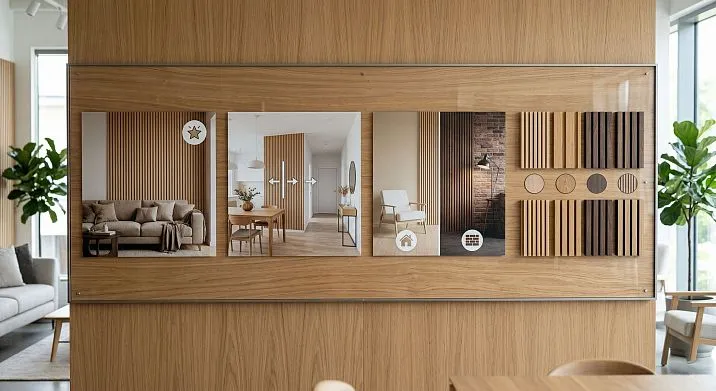
The slatted panel market offers dozens of catalog items, equally beautiful photos, and roughly similar descriptions. Choosing based on a picture is like guessing. That's why the question 'where to buy a slatted wall panel' should be phrased differently: 'which specific panel to buy for my task.' Because tasks vary, surfaces differ, materials are different—and the right panel for a living room with straight walls is not at all the same as a panel for a furniture front with a radiused edge.
This article is all about practice. No abstractions about 'the beauty of wood' or 'interior coziness.' Specific selection criteria, specific product formats, specific application scenarios, proven and non-obvious nuances that only become clear after the first incorrectly purchased batch. If you're planning toBuy slat panels for walls—this article will give you a system, not just information.

Why buying 'by the picture' leads to disappointment
Let's start with the main misconception. A slatted panel looks very convincing on screen: warm oak tones, a regular rhythm of vertical lines, a beautiful interior. The buyer looks at the picture, relates it to the desired result, and makes a decision. Then they receive the batch, install it—and discover that the tonal variation between the slats is noticeable, the spacing between them along the panel length 'shifts,' and on a radiused corner transition, the rigid board doesn't bend without cracking.
This is not uncommon—it's a consequence of choosing without understanding the product's structural characteristics. Fixing it is simple: make a purchase decision based on five parameters, not just one visual image.
Five purchase parameters:
-
Your surface geometry—straight, curvilinear, mixed
-
Slat material—MDF, solid oak, solid beech
-
Panel base type—rigid MDF backing or flexible fabric base
-
Application scenario—wall, ceiling, furniture front
-
Finish coating—oil, varnish, tinting, RAL enamel
Only when all five parameters are defined—the purchase becomes informed. And only then does the chosenslat panel for the walldeliver the result it was selected for.




First parameter: surface geometry
This is a question most buyers never ask — and it's the most important one when choosing a structural format.
Our factory also produces:



Straight wall — rigid module or flexible base
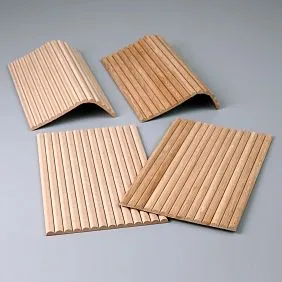
For perfectly flat straight walls, both formats are suitable: a rigid module on an MDF backing and a flexible panel on a fabric base. The rigid module is a more economical solution for standard straight surfaces. The factory board maintains perfect geometry: the spacing between slats is consistent along the entire length, and the ends are calibrated for seamless joining without visible transitions.
When should you choose the flexible format for a straight wall? When the same project includes columns, niches, arched transitions, or curved furniture fronts. One construction — all surfaces. No need to order different products, deal with different technical specifications, or organize separate deliveries.
Get Consultation
Curved surfaces — only flexible fabric base
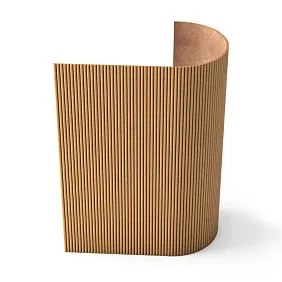
There is no choice here. A rigid MDF board cannot bend without breaking — that's the physics of the material, not a flaw of any specific manufacturer. Attempting to cut a rigid board into narrow strips to wrap around a radius results in visible seams every few centimeters. The outcome is worse than simply painting the surface.
Buy a flexible slatted panel for the wall— means getting a structure that can take any radius without distorting the slatted rhythm. The fabric base flexibly follows the shape of the surface. The slats spread evenly along the outer arc — the spacing between them is maintained. A continuous slatted rhythm around the entire perimeter of a column, through an arch, along a radius partition — this is only possible with a flexible construction.
Three types of surfaces where a flexible base is indispensable:
-
Closed cylindrical supports and columns
-
Arched vaults and transitions
-
Curved furniture fronts and rounded corner transitions
Second parameter: slat material
Material choice is a choice of aesthetic surface character for years to come. Three options in the assortment, each with its own logic.
MDF: when color is more important than texture
High-density board 750–850 kg/m³ with a homogeneous, non-porous surface. No natural texture — but absolute freedom in color choice. Any shade from any catalog: RAL, NCS, Pantone. Matte, satin, semi-gloss finish — paint applies evenly on MDF, without showing through the structure, without tonal variation between slats.
The right scenario for MDF: a monochrome interior where the panel is painted to match the exact wall tone. No color accent — only relief. The vertical rhythm of the battens is revealed exclusively through light and shadow. This is subtle architectural minimalism, achievable only on MDF with a perfect surface.
Second scenario: corporate space with precise brandbook color matching. MDF under polyurethane enamel is the only way to guarantee reproduction of the corporate color on a slatted surface.
Before purchasing MDF panels for painting — find out if there is preliminary priming. A primed surface is immediately ready for applying the finish coating: two layers of polyurethane primer seal the pores, prevent uneven paint absorption. Without priming — an on-site preparation stage is needed.
Solid oak: when texture itself is the goal
Buy oak slat wall panel— means getting a living surface that no film or print can reproduce. The layered pattern of oak grain is unique to each board. Density 700–750 kg/m³, Brinell hardness 3.7–3.9 kN/mm² — this is one of the most durable materials for interior applications.
The semicircular profile of the oak slat disperses light in a special way. The rounded surface creates a smooth transition from the illuminated edge to the shaded space between the slats. The surface changes with the lighting angle: warm and golden with morning side light, deep and voluminous with evening spotlights.
Oak finish:
-
Clear oil — natural honey-golden tone, matte surface, tactile warmth of wood, renewed every 3–5 years without dismantling
-
Tinting or stain — range from bleached Scandinavian to rich wenge, wood grain pattern remains visible
-
Hard lacquer — maximum surface protection, gloss or matte, recommended for hallways, commercial facilities, high-traffic areas
Important nuance when ordering: specify the reglue grade. 'For tinting' — slats matched by tone and texture within the module, for semi-transparent finishes that reveal the wood pattern. 'For enamel' — without tonal matching, for opaque finishes. The grade determines how uniform the finished surface looks.
Solid beech: neutrality for painting
Beech is a homogeneous fine-pored wood with a neutral light tone and subtle grain pattern. It accepts enamel coatings more evenly than open-pored oak: paint does not show through the texture, and the surface under enamel appears uniform.
Beech slatted panel is a choice for color concepts: charcoal-black slatted wall, deep emerald green, dusty powder. The material remains natural wood with proper tactile feel and natural weight, but with the level of color controllability that open-pored oak provides significantly worse.
Comparison table before purchase
| Parameter | MDF | Oak | Beech |
|---|---|---|---|
| Natural texture | No | Pronounced | Soft |
| Finish | Any RAL paint | Oil, varnish, tinting | Enamel, oil, varnish |
| Color controllability | No restrictions | Within the wood tone | Wider than oak |
| Commercial projects | Good | Optimal | Good |
| Residential interiors | Excellent | Excellent | Excellent |
| Tactile sensation | MDF under coating | Natural wood | Natural wood |
| Service life | Depends on coating | Decades | Decades |
Parameter three: slat spacing and profile
Two parameters that are underestimated when purchasing—and that shape the entire visual character of the surface.
Spacing: density or airiness
Slat spacing is the distance between the nearest edges of adjacent battens, not between centers. This distance determines how much the surface 'breathes'.
Narrow spacing (up to 15 mm): surface is dense, rich, almost monolithic. Representative, substantial character. Suitable for large halls, offices, lobbies. In small rooms, it creates a feeling of overload if the slatted area is large.
Medium spacing (15–35 mm): universal balance. The surface is rhythmic but not heavy. The best choice for residential interiors — living rooms, bedrooms, hallways. Works equally well with wooden slats and paintable MDF.
Wide spacing (over 35 mm): airiness, pause, lightness. Japanese minimalism, Scandinavian simplicity. Looks interesting with oak under light oil: wide slats and wide shadows create a graphic rhythm without overload.
Rule for small rooms: vertical slatted rhythm visually elongates the room in height. In a narrow corridor with medium spacing — the effect is noticeable even with a modest ceiling height. Do not neglect this tool when calculating the future result.
Profile: rectangle or semicircle
Rectangular slat cross-section gives a clear geometric shadow — a strict architectural character, contrasting and tense. Semicircular cross-section diffuses light smoothly, creating a soft transition between the illuminated top and the shadow of the gap. Natural, warm surface. This is why semicircular profile made of solid oak is the most in-demand format for residential interiors: it works softly and warmly even under harsh directional lighting.
Buy slatted panel for living room: what's important
Living room — the most common and at the same time most demanding application scenario. The area of the slatted surface here is typically maximum. The surface will be well-lit and constantly in view. Any mistake in tone, spacing, or joining — is immediately noticeable.
Three scenarios for the living room:
TV zone. The wall behind the TV is the most active working surface of the living room. A dark screen against a slatted surface of dark oak or graphite-painted MDF creates one of the most stylish modern looks: technology against material. LED strip, hidden behind the panel on a mounting frame, adds soft diffused glow through the slat gaps in the evening — a backlight effect without a visible source. For this scenario, precise wall geometry is important: if irregularities are significant — the surface must be leveled before installation. No panel thickness can hide unevenness.
Accent wall behind the sofa. In open-plan living roomsbuy slatted panelsfor the wall behind the sofa means simultaneously obtaining an accent decorative object and an architectural zoning tool. The slatted surface behind the sofa visually separates the living area from the dining area without a physical partition. The space 'reads' as two — while remaining one.
Zoning slatted structure. In studios and combined layouts — a slatted partition, open through the gaps between the slats. It doesn't divide, but hints at a boundary. Light, air, and visual connection between zones are preserved.Buy a slatted panel for a partition— means adding structure to the space without losing volume.
Buy a slatted panel for the bedroom: silence and tactility
In the bedroom, a slatted panel works differently than in the living room. Here, the main thing is not accent, but atmosphere. Warm wood, soft light, natural texture. A wall behind the bed made of oak with an oil finish creates a feeling of natural silence that cannot be reproduced with either paint or wallpaper.
The correct format for the bedroom: a panel from floor to ceiling behind the bed — maximum architectural effect. Or a panel from mattress level to a height of 1.2–1.5 m — a delicate horizontal accent.
Material: oak under clear oil — warm golden tone, matte natural surface, soft diffusion of light from bedside lamps. MDF under powder, pastel, terracotta enamel — for monochrome concepts with a color mood. Both options create the right atmosphere when applied correctly.
Hidden bedside lamps in the gaps between slats or behind the panel on a mounting frame — plan the lighting before installation, not after.
Buy slatted panel for hallway: first impression plus protection
In the hallway, more than anywhere else, simultaneous work on two levels is important. The first is aesthetic: the hallway forms the first impression of the apartment. The second is functional: it is the most mechanically loaded zone, where walls regularly come into contact with clothing, bags, and umbrellas.
Slatted wall panelThe slatted panel for the hallway addresses both requirements. Oak under hard lacquer or MDF under polyurethane enamel withstand regular mechanical contact and wet cleaning. At the same time, the vertical rhythm of the slats optically stretches a narrow corridor in height—one of the few decorative techniques that genuinely changes the perception of the hallway's geometry.
For the hallway, I recommend the hardest coating available in your chosen material. For oak—polyurethane lacquer with a film hardness of at least 4H on the pencil test. For MDF—two-component polyurethane enamel with a hardener.
Buy slatted panel for furniture: how slats transform furniture
Buy a slat panel for furnitureThe slatted panel is one of the most effective techniques in modern furniture design. A slatted facade visually lightens a large furniture volume: a floor-to-ceiling wardrobe with slatted facades ceases to be perceived as a neutral rectangle and becomes an architectural object.
For straight furniture facades—both rigid and flexible panels are suitable. For curved facades, radius cabinets, rounded corner sections—only a flexible construction on a fabric base. The fabric base accepts any radius of curvature without deforming the slatted rhythm.
Additional furniture scenario: slatted decoration of ends. The side end of a wardrobe, an open shelving section, a kitchen island—a slatted strip along the end turns a utilitarian detail into a design element. A small strip—a noticeable visual result.
Buy slatted panel for radius and complex surfaces
This topic deserves separate attention because this is precisely where most buyers make mistakes. A detailed breakdown of the application of flexible panels on columns, arches, niches, and complex interior structures—in a separate article:Flexible wall panels.
Here's what matters:
Column. The flexible panel wraps around the cylinder along the entire perimeter without breaks. One joint — at the least noticeable point. The slat rhythm closes continuously.
Arch. The panel follows the curve of the arched vault, maintaining equal slat spacing throughout the bend. Continuous rhythm through the straight wall and arch — visually powerful, but technically possible only on a flexible base.
Niche. The back wall and side slopes, clad with a flexible panel from a single roll, create a closed slat object. When illuminated along the slopes — the volume and depth of the niche visually increase by one and a half to two times.
Rounded corner. A radius corner transition between two planes is a typical task in modern interiors. The flexible panel passes this transition without a joint. Continuous slat rhythm from one room to another — this is an architectural technique that makes the space unified.
Checklist: what to check before placing an order
The order is prepared. Before clicking the 'pay' button — go through this checklist. It takes three minutes and protects against 90% of problems after delivery.
Regarding construction:
-
Geometry of all surfaces — straight, curvilinear?
-
Base type selected according to surface geometry
-
Minimum working radius of flexible panel clarified if curved surfaces exist
By material:
-
Material selected according to coating type (oil, enamel, varnish)
-
For oak under tinting — grade of lamination 'for tinting' clarified
-
For MDF under painting — presence of factory priming clarified
By parameters:
-
Slat spacing selected according to surface area and ceiling height
-
Cross-section profile (rectangular / semicircular) selected consciously
By logistics:
-
Entire volume ordered from one batch (uniform tone within project)
-
10–12% surplus added for trimming
-
A sample has been requested to check the tone and surface quality under real room lighting
Regarding timelines:
-
Shipping timelines have been clarified — from stock or made-to-order
-
Installation is scheduled after material acclimatization on site (24–48 hours if there is a sharp temperature difference)
What's important to know about buying from the manufacturer
Buy wall slat panels from the manufacturer— it's not just a matter of price. It's direct control over three critical parameters.
Batch uniformity. The manufacturer knows which wood batch specific products are made from. This is the only way to guarantee uniform tone and texture across the entire volume of one project. A dealer typically does not have this information.
Non-standard parameters. Need a non-standard spacing, non-standard slat width, non-standard module length? The manufacturer is the only one who can accept such an order. For slat panels tailored to a specific interior project, this is critical.
Technical support. Questions about installation, proper finishing, choosing adhesive for a specific substrate — the manufacturer answers them competently. The information comes from the one who creates the product and knows it thoroughly.
How to calculate the number of panels
Calculation is not a mathematical trick, but a practical task with one catch: the allowance for trimming. Step-by-step algorithm:
-
Measure the width and height of each surface to be clad in millimeters
-
Subtract the areas of openings, sockets, and switches from the dimensions
-
Divide the surface width by the width of one module — you get the number of vertical strips
-
Multiply by the number of rows in height (if the panel is shorter than the wall height)
-
Add 10–12% to the resulting number — this is the allowance for trimming and possible defects during installation
Example: a wall 3,600 × 2,700 mm (width × height). Module 600 × 2,700 mm (standard height). Number of strips: 3,600 ÷ 600 = 6 strips. 10% allowance: 6 × 1.1 = 6.6 → order 7 strips. This is a specific calculation for a specific case. For complex areas with niches, arches, columns — create a layout diagram on a sheet of paper or in a simple graphics editor before placing an order.
Installation: practical steps
buy slat panels for interior wall finishing— half the job. The result is determined by the installation.
Acclimatization
Any solid wood product must be acclimatized in the room for 24–48 hours before installation. This is a mandatory step, not a recommendation. Wood reacts to changes in humidity and temperature: if installed without acclimatization, subsequent deformation is possible — especially if the object was delivered in winter or under conditions of a sharp climate transition.
Foundation Preparation
Surface — clean, dry, degreased. Maximum deviation: 3 mm per linear meter. Porous substrates (plaster, drywall) — prime before applying mounting adhesive.
Marking
Vertical axis from the corner, horizontal level along the bottom edge of the first row. Error in the first module accumulates and by the last one — becomes noticeable.
Fixation
Rigid module: mounting adhesive around the perimeter and diagonally on the backing. Press, hold for 1–2 minutes. Additional fixation with micro-pins for ceiling applications.
Flexible panel: contact adhesive — on the fabric base and on the wall surface. Open exposure according to adhesive instructions. Apply, starting from one edge, without trapping air. Micro-pins at tension points.
Joining
End to end, no gap, no overlap. Factory spacing ensures continuous slatted rhythm through joints. Deviation in the joint by 1 mm — noticeable under side lighting. Check jointing on samples.
Lighting paired with a slatted surface
Decorative Slat Panels for Wallswithout proper lighting — it's potential realized only halfway.
Directional spotlights at a 30–45° angle: shadow in the gaps, volume and depth of the surface. The sharper the angle — the harsher the shadow. Usually at 30–35° the shadow is softer and more natural than at 15–20°.
LED strip behind the panel on the frame: diffused light through the gaps between slats. Soft organic glow without a visible source. One of the most atmospheric evening effects.
Bedside lamps to the side of a slatted wall: for bedrooms — light falls along the slatted surface. Semi-circular profiles of battens create smooth light and shadow. Natural tactility is multiplied.
One rule: lighting is planned simultaneously with panel selection — before installation.
FAQ: answering questions asked before purchase
Can I buy a slatted panel for DIY installation without experience?
Yes. A rigid panel on a flat wall — installation is accessible with basic repair experience. Tools: level, mounting gun, pneumatic gun for micro-pins, rubber mallet. A flexible panel on curved surfaces — more complex. At least one trial installation on a small area before final mounting is recommended.
What is the current price for slatted panels?
Buy slatted wall panelwith current prices — in the catalog on the manufacturer's website. Cost depends on material (MDF, oak, beech), sanding level (standard/prestige), order volume, and presence of priming. Check the current price list directly.
Is there delivery throughout Russia?
Yes — delivery throughout Russia and CIS countries. In-stock items — shipment within 3 business days. Custom-made items — 5–10 business days.
Can I order a custom size?
Yes. A production order for non-standard parameters — module length, slat spacing, batten width — is accepted directly with the manufacturer. Clarify technical conditions and timelines upon inquiry.
How to store slatted panels before installation?
In a dry room, horizontally, on even supports spaced no more than 500 mm apart. Storage on damp floors, under direct sunlight, or in conditions of sharp temperature and humidity fluctuations is not permissible.
Which adhesives are suitable for installation?
For rigid modules — acrylic or polyurethane mounting adhesive. For flexible panels — contact adhesive with adhesion to textiles and the wall substrate. Check the manufacturer's recommended adhesives: compatibility with the specific substrate coating is critical for long-term results.
Is it necessary to treat the edges after cutting?
Yes. After cutting solid wood — the edges are sanded with sandpaper and coated with the same oil, varnish, or tint as the main surface. An unprotected edge absorbs moisture and becomes a starting point for deformation. For MDF — edges are filled and primed after cutting.
How long does a slatted panel last?
With proper finishing and normal operating conditions — oil coating on oak is renewed every 3–5 years without dismantling. Varnish coating in residential interiors without significant mechanical loads does not require renewal. With proper care — for decades.
About the company STAVROS
Behind any quality product lies a production culture that cannot be created in one season. STAVROS has been shaping it since 2002.
The company was founded by two artists — Andrey Ragozin and Evgeny Tsapko — who started with a small workshop for carved wooden products. In the very first years, their work was noticed at the state level: the reconstruction of the Konstantinovsky Palace in Strelna became the first major project. It was followed by interiors of the Hermitage, Alexander Palace, Trinity-Izmailovsky Cathedral, and Sheremetev Mansion. More than twenty years — and the principle remains unchanged: each product is created with a full understanding of artistic laws and technical requirements for interior application.
Today STAVROS produces a full range of slatted panels in MDF format for painting, solid oak and beech — in rigid versions for flat surfaces and flexible versions on a fabric base for curved surfaces, columns, arches, and furniture fronts. A large stock program ensures shipment of in-stock goods within 3 business days. Custom production — 5–10 business days. Delivery throughout Russia and CIS countries. Showrooms in St. Petersburg and Moscow — for those who make decisions with a sample in hand.
Slat wall panels for walls buywith current prices — in the catalog. Samples upon request. Quality without complaints — the STAVROS standard, which the company adheres to without exceptions.