Article Contents:
- What to know before buying: three parameters that determine everything
- First parameter: surface — flat or curved
- Second parameter: finish — ready-made color or custom painting to match the interior
- Third parameter: application scenario — wall or furniture
- Buy slatted panels: complete overview of the model range
- PAN-001: flexible fabric-backed panel — for all non-standard applications
- PAN-002: primed MDF fabric-backed panel — for precise color matching
- RK-002: interior slat — for custom constructions
- Buy MDF slat panel: when it's the right choice
- Monochromatic interior: MDF without options
- Commercial interior with corporate colors
- Spaces with variable humidity
- Repainting without replacing cladding
- Buy oak slat panel: when naturalness is more important than color accuracy
- When to choose solid oak
- Features of working with oak
- Beech: when oak is too bright
- Buy flexible slat panel: design and scenarios breakdown
- What makes a panel flexible and why it's not a compromise
- Flexible panel application scenarios
- Flexible panel installation: key differences from rigid panels
- Buy slatted wall panel: application by room type
- Living room: TV zone and accent wall
- Bedroom: headboard and atmosphere
- Hallway and corridor: practicality and first impression
- Study and home office
- Furniture fronts: unified slatted environment
- What you need to know about installation: essentials for buyers
- Base preparation: everything depends on this
- Adhesive: don't skimp on this
- Panel joining: invisible seam
- Cutting: MDF — with a saw, flexible panel — with scissors
- Final coating PAN-002
- How to calculate the quantity and cost of panels
- Quantity calculation formula
- Important: one batch
- Delivery and timelines
- Comparison table: which panel to choose
- FAQ: Answers to Questions Asked Before Purchase
- Conclusion: how to make the right decision

The moment when a person decidesto buy a slat panel— is not the beginning of a purchase. It's the beginning of questions. MDF or oak? Flexible base or rigid module? For painting or with ready-made texture? For a wall or for furniture? For a flat surface or for a column with a radius?
Each of these questions changes the answer to the others. And that's precisely why most people encountering slatted panels for the first time find themselves at a dead end: there's a lot of information, but it's fragmented, and nowhere is there a specific answer to 'what should I get exactly.'
This article is written to remove that dead end. Not an overview of 'what slatted panels are'—you've probably already read that. Here is a precise breakdown: which panel type suits which task, which material works in which interior, which construction to choose for a straight wall and which for a curved one, and how not to make a mistake with the purchase. Everything is specific, with technical parameters and examples from real scenarios.
What you need to know before buying: three parameters that determine everything
Before looking at specific models and prices, it's worth fixing the three parameters of your task. They narrow the choice from 'a lot of everything' to 'two or three options,' from which it's already easy to choose.




First parameter: surface—straight or curved
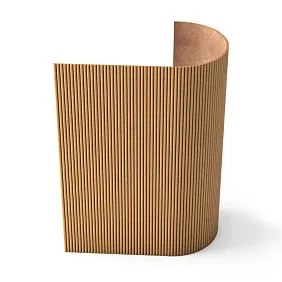
This is a question of construction, not aesthetics. On a straight, flat wall, any type of panel works—a rigid module on an MDF backing or a flexible panel on a fabric base. On a curved surface—a column, arch, curved wall, rounded corner—only a flexible panel works. A rigid module physically cannot wrap around a radius without being cut into sectors, after which seams will inevitably be visible.
If your surface is straight—you have all options. If there is at least one curve—buying a flexible slatted panelon a fabric base will be the only correct solution for that section.
Our factory also produces:



Second parameter: finish—pre-made color or painting to match the interior
Here is a choice between two fundamentally different approaches.
Pre-finished color — these are panels made of solid oak or beech with tinting or clear varnish. You get the natural wood texture, the living pattern of the fibers, the tactile warmth of the surface. The color is fixed: light oak, dark walnut, natural beech. It won't be possible to match a specific wall shade exactly — only 'similar' or 'in theme'.
For painting — these are MDF panels with factory primer. The final color — any, from any palette (RAL, NCS, Caparol). There is no wood texture, only the rhythm of the ribs and the play of shadow. Perfect for monochrome interiors where precise color matching of the panel with walls or furniture is needed.
Get Consultation
Third parameter: application scenario — wall or furniture
This affects the format. For solid vertical wall cladding from floor to ceiling, a 2700 mm height format is needed. For an accent panel, a bed headboard, a local TV zone — 950 mm. For furniture fronts — a flexible panel that can be cut to the required size without restrictions.
Three parameters — surface, finish, scenario — create a selection matrix that narrows the question down to a specific model. Let's examine each option in detail.
Buy slatted panels: a complete overview of the model range
On the marketof slatted panels made of MDF and oakthere are several clearly defined product classes. Understanding these classes is the basis for an informed choice.
PAN-001: flexible panel on a fabric base — for everything non-standard
PAN-001 is the most technologically interesting solution in the lineup. Half-round profile battens are fixed on an elastic fabric base with a precise, constant pitch. The finished structure is rolled into a compact roll for transportation. During installation, it unrolls and conforms to any surface shape—straight, convex, concave, or cylindrical.
Technical parameters of PAN-001:
-
Width: 1010 mm
-
Roll length: 2750 mm
-
Bat material: three options—deep-milled MDF (for painting), solid oak, solid beech
-
Bat profile: half-round
-
Base: flexible fabric panel
-
Installation: contact adhesive + micro-pins
For which tasks PAN-001 is the only correct choice:
Straight walls—yes, suitable. But here, competition with rigid modules arises. However, for everything listed below, PAN-001 has no alternatives:
-
Decorative columns of any diameter from 300 mm and above.
-
Arch openings — rounded top of the arch.
-
Radius walls in bay windows, on turns of non-standard geometry.
-
Rounded corners in wardrobes and niches.
-
Furniture fronts — cabinets, chests, built-in structures with curved elements.
-
Ceiling structures with transition from wall to ceiling — flexible panel wraps the internal corner without breaking the rhythm.
Buy panel from slats on fabric baseChoosing model PAN-001 means getting a product that solves problems where any other type of construction requires significantly more complex work or doesn't work at all.
Feature of the 'MDF for painting' version in PAN-001: the battens of this option are primed before installation with two layers of primer, after which you can paint with finishing enamel. This is an additional step compared to PAN-002, but the construction is flexible.
PAN-002: primed MDF panel on fabric base — for exact color
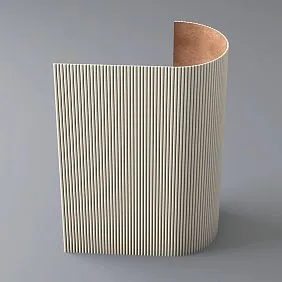
PAN-002 is MDF battens with deep milling, fixed on a flexible fabric base, with factory two-layer polyurethane-based insulating primer. The surface is ready for finishing painting immediately after installation — no additional priming, no surprises with uneven paint absorption.
PAN-002 Technical Parameters:
-
Width: 1010 mm
-
Height: two formats — 950 mm and 2700 mm
-
Molding material: Deep-milled MDF
-
Coating: two-layer polyurethane-based primer-insulator
-
Base: flexible fabric panel
-
Installation: contact adhesive + micro-pins
Two formats — two applications:
2700 mm format — for continuous vertical cladding from floor to ceiling in rooms with standard height. One module covers the full height without a horizontal joint. This is fundamentally important for the TV zone, accent wall in the living room, hallway cladding.
950 mm format — for local accents. Bed headboard in the bedroom: a panel of the required width at 950 mm height creates exactly that architectural rectangle above the bed, which reads as a complete independent composition. Also suitable for the lower part of the wall (panel solution under the cornice), for niches, for furniture fronts of limited height.
Buy slatted panel for paintingPAN-002 means getting a product that is ready for finishing without extra preparation stages and provides precise control over the final color.
RK-002: interior slat — for custom constructions
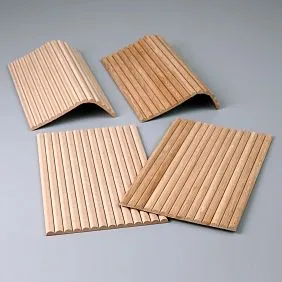
A separate format —to buy a slat panelas individual profiles for independent creation of slatted structures. The RK-002 MDF or oak-veneered MDF slat, 2750 mm long, is mounted on a base with adjustable spacing.
This format is chosen when a non-standard design is needed: diagonal slat layout, three-dimensional relief, variable spacing, decorative partitions with gaps. For typical cladding tasks, ready-made PAN-001 and PAN-002 panels work faster and more accurately.
Buy MDF slat panel: when it's the right choice
MDF in slatted panels is not a budget alternative to wood. It's a different material with different properties, solving different tasks. Confusing them means being regularly disappointed.
Monochromatic interior: MDF without alternatives
If the designer or apartment owner works with a precise palette — a specific shade of dusty pink, deep indigo, anthracite, or warm milk — then natural oak or beech will never match this color exactly. Wood is a living material with tonal variability even within the same species and batch.
Paintable MDF + finishing tint according to palette = perfect match. Wall, furniture, and slatted cladding in the same tone — this is a monochromatic interior in its purest form. Achieving such a result with natural wood is impossible.
Commercial interior with corporate colors
Office, showroom, restaurant, hotel — in commercial spaces, slatted panels must accurately reproduce the brand color. Here, paintable MDF wins again: any RAL color, reproduced without deviations across the entire volume.
Rooms with variable humidity
MDF is more stable than natural wood in humidity fluctuations. Entrances with outdoor air, kitchens with steam, hallways — in all these rooms, MDF moldings behave predictably, while solid wood may slightly "move" during sharp microclimate changes.
Buy primed slat panelwith moisture-resistant enamel finish — this is a cladding that will last as long as needed, without deformation or changes in geometry.
Repainting without replacing cladding
This is a rarely mentioned but important advantage. Interiors change. In five to seven years, you might want to update an accent wall, change the color. A paintable MDF panel can be easily repainted right on the wall — sand, prime the joints, apply a new color. Repainting natural wood is significantly more difficult: you need to remove the old coating, sand, and refinish.
Buy oak slat panel: when naturalness is more important than color accuracy
Oak in slat panels is a material statement. Not just beautiful, but truly so. A pronounced grain pattern, tonal transitions within a single slat, the tactile warmth of the surface that is felt even visually — all this creates an effect that MDF is powerless against.
When to choose solid oak
Natural styles. Scandinavian interior, eco-style, Japanese minimalism, biophilic design — in any of these styles, oak works as an organic part of the concept, not as an insert. Solid wood here is not an accent against a background, but a living environment.
Bedroom and study. Rooms where a person spends a lot of time require materials with tactile warmth. Paintable MDF works well in a bedroom, but oak works better — simply because it is alive. This is not a feeling that can be explained rationally. It just needs to be taken into account as a fact.
Living room with a wood palette. If the floors are parquet, the furniture is in warm wood, the textiles are linen — an oak slat panel on an accent wall doesn't stand out from this environment but enhances it. MDF would look alien in such a situation, even if painted in a similar shade.
Special features of working with oak
Oak requires high-quality finishing. Clear varnish fixes the natural color and provides a clean, dust-free surface. Oil penetrates the structure, gives a matte result, and preserves the 'liveliness' of the surface — the slats remain tactilely warm. Tinting allows shifting the tone in the desired direction: lighten, give a silvery hue, add dark saturation.
One crucial point: always order the entire volume from the same batch. Oak from different batches may vary in tone. This is not a defect — it's a property of natural material. But when joining two batches, the difference will be noticeable.
Beech: when oak is too bright
Solid beech is more uniform, lighter, without sharp grain patterns. Beech is chosen precisely for interiors where naturalness is needed without the aggressive presence of wood. A children's room, a bedroom in a light pastel palette, a Scandinavian living room with a neutral wooden accent wall — beech is more accurate than oak everywhere.
Buy slat panels for wallsin beech execution in the PAN-001 line — means getting a lively texture without the 'heaviness' of the characteristic oak pattern.
Buy flexible slat panel: breakdown of construction and scenarios
Flexible slat panels deserve a separate section — because they are not just 'another type of panel,' but a fundamentally different class of products with unique capabilities.
What makes a panel flexible and why it's not a compromise
Common misconception: flexible means lower quality, less durable. In fact, the fabric base is not a simplification but a technological solution that opens up possibilities unavailable to rigid structures.
The fabric panel is elastic, durable, and does not deform under load. The battens are fixed on it with a constant pitch and maintain this pitch when the structure bends. That is, on a convex column, the slats are spaced at the same interval as on a straight wall—without pitch divergence, without breaking the rhythm.
This is the key point. On a rigid module, when cutting into sectors for column cladding, the pitch is inevitably disrupted: the slats on one side of the sector are closer together, on the other—farther apart. On a flexible panel—everything is uniform.
Application scenarios for the flexible panel
Decorative columns. The most obvious application. The flexible panel is mounted continuously around the column, preserving the rhythm. Minimum diameter for convenient installation—about 300 mm.
Arches. The side vertical sections of the arch are mounted with any type of panel. The rounded top—only with a flexible one. With proper installation, the transition between the vertical and curved sections is invisible.
Niches with radius corners. In modern apartments, there are niches with rounded interior corners. A rigid panel here requires complex trimming. A flexible one—simply wraps around the corner.
Furniture fronts.Buy a slat panel for furniture—means gaining the ability to clad a wardrobe, cabinet, or shelving unit in the same slat rhythm as the wall behind them. A unified slat environment 'wall + furniture' is a technique found in the best modern interiors and creates a sense of architectural integrity in the space.
Ceiling structures. Transitioning slat cladding from wall to ceiling is another impressive technique. The flexible panel wraps around the interior wall/ceiling corner without a break, creating continuous slat coverage.
Radius walls in bay windows. A smoothly curving bay window wall is a classic candidate for a flexible panel.Buy slat panel for radius wallPAN-001 is the only correct solution for such surfaces.
Flexible panel installation: key differences from rigid
Main point: on curved surfaces, adhesive is applied to the entire back surface without gaps. Any air pocket during bending creates a risk of delamination. Thorough, even adhesive application + pressure with gradual progression from center to edges.
Additional fixation with micro-pins is recommended by the manufacturer. On straight sections, pins around the perimeter. On curves — across the entire bending zone, every 100–150 mm.
If a pin gun is unavailable — you can manage with a reinforced adhesive seam and longer pressing time. But this is a less reliable option for actively used surfaces.
Buy wall slat panel: application by room
Choosing the right model and material is half the battle. The other half is understanding how exactly a specific panel type works in a specific room. Let's examine the main scenarios.
Living room: TV zone and accent wall
The living room is the flagship application of slatted panels. Here they work in two key scenarios.
TV zone. Slatted cladding behind the TV solves the problem of an empty wall, turning the screen from a 'black hole' into part of the architectural composition. Mandatory conditions: from floor to ceiling (a partial 'patch' looks unfinished), width — at least the width of the console, optimally — from wall to wall.
For a TV zone on a flat wall: PAN-002 in 2700 mm format, dark tone, vertical orientation. If there is a column or radius element in the zone — PAN-001 for this section.
Accent wall. Slatted cladding on the wall behind the sofa creates completeness for the relaxation zone and structures the open space without partitions. For Scandinavian style — PAN-001 made of solid oak or beech in a light tint. For minimalism — PAN-002 for painting in a dark tone.
Bedroom: headboard and atmosphere
The headboard zone is the most frequent application of slatted panels in the bedroom. Accent cladding behind the bed creates an architectural frame that highlights the sleeping area.
PAN-002 in 950 mm format creates a horizontal rectangle of the required width — precisely that 'patch' above the bed, which reads as an independent, complete composition. This is a solution for those who want an accent, but not total cladding of the entire wall.
PAN-002 in 2700 mm — for continuous cladding from floor to ceiling. Monumental, solemn, but requires corresponding floor area and ceiling height.
PAN-001 made of solid oak or beech — for a bedroom with a natural, warm atmosphere. The tactile warmth of wood in the headboard area creates a sense of coziness that MDF cannot provide, despite all its precision.
Hallway and corridor: practicality and first impression
The hallway is a challenging space for slatted panels: small size, variable humidity, high traffic. This is where material choice is especially important.
Material: MDF with moisture-resistant finish enamel — the first choice for the hallway. More stable than solid wood in humidity fluctuations, easy to wipe clean, resistant to accidental impacts.
Construction: if the hallway has turns, rounded corners, or non-standard geometry — PAN-001 on a fabric base handles all these complexities without visible seams. Straight, flat sections — any type.
Slat orientation: in narrow corridors — strictly vertical. Horizontal slats on a long corridor wall emphasize its length and enhance the 'tunnel' effect.
Office and home office
Slatted panels in the study work on two levels: acoustics and status. Vertical battens scatter sound waves, reduce reverberation — in a study, this means a more comfortable environment for concentration. Visually — slatted cladding behind the desk creates a sense of a serious, well-thought-out space.
For the study, dark tones are optimal: dark oak with rich tinting or MDF in deep gray. Vertical orientation, medium spacing.
Furniture fronts: a unified slatted environment
This application is one of the most effective and yet least obvious scenarios. When slatted cladding transitions from the wall to the furniture front, it creates a sense of architectural integrity: the wall and furniture are a single organism, not two separate objects side by side.
Buy a slat panel for furniturePAN-001 on a fabric base means being able to clad a cabinet with the same panel as the wall behind it. The flexibility of the construction allows working with non-standard shaped fronts — curved, radiused, with a broken profile.
What you need to know about installation: the main points for the buyer
Installation is important not only for DIYers. Even when hiring a professional, understanding the process allows you to control quality and avoid accepting poor results as normal.
Surface preparation: everything depends on this
The surface must be: dry, clean, free of dust and grease, without peeling paint or plaster. Variations exceeding 5 mm per meter for rigid panels require preliminary leveling. For flexible panels, it's more lenient: up to 8–10 mm can be compensated by the fabric backing.
Surface moisture is a critical parameter. Installing on a damp wall (just after plastering or puttying) will cause adhesive failure within months. The wall must be completely dry.
Adhesive: don't skimp on this
Contact adhesive is standard for both panel types. Applied to the back of the panel and the wall, allowed to set according to adhesive instructions, then the panel is pressed firmly. Saving on adhesive or applying it with gaps is a direct path to delamination within a year.
For flexible panels on curved surfaces: adhesive over the entire back surface, without gaps. On bends, an air pocket under the fabric backing is a problem that will manifest over time.
Panel joining: invisible seam
The joint between panels is the most vulnerable point of any slatted cladding. Proper joining: the slats of the next panel should continue the row of the previous panel without offsetting the pattern. This principle requires pre-laying panels on the floor: check pattern alignment before installation.
For PAN-002 paintable panels, the seam is filled with finishing putty, sanded flush, and repainted. After this, the joint disappears.
Trimming: MDF - with a saw, flexible panel - with scissors
MDF moldings are cut with a hacksaw or wood jigsaw. Careful trimming of the ends is key to a clean fit against the ceiling, floor, and side walls.
The flexible fabric base is cut with a utility knife or good scissors. This is one of the undeniable advantages of the design: no saw is needed, no sawdust, fast and precise.
Final painting PAN-002
Two coats of final acrylic or latex paint. After the first coat - sanding with fine sandpaper (grit 240) to remove raised fibers and visible seams. After sanding - the second coat. Result: a monochrome slatted surface without visible joints.
Nuance: the first coat of paint will reveal the seam between panels - this is normal. After sanding and the second coat, the seam will disappear. Don't panic after the first coat.
How to calculate the quantity and cost of panels
Practical calculation - what needs to be done before ordering.
Quantity calculation formula
-
Determine the cladding area: width × height. Subtract openings.
-
For PAN-001 (roll 2750 × 1010 mm): roll area = 2.775 m². Divide the cladding area by 2.775. Add 15%.
-
For PAN-002 format 2700 mm: wall height ≤ 2.7 m — one row in height. Divide the cladding width by 1010 mm. Add 10%.
-
For PAN-002 format 950 mm: divide the cladding area by 0.96 m² (1010 × 950 mm). Add 15%.
Example. Wall 3.6 m × 2.7 m. PAN-002 format 2700 mm required.
3600 ÷ 1010 = 3.56 → 4 panels. With a 10% margin — 5 panels.
Important: one batch
Order the entire volume from one production batch. For MDF this is less critical — it's a standardized material. For solid oak — it's essential: slats from different batches may vary in tone. The difference is slight, but when joining two batches on one wall it will be noticeable.
Delivery and lead times
Panels are made to order. Production lead time is 5–10 working days. Delivery across Russia via transport companies. When ordering, it is recommended to request a sample OPAN-001 — it allows you to assess the real color and texture of the material before placing the main order. This is especially important for solid oak and beech, where the tone on the monitor screen and the tone in real life may differ.
Comparison table: which panel to choose
| Task | Recommended model | Material | Why |
|---|---|---|---|
| Straight wall, exact color | PAN-002 | Primed MDF | Exact palette match, ready for painting |
| Straight wall, natural wood | PAN-001 | Oak or beech | Live texture, tactile warmth |
| Radius wall, column, arch | PAN-001 | MDF, oak or beech | Flexible base, the only option for curves |
| Furniture front | PAN-001 | MDF or oak | Flexibility for non-standard shapes |
| Accent wall in the living room | PAN-002 (2700 mm) | Primed MDF | Solid cladding without vertical joints |
| Bed headboard (accent) | PAN-002 (950 mm) | Primed MDF | Required format for panel above bed |
| Hallway, corridor | PAN-002 | Primed MDF | Stability under variable humidity |
| Custom construction | RK-002 | MDF or oak | Full control of spacing and orientation |
FAQ: answers to questions asked before purchase
How to buy a slat panel and not make a mistake with the size?
Order a sample before the main order. Measure the cladding area three times at different points. Add 10–15% extra. The entire volume should be from the same batch.
Buy a slatted panel in MDF or oak — which is more durable?
With proper finishing, both materials are durable. MDF with moisture-resistant enamel is more stable in rooms with variable humidity. Oak with oil or varnish lasts for decades with minimal care.
Buy a slatted panel for painting and paint it yourself or order a finished one?
It depends on the task. If you need an exact color from a palette — only for painting (PAN-002). If you're satisfied with the natural wood tone — PAN-001 in oak or beech is ready for installation and finishing immediately.
Buy a flexible slatted panel — will it withstand the same load as a rigid one?
Yes. The fabric base is a strong structural element that does not weaken the fastening. After installation with adhesive and micro-pin fixation, the flexible panel is not inferior to the rigid one in reliability.
Can I buy a slatted panel with delivery to the regions?
Yes. The manufacturer ships orders throughout Russia via SDEK. The panels are packaged for transportation — PAN-001 and PAN-002 rolls arrive without deformation.
Buy a slatted panel to order — what does this mean?
Products are manufactured after receiving an order, not from stock. Production time is 5–10 business days. This is standard practice for interior wood product manufacturers.
What is better: to buy a slat panel from a manufacturer or from a distributor?
From the manufacturer — it's a guaranteed batch from one production series, direct consultation on selection, and the possibility to order custom parameters. More details — in the article buy slat panels: a complete buyer's guide.
Where to buy slat panels and how to check quality before purchase?
Request a sample OPAN-001 before the main order. It allows you to evaluate the actual color, texture, processing quality, and uniformity of slat spacing — things that aren't conveyed in photos. Tips for selection and quality assessment — also in the article where to buy slat panels.
Is a professional needed for installation or can you do it yourself?
PAN-001 and PAN-002 are designed for self-installation. Needed: tape measure, level, contact adhesive, spatulas, pneumatic pin nailer (optional). Step-by-step guide on construction and installation — in the article slatted modular wall panel.
Buy slat panel price — what does the cost depend on?
Price is determined by the material of the battens (MDF is cheaper than solid wood), format (2700 mm is more expensive than 950 mm), and order volume. Current prices are in the catalog on the manufacturer's website. It is recommended to calculate the exact volume before requesting a cost estimate — this will speed up receiving a commercial proposal.
Conclusion: How to Make the Right Decision
Before buying a slatted panel, three questions provide 90% of the answer: is the surface flat or curved, do you need an exact color or natural texture, is it for a wall or for furniture. Other parameters — format, orientation, spacing — are clarified within the chosen type.
Flexible panel PAN-001 on a fabric base — for everything non-standard: curved surfaces, columns, arches, furniture. Primed panel PAN-002 — for a precise monochrome result on flat walls. Solid oak — where the naturalness of the material is conceptually and tactilely important.buy slatted panelswith the full range of all the listed solutions can be found at the manufacturer.
The company STAVROS has been operating since 2002 — from the moment two artists founded a workshop for carved wooden products. Over more than twenty years, STAVROS has evolved from participating in the restoration of the Konstantinovsky Palace to developing a modern line of slatted interior panels, which are now used in residential apartments, private houses, offices, restaurants, and hotels throughout Russia. The STAVROS catalog includes flexible PAN-001 panels in three versions (MDF, oak, beech), primed PAN-002 panels for painting in two height formats, and interior slats RK-002 for custom constructions. Production is in Russia, manufacturing time is 5–10 working days, delivery is nationwide. STAVROS — products that work exactly as intended.