Article Contents:
- Why 'buy wall molding' is not a single product but an entire system of solutions
- Wall molding vs ceiling molding: what's the difference
- What exactly can you buy for wall decoration: a complete breakdown of categories
- Moldings: the building block of any system
- Decorative overlays: character in details
- Wall panels: maximum effect
- Pilasters and half-columns: vertical axis
- Wall ornaments, panels, and friezes
- Ready-made accent wall kits
- What types of wall molding materials are there: comparison and selection
- Polyurethane: why it's the #1 choice for wall molding
- Plaster: when it's justified
- Polystyrene: an honest assessment without illusions
- Wood and MDF: for wall panels with live texture
- How to choose molding based on wall format
- For an accent wall (one of four)
- For a fireplace area
- For TV zone
- For a wall with a mirror
- For hallway and corridor
- How to choose wall molding to match interior style
- Classic
- Neoclassicism
- Modern classicism
- Calm modern interior
- Expressive decorative interior
- What to buy for different rooms
- Living Room
- Bedroom
- Entry Hall
- Office
- Dining Room
- Hall in a private house
- What to check before buying: buyer's checklist
- Material and purpose
- Sizes
- Relief and ornament
- Ready for painting
- Availability of accompanying elements
- Logistics and volume
- When moldings are enough, and when panels or complex decor are needed
- Moldings are enough if:
- Panels and a full system are needed if:
- Ready-made kits are the best choice if:
- How to compare prices without mistakes
- Typical mistakes when comparing prices:
- Rules for correct comparison:
- Typical mistakes when buying wall moldings
- Buying ceiling elements instead of wall ones
- Choosing decor that is too small for a large wall
- Buying an overly complex ornament for a small room
- Choosing only by picture in the catalog
- Mismatch with Furniture Style
- Lack of an overall plan
- What to buy for different tasks: final matrix
- Purchase algorithm: where to start if you have no experience
- FAQ: answers to common questions
- About the Company STAVROS
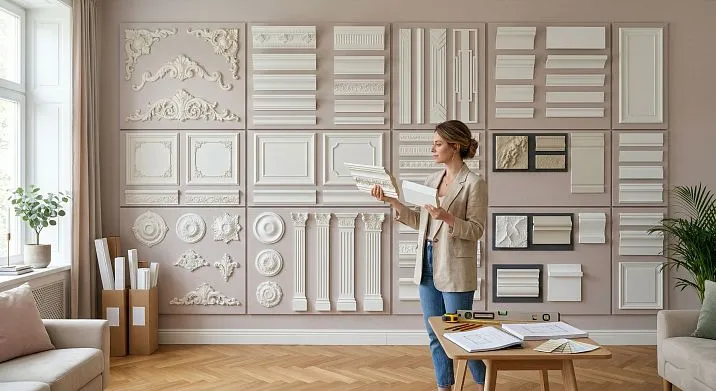
Let's say you already know what you want: the wall in the living room should become expressive, not just painted. You typed 'buy wall molding' into the search — and immediately drowned in hundreds of cards, catalogs, marketplaces, and unclear descriptions. Plaster, polyurethane, moldings, frames, overlays, ornaments, pilasters, panels — which of these do you need? What's for the wall, and what's for the ceiling? What's made of polyurethane, and what's better made of wood? Where to buy and how not to overpay?
This article answers exactly these questions. Not as an advertisement, but as a guide from someone who knows the market from the inside and understands what the buyer needs at different stages of selection.


Why 'buy wall molding' is not one product, but a whole system of solutions
The mistake many make: they go into a catalog with a vague query 'wall molding', see thousands of items, and either choose at random or postpone the purchase indefinitely.
In fact, the query 'buy wall molding' hides at least six fundamentally different types of products:
-
moldings — linear profiles for frames, divisions, borders;
-
decorative overlays — individual relief elements: corner blocks, medallions, ornaments;
-
wall panels — full-fledged architectural systems with pilasters, frames, and cornices;
-
pilasters and half-columns — vertical architectural elements;
-
wall ornaments and panels — independent relief compositions;
-
ready-made decorative sets — kits for decorating a specific area (fireplace, TV, mirror).
And each of these types has its own function, material, price, and application scenario. Let's break it down in order.




Wall molding vs ceiling molding: what's the difference
Important point before purchase: do not confuse wall and ceiling elements. These are different product groups.
-
Ceiling cornices are installed at the junction of the ceiling and wall; they are designed for bottom-to-top mounting.
-
Wall moldings are mounted horizontally or vertically on the wall surface.
-
Ceiling rosettes are only for ceilings; they are not installed on walls.
-
Pilasters are only for walls; they are not used on ceilings.
Beforebuy decorative molding for walls, make sure the product card states: 'wall-mounted' or 'for walls'. This will save time, money, and nerves.
Our factory also produces:


What exactly can be bought for wall decoration: a complete breakdown of categories
Get Consultation
Moldings: the building block of any system
Wall molding for decoration— these are linear profiles from which all wall systems are built. They are sold by the linear meter. The length of one 'stick' is usually 2 meters, less often 1.5 or 2.5 m.
What is important when buying moldings:
-
Profile width — from 15 mm (delicate) to 120 mm (for tall formal rooms);
-
Profile height (projection) — how much the molding "protrudes" from the wall; affects the expressiveness of the relief and chiaroscuro;
-
Cross-section shape — smooth, with a groove, with ornamentation along the length;
-
Compatibility with corner elements — molding at 45° or with ready-made corner blocks.
The STAVROS catalog features polyurethane wall moldings in 40+ profiles with widths of 30–100 mm and prices ranging from 800 to 3,500 rubles per linear meter.
Decorative overlays: character in the details
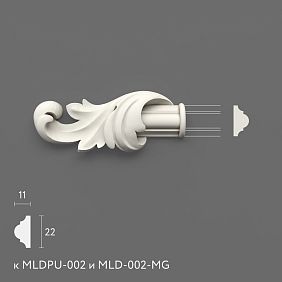
STAVROS polyurethane decorative overlays— are individual elements that you purchase by the piece, not by the meter. They come in several types:
-
Corner blocks — installed at the intersection of moldings in the corners of a frame. Size: from 5×5 to 20×20 cm. They eliminate the problem of joining molding at 45° and simultaneously add a decorative accent.
-
Central medallions — placed in the center of a frame. Diameter: 10–50 cm. They create a visual focal point.
-
Ornamental inserts — horizontal or vertical elements with a relief pattern. Sizes vary widely.
-
Corner appliqués and cartouches are more complex relief elements for formal interiors.
Important rule: appliqués must belong to the same collection as moldings. Mixing styles (baroque appliqué + geometric molding) is a common and crude mistake.
Wall panels: maximum effect
STAVROS boiserie wall panelsThese are full-fledged architectural systems. They include: molding frames, decorative appliqués, pilasters on the sides, a cornice at the top, and a baseboard at the bottom. This is not a separate product—it is a project for a specific wall.
When to buy a panel system instead of a set of moldings:
-
when full wall cladding is needed, not just one or two elements;
-
when ceiling height is from 2.9 m;
-
when the interior style is classic, neoclassical, or modern classic;
-
when a prestigious, formal result is important.
Pilasters and half-columns: vertical axis
Pilasters are flat vertical elements embedded into the wall. Half-columns protrude by one-third of their circumference. Both types are sold as a set: shaft + capital + base. They are purchased individually — singly or in pairs.
Application: on the sides of fireplaces, doorways, niches, TV zones. They are not only decorative — they structure the wall vertically, creating a connection between the floor and ceiling.
Wall ornaments, panels, and friezes
Ornaments are independent relief elements that are installed without a molding system. Suitable as accent decor: on the wall behind a sofa, above a bed headboard, in a niche.
Friezes are horizontal strips with ornamentation running along the top of the wall (usually under the ceiling or above a molding belt). In the STAVROS catalog, friezes are available in several styles — from geometric to floral.
Ready-made sets for an accent wall
For those who don't want to figure out the system of elements themselves, buy molding online for an accent wall is available in a kit format: moldings + corner blocks + central medallion + linear footage calculation. This is the most convenient format for beginners and for those who want to guarantee compatible elements.
What materials are available for wall molding: comparison and selection
This is a key question before purchase. The material determines the price, weight, durability, possibility of painting, and installation complexity.
Polyurethane: why it's the #1 choice for wall molding
Wall decor made of polyurethane STAVROS— over 500 models in the catalog. And this is no coincidence: polyurethane combines all the qualities a buyer needs in wall decor.
Parameters in comparison:
| Characteristic | Polyurethane | Gypsum | Polystyrene |
|---|---|---|---|
| Weight (2 m of molding) | 0.3–0.7 kg | 3–8 kg | 0.1–0.3 kg |
| Relief | High precision | High precision | Fuzzy |
| Moisture resistance | High | Low | Medium |
| Paintability | Any paint | Yes, after priming | Poor |
| Installation | Glue + dowels | Anchor fastening | Adhesive only |
| Durability | More than 50 years | More than 50 years | 10–15 years |
| Cost (RUB/m) | 800–3500 | 1500–8000 | 150–600 |
Conclusion: polyurethane is the optimal choice for wall molding in 95% of cases. It does not visually fall short of plaster but significantly surpasses it in practicality. At the same time, it costs substantially less than professionally executed plasterwork.
Plaster: when it is justified
Plaster molding is a traditional material with high density and 'substantial weight,' which polyurethane reproduces only visually. It is purchased for:
-
restoration objects with historical requirements;
-
ceremonial rooms with ceilings 4+ m, where authenticity is important;
-
Custom hand-molded works.
For walls in residential apartments, gypsum has significant limitations: its weight requires special fastening, any moisture destroys the material, and its fragility makes installation in corners difficult. In standard renovations, gypsum as a material for wall decor has been largely replaced by polyurethane.
Polystyrene: An Honest Assessment Without Illusions
Polystyrene is the cheapest option. It is suitable for temporary solutions, for children's rooms or country house interiors where long-term results are not planned. For primary residences, polystyrene is a mistaken choice: unclear relief, fragility, poor paintability, and a limited service life. Buying decorative wall molding made of polystyrene to save money means paying twice: for the material and for replacement in a few years.
Wood and MDF: For Wall Panels with a Living Texture
Wooden moldings and panelsmade of solid oak, beech, ash — for interiors where a natural texture is needed. MDF for painting — for white panel systems in a classical spirit. Wood as wall panels is combined with polyurethane moldings around the perimeter — this is a standard and very effective technique of modern classic style.
How to Choose Molding According to Wall Format
The correct wall format is not only about 'looking beautiful' but also about correct geometry. A poorly chosen frame format ruins the impression even when using expensive materials.
For an accent wall (one of four)
This is the most popular scenario. A system of frames made from moldings is mounted on one wall—4–8 rectangular contours. The other three walls remain without decoration or with minimal molding.
What to buy: moldings 30–55 mm + corner blocks. Footage: perimeter of each frame × number of frames + 10–15% reserve. Made of polyurethane—for easy DIY installation.
For the fireplace area
A fireplace requires a framed surround: a portal + pilasters on the sides + a horizontal cornice above the shelf. This is a three-element system. Purchased as a set: moldings for the portal + two pilasters included (shaft + capital + base) + horizontal molding above the fireplace.
For the TV zone
A molding frame around the screen + symmetrical vertical moldings on the sides (or pilasters). A TV in such a frame no longer 'hangs'—it integrates into the wall's architecture. Additionally: corner blocks and a central molding below the screen—to connect with the media console area.
For a wall with a mirror
A mirror in a molding frame is mounted in two ways:
-
The mirror itself in a wooden frame + molding around the perimeter of the wall—the mirror integrates into the architectural context.
-
A mirror without a frame + molding forming a frame from the wall decoration—the mirror becomes part of the wall.
For the second option, moldings with precise 45° angles and corner blocks are needed—otherwise the joint will be noticeable.
For the hallway and corridor
In a narrow hallway, vertical moldings work well—they elongate the room. On the end wall, there is a system of frames. In a long corridor, rhythmic vertical stripes run from floor to ceiling at equal intervals.
Buy molding from an online store and transform your interior over the weekend—an express format for updating a hallway or living room without professional skills.
How to choose wall molding to match the interior style
Style is not just about aesthetics. It is a parameter that determines the type of ornament, the width of the molding, the complexity of overlays, and the overall richness of the decor.
Classic
What to buy: moldings with pronounced ornamentation (acanthus, meander, egg-and-dart pattern), ornamental overlays, pilasters with capitals featuring relief floral decor. Molding width: 55–100 mm. Overlays: with detailing. Systems: multi-tiered. Room requirements: ceiling height from 3 m, area from 20 sq. m.
Neoclassicism
What to buy: moldings with a moderate profile or minimalist ornamentation, corner blocks of simple shape, decorative medallions in frames. Molding width: 35–65 mm. Color: monochrome. Result: an architectural wall without historical grandeur.
Modern classic
What to buy: smooth moldings (without ornamentation) + wooden inserts in frames or beneath them. Combination of polyurethane profile and natural wooden panels. Molding width: 30–55 mm. Minimal overlays. One material accent.
Calm modern interior
What to buy: narrow smooth moldings 20–35 mm. Only right angles. No ornamentation. Monochrome solution. One horizontal molding or several frames on an accent wall. Simple installation, minimal budget, maximally delicate result.
Expressive decorative interior
What to buy: moldings with a pronounced profile + ornamental overlays + possibly geometric panels. Contrasting color scheme. This option requires confidence in choice: expressive decor does not forgive mistakes in proportions.
What to buy for different rooms
Living Room
This is the flagship room for wall stucco decor. The choice depends on which scenario you are implementing:
-
Wall behind the sofa: moldings 35–55 mm, corner blocks, possibly a central medallion. Footage: 8–15 l/m for a wall 3–4 m.
-
TV area: moldings + a pair of pilasters (1–1.5 m each).
-
Fireplace wall: portal moldings + pilasters + horizontal cornice.
For a living room with ceiling height up to 2.8 m — moldings 35–45 mm. For 3 m and above — 50–70 mm.
Bedroom
In the bedroom, one scenario works — an accent wall behind the headboard. What to buy: moldings 30–40 mm + corner blocks. Frames — elongated vertically or square. Everything in monochrome. Footage for a wall 2 m wide with two frames — 10–14 l/m.
Entryway
Vertical moldings: 30–40 mm, length according to room height. On the end wall — 2–3 frames. For narrow spaces: vertical rhythm, not horizontal divisions.
Office
Frame panels on the wall behind the desk + pilasters on the sides of the book niche. Molding width 40–55 mm. Ornament — moderate or absent. Color — calm neutral palette.
Dining Room
Full system or three-part wall division: plinth (molding 20–30 mm) + field with frames + frieze under the ceiling. For rooms with ceilings from 3 m. Pilasters are appropriate.
Hall in a private house
Maximum potential for wall molding. High ceilings allow for full implementation ofwall panels INT-024— a system with carved overlays, cornices, and moldings. Full-height pilasters — the most impressive solution.
What to look for before buying: buyer's checklist
When you've already entered the catalog and are selecting specific items — check each product against these parameters:
Material and purpose
-
For wall or for ceiling? (See product tag/category)
-
What is it made of: polyurethane, plaster, MDF, wood?
-
Moisture resistance: suitable for kitchen/bathroom?
Dimensions
-
Profile width (mm)
-
Profile height (projection) (mm)
-
Stick length (m) — affects footage calculation and number of joints
Relief and ornament
-
Smooth or with a pattern?
-
Does the ornament match your style?
-
Is it compatible with corner blocks and overlays from the same collection?
Ready for painting
-
Does it require priming?
-
Which paints are suitable: water-based, acrylic, oil-based?
-
Does the product card include surface preparation information?
Availability of accompanying elements
-
Are there corner blocks for this profile?
-
Are internal and external corners included in the set?
-
Are overlays from the same collection sold?
Logistics and volume
-
Stock availability (important: not on order, but in stock)
-
Delivery cost to your region
-
Minimum order (manufacturers often require 5–10 linear meters)
-
Meterage calculation option on the website
inSTAVROS polyurethane molding online storeavailability is updated daily, in product cards — profile photo, dimensions, and compatible elements.
When moldings are enough, and when panels or complex decor are needed
This is one of the most practical questions when purchasing.
Moldings are enough if:
-
the goal is to give the wall structure and character without spending a large budget;
-
ceiling height is 2.5–2.8 m;
-
interior style is modern, neoclassical, contemporary classic;
-
you plan to install it yourself;
-
fast implementation without design needed.
Panels and a full system are needed if:
-
the goal is a formal, representative, status wall;
-
ceilings from 2.9–3 m;
-
style — classic, historical neoclassicism;
-
there is a professional installer or designer-architect;
-
room — living room, hall, study with high interior requirements.
Ready-made sets are the best choice if:
-
you don't want to independently select compatible elements;
-
a specific scenario is needed (accent wall for TV, area behind the sofa, bed headboard);
-
Compatibility guarantee for moldings, corners, and overlays is important.
How to compare prices without mistakes
Price is the main parameter when buying online. But a direct comparison often leads to confusion.
Typical mistakes when comparing prices:
-
Comparing price per piece instead of per linear meter (some sell a 1 m stick, others a 2 m stick — price per piece differs, per meter — the same).
-
Ignoring profile width: a molding at 400 rub./m with a width of 20 mm and a molding at 1200 rub./m with a width of 60 mm — these are not the same in visual result.
-
Ignoring delivery cost: a manufacturer may be more expensive, but delivery is free above a certain amount — overall more advantageous.
-
Buying from a distributor at a price that already includes a markup, instead of buying directly from the manufacturer.
Rules for correct comparison:
-
Compare price per linear meter.
-
Compare elements of the same profile width.
-
Sum up the product price + delivery + consumables (glue, primer).
-
Check if corner elements are included or need to be purchased separately.
-
Confirm stock availability — 'made to order' means additional waiting time.
Common mistakes when buying wall molding
Buying ceiling elements instead of wall elements
Ceiling cornices are installed differently — with a joint at the corner of the wall and ceiling. When mounted on the wall, they look incorrect and do not provide the desired effect.
Choosing decor that is too small for a large wall
A 20 mm molding on a 4 m high wall with a 3 m ceiling is like drawing a thin dividing line on a large canvas: it doesn't read. The scale of the molding must match the scale of the wall.
Buying an overly complex ornament for a small room
Baroque acanthus leaves on molding in a 12 sq. m room create not luxury, but a feeling of overload. Simple profiles are always safer.
Selection based only on catalog pictures
The picture in the product card is often taken close-up — the detailing looks larger than in reality. Look at real photos in interiors and consider the scale relative to the wall height.
Mismatched furniture style
Ornamental moldings with a plant pattern paired with Scandinavian furniture is an obvious style conflict. The type of ornament and furniture style should belong to the same stylistic era.
Lack of an overall plan
Buying moldings without a layout plan for the frames is a path to errors in footage and unpredictable results. Draw the wall on paper with dimensions, mark the frames, calculate the perimeter of each — and only then place the order.
What to buy for different tasks: final matrix
| Task | What to buy | Material | Molding width |
|---|---|---|---|
| Delicate decor | Smooth moldings + frames | Polyurethane | 20–35 mm |
| Accent wall | Moldings + corner blocks + medallion | Polyurethane | 35–55 mm |
| Classic interior | Ornamental moldings + pilasters | Polyurethane / plaster | 55–100 mm |
| Modern project | Smooth moldings + wooden inserts | Polyurethane + MDF | 30–50 mm |
| Budget update | 1–2 moldings on an accent wall | Polyurethane | 25–35 mm |
| Status finishing | Wall paneling boiserie | Wood + polyurethane | System |
| Hallway | Vertical moldings + end frames | Polyurethane | 25–40 mm |
| Bedroom | Headboard frames | Polyurethane | 30–40 mm |
Purchase algorithm: where to start if you have no experience
If you're buying wall molding for the first time and don't know where to start — follow this order:
-
Choose one wall — don't start with all at once. One successful result is better than several mediocre ones.
-
Measure the wall — width and height. Determine how many frames you want and what size.
-
Draw a diagram — on paper or in an online editor. Check the margins and proportions.
-
Choose molding type — width according to ceiling height, ornament matching furniture style.
-
Calculate linear footage — perimeter of all frames + 15% allowance for joints.
-
Select compatible corners and overlays — from the same collection.
-
Place order — check stock availability and delivery cost.
-
Prepare tools — miter box, mounting adhesive, joint filler, paint.
FAQ: answers to frequently asked questions
What is included in the 'wall molding' category?
Moldings, decorative frames, overlays, ornaments, pilasters, half-columns, wall panels, wall panels and friezes. Ceiling cornices and rosettes are a separate category.
What is better to buy for walls: plaster or polyurethane?
In most cases — polyurethane. Several times lighter, moisture-resistant, easier to install, costs less, visually identical to plaster. Plaster is justified only for restoration and formal projects with special requirements for authenticity.
Is molding suitable for a modern interior?
Yes — when choosing smooth moldings without ornament and a monochrome color scheme. Geometric frames and straight profiles work in any modern style.
What to buy for an accent wall?
Moldings 35–55 mm + corner blocks from the same collection + optional central medallion. All in the wall color.
When are moldings needed, and when are panels or ornaments?
Moldings — for creating structure (frames, divisions). Ornaments and overlays — for accent details within the system. Panels — for full architectural cladding. For most tasks, moldings are sufficient.
Can you buy molding for painting?
Yes. STAVROS polyurethane moldings have a surface ready for painting. Any water-based or acrylic paint is suitable.
What to look for when buying molding online?
Width and height of the profile, length of the stick, availability in stock, compatibility with corner elements, delivery cost. Be sure to look at photos in interiors, not just close-ups of the profile.
How to calculate how much molding is needed for a wall?
Calculate the perimeter of each planned frame, sum them up, and add 10–15% for joints. For horizontal molding — the length of the wall plus a margin. The STAVROS website has a built-in footage calculator.
What molding is best for a living room?
Depends on the style. For neoclassicism — moldings 40–55 mm with a moderate profile + corner blocks. For modern interiors — smooth molding 30–40 mm matching the wall color. For classic style — ornamental moldings + pilasters.
How to avoid mistakes when comparing prices?
Compare the price per linear meter for the same width. Consider delivery and consumables. Buy directly from the manufacturer — this eliminates distributor markups.
About the company STAVROS
When it comes to where to buy wall moldings — the answer, backed by a twenty-year history, in-house production, and international recognition, is unequivocal.
STAVROS is a St. Petersburg-based manufacturer of architectural decor, operating since 2002. Production area — 6,000 sq. m, 19 CNC machines with manual finishing. Assortment: 4,000+ items — moldings of all profiles and sizes, decorative overlays, pilasters, ornaments, wall panels, cornices, rosettes. Warehouse — 2,000 sq. m in St. Petersburg with 90% of catalog items in stock.
Products are supplied to 15+ countries worldwide. The company has been awarded the title of 'Industry Leader of Russia'. Delivery — throughout Russia and the CIS.
In the STAVROS catalog, you will find exactly what you need:Polyurethane wall decorwith full descriptions, interior photos, dimensions, and prices. From a single molding for an accent wall to a complete systemFor boiserie wall panels— all in one place, from a single manufacturer, with direct delivery.