Article Contents:
- Historical Continuity of Forms and Ornamentation
- Ancient Heritage in Profiles
- Renaissance: Revival of Classical Forms
- Baroque and Rococo: Peak of Ornamentation
- Neoclassicism: Return to Rigor
- Role of Wood in Classical Rooms
- Oak: Standard of Nobility
- Beech: European Tradition
- Ash: Light Elegance
- Combination of Massive Profiles and Carved Elements
- Hierarchy of Ornamentation
- Classic Carved Motifs
- Wood Carving Techniques
- How to Adapt Classicism to a Modern Home
- Scaling to Modern Proportions
- Simplification of Decoration
- Color solutions
- Combining with modern materials
- Application in Restoration Projects
- Recreating Historical Profiles
- Selecting Historical Wood Species
- Technologies of Historical Finishing
- Care for Oak and Beech Items
- Regular Cleaning
- Updating Oil Finish
- Care for Lacquered Surfaces
- Protection from Unfavorable Factors
- Frequently Asked Questions
- Conclusion
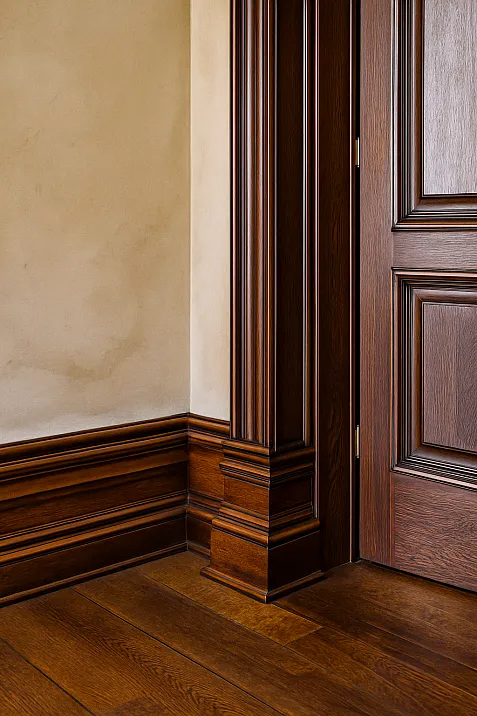
Classic interiors are built on centuries-old architectural logic traditions, where each element carries semantic meaning and adheres to strict proportional laws.Wooden baseboardcreates the architectural base of the wall, from which the entire vertical composition of the room is built.wooden cornicecompletes the wall at the top, forming a smooth transition to the ceiling and creating a visual framing of the space.Moldings from solid woodstructure wall surfaces, forming panel systems of boiserie, which characterize aristocratic interiors of the 17th to 19th centuries.Carved Elementsadd decorative value, transforming utilitarian architectural details into works of art.Wooden plankUsed for creating panelled surfaces and mouldings, where simplicity of lines highlights the nobility of oak or beech wood.


Historical continuity of forms and ornamentation




Ancient heritage in profiles
Classical architectural profiles originate in ancient Greek and Roman architecture, where each line had a constructive basis and philosophical meaning. Gusset - an S-shaped profile - symbolized flexibility and strength simultaneously. Groove - a vertical channel - originally compensated for visual distortion of round columns. Bulge - a convex semicircular element - created a transition between different planes.wooden corniceClassic form repeats these ancient elements in miniature.
The Greek architectural order established proportional relationships between elements. The height of the column base related to the diameter of the shaft as 1:3. These mathematical proportions were adopted in interior architecture.Wooden baseboardA height of 100 millimeters in a 3-meter-high room follows the classical 1:30 ratio, ensuring visual harmony.
Roman architecture added richness of ornamentation - acanthus leaves, meanders, palmettes, rosettes. These plant and geometric motifs became a universal language of classical decoration.Carved ElementsThese ancient ornaments are repeated on cornices and mouldings, linking modern interiors with a thousand-year tradition.
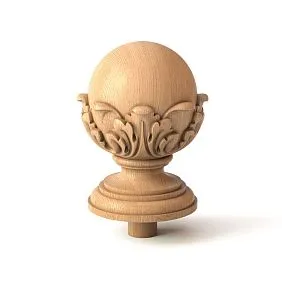
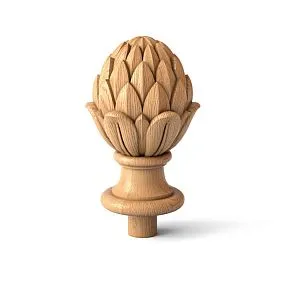
Our factory also produces:


Renaissance: revival of classical forms
Italian Renaissance of the fifteenth and sixteenth centuries revived interest in ancient architecture, adapting its forms to residential interiors. Architects-theorists Alberti, Palladio, Vignola systematized classical proportions, creating treatises that became textbooks for subsequent generations.Moldings from solid woodRenaissance palazzi created geometric panels on walls, structuring the plane and giving it architectural logic.
Coved ceilings with deep square or octagonal recesses were framed by profiled cornices.wooden corniceThese cornices created a transition from vertical to horizontal at the wall-ceiling junction, visually lowering the high ceilings of palazzi. Carved rosettes at the center of each cove added decoration while preserving the geometric rigor of the composition.
The panel system of buazerie - wooden panels framed by profiled frames - became a characteristic feature of Renaissance interiors.Wooden plankFrames of 40x60 millimeters section formed rectangular panel frames. The panels were filled with carved appliqués, inlays, and painting.Wooden baseboardA height of 120-150 millimeters formed the base of the panel system.
Get Consultation
Baroque and Rococo: peak of ornamentation
Baroque of the seventeenth century pushed ornamentation to its maximum. Straight lines of classicism were replaced by curved lines, static forms by dynamic ones.wooden corniceBaroque interior profiles reached a height of 200-250 millimeters, had a complex multi-tiered profile with alternating convex and concave elements. Carving covered the entire surface, creating a dense decorative texture.
Eighteenth-century Rococo softened Baroque power, replacing it with refined elegance. Asymmetric ornaments - rocaille, shells, scrolls - created an impression of lightness and playfulness.Carved ElementsRococo ornaments are characterized by delicacy and detail - masters created lace carving several millimeters thick. Gilding, patination, polychrome coloring enhanced the decorative effect.
Moldings from solid woodRococo often had irregular shapes, following the curves of the ornament. Rectangular panels of classicism were replaced by oval medallions, irregularly shaped cartouches.Wooden baseboardIt retained relative strictness, contrasting with the excessive ornamentation of upper parts of the room.
Neoclassicism: return to strictness
Neoclassicism at the end of the eighteenth and beginning of the nineteenth century was a reaction against the excesses of Rococo. Return to ancient ideals of simplicity and proportionality purified interiors of decorative excesses.wooden corniceNeoclassical interiors had a clear profile with distinct geometric elements. Height was reduced to 100-150 millimeters, decoration became restrained and symmetrical.
Empire - the late stage of neoclassicism of the Napoleonic era - added military symbolism to ancient motifs. Laurel wreaths, torches, swords, eagles became characteristic decorative elements.Carved ElementsEmpire profiles are characterized by strict symmetry and clear execution. Color palette - dark walnut, redwood, black with gilding - created a formal, ceremonial atmosphere.
Role of wood in classical interiors
Oak: the standard of nobility
Oak has become the standard species for classic interiors due to its unique combination of physical and aesthetic qualities. Density of 650-750 kilograms per cubic meter ensures high mechanical strength. Hardness of 3.7-4.0 on the Brinell scale makes oak resistant to abrasion and impacts.Wooden baseboardOak in high-contact zones — near doors, in hallways — serves for decades without noticeable wear.
Oak displays the natural beauty of wood over a large area.wooden corniceMade of oak, showcasing the natural beauty of wood over a large span.
Oak holds its profile well due to uniform density and absence of knots in quality wood.Moldings from solid woodOak with small decorative elements retains line clarity after decades of use. Carving on oak creates an expressive relief with deep shadows. The open porous structure of oak enhances the play of light on carved elements.
Staining oak with stains creates a wide range of shades from golden to black. Staining highlights the texture, making growth rings more contrasting. Oil finishes preserve the tactile warmth of wood. Lacquering creates a protective film with varying degrees of gloss.Wooden baseboardStaining oak allows creating any shade while preserving the natural texture.
Beech: European tradition
Beech is characterized by a smooth light texture and fine-pored structure. Density of 700-780 kilograms per cubic meter exceeds oak's density, providing high strength with less pronounced texture. Natural beech color — from cream-white to pink — creates a light warm palette.wooden corniceBeech is ideal for light interiors in European style.
Uniform beech structure ensures perfect staining. Wood absorbs stains and dyes evenly without spots or streaks. Beech stains easily to any color from natural light to dark wenge.Moldings from solid woodBeech surfaces finished with enamel create perfectly smooth surfaces due to fine-pored structure.
Beech is easily machined with cutting tools. Routing creates clean surfaces without fiber tearing.Carved ElementsBeech items feature clear details and smooth surfaces. Turning beech creates complex profiles with smooth transitions.Wooden plankBeech items demonstrate precise geometry.
Beech requires moisture protection due to hygroscopic nature. Quality lacquering or oil impregnation creates a protective barrier.Wooden baseboardBeech is recommended for rooms with stable humidity of 40-60 percent. Under such conditions, beech items serve for decades, preserving geometry and aesthetics.
Ash: light elegance
Ash features an expressive contrasting texture with a light overall tone. Growth rings are clearly visible, creating a wavy pattern on tangential cuts. Color ranging from light cream to light brown with gray undertones creates a cool elegance.wooden corniceAsh is ideal for Scandinavian and neoclassical interiors dominated by light tones.
Ash density of 650-700 kilograms per cubic meter provides strength comparable to oak. Wood elasticity makes ash resistant to impact loads — the material bends without breaking.Wooden baseboardAsh withstands mechanical impacts without chips or cracks.
Ash is easily processed by all types of tools. Planing creates a smooth surface with characteristic silky sheen.Moldings from solid woodAsh items demonstrate clear profiles. Staining highlights the contrasting texture, creating an eye-catching surface. Oil finishes reveal texture depth, lacquers create a protective film.
Combination of massive profiles and carved elements
Decorative hierarchy
Classic interiors are built on a hierarchy of elements from simple to complex.Wooden baseboardThe base of the wall has a relatively simple profile — a molding, a shelf, a bevel. The middle section of the wall is structured with medium-decorative moldings.wooden corniceThe junction between wall and ceiling achieves maximum decorative effect — a complex multi-level profile with carved elements.
This hierarchy corresponds to natural perception — the gaze moves from bottom to top, and decoration increases, reaching its maximum at eye level and above.Carved ElementsThey are placed on cornices, upper parts of panel systems, door and window casings — where they are well visible and illuminated.
The scale of decoration corresponds to the size of the element. A high cornice 150-200 millimeters receives large carving with depth of 15-20 millimeters. A medium molding 80-100 millimeters is decorated with elements of depth 8-10 millimeters.Wooden plankElements of small section remain smooth or receive minimal beveling.
Classic carved motifs
The acanthus leaf became a symbol of classical carving. A stylized depiction of a Mediterranean plant with serrated leaf edges creates a complex relief with deep recesses.Carved ElementsWith acanthus, they decorate capitals of pilasters, corner blocks of casings, central parts of cornices. The depth of carving reaches 20-25 millimeters, creating expressive play of light and shadow.
Meander — a geometric ornament formed by a continuous broken line creating a rectangular spiral. The ancient motif symbolizes infinity and perfection.Moldings from solid woodWith pierced meander, they create an openwork texture. The height of the meander usually corresponds to the height of the molding, creating a proportional composition.
Palmette — a stylized depiction of a fan-shaped palm leaf. A symmetrical motif with petals radiating from the center decorates friezes, panel borders, central parts of cornices.wooden corniceWith palmettes placed at equal intervals, they create a rhythmic decorative structure.
Rosette — a circular or polygonal decorative element with symmetrical plant or geometric ornament. Placed at the center of panels, at intersections of moldings, in room corners.Carved ElementsRosettes vary from simple ones with several petals to complex multi-level compositions.
Wood carving techniques
Solid carving creates relief on a flat surface without through openings. The background is recessed by 5-15 millimeters, the ornament remains at the original level. Such carving decoratesMoldings from solid woodWide-profile elements, door panels, panels. The depth of carving determines expressiveness — the deeper, the more contrasted the play of light and shadow.
Pierced carving creates through openings, forming an openwork ornament. The technique requires high skill from the craftsman — thin spacers between openings must retain strength.Carved ElementsPierced carving is used as applied details on flat surfaces or as standalone openwork panels.
Sculptural carving creates volumetric three-dimensional elements — capitals, brackets, corner blocks. Carving is done from all sides, creating a full-scale sculpture.wooden corniceIt may rest on sculptural brackets with carved volutes, mascarons, garlands.
Contour carving creates a pattern with shallow grooves 2-3 millimeters deep. The simplest form of carving is used for geometric ornaments, inscriptions, delicate plant motifs.Wooden plankIt may be decorated with contour carving without significant change in section.
How to adapt classicism to a modern home
Scaling to modern proportions
Modern apartments have lower ceiling heights compared to historical buildings. Standard height of 2.7-2.8 meters versus 3.5-4.5 meters in palace interiors requires proportional reduction of architectural elements.Wooden baseboardHeight of 80-100 millimeters corresponds to modern proportions, versus 120-180 millimeters in historical interiors.
wooden corniceIt scales similarly — height of 80-120 millimeters instead of 150-250 in historical prototypes. The profile is simplified, the number of levels is reduced from three to four to two to three. Decorative elements are proportionally reduced.Carved ElementsDepth of 10-15 millimeters replaces historical 20-25 millimeters.
Panel systems are adapted to modern room sizes. Panel dimensions are reduced — 800x1200 millimeters instead of historical 1000x1500.Moldings from solid woodThe framing panels have a smaller section - 40-60 millimeters versus 60-80 in historical interiors. The number of panels on the wall is reduced due to the smaller area.
Simplification of decoration
Modern perception requires greater restraint in decoration. The excessive ornamentation of baroque and rococo is perceived as overloading. Adapting classicism to modern taste implies selective use of decorative elements.wooden corniceAchieves a restrained profile with one or two carved elements instead of dense carving coverage.
Carved ElementsUsed selectively - on corner blocks of moldings, in the center of cornices, on capitals of pilasters. Other surfaces remain smooth with a simple profile. This approach creates accents without overloading the space with decoration. The ratio of decorated to smooth surfaces is approximately 1:5, compared to 1:2 in historical interiors.
Ornament stylization simplifies complex historical motifs. The acanthus leaf with numerous incisions is simplified to a stylized plant element with fewer details. The meander retains its characteristic broken line but becomes less dense.Moldings from solid woodWith simplified motifs, they retain their classical character while appearing modern and restrained.
Color Solutions
The historical color palette of classical interiors included rich dark tones - dark walnut, redwood, wenge. Modern adaptation expands the palette toward light natural shades.Wooden baseboardMade from light oak or ash, they create classical forms in a modern color scheme.
Painting in white, gray, beige tones creates a modern interpretation of classicism.wooden corniceA classical profile, painted matte white, retains relief against a neutral color palette. This technique is popular in Scandinavian and neoclassical styles, where classical forms are dressed in modern color schemes.
Contrasting combinations create modern dynamism. DarkWooden baseboardLightMoldings from solid woodHistorical interiors preferred tonal combinations, while modern interiors favor contrasting ones.
Combining with modern materials
Classical wooden elements harmoniously combine with modern materials - glass, metal, concrete.wooden corniceAt the junction of wooden wall panels and painted ceilings, they create a transition between different materials.Wooden baseboardFrames poured polymer flooring or ceramic tiles, creating a contrast between natural and artificial materials.
Metallic accents complement wooden elements. Bronze or brass handles on doors with wooden moldings create a premium combination. Glass doors in wooden portals combine transparency and materiality.Moldings from solid woodFrame mirror panels, creating a classical frame for a modern surface.
Application in restoration projects
Recreating historical profiles
Restoring historical interiors requires precise reproduction of original profiles. Measured drawings of preserved elements create the basis for manufacturing copies.Moldings from solid woodCrafted to individual knives, replicating the historical profile with millimeter precision. CNC machining ensures identicality of all elements.
Recreating carved elements is done manually by experienced carvers. Preserved fragments serve as templates for copying.Carved ElementsThey replicate not only the form but also the character of the finish - tool marks, degree of detail, proportions. Hand-carving of each element creates minor variations characteristic of historical pieces.
Wooden baseboardHistorical profiles often have non-standard heights of 120-180 millimeters and complex multi-layered sections. Manufacturing such profiles requires special tooling. STAVROS creates individual milling cutters for restoration projects, ensuring precise conformity to historical samples.
Selecting historical wood species
Historical interiors used specific wood species depending on the era and region. European interiors of the 17th-18th centuries used oak, walnut, cherry. Russian palaces of the 19th century used Karelian birch, ash, mahogany.wooden corniceFor a restoration project, it is made from the same species as the original.
Rare exotic species - redwood, padauk, ebony - are replaced by accessible analogs with similar characteristics. Mahogany is replaced by stained sapelli, ebony by stained oak.Moldings from solid woodModern species, after quality tinting, are visually indistinguishable from historical ones.
Aging new wood creates the illusion of historical patina. Mechanical brushing removes soft fibers, revealing texture. Chemical patination darkens recesses, creating an effect of long-term use.Carved ElementsAfter artificial aging, they integrate into historical interiors without standing out as new.
Historical Wood Finishing Technologies
Historical wood finishing used natural materials — oils, waxes, shellac. Re-creating historical finishes requires using similar compositions. Linseed oil with natural pigments creates deep tinting while preserving texture.Wooden baseboardWith an oil finish, it acquires a warm tone and a silky surface.
Shellac finish — traditional French polishing — creates a deep gloss with an inner glow effect. Dozens of thin shellac layers are applied with a pad, with intermediate polishing.wooden corniceWith French polishing, it demonstrates refined craftsmanship of historical quality.
Traditional gilding uses sheet gold several micrometers thick. The wooden surface is primed with levkas, polished to perfect smoothness, and covered with an adhesive compound — micsion or polyment. Ultra-thin gold leaves are adhered and polished with an agate brush.Carved ElementsWith classic gilding, they create the luxury of historical palace interiors.
Care for Oak and Beech Wood Items
Regular cleaning
Daily care for wooden elements involves removing dust with a dry soft cloth or vacuum cleaner with a soft brush attachment. Dust accumulates in profile recesses, on horizontal cornice surfaces, and in carved grooves.wooden corniceItems with complex profiles require thorough cleaning of all elements.
Wet cleaning is performed once every week or two with a well-wrung cloth. Water must not penetrate joints or recesses, where it may cause wood swelling.Wooden baseboardIt is wiped along the grain. Special wood care products are added to water according to the manufacturer's instructions.
Stains are removed immediately before absorption into the wood. Grease stains are blotted with a cloth, then the area is wiped with a weak soap solution. Scratches and abrasions on lacquered surfaces are masked with wax pencils matching the finish color.Moldings from solid woodThey require careful handling to preserve their original appearance.
Updating Oil Finish
Wooden baseboardItems with an oil finish require annual renewal of the protective layer. The surface is cleaned of dust and dirt with a specialized oil-wood cleaner. The cleaner is applied with a cloth, worked in with circular motions, and excess is wiped off with a clean cloth. The surface must be completely dry before applying oil.
Oil is applied in a thin layer with a soft cloth or brush along the grain. Excess oil is wiped off with a dry cloth after 10–15 minutes — no liquid film should remain on the surface. The oil should penetrate into the wood, not form a surface layer. After 12–24 hours, a second layer is applied in the same manner.wooden corniceAfter updating the oil finish, it acquires a fresh appearance and enhanced protection.
Hard oil-wax creates a more durable finish compared to liquid oil. Wax is applied in a thin layer and polished with a soft cloth to a light sheen after one hour.Moldings from solid woodItems with oil-wax finish are resistant to abrasion and moisture, requiring renewal every 2–3 years.
Care for Lacquered Surfaces
Lacquered wooden elements require minimal care. Regular dry and periodic wet cleaning maintain cleanliness. Special polishes for lacquered furniture provide additional protection and enhance gloss. The polish is applied with a soft cloth and buffed to an even sheen.Wooden baseboardWith lacquer finish, it retains its original appearance for years without special care.
Scratches on lacquered surfaces are masked with touch-up markers or wax pencils matching the finish color. Deep damage requires local restoration — the damaged area is sanded with fine sandpaper, degreased, and covered with lacquer in several thin layers.wooden corniceWith quality lacquer finish, it is resistant to mechanical impacts and ultraviolet radiation.
Full lacquer finish renewal is performed every 15–20 years of use or after significant damage. Old lacquer is removed by sanding, the surface is primed, and 2–3 new lacquer layers are applied with intermediate sanding.Moldings from solid woodAfter full restoration, they appear new while preserving the natural wood texture.
Protection from adverse factors
Direct sunlight causes wood fading and destruction of protective coatings.wooden corniceOn the south side of the room, protection with heavy curtains or blinds during the day is required. Ultraviolet light destroys lignin in wood, causing darkening of light-colored species and fading of dark ones.
Fluctuations in humidity cause wood deformation. Optimal relative humidity of 45-65 percent ensures dimensional stability.Wooden baseboardIn rooms with humidifiers or air conditioners, geometry is preserved for decades. Sudden humidity fluctuations exceeding 20 percent over a short period cause coating cracking and deformation.
Mechanical damage is prevented by careful handling.Carved ElementsWith delicate protruding details, special care is required during cleaning and furniture arrangement. Soft pads on furniture legs protect baseboards from impacts.Wooden plankAt the lower part of walls, protection from vacuum cleaners and mops is required.
Frequently asked questions
What height of baseboard is suitable for a classic interior?
heightSolid Wood Skirting BoardIn a classic interior, baseboard height is determined by room height. The optimal ratio is 1:25 - 1:30. For standard ceiling heights of 2.7-2.8 meters, baseboards of 90-110 millimeters are suitable. For high ceilings of 3.2-3.5 meters, baseboards of 120-140 millimeters are used. Rooms with ceilings higher than 3.5 meters require baseboards of 150-180 millimeters to maintain proportions.
Can a walnut baseboard be used with a beech cornice?
Combining different species is possible provided there is uniform finish.Wooden baseboardMade of walnut andwooden corniceMade of beech, are tinted to one color, creating visual unity. Texture differences are noticeable only upon close inspection. Enamel completely hides species differences. It is preferable to use one species for all architectural elements of the room, ensuring material unity.
How often should oil finish be renewed?
Moldings from solid woodBaseboards with oil finish require annual renewal in high-contact zones — baseboards, door casings. Cornices and wall moldings, not subject to contact, are renewed every 2-3 years. Rooms with increased humidity require more frequent renewal — every 6-12 months. Hard oil-wax lasts longer than liquid oil — renewal every 2-3 years for all elements.
Can a wooden baseboard be painted white?
Wooden baseboardMade of solid wood, can be painted any color, including white. The surface is sanded, degreased, and primed with a special wood primer. Enamel is applied in 2-3 layers with intermediate sanding using fine-grit sandpaper. Matte white enamel creates a modern interpretation of classic style. Glossy white enamel corresponds to traditional palace interior finishes.
What cornice profile is suitable for a neoclassical interior?
Neoclassicism prefers restrained profiles with clear geometry.wooden corniceCornices 80-120 millimeters high with a two- or three-tiered profile — a roll, a shelf, a gusset — create a classic form without excess.Carved ElementsUsed minimally — small rosettes in corners or center of the cornice. Color — natural light wood or painting in white, beige, light gray.
How to determine the required amount of moldings for a panel system?
The calculation begins with determining the size of the panels. Classic panel proportions are rectangles with side ratios of 1:1.5 or 1:1.618 (golden section). For a wall 4 meters wide and 2.7 meters high, optimal are 4 panels 900 mm wide and 1350 mm high.Moldings from solid woodFrame each panel around its perimeter. Calculation: 4 panels × (0.9 + 0.9 + 1.35 + 1.35) meters = 18 linear meters plus 10% reserve.
Can wooden elements be installed in a bathroom?
Wooden baseboardInstallation in a bathroom requires special treatment with moisture-resistant compounds. Preferred are lacquer coatings in 3-4 layers, creating an impermeable film. Species with low hygroscopicity — larch, teak — are preferable to oak and beech. Ventilation of the room is critical to prevent excessive humidity. An alternative — polyurethane elements, imitating wood, completely moisture-resistant.
How to restore a damaged carved element?
Small chipsof carved elementsRestored with wood putty. The damaged area is cleaned, degreased, and filled with putty slightly in excess. After drying, the putty is sanded to restore the lost detail’s shape. The surface is primed, stained, and coated with lacquer matching the rest of the element. Significant damage requires manufacturing a copy of the lost fragment by a carver using the preserved parts.
Which wood is better for a cornice — oak or beech?
Oak is preferable forwooden cornicedue to its expressive texture and high stability. Characteristic medullary rays create visual interest over the length of the cornice. Beech provides a more uniform light surface, ideal for painting. The choice depends on the interior concept — oak for traditional classical, beech for neoclassical and painted interiors.
Do wooden elements need acclimatization before installation?
Mandatory acclimatizationSolid Wood Skirting Boardand other solid wood elements lasts a minimum of 72 hours in the installation room. The items are laid horizontally without packaging, ensuring air access from all sides. The wood adapts to the room’s temperature and humidity, reaching equilibrium moisture. Installation without acclimatization leads to deformation, gaps after drying, or warping upon swelling.
Conclusion
A classical interior represents a complex architectural system, whereWooden baseboardcreates the base,wooden corniceforms the finish,Moldings from solid woodstructure the walls,Carved Elementsadd decorative elements. Each element adheres to strict proportional laws inherited from ancient architecture.
Historical continuity of forms links modern interiors with a thousand-year tradition. Profiles of ancient orders were transformed into details of classical interiors. The Renaissance systematized proportions, Baroque took decorative elements to their peak, Neoclassicism returned restraint.Wooden plankUsed to create panel systems of boiserie, characteristic of classical interiors.
Adapting classicism to a modern home requires scaling proportions, simplifying decoration, expanding the color palette. The height of elements is reduced according to the lower height of modern ceilings. Decorativeness is used selectively, creating accents without overloading. Light natural tones and painting expand the traditional dark palette.
Restoration projects require precise reproduction of historical profiles, selection of authentic species, application of traditional finishing techniques. Care for oak and beech items includes regular cleaning, renewal of protective coatings, protection from adverse factors.
Since 2002, the company STAVROS has created decorative elements from solid oak, beech, and ash for classical interiors. A wide range of profiles from historical to modern adaptations, the possibility of manufacturing custom shapes, professional consultation ensure the implementation of projects of any complexity. High-quality processing, precise dimensions, variety of finishing options guarantee the creation of authentic classical interiors, where tradition meets modern quality and durability.