Article Contents:
- What makes an interior classic
- Wooden baseboard: visual weight
- Oak door casing: interior portals
- Wooden moldings: wall zoning
- Door trim: architectural logic of entrances
- Decorative layout: detailing
- Combining profiles in one room
- Rules for selecting sizes and cross-sections
- Conclusion: classic set from STAVROS
- Frequently Asked Questions

A classic interior is not just a set of expensive furniture and crystal chandeliers. It is primarily architectural logic, where each element performs its role in creating a harmonious space.Wooden baseboardcreates visual weight at the bottom, grounds the composition, serves as a base for vertical planes.Oak casingframes door openings, turning them into portals, architectural dominants.Wooden moldingsdivides walls into tiers, creates panel systems, refers to the ancient tradition of classical orders.Door Trim— boxes, dados, false strips — forms the functional and aesthetic integrity of the door assembly.Decorative wooden moldingworks out details, creates small geometry of panels and lattices. Let's figure out how to assemble a classic set, where each element is coordinated with others by material, profile, proportions.



What makes an interior classic
Classicism as an architectural style emerged in the Renaissance from a re-evaluation of ancient heritage. Main principles — order system, symmetry, proportionality, hierarchy of elements. What worked in temples and palaces was transferred to residential interiors, where each room was designed as a complete architectural composition.
The vertical structure of a classic interior is three-part, similar to an ancient column. The plinth (lower part) corresponds to the column's base — this is a baseboard 100-150 mm high, often painted in a darker tone than the wall. The shaft (middle part) corresponds to the column's stem — this is the main wall field, which may be divided into panels by moldings. The capital (upper part) corresponds to the column's capital — this is the ceiling cornice, completing the composition at the top. This three-part structure creates a sense of architectural logic, completeness, and thoughtfulness.
Horizontal divisions of the wall also follow rules. A classical panel (boiserie) divides the wall into three horizontal tiers. The lower tier, 80-120 cm high, is framed by moldings and often painted in a more saturated color or covered with fabric. The middle tier — the main field, occupying 60-70% of the wall height. The upper tier (frieze), 40-60 cm high, may be decorated with stucco, painting, or patterned wallpaper. Moldings separating tiers create a clear horizontal structure.
Symmetry is a fundamental principle of classicism. A door opening is placed strictly at the center of the wall or symmetrically relative to a fireplace, window, or another significant element. Molding panels on walls mirror each other relative to the central axis. Furniture is arranged symmetrically. Any violation of symmetry is perceived as an error, randomness, or imbalance.
Proportions of a classic interior are based on the golden section and modular systems. The height of the baseboard relates to the wall height as 1:8 or 1:10. The width of the door opening is 1/3 or 1/4 of the wall width. The dimensions of molding panels relate to each other as 2:3 or 3:5. These proportions are not calculated mathematically on each project; they are intuitively felt, developed through experience, creating harmony without conscious analysis.
Materiality — a criterion of authenticity of a classic interior. Imitations don't work: plastic baseboards mimicking wood, polyurethane moldings, veneered door casings — all of this is perceived as counterfeit and destroys the effect. A classic interior requires natural materials:Wooden skirting boards, Decorative wooden moldings, Wooden profilefor doors. Only natural solid oak or beech creates the tactile conviction that distinguishes true classicism from stylization.
The color palette of a classic interior is restrained and noble. Light neutral tones — white, cream, beige, gray-blue — dominate for walls and ceilings. Wooden elements — baseboards, door casings, moldings — either retain the natural oak color under transparent lacquer or are painted white, creating contrast with colored walls. Dark noble tones — wenge, walnut, chocolate — are used accentually for doors and furniture, creating visual dominants.




Wooden baseboard: visual weight
Floor wooden skirtingIn a classic interior — this is not a thin strip discreetly hiding the gap between the wall and floor. It is an architectural element 100-150 mm high with a multi-tiered profile, creating a visual base on which the entire wall composition 'stands'. A classic baseboard is substantial, foundational, expressive — it declares itself, creating an impression of strength, reliability, and status.
The profile of a classic baseboard is multi-tiered and complex. The lower tier — a wide shelf (plinth) 20-30 mm wide, adjacent to the floor. The middle tier — the body of the baseboard with convexities (bosses) and concavities (ovals), creating play of light and shadow. The upper tier — a cap shelf 10-15 mm wide, creating a transition to the wall. Each tier performs its visual role, and together they form a complex, sculptural shape.
The height of the baseboard is determined by the room's height. In rooms with 2.7-meter ceilings, the optimal baseboard height is 100-120 mm. At 3.0-meter ceilings — 120-140 mm. In grand rooms with high ceilings of 3.5 meters or more, the baseboard can reach 150-180 mm. The proportion rule: the baseboard height should be 1/25 - 1/20 of the room's height. A too low baseboard disappears, failing to create the necessary visual weight. An excessively high baseboard suppresses, making the room appear low and cramped.
The color solution for the skirting board in a classical interior follows several canons. The first — skirting board in the color of the door and casing, creating a unified system of vertical and horizontal frames. This emphasizes architectural logic and creates visual connections. The second — skirting board in the color of the walls, but 1-2 tones darker, creating a soft gradient that visually grounds the wall. The third — contrasting skirting board: white on colored walls or dark on light walls. Contrast highlights the boundary between the vertical plane and the floor.
In a genuinely classical interior, the skirting board material is only solid oak or beech.Wooden baseboardMade from solid wood, it creates the weight and tactile authenticity that cannot be imitated by MDF or plastic. An oak skirting board with density of 700-800 kg/m³ does not dent from impacts, does not form dents, and retains its geometry for decades. This is an investment that pays off through longevity and unchanging quality.
Installation of a classical skirting board is done discreetly, without visible fasteners. The traditional method — using finishing nails 50-60 mm long, driven through the body of the skirting board into the wall at intervals of 400-500 mm. Nail heads are recessed by 2 mm, recesses are filled with wood putty matching the wood tone, sanded smooth. The modern method — using a concealed mounting strip, which is attached to the wall, and the skirting board clicks onto the strip with special clips. This ensures a clean front surface and allows for disassembly without damage.
The junction between the skirting board and the door casing — a technically and aesthetically complex joint. In a classical interior, the skirting board does not simply butt against the casing edge — this would look crude. One of two methods is used: the skirting board is mitered at 45 degrees, creating a bevel that visually softens the joint; or a decorative corner element (rossette) is used, concealing the joint and turning it into a decorative accent. Both elements — the skirting board and the casing — must be made from the same solid oak and have a unified color.
Our factory also produces:


Oak casing: the portals of the interior
Oak casingIn a classical interior — this is not simply a strip hiding the mounting gap. It is an architectural portal, frame, transforming the door opening into a significant compositional element. The width of a classical casing is 90-120 mm — significantly wider than in modern interiors, where 60-70 mm is sufficient. This width creates massiveness, dignity, emphasizes the importance of entry and exit.
The profile of a classical casing is complex and multi-layered. The basic plane, 50-70 mm wide, forms the main body of the casing. A protruding bead or reeded molding creates a vertical line dividing the profile. A recessed rounded corner adds depth and play of light and shadow. The capping rail completes the profile, creating a transition to the wall. Each profile element is milled separately with a router, then layers are assembled into a single structure, sanded, and finished.
Oak casing displays the noble texture of wood. Prominent annual rings, radial heartwood rays, natural variations in tone create a living surface. Under transparent lacquer or oil, this texture becomes the main decorative element, requiring no additional embellishment. Oak is associated with strength, durability, nobility — qualities valued in classical interiors.
In a classical interior, corner joints of casings are mitered at 45 degrees, creating neat joints with matching profile relief. The miter is cut on a circular saw with precision to 0.5 degrees — even the slightest deviation results in a gap. After cutting, elements are dry-fitted to check quality. Then they are glued with carpentry glue and additionally secured with finishing nails. Fastening points are filled with putty, sanded, and become invisible.
Casing dimensions are coordinated with door opening dimensions and room scale. For a standard opening 2000x800 mm in a room with 2.7 m ceilings, a casing width of 90-100 mm is suitable. For a wide opening 2100x900 mm in a high room 3.2 m, a casing 110-120 mm is required. Proportion: the casing width should be 1/8 - 1/10 of the opening width. This creates visual balance, where the casing is noticeable but does not overwhelm the opening.
The color solution for casings follows the overall concept. Natural oak under lacquer creates a warm, traditional atmosphere. White casings on colored walls — a classic technique of 18th-century French interiors, creating graphic clarity and structural definition. Dark casings in walnut or mahogany tones on light walls — a dramatic, contrasting solution, emphasizing portals as spatial dominants.
Coordination of casings with the door panel is critical. In a classical interior, the door and casings are always made from the same wood species and color. An oak door requires oak casings. A white-painted door requires white casings. Mismatched tones or texture discrepancies ruin the integrity of the door assembly, creating an impression of haphazard selection.Door Trim— this is a system where all elements work toward a unified image.
Get Consultation
Wood moldings: wall zoning
Wooden moldings— a key element of classical interiors, creating architectural wall structure. A molding is a profiled strip 40-100 mm wide, mounted on the wall, creating relief lines that divide the plane into panels, tiers, and sections. The function of molding — organizing space, creating hierarchy, referencing architectural tradition.
Horizontal moldings divide the wall into tiers. The lower molding (padinga) is installed 80-120 cm from the floor, separating the baseboard panel from the main wall surface. The upper molding (frieze) is placed 40-60 cm from the ceiling, creating the upper tier. The ceiling molding (cornice) finishes the transition from wall to ceiling. This three-tiered system traces back to classical architecture, where buildings were divided into base, body, and crowning section.
Vertical moldings create panel systems. Rectangular frames made of moldings divide the wall into symmetrical sections. Within each frame, another finish may be applied — patterned wallpaper, fabric upholstery, MDF painted in contrasting color, mirror.Decorative wooden moldings— create boundaries of these zones, emphasize geometry, form visual structure.
The molding profile determines its expressiveness. A simple molding with one rounded edge — minimalist option for restrained neoclassicism. A molding with complex profile — multiple protrusions, rounded corners, reeding — for full classical style. Carved molding with vegetal motifs, denticles (tooth-like elements), rosettes — for luxurious baroque interiors. The molding profile must coordinate with skirting board and casing profiles.
Molding panel dimensions follow proportional systems. Classical proportion — golden section, where the ratio of the smaller side to the larger is approximately 0.618. A 100 cm wide panel should have a height of 162 cm. In practice, simpler ratios are used: 2:3, 3:4, 3:5. The main thing — avoid square panels (1:1) and overly elongated ones (1:3 and more) — they are perceived as disproportionate.
Moldings are installed using PVA or polyurethane glue with additional fixation by finishing nails. Nails 30-40 mm long are driven in at intervals of 400-500 mm, heads are recessed, filled with putty, sanded. Corner joints are mitered at 45 degrees, dry-fitted with matching profiles, glued. Quality of corner joints — a measure of craftsmanship: an ideal joint is invisible, creating the impression of a monolithic frame.
Molding color can be in tone with the wall, creating a monochromatic relief surface where effect is built on play of light and shadow. Or contrasting — white moldings on colored walls, gold or patinated on gray, black on light walls. Contrast emphasizes panel geometry, making structure more graphic. Oak moldings under transparent lacquer create a warm, natural frame, harmonizing with oak casings and skirting boards.
Door trim: architectural logic of entrances
Door Trim— in a classical interior, this is a complex system of elements, where each performs its function. The door frame made of solid oak defines the opening geometry and carries the door panel. Door stops extend the frame to wall thickness. Casings frame the opening externally, hiding mounting gaps. Door stop strips seal the door stop, reducing noise. Threshold (if used) creates transition between rooms and hides differences in floor levels.
A solid oak door frame has an L-shaped or U-shaped cross-section with grooves for hinges, lock, and seals. Frame width 100-120 mm is chosen based on wall thickness. Thickness 35-40 mm ensures structural strength and ability to carry heavy doors weighing 40-60 kg. An oak frame does not deform over time, does not sag, retains geometry for decades. This is critical for classical interiors, where doors are often heavy, with carved panels.
Door stops are made from the same solid oak as the frame. They join with the frame via groove or overlap, forming a single plane. Stop width varies depending on wall thickness — from 50 to 150 mm. A quality stop is invisible after installation — it is perceived as an extension of the frame, not as a separate added element. Oak texture and finish color must match absolutely.
Door stop strips create tight door-to-frame contact. In the closed position, the door presses against the strip, creating an airtight and soundproof joint. Solid oak stop strips do not deform from constant contact with the door, retain geometry, ensure reliable lock operation. In classical interiors, where functionality and longevity are valued, stop strips are a mandatory element.
Thresholds in classical interiors are used selectively. A solid oak threshold 15-20 mm high is installed where it is necessary to hide floor level differences (e.g., between parquet in the living room and tile in the hallway) or to provide additional sound insulation. An oak threshold withstands thousands of passes without wear, does not dent, retains its shape. Threshold profile — smooth bevel — makes transition safe and convenient.
Coordination of all door trim elements by color and texture is critical. Frame, stops, casings, door stop strips, threshold must be made from the same batch of wood, with a unified staining and finishing process. Even minor color mismatch is noticeable, especially under daylight, and creates an impression of carelessness. The best way to ensure coordination — order all components together.Door Trimsimultaneously from one manufacturer.
Installation of door trim in a classical interior requires the highest level of skill. The frame is installed with precision to 1 mm vertically and horizontally. Baseboards are mitered at 45 degrees with accuracy to 0.5 degrees. All joints are glued, spackled, sanded until completely invisible. Only flawless execution reveals the potential of oak trim, transforming the door assembly into an architectural masterpiece.
Decorative molding: detailing
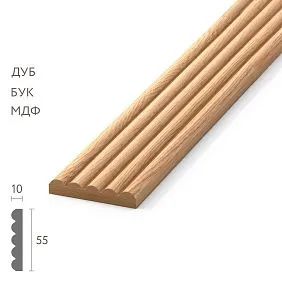
Decorative wooden moldingDecorative molding creates fine geometry within large forms. If moldings divide a wall into panels of 100x150 cm, decorative molding divides these panels into smaller sections of 40x50 cm. If a door has a panelled structure, decorative molding divides the panels into even smaller fragments. This multi-level detailing is characteristic of classical interiors, where complexity, richness of forms, and architectural refinement are valued.
Decorative molding width 20-35 mm — less than moldings (40-100 mm), but sufficient to be noticeable and create structure. Thickness 8-15 mm ensures strength and visual volume. Decorative molding profile can be flat rectangular or shaped with rounding, bevel, or fluting. Shaped decorative molding creates volume, play of light and shadow, visual interest.
Decorative molding on wall panels divides large sections into smaller ones. A rectangular panel 100x150 cm can be divided by decorative molding into 4-6-9 smaller rectangles. Each is filled with its own material: fabric, wallpaper, painted MDF. Variety of fillings creates visual complexity, richness of textures. Oak decorative molding, with its pronounced texture, creates clear boundaries between sections.
Decorative molding on doors forms the structure of classical panelled doors. The main door frame, 80-100 mm wide, forms the perimeter. Inside, cross-shaped decorative molding divides the door into 4-6 sections. Each section is a panel, flat or three-dimensional. Decorative molding is glued on with additional fixation using finish nails. After painting, the difference between a true frame-panel construction and applied decorative molding is barely noticeable.
Decorative molding on furniture facades creates the classic structure of cabinets and buffets. Each door is divided by decorative molding into sections perceived as separate panels. Decorative molding width 25-30 mm is optimal for furniture — sufficiently noticeable, but not overpowering. Decorative molding profile must match the profile of the furniture body and other interior elements.
Decorative molding color is usually matched with the color of the main frame — molding, door frame, furniture body. This creates a monolithic image, where decorative molding is perceived as part of the structure. Contrasting decorative molding color emphasizes geometry, making the structure more expressive. Popular combinations: white decorative molding on gray background, gold on cream in luxurious interiors, dark on light for graphic effect.
Decorative molding installation requires precision and care. All elements must be parallel and perpendicular, forming exact 90 or 45-degree angles, fitting together without gaps. Any carelessness — a crooked line, a gap at the joint, profile mismatch — destroys the impression of quality. Professional craftsmen use laser levels, guides, templates to ensure perfect geometry.
Combining profiles in one room
Creating a harmonious classical interior requires coordination of all profiled elements — baseboards, baseboards, moldings, decorative moldings. Basic principle — unity of motifs. If baseboard has a 8 mm radius rounding, baseboards should have similar or proportional 5-6 mm rounding. If moldings contain a specific shape, decorative moldings should repeat a similar motif at a smaller scale.
Element color coordination follows several schemes. Monochromatic scheme — all wooden elements one color (natural oak, white, wenge) — creates a calm, balanced atmosphere. Tonal scheme — elements of one color with varying saturation (light gray baseboard, gray baseboards, dark gray moldings) — adds depth while maintaining unity. Contrast scheme — two colors (white and oak, white and wenge) — creates graphic effect, expressiveness.
What height of skirting board is optimal for a classic interior? 100-150 mm depending on ceiling height. For standard 2.7 m — 110-120 mm, for high 3.5 m — 140-160 mm.
Material unity is critical. All wooden elements must be from one species — oak or beech. Mixing oak and beech gives different textures that disrupt integrity even under identical paint. Exception — intentional contrast, for example, baseboards and baseboards from oak with lacquer, while moldings are painted white. But this must be a deliberate design technique with clear logic.
Stylistic unity means all profiles correspond to one era of classicism. Strict, minimalist profiles — for early classicism and neoclassicism. More elaborate, with carved elements — for mature classicism. Luxurious, with complex carving and gilding — for baroque and empire. Mixing styles from different eras creates eclectic, ambiguous imagery requiring high designer skill.
Designing a profile system begins with sketches and computer visualizations. The designer draws all elements to scale, evaluates proportions, profile consistency, color combinations. Samples of all profiles are ordered, assembled into a wall or door fragment mockup. Harmony of combinations is assessed. Adjustments are made until the ideal result is achieved. Only after concept approval is an order placed for full production.
Rules for selecting sizes and cross-sections
Selection of trim sizes follows proportional systems tested by centuries of architectural practice. Basic principle — element sizes relate to room dimensions and to each other according to specific rules.
Baseboard height is determined by the formula: room height / 20 or 25. For a 2.7 m high room: 2700 / 22 ≈ 120 mm. For 3.0 m height: 3000 / 22 ≈ 135 mm. For 3.5 m height: 3500 / 22 ≈ 160 mm. This creates visual balance, where baseboard is noticeable but not overpowering.
Baseboard width is determined relative to opening width: opening width / 8 or 10. For an 800 mm opening: 800 / 9 ≈ 90 mm. For a 900 mm opening: 900 / 9 ≈ 100 mm. For a wide 1200 mm opening (double doors): 1200 / 10 ≈ 120 mm. Too narrow a baseboard disappears on a wide opening, overly wide one overwhelms.
Decorative molding width for wall panels is chosen based on panel dimensions. For a 100x150 cm panel, 60-70 mm molding is suitable. For a large 150x200 cm panel — 80-100 mm. For small 60x80 cm panels — 40-50 mm. Rule: molding width should be 1/15 - 1/20 of the smaller panel side.
Decorative molding width is always less than the molding it complements. If molding is 80 mm, decorative molding is 25-30 mm. If molding is 60 mm, decorative molding is 20-25 mm. Ratio approximately 1:3 or 1:2.5. This creates visual hierarchy, where large elements dominate, small ones detail.
Element thickness affects visual weight. Thin elements 10-15 mm appear elegant but may seem fragile. Medium thickness 16-22 mm — universal solution, balancing elegance and solidity. Thick elements 25-35 mm create massive, monumental appearance, characteristic of formal rooms.
Section proportions (width-to-thickness ratio) affect perception. Square section (50x50 mm) is perceived as a plank — constructive, but not decorative element. Rectangular section with width predominance (80x20 mm) creates flat, panel-like appearance. Optimal ratio for decorative elements 3:1 or 4:1 (80x20, 100x25) — sufficiently flat to adhere to walls, sufficiently voluminous to create expressive relief.
Material quantity calculation is performed by room perimeter for baseboards, by opening perimeter for baseboards, by line length for moldings. 10-15% allowance is added to calculated quantity for trimming, corner joints, possible defects. Saving on allowance leads to problems during installation when a few centimeters are missing and additional purchase is required, risking color mismatch.
Conclusion: Classic set from STAVROS
Classic interior requires flawless quality of each element. STAVROS company specializes in manufacturing complete trim sets for classical interiors:Wooden baseboard, Oak skirting boards are an indispensable element of classic interior styles. In the English style, oak skirting boards with rich carving emphasize the aristocracy and solidity of the space. Dark wood tones harmonize beautifully with traditional materials — natural stone, leather, bronze., Wooden moldings, Door Trim, layouts.
Selected oak and beech wood, kiln-dried to 8±2%, processed on high-precision equipment, professional finishes — STAVROS quality standards. All elements are manufactured from one batch of wood with a unified processing process, guaranteeing color and texture compatibility.
Wooden skirting boards, decorative moldings, Wooden profileAvailable from stock in Saint Petersburg and Moscow with delivery across Russia. Custom manufacturing possible based on individual drawings with development of unique profiles.
Frequently asked questions
What height of skirting board is optimal for a classic interior? 100-150 mm depending on ceiling height. For standard 2.7 m — 110-120 mm, for high 3.5 m — 140-160 mm.
Can oak and beech elements be combined? Not recommended — the texture difference is noticeable even under paint. It’s better to use one wood species for all elements.
How to coordinate skirting board and casing profiles? They should have similar motifs — rounding radii, profile characteristics. Order samples and assemble a mock-up for evaluation.
How much does a classic set for a 20 m² room cost? It depends on the number of openings and the area of molding panels. On average, 80,000–150,000 rubles including materials and installation.
Do you need to treat oak skirting boards additionally? If supplied with factory finish — no. Untreated solid wood requires primer and 2–3 layers of lacquer.
What is the service life of oak skirting boards? With proper use — 30–50 years. Oak practically does not wear out; only the finish needs updating every 7–10 years.
Can you install a classic skirting board yourself? Technically possible with the right tools and experience. For an ideal result, it’s recommended to hire professionals.