Article Contents:
- Why trim should be chosen as a system, not individually
- What happens when this logic is broken
- What role does a wooden cornice play in the overall composition
- Three roles of a wooden cornice
- How a wooden cornice should relate to the rest of the trim
- Types of wooden cornices by profile
- How to choose a wooden skirting board for the floor to match the cornice and moldings
- Skirting board height and its connection to the cornice
- Skirting board profile language
- Wooden skirting board: wood species and tone
- Wooden ceiling skirting as an alternative to classic cornice
- How moldings connect top and bottom and make trim a system
- What is wooden molding and why it is needed
- How moldings should relate to cornice and skirting board
- Wall moldings: practice
- What should match: profile, wood, radius, scale, and tone
- Parameter 1. Profile geometry and level of decorativeness
- Parameter 2. Scale and visual weight
- Parameter 3. Wood species and tone temperature
- Parameter 4. Finish coating
- Parameter 5. Line frequency
- When it's better to make a set calm, and when — more expressive
- Calm set: when it's the right choice
- Expressive set: when it's justified
- What mistakes make the interior disjointed
- Mistake 1. Cornice as the main character to the detriment of the system
- Mistake 2. Different wood without tinting
- Mistake 3. Moldings from a different stylistic language
- Error 4. Ignoring proportions
- Error 5. Too many horizontal pulls
- Error 6. Different coating gloss levels
- Error 7. Good trim and cheap mounting substrate
- How to choose trim products for different rooms
- Living Room
- Bedroom
- Office
- Hallway and entrance hall
- Staircase zone
- Dining Room
- Practical checklist before purchasing a trim set
- FAQ: answers to the most important questions about trim selection
- Conclusion
This is the main pitfall of wooden millwork: each element individually can be excellent, but together they create a mismatch that ruins the entire impression of the interior. This is where the question arises, asked during any serious renovation: how to select wooden cornice, with a classic profile creates a sense of solidity, reliability.andMoldings so that everything works together as a unified system?
The answer to this question is not about buying everything in one store. The answer lies in understanding the principles by which millwork products are combined. And it is these principles that we will examine in this article — in detail, practically, without empty words.




Why millwork should be chosen as a system, not individually
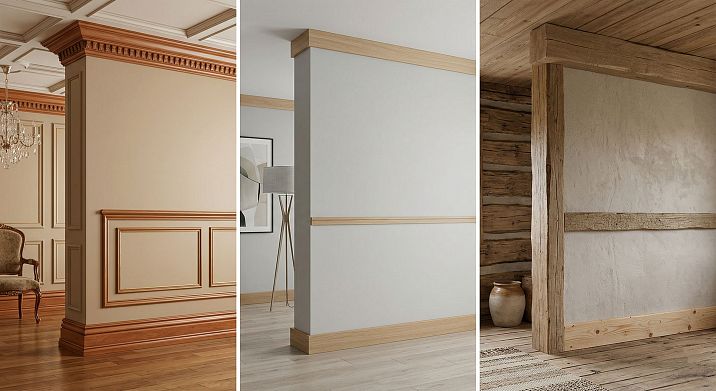
There is a logic that architects and designers understand but rarely explain to buyers. Any room has three horizontal levels that the eye perceives as the frame of the space:
-
The upper level is the junction of the wall and ceiling. This is where the cornice or ceiling plinth works.
-
The middle level is the plane of the wall. This is where moldings work: paneling, horizontal or vertical framing.
-
The lower level is the junction of the wall and floor. This is where the floor plinth works.
When all three levels are designed coherently, the space reads as a whole. When there is no visual connection between them, the room seems 'pieced together from fragments.'
Exactly thereforeWooden trimneeds to be considered not as a set of separate product items, but as an architectural system. Each element should 'speak' to the adjacent one: they should share a common plastic language, a similar tone, and a matching scale of decorativeness.




What happens when this logic is broken
One of the most common scenarios: a person chooses a ceiling cornice with a lush classical ogee, then moldings from a more modern series with a minimalist straight profile, and takes a floor plinth from an MDF collection 'whatever was in stock.' The result is three different stylistic languages, three different material sensations, three different 'moods.' The room looks not well-thought-out, but randomly assembled.
And conversely: when the cornice, moldings, and plinth are taken from a unified stylistic register—with profiles close in spirit, from the same wood species or the same tonal range—the interior acquires that very integrity, which cannot be added later with any decorative cosmetics.
Trimming Itemsmade of natural wood is the frame you place around your space. And this frame should be organic, not assembled.
Our factory also produces:


What role does a wooden cornice play in the overall composition?
The cornice is the first thing the eye 'reads' when entering a room and scanning the wall from top to bottom. It is the cornice that sets the tone for the entire trim system. It is not just a decorative strip at the junction of the wall and ceiling—it is architectural punctuation that tells the observer: here is classic, here is modernity, or here is something else.
Get Consultation
Three roles of a wooden cornice
The first role is visual closure of the upper joint. Even a perfectly executed renovation rarely yields a perfect joint between the wall and ceiling around the entire perimeter. A wooden cornice closes this joint, creating a clean horizontal line that visually 'lifts' the ceiling and structures the space.
The second role is the semantic starting point of the system. It is the cornice that sets the level of decorativeness for all the trim. An active, rich-profile cornice is an invitation to a classic interior. A calm rectangular or slightly rounded profile is modern classic or neoclassical. A minimal straight batten is for Nordic and Scandinavian interiors.
The third role is the visual frame of the ceiling. In rooms with high ceilings, the cornice acts as a boundary that 'separates' the ceiling plane from the wall plane. When decorating the ceiling (coffers, painting, stucco), the cornice is a framing element that completes this decoration.
How should a wooden cornice relate to the rest of the trim?
Universal rule: the cornice should not be more active than the moldings and baseboard combined. If the cornice has deep relief, a three-level profile, and complex plasticity—the moldings should be related to it in style but slightly calmer. The baseboard should be yet another step calmer.
wooden cornicewith a projection of 60–80 mm is the classic scale for rooms with ceilings of 2.8–3.2 m. For low ceilings (2.5–2.7 m), a cornice with a projection of more than 50 mm will feel oppressive and create a sense of 'overhang'. For high ceilings (3.2 m and above), a cornice with a projection of 80–120 mm is appropriate and even necessary for proportion.
Types of wooden cornices by profile
-
Single cove molding — a simple concave transition. Minimal decor, maximum conciseness. Works well in modern classic and neoclassical styles.
-
Double cove molding or stepped profile — a more complex form with horizontal shelves. A classic option for a full-fledged classical interior.
-
Cornice with quarter-round — a form characteristic of European classicism with a rounded protruding element. Rich, expressive, requires matching baseboard and moldings.
-
Flat shelf cornice — a minimalist profile, essentially a horizontal shelf at the joint. For interiors where any relief is perceived as excessive.
-
Cornice with reverse cove — a rarer, refined profile where the concavity faces outward. Creates a sense of lightness and visually 'detaches' the ceiling from the walls.
How to choose a wooden floor baseboard to match cornice and moldings
Floor baseboard is the lower point of a room's architectural frame. And although it is located right at the floor, it is the first thing noticed when the gaze slides along the perimeter of the room.
The main rule for choosing a wooden baseboard in a system with cornice and moldings: the baseboard should be related to the cornice in form, but not compete with it in scale.
Baseboard height and its relation to the cornice
There should be a proportional relationship between the height of the cornice and the height of the baseboard. Classical recommendations:
| Ceiling Height | Cornice (projection/height) | Baseboard (height) |
|---|---|---|
| 2.5–2.7 m | 40–50 mm | 60–80 mm |
| 2.7–3.0 m | 50–70 mm | 70–90 mm |
| 3.0–3.5 m | 70–100 mm | 80–100 mm |
| Above 3.5 m | 100–140 mm | 100–120 mm |
The baseboard can be equal in height to the cornice or slightly lower. A baseboard taller than the cornice is almost always a visual mistake that 'overturns' the space.
Baseboard profile language
The same principle applies here as with the cornice: the profile type must match or be related.
Cornice with a cavetto → baseboard with a cavetto. Cavetto — a concave quarter-round transition — is one of the most common motifs in classical molding. If the cornice has a cavetto, a baseboard with a similar element creates a stylistic rhyme.
Cornice with a quarter-round torus → baseboard with a semicircular projection or stepped profile. The rounded motif of the top should be echoed in the bottom line.
Minimalist cornice → straight baseboard without a figured profile. The purest contemporary system: straight lines at the top and bottom, no deliberate 'decorations'.
Wooden baseboard: wood species and tone
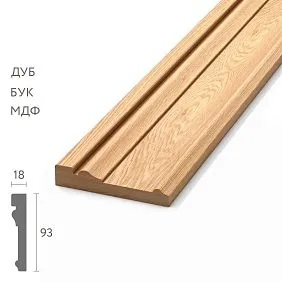
with a classic profile creates a sense of solidity, reliability.Solid oak, beech, or ash — it's not just beautiful. It's functional: solid wood is durable, resistant to mechanical damage, can be restored and repainted. Unlike MDF — it does not swell from accidental moisture exposure and does not lose its shape over time.
Tone rule: the baseboard can be slightly darker than the cornice—this creates a 'grounding' of the space, a visual weight at the floor. A baseboard lighter than the cornice is atypical and requires a deliberate design decision.
Buying a wooden baseboardAvailable in several profile and wood species options—it's important to choose immediately considering which cornice and moldings already exist or are planned for the interior.
Wooden ceiling baseboard as an alternative to the classic cornice
A separate category—Ceiling baseboard woodenThis is a lighter and more delicate element than a cornice with a projection—it is attached in the corner between the wall and ceiling and creates a neat transition line without a massive overhang. A good option for rooms with low ceilings or in interiors where a system is needed but without classical opulence.
How moldings connect the top and bottom and make the trim a system
Moldings are the middle line. If the cornice is the beginning of a sentence, the baseboard is its end, then moldings are its content, its development. They are what create the architectural richness of the wall: paneling, framing, horizontal bands, decorative frames.
What is a wooden molding and why is it needed
Wooden molding—is a profiled strip made of solid wood with a decorative cross-section. Unlike a flat batten or trim, a molding has a shaped profile: a torus, a cavetto, a bevel, a step, a cyma, or their combination. It is this profile that creates the play of light and shadow on the wall.
Wood moldings are used:
-
Along the perimeter of wall panels — they form rectangular frames, dividing the wall into zones
-
As a horizontal rail — at a height of 80–120 cm from the floor, it separates the lower panel zone and the upper painted zone of the wall
-
As framing for niches, doorways, mirrors — a decorative frame made of moldings
-
As a rail under the cornice — an additional horizontal line under the top border of the wall, which supports the cornice and creates a sense of layered classical finishing
How moldings should relate to the cornice and baseboard
Key principle: moldings should quote, not copy, the cornice and baseboard.
If the cornice has a double ogee — the molding can have a single one. If the baseboard has a rectangular stepped profile — the molding can have a similar but scaled-down one. This creates a family resemblance among elements without a sense of monotony.
Unacceptable: moldings from a fundamentally different stylistic register than the cornice and baseboard. Carved moldings in a Baroque spirit + minimalist cornice + Scandinavian baseboard — these are three different interior languages in one space.
Wall moldings: practice
Moldings for walls to buy— means first and foremost determining:
Molding width. For small rooms — 20–35 mm. For large living rooms and halls — 40–60 mm. For monumental classical spaces — 60 mm and more.
Relief depth. A delicate profile with a relief of 5–8 mm — for modern classic. A rich relief of 15–25 mm — for classical and neoclassical interiors. Minimal relief or flat molding — for laconic interiors.
Placement spacing. Horizontal molding rails: one line at a height of 80–100 cm from the floor — standard. Rectangular wall panels: horizontal spacing 60–90 cm, vertical — from the baseboard to the horizontal rail or to the cornice.
What should match: profile, wood, radius, scale, and tone.
This is the most important expert section. Not 'what to buy,' but 'how to make sure everything will work together.' Five parameters by which millwork either becomes a system or falls apart into unrelated parts.
Parameter 1. Profile geometry and level of decorativeness.
The profile of each millwork element is characterized by two things: the type of curves (straight, concave, convex, composite) and the level of saturation (how many elements, how complex the cross-section).
All three elements of the system — cornice, moldings, baseboard — must be in the same saturation range:
| Range | Crown Molding | Moldings | Skirting board |
|---|---|---|---|
| Minimalist | Straight or one small bevel. | Flat or with a minimal bevel. | Straight rectangle |
| Modern Classic | One bead + shelf | One bead or profile with smooth transition | Profile with one projection |
| Classic | Double bead + torus + shelves | Double bead or torus + shelf | Profile with bead + projection |
| Neoclassical rich | Multi-level profile with reverse curves | Rich relief, multiple levels | High skirting board with a pronounced profile |
Parameter 2. Scale and visual weight
Scale is not only about physical size but also the visual 'weight' of an element. A wide, thin molding and a narrow, deep molding can have the same width but completely different visual weights.
Principle: all elements of the system should be in the same 'weight class'. A massive, rich cornice + a thread-like molding + a light skirting board are different weight categories that create visual imbalance.
Parameter 3. Wood species and tone temperature
Wood is a living material. Each species has its own perceived temperature:
-
Oak — warm, substantial, neutral in temperature
-
Ash — slightly cooler than oak, lighter, with a pronounced grain
-
Beech — uniform, soft, takes finishes well
-
Birch — light, somewhat cool, delicate
-
Walnut — dark, warm, rich
-
Larch — reddish, resinous, warm
Mixing a cornice made of light ash and a baseboard made of warm oak without tinting means getting a mismatch in temperature. It is best to take all three elements from the same wood species or from species of the same temperature group.
Parameter 4. Finish coating
The coating should be uniform or at least of the same type for the entire system:
-
All elements in natural oil — an organic system with a living, warm surface
-
All elements in matte varnish — a smooth, modern surface
-
All elements in opaque paint — a uniform color that hides differences in wood species. Works well when painted to match the wall color or in a contrasting white
Not allowed: cornice in glossy varnish, moldings in matte, baseboard in oil. Three different surfaces will create inconsistency even with the same wood species.
Parameter 5. Line frequency
Moldings create a horizontal rhythm on the walls. If the cornice has three horizontal lines in its profile, the moldings add three more, and the baseboard adds another two, resulting in the wall being 'covered' with a fine horizontal raster. This is acceptable for a rich classical interior in a large room. For a small room, it's overkill.
Principle: the total number of horizontal lines in the profiles of the entire system should correspond to the scale of the room.
When it's better to choose a calm set, and when to opt for a more expressive one
This is not a matter of taste—it's a matter of space, ceiling height, and interior design goals.
Calm set: when it's the right choice
Small room (up to 20 m²). A rich set with an active cornice, moldings, and a tall profiled baseboard will 'eat up' the space. A light cornice 40–50 mm, delicate moldings 20–25 mm, and a 60 mm baseboard without excessive relief—this is a system that frames without overwhelming.
Low ceilings (up to 2.7 m). Here, it's important not to create a feeling of 'overhang from above' and 'pressure from below.' A cornice up to 40–50 mm without a protruding roll, molding strips instead of full-fledged frames, and a baseboard up to 70 mm.
Modern interior in neutral tones. Gray, white, cream walls + light floor. Here, active relief in the set will look archaic. A flat or nearly flat cornice, thread-like or lightly profiled moldings.
Scandinavian and Nordic style. The principle 'less is more' in full effect. A rectangular baseboard 60×12 mm, a thin cornice 30×20 mm, moldings are absent or replaced by a straight wooden batten.
Expressive set: when it's justified
High ceilings (3.0 m and above). Here, a cornice with a projection of 80–120 mm, full-size moldings with a relief of 15–20 mm, and a high baseboard of 80–100 mm are not only appropriate — they are necessary. Without them, a tall room seems 'empty' and unfinished.
Classic interior. Furniture in a classic style, dark wood, textiles with historical motifs — all of this requires corresponding trim. A rich cornice, moldings with a cove or double ogee profile, a high baseboard with a profile.
Living room as the 'main hall'. In formal living rooms, rich trim emphasizes the status of the room. This is acceptable even with ceilings of 2.8–2.9 m, if the profiles are carefully proportioned.
Neoclassicism. A modern interior with classical architectural references is one of the most relevant trends. Here, the trim is more moderate than in pure classicism, but significantly richer than in minimalism.
What mistakes make an interior look disjointed
These are not abstract recommendations. These are real mistakes that are repeated again and again — and which can be easily avoided by understanding the logic of the system.
Mistake 1. The cornice as the main character to the detriment of the system
The most common mistake is to buy a lush, rich cornice, attracted by its beautiful appearance on a separate sample. And then discover that baseboards and moldings of the same level of richness are not available, and as a result, the set turns out to be unbalanced.
Rule: start choosing trim not with the cornice, but with the moldings. Moldings are the middle level, which is most often the most visible on the wall. By determining their level of decorativeness, you can easily match them with a slightly more active cornice and a slightly calmer baseboard.
Mistake 2. Different wood without staining
Pine cornice in natural color — yellowish-reddish. Birch moldings in natural — almost white. Oak wooden baseboard — warm brown. All three in their 'natural' state will produce three different colors. If this cannot be covered by a single paint — you either need to take them from the same wood species or tint them to a uniform tone.
Mistake 3. Moldings from a different stylistic language
Moldings with a 'baroque' curve together with a straight Scandinavian cornice — this is not eclecticism, it's a mistake. Eclecticism is a conscious mixing; such a mix is simply inconsistency.
Mistake 4. Ignoring proportions
A 120 mm baseboard in a room with 2.5 m ceilings is a visual 'hoop' at the floor that presses down and compresses the space. A cornice with a 100 mm projection at a 2.6 m ceiling — a similar effect from above. Proportions are not an option, but a mandatory condition.
Mistake 5. Too many horizontal moldings
If, besides the cornice, moldings, and baseboard, you add two more horizontal molding strips on the wall, decorative strips under the cornice, and an additional frieze — you'll get a 'latticed' wall. This is especially destructive in small rooms.
Mistake 6. Different gloss levels of finishes
Glossy cornice + matte moldings + semi-matte baseboard — three different light reflections. This is very noticeable under directional lighting. The finish coating should be the same for the entire system.
Mistake 7. Good trim and cheap mounting substrate
An expensive wooden cornice installed on uneven plaster 'as it turned out' will create a wavy contour along the entire ceiling perimeter. High-quality millwork requires high-quality installation. This is not a detailed topic of this article, but it's important to remember: the millwork system begins with proper surface preparation.
How to choose millwork products for different rooms
Different rooms — different tasks. The same millwork system does not work the same in the living room and the study, in the hallway and the bedroom.
Living Room
The main formal room. Here, the millwork can be the most saturated and expressive. A cornice with a projection of 60–100 mm, moldings with wall paneling, a wooden floor baseboard 80–100 mm. If the ceiling allows — a two-level system: a cornice molding and frame moldings on the walls.
Wood species for the living room: oak, ash, or walnut — warm, representative, looking good in any lighting.
Bedroom
A space for rest requires quieter, calming millwork. A cornice 40–60 mm without a pronounced projection, delicate moldings or replaced by a horizontal molding strip, a wooden floor baseboard 60–80 mm with a soft profile.
A good solution for the bedroom is a wooden ceiling baseboard instead of a cornice and a thin molding strip at a height of 90–100 cm as the only decorative element on the walls.
Office
The study gravitates towards a 'library' language: wood, order, strictness. The millwork here can be more saturated than in the bedroom — especially if the interior is rich in wood: shelving, parquet, wooden panels. A cornice 50–70 mm, medium-scale moldings, a tall wooden baseboard 80–100 mm made of oak or walnut.
Corridor and hallway
A narrow room with frequent movement. The millwork should be functional and not overwhelm the space. A delicate cornice 30–40 mm or a ceiling baseboard, moldings only as a horizontal strip — or absent altogether, a reliable wooden floor baseboard of medium height 60–70 mm. In the hallway, the durability of the baseboard is especially important — it will receive impacts from shoes, bags, suitcases.
Staircase zone
The staircase is an architectural object visible on multiple levels. The millwork here works differently: cornices on landings, moldings along the flight as horizontal strips, baseboards around the perimeter of each landing. Consistency with the wooden elements of the staircase itself is important: steps, stringers, railings.
Dining Room
The space for dining and socializing can accommodate warmer and more substantial trim than the bedroom. Cornice 50–70 mm, frame-style moldings around the table, wooden baseboard 70–90 mm. Wooden coving at the wall-ceiling junction is appropriate here.
Practical checklist before purchasing a trim set
Before going to choose wooden cornice, baseboard, and moldings — answer these questions. They will save you from costly mistakes.
1. In which room and for which zones is the trim needed?
Formal living room → a rich set is possible. Small bedroom → delicate. Hallway → functional and durable.
2. What is the ceiling height?
Up to 2.7 m → cornice no more than 50 mm projection, baseboard up to 70 mm. 2.7–3.0 m → cornice 50–70 mm, baseboard 70–90 mm. Above 3.0 m → cornice 70–100 mm, baseboard 80–100 mm.
3. What level of decorativeness is needed: calm or rich?
Modern classic / neoclassical → moderate. Classic → rich. Minimalism / Scandinavian → delicate.
4. Is painting of the trim planned or will the natural wood be preserved?
Painting → you can use different wood species, but a uniform finish is important. Natural wood → only one species or one tonal group.
5. Are there already elements in the interior that set the tone?
Oak parquet → oak skirting board or a similar tone. White doors with milling → cornice with a similar profile tongue.
6. Is a full set (cornice + moldings + skirting) needed or only part?
If only skirting — keep in mind that it will later need to match the cornice. It's better to define the entire system at once.
7. What tone and finish are already used or planned?
Uniform finish — mandatory.
8. Is there a need to purchase material later?
If you need a reserve — buy immediately with a 10–15% surplus. Wood batches may vary in tone.
Buywooden cornice, Moldings for wallsandWood skirting boardas a set — this is the correct approach, which guarantees stylistic unity of the system and saves time on subsequent selection.
FAQ: Answers to the Most Important Questions About Selecting Molding
How to Choose a Wooden Cornice to Match the Baseboard?
The cornice and baseboard should match in the stylistic register of the profile (both classic or both modern), in wood species or tonal range, and in the scale of decorativeness. The cornice is typically slightly more prominent than the baseboard—it forms the upper frame and sets the tone for the system.
Which Wooden Floor Baseboard Pairs Best with Moldings?
The wooden floor baseboard should be the 'younger sibling' of the moldings: have a related profile but a more restrained scale. If the moldings have a bead—the baseboard should have a similar bead but of a smaller cross-section. If the moldings are flat—the baseboard should be rectangular.
Can Different Moldings and One Cornice Be Used?
Yes, but with caution. Different moldings are permissible in different zones of the same room (e.g., frame moldings in one part and a cornice in another)—if they are all from the same series or share the same profile language. Mixing moldings from fundamentally different stylistic series is a mistake.
What Is More Important: Matching the Profile or Matching the Wood Tone?
Both parameters are equally important. The profile determines the stylistic connection. The wood tone determines the visual temperature. When painting the molding in a uniform color, the wood tone becomes secondary—only the profile matters. With a natural finish—both parameters are critical.
Is It Necessary to Choose All Molding from the Same Series?
This is an ideal scenario, but not mandatory. It's more important that all elements are in the same stylistic register and tonal range. You can combine different series if they are stylistically close.
Which molding is best for a calm, modern interior?
Wooden molding with a minimal profile: flat with a small bevel, or with one gentle cove, 20–30 mm wide. It works well as a horizontal rail at a height of 80–100 cm, without frame trims.
Where to buy millwork products in the same style?
In the STAVROS catalog — wooden cornice, wooden floor skirting, wooden moldings, wooden ceiling skirting, and full wooden millwork are produced in unified stylistic series with coordinated profiles.
Can I buy a set of wooden millwork at once?
Yes. Choose all elements from one series or one stylistic register, from one wood species, and with a unified finish. This is the most professional approach, guaranteeing a cohesive visual result without subsequent rework.
How to calculate the amount of millwork?
The perimeter of the room (in linear meters) is the base unit for cornice and skirting. Moldings are calculated by the total length of all horizontal rails and vertical trims. Add a 10–15% reserve for cutting and joints.
Conclusion
An interior does not come together by itself from randomly assembled details. It is built according to the laws of visual logic, which work regardless of whether the apartment owner knows about them or not. Wooden cornice, wooden skirting, and moldings are precisely those three points of support that hold the architectural image of a room: the top line, the middle division, the bottom finish.
When all three elements speak the same language — similarly warm wood, related profiles, coordinated scale, and unified finish — the space gains an integrity that cannot be added with furniture, textiles, or decor. It is wooden millwork that creates that architectural frame within which everything else becomes organic.
Conversely, a mismatch in millwork is a quiet but ineradicable source of visual discomfort. Correcting it after finishing work is very difficult and expensive.
That is why selecting millwork products is not a step for 'later,' but a decision that needs to be made at the very beginning of the project, before purchasing materials and before installation begins.
STAVROS company produces a full range of solid oak, beech, and ash wooden millwork: cornices, moldings, floor and ceiling skirting boards, glazing beads, battens, and slats. All STAVROS products are released in coordinated style series — with thoughtful profiles, uniform surface finish quality, and stable dimensions, allowing for the formation of complete millwork sets without the risk of stylistic mismatch.
If you want your interior to look cohesive, expensive, and well-considered — start with the right choice of millwork. In the STAVROS catalog, you will find everything you need: from a delicate ceiling skirting board for a modern bedroom to a rich classic cornice for a formal living room. Each element can be selected within a unified system — by profile, wood species, scale, and tone. This is how wooden millwork transforms from a set of separate planks into an architectural statement that makes your space truly complete.