Article Contents:
- Anatomy of a Reliable Connection: Understanding the Basics
- Physics of Loads and Materials Science
- Types of Fastening Systems
- Tool Preparation: The Master's Arsenal
- Accuracy — the foundation of quality
- Specialized fixtures
- Methodology of Fastening: From Theory to Practice
- Shank Connections: The Classic of Carpentry
- Threaded connections: strength of metal
- Modern Fastening Systems
- Step-by-step installation technology
- Preparation Stage: Planning and Marking
- Drilling Hole Technology
- Installation and Fixation Procedure
- Working with different materials: key features
- Hardwood Species
- Softwood Species
- Composite and Engineering Materials
- Quality Control and Problem Diagnosis
- Methods for Checking Connection Reliability
- Typical Defects and Ways to Eliminate Them
- Innovative Technologies and Modern Solutions
- Digital Technologies in Carpentry
- Smart Materials and Coatings
- Economic Aspects and Project Planning
- Cost Optimization Without Compromising Quality
- Comparative Analysis of Fastening Methods
- Safety and Occupational Health
- Personal Protection During Work
- Electrical Safety on Site
- Conclusion
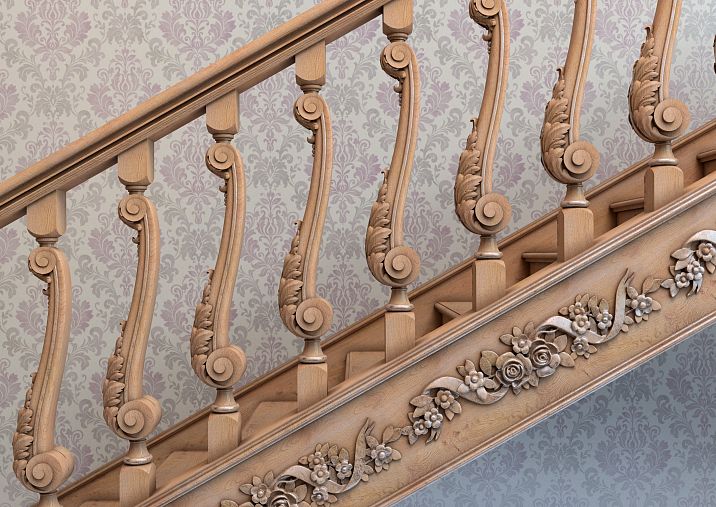
Imagine a staircase without securely fastened balusters. This is not merely an architectural oversight — it is a potential safety hazard for anyone ascending the steps. After fifty years of work in the woodworking industry, I have come to understand: how to secure a baluster to a step correctly — this is a question that requires not only technical knowledge but also an understanding of the philosophy of reliability.
Each baluster is not merely a decorative element. It is a safety guard that must withstand not only static loads but also sudden jerks, children’s play, and accidental bumps. A poorly secured post can become the cause of serious injury. That is why I decided to share my accumulated experience, revealing all the nuances and intricacies of professional fastening.
In this material, you will find not just instructions, but a deep understanding of the process. We will examine various fastening methods, study the characteristics of working with different materials, consider typical mistakes and ways to avoid them. Ready to dive into the world of professional craftsmanship?


Anatomy of a Reliable Connection: Understanding the Basics




Physics of Loads and Materials Science
Before picking up the tools, it is necessary to understand what forces will act upon our connection. The baluster experiences not only vertical loads from its own weight and the weight of the handrail, but also horizontal forces from people leaning on the railings. Dynamic loads can be several times greater than static ones — that is why it is so important to correctly calculate and execute the fastening.
Wood is an anisotropic material, meaning its properties vary depending on the direction of the fibers. Compressive strength along the grain may be 10-15 times higher than across the grain. This is critically important to consider when selecting fastening methods and the orientation of fasteners.
Wood moisture plays a key role in the longevity of the joint. Dry wood with a moisture content of 8-12% ensures dimensional stability and fastener strength. Wet wood shrinks upon drying, which may weaken joints. That is why professionals always monitor material moisture before starting work.
The coefficient of thermal expansion varies among different wood species. Oak behaves differently than pine, and larch is not like birch. An experienced craftsman takes these characteristics into account when selecting fasteners and installation techniques, ensuring joint longevity under various climatic conditions.
Our factory also produces:


Fastener System Types
The modern industry offers numerous ways to fasten balusters to treads. Each method has its advantages and limitations, and the choice depends on specific conditions: type of wood, expected loads, aesthetic requirements, and project budget.
Mechanical fasteners provide high strength and the ability to disassemble. These include various types of bolts, screws, and self-tapping screws. The main advantage is the ability to tighten the joint if it loosens. The disadvantage is the visibility of fasteners unless special masking measures are taken.
Adhesive joints create a monolithic structure with even stress distribution. Modern wood adhesives provide strength exceeding that of the wood itself. However, such joints are irreversible and require ideal surface preparation.
Combined methods combine mechanical fastening with adhesive, ensuring maximum reliability. The adhesive fills microscopic irregularities, creating additional contact area, while mechanical fastening provides the primary load-bearing capacity.
Get Consultation
Tool Preparation: The Craftsman's Arsenal
Accuracy — the Foundation of Quality
Quality tools are not a luxury but a necessity for professional work. After years of practice, I’ve learned: saving on tools results in lost time, reduced quality, and ultimately additional expenses.
A precision drill with variable speed is the foundation of accurate drilling. High speeds are suitable for small holes in soft wood, while low speeds are for large holes in hard woods. The reverse function is necessary to remove jammed drills and clear shavings from deep holes.
Wood drill bits must be made of high-quality steel and properly sharpened. Spiral grooves should be polished for easy chip removal. A centering tip ensures accurate drill bit positioning and prevents displacement during initial drilling.
Measuring tools require special attention to accuracy. A metal tape measure provides more accurate results than a cloth one. A caliper is necessary to control hole and fastener diameters. An angle gauge will help precisely determine the angles for trimming balusters on inclined staircases.
Specialized Tools
A drill guide is a device that many consider unnecessary. However, it guarantees that the hole is perpendicular to the workpiece surface. A homemade drill guide can be made from a piece of hard wood with bushings of the required diameter.
Clamps of various sizes are necessary to hold parts during processing and assembly. Quick-release clamps speed up work, but screw clamps provide greater clamping force. Soft pads prevent damage to the wood surface.
The laser level revolutionized marking accuracy. It allows constructing perfectly horizontal and vertical lines at any distance. When installing long rows of balusters, the laser beam ensures precision unattainable with traditional methods.
Fastening Methodology: From Theory to Practice
Dowel Joints: The Classic of Carpentry
Wooden dowels are a time-tested technology for joining wooden parts. A properly executed dowel joint can last for centuries without losing strength. The secret lies in precise manufacturing and material quality.
The dowel diameter should be approximately one-third of the thickness of the joined parts. For 50×50 mm balusters, optimal dowels are 12–16 mm in diameter. The dowel length is calculated so that it enters each part to a depth of at least two diameters.
The quality of dowel wood is critically important. The best dowels are made from hardwoods — beech, oak, ash. Wood moisture should not exceed 8%, otherwise, upon drying, the dowel will shrink and weaken the joint. Factory-made dowels undergo special treatment ensuring dimensional stability.
Drilling holes for dowels requires meticulous precision. Even the slightest deviation from coaxial alignment will result in an impossible assembly or weakened joint. I use special drill guides that ensure perfect coaxial alignment of holes in the joined parts.
The adhesive technology is no less important than drilling precision. Adhesive is applied both into the hole and onto the dowel surface. Modern PVA wood adhesives provide joint strength exceeding that of the wood itself. Setting time is 15-20 minutes, full curing takes 24 hours.
Threaded Connections: The Strength of Metal
Metal screws provide maximum strength for fastening balusters. Threaded connections can be tightened if loosened, which is especially important for structures under high loads. A properly executed threaded connection withstands loads many times exceeding operational limits.
The screw diameter depends on the baluster size and expected load. For standard balusters, an M8 or M10 screw is sufficient. Thicker screws may split the wood, especially when installed into end surfaces. Thinner screws will not provide the required strength.
The thread must be metric with a fine pitch. Coarse threads are easier to cut but provide less joint strength. Fine threads create more threads per unit length, increasing contact area and joint strength.
The screw material must match the operating conditions. Galvanized steel is suitable for indoor use, while stainless steel is required for humid conditions. Brass screws are attractive but less strong and suitable only for decorative structures with minimal loads.
Modern mounting systems
The industry is not standing still, offering increasingly advanced baluster fastening systems. Modern solutions combine ease of installation with high reliability and aesthetic appeal.
Insert systems consist of metal sleeves with internal threads that are glued into the base. Balusters are equipped with corresponding threaded elements, ensuring quick and reliable connection. Such a system allows disassembling elements without damaging the structure.
Adjustable fasteners compensate for minor dimensional inaccuracies and allow adjusting baluster positions after installation. This is especially important when working with non-ideal surfaces or when precise alignment of elements is required.
Magnetic fastening systems are an innovation of recent years. Powerful neodymium magnets provide secure fixation without mechanical elements. Such systems are still expensive and are primarily used for temporary structures or when frequent disassembly is required.
Step-by-step installation technology
Preparation Stage: Planning and Marking
Quality installation begins with careful planning. It is necessary to determine the exact number of balusters, their placement, and method of fastening. Building codes require that the distance between vertical elements does not exceed 150 mm on center, but for better appearance, I recommend 100-120 mm between centers.
Marking is performed with mathematical precision. I measure the total length of the installation area, subtract the distances to the outer support posts, and divide the resulting value by the number of gaps between balusters. If the result is not divisible by the desired spacing, I adjust the number of balusters upward.
Each mark is checked twice, and every dimension is independently controlled. Errors in marking are corrected only by complete rework, so saving time at this stage is unacceptable. I use a laser level to establish base lines and a tape measure for precise measurements.
The quality of the base is critically important for reliable fastening. Steps must be perfectly aligned, cleaned of dust and contaminants. Wood moisture is controlled with a moisture meter — it must not exceed 12%. If necessary, the material is dried under natural conditions.
Drilling technology
Drilling holes is an operation requiring maximum concentration and precision. Each hole must be strictly perpendicular to the surface and have a precisely specified diameter. Deviations are unacceptable — they will result in weakened connections or impossible assembly.
The drill bit diameter depends on the type of fastener. For dowels, the hole diameter must exactly match the dowel diameter. For threaded bolts, the hole in the baluster is drilled 1-2 mm smaller than the thread diameter, and in the step — 1-2 mm larger to allow free passage.
Drill depth is controlled by a drill stop or a special bushing. For dowel connections, the hole depth should be half the dowel length plus 2-3 mm for glue. For threaded connections — 5-10 mm deeper than the length of the threaded portion.
Drilling mode is selected depending on the hardness of the wood. Softwoods are drilled at high speeds with large feed, while hardwoods are drilled at low speeds with small feed. Periodic withdrawal of the drill prevents overheating and clogging of the flutes with chips.
Installation and fixation procedure
Securing the baluster to the step Starts with installing the outer support posts. These elements serve as references for all other balusters and must be installed with maximum precision. Any deviation of the outer posts will cause the entire row to be misaligned.
Verticality is controlled by a laser level in two mutually perpendicular planes. Deviation exceeding 1 mm per meter of height is unacceptable. If deviations are detected, I immediately adjust the post position until the fastening is fully secured.
Intermediate balusters are installed using a taut string between the outer posts as a reference. Each baluster is checked for verticality and alignment with the marking. The distance between adjacent elements must be equal with an accuracy of 2-3 mm.
When using glued connections, it is important to follow the technology. Glue is applied both into the hole and onto the surface of the fastening element. The open time is 3-5 minutes, after which the parts must be connected and secured until the glue fully sets.
Features of Working with Different Materials
Hardwood species
Oak, beech, and maple require a special approach when securing balusters. The high density and hardness of these species provide exceptional connection strength, but complicate processing. All fastener holes must be pre-drilled — attempting to screw in a screw without preparation will cause the wood to crack.
Pre-drilling is performed with a drill bit 1-2 mm smaller than the fastener diameter. This ensures tight thread fit and prevents splitting. To ease insertion, the thread can be lubricated with soap or wax — this is a traditional carpenter’s technique.
Glued connections in hardwoods are especially strong due to the dense wood structure. However, setting time may increase due to the material’s low absorption capacity. It is recommended to use glues with extended open time.
Dowel connections in hardwoods last practically forever. Dense wood securely holds the dowel, and the high strength of the material prevents deformation under load. The key is to ensure precise drilling and quality gluing.
Soft coniferous species
Pine, spruce, and fir have a softer structure, which simplifies processing, but requires special attention to connection strength. Softwood may compress under load, so the contact area must be maximized.
Screws in softwoods can be screwed in without pre-drilling, but the fastener diameter must be increased to compensate for the lower material strength. It is recommended to use screws with coarse threads, which grip better in softwood.
Glued connections require special attention to surface preparation. Resin in coniferous species may hinder gluing, so surfaces must be degreased with a solvent. Glue setting time in softwoods is usually shorter due to high absorption capacity.
Dowel connections in softwoods are less reliable due to the possibility of wood compression around the dowel. It is recommended to use dowels of larger diameter or increase their number to ensure sufficient strength.
Composite and engineered materials
Modern wood-polymer composites (WPC) open new possibilities for creating durable stair structures. These materials combine the beauty of natural wood with the practicality of modern technologies.
WPC materials are resistant to rot, do not require protective treatment, and are dimensionally stable. They do not shrink or crack, which simplifies fastening and increases connection longevity. However, composites require special fasteners and pre-drilling of all holes.
Glued wood (glulam) has increased dimensional stability and strength compared to solid wood. The grain direction in adjacent layers is mutually perpendicular, which prevents warping and cracking. Fastening balusters to glued wood is performed using the same methods as for solid wood.
Quality control and problem diagnosis
Methods for checking connection reliability
After completion of installation, a comprehensive quality check of all connections must be performed. Visual inspection reveals obvious defects: gaps, unevenness, deviations from vertical. However, the true strength of a connection can only be assessed using specialized methods.
Load testing is performed by applying controlled forces to each baluster. A horizontal load of 30 kg applied at a height of 900 mm should not cause visible deformations or play. Any movement indicates a defect in the connection.
Acoustic diagnostics help identify hidden defects. Tapping a baluster with a hammer should produce a clear sound. A dull sound indicates the presence of voids or weakened connections. Squeaking indicates play in the fasteners.
Measurement control includes checking the verticality of each baluster, uniformity of distances between them, and compliance with project height dimensions. Deviations must be within tolerances established by construction standards.
Typical defects and methods of their elimination
Over the years of practice, I have encountered numerous defects in baluster fastening. Most of them arise due to violations of technology or use of low-quality materials. It is important to be able to recognize the problem at an early stage and properly eliminate it.
Play in connections is the most common problem, manifesting as movement of the baluster when lightly rocked. Causes may vary: inaccurate hole manufacturing, wood shrinkage, loosening of fasteners, poor glue. Minor play can be eliminated by tightening fasteners or adding glue to the joint.
Gaps in connections arise due to inaccurate fitting of parts or wood shrinkage. Small gaps are filled with wood putty matching the base material color. Large gaps require installation of wooden inserts followed by sanding and finishing.
Deviations from vertical are usually the result of installation errors. Minor deviations can be corrected by adjusting fasteners if the structure allows. Significant deviations require reinstallation of the baluster.
Innovative technologies and modern solutions
Digital technologies in carpentry
Modern technologies have fundamentally changed approaches to designing and manufacturing stair structures. 3D modeling allows visualizing the future structure and identifying potential issues during the design phase.
CNC machines provide ideal precision in processing parts. Programmable centers can perform complex operations with accuracy down to hundredths of a millimeter. This is especially important when manufacturing balusters with complex shapes or when precise dimensional matching is required.
Laser measurement systems allow controlling the geometry of products during manufacturing. Any deviations from specified parameters are immediately detected and corrected. This ensures perfect fitting of parts during assembly.
Computer-aided design (CAD) systems optimize material cutting, minimizing waste. Special programs calculate optimal placement of parts on blanks, taking into account wood grain direction and defect locations.
Smart materials and coatings
The development of the chemical industry has led to the emergence of new materials with unique properties. Self-healing coatings can close minor scratches under heat. Antibacterial compositions prevent microbial growth on wood surfaces.
Nanomaterials open new possibilities for wood protection. Nanoparticles penetrate deeply into the material structure, creating an invisible protective barrier. Such coatings exhibit high wear resistance and longevity.
Thermally modified wood is obtained by processing at high temperatures in an oxygen-free environment. This process alters the material's structure, enhancing its stability and resistance to biological damage. Balusters made from thermally modified wood do not require additional protective treatment.
Economic aspects and project planning
Cost optimization without compromising quality
Proper budget planning is key to successful project implementation. Cutting corners on material and fastener quality is unacceptable, as it reduces the reliability and longevity of the structure. However, there are ways to optimize costs without compromising quality.
The choice of optimal fastening method depends on specific project conditions. For temporary structures, simpler and cheaper methods can be used. For permanent staircases, reliable and durable connections are required, even if they cost more.
Bulk material purchases allow significant discounts. When planning multiple projects, it makes sense to consolidate orders. However, storage conditions must be considered — wood requires protection from moisture and direct sunlight.
Investments in quality tools pay off already on the second or third project. Professional equipment not only speeds up work but also ensures higher quality results. Cheap tools often become the cause of defects and rework.
Comparative analysis of fastening methods
|
Mounting method |
Cost of materials |
Installation time |
Strength |
Durability |
Repairability |
|
Shanks + glue |
Low |
High |
MDF with film |
50+ years |
Low |
|
Threaded rods |
Medium |
Average |
High |
30+ years |
High |
|
Self-tapping screws |
Very low |
Low |
Medium |
10–15 years |
Medium |
|
Special systems |
High |
Low |
High |
25+ years |
MDF with film |
The choice of the optimal method depends on the project's priorities. If maximum durability is important, choose pegged joints. For structures requiring periodic maintenance, threaded joints are better suited.
Safety and Occupational Health
Personal Protection During Work
Working with wood and power tools requires adherence to safety rules. Safety glasses are mandatory when drilling or sanding — wood dust and shavings can seriously damage eyes. A respirator protects lungs from fine dust, which is especially hazardous when working with hardwoods.
Work gloves protect hands from splinters and cuts, but when using rotating tools, it's better to remove them — there is a risk of entanglement in the mechanism. For hand assembly, I use thin nitrile gloves, which provide good sensitivity.
Proper organization of the workspace reduces the risk of injury. Tools should be arranged in a specific order, and the work surface should be well-lit. Electrical cables should be placed to avoid interference during work and to prevent damage.
Electrical safety on site
Using power tools requires special attention to safety. All tools must have proper insulation and grounding. Working in wet conditions is permitted only with tools of the appropriate protection class or when using isolation transformers.
Extension cords must be rated for the power of the tool with a safety margin of at least 20%. Overloading can cause overheating and fire. Cables should be arranged to prevent damage and interference during work.
Regular inspection of electrical equipment is a mandatory condition for safe work. Damaged cables, faulty switches, and sparking contacts must be repaired or replaced immediately.
Conclusion
Mastercraft baluster-to-step connections Experience comes with time, but fundamentals can be mastered by following proven methods. After half a century of work, I learned the main thing: the quality of a joint depends not only on technical skills but also on one’s attitude toward work. Each baluster is a responsibility to those who will use the staircase.
Modern technologies open new possibilities, but core principles remain unchanged: precision, quality of materials, adherence to technology. These principles I pass on to young masters, who will carry them forward, preserving the tradition of quality craftsmanship.
Do not cut corners on safety. It’s better to spend more time and money on proper fastening than regret the consequences later. Quality work is an investment in the future, in the safety of loved ones, and in the master’s reputation.
Remember: a staircase is not built for one year or ten years. It must serve generations. And every joint, every fastening element — this is your personal contribution to this enduring structure. Make it worthy of your name.
STAVROS Company understands the importance of high-quality fastening of staircase elements and offers not only superior solid wood products but also professional advice on their installation. STAVROS’s decades of experience in woodworking guarantees that every recommendation is based on a deep understanding of wood properties and requirements for staircase construction.