Article Contents:
- Formula for calculating wooden skirting board footage
- Basic formula: perimeter minus openings
- How to correctly measure the perimeter
- Subtracting door openings
- Length of a standard skirting board plank
- Allowance for miter cuts: what percentage to add
- Why you cannot order exactly to the footage
- Safety factor depending on room complexity
- Additional allowance: not just for corners
- Table: net footage and planned order
- Installation rates for wooden skirting board
- Structure of installation work costs
- Current installation rates for wooden skirting board (2025–2026)
- Rates for the material itself
- Turnkey estimate: material, labor, delivery
- Structure of the full skirting board estimate
- Typical estimate for one room: template
- Calculation example for a 20 m² room with three door openings
- Input data
- Step 1: Calculate the perimeter
- Step 2: Subtract door openings
- Step 3: Add allowance
- Step 4: Convert to planks
- Step 5: Calculate material cost
- Step 6: Calculate labor cost (self-installation)
- Final estimate for the example
- Calculation for an entire apartment: logic of flow calculation
- How to calculate multiple rooms simultaneously
- Why a complete order is more profitable than separate orders
- Online Calculator or Excel: How to Create an Estimate Yourself
- Excel Spreadsheet for Skirting Board Calculation: Template
- Online Calculators: Capabilities and Limitations
- Manager Consultation as a Tool for Accurate Calculation
- FAQ: Answers to Common Questions About Skirting Board Calculation
- About the Company STAVROS

An error in calculating skirting board length costs money twice. First — if you bought too little: delivery of a repeat order, waiting, risk that the required profile is out of stock, and a new batch may slightly differ in tone. Second — if you bought too much: solid wood skirting is not paper; leftover scraps cannot be returned, and the remainder sits as dead stock.
Correct Calculationwooden baseboard— is not 'measured with a tape and ordered.' It is a system that accounts for perimeter, doorways, allowance for miter cuts, standard length per skirting board piece, and the specifics of the particular room. This article is a complete guide to calculation: from the formula to a ready estimate with numbers you can take and use.
And yes: at the end — a detailed example for a real room with three doorways. Specifically, step-by-step, with the final total.





Formula for Calculating Wooden Skirting Board Length




Basic formula: perimeter minus openings
The basis for calculating quantitywooden baseboard— is simple but requires careful measurement:
Net length = Room perimeter − Sum of door opening widths
This is the 'net' length, without allowances. To this, add an allowance for miter cuts and possible defects.
Total length (to order) = Net length × Allowance coefficient
The allowance coefficient depends on room complexity — covered in detail in the next section.
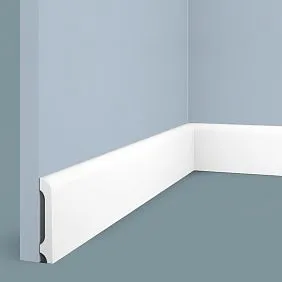
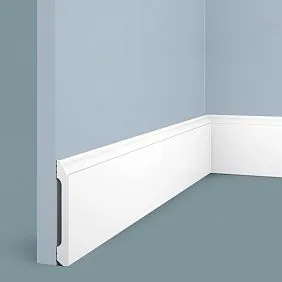
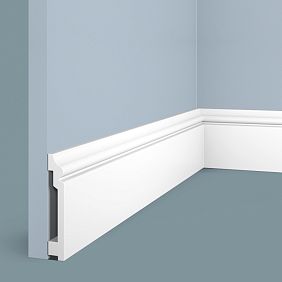
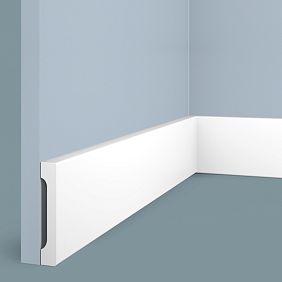
Our factory also produces:

How to Correctly Measure Perimeter
Room perimeter is the sum of the lengths of all walls along the internal contour. Seems elementary. But there are several nuances that regularly lead to errors.
Nuance 1: Measure at floor level, not mid-wall. Walls in typical apartments are rarely perfectly vertical — a slight slope exists almost everywhere. If measured at a meter height from the floor, but skirting is installed at floor level — you can get a discrepancy of 3–5 cm per side. Measure strictly at floor level: tape pressed against the base of the wall.
Nuance 2: Account for protrusions and niches. If the room has pilasters, columns, niches, a fireplace, a protruding pipe casing — their perimeter is added to the calculation. Trace each obstacle with a tape measure along the 'path' at floor level.
Nuance 3: Enclosed sliding wardrobes. If the wall behind a built-in sliding wardrobe will be permanently covered — no skirting is needed there. Subtract the length of that wall from the perimeter.
Nuance 4: Arched openings. An arch without a door — count as a door opening (arch width is subtracted from the perimeter). An arch with a curtain or drape — also subtracted. If an arch has wooden trim and a threshold — also subtracted.
Perimeter formula for a rectangular room:
P = 2 \times (A + B)
where A is length, B is room width.
For non-rectangular rooms (L-shaped, trapezoidal, with niches): perimeter = sum of all sides. Measure each side separately.
Get Consultation
Subtracting Door Openings
Door openings do not need skirting — a door frame or trim is installed there. The width of each door opening is subtracted from the perimeter.
Important: subtract the clear width of the door opening (distance between jambs), not the door leaf width. Standard values:
| Door type | Clear opening width |
|---|---|
| Standard interior | 700–900 mm (0.7–0.9 m) |
| Wide interior | 900–1,100 mm (0.9–1.1 m) |
| Double-leaf | 1,200–1,500 mm (1.2–1.5 m) |
| Entrance | 900–1,000 mm |
| Arch | Custom |
If the door frame is installed: measure the distance from the outer edge of the frame to the outer edge on the other side — this is the width to subtract.
Standard baseboard strip length
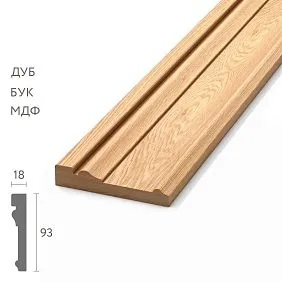
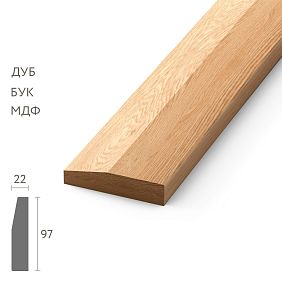
Wooden skirting board K-series STAVROSis produced in a standard length of 2.2 m per strip. This is an important parameter for calculation: when ordering, you need to specify the number of strips or linear meters, and the manager will calculate how many 2.2 m strips fit into the required footage.
Why 2.2 m and not 3 m? Chamber drying of solid wood baseboard is a process that limits the length of a stable strip. A 3 m strip is more likely to warp during transportation and storage in residential conditions (humidity fluctuations). A 2.2 m strip is a stable standard for solid hardwood molding.
Calculating the number of strips:
N_{strips} = ⌈M_{total} ÷ 2.2⌉
WhereM_{total}— total footage with margin, the 'ceiling function' symbol — rounding up to the nearest whole number.
Margin for miter cuts: what percentage to add
Why you can't order exactly by footage
This is one of the most common miscalculations in renovation. Ordered exactly 32 linear meters — received exactly 32 lm. But in the end, 1.8 m was missing. Why?
Because wooden baseboard is cut at angles. Each internal corner of a room is two 45° cuts. Each external corner is also two cuts. When cutting at 45°, an oblique piece — a triangular scrap — is cut from the end of the strip. The shorter the strip between two corners, the greater the percentage of material 'goes' into scraps.
Margin coefficient depending on room complexity
| Room Type | Number of corners | Recommended margin |
|---|---|---|
| Simple rectangular room | 4 internal corners | +10% |
| Room with a niche or protrusion | 6–8 corners | +12–15% |
| L-shaped room | 6 internal + 2 external | +15–18% |
| Room with columns / pilasters | 8+ corners | +20% |
| Bathroom / toilet (small area) | 4 corners, short walls | +15–20% |
| Corridor (long narrow) | 4 corners, walls of different lengths | +12% |
Basic rule: for a standard rectangular room — +10% to the net footage. For any complex-shaped room — +15%.
Additional margin: not just for corners
Margin is needed not only for corner trimming. Two more sources of waste:
Defective plank sections. Solid wood skirting is a living material. Even in chamber-dried STAVROS skirting (8–10% humidity, QC before shipment), a batch may contain a plank with a small knot or micro-crack in a visible spot. A professional installer won't place such spots — they reposition the plank so the defect goes into a hidden corner or cut it out. This 'consumes' additional centimeters.
Cutting error. Even an experienced craftsman sometimes cuts at the wrong angle — and the piece becomes waste. The calculation includes 1–2 'erroneous' cuts per room.
Final margin considering everything:
-
Simple rectangular room: +10–12%
-
Medium complexity room: +15%
-
Complex room with multiple corners: +20%
-
Small room (bathroom, toilet, walk-in closet): +20–25%
Why do small rooms require more margin? Because with a short wall (1–1.5 m), the cut 'consumes' proportionally more. A 1.2 m wall between two corners: a 45° cut from each end 'takes' 40–50 mm each. Total 'usable' length from a 2.2 m plank — about 1.1 m. Waste — 50% of the plank in offcuts.
Table: net footage and planned order
| Net footage (lm) | 10% margin | 15% margin | 20% margin | 2.2 m planks (15%) |
|---|---|---|---|---|
| 10 | 11,0 | 11,5 | 12,0 | 6 |
| 15 | 16,5 | 17,25 | 18,0 | 8 |
| 20 | 22,0 | 23,0 | 24,0 | 11 |
| 25 | 27,5 | 28,75 | 30,0 | 14 |
| 30 | 33,0 | 34,5 | 36,0 | 16 |
| 40 | 44,0 | 46,0 | 48,0 | 21 |
| 50 | 55,0 | 57,5 | 60,0 | 27 |
Installation rates for wooden skirting
Structure of installation work costs
Wooden skirting rates for installation — one of the most requested parameters when preparing a repair estimate. The cost of skirting installation work varies depending on:
-
Region (Moscow — more expensive, regions — 30–50% cheaper)
-
Room complexity (number of corners, presence of niches, stairs)
-
Fastening type (dowels, liquid nails, combined)
-
Need for painting/coating the skirting board after installation
-
Presence of old skirting board removal
Current rates for wooden skirting board installation (2025–2026)
| Type of work | Cost (Moscow) | Cost (regions) |
|---|---|---|
| Skirting board installation (standard) | 120–180 RUB/linear meter | 70–120 RUB/linear meter |
| Installation with painting (2 coats) | 280–380 RUB/linear meter | 180–260 RUB/linear meter |
| Removal of old skirting board | 40–80 RUB/linear meter | 30–60 RUB/linear meter |
| Internal corner cut (pair) | 150–250 RUB/pair | 100–180 RUB/pair |
| External corner cut (pair) | 200–350 RUB/pair | 150–250 RUB/pair |
| Sealing gaps with acrylic | 30–60 RUB/linear meter | 20–40 RUB/linear meter |
| Oil application (without painting) | 80–150 RUB/linear meter | 60–100 RUB/linear meter |
Important: rates for wooden skirting board installation in crew price lists are often indicated per 'linear meter', but without the cost of cuts — corner work is paid separately. Clarify when requesting a commercial proposal: whether cuts are included in the linear meter price or not.
Material rates
PriceSTAVROS K-series wooden skirting boardfrom the catalog:
| Profile | Cost per plank (2.2 m) | Cost per linear meter |
|---|---|---|
| K-034 (simple, 40 mm) | from 230 rub. | from 105 rub./lm |
| K-006 (basic, 60 mm) | from 440 rub. | from 200 rub./lm |
| K-016 (medium, 70 mm) | from 680 rub. | from 310 rub./lm |
| K-009 (classic, 90 mm) | from 1,420 rub. | from 645 rub./lm |
| K-018 (rich, 100+ mm) | from 1,630 rub. | from 740 rub./lm |
| K-066 (monumental, 140+ mm) | from 2,580 rub. | from 1,173 rub./lm |
For estimate preparation: material cost is multiplied by the total footage (with margin), installation cost — by the net footage (work is paid per actually installed linear meter).
Turnkey estimate: material, labor, delivery
Structure of a complete skirting board estimate
A professional estimate for wooden skirting board installation consists of four blocks:
Block 1: Material
-
Skirting board (lm × price per lm, with margin)
-
Fasteners (dowels, screws, or mounting adhesive)
-
Acrylic sealant (1 tube per 15–20 lm)
-
Decorative caps for screw heads (if needed)
-
Coating (oil, varnish, paint — if not included in the skirting board cost)
Block 2: Installation works
-
Skirting board installation (lm × rate)
-
Corner cuts (number of corners × rate per pair)
-
Gap sealing with acrylic (lm × rate)
-
Painting/coating application (if separate)
-
Old skirting board removal (if necessary)
Block 3: Delivery
-
Delivery of STAVROS wooden skirting boardwithin Moscow — cost confirmed upon order
-
Pickup from warehouse in Moscow or St. Petersburg — free
-
Delivery to regions — by transport company (SDEK, PEK, Delovye Linii)
Block 4: Additional expenses
-
Samples for selection (180 rub./set — credited upon order)
-
Tools (if unavailable: miter saw, screwdriver — rental or purchase)
-
Painter's tape, putty, primer for preparation
Typical estimate for one room: template
| Position | Unit of measurement | Quantity | Price | Total |
|---|---|---|---|---|
| Skirting board K-009 (oak) with margin | lm | 23 | 645 р. | 14 835 р. |
| Screw anchor 6×60 mm | pcs. | 50 | 5 р. | 250 р. |
| Acrylic sealant | tube | 1 | 350 р. | 350 р. |
| Osmo oil 3101 (0.375 l) | pcs. | 1 | 1 800 р. | 1 800 р. |
| Total materials | 17 235 р. | |||
| Skirting board installation | lm | 20 | 150 р. | 3 000 р. |
| Corner cuts (4 internal) | pair | 4 | 200 р. | 800 р. |
| Sealing gaps with acrylic | lm | 20 | 50 р. | 1 000 р. |
| Oil application | lm | 20 | 100 р. | 2 000 р. |
| Total labor | 6 800 р. | |||
| Delivery (Moscow) | 600 р. | |||
| Estimate total | 24 635 р. |
Calculation example for a 20 m² room with three door openings
Initial data
Let's examine a specific example — a real situation many encounter. A room in a Moscow apartment:
-
Layout: rectangular, dimensions 4.5 × 4.4 m
-
Three door openings: two standard (80 cm wide each) and one wide (120 cm — opening to the living room)
-
Selected skirting board: K-009 made of oak (classic profile, height 90 mm)
-
Task: install the skirting board yourself, finish — Osmo oil
Step 1: Calculate the perimeter
P = 2 × (4.5 + 4.4) = 2 × 8.9 = 17.8 m
Step 2: Subtract door openings
Three openings:
-
Door 1: 0.8 m
-
Door 2: 0.8 m
-
Door 3 (wide): 1.2 m
Total openings:0.8 + 0.8 + 1.2 = 2.8 m
Net length:
M_net = 17.8 − 2.8 = 15.0 m
Step 3: Add margin
Room is rectangular, 4 internal corners → 10% margin:
M_full = 15.0 × 1.10 = 16.5 m
But we have three door openings — at each opening the skirting board meets from both sides and is cut at 90° (end cut flush with the casing). This is not a miter joint, but a neat end cut. Let's add another 0.5 m for three openings (6 end cuts).
Final total length:
M_order = 16.5 + 0.5 = 17.0 m
Step 4: Convert to planks
STAVROS K-009 plank = 2.2 m. Number of planks:
N = ⌈17.0 ÷ 2.2⌉ = ⌈7.73⌉ = 8 planks
8 planks × 2.2 m = 17.6 lm — a small additional margin (+0.6 lm) beyond the calculated.
Step 5: Material cost calculation
K-009 made of oak: from 1,420 rub./plank (2.2 m)
8 planks × 1,420 rub. = 11,360 rub.
Additional materials:
-
Samples (profile already selected) — 180 rub. (credited towards order)
-
Fasteners (dowels 6×60): 40 pcs. × 5 rub. = 200 rub.
-
Acrylic sealant: 1 tube = 350 rub.
-
Osmo Polyx-Oil 3101 oil (0.375 l per 15 lm): 1,800 rub.
Total materials: 13,710 rub.
Step 6: Labor cost calculation (self-installation)
With self-installation, labor is free. Tools needed:
-
Miter saw with rotating table: if unavailable — rental 500–800 rub./day or purchase used from 3,000 rub.
-
Screwdriver: usually available
-
Tape measure, pencil, painter's tape
For turnkey installation (professional): 15 lm × 150 rub. = 2,250 rub. + 4 corner pairs × 200 rub. = 800 rub. + acrylic 15 lm × 50 rub. = 750 rub. + oil 15 lm × 100 rub. = 1,500 rub. Total labor: 5,300 rub.
Final estimate example
| Position | Total |
|---|---|
| Baseboard K-009 (8 planks) | 11 360 р. |
| Fasteners + acrylic + oil | 2 350 р. |
| Installation work (professional) | 5 300 р. |
| Delivery | 600 р. |
| TOTAL | 19 610 р. |
Turnkey cost per linear meter: 19,610 ÷ 15 = 1,307 rub./lm — materials + labor + delivery.
Calculation for entire apartment: batch calculation logic
How to calculate multiple rooms simultaneously
When calculating baseboard for an entire apartment, it's convenient to use a summary table: each room as a separate row.
| Room | Perimeter | Openings | Net m | Reserve % | To order | Planks |
|---|---|---|---|---|---|---|
| Living room | 18.4 m | 2.0 m | 16.4 m | 10% | 18.0 m | 9 |
| Bedroom | 15.6 m | 0.8 m | 14.8 m | 10% | 16.3 m | 8 |
| Kitchen | 13.2 m | 1.6 m | 11.6 m | 15% | 13.3 m | 7 |
| Corridor | 12.8 m | 3.2 m | 9.6 m | 15% | 11.0 m | 5 |
| Bathroom | 8.4 m | 0.7 m | 7.7 m | 20% | 9.2 m | 5 |
| Toilet | 6.2 m | 0.7 m | 5.5 m | 20% | 6.6 m | 3 |
| TOTAL | 65.6 m | 74.4 m | 37 |
37 planks × 1,420 rub. (K-009) = 52,540 rub. — material cost for the entire apartment.
Why a complete order is more advantageous than separate orders
When ordering from 20 planks, many manufacturers offer wholesale terms. In the case of STAVROS — a loyalty program for designers and large orders. Request when ordering 30+ planks.
Second argument: the entire order from one batch — guaranteed tone matching. If ordering room by room in different batches, there may be slight tonal variations between batches. With natural oil, this is noticeable: different batches of wood absorb oil slightly differently. One order for the entire apartment — solves this problem.
Online calculator or Excel: how to create an estimate yourself
Excel spreadsheet for skirting board calculation: template
Create a table with five columns:
| Room | Perimeter (m) | Deduct openings (m) | Net footage | Margin (%) | To order (m) | Planks (2.2 m) | Plank price | Total |
Excel Formulas:
-
E = C − D (net length = perimeter − openings)
-
G = ROUNDUP(E × (1 + F/100) / 2.2; 0) (number of planks)
-
I = G × H (total for the item)
The summary row totals all values. Add a separate row for calculating labor costs (net length × rate), delivery, and other expenses.
Online Calculators: Capabilities and Limitations
Online baseboard calculators are a popular tool, but with limitations:
What most calculators can do:
-
Calculate perimeter based on entered dimensions
-
Subtract the number of door openings (using average width)
-
Add a margin (usually 10% by default)
-
Convert to number of packages / planks
What they cannot do:
-
Account for irregular room shapes
-
Correctly account for specific opening widths (usually an average is used)
-
Account for corner specifics (external corners are more expensive to miter)
-
Calculate installation cost separately considering mitered corners
Conclusion: For a simple rectangular room with one door, an online calculator is sufficiently accurate. For a complex room or an entire apartment, an Excel spreadsheet with manual entry for each room is more reliable.
Consultation with a manager as a tool for precise calculation
A practice used by most professional designers: send the room layout to the supplier's manager and receive a calculation from them. This is a free service, the result of which is an accurate specification: profile, number of planks, cost. Without one-sided errors.
STAVROS provides such a calculation when contacting 8 (800) 555-46-75 — you need to provide room dimensions or send an apartment plan.
FAQ: Answers to popular questions about baseboard calculation
If the walls are uneven, is a larger margin needed?
Yes. Uneven walls require more intermediate connections — where one piece of baseboard cannot lie flat along the entire wall length and needs to be divided into two. Each additional connection means two additional end cuts. Add an extra 5% to the base margin.
Can offcuts from one wall be used for another?
Yes — if the offcut is longer than 50 cm and has no defects in visible areas. Short offcuts (less than 30 cm) are not usable — it's too difficult to precisely miter both ends on a short piece without risk of splitting.
What is the minimum margin for an entire apartment?
At least 10% for each room, but not less than one full plank 'in reserve' for the entire apartment. One spare plank is insurance for replacing a damaged fragment after one or two years.
Are radiators and pipes considered when calculating the length?
Radiators — no, baseboard is installed under the radiator. Heating pipes near the floor (risers) — are subtracted only if they occupy more than 10 cm in length. In most cases, pipes are flush against the wall and the baseboard bypasses them with a cutout — this does not affect the length, but requires careful cutting of a 'U-shaped' notch.
What is more expensive - wooden skirting board or its installation?
Depends on the profile. For skirting board K-034 (from 105 rub./lm) the installation cost (150 rub./lm) is more expensive than the material. For skirting board K-018 (from 740 rub./lm) the material is more expensive than the installation. For most profiles in the mid-price category (K-006, K-016) the ratio is: material 60% / labor 40%.
Is it necessary to reserve skirting board for a balcony / loggia?
Wooden skirting board on an unheated balcony is undesirable: temperature and humidity fluctuations will cause deformations. For a glazed, heated loggia - it is acceptable, calculation as for a standard room.
About the company STAVROS
Wooden skirting board K-series STAVROS— this is more than 30 profiles made from chamber-dried solid oak and beech in planks of 2.2 m. Price range: from 230 rub. (K-034, simple profile) to 6,060 rub. (K-104, monumental) per plank — a wide choice for any budget and any style.
For an accurate estimate calculation: request a calculation based on your plan from STAVROS managers — it's free and takes one business day. Samples for visual selection: 180 rub./set, cost is credited upon order. Delivery: pickup from the warehouse in Moscow and St. Petersburg, or by transport company throughout Russia.
In addition to skirting board:carved wooden casingsfor doorways,KZ-series cornicesfor ceiling framing,Wooden furniture handles— a unified system, a single supplier, a single tone.
Consultation and estimate calculation: 8 (800) 555-46-75.
STAVROS — because the correct calculation starts with the correct material.