Article Contents:
- Physical principles of attachment: understanding loads and stresses
- Calculation of connection load-bearing capacity
- Attachment technologies to various types of floors
- Wooden floors: traditional methods with modern improvements
- Concrete foundations: maximum strength
- Metallic structures: specialized solutions
- Tools and materials for quality installation
- Cutting and drilling tools
- Measuring tools
- Fastening materials
- Step-by-step installation technology
- Preparation stage
- Creating holes
- Installation of Fasteners
- Special cases of attachment
- Installation on heated floors
- Attachment to poured floors
- Installation on multi-layered constructions
- Quality Control and Testing
- Geometric control
- Strength Testing
- Typical Errors and Ways to Prevent Them
- Marking Errors
- Errors in drilling
- Installation Errors
- Modern technologies and innovations
- New Materials
- Digital technologies
- Maintenance and repair of connections
- Preventive Measures
- Repair work
- Economic Aspects
- Cost of Various Technologies
- Long-Term Efficiency
- Conclusion
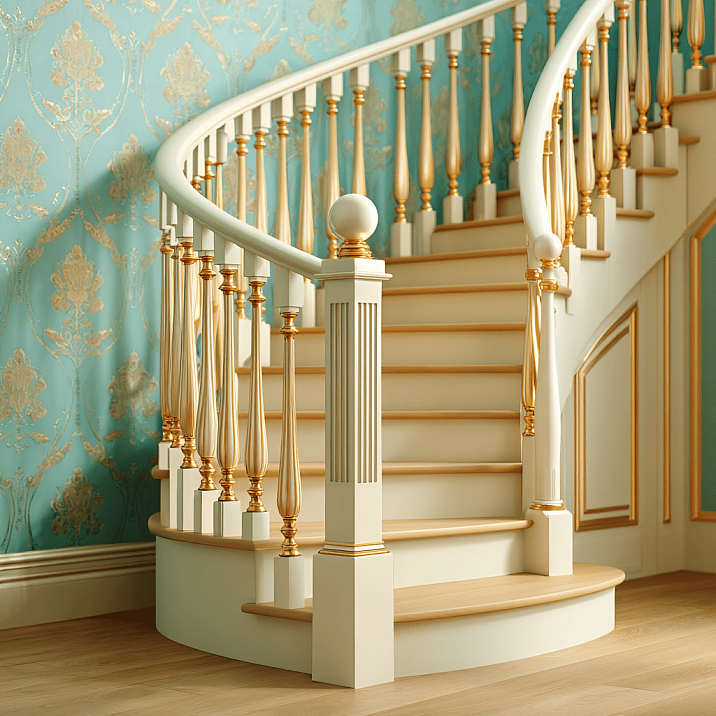
Ladder safety depends on many factors, but one of the key ones is the quality of baluster attachment to the base. Understanding that, how balusters are attached to the floor, becomes fundamental knowledge for anyone who aims to create not only an aesthetically pleasing but also absolutely safe staircase structure. Proper installation of these vertical elements requires a deep understanding of materials, tools, and technological processes that ensure the long-term durability of the entire railing system.
The skill of installing balusters is developed through understanding the physical properties of different materials and their interaction under load. Each connection must consider not only static loads but also dynamic forces that arise during daily use of the staircase. A professional approach to this task guarantees the creation of a structure that will serve for decades without losing its functional qualities.


Physical principles of attachment: understanding loads and stresses
Successful installation of balusters begins with a deep understanding of the mechanics of loads that a staircase structure experiences. Vertical forces from the handrail's weight and accidental impacts are transmitted through balusters to the floor, creating compressive stresses in the base material. Horizontal loads arise when people lean on the handrail and can reach significant values, especially under dynamic impacts.
Torque moments appear with uneven load distribution and can lead to weakened fastening if not considered during the design of connection joints. Understanding these factors allows selecting the optimal fastening method for each specific situation.
Material science aspects play a critical role in selecting the installation technology. Wooden floors require one approach, concrete—another, and metal structures—a third. Each material has its own characteristics that must be considered when choosing fastening elements and their installation methods.




Calculation of connection load-bearing capacity
Normative requirements establish minimum strength parameters for staircase railings. The horizontal load on the handrail must be at least 100 kg/m without residual deformation. This requirement defines the minimum characteristics of fastening elements and their installation methods.
The safety factor for stair structure components is taken as 2-3. This means the actual strength of connections must exceed the normative requirements by several times. This approach ensures long-term reliability of the structure even under intensive use.
Load distribution in the railing system is uneven. Maximum forces occur at the support posts at the beginning and end of the stair run, as well as at the balusters located in the middle of the span. Understanding this principle allows optimizing the fastening design for each specific element.
Our factory also produces:


Fastening technologies to various types of floors
Get Consultation
Wooden floors: traditional methods with modern improvements
A solid board 40-50 mm thick provides sufficient strength for secure baluster mounting. The direction of the floor's wood grain must be considered when selecting the type and placement of fasteners. Fastening perpendicular to the grain ensures maximum connection strength.
Parquet floors require a special approach due to the relatively small thickness of the planks. Fasteners must pass through the parquet and be secured into the subfloor or joists. Preliminary marking is performed taking into account the joist placement beneath the parquet.
Laminate floors present the greatest difficulty for baluster mounting. The thin laminate layer cannot provide reliable fixation, so fastening is done to the subfloor using special anchors or long screws.
Concrete foundations: maximum strength
Monolithic concrete floors provide the most reliable baluster mounting. 10-12 mm diameter anchor bolts with a minimum embedment depth of 80 mm are used. Chemical anchors provide even higher connection reliability by fully filling the hole with a special compound.
Reinforced concrete structures require special attention to the reinforcement. When drilling holes, it is important not to damage the reinforcing bars, which could weaken the structure's load-bearing capacity. Special rebar detectors are used to determine their location.
Prefabricated concrete elements may have voids or channels that must be considered when selecting the mounting method. In such cases, spread anchors or chemical mounting with void filling are used.
Metallic structures: specialized solutions
Steel bases require special fasteners and mounting technologies. Metal screws with hexagonal heads or bolted connections provide secure fixation. Anti-corrosion protection of all metal components is mandatory to prevent connection failure.
Aluminum structures have lower strength compared to steel, requiring the use of larger diameter fasteners or increased number of mounting points. Special aluminum rivets or stainless steel bolts prevent electrochemical corrosion.
Metal-based composite materials require an individual approach to fastener selection. The material's structural characteristics and its behavior under load must be considered.
Tools and materials for quality installation
Cutting and drilling tools
Drill with a set of drill bits of various diameters — the primary tool for creating holes for fasteners. Drill bits must be sharp and designed for specific materials. Using dull or inappropriate drill bits may result in chipping and inaccurate holes.
Hammer drill is necessary for working with concrete foundations. Impact drilling significantly speeds up the process of creating holes in hard materials. Special concrete drill bits ensure clean holes without chipping edges.
Miter saw provides precise cutting of balusters at required angles. Cutting quality is critically important for joint tightness and overall appearance of the structure.
Measuring tools
Laser level ensures accurate marking and vertical alignment control for baluster installation. Deviations from verticality exceeding 2 mm per meter height are unacceptable for quality installation.
Protractor is necessary to determine cutting angles of balusters when installing on inclined surfaces. Accuracy of angular dimensions is critically important for connection quality.
Tape measure and ruler are used for marking distances between balusters and controlling element dimensions. Measurement accuracy must be at least 1 mm.
Fastening materials
Stainless steel anchor bolts with a diameter of 10-12 mm provide maximum connection strength with concrete foundations. Anchor length must ensure an embedment depth of at least 80 mm.
Wood screws with hexagonal heads, 80-100 mm long, are used for mounting to wooden floors. The thread must be sharp and deep to ensure secure fixation in wood.
Chemical anchors are two-component compounds that harden in the hole, creating a monolithic connection with the base. They are especially effective for hollow structures and low-density materials.
Step-by-step installation technology
Preparation Stage
Designing the railing system begins with analyzing the staircase structure and determining the optimal placement scheme of elements. Loads, aesthetic requirements, and regulatory constraints are considered.
Installation locations are marked using a laser level and special templates. Marking accuracy determines the quality of all subsequent work. The allowable deviation from the design position must not exceed 2 mm.
Tool preparation includes checking the sharpness of cutting elements, calibrating measuring instruments, and preparing fastening materials. High-quality tools are the foundation of professional results.
Drilling holes
Holes in the floor are drilled strictly perpendicular to the surface. Guiding fixtures or drill jigs are used to ensure accuracy. The hole diameter must exactly match the selected fastener type.
Boring depth is controlled using drill stop collars or special stops. Insufficient depth may result in weak fastening, while excessive depth may damage the floor structure.
Cleaning holes of dust and chips is mandatory to ensure quality connection. Special brushes or compressed air blowing are used.
Installing fasteners
Anchor bolts are installed into prepared holes using special tools. Tightening is performed with force control to prevent damage to threads or the base.
Chemical anchors require precise adherence to mixing technology and curing time. Ambient temperature affects the polymerization rate of the compound.
Self-tapping screws are driven in with pre-drilled pilot holes. This prevents wood cracking and ensures accurate fastener positioning.
Special mounting cases
Installation on heated floors
Heating floor systems create additional challenges when installing balusters. Elevated temperature may cause rapid drying of adhesive compounds and changes in material properties.
Fastener selection must consider the operating temperature regime. Heat-resistant compounds and materials retaining their properties up to 60-80 degrees Celsius are used.
Temperature in the baluster installation zone is monitored using an infrared thermometer. Installation work is performed with the heating system turned off, followed by gradual ramp-up to operating mode.
Mounting on poured floors
Polymer poured floors require a special approach to baluster mounting. The thin polymer layer cannot provide secure fixation, so mounting is done to the base substrate.
Preparation includes determining the thickness of the poured layer and characteristics of the base substrate. Fastener length is calculated to account for penetration through the polymer layer.
Sealing mounting locations prevents moisture ingress under the poured floor. Special sealants compatible with the coating material are used.
Mounting on multi-layered structures
Complex floor systems with multiple layers of different materials require a comprehensive approach to mounting. Each layer must be considered when selecting fastener type and length.
Expansion joints in floor coverings may affect baluster placement. Mounting near joints requires use of special compensating elements.
Quality control and testing
Geometric control
Verticality of each baluster is checked using a level or plumb bob. Deviation from verticality must not exceed 2 millimeters per meter of height.
Checking distances between balusters ensures uniform railing and compliance with safety requirements. Maximum distance between baluster centers must not exceed 150 millimeters.
Installation height is checked from the floor level. All balusters must have the same height with a tolerance of no more than 3 millimeters.
Strength Testing
Static loads are applied to various points of the structure to test connection strength. Standard horizontal load is 100 kg/m without residual deformation.
Dynamic tests simulate real operating conditions. Repeated application of loads helps identify potentially weak areas in the structure.
Fatigue tests are conducted for critical structures. Cyclic loading over a specified time allows assessment of long-term connection reliability.
Typical errors and ways to prevent them
Marking Errors
Inaccurate marking is the most common cause of problems during baluster installation. Using quality measuring tools and careful size verification at each stage helps avoid this error.
Misaligned holes may cause baluster misalignment or prevent installation. Using drill jigs and guiding fixtures ensures accurate drilling.
Incorrect installation spacing not only compromises the structure's aesthetics but also safety requirements. Distance between balusters must strictly match design specifications.
Drilling errors
Material chips during drilling occur due to using dull drills or incorrect processing mode. Sharp drills and properly selected drill speeds ensure clean holes without damage.
Incorrect hole depth may lead to insufficient joint strength or damage to floor utilities. Using depth limiters on drills ensures accurate drilling.
Tool overheating when working with hard materials may cause drill bit dulling and reduced hole quality. Periodic tool cooling and lubricant use prevent overheating.
Installation errors
Insufficient fastener tightening leads to joint loosening over time. Controlling tightening torque with a torque wrench ensures optimal fixation.
Thread damage during fastener installation may completely disrupt the joint. Careful work and use of quality tools prevent such damage.
Incorrect operation sequence may create additional difficulties during installation. Planning the work sequence and preparing all elements in advance simplifies the installation process.
Modern technologies and innovations
New materials
Carbon fiber-based composite fasteners offer high strength at low weight. They are corrosion-resistant and ensure long-term joint reliability.
New-generation adhesives with improved adhesion and elasticity allow creating more reliable joints. Some formulations have the ability to self-repair minor cracks.
Smart materials with variable properties open new possibilities for creating adaptive joints. Shape-memory materials can compensate for thermal deformations.
Digital technologies
Laser marking provides unmatched positioning accuracy. Laser projectors create precise templates for hole and installation line marking.
Robotic drilling guarantees ideal hole accuracy and repeatability. Robots can work with precision down to fractions of a millimeter, which is unattainable with manual processing.
Quality control systems using machine vision allow automatic checking of geometric parameters of installed elements and detection of deviations from standards.
Maintenance and repair of joints
Preventive measures
Regular inspection of joints should be conducted at least twice a year. Special attention is given to baluster mounting points to the floor, where maximum loads are concentrated.
Controlling room humidity helps prevent corrosion of metal fasteners and deformation of wooden structures. Optimal air humidity is 45-65%.
Fastener tightening is performed upon detecting joint loosening. Threaded joints are retightened with torque control to avoid damaging the base material.
Repair work
Replacement of weakened fastener elements may be required after several years of operation. New elements must exactly match the dimensions and material of original parts.
Restoration of damaged holes is performed using special compounds or oversized mechanical anchors. After restoration, joint strength is checked.
Joint reinforcement may be required when loads increase or operating conditions change. Additional fastening elements are installed without compromising the integrity of the main structure.
Economic Aspects
Cost of various technologies
Traditional fastening methods remain the most cost-effective, but require high installer skill. Simple anchor connections cost 2-3 times less than modern fastening systems.
Innovative solutions require higher initial investment but provide cost savings during operation due to longer service life and ease of maintenance.
The cost of errors from improper fastening may be several times higher than professional installation costs. This underscores the importance of selecting the right technology and qualified installers.
Long-term effectiveness
Quality connections pay off in the first years of operation due to the absence of need for repair and maintenance. Properly installed fasteners serve for decades without loss of strength.
Property value increases with the presence of quality architectural elements. Reliable stair railings enhance the property's appeal in the real estate market.
Conclusion
The skill of attaching balusters to the floor is developed through deep understanding of materials, mastering various technologies, and accumulating practical experience. Attaching balusters by hand — is a task that requires not only technical skills but also an understanding of aesthetic principles for creating a harmonious interior.
Each project is unique and requires an individual approach, but the core principles remain unchanged: precision in measurements, quality of materials, and strict adherence to technology. Properly installed balusters ensure not only the safety of stair use but also create an aesthetically appealing interior element.
Modern requirements for the safety and durability of stair structures are constantly increasing, stimulating the development of new technologies and materials. However, the foundation of success always remains the professionalism of the installers and their responsible attitude toward every detail of the work.
Investments in quality materials and professional installation pay off through the longevity and reliability of the structure. Properly installed balusters for creating a unique interior serve not only as a safety element but also as a decoration of the house, highlighting the taste and status of the owner.
When selecting materials for stair structures, special attention should be paid to the reputation of the supplier and the quality of the products. The company STAVROS has proven itself as a reliable manufacturer of high-quality solid wood products. Years of experience, use of modern technologies, and strict quality control at all production stages allow STAVROS to create products that fully meet the highest standards and exceed even the expectations of the most demanding clients, striving to create flawless stair structures.