Article Contents:
- Evolution of Wooden Columns: From Antiquity to the Present
- Historical Roots and Cultural Significance
- Technological Evolution: From Axe to CNC Machine
- Modern Trends and Revival of Traditions
- Materials and Wood Species: Choosing the Ideal Base
- Criteria for Selecting Wood for Columns
- Coniferous Species: Practicality and Accessibility
- Hardwood Species: Nobility and Durability
- Exotic Species: Uniqueness and Prestige
- Innovative Materials: Laminated Beam and Composites
- Technology of Manufacturing Wooden Columns: From Concept to Realization
- Design and Calculation: The Foundation of Success
- Material Preparation: The Foundation of Quality
- Turning and Milling Operations: Giving Shape
- Carving and Decorative Elements: The Soul of the Column
- Sanding and Final Finishing: Perfection in Details
- Variety of Styles and Designs of Wooden Columns
- Classical Orders: Eternal Harmony
- Baroque and Rococo: triumph of ornamentation
- Neo-Gothic and Historicism: The Romance of the Middle Ages
- Modern and Art Deco: New Aesthetics
- Modern and Minimalist Solutions
- Applications of Wooden Columns in Various Spaces
- Interior solutions: from classic to avant-garde
- Exterior Applications: From Porches to Gazebos
- Commercial Spaces: Restaurants, Hotels, Boutiques
- Technical Aspects of Installation and Operation
- Installation and Mounting: Reliability and Safety
- Protection from Moisture and Biological Damage
- Maintenance and Restoration: Extending Lifespan
- Economic Aspects of Choosing Wooden Columns
- Price-to-Quality Ratio: Reasonable Investments
- Durability and investment attractiveness
- Conclusion: Choosing Professionals to Create Perfection
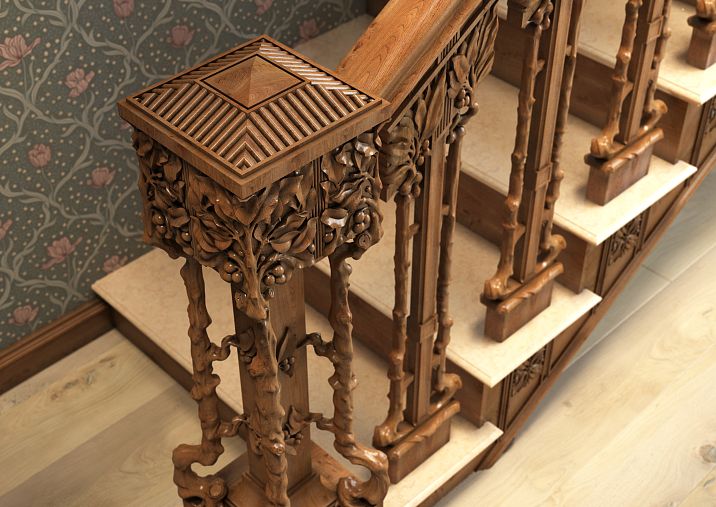
Grand mansions, refined interiors, luxurious terraces and porches — what unites these spaces filled with an atmosphere of nobility and elegance? The answer is simple — architectural elements, among which wooden columns hold a special place. These vertical dominants not only perform an important structural function but also become central accents in design, giving rooms character, individuality, and status.
Manufacturing Wooden Columns is a remarkable synthesis of engineering calculation, carpentry craftsmanship, and artistic vision. It is a process in which centuries-old woodworking traditions merge with innovative technologies, and the natural beauty of the material is revealed through the skill of the craftsman.
In this article, we will delve into the exciting world of creating wooden columns: from selecting the ideal wood to final finishing, from classical canons to modern trends, from technical nuances to artistic solutions. You will learn why wooden columns remain unmatched even in the age of new materials, how to properly choose columns for your project, and what factors influence their durability and aesthetic qualities.


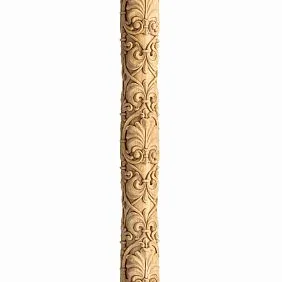
Evolution of Wooden Columns: From Antiquity to the Present




Historical Roots and Cultural Significance
Wooden columns have a rich history dating back to deep antiquity. Long before the advent of stone temples and palaces, people used wooden posts and columns to construct the first monumental buildings. Archaeological findings indicate that wooden cult structures with columns already existed in the Neolithic period (8000–3000 BCE).
In ancient Greece, the first temples were also built of wood, and only later were they constructed of stone, while preserving the proportions and elements of their wooden prototypes. Triglyphs in the Doric order are nothing more than stylized ends of wooden beams, and fluting on columns was originally carved into wooden posts to divert rainwater.
In ancient China and Japan, wooden columns reached an incredible level of perfection. Pagodas and temple complexes, built without a single nail, with columns made from whole trunks of multi-century trees, still astonish with their beauty and engineering ingenuity.
In Russian wooden architecture, columns and posts played a crucial role. Carved columns of verandas, galleries, and interior spaces of churches and tsars’ palaces demonstrated the highest craftsmanship of Russian carpenters and woodcarvers. Each region of Russia had its own traditions of manufacturing wooden columns, their characteristic ornaments and technical techniques.
Our factory also produces:



Technological Evolution: From Axe to CNC Machine
Over millennia, the technology of manufacturing wooden columns has undergone tremendous development. In antiquity, columns were crafted by hand using the simplest tools — axe, adze, chisel. Masters relied exclusively on their eye, experience, and intuition.
With the advent of lathes powered by water or muscle power, the production of round columns became significantly simpler. This allowed for the creation of more complex profiles and decorative elements. In the Baroque and Rococo eras, wooden columns reached incredible refinement — spiral forms, rich carving, gilding turned them into true works of art.
The Industrial Revolution brought steam, and then electric machines, making the production of wooden columns more accessible and standardized. However, mass production often led to simplification of forms and loss of individuality.
A true technological breakthrough occurred with the advent of computer modeling and CNC machines (Computer Numerical Control). Modern Manufacturing Wooden Columns can combine the highest precision of machine processing with an individual approach to each item. Computer modeling allows creating columns of any complexity, with ideal proportions and flawless geometry.
Get Consultation
Modern Trends and Revival of Traditions
In the last decades, an interesting phenomenon has been observed — a return to interest in traditional techniques and handcrafting, while simultaneously using the most modern technologies. This creates a unique synthesis, where centuries-old woodworking traditions are enriched by the possibilities of the digital age.
Modern wooden columns can be either classical, adhering to strict architectural orders, or avant-garde, with unconventional forms and unexpected solutions. They can be executed in a minimalist style or, conversely, astonish with rich ornamentation.
Sustainability is becoming an important trend. Modern wood processing and protection technologies allow creating columns that will serve for decades without harming the environment or human health. More and more manufacturers use wood from certified forestry operations, where new trees are planted in place of felled ones.
Materials and Wood Species: Choosing the Ideal Base
Criteria for Choosing Wood for Columns
Choosing the right wood species is the first and, perhaps, most important step in the column manufacturing process. This choice affects not only the aesthetic qualities of the finished product, but also its strength, durability, and resistance to external influences.
The following criteria are considered when selecting wood for columns:
Strength and load-bearing capacity — columns often serve a structural function, supporting floors, balconies, canopies. Therefore, the wood must have high compressive and bending strength.
Dimensional stability — a crucial quality for columns that must retain their shape regardless of temperature and humidity changes. Wood with high stability is less prone to warping, cracking, and deformation.
Resistance to rot and insects — especially important for columns installed outdoors or in humid environments.
Texture and aesthetic qualities — grain pattern, color, ability to polish and stain play a decisive role in the visual perception of the column.
Workability — some species are easily carved and turned, which is important for creating complex decorative elements, while others are better suited for smooth, minimalist forms.
Coniferous Species: Practicality and Accessibility
Coniferous species are traditionally widely used for column manufacturing due to their availability, good workability, and sufficient strength.
Spruce — the most common and accessible species. Spruce wood has a beautiful golden color, expressive texture with visible annual rings and resin pockets. It is easy to process, takes glue and stains well. However, spruce is relatively soft and susceptible to mechanical damage, and outdoors requires careful protection from moisture and ultraviolet radiation.
Larch — one of the strongest and most durable coniferous species. Due to its high content of resin and tannins, larch wood has natural resistance to rot and insects. It has a beautiful amber color, which over time develops into a noble silver-gray hue. Larch columns can serve for decades even when installed outdoors.
Coniferous species are typically harder, stronger, and more durable than hardwoods, making them ideal for structural applications and prestigious interiors.
Hardwood Species: Nobility and Durability
Hardwoods are generally harder, stronger, and more durable than conifers, making them ideal for structural applications and prestigious interiors.
Oak is a classic material for columns, symbolizing strength and durability. Oak wood is exceptionally strong, resistant to rot and mechanical damage. It has a beautiful, distinct grain with characteristic radial rays, which look especially striking when cut radially. Oak's color ranges from light golden to dark brown, and over time, the wood develops a noble patina. Oak columns can last for centuries, as proven by medieval structures that have survived to this day.
Ash is a strong and elastic wood with a beautiful wavy grain. Ash is easy to work with, polish, and stain, allowing for columns of various styles and shades. Ash columns are highly resistant to mechanical loads and vibrations.
Beech is a hard and strong wood with a uniform structure and a pleasant pinkish hue. Beech is excellent for turning and carving, making it ideal for columns with complex profiles and decorative elements. However, beech wood is sensitive to humidity changes and requires careful drying and protection.
Exotic Species: Uniqueness and Prestige
Exotic wood species are used to create exclusive premium columns, where not only technical properties but also status, uniqueness, and visual impact are important.
Teak is a legendary species known for its exceptional resistance to moisture, insects, and fungi. Teak wood contains natural oils that protect it from rot, even in seawater. Teak columns have a beautiful golden-brown color with characteristic dark streaks and a silky texture. Teak is considered one of the best materials for outdoor use, but its high cost limits its application.
Mahogany (redwood) is a noble species with a rich red-brown color and distinctive wood grain pattern. Mahogany is characterized by high dimensional stability, resistance to rot, and excellent workability. Columns made of redwood are traditionally associated with luxury and aristocracy.
Wenge is an exotic African species with a dark brown, almost black color and contrasting light streaks. Wenge is an exceptionally hard and dense wood, resistant to mechanical damage and biological effects. Wenge columns create a dramatic, expressive accent in interiors.
Innovative materials: glued laminated timber and composites
Modern Manufacturing Wooden Columns Increasingly, innovative materials are used that preserve the natural beauty of wood but surpass it in certain technical properties.
Glued laminated timber is a material obtained by bonding several layers of wood with different grain orientations. This construction provides high strength, geometric precision, and dimensional stability. Glued laminated timber columns do not crack or deform and can have virtually any size and shape. Additionally, glued laminated timber allows for rational use of wood, combining more valuable species for visible surfaces with more affordable ones for internal layers.
Thermowood is an innovative material obtained by thermally treating wood at high temperatures (180-240°C) in the absence of oxygen. As a result of this treatment, the wood gains enhanced resistance to moisture, rot, and insects, as well as more stable dimensions. Thermowood columns can be installed in rooms with high humidity and even outdoors without additional chemical protection.
Wood-polymer composites (WPC) are materials combining wood fibers with polymer binders. WPC imitates the appearance of natural wood but surpasses it in moisture resistance, UV resistance, and resistance to biological effects. WPC columns require no regular maintenance and can be used in extreme conditions, although they are inferior to natural wood in ecological properties and tactile feel.
Wooden column manufacturing technology: from concept to realization
Design and calculation: the foundation of success
The process of creating a wooden column begins long before the first touch of wood — with careful design and calculations. This stage is critically important for ensuring not only the aesthetic qualities but also the structural reliability of the future product.
Column design includes several key aspects:
Determining proportions and dimensions — classical architectural orders prescribe strict ratios between the column's diameter, height, base, and capital dimensions. Even when creating modern columns that do not follow classical canons, it is important to maintain harmonious proportions that take into account the characteristics of human perception.
Structural calculation — if the column serves a load-bearing function, its ability to withstand expected loads must be calculated, taking into account the properties of the selected wood species. This includes not only static loads (weight of structures) but also dynamic loads (wind loads, vibrations).
Designing connections — special attention is paid to joints connecting the column to the foundation and to the supported structures. These connections must be not only strong but also allow for natural wood deformation due to changes in humidity and temperature.
3D modeling — modern technologies allow creating a detailed three-dimensional model of the future column, helping to evaluate its appearance, check proportions, and identify potential issues before production begins.
Material preparation: the foundation of quality
Quality of the raw material and its proper preparation — the guarantee of longevity and aesthetic perfection of the wooden column.
Selection and sorting of wood — for columns, only high-quality lumber is selected, free of knots, cracks, resin pockets, and other defects that could weaken the structure or spoil the appearance. Special attention is paid to the direction of the grain and annual rings, which affect strength and dimensional stability.
Drying — a critically important stage that determines the future stability of the column. The wood must be dried to a moisture content corresponding to the conditions of use (typically 8-12% for indoor applications and 12-15% for outdoor use). Drying can be natural (takes a long time but provides a more stable result) or kiln-dried (faster but requires strict adherence to technology).
Acclimatization — before processing, the wood must adapt to workshop conditions to avoid deformation during work. This stage is especially important for large blanks used for large columns.
Primary processing — includes cutting logs or beams into blanks of the required size, taking into account allowances for processing and shrinkage, as well as initial planing to reveal hidden defects.
Turning and milling operations: shaping the form
After material preparation, the stage of forming the column's basic geometry begins. Depending on the design and technical capabilities of the production, various methods are used:
Turning - a traditional method for creating round and shaped columns. The blank is secured in a lathe and rotates around its axis, while the craftsman gradually shapes the desired profile using special cutting tools. Modern CNC lathes allow automating this process, ensuring the highest precision and repeatability.
Milling - a method in which the shape is created by a rotating cutting tool (milling cutter) moving relative to a stationary or slowly rotating blank. Milling allows creating complex profiles, grooves, protrusions, and other elements. CNC machines have greatly expanded milling capabilities, enabling the creation of columns of virtually any complexity.
Segmented assembly - a method in which the column is assembled from individual wooden segments previously cut according to a template. This method allows creating columns of large diameter and complex shapes, as well as saving valuable timber.
Combined methods - often various technologies are used in combination. For example, the main shape of the column may be created on a lathe, while decorative elements are added using milling or hand carving.
Carving and decorative elements: the soul of the column
Decorative elements transform a simple post into a work of art, giving the column individuality and character. Depending on the style and purpose of the column, the decoration may be minimalist or, conversely, extremely rich.
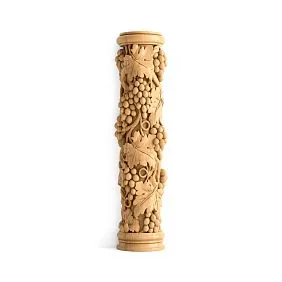
Hand carving - a traditional method requiring the highest level of craftsmanship and artistic taste. The carver creates relief patterns, ornaments, plant or zoomorphic motifs on the column's surface using special tools (chisels, cutters, knives). Hand carving gives the column uniqueness and the warmth of handcrafted work.
Machine carving - performed on specialized carving machines or CNC milling machines. This method ensures high precision and repeatability, which is important when creating multiple identical columns. Modern technologies allow reproducing even very complex patterns with high detail.
Applied elements - separately manufactured decorative details attached to the main body of the column. This method allows creating complex compositions and saving time in mass production.
Inlay and marquetry - techniques in which elements made from other wood species are inserted into the column's surface, creating a contrasting pattern. These methods require the highest precision and are used to create exclusive premium-class columns.
Sanding and final finishing: perfection in details
Final processing stages determine how expressively the wood texture will appear and how long the column will retain its beauty.
Sanding - sequential surface processing with abrasive materials, gradually reducing grit size. Quality sanding makes the surface perfectly smooth, highlights the wood texture, and prepares it for finishing materials.
Staining - imparting the desired shade to wood using stains, dyes, or tinting oils. This stage allows emphasizing the natural beauty of wood or, conversely, radically changing its color according to the design project.
Protective treatment - applying compositions that protect wood from moisture, UV radiation, mold, mildew, and insects. For columns installed outdoors or in high-humidity rooms, this stage is especially important.
Final coating - the finishing layer that determines the column's final appearance and provides additional protection. Depending on the desired effect, various materials may be used:
- Lacquers (matte, satin, glossy) create a protective film on the wood surface
- Oils and waxes penetrate into the wood structure, highlighting its texture and creating a "living" wood effect
- Paints completely cover the texture, but allow creating any color solutions
- Special effects - patina, craquelure, gilding - for creating unique decorative effects
Variety of styles and designs of wooden columns
Classical orders: eternal harmony
Classical architectural orders, developed in ancient Greece and Rome, remain the standard of proportions and harmony. Wooden columns executed according to classical order canons impart nobility and grandeur to interiors or exteriors.
Doric order - the most strict and minimalist. Doric columns have a simple capital consisting of an abacus (square slab) and echinus (round cushion). The column shaft usually has entasis (a slight bulge in the middle) and may be decorated with vertical grooves - fluting. Wooden Doric columns are often used in interiors in neoclassical or Empire styles.
Ionic order - more elegant and decorative. A characteristic feature of Ionic columns is the capital with volutes (spiral scrolls). The column shaft is thinner and taller than in the Doric order, and usually has 24 flutes. Wooden Ionic columns look excellent in elegant classical interiors, libraries, offices.
Corinthian order - the most luxurious and decorative. The capital of a Corinthian column is adorned with stylized acanthus leaves and volutes. The shaft is tall and slender, with 24 flutes. Wooden Corinthian columns require the highest level of carving skill and are used in luxurious palace-style interiors.
Composite order - combines elements of Ionic and Corinthian orders. The capital has acanthus leaves, as in the Corinthian order, and volutes, as in the Ionic order. Wooden composite columns allow creating rich but not overloaded with decoration interiors.
Baroque and Rococo: triumph of ornamentation
Baroque and Rococo styles, flourishing in the 17th-18th centuries, are characterized by opulence, dynamic forms, and rich decoration. Wooden columns of these styles are true works of art, demonstrating the virtuosity of carvers.
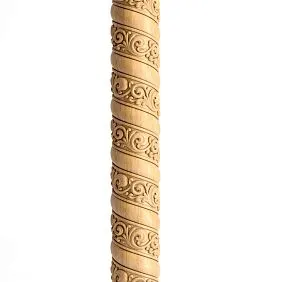
Twisted (Solomonic) columns - a characteristic element of Baroque architecture. The shaft of such a column has a spiral shape, often enhanced with carved floral ornamentation. Twisted columns create a sense of movement, dynamism, and emotional intensity.
Columns with cartouches and rocaille - typical for the Rococo style. They are decorated with asymmetrical ornaments in the form of shells, scrolls, floral garlands. Gold leaf is often used, emphasizing the elegance of the carving.
Fluted columns with gilding - another characteristic element of baroque and rococo interiors. The vertical grooves (fluting) on the column shaft create an effective play of light and shadow, while partial or full gilding enhances the decorative effect.
Neo-Gothic and Historicism: Romance of the Middle Ages
The styles of neo-Gothic and historicism, popular in the 19th century, turned to medieval architectural forms, interpreting them in accordance with new technological capabilities and aesthetic preferences.
Cluster columns - a characteristic element of Gothic architecture, consisting of a group of slender columns united into a single structure. In wooden form, such columns create an effect of lightness and upward aspiration.
Columns with fleurs-de-lis and acanthus leaves - decorated with stylized plant motifs characteristic of Gothic architecture. Fleur-de-lis (pointed turrets) and acanthus leaves (curved leaves) create a dynamic, upward-reaching silhouette.
Columns with heraldic motifs - decorated with coats of arms, shields, and fantastical animals. Such columns were often used in the interiors of castles and mansions in the historicism style, creating an atmosphere of knightly romance.
Modern and Art Deco: New Aesthetics
The styles of modern (Art Nouveau) and Art Deco, emerging at the turn of the 19th and 20th centuries, brought new aesthetics based on smooth, organic lines (modern) or geometric, rhythmic forms (Art Deco).
Columns with plant motifs - characteristic of the modern style. They may imitate tree trunks, plant stems, flowers. The carving is smooth, flowing, with characteristic S-shaped lines.
Geometric columns - typical of the Art Deco style. They have clear, rhythmic forms, often with zigzag or stepped elements. They may combine wood with other materials - metal, glass, mirrors.
Columns with abstract motifs - another option for interiors in the Art Deco style. They are decorated with stylized, simplified ornaments that create an effect of dynamism and rhythm.
Modern and minimalist solutions
Modern design offers new interpretations of traditional architectural elements, adapting them to current aesthetic trends and technological possibilities.
Minimalist rectangular columns - characteristic of minimalist interiors. They have a simple geometric form, devoid of decoration, but may stand out through wood texture or unconventional lighting.
Sculptural columns - objects at the boundary between architecture and art. Such columns may have non-standard shapes, be asymmetrical, resemble natural objects or abstract compositions.
Columns with integrated functional elements - a modern approach where the column combines decorative and practical functions. For example, shelves, lighting, or smart home elements may be built into the column.
Applications of wooden columns in various spaces
Interior Solutions: from Classic to Avant-Garde
Wooden columns in interiors can serve both structural and purely decorative functions, becoming central design elements.
Columns in living rooms and halls - create an atmosphere of grandeur and status. In classical interiors, columns are often used to frame doorways, arches, and niches. In modern spaces, they may serve as zoning elements, visually dividing large rooms into functional zones without using walls.
Columns in libraries and offices - emphasize an intellectual atmosphere, create a sense of solidity and respectability. Columns are often integrated with bookshelves, framing work areas or fireplaces.
Columns in bedrooms - may be used to create canopies over beds, to design wardrobe zones, or to give interiors a romantic or luxurious character.
Columns in bathrooms - an unexpected but effective solution. Modern wood processing technologies allow using wooden columns even in high-humidity spaces. They may frame bathtubs, sink areas, or create a spa salon atmosphere.
Exterior applications: from verandas to gazebos
Outdoors, wooden columns not only perform an important structural function but also become key elements of architectural composition.
Columns on verandas and terraces - support awnings or roofs protecting from sun and rain. They may be simple and functional or richly decorated, depending on the overall house style.
Columns in gazebos and pavilions - create a sense of lightness and airiness. Often, twisted or carved columns are used, which harmoniously blend with the surrounding nature.
Columns in landscape design - may be used as standalone decorative elements, supports for climbing plants, or bases for pergolas or arches.
Columns at entrance groups - emphasize the status of the building, create a grand, representative entrance. Often, paired columns are used to support a portico or awning over the porch.
Commercial spaces: restaurants, hotels, boutiques
In commercial interiors, wooden columns help create a memorable atmosphere, highlight the concept of the establishment, and stand out among competitors.
Columns in restaurants and cafes can support the thematic concept of the establishment (e.g., ancient style, medieval castle, oriental palace) or create a specific atmosphere (cozy, luxury, exotic).
Columns in hotels are often used in lobbies, restaurants, and conference halls to create impressive, status-oriented spaces. The style of columns usually corresponds to the hotel's overall concept and target audience.
Columns in boutiques and showrooms help create a unique, memorable interior that highlights the value and exclusivity of the displayed products. Non-standard, custom solutions are often used.
Technical aspects of installation and operation
Installation and mounting: reliability and safety
Correct installation of wooden columns is the guarantee of their longevity, safety, and aesthetic appeal.
Foundation preparation - a critically important stage. Load-bearing columns require a strong foundation or support structure capable of withstanding all anticipated loads. Decorative columns also require a stable, level base.
Mounting methods to the base - depend on the column's function and the type of base. May include:
- Metallic base plates, which are attached to the floor or foundation and connected to the column using bolts or studs
- Hidden fasteners, where a metal rod is inserted into a pre-drilled hole in the base and the lower part of the column
- Decorative metal bases that simultaneously serve as fasteners and decorations
Connection to upper structures - also requires careful design and execution. Various types of connections are used:
- Traditional joinery connections (dovetail, mortise and tenon)
- Metal fasteners (brackets, plates, angles)
- Combined solutions combining joinery with metal fasteners
Thermal expansion compensation - an important aspect, especially for columns installed outdoors or in spaces with temperature fluctuations. It is necessary to provide for small movements of wood due to changes in temperature and humidity to avoid cracking or deformation.
Protection against moisture and biological damage
Wood is an organic material that requires protection from environmental factors to preserve its qualities.
Structural protection - the first line of defense. It includes:
- Preventing direct contact of wood with soil or concrete
- Ensuring good ventilation around wooden elements
- Protection from direct water exposure using canopies, gutters, and proper surface slopes
Chemical protection - includes treating wood with special compounds:
- Antiseptics preventing mold, mildew, and rot development
- Fire retardants increasing fire resistance
- Hydrophobic agents reducing water absorption
Protective-decorative coatings - finishing layers that not only protect wood but also highlight its beauty:
- Lacquers (alkyd, polyurethane, acrylic) create a protective film on the surface
- Oils and waxes penetrate into the wood structure, protecting it from within
- Paints fully cover the surface, providing maximum protection against ultraviolet radiation
Maintenance and Restoration: Extending Lifespan
Proper care of wooden columns significantly extends their service life and preserves their aesthetic appeal.
Regular inspection and preventive maintenance allow problems to be identified early, when they are easy to resolve:
- Checking for cracks, delamination, and deformation
- Monitoring the condition of protective coatings
- Checking the reliability of fasteners and connections
Periodic renewal of protective coatings is necessary to maintain effective protection:
- For interior columns - every 5-10 years, depending on operating conditions
- For exterior columns - every 2-5 years, depending on climate and degree of protection
Restoration work allows damaged columns to be restored:
- Repairing minor defects using putties and repair compounds
- Replacing damaged fragments while preserving the overall style and character of the item
- Complete reconstruction of severely damaged elements
Economic Aspects of Choosing Wooden Columns
Price-to-quality ratio: reasonable investment
The cost of wooden columns can vary over a very wide range depending on many factors. Understanding these factors will help make a justified choice that matches your budget and expectations.
Factors affecting cost:
- Wood species (from affordable pine to exclusive exotic species)
- Dimensions and complexity of shape
- Presence and complexity of decorative elements
- Manufacturing technology (handmade or machine production)
- Type and quality of finish
- Manufacturer's reputation and level
Optimal choices for different budgets:
- Economical option: simple-shaped pine or spruce columns with minimal decoration, machine-made
- Mid-range segment: oak, ash, or larch columns with moderate decoration, combination production
- Premium segment: columns from valuable or exotic species with rich decoration, predominantly handmade
Durability and Investment Appeal
High-quality wooden columns should be considered not merely as consumable materials, but as long-term investments.
The service life of high-quality wooden columns may be:
- In interior spaces - 50 to 100 years or more
- Outdoors with proper protection - 20-50 years
Impact on property value - quality architectural details, including wooden columns, increase the market value of the property, making it more attractive to potential buyers.
Aesthetic value - unlike many modern materials, natural wood often becomes more beautiful with age, acquiring a noble patina and character.
Conclusion: choosing professionals for creating perfection
Manufacturing Wooden Columns It is an art requiring deep knowledge, years of experience, and genuine love for wood. It is a process where engineering precision, carpentry craftsmanship, and artistic vision come together. The result is items that not only perform a functional role but also create a unique atmosphere, filling space with the warmth and nobility of natural material.
When choosing wooden columns for your project, consult professionals who understand all the nuances of working with wood, adhere to the traditions of craftsmanship, and simultaneously use modern technologies to achieve the best results.
STAVROS specializes in creating high-quality wooden items, including columns of any complexity and style. Years of experience, in-house full-cycle production, and a team of talented craftsmen enable STAVROS to create items that become true ornaments of interiors and exteriors, preserving their beauty and functionality for decades.
By consulting STAVROS specialists, you receive not just wooden columns, but a comprehensive solution for your space — from professional consultation and custom design development to manufacturing, delivery, and installation. This guarantees perfect alignment with your expectations and an impeccable result you will be proud of for many years.