












































































Article Contents:
- Trim products: meters of decorative lines
- Ceiling cornices: the boundary of top and light
- Wall moldings: verticals and horizontals
- Floor skirting boards: protection and finishing
- Architraves: framing openings
- Individual pieces: accents and decorative points
- Ceiling rosettes: center and light
- Consoles and brackets: visual support
- Keystones: the crown of an arch
- Decorative overlays: fine decor
- Architectural products: order monumentality
- Columns: Verticals of Strength
- Pilasters: flat columns
- Capitals and bases: individual elements
- Facade products: exterior
- Rustication: corners and masonry
- Window and door facade architraves
- Facade cornices and friezes
- Furniture products: furniture upgrade
- Furniture overlays
- Furniture legs
- Special products: non-standard tasks
- Flexible moldings and cornices
- Corner elements for cornices
- Frequently asked questions about polyurethane products
- How much does one meter of cornice weigh?
- How does polyurethane differ from polystyrene foam?
- Can polyurethane products be painted?
- How much does it cost to decorate a 70 m² apartment?
- Where to buy rare products (coffers, large columns 4+ meters high)?
- What to use to glue polyurethane?
- Conclusion: the universe of decor in one material
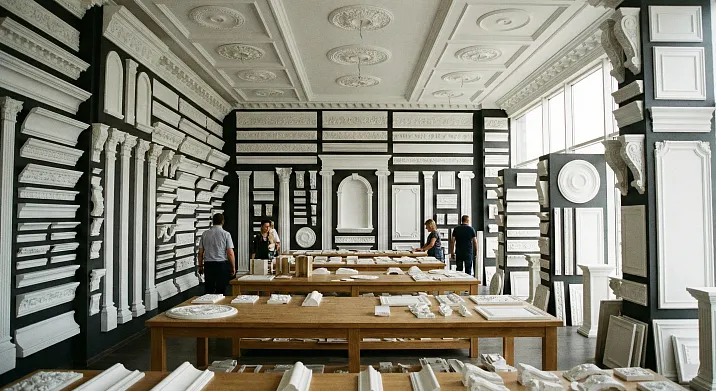
Imagine: you enter a room, and your gaze catches not the furniture, not the textiles, but the architecture. A ceiling cornice with an elegant relief separates the ceiling plane from the walls, creating a clear boundary and a play of light. The rosette under the chandelier is not just a circle, but a multi-tiered composition with acanthus leaves, like a greeting from 18th-century palaces. Columns on the sides of the arch visually support the arc of the opening, their capitals adorned with volutes—scrolls cast with millimeter precision. The baseboard at the floor is not a plastic strip, but a three-dimensional profile 12 centimeters high, finishing the flooring with the same elegance with which a cuff finishes a suit sleeve. All this is —polyurethane molding products, which transformed an ordinary space into an architectural work.
Polyurethane as a material for decor has conquered the world over the last 30 years. Previously, molding meant plaster (heavy, fragile, expensive to install) or wood (dries out, requires complex processing, fears moisture). Polyurethane is lightweight (the weight of elements is 5-15 times less than plaster counterparts), durable (does not crumble, does not break during transportation and installation), moisture-resistant (suitable for kitchens, bathrooms, facades), long-lasting (30-50 years without cracks and deformations), technologically advanced (glued in hours, not days, like plaster counterparts). And most importantly — affordable: the price per linear meter of cornice or baseboard made of polyurethane is 3-6 times lower than that of plaster or wooden equivalents. This has made decorative molding a mass product, accessible not only to wealthy clients of mansions but also to owners of ordinary apartments who want to turn a standard box into a space with European aesthetics.
But what arepolyurethane products for decorin practice? How many types, forms, sizes exist? How to navigate this diversity when manufacturers' catalogs contain 1500-2000 items? This article is a systematic guide to the universe of polyurethane molding. We will break down all products into categories: linear (moldings, cornices, baseboards, architraves — what comes in meters, installed along lines), piece (rosettes, consoles, keystones, overlays — what is sold individually, installed at specific points), architectural (columns, pilasters, capitals, bases — full-scale order elements), facade (rustication, pediments, frontons — for exteriors), furniture (overlays, legs, facade decors — for furniture upgrades), special (flexible elements for arches and curves, corner elements to simplify installation). We will analyze each category in detail: sizes, purpose, production technology, areas of application, prices, installation features. The goal is to give you a complete map of the territory, so you understand which product is for which task, how products combine, how to assemble a composition from them that turns an interior or facade into a work of art.


Linear products: meters of decorative lines
Linear elements are the foundation of any decorative system. Sold by the meter (more precisely, in sections of 200-240 cm), installed along lines (along perimeters, along plane boundaries, around openings). Create relief frames, transitions, spatial divisions.




Ceiling cornices: the boundary of the top and light
Ceiling cornice (also called molding, cove, ceiling baseboard) is a profiled strip installed at the junction of the wall and ceiling. Width is measured diagonally (from the lower point of contact with the wall to the upper point of contact with the ceiling): from 30 mm (minimalist thin profiles) to 300 mm (monumental Baroque cornices). The length of a standard section is 240 cm (some manufacturers produce 200 cm or 250 cm).
Functional purpose: visual separation of the ceiling from the walls (creates a clear boundary, fixes the transition between planes of different colors or textures), masking of joint defects (gaps between the wall and ceiling, plane differences up to 5-8 mm are covered by the cornice), placement of hidden lighting (LED strip behind the cornice, installed with a gap from the ceiling, creates a floating ceiling effect — light is directed upward, the ceiling glows from within), architectural proportion (a wide cornice 150-250 mm visually reduces the room height by 10-15 cm, makes the space cozier; a narrow one 30-70 mm preserves height, suitable for low ceilings of 2.4-2.5 meters).
Profile typology:
Smooth minimalist — simple geometry without ornament (one or two curves, beads, flutes). Width 30-80 mm, relief minimal 3-8 mm, weight 0.25-0.6 kg/meter. For modern interiors (minimalism, Scandinavian style, contemporary, loft). Price 220-520 rub./meter.
Classical ornamental — egg-and-dart (oval beads, strung in a chain), dentils (small rectangular teeth, imitation of beam ends), meander (Greek ornament broken line), pearls (beadwork, round beads). Width 70-140 mm, relief 10-20 mm, weight 0.6-1.1 kg/meter. For neoclassicism, classicism, Greek style. Price 450-980 rub./meter.
Baroque lush — acanthus leaves (stylized acanthus leaves, twisted into spirals, multi-tiered), garlands (flowers, ribbons, fruits in compositions), cartouches (oval frames with ornament inside), volutes (S-shaped scrolls). Width 100-280 mm, relief 20-45 mm, weight 1.0-2.3 kg/meter. For Baroque, Rococo, palace interiors. Price 720-1750 rub./meter.
Cornices with a cavity for lighting — the profile contains a protruding shelf or is installed with a gap, LED strip is placed in the resulting cavity. Width 80-200 mm, gap for the strip 30-100 mm. Price 580-1480 rub./meter.
Production technology: casting in molds. Liquid two-component polyurethane (polyol + isocyanate, mixed in proportion, foamed, hardens in 3-8 minutes) is poured into a silicone mold that replicates the cornice profile. After 8-15 minutes, the element is extracted, dried for 24 hours, primed in three layers (white acrylic primer, applied by spraying), cut into 240 cm sections. The density of polyurethane for rigid cornices is 300-380 kg/m³ (ensures strength, shape stability, absence of shrinkage).
Our factory also produces:


Wall moldings: verticals and horizontals
Wall molding is a narrow profiled strip for decorating walls. Width from 15 to 150 mm, thickness 8-30 mm, section length 200-240 cm. Unlike cornices (installed only at the wall-ceiling junction), moldings are installed anywhere on the wall (horizontally, vertically, diagonally).
Functional purpose: framing decorative panels (moldings highlight rectangular zones on the wall — inside the panel is painted a contrasting color, wallpapered with a different color or pattern, covered with fabric, wood — the molding creates a relief frame), horizontal division of the wall (molding at a height of 90-120 cm from the floor divides the wall into lower and upper parts — a classic technique: the bottom is painted a dark color, the top a light color, the molding is the boundary), framing doors, windows, mirrors (molding around the perimeter creates a decorative architrave), creating relief on smooth planes (vertical moldings on the wall imitate pilasters, horizontal ones — friezes).
Profile typology:
Simple rectangular — one or two beads, a curve, minimal relief 3-6 mm. Width 15-60 mm. Universal, suitable for any styles. Price 180-420 rub./meter.
Figurative classical — curves, flutes (vertical grooves), egg-and-dart, dentils (like on cornices, but narrower). Width 50-100 mm, relief 8-18 mm. For classical interiors. Price 340-780 rub./meter.
Wide decorative — complex profile with ornament (acanthus, meander, plant motifs, geometric patterns). Width 80-150 mm, relief 15-30 mm. For creating monumental panels, luxurious frames. Price 520-1200 rub./meter.
Installation technology: with polyurethane or acrylic mounting adhesive (Moment Montage, Tytan Professional, liquid nails). The wall surface must be level (differences up to 3 mm are acceptable, more than 3 mm — level with putty), clean (without dust, grease), dry. Adhesive is applied in a zigzag or dots (every 30-40 cm) on the back side of the molding, the molding is pressed against the wall, fixed with painter's tape (every 50-70 cm, tape is stuck from the molding to the wall — holds until the adhesive dries). After 12-24 hours, remove the tape, seal the joints with white acrylic sealant (fill gaps, smooth with a wet finger, remove excess with a sponge).
Get Consultation
Floor baseboards: protection and finishing
Floor baseboard is a profiled strip at the junction of the wall and floor. Height from 40 to 300 mm (standard 70-120 mm, European high baseboards 150-300 mm), section length 200-240 cm.
Functional purpose: masking the expansion joint (when laying laminate, parquet, linoleum, a gap of 8-15 mm is left around the perimeter of the room to compensate for material expansion due to temperature and humidity changes — the baseboard covers this gap), protection of the lower part of the wall from mechanical damage (kicks from feet, mop, vacuum cleaner, furniture legs — the baseboard takes the impact, the wall remains intact), visual boundary (the baseboard separates the floor from the wall, finishes the flooring, creates a transition between horizontal and vertical planes), hiding wiring (baseboards with cable channels contain a cavity for electrical cables, internet cables, TV antenna cables — wiring is hidden inside the baseboard, does not hang on walls, does not spoil aesthetics).
Typology:
Simple — minimal relief, one or two coves or beads. Height 50-100 mm, weight 0.3-0.7 kg/meter. For modern interiors. Price 240-580 rub./meter.
Figurative — complex profile with coves, beads, flutes (imitation of classic wooden skirting boards). Height 70-140 mm, weight 0.5-1.0 kg/meter. For neoclassicism, classicism. Price 360-850 rub./meter.
High Euro skirting boards — skirting boards 150-300 mm high, creating a powerful vertical boundary. Visual effect: they raise the ceiling (the gaze slides up the high skirting board, making the room seem taller), modern aesthetic (popular in Scandinavian and minimalist interiors). Height 150-280 mm, weight 0.8-1.8 kg/meter. Price 620-1580 rub./meter.
Skirting boards with cable channel — two-part construction: base (attached to the wall with screws or adhesive, contains a cavity for cables) and cover (snaps onto the base from above, covering the cables). Height 60-140 mm, channel cross-section from 15×15 mm (2-3 cables) to 30×40 mm (8-12 cables). Price 420-980 rub./meter.
Architraves: framing openings
Architrave — a molding installed around the perimeter of a door or window opening. Width from 35 to 150 mm, thickness 10-35 mm, section length 220-240 cm (for doors 200 cm high, two side sections of 210 cm and one horizontal top section of 100-120 cm are needed, totaling 520-540 linear cm).
Functional purpose: concealing the installation gap (a 15-30 mm gap remains between the door frame and the wall after door installation — the architrave covers it), decorative framing (the door or window is highlighted by a relief frame, becoming an architectural accent, not just an opening in the wall).
Profile typology: analogous to wall moldings (simple, classic figurative, wide decorative). Price 220-950 rub./meter.
Installation technology: with adhesive (for lightweight architraves up to 70 mm, weight less than 0.5 kg/meter) or with finishing nails (thin nails 20-30 mm, driven through the architrave into the wall every 40-50 cm, heads are countersunk 1-2 mm, filled with putty, painted — invisible). Corners are joined at 45° at the top corners of the opening (cut with a miter saw or miter box).
Individual pieces: accents and decorative points
Individual elements are sold by the piece (not by the meter), installed in specific places as decorative accents, focal points. They create visual support, complete compositions, attract the eye.
Ceiling rosettes: center and light
Ceiling rosette — a round, oval, square, or polygonal element with a relief ornament, installed on the ceiling (usually in the geometric center of the room under a chandelier). Diameter from 20 to 150 cm (standard 40-80 cm), thickness 12-50 mm, weight from 0.4 to 10 kg.
Functional purpose: framing the chandelier (the rosette creates a decorative background, enhances the visual weight of the fixture, makes the chandelier the center of the composition), concealing ceiling defects at the chandelier mounting point (stains from an old fixture, plaster irregularities, installation marks are covered by the rosette), centering the composition (the rosette fixes the geometric center of the room, organizes the space around itself).
Ornament typology:
Smooth geometric — radial or concentric flutes (grooves), minimal relief 5-12 mm. Diameter 25-70 cm, weight 0.4-2.5 kg. For minimalism, art deco, modern interiors. Price 650-2200 rub.
Classical — egg-and-dart, dentils, meander, acanthus leaves in a circular composition (ornament radiates from the center to the edges). Diameter 40-90 cm, relief 12-28 mm, weight 1.5-5 kg. For neoclassicism, classicism. Price 1200-4200 rub.
Baroque — multi-tiered relief (two or three tiers of ornament, each higher than the previous), garlands, cartouches, cupids, roses, grapevines. Diameter 60-150 cm, relief 25-50 mm, weight 3-10 kg. For baroque, rococo, palace interiors. Price 2800-8500 rub.
Installation technology: lightweight rosettes up to 65 cm, weight up to 2.5 kg — with adhesive (polyurethane or acrylic mounting adhesive, applied in dots every 8-12 cm around the circumference on the back of the rosette, the rosette is pressed to the ceiling, fixed with temporary props or painter's tape for 24 hours). Heavy rosettes 70-150 cm, weight over 2.5 kg — with adhesive + screws (3-6 screws around the circumference through the rosette into the ceiling, screw length 35-50 mm, heads are countersunk into a countersink on the back of the rosette, after installation filled with putty, painted — invisible from the front).
Corbels and brackets: visual support
Corbel (bracket) — a vertical or inclined element imitating a support. Height from 50 to 350 mm, width 40-220 mm, projection from the wall 25-120 mm, weight 0.3-4 kg.
Functional purpose: visual support for cornices (corbels are installed under the ceiling cornice at room corners or along the wall at equal intervals of 150-250 cm — creating the impression that the corbels hold the cornice, although in reality the cornice is held by adhesive), arch decoration (corbels on the sides of the arch at the level of the springing points — where the arc transitions into the vertical part of the opening — visually support the arc), functional shelves (corbel under a wooden, glass, or stone shelf — actually holds the weight of books, decorative items; in this case, the corbel is anchored, withstands a load of 20-80 kg depending on size).
Ornament typology:
S-shaped volutes — classic form, upper and lower scrolls. Height 70-200 mm, width 50-120 mm. For classicism, baroque. Price 550-1650 rub. per piece.
Acanthus leaves — stylized leaves, curled into spirals. Height 90-280 mm, deep relief 20-40 mm. For baroque, rococo. Price 850-2800 rub.
Geometric rusticated — straight blocks with imitation of stone masonry (rustication — roughly worked stone with a convex surface). Height 100-350 mm, width 80-220 mm. For loft style, industrial, neoclassical with rustic elements. Price 950-2500 rub.
Keystones: crown of the arch
Keystone — a decorative element for the top of an arch (center of the arc, the highest point). Shape trapezoidal (widening downwards, top narrow 50-90 mm, bottom wide 100-180 mm), wedge-shaped (triangle with apex up), sculptural (mascaron — face of a person, lion, god; cartouche — oval frame with a coat of arms or monogram; garland). Height 80-280 mm, width 60-220 mm, weight 0.5-3.5 kg.
Functional purpose: completing the arch (symbolically — the last stone inserted into the top of the arch, holding the entire structure; decoratively — an accent attracting the eye to the center of the arch), concealing the molding joint (if the arch arc is framed with flexible molding, at the top of the arc the two ends of the molding meet — the keystone overlaps the joint, simplifying installation).
Price: 750-5500 rub. depending on size and relief complexity (simple smooth trapezoidal 750-1350 rub., ornamental with rosette 1500-3200 rub., sculptural mascaron 3000-5500 rub.).
Decorative overlays: small decor
Overlays (appliqués, decorations, ornaments) — small individual elements for spot decoration. Size from 4×4 cm to 35×50 cm, thickness 5-20 mm, weight 15-400 grams.
Shapes: round rosettes (diameter 5-18 cm, concentric or radial ornament), corner elements (decorate the corners of molding frames — instead of mitering moldings at 45°, a ready-made corner decoration is inserted), cartouches (oval frames from 8×12 cm to 20×30 cm, empty inside or with ornament), stylized leaves and flowers (acanthus leaves, grape clusters, roses, lilies — size 6-25 cm), coats of arms and monograms (shields, crowns, initials — size 10-30 cm).
Functional purpose: decorating furniture (overlays are glued onto the fronts of cabinets, dressers, nightstands — turning a smooth door into a decorated one, making IKEA look like an antique), door decor (an overlay in the center of a door panel — an accent, making the door more interesting), decorating frame corners (instead of complex mitering of moldings — a ready-made corner element, easier installation), filling voids on walls (single overlays on a smooth wall — accent points).
Price: 120-1200 rubles per piece (small rosettes 5-10 cm — 120-350 rubles, medium leaves and flowers 12-20 cm — 350-750 rubles, large cartouches and coats of arms 25-40 cm — 750-1200 rubles).
Architectural products: order monumentality
Architectural forms — full-scale elements of the classical order system. Create vertical divisions, monumentality, academic rigor, connection with ancient and classical architecture.
Columns: verticals of strength
Column — a vertical cylindrical or polygonal element from floor to ceiling. Height from 180 to 450 cm (standard 220-320 cm for ceilings 2.5-3.5 meters), diameter from 12 to 45 cm, weight from 8 to 55 kg (hollow inside, wall thickness 15-25 mm).
Structure: base (lower part, stands on the floor, widened, height 8-20 cm), shaft (cylindrical middle part, smooth or with flutes — vertical grooves, height equals room height minus base minus capital), capital (upper decorated part, visually supporting the entablature, arch, or ceiling, height 15-45 cm).
Orders (column styles):
Doric — the simplest and most massive. Base low, round (height 8-12 cm), shaft smooth or with 16-20 wide flutes depth 15-25 mm, diameter 22-40 cm, capital austere (echinus — convex cushion + abacus — square slab on top, total capital height 15-25 cm). For masculine, austere interiors (studies, libraries, halls). Price for a set (base + shaft + capital) for one column 11000-24000 rubles.
Ionic — more elegant and slender. Base tall with toruses and scotias (height 12-20 cm), shaft with 20-24 narrow flutes depth 10-18 mm, diameter 18-35 cm, capital with volutes (S-shaped scrolls on the sides, capital height 20-35 cm). For elegant, feminine interiors (living rooms, dining rooms, formal rooms). Price 15000-35000 rubles per column.
Corinthian — the most luxurious and complex. Base like Ionic, shaft with flutes, diameter 20-38 cm, capital with two-three tiers of acanthus leaves (lower tier large leaves, middle smaller, upper smallest, all twisted into spirals, capital height 25-50 cm, relief deep 30-70 mm). For luxurious, palatial interiors (mansions, hotels, high-class restaurants). Price 22000-58000 rubles per column.
Application: columns are installed in halls (on either side of the entrance, creating a ceremonial portal), living rooms (framing the fireplace area, sofa, columns in corners or along a wall create rhythm), dining rooms (columns on either side of an arched opening between living and dining rooms), commercial premises (banks, hotels, restaurants — columns symbolize reliability, tradition, status).
Pilasters: flat columns
Pilaster — a flat vertical projection on a wall, repeating the structure of a column (base, shaft, capital), but not cylindrical, but rectangular in cross-section. Width 70-250 mm, thickness (projection from wall) 25-90 mm, height from floor to ceiling or to frieze level, weight 4-25 kg.
Advantage over a column: a pilaster does not occupy floor area (projects from the wall 3-9 cm, a column occupies a circle 20-45 cm in diameter — critical in small spaces), cheaper (pilaster is lighter, less material, easier installation — price 7500-38000 rubles per pair, columns 22000-116000 rubles per pair).
Application: decorating walls (pilasters on room corners, on either side of doors, windows, fireplaces — create vertical divisions, rhythm, imitate the order system without cluttering space), framing portals (two pilasters on either side of an arched opening + cornice on top = classical portal).
Capitals and bases: separate elements
Capital and base are sold both as part of a column/pilaster set and separately. Separate capitals are used to create compositions without a column (a capital on a wall as a decorative element, console), bases — as pedestals for sculptures, vases, decorative objects.
Price of separate elements: Doric capitals 1650-5000 rubles, Ionic capitals 2300-8500 rubles, Corinthian capitals 4200-16000 rubles (depends on diameter and complexity of relief). Bases 1100-4000 rubles.
Façade products: exterior
Assortment of polyurethane decorincludes elements for building façades. Façade molding creates architectural expressiveness for the exterior, conceals construction defects, imitates historical architecture.
Rustication: corners and masonry
Rustication — a rectangular block with relief imitating roughly worked stone. Size from 10×15 cm to 25×50 cm, thickness 20-60 mm, weight 0.4-3 kg. Installed on building corners (vertical chain of rustication from ground to roof), around windows and doors, on wall planes (imitating masonry).
Effect: the building looks as if built from stone (though actually brick or concrete, faced with plaster), more monumental, expensive, historically authentic (rustication is characteristic of Renaissance, Baroque, Classical architecture).
Price: 450-2200 rubles per piece (small rustication 10×15 cm — 450-850 rubles, medium 15×25 cm — 850-1500 rubles, large 20×40 cm — 1500-2200 rubles).
Window and door façade casings
Façade casings — profiled strips for framing windows and doors on the outside of a building. Width from 60 to 200 mm, thickness 25-80 mm, section length 200-240 cm. Profile is more massive than interior casings (façade requires a larger scale, small decor is not legible from a distance).
Configuration: side casings (two vertical strips on either side of the window), top casing (horizontal strip above the window, often with a keystone in the center), bottom windowsill molding or cornice (horizontal strip under the window).
Price: 380-1450 rubles/meter (simple profiles 60-100 mm — 380-750 rubles/meter, complex ornamental 120-200 mm — 850-1450 rubles/meter).
Facade cornices and friezes
A facade cornice is a horizontal profiled strip installed under the roof of a building (at the junction of the wall and roof overhang) or between floors. Width ranges from 120 to 400 mm, projection (extension from the wall) from 80 to 300 mm, section length 200-240 cm.
Function: visual completion of the building from the top (the cornice separates the wall from the roof), protection of the wall from water running off the roof (a cornice with a 150+ mm projection diverts water away from the wall plane), architectural proportion (the cornice divides the building into zones, creates horizontal divisions).
Price: 650-2800 rubles/meter (simple cornices 120-200 mm — 650-1350 rubles/meter, monumental cornices with consoles 250-400 mm — 1600-2800 rubles/meter).
Furniture items: furniture upgrade
Types of polyurethane productsinclude elements for decorating furniture — overlays, legs, facade decorations.
Furniture overlays
Furniture overlays are small decorative elements glued onto the facades of cabinets, dressers, nightstands, and bed headboards. Size from 5×5 cm to 30×40 cm, thickness 5-18 mm, weight 20-350 grams.
Shapes: rosettes, cartouches, leaves, flowers, corner elements, coats of arms, monograms (similar to interior decorative overlays, but often adapted to furniture dimensions — smaller in size, with a flat relief of 3-12 mm).
Application: transforming simple furniture into decorated furniture (an IKEA cabinet with smooth doors + 6-8 overlays on the doors = a cabinet in Provencal or neoclassical style), restoring old furniture (lost wooden decorations are replaced with polyurethane ones — lighter, cheaper, do not dry out), creating accents (an overlay in the center of a bed headboard, on the central door of a sideboard).
Price: 100-950 rubles per piece.
Furniture legs
Polyurethane furniture legs are decorative replacements for standard legs. Height from 8 to 35 cm, diameter 4-12 cm, shapes include cylindrical with relief (fluting, beads, balusters — turned shapes like stair railings), conical (widening towards the bottom or top), figured (carved legs with ornament).
Application: replacing legs on sofas, armchairs, dressers, beds, tables (standard chrome or plastic legs are replaced with decorative polyurethane ones — furniture becomes more interesting, fits into a classic interior).
Price: 280-1450 rubles for a set of 4 pieces.
Special products: non-standard tasks
Flexible moldings and cornices
Flexible molding is a profiled strip made of elastic polyurethane with a density of 180-260 kg/m³ (compared to 320-380 kg/m³ for rigid ones). It can be bent by hand to a radius from 250 mm (narrow moldings 25-45 mm) to 1200 mm (wide ones 100-140 mm) without heating and without risk of breaking.
Application: framing arched openings (molding along the arch curve), wrapping around round columns (molding encircles the column cylinder), decorating curved walls (radius partitions, bay windows, niches with rounded corners).
Price: 35-70% more expensive than rigid counterparts (flexible molding 70 mm — 520-920 rubles/meter, rigid counterpart 340-620 rubles/meter; the difference is due to raw material cost and technology — elastic polyurethane is more expensive, requires different component ratios).
Corner elements for cornices
A corner element is a ready-made internal (concave 90°) or external (convex 90°) angle for joining cornices or moldings without cutting. Size corresponds to the cornice width (for a 90 mm cornice — a 90×90 mm corner element, for a 120 mm cornice — a 120×120 mm element).
Advantage: simplifies installation (no miter saw needed, no skills required for cutting 45° angles — simply insert the ready-made element between straight cornice sections and glue it). Disadvantage: limited assortment (corner elements are produced only for popular cornice models, you won't find them for rare ones).
Price: 250-800 rubles per pair (internal + external) or for two internal ones (for one room corner, two internal corner elements are needed — left and right).
Frequently asked questions about polyurethane products
How much does one meter of cornice weigh?
Depends on width, polyurethane density, and profile complexity. A smooth 50 mm cornice — 0.25-0.45 kg/meter, an ornamental 100 mm cornice — 0.7-1.1 kg/meter, a Baroque-style 200 mm cornice — 1.5-2.5 kg/meter. Weight is critical for choosing the mounting method: light ones up to 1 kg/meter are mounted with adhesive, heavy ones over 1.2 kg/meter — adhesive + screws.
How does polyurethane differ from polystyrene foam?
Polystyrene foam (expanded polystyrene) — foamed polystyrene, density 15-35 kg/m³, open-cell structure (beads visible), easily crumbles, breaks, yellows from UV light in 3-5 years. Polyurethane — density 300-380 kg/m³ (10-20 times denser), closed-cell homogeneous structure (no beads visible, surface smooth), durable (does not crumble or break), UV-stable (does not yellow for 30-50 years with quality raw materials). Polystyrene foam is cheaper (60 mm cornice — 80-150 rubles/meter) but fragile and short-lived. Polyurethane is more expensive (60 mm cornice — 280-480 rubles/meter) but durable and long-lasting.
Can polyurethane products be painted?
Yes, polyurethane can be painted with acrylic and latex paints in any color. The factory-applied white primer is ready for painting without additional preparation. Technique: paint with a roller (smooth areas) and a brush (ornament, recesses) in two coats with a 4-hour interval between coats. For exterior products, use exterior paints with UV filters (Dulux Weathershield, Tikkurila Euro Facade, Caparol AmphiSilan).
How much does it cost to decorate a 70 m² apartment?
Basic set (cornices around the perimeter of all room ceilings + floor skirting boards + 2 ceiling rosettes for chandeliers): materials 16,000-30,000 RUB, DIY installation (tools + adhesive + sealant 3,000-5,000 RUB) or by a professional 15,000-27,000 RUB, total 19,000-57,000 RUB. Extended set (+ wall moldings for panel framing + door architraves): materials 30,000-55,000 RUB, installation 22,000-40,000 RUB, total 52,000-95,000 RUB.
Where to buy rare products (coffers, large columns 4+ meters high)?
Local showrooms stock only popular items (cornices, skirting boards, standard-sized rosettes up to 80 cm, columns up to 3 meters). Rare and large-sized products are ordered directly from manufacturers (via website, by phone, custom production lead time 5-15 days, delivery by transport companies, minimum order amount usually 15,000-25,000 RUB).
What to use for gluing polyurethane?
For interior products: polyurethane adhesive (Titanium, Orac Decor DecoFix Pro — sets in 10-15 minutes, full polymerization in 24 hours, holds instantly) or acrylic mounting adhesive (Moment Montazh Express MV-50, Tytan Professional — sets in 20-30 minutes, full polymerization in 24 hours, cheaper than polyurethane). For exterior products: polyurethane adhesive for exterior use (frost-resistant, moisture-resistant) + mechanical fastening with screws or anchors (adhesive + mechanical fastening — 100% reliability).
Conclusion: the universe of decoration in one material
Polyurethane has created a revolution in decorative finishing, transforming stucco from an elite product (accessible to few, requiring plaster workshops, weeks of work, large budgets) into a mass-market material (accessible to everyone, installed in days, inexpensive).polyurethane molding productsThey form an integrated system of decorative elements covering all architectural tasks for interiors and facades: linear products (cornices, moldings, skirting boards, architraves — 400+ models, create lines, boundaries, frames, price 180-2,800 RUB/meter), individual pieces (rosettes, consoles, keystones, overlays — 300+ items, create accents, focal points, price 100-8,500 RUB per piece), architectural (columns, pilasters, capitals, bases — 100+ sets of all orders, create verticals, monumentality, price 7,500-58,000 RUB per piece), exterior (rustication, architraves, cornices — 150+ models, create exterior architecture, price 380-2,800 RUB/meter or per piece), furniture (overlays, legs — 80+ items, furniture upgrade, price 100-1,450 RUB), special (flexible for arches, corner pieces to simplify installation — 60+ items).
Production of polyurethane products is a high-tech process: casting in silicone molds (molds cost 150,000-600,000 RUB, last for 5,000-15,000 castings, reproduce relief with an accuracy of 0.2-0.3 mm), component dosing (polyol + isocyanate mixed in a 100:45-55 ratio, temperature 20-30°C, dosing accuracy ±0.5% — ensured by automation), molding (liquid polyurethane foams, fills the mold, hardens in 3-8 minutes, final density 180-380 kg/m³), priming (three layers of white acrylic primer, thickness 0.15-0.18 mm, applied by robotic sprayers, uniformity 100%). The quality of the final product depends on the raw materials (European systems BASF, Huntsman provide density 320-380 kg/m³, stability, durability; cheap Asian systems — density 200-280 kg/m³, shrinkage, yellowing after 5-10 years), dosing accuracy (error in component ratio — insufficient strength or excessive brittleness), mold quality (silicone molds Wacker, Bluestar reproduce relief with 0.2 mm accuracy, cheap molds — 0.5-1 mm, blurred ornament).
Application of polyurethane products is universal: residential interiors (apartments, country houses — cornices, skirting boards, rosettes, moldings, columns create European aesthetics, classic or contemporary style), commercial premises (offices, banks, hotels, restaurants — stucco creates representativeness, status, atmosphere), public spaces (museums, theaters, libraries — restoration of historical interiors with polyurethane copies of lost plaster stucco), facades (decoration of entrance groups, window framing, cornices, rustication — the building becomes architecturally expressive), furniture (decoration of facades, replacement of legs — upgrading simple furniture into decorated furniture). Scale of application from minimal (one room 15 m², basic cornice around the perimeter, material cost 2,500-4,500 RUB, visual effect disproportionate to investment) to maximal (mansion 500 m², full decoration of all rooms and facades — columns, coffers, panels, exterior portals, cost 800,000-2,500,000 RUB, result — a palace).
Company STAVROS — leader of the Russian polyurethane stucco market, operating since 2002 (24 years of experience, over 200,000 completed orders), own production in the Moscow region (factory area 8,500 m², 45 Hennecke Germany injection molding machines, capacity up to 15,000 meters of linear products per day), European raw materials (polyurethane systems BASF Germany, density 320-380 kg/m³, frost resistance down to minus 50°C, moisture resistance 100%, UV stability, no yellowing for 30-50 years), high-precision molds (silicone molds Wacker Germany, relief detail 0.2-0.3 mm — every leaf of ornament, every bead, every groove reproduced perfectly). STAVROS assortment: 1900+ items covering all product categories (ceiling cornices 430 models width from 30 to 300 mm, wall moldings 390 models width from 15 to 150 mm, floor skirting boards 290 models height from 40 to 300 mm, ceiling rosettes 165 models diameter from 20 to 150 cm, columns and pilasters 98 sets of all orders height from 180 to 450 cm, consoles 88 models, keystones 68 models, decorative overlays 145 items, exterior products 180 items, flexible moldings 48 models, corner elements for 190 cornice models).
Choose STAVROS — choose the full range of polyurethane products, classified, systematized, stylistically coordinated (elements of one collection harmonize ornamentally — egg-and-dart of one shape, acanthus leaves of one pattern, profiles of coordinated proportions — you assemble a composition, elements combine perfectly), high-quality (European polyurethane, detail 0.2-0.3 mm, durability 30-50 years, moisture resistance, frost resistance, UV stability), affordable in price (180-2,800 RUB/meter linear, 100-8,500 RUB individual pieces, 7,500-58,000 RUB architectural — 2-6 times cheaper than plaster and wooden analogues), diverse (1900+ items — you will find products for any style from minimalism to baroque, any room from a 10 m² bedroom to a 250 m² banquet hall, any budget from 2,500 to 2,000,000 RUB, any task from a basic cornice to a full order system with coffers). Your interior, your facade, your furniture deserve decoration made from the material of the 21st century — STAVROS polyurethane stucco transforms standard spaces into architectural works, serving for decades, delighting every day, creating that elusive atmosphere of European aesthetics, nobility, timeless elegance that distinguishes a home from a box, an interior from finishing, a space from a set of square meters.


