Article Contents:
- Furniture Set: More Than Just a Collection of Items
- Advantages of a Comprehensive Approach to Interior Design
- Types of Furniture Sets: From Kitchen to Bedroom
- The History of Furniture Sets: From Luxury to Accessibility
- Materials and Technologies: Where You Shouldn't Cut Corners
- Natural Wood: Eternal Classic with Character
- Engineering Materials: Modern Solutions for Practical Furniture
- Hardware and Mechanisms: Invisible Heroes of Comfort
- Styles of Furniture Sets: From Classic to Avant-Garde
- Classic Style: Beyond Time and Trends
- Modern Style: Functionality and Clean Lines
- Scandinavian Style: Naturalness and Coziness
- Loft and Industrial Style: Brutality and Character
- Minimalism: Less Means More
- Where to Buy a Furniture Set: Overview of Options
- Specialized Furniture Stores: Advantages of a Professional Approach
- Furniture Factories: From Manufacturer to Consumer
- Online Stores: Convenience and Wide Selection
- Design Studios: Exclusive Solutions
- Criteria for Choosing a Reliable Supplier
- Practical Tips for Choosing a Furniture Set
- Measurements and Planning: Avoiding Costly Mistakes
- Assessing Quality: What to Pay Attention to When Buying
- Ergonomics and Functionality: Comfort Comes First
- Stylistic Harmony: Harmony in the Interior
- Trends and Innovations in the World of Furniture Sets
- Modern Trends: What's Relevant Today
- Technological Innovations: Smart Furniture for the Modern Home
- Ecological Aspects: Sustainable Development in Furniture Production
- Conclusion: How to Create the Interior of Your Dreams with the Perfect Set

Imagine: you enter a room, and the first thing that catches your attention is a harmonious ensemble of furniture that seems to tell a story about its owners. Each item is in its place, creating a sense of completeness and thoughtful space design. This is precisely the impression a well-chosen furniture set — a collection of items united by a common design solution — produces. But where to buy a furniture setwhich will become not just functional home furnishings, but its true decoration? How to avoid getting lost in the variety of styles, materials, and manufacturers? Let's explore these questions and learn how to choose furniture that will delight you for many years.


Furniture Set: More Than Just a Collection of Items
A furniture set is not a random collection of cabinets, tables, and chairs. It is a carefully thought-out ensemble, where each element complements the others, creating a unified composition. Let's explore why a set has advantages over individual furniture items and what types of sets exist.




Advantages of a Comprehensive Approach to Interior Design
Choosing a furniture set instead of individual items has several significant advantages:
- Stylistic Unity. All elements of the set are made in one style, using the same materials, hardware, and color solutions. This creates a harmonious, cohesive image of the room without visual "noise" from mismatched items.
- Ergonomics and Functionality. The items of the set are designed with their interaction in mind. For example, the height of the kitchen set's countertop perfectly matches the height of the chairs, and the depth of the cabinets corresponds to the room's size. This ensures maximum comfort of use.
- Optimal Use of Space. A set allows for the most efficient use of available space, especially in small rooms. Modules can be arranged in various ways, adapting to specific layouts.
- Time and Effort Savings. Instead of searching for individual furniture items that will match each other, you get a ready-made solution. This significantly simplifies the interior design process.
- Durability and Repairability. A quality set is designed for long-term use. If necessary, you can replace an individual element without changing the entire set.
Our factory also produces:


Types of Furniture Sets: From Kitchen to Bedroom
Furniture sets differ by purpose and composition. Let's consider the main types:
Kitchen Set — the most common type. Includes:
- Floor Cabinets (depth 60 cm, height 85-90 cm)
- Wall Cabinets (depth 30-40 cm)
- Countertop (thickness from 28 to 40 mm)
- Built-in Appliances (oven, cooktop, dishwasher)
- Sink and Faucet
- Backsplash (height 60-70 cm)
Modern kitchen sets are equipped with soft-close drawer systems, pull-out mechanisms, built-in lighting, and other functional elements that make kitchen use maximally comfortable.
Living Room Set (for the living room) usually includes:
- Wall Unit or Storage System (height up to 240 cm)
- Sofa and Chairs
- Coffee Table
- TV Stand
- Additional Elements (ottomans, consoles, display cases)
Living room sets often have a modular construction, allowing elements to be combined depending on room size and owner needs.
Bedroom Set consists of:
- Beds (standard sizes: single 90×200 cm, double 120×200 cm, queen 140×200 or 160×200 cm, king-size 180×200 or 200×200 cm)
- Nightstands
- Cabinet or Wardrobe
- Commode
- Makeup Table with Mirror (optional)
A quality bedroom set ensures not only comfortable sleep but also convenient storage for clothes, linens, and personal items.
Children's furniture is designed taking into account the needs of a growing child:
- Bed (often convertible or with pull-out drawers)
- Closet
- Desk
- Shelving for Books and Toys
- Chests and Dressers
Children's furniture has higher safety requirements: absence of sharp corners, eco-friendly materials, structural durability.
Office furniture includes:
- Work Desk (75-80 cm high)
- Ergonomic Chair
- Document Storage Systems
- Chests and Cabinets
- Additional Elements (Stands, Organizers)
Office furniture is designed with ergonomics of the workspace and optimization of work processes in mind.
Get Consultation
History of Furniture Sets: From Luxury to Accessibility
The history of furniture sets spans several centuries. In the 17th-18th centuries, France saw the emergence of the first sets of furniture, crafted in a unified style for aristocratic homes. These sets were true works of art, created by the best craftsmen of their time.
In the 19th century, with the development of industrial production, furniture sets became more accessible to the middle class. Factories specializing in producing furniture sets in popular styles of the time—Empire, Biedermeier, Eclecticism—appeared.
The 20th century brought a revolution in furniture design. Bauhaus and Modernism proclaimed principles of functionality and accessibility. Modular systems emerged, allowing owners to combine elements as desired. IKEA and other manufacturers made designer furniture accessible to the mass consumer.
Today we are witnessing a return of interest in individuality and quality. Modern furniture sets combine innovative technologies, eco-friendly materials, and unique designs tailored to specific customer needs.
Materials and Technologies: Where You Shouldn't Cut Corners
The quality of furniture sets largely depends on the materials used to make them. Let's consider the main options and their characteristics.
Natural Wood: Eternal Classic with Character
Natural wood remains one of the most popular materials for furniture production. Its advantages:
- Ecological and natural. Wood is a fully natural material, emitting no harmful substances.
- Durability. Quality wooden furniture can serve for decades and even be passed down through generations.
- Aesthetic appeal. The unique texture of each piece of wood makes furniture one-of-a-kind.
- Repairability. Wooden furniture can be restored, updated, or repainted.
Various types of wood are used to manufacture furniture sets:
Oak is one of the best materials for furniture. It is distinguished by exceptional strength (hardness on the Brinell scale 3.7-4.5), resistance to moisture and mechanical damage. Oak density is 700-800 kg/m³, ensuring excellent structural stability. Oak furniture can serve for centuries, acquiring a noble patina over time.
Beech is a hard wood (hardness on Brinell scale 3.5-4.0) with a uniform structure, easily processed. Furniture made of beech is elegant and has a light, warm tone. Density 650-750 kg/m³ guarantees good strength.
Walnut is a noble wood with rich, expressive texture. Hardness on Brinell scale 3.4-3.8, density 600-650 kg/m³. Walnut furniture looks luxurious and prestigious.
Ash - a strong, elastic material (Brinell hardness 3.8-4.2) with an attractive grain. Often used for bent furniture due to its flexibility. Density 650-750 kg/m³.
Spruce - an affordable coniferous species with a distinctive grain and aroma. Softer than hardwoods (Brinell hardness 1.5-2.5), but with proper treatment, it can last for decades. Density 400-500 kg/m³.
Engineering materials: modern solutions for practical furniture
The modern furniture industry actively uses engineering materials that surpass natural wood in certain parameters:
MDF (Medium Density Fiberboard) - a material obtained by pressing wood fibers. Compared to particleboard, it has greater strength (25-35 MPa bending), moisture resistance, and eco-friendliness. MDF density is 700-870 kg/m³, bringing it close to natural wood. MDF is easily machinable, allowing for furniture with complex decoration.
Particleboard (Particleboard) - a material made of wood particles bonded with synthetic resins. Modern laminated particleboard (Laminated Particleboard) has a protective coating resistant to abrasion (wear resistance class 1 to 5 according to Taber scale), moisture, and stains. Particleboard density varies from 550 to 750 kg/m³.
Veneer - a multi-layer material made of glued veneer sheets. It features high strength (up to 80 MPa bending), moisture resistance, and dimensional stability. Often used for furniture in Scandinavian style.
Furniture panel - wooden laminates glued together. Combines the advantages of solid wood (naturalness, aesthetics) with improved dimensional stability and absence of warping. The typical thickness of furniture panels is 18-40 mm.
Plastic and composite materials are used for making fronts, countertops, and decorative elements:
- Acrylic - a glossy material with high UV resistance
- HPL plastic - a super-strong laminated material for countertops
- Artificial stone - a composite based on acrylic resins and mineral fillers
Hardware and mechanisms: the invisible heroes of comfort
The quality of furniture sets largely depends on the hardware and mechanisms used. It is precisely these components that ensure ease of use and longevity of furniture.
Hinges - provide door opening and closing. Modern hinges come in many variations:
- Surface-mounted (visible)
- Semi-surface-mounted
- Inset (hidden)
- With a soft-close mechanism
- With a push-to-open system
- With three-plane adjustment
High-quality hinges are made of steel with anti-corrosion coating and can withstand a load of 25-30 kg per pair of hinges. The service life of premium hinges is 80,000-100,000 opening/closing cycles.
Drawer guides determine how smoothly and quietly drawers will slide out:
- Ball-bearing (mid-range price segment, support up to 30-35 kg)
- Ball-bearing (mid-range price segment, support up to 30-35 kg)
- Telescopic (premium segment, support up to 45-50 kg, ensure full drawer extension)
- Hidden mounting (installed under the drawer base, not visible)
Lift mechanisms are used for opening upper cabinets:
- Gas (with pneumatic dampers)
- Spring
- Electric
Extension systems for organizing storage:
- Pull-out baskets for kitchen cabinets
- Pantographs (closet lifts)
- Pull-out hangers for pants and ties
- Cargo (pull-out systems for kitchens)
Connecting hardware ensures structural integrity:
- Fasteners (furniture screws)
- Excentric clamps
- Angles and plates
- Shanks (wooden or plastic dowels)
Leading furniture manufacturers (Blum, Hettich, Grass, Hafele) offer comprehensive solutions ensuring maximum comfort of furniture use. For example, soft-close systems, synchronizers for simultaneous opening of multiple elements, electric drives with remote control.
Furniture set styles: from classic to avant-garde
Choosing a furniture set style is not only an aesthetic question, but also a reflection of your lifestyle, values, and personality. Let's consider the main stylistic directions and their features.
Classic style: timeless and trend-free
Classic style in furniture is the embodiment of elegance, harmony, and respectability. It never goes out of fashion and always looks appropriate.
Features of a classic set:
- Symmetrical, proportional forms
- Use of valuable wood species (walnut, mahogany, oak)
- Carved decoration, inlay, marquetry
- Curved legs, cornices, pilasters
- Natural upholstery (leather, velvet, jacquard)
- Natural wood tones or pastel shades
Neoclassicism - a modern interpretation of classic style. It preserves the elegance and proportionality of classicism, but features more minimalist forms, light tones, and minimal decoration.
Furniture in classic style is ideally suited for spacious rooms with high ceilings. It creates an atmosphere of luxury and nobility, emphasizing the owner's status and respect for traditions.
Modern style: functionality and clean lines
Modern style (contemporary) - today's current trends. It is characterized by functionality, minimalism, and comfort.
Features of a modern set:
- Clear, geometric forms
- Minimal decoration
- Combination of various materials (wood, metal, glass, plastic)
- Neutral color palette with bright accents
- Multifunctionality and transformability
- Built-in lighting and technological solutions
Modern furniture fits perfectly into city apartments and offices. It creates a sense of freedom and space, without visually overloading the area.
Scandinavian style: naturalness and coziness
Scandinavian style gained popularity due to its simplicity, functionality, and special coziness.
Features of a Scandinavian set:
- Light wood tones (birch, pine, beech)
- Simple, minimalist forms
- Natural materials
- Functionality and practicality
- Minimalism in decoration
- Light color palette (white, beige, gray) with bright accents
Scandinavian furniture creates an atmosphere of calm and harmony. It is ideally suited for small rooms, visually expanding the space due to light tones and light forms.
Loft and industrial style: brutality and character
Loft and industrial style reflect urban aesthetics, combining roughness and sophistication.
Features of a loft-style set:
- Massive forms
- Combination of wood and metal
- Unfinished surfaces, deliberately 'careless' appearance
- Functionality
- Vintage elements
- Open storage systems
- Dark, saturated colors or natural wood tones
Furniture in loft style looks great in spacious rooms with high ceilings, open floor plans, and brick walls. It creates an atmosphere of creative freedom and nonconformity.
Minimalism: less is more
Minimalism is a design philosophy based on the principle 'less is more'. It focuses on functionality and eliminating everything unnecessary.
Features of a minimalist set:
- Simple geometric forms
- Absence of decorative elements
- Monochromatic color palette
- Functionality of each item
- Hidden storage systems
- Quality materials with interesting texture
Minimalist furniture creates a sense of order and calm. It is ideally suited for people who value functionality and dislike visual clutter.
Where to buy a furniture set: overview of options
Which set will perfectly suit your interior? where to buy a furniture setLet's consider the main options with their advantages and disadvantages.
Specialized furniture stores: advantages of professional approach
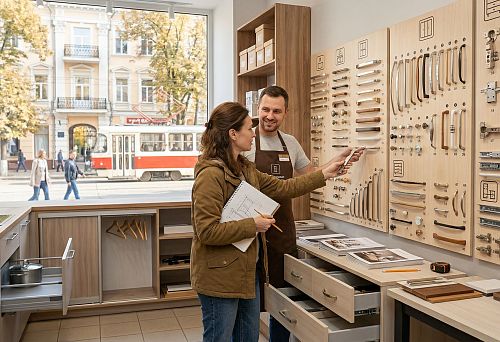
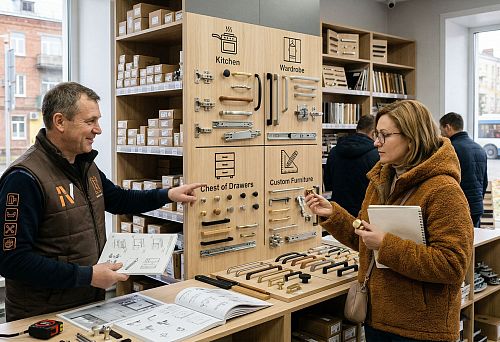
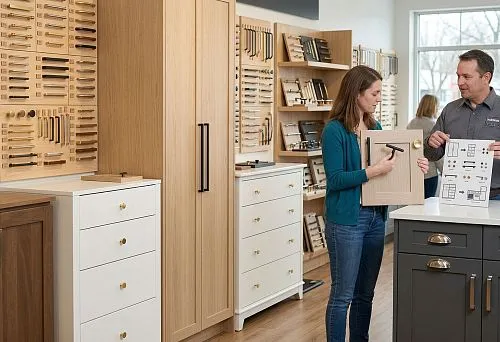
Furniture stores offer a wide range of sets in various styles and price categories. Their main advantages:
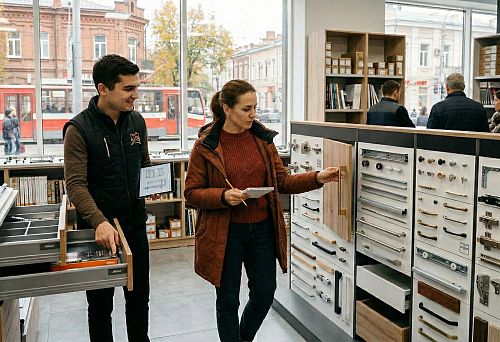
- Opportunity to see and feel the furniture before purchase. You can assess the quality of materials, hardware, assembly, check how easily drawers and doors open.
- Professional consultation from specialists. Experienced consultants will help you choose a set matching your needs and interior style.
- Quality guarantee and service. The store's reputation guarantees you will receive quality furniture and service.
- Opportunity to order custom-made furniture. Many stores offer services for custom furniture production.
- Additional services (delivery, assembly, design project).
Company 'Stavros' - one of the leaders of the furniture market, offering a wide range of quality furniture in various styles and price categories. Here you can not only buy a furniture setbut also receive professional consultation on choosing and furnishing the interior.
Furniture factories: from manufacturer to consumer
Buying furniture directly from the manufacturer has several advantages:
- Lower prices due to absence of intermediaries. You pay only for the furniture, without distributor or store markup.
- Option to order custom manufacturing. Factories often offer services for custom furniture production, taking into account all customer preferences.
- Quality guarantee from the manufacturer. Factories value their reputation and control quality at every stage of production.
- Complete information about materials and production technologies. You can obtain comprehensive information about what your furniture is made of and how it is manufactured.
Many factories have their own exhibition halls, where you can view product samples and place an order.
Online stores: convenience and wide selection
Online shopping is becoming increasingly popular, and the furniture industry is no exception. Advantages of buying furniture online:
- Time-saving. You can choose furniture at any convenient time, without leaving home.
- Ability to compare prices and features of different models. Online catalogs allow you to quickly compare dozens of options.
- Access to reviews from other customers. You can learn about real user experiences with furniture from other clients.
- Wide assortment, not limited by exhibition hall space.
- Delivery to your home.
However, when buying furniture online, it is important to carefully study the product description, materials, dimensions, and reviews. Also, it is advisable to clarify delivery, assembly, and return conditions.
Design studios: exclusive solutions
If you are looking for unique, designer furniture, consider specialized design studios. They offer:
- Exclusive models created by renowned designers.
- Individual approach to each client.
- Highest quality materials and craftsmanship.
- Comprehensive solutions for interior design.
Of course, such furniture costs more than mass production, but it becomes a true decoration of the interior and a source of pride for the owner.
Criteria for choosing a reliable supplier
Regardless of the fact, where to buy a furniture setit is important to evaluate the supplier's reliability based on the following criteria:
- Reputation and experience. The longer a company has been on the market, the more likely it is that it values its reputation and offers quality products and services.
- Customer reviews. Study reviews on independent platforms, social networks, and ask acquaintances.
- Warranty obligations. A reliable supplier always provides a warranty on their products and clearly outlines warranty service conditions.
- Transparency of information. A reputable seller provides complete information about materials, manufacturer, delivery, and assembly conditions.
- Service. Quality of service, professionalism of consultants, willingness to answer all questions.
- Additional services. Delivery, assembly, possibility of returns or exchanges, after-sales service.
Practical tips for choosing a furniture set
Choosing a furniture set is a responsible process requiring attention to detail. Here are several practical tips to help you make the right choice.
Measurements and planning: avoid costly mistakes
Before purchasing furniture, carefully measure the room and plan the layout:
- Measure the room dimensions - length, width, ceiling height.
- Mark the location of doors, windows, outlets, radiators - this will help avoid situations where furniture blocks access to important elements.
- Create a scaled room plan - you can use special programs or simply draw it on paper.
- Consider movement space - there should be enough room between furniture pieces for comfortable movement (minimum 70-80 cm).
- Check delivery routes - measure doorways, stairwell widths, elevator dimensions to ensure furniture can be delivered to your apartment.
- Consider room features - window placement (furniture should not block natural light), door swing direction, ventilation vent locations.
Quality assessment: what to pay attention to when purchasing
When choosing a furniture set, pay attention to the following quality aspects:
- Materials. Check the quality of materials: uniformity of wood texture, absence of defects, surface finish quality. For MDF and particleboard, board thickness (optimal 16-18 mm for carcasses, 18-22 mm for fronts) and veneer quality are important.
- Hardware. Check the operation of all mechanisms: smooth drawer movement, hinge reliability, damper function. Quality hardware ensures comfortable use and furniture longevity.
- Assembly. Evaluate assembly quality: absence of gaps, seam straightness, connection reliability. In quality furniture, all parts fit perfectly, without gaps or misalignments.
- Finishing. Check the quality of finishing: even paint application, absence of drips, quality of lacquer coating. Run your hand over the surface - it should be smooth, without roughness.
- Odor. Quality furniture should not have a sharp chemical smell, which may indicate the use of low-quality materials or glue.
- Weight. Assess the furniture's weight - too light furniture may be made from low-quality materials, too heavy furniture may cause problems during moving.
Ergonomics and functionality: comfort first
Furniture ergonomics - a key factor determining its comfort of use:
- Working surface height. Optimal kitchen countertop height - 85-90 cm, desk height - 75-80 cm, dining table height - 75 cm.
- Cabinet and shelf depth. Standard cabinet depth - 60 cm, which ensures convenient hanging storage. Bookshelf depth - 25-30 cm.
- Seat height. Optimal chair height - 45-48 cm, sofa height - 40-45 cm. It is important that the standing person's feet fully touch the floor.
- Distance between elements. In a kitchen set, the distance between lower and upper cabinets should be 45-60 cm, ensuring convenient work.
- Functional zones. Furniture should be organized according to functional zones: work area, resting area, storage area.
- Storage systems. Evaluate storage capacity and organization: presence of dividers, pull-out elements, specialized compartments.
Stylistic harmony: harmony in the interior
The furniture set should harmoniously fit into the overall interior style:
- Architectural compatibility. In classical interiors with moldings and high ceilings, classical furniture is appropriate; in modern minimalist spaces, minimalist sets are suitable.
- Color harmony. The furniture color should match the wall, floor, and textile colors. Use a color wheel to select harmonious combinations.
- Scale and proportions. Furniture size should match room size. In small rooms, use compact furniture; in spacious rooms, you can afford large items.
- Style unity. All furniture set elements should be consistent in style, using the same materials, hardware, and color solutions.
- Accent and dominant elements. The interior should have accent elements that attract attention and a neutral background on which they stand out.
Trends and innovations in furniture sets
The world of furniture design is constantly evolving, with new materials, technologies, and aesthetic solutions emerging. Let's consider current trends and innovations.
Current trends: what is relevant today
- Ecological and natural materials. Furniture made from eco-friendly materials with minimal synthetic components is gaining increasing popularity. Natural textures of wood, stone, and leather are valued.
- Multifunctionality and transformability. In spaces with limited area, furniture that can change configuration and perform multiple functions is especially in demand: convertible sofas, transformable tables, modular storage systems.
- Minimalism and functionality. The trend for minimalist furniture without unnecessary decoration continues to develop, where each element has a practical purpose.
- Individualization. Demand for furniture reflecting the owner's individuality is growing: ability to choose materials, colors, configurations, and add personal details.
- Return to craft traditions. Alongside technological progress, there is a renewed interest in handcrafted work, traditional furniture-making techniques, and unique designer pieces.
- Style mixing. Modern interiors often combine elements of different styles: classical forms with modern materials, vintage items in minimalist surroundings.
Technological innovations: smart furniture for the modern home
Technological progress fundamentally changes the perception of what furniture can be:
- Built-in electronics. Modern sets are increasingly equipped with built-in charging stations, USB ports, wireless charging panels.
- Smart storage systems. Cabinets with automatic item sorting, content tracking systems, and automatic maintenance of optimal microclimate.
- Integration with "smart home" systems. Furniture can be connected to a central home management system: automatic cabinet opening via voice command, adjustable table heights, control of built-in lighting.
- Adaptive materials. Materials are being developed that can change their properties depending on conditions: self-healing surfaces, materials with variable stiffness, temperature and humidity adaptive materials.
- 3D printing of furniture. 3D printing technology allows creating furniture of complex shapes, inaccessible to traditional manufacturing methods, with minimal material waste.
- Virtual and augmented reality in furniture design. VR and AR technologies allow "trying on" furniture in an interior before purchase, seeing how it will look in different colors and configurations.
Ecological aspects: sustainable development in furniture production
Ecological awareness is becoming an important factor when choosing furniture:
- Sustainable forestry. Leading manufacturers use wood from certified forestry operations, where new trees are planted in place of felled ones.
- Recycled and recyclable materials. Materials from secondary raw materials are increasingly used, and constructions are being developed that can be easily disassembled for subsequent recycling.
- Energy-efficient production. Technologies are being implemented that reduce energy consumption and CO2 emissions during furniture production.
- Non-toxic materials and coatings. Elimination of harmful chemicals in adhesives, lacquers, paints, and upholstery materials.
- Durability as an ecological factor. Quality furniture that serves for decades reduces the need for replacement and, consequently, reduces waste.
- Local production. Reduction of transportation costs and emissions by producing furniture closer to the end consumer.
Conclusion: how to create the dream interior with the perfect set
Choosing a furniture set is a creative process in which it is important to find a balance between aesthetics, functionality, and quality. Properly selected furniture creates an atmosphere of comfort and coziness, reflects your individuality, and becomes a reliable companion for many years.
Solving, where to buy a furniture setRemember, not only the price, but also the quality of materials, reliability of the manufacturer, level of service, and warranty obligations. Investments in quality furniture always pay off — it lasts longer, looks better, and creates a unique atmosphere in your home.
Remember that interior is not a static image from a glossy magazine, but a living space that develops and changes alongside you. Do not be afraid to experiment, combine different styles and materials, add new elements, and get rid of what has lost its relevance.
Create an interior that will delight you every day, reflect your individuality, and give you the feeling of a real home — a place you always want to return to.
Let your furniture set become not just functional space-filling, but a true work of art, creating a unique atmosphere in your home. And remember: the ideal interior is the one that is comfortable for you, reflecting your personality and lifestyle.