Article Contents:
- History of balusters: from antiquity to the present day
- The Birth of an Architectural Element
- Anatomy of perfection: what a balustrade consists of
- Functional role of balusters in staircase construction
- Safety Above All
- Structural Strength and Rigidity
- Ergonomics and Comfort
- Types of Wooden Balusters: Shape, Design, Wood Species
- Classification by shape and cross-section
- Methods of Manufacturing and Decoration
- Wood Species for Balusters
- Technical Specifications and Standards
- Sizes and proportions
- Requirements for strength and safety
- Durability and Service Life
- Advantages of wooden newels over other materials
- Aesthetic advantages
- Practical advantages
- Economic advantages
- Choosing Wooden Balusters for Different Interior Styles
- Classic style
- Modern style
- Art of installation: installing trims
- Scandinavian Style
- Loft and Industrial Style
- Installation and Mounting of Wooden Balusters
- Ways to mount balusters
- Tools and Materials for Installation
- Step-by-step installation guide
- Care for Wooden Balusters
- Regular Cleaning
- Protection from Moisture and Ultraviolet Rays
- Repair and restoration
- How to Choose Quality Balusters: Expert Tips
- What to Pay Attention to When Choosing
- Where to Buy Quality Balusters
- Conclusion: an investment in beauty and longevity
Imagine a staircase without railings. Bare steps leading upward, with nothing to hold onto. It not only looks unsafe but also unfinished, as if an artist forgot to draw an important detail in the painting. It is precisely the balusters — these elegant vertical elements — that transform an ordinary staircase into an architectural work of art, making it not just a functional structure, but a central element of interior design.
We will explore their history, varieties, selection and installation features. You will learn why wood remains unmatched among other materials and how to properly choose balusters so they harmoniously fit into your interior, highlighting its uniqueness and style.
In this article, we will dive into the wonderful world of wooden staircase balustersWe will uncover their history, varieties, selection and installation features. You will learn why wood remains unmatched among other materials and how to properly choose balusters so they harmoniously fit into your interior, highlighting its uniqueness and style.


History of balusters: from antiquity to the present day
The word 'baluster' has Italian roots and comes from 'balaustro', meaning 'wild pomegranate'. The first balusters resembled the shape of the flower of this plant. Interestingly, this architectural element, which today seems so commonplace, was not known in Ancient Rome and Ancient Greece, despite the advanced architecture of these civilizations.




The Birth of an Architectural Element
Balusters began their triumphant march in architecture only during the Renaissance. Initially, they were used exclusively for balcony railings, and it was only in the 15th century that craftsmen realized their application for staircase structures. From this moment, balusters became an indispensable part of interiors, gradually evolving and adopting new forms in accordance with changing architectural styles.
Interestingly, some researchers consider balusters to be reduced copies of columns, which explains their classic shape with thickening in the central part. This theory has merit, considering that during the Renaissance, ancient motifs were actively reinterpreted and adapted to new architectural solutions.
Our factory also produces:


Evolution of Forms and Materials
Over the centuries, balusters were made from various materials: stone, marble, concrete, metal. However, wooden balusters have always occupied a special place due to the accessibility of the material, ease of processing, and natural beauty of wood.
The decoration of balusters changed over different eras, but their primary function remained unchanged — ensuring safety and providing additional rigidity to the structure. In Classicism, balusters were characterized by strictness and symmetry, in Baroque — opulence and ornamentation, in Modernism — smooth, flowing lines.
Today, in the 21st century, with minimalism becoming fashionable, many designers prefer simple, laconic forms. However, classic carved balusters remain in demand, especially in interiors styled to resemble antiquity or executed in the neoclassical style.
Get Consultation
Functional significance of balusters in staircase construction
Before delving into aesthetic aspects, it is important to understand the functional role balusters play in staircase construction. These are not merely decorative elements — they perform several critical tasks, ensuring the safety and reliability of the entire structure.
Safety above all
The main function of balusters is to ensure safety while moving along the staircase. They prevent falls from height, especially important in homes with children or elderly people. It is no coincidence that building codes regulate the distance between balusters — it should not exceed 15 cm to prevent a child from slipping between them.
In addition, balusters serve as supports for handrails, which we instinctively grasp when ascending or descending. This reflex has become automatic and plays an important role in preventing accidents.
Structural Strength and Rigidity
wooden balusters for staircases They provide the entire structure with additional rigidity and strength. Unlike concrete staircases, where the strength of the railing is ensured by a metal frame inside the balusters, in wooden staircases, the balusters themselves are a crucial structural element.
They evenly distribute the load, prevent swaying and deformation of handrails under lateral pressure. Thanks to this, the staircase becomes more stable and durable, retaining its operational qualities for many years.
Ergonomics and comfort
Properly selected and installed balusters make staircase use more comfortable. They provide reliable support for hands, which is especially important when descending, when the risk of losing balance is higher. In addition, they create a psychological sense of security, allowing one to feel more confident while moving along the staircase.
The optimal height of the railing from the surface of the steps to the top of the handrail is 90-100 cm — this ensures convenience of use for people of different heights and ages.
Types of Wooden Balusters: Shape, Design, Wood Species
The world of wooden balusters is incredibly diverse. They differ by shape, design, method of manufacture, and, of course, wood species. Each variant has its own features, advantages, and areas of application.
Classification by shape and cross-section
Round balusters - a classic variant with a round cross-section of diameter from 2.5 to 4 cm. They give stairs a traditional, elegant look and harmonize well with various interior styles. Round balusters are especially suitable for classic interiors, as well as country and Provence styles.
Square and rectangular balusters - a more modern variant that fits perfectly into minimalist and Scandinavian interiors. They create clear geometric lines and emphasize the structural design. The standard cross-section of such balusters ranges from 40×40 to 80×80 mm.
Flat balusters - made from plywood or solid wood and often decorated with carved patterns or ornaments. They create a sense of lightness and airiness, allowing light to freely pass through delicate cutouts. This is an excellent solution for small rooms where it is important not to visually weigh down the space.
Figured balusters - have complex shapes with various decorative elements. They can be made in the form of spirals, braids, or other fantasy shapes. Such balusters become a true decoration of the interior, attracting attention and admiration.
Methods of manufacturing and decoration
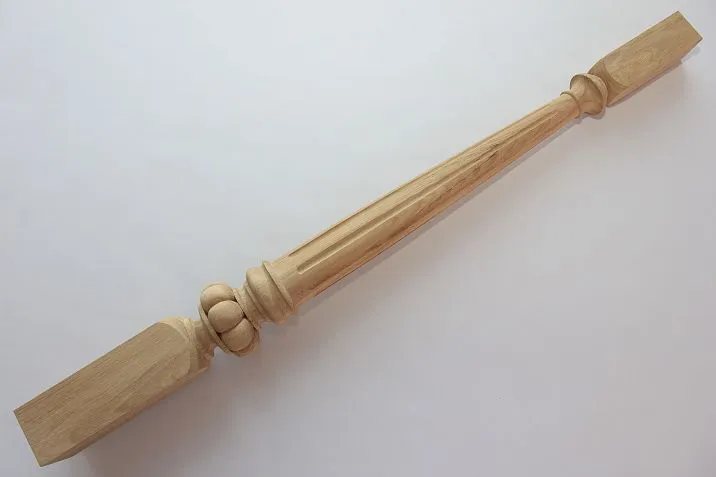
Turned balusters - a classic variant, manufactured on a lathe by rotating the blank and removing excess material. They have a symmetrical shape with smooth lines and may include various decorative elements: beads, rings, grooves (vertical channels). Turned balusters are ideal for classic interiors.
Milled balusters - created using milling, which allows forming various patterns and ornaments on the wood surface. Longitudinal or helical cutting is used, giving the items a special attractiveness and originality. Such balusters are in high demand due to their uniqueness and aesthetic value.
Carved balusters - true works of art, created by woodcarvers. They may contain complex patterns, plant motifs, geometric ornaments, or even narrative compositions. Carved balusters become the central design element of stairs, attracting attention and admiration. They are especially suitable for interiors in Baroque, Rococo, or Art Nouveau styles.
Wood species for balusters
Choosing wood species for balusters is not only an aesthetic issue but also a practical one. Different species have varying characteristics of strength, moisture resistance, and resistance to mechanical damage, as well as different costs.
Oak - one of the best materials for manufacturing balusters. Oak wood is characterized by high strength, moisture resistance, and resistance to mechanical damage. Oak balusters have a beautiful dark color and pronounced texture, which becomes even more noble over time. Despite high density, oak is easy to process, and finished products do not deform or crack.
Ash - a valuable wood species with flexible and dense structure, making ash balusters withstand high mechanical loads. Ash wood is resistant to wet steam and decay processes. Ash has a beautiful light color with a distinct wood grain pattern, making balusters made from this material especially attractive.
Beech - a hard wood species with uniform structure and pleasant light-pink hue. Beech balusters are characterized by high strength and resistance to abrasion. Beech is easy to process, allowing the creation of balusters with complex shapes and delicate decorative elements.
Spruce and birch - more affordable options, yet still possessing good operational characteristics. Balusters made from spruce and birch are easy to process, have a pleasant light color, and accept various finishing materials well. With proper treatment and protection, they can serve for many years without losing their qualities.
Larch - a unique wood species that increases its strength over time. Larch balusters are resistant to moisture, high temperatures, and even open flames. This wood contains natural resins that protect it from decay and insects. Larch has a beautiful golden hue that develops a noble patina over time.
Technical Specifications and Standards
When choosing wooden staircase balusters It is important to consider not only their appearance but also technical parameters that determine their functionality and compliance with safety requirements.
Dimensions and Proportions
The standard height of balusters for stairs is from 800 to 900 mm. This is the optimal size ensuring safety when using stairs. The diameter or thickness of balusters usually varies from 40 to 80 mm for round models and from 40×40 to 80×80 mm for square ones.
The distance between balusters also matters - it should not exceed 150 mm to prevent children from slipping between them. The optimal distance between centers of adjacent balusters is 150-200 mm.
The number of balusters is calculated based on the length of the staircase. It is considered best to install posts at 15 cm intervals. Installing balusters less frequently is not recommended - it is unsafe, impractical, and aesthetically less appealing.
Requirements for strength and safety
Wooden balusters must withstand significant loads, as their strength directly affects human safety. According to construction standards, balusters must withstand a horizontal load of at least 0.3 kN (about 30 kg) applied at any point.
It is also important that the wood for balusters is well-dried (moisture not exceeding 12%) and free of defects that could reduce its strength - knots, cracks, rot. Quality balusters are manufactured from well-dried, defect-free wood using modern equipment and in compliance with all technological requirements.
Durability and service life
The minimum service life of quality wooden balusters is 50 years. To provide additional protection, special impregnations and varnishes are applied, enhancing resistance to moisture, ultraviolet radiation, and biological microorganisms.
Wood is resistant to adverse external factors - temperature fluctuations, high humidity, ultraviolet radiation, and biological microorganisms. With proper care, wooden balusters can serve for decades, preserving their aesthetic and functional qualities.
Advantages of Wooden Balusters Over Other Materials
In modern construction, balusters made from various materials - metal, glass, stone, concrete, plastic - are used. However, wooden balusters retain their popularity due to a number of undeniable advantages.
Aesthetic advantages
Natural beauty and warmth - wood creates a special atmosphere of coziness and comfort in the home. Wooden balusters emit warmth, soften the interior, and give it a natural elegance. Unlike cold metal or glass, wood always looks welcoming and hospitable.
Variety of textures and shades - each wood species has its own unique wood grain pattern and color palette. This allows selecting balusters that perfectly match the overall interior style. From light birch to dark oak - the palette of wooden balusters is truly limitless.
Ability to create unique designs - wood is easily processed, allowing for the realization of the most daring design ideas. From simple geometric forms to complex carved compositions - all of this is possible with wooden balusters.
Practical Advantages
Ecological safety - wood does not emit harmful substances, does not accumulate static electricity, and does not cause allergic reactions. Moreover, natural wood contains essential oils and organic resins that have healing properties. They positively affect the microclimate in the room, promote relaxation, and improve well-being.
Light weight - wooden balusters are significantly lighter than stone or concrete analogs. This simplifies their transportation and installation, as well as reduces the load on load-bearing structures.
Ease of processing and modification - wood can be easily sawn, planed, milled, and sanded, allowing balusters to be adapted to specific conditions right at the installation site.
Restorability - unlike many other materials, wooden balusters can be restored, extending their service life. A scratched or worn surface can be sanded and re-coated with a protective finish.
Good thermal insulation properties - wood does not conduct cold, so wooden balusters are always pleasant to the touch, even in cold weather.
Economic advantages
Affordable price - wooden balusters, especially those made from common wood species, have relatively low cost compared to analogs made from other materials.
Longevity with proper care - high-quality wooden balusters can serve for decades, maintaining their aesthetic and functional qualities.
Ability for self-manufacture and installation - with basic woodworking skills, one can manufacture and install balusters themselves, significantly reducing costs.
Choosing wooden balusters for various interior styles
Wooden balusters can become a key design element in any interior style. Let's examine how they fit into various stylistic directions and which baluster variants are best suited for each.
Classic style
Classic interiors are characterized by symmetry, proportionality, and restrained luxury. For this style, turned balusters with smooth lines and symmetrical shapes are ideal. Best wood species - oak, walnut, mahogany.
Balusters in the classic style often have the shape of a vase or column with a thickened center. They may be adorned with fluting (vertical grooves), beads, rings, and other traditional elements. Color - dark or medium, with emphasized wood grain texture.
Modern style
Modern style leans toward simplicity, functionality, and clean lines. For this style, balusters with simple geometric shapes - square, rectangular, round - without excessive decoration are suitable. Best wood species - beech, maple, birch.
Balusters in modern style often have straight lines and minimal decorative elements. They may be painted white, gray, or black, or retain a natural light tone. An interesting option - combining wooden balusters with metal or glass elements.
Country and Provence
Country and Provence styles are characterized by warmth, coziness, and rustic simplicity. For these styles, balusters with handcrafted elements that imitate vintage items are suitable. Best wood species - pine, spruce, cedar.
Balusters in the country style may have simple shapes with minor decorative elements or be adorned with simple carving. They often feature worn areas, cracks, and other signs of "aging." Color - natural or slightly tinted, preserving visible wood grain texture.
Scandinavian style
Scandinavian style is characterized by light tones, simple forms, and functionality. For this style, balusters with simple geometric shapes made from light wood species - birch, pine, spruce - are suitable.
Balusters in Scandinavian style usually have straight lines and minimal decoration. They are often painted white or retain a natural light tone. An important feature - matte, non-glossy surface, which creates a sense of naturalness and coziness.
Loft and industrial style
Loft and industrial styles are characterized by rawness, open spaces, and combinations of various materials. For these styles, balusters combining wood and metal are suitable. Best wood species - oak, beech, larch.
Balusters in the loft style may have simple geometric shapes with metal inserts or fasteners. An interesting option - wooden handrails on metal posts or cables. Wood color - natural, with emphasized texture, often with an aged effect.
Installation and mounting of wooden balusters
– an important stage that affects not only the appearance but also the durability of the structure: wooden staircase balusters - guaranteeing their longevity and safety. There are several ways to mount balusters, each with its own features and applications.
Ways to Mount Balusters
Mounting in grooves - balusters are installed into special grooves cut into the treads and stringers of the staircase. This method ensures secure mounting, but requires precision in groove manufacturing. The baluster is secured in the grooves using glue or additional fasteners.
Mounting with dowels - balusters are mounted to the base using wooden or metal dowels inserted into pre-drilled holes. Larger grooves are drilled under the dowels than under the bolts. This method allows for easy replacement of individual balusters if needed.
Mounting with bolts - a simple method for mounting balusters to the treads of the staircase on the stringers. The bolt is screwed into the tread so that it protrudes halfway above its surface. Then, the wooden baluster is screwed onto the bolt.
For installing wooden balusters, the following tools and materials are required:
Tools and materials for installation
To install wooden balusters, the following tools and materials are required:
- Drill or screwdriver
- Wood drill bits of various diameters
- Chisel (for fitting mortises)
- Hammer
- Wood glue
- Screws, bolts, or self-tapping screws (depending on the chosen fastening method)
- Level
- Tape measure
- Pencil
- Sandpaper
- Wood protection finishes (varnish, oil, wax)
Step-by-step installation instructions
- Preparation - measure the distance between steps and handrails to determine the required baluster length. Ensure balusters are inserted into mortises or holes to a depth of at least 2 cm.
- Marking - mark the locations for baluster installation on steps and handrails. The spacing between balusters should be even and not exceed 15 cm.
- Preparing holes or mortises - depending on the chosen fastening method, drill holes for dowels or bolts, or cut mortises for baluster installation.
- Preparing balusters - if necessary, trim balusters to the required length. Drill holes for dowels or bolts if this fastening method is used.
- Installation - start by installing the end balusters, then evenly distribute the rest. If using glue, apply it to the holes or mortises before installing the balusters.
- Inspection - ensure all balusters are installed vertically using a level. Make adjustments if necessary.
- Final finishing - after installing all balusters, sand the joint areas with sandpaper to remove excess glue and smooth irregularities. Then apply a protective finish (varnish, oil, or wax) to protect the wood from moisture and mechanical damage.
Care for wooden balusters
Wooden balusters require specific care to ensure their longevity and maintain their attractive appearance. Proper care is an investment in the long-term durability of your staircase or railing.
Regular cleaning
Regularly clean wooden balusters from dust using a soft, damp cloth. Avoid abrasive materials that may scratch the surface. For more stubborn stains, use specialized wood cleaning products.
Periodically inspect balusters for damage - cracks, chips, loose joints. Prompt detection and repair of minor defects will prevent more serious problems in the future.
Protection from moisture and UV radiation
Wood is sensitive to moisture and UV exposure, so balusters require protection. For indoor staircases, periodic renewal of varnish or oil finish (every 3-5 years) is sufficient. For outdoor structures, protective treatment should be performed more frequently - every 1-2 years.
There are various wood protection finishes:
- Varnishes - create a strong protective film on the surface that protects wood from moisture and mechanical damage. Varnishes can be glossy, semi-gloss, or matte.
- Oils - penetrate deeply into the wood structure, protecting it from within. Oils enhance the natural wood texture and create a "breathable" finish.
- Waxes - form a water-repellent coating that gives wood a silky sheen. Waxes are often used in combination with oils.
- Antiseptics - protect wood from mold, fungi, and insects. Especially important for balusters installed in humid areas or outdoors.
Repair and Restoration
If you find a baluster has become loose, it must be immediately secured. In extreme cases, you can drive a nail at a 45° angle, bury the head into the baluster, fill the hole with putty, and then paint and varnish the surface.
If a crack appears on a baluster, clean it of dust and debris, apply glue, and use painter’s tape to bond the damaged area. After the glue dries, remove the tape, and if necessary, re-stain and varnish the wooden surface.
In case of serious damage, individual balusters may need to be replaced. This is one of the advantages of wooden structures - the ability to perform local repairs without replacing the entire railing.
How to choose quality balusters: expert advice
Choosing wooden staircase balusters A critical stage in creating a staircase or railing. The correctness of this choice affects not only the appearance of the structure, but also its functionality, durability, and safety.
What to pay attention to when choosing
Wood quality - this is the key factor in the longevity of balusters. Pay attention to the following parameters:
- Wood moisture content - it should be within 8-12%. Too dry wood may crack, while overly moist wood may warp upon drying.
- No defects - the wood should not have rot, mold, large knots, cracks, or other defects that may reduce the strength of the product.
- Surface finish quality - the balusters' surface should be smooth, without burrs or roughness. All elements must be symmetrical, and joints must be precise.
Style compatibility - balusters should harmoniously fit the overall interior style. For classic interiors, turned balusters with smooth lines and symmetrical shapes are suitable. In modern minimalist spaces, simple geometric forms - square or rectangular balusters with minimal decoration - look better.
Functional requirements - when selecting balusters, it is important to consider not only their appearance but also functional requirements:
- Strength and reliability - balusters must withstand expected loads. This parameter is especially important for homes with children or elderly people.
- Resistance to operating conditions - for outdoor staircases and terraces, choose balusters made from wood species resistant to moisture and temperature fluctuations, such as larch or oak.
- Ease of maintenance - the baluster surface should be smooth, without sharp edges or hard-to-reach areas where dust may accumulate.
Where to buy quality balusters
When choosing a supplier of wooden balusters, pay attention to the following factors:
- Company reputation and experience - prefer companies with a good reputation and significant market experience. Study customer reviews, view completed projects, and learn about warranty obligations.
- Material and production quality - a reliable manufacturer is always open to dialogue and ready to provide all necessary information about their products, including quality certificates and technical specifications.
- Product range and customization options - a good manufacturer offers a wide range of balusters in various shapes, sizes, and designs. Even better, if the company provides the option to manufacture balusters to order - according to your preferences and the specific features of the room.
- Service and additional services - pay attention to the level of service the company offers: specialist consultations, delivery, installation, warranty, and after-sales service.
Conclusion: an investment in beauty and longevity
Wooden balusters are not just a functional element of a staircase or railing, but also an important part of interior design, capable of transforming space, giving it individuality and charm. Choosing quality wooden balusters for staircases, you invest in the beauty, comfort, and ecological safety of your home.
Natural wood creates a unique atmosphere of warmth and coziness that artificial materials cannot provide. It is pleasant to the touch, has a natural aroma, and visually softens the interior. With the right choice of wood species, design, and manufacturing quality, wooden balusters will delight you with their beauty and reliability for many decades.
STAVROS Company offers a wide range of wooden balusters in various shapes, sizes, and designs. All products are manufactured from high-quality wood using modern equipment and in accordance with all technological requirements. The company's experienced specialists will help you choose the optimal baluster option that meets your preferences and interior features.
Investing in high-quality wooden balusters from STAVROS Company means you get not only a beautiful and functional interior element, but also a guarantee of reliability, durability, and ecological safety. This is a choice that will delight you and your loved ones every day, creating an atmosphere of comfort, coziness, and harmony in your home.