Article Contents:
- Material Selection: Decoding the Language of Wood
- Oak: The Monarch Among Species
- Ash: Elegance and Plasticity
- Walnut: Aristocracy in Wood
- Beech: Universality and Accessibility
- Technological processes: from raw material to masterpiece
- Raw material preparation: the foundation of quality
- Cutting and Preparing Blank Materials
- Mechanical Processing: Precision and Mastery
- Design Solutions: Harmony of Form and Function
- Minimalism: beauty in simplicity
- Scandinavian Style: Functionality and Coziness
- Classic Style: Traditions and Luxury
- Specialized Items: Mastery in Details
- Cabinet Furniture: Engineering Solutions
- Carpentry Items for Interior
- Decorative elements
- Modern Technologies in Working with Solid Wood
- CNC Processing: Precision and Reproducibility
- Innovative Joining Methods
- Environmental Aspects and Certification
- Responsible forestry
- Ecologically clean coatings
- Trends in Development and the Future of the Industry
- Personalization and Mass Customization
- Integration of smart technologies
- Economic aspects: investment in the future
- Pricing factors
- Secondary Market and Restoration
- Regional Characteristics and Traditions of Craftsmanship
- European Schools of Craftsmanship
- Domestic Traditions
- Quality Control and Standardization
- Quality Management System
- International standards
- Marketing Aspects and Promotion
- Market Positioning
- Digital marketing
- Conclusion: Art Tested by Time
What drives a person in an era of advanced technologies to turn to ancient materials? Why are solid wood items increasingly decorating modern interiors? from solid natural woodThe answer lies in a deep need to touch the authentic, to feel a connection with nature, to surround oneself with materials that breathe life and carry the energy of centuries.
Solid natural wood is not just a material—it is a philosophy of life embodied in tangible forms. Each fiber holds memories of rain and sun, of seasons and decades of growth. When a craftsman takes a blank in hand, they become co-creators of nature, revealing the hidden beauty and functionality of wood.
Modern production of items from natural solid wood represents a remarkable synthesis of traditional craftsmanship and advanced technologies. It is an art where precision of engineering calculations combines with the craftsman’s intuition, where time-honored processing techniques are complemented by innovative equipment.


Material Selection: Decoding the Language of Wood
The correct choice of wood species determines not only the aesthetic qualities of the finished product, but also its functional characteristics, durability, and specific application. Each species has a unique character that an experienced craftsman knows how to read and interpret.




Oak: Monarch Among Species
Oak wood embodies concepts of reliability and prestige. Its dense structure with characteristic radial rays creates a unique pattern that cannot be imitated by artificial materials. High content of tannins provides natural protection against moisture and pests.
Oak's color palette varies from light golden to rich brown tones. A distinctive feature of this species is its noble aging — over time, the wood acquires deeper shades and a distinctive patina. Oak's mechanical properties allow creating massive structures without loss of strength.
Our factory also produces:


Ash: Elegance and Plasticity
Ash wood is attracted by its contrasting texture with clearly defined annual rings. Its light color palette visually expands space, creating a sense of airiness and lightness. High impact toughness makes ash ideal for items subjected to dynamic loads.
Structural features of ash allow creating thin, elegant elements without loss of strength. The wood is well-suited to various processing methods, including bending and turning. Its porous structure ensures excellent penetration of protective compounds and dyes.
Get Consultation
Walnut: Aristocracy in Wood
Walnut wood is traditionally considered premium-grade material. Its rich color palette, ranging from light brown to dark chocolate tones with characteristic grain, creates a luxurious appearance. Moderate density ensures optimal weight-to-strength ratio.
A distinctive feature of walnut wood is dimensional stability under humidity changes. The wood practically does not crack and minimally deforms, which is especially important for precise joints and complex structures. Excellent turning qualities allow creating decorative elements of the highest quality.
Beech: Universality and Accessibility
Beech wood presents an optimal combination of quality characteristics and economic accessibility. Uniform fine-pored structure ensures a smooth, pleasant-to-touch surface. Neutral color allows easily adapting products to various stylistic solutions.
High density of beech guarantees longevity of products under intensive use. The wood is excellent for all types of mechanical processing, including milling complex profiles. Excellent adhesive properties ensure reliable glued joints.
Technological processes: from rough material to masterpiece
Creating a quality product from solid natural wood requires strict technological discipline at every production stage. Any deviation from established parameters may result in scrap or reduced quality of the finished product.
Raw Material Preparation: The Foundation of Quality
The process begins with careful wood selection. Experienced craftsmen evaluate each board based on multiple criteria: grain direction, presence of defects, density of structure, and moisture content. Proper grain orientation in the construction determines the strength and stability of the finished product.
Wood drying is a critically important stage requiring precise control of temperature, humidity, and air circulation. Modern drying chambers allow programming the drying process according to the wood species and required final parameters. Optimal final moisture content is 8±2%, ensuring stability under operating conditions.
Cutting and preparing blanks
Cutting solid wood requires deep understanding of wood structure and future product design. Cutting direction determines not only the strength characteristics of parts but also their decorative qualities. Radial cutting provides the most stable blanks with beautiful texture, while tangential cutting is more economical but less stable.
Modern equipment allows cutting with precision down to tenths of a millimeter. Format-cutting machines provide clean cuts without chipping, which is critically important for visible surfaces. Optimization software helps minimize waste and maximally efficiently use expensive raw material.
Mechanical Processing: Precision and Craftsmanship
Jointing and resawing create basic surfaces for further processing. Quality of these operations determines accuracy of all subsequent technological processes. Modern machines allow achieving surfaces with roughness close to sanded surfaces.
Milling profiles and grooves requires use of specialized tools and precise equipment setup. Each type of joint has its own processing characteristics and accuracy requirements. High-quality hardware requires precise drilling of holes with strict tolerances on dimensions and mutual positioning.
Design Solutions: Harmony of Form and Function
Modern design of solid wood products balances classic traditions with current trends. Each direction has its own specifics of working with wood and requirements for surface processing.
Minimalism: beauty in simplicity
Minimalist approach to wooden product design emphasizes the natural beauty of the material. Clean geometric forms, absence of excessive decoration, focus on surface quality and precision of execution. Every line must be justified functionally or aesthetically.
Color solution in minimalist design leans toward natural wood tones. Transparent protective coatings preserve natural texture, highlighting uniqueness of each element. Matte surfaces create a sense of warmth and coziness, while glossy surfaces add elegance.
Scandinavian Style: Functionality and Coziness
Scandinavian approach to wooden furniture design is characterized by practicality and simplicity of forms. Light wood species create a sense of spaciousness and lightness. Special attention is paid to ergonomics and ease of use.
Surface processing in Scandinavian style is minimal — wood is often used in its natural state or coated with a thin layer of colorless oil. This approach highlights the natural origin of the material and creates tactile connection with the user.
Classic Style: Traditions and Luxury
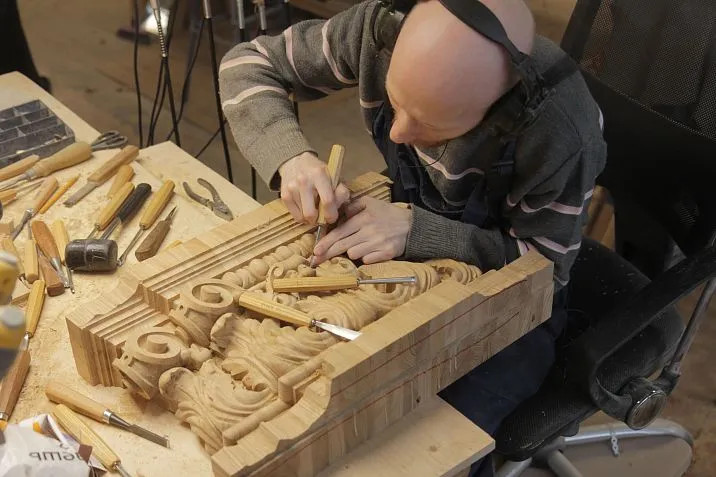
Classic Furniture from solid natural wood Requires the highest level of skill in handling decorative elements. Carving, inlay, complex profiles — all of this requires the use of traditional techniques combined with modern equipment.
Classic-style finishing involves multi-layered coatings with intermediate sanding of each layer. Polishing to a mirror finish requires patience and skill. Patination creates an effect of noble antiquity, highlighting the item's status.
Specialized items: Mastery in Details
Cabinetry: Engineering Solutions
Creating cabinetry from solid wood requires a deep understanding of how wood behaves under changes in humidity and temperature. Structural solutions must account for linear expansion of the material and prevent deformation.
Modern joining systems allow creating disassemblable structures without loss of strength. Hidden hinges, full-extension guides, and soft-close mechanisms — all require precise marking and drilling. Internal cabinet fillings are planned with ergonomic requirements and space optimization in mind.
Carpentry items for interiors
Solid wood doors, staircases, built-in cabinets require an individual approach to each project. Precise measurements, consideration of room-specific features, coordination with other finishing works — all of this affects the final result.
Installation of wooden items requires professional qualifications of installers. Proper installation ensures longevity and trouble-free operation. Adjustment mechanisms allow compensating for minor wall and floor irregularities.
Decorative elements
Carved appliqués, balusters, cornices create a unique character of interiors. Modern CNC routers allow reproducing complex ornaments with high precision. Hand-finishing adds individuality and liveliness to the items.
Gilding, silvering, patination require special skills and materials. Each technique has its own application specifics and surface preparation requirements. High-quality decorative finishing can transform a simple item into a work of art.
Modern technologies for solid wood
CNC Processing: Precision and Reproducibility
CNC machines have revolutionized the production of solid wood items. The ability to create complex 3D surfaces with high precision opens new horizons in design. Programming allows optimizing processing trajectories and minimizing manufacturing time.
3D modeling allows visualizing the item before production begins, identifying structural errors, and optimizing material usage. Parametric design enables quickly adapting the base model to various sizes and configurations.
Innovative joining methods
Modern adhesive compositions provide joint strength exceeding that of the wood itself. Polyurethane adhesives are water-resistant and elastic, which is especially important for items used under variable humidity conditions.
Mechanical connectors of the new generation allow creating high-strength disassemblable structures. Confirmers, minifixes, eccentric clamps ensure reliable connections with the possibility of multiple assembly/disassembly cycles.
Ecological Aspects and Certification
Responsible forestry
Modern solid wood furniture production is unthinkable without adherence to sustainable development principles. FSC certification guarantees that the wood comes from responsibly managed forests, where economic interests and ecological safety are balanced.
Forest regeneration programs ensure the reproduction of forest resources. Using local wood species reduces the ecological footprint of transportation and supports regional economies. Modern technologies allow maximizing the efficient use of every cubic meter of processed wood.
Ecologically Safe Coatings
Water-based varnishes and paints contain virtually no volatile organic compounds, making them safe for human health and the environment. Natural oils and waxes create a breathable finish that preserves the natural properties of wood.
Coating application technologies are constantly improving in terms of reducing material consumption and enhancing surface quality. Electrostatic spraying ensures uniform coverage with minimal losses. UV curing allows achieving top-quality finishes in seconds.
Trends in development and the future of the industry
Personalization and mass customization
Modern consumers increasingly demand customized solutions tailored to specific needs and preferences. Flexible production systems enable efficient manufacturing of single items with serial production quality.
Online configurators allow customers to independently select dimensions, materials, colors, and hardware. Virtual reality enables viewing the future item in the interior before its manufacture. This approach significantly reduces errors and increases customer satisfaction.
Integration of smart technologies
Built-in sensors can monitor humidity, temperature, and lighting inside furniture. Automatic ventilation systems prevent mold and unpleasant odors. Wireless device charging is integrated into countertops and bedside tables.
Mobile applications allow monitoring the condition of furniture, receiving care recommendations, and scheduling preventive maintenance. Artificial intelligence analyzes usage patterns and suggests optimizing internal space.
Economic aspects: investment in the future
Items from solid natural wood represent a long-term investment, paying off through exceptional durability and the possibility of multiple updates. Unlike furniture made from artificial materials, wooden items do not lose their value over time, and with proper care, they become even more attractive.
Pricing Factors
The cost of a finished item consists of many components: raw material prices, processing complexity, installer qualifications, use of premium-grade hardware. Handwork significantly increases the cost but ensures the uniqueness of each item.
The geographical origin of wood affects its price — exotic species are significantly more expensive than local ones, but offer unique decorative properties. The age of the tree also matters — old-growth wood has special density and texture beauty.
Secondary market and restoration
Antique solid wood furniture not only retains its value, but often significantly increases in price. The possibility of restoration allows to restore items to their original appearance or adapt them to modern requirements.
Professional restoration requires deep knowledge of historical technologies and materials. Modern analysis methods allow accurately determine the composition of original finishes and reproduce them using compatible materials.
Regional characteristics and craftsmanship traditions
Different regions of the world have developed unique approaches to working with wood, reflecting local traditions, climatic conditions, and material availability. These features continue to influence modern production, creating recognizable stylistic directions.
European Schools of Craftsmanship
German woodworking traditions are renowned for precision and reliability of construction. The use of advanced technologies in combination with centuries-old traditions creates products of the highest quality. Special attention is paid to the functionality and ergonomics of items.
Italian masters are known for their artistic approach to design. Elegant forms, rich finishes, and use of contrasting materials create items of exceptional beauty. Handcraft remains an important component of the production process.
Scandinavian traditions emphasize connection with nature and functionality. Simple, minimalist forms, use of light wood species, minimal surface treatment create an atmosphere of comfort and tranquility.
Domestic traditions
Russian masters traditionally worked with local species — birch, oak, pine, linden. A distinctive feature of the domestic school is solid construction and practical solutions. Wood carving developed into an independent art, creating unique decorative elements.
Modern Russian manufacturers successfully combine traditional methods with advanced technologies. Use of domestic raw materials makes the products competitive in price while maintaining high quality execution.
Quality control and standardization
Quality management system
Modern solid wood furniture production requires implementing quality control systems at all stages of the manufacturing process. Incoming control of raw materials, operational control of technological processes, acceptance control of finished products — all this ensures stable quality of the produced goods.
Statistical control methods allow identifying trends in quality changes and taking preventive measures. Automated control systems increase objectivity of assessment and reduce the influence of human factors.
International Standards
Compliance with international quality standards opens access to global markets and increases product competitiveness. ISO standards define requirements for quality management systems, environmental management, and occupational safety.
Product certification confirms compliance with established requirements and increases consumer trust. Regular audits ensure the quality system remains at an adequate level.
Marketing aspects and promotion
Market positioning
Solid wood items occupy the premium market segment, requiring appropriate positioning. Emphasis on material quality, craftsmanship, and design exclusivity creates an image of a status product.
Environmental considerations are becoming an increasingly important factor for modern consumers. Highlighting the natural origin of materials, health safety, and contribution to environmental preservation increases product appeal.
Digital marketing
Online presence is critically important for modern business. Professional product photography, virtual factory tours, and videos about manufacturing processes create an emotional connection with the brand.
Social networks allow showcasing finished projects in interiors, sharing customer stories, and demonstrating artisans' skills. Content marketing through educational materials about wood properties, care for items, and design trends increases brand expertise.
Conclusion: art tested by time
The world is changing rapidly, new materials and technologies are emerging, but items from solid natural wood remain unmatched in aesthetics, eco-friendliness, and longevity. These are not just interior items — they are embodiments of harmony between humans and nature, between tradition and innovation.
Modern technologies do not replace craftsmanship, but merely expand its possibilities. CNC machines allow creating complex shapes with jewel-like precision, but choosing wood, understanding its nature, sense of proportion — this remains the prerogative of humans. It is precisely the combination of advanced technologies and traditional craftsmanship that produces items becoming family heirlooms.
Environmental responsibility today is not a fashionable trend, but a necessity. Choosing solid wood items contributes to preserving natural resources, supports sustainable forestry development, and creates a healthy living environment for future generations.
Personalization is becoming a key trend in interior design. Standard solutions give way to individual projects reflecting the owner's character and needs. Solid wood furniture is ideal for realizing the boldest design ideas due to the material's versatility and wide range of technological possibilities.
The quality of solid wood items is determined by numerous factors: from raw material selection to final finishing. Each production stage requires a professional approach and strict control. Only a comprehensive approach to quality guarantees the creation of items that will delight owners for decades.
Investing in solid wood furniture is an investment in the future. Unlike items made from artificial materials, wooden furniture does not become outdated or lose functionality over time. The possibility of restoration and renewal extends the life of the items for centuries.
STAVROS brings to life the best traditions of working with natural wood, combining centuries-old craftsmanship with modern technologies. Every STAVROS item is the result of careful material selection, thoughtful design, and flawless execution. STAVROS masters create not just furniture, but works of art that become an inseparable part of their owners' lives.
By choosing STAVROS, you select quality proven over time, exclusive design solutions, and responsible ecological practices. Each STAVROS project is unique and reflects the individuality of the client, creating a space where you want to live and create. STAVROS is the guarantee that your items from solid natural wood will become family heirlooms, passed down from generation to generation.