Article Contents:
- Where Molding Came From: A Brief History of Architectural Profile
- Anatomy of Molding: What a Profile Consists Of
- Base Plane and Protruding Elements
- Decorative elements and carving
- Sizes and proportions
- Materials: Wood as a Choice of Reason and Feeling
- Why Wood
- Wood Species for Molding
- Functionality of Molding: What It's For Besides Beauty
- Visual Proportion Correction
- Covering defects and joints
- Protection of Corners and Edges
- Hiding utilities
- Stylistic Palette: Molding in Different Interiors
- Classical Interior: The Language of Orders
- Baroque and Rococo: Decorative Abundance
- Empire: imperial monumentality
- Art Nouveau: Organic Curves
- Art Deco: Geometric Luxury
- Minimalism: Invisible Molding
- Loft and Industrial Style: Roughness as Aesthetic
- Scandinavian style: bright simplicity
- Application of Molding: Where and How
- Ceiling Molding: A Classic Solution
- Wall Panels: An Aristocratic Tradition
- Framing Door and Window Openings
- Mirror and Picture Frames
- Decorative Panels and Compositions
- Space Division
- Color and Finish: How to Make Molding Resonate
- Natural Finish: Transparent Coatings
- Painting: An Infinite Palette
- Special Techniques: Patina, Gilding, Crackle
- Installation: How Molding Becomes Part of the Wall
- Surface Preparation
- Medium-thickness pieces are attached using a combined method - with adhesive and additional mechanical fixation.
- Fastening
- Finishing
- Trends 2026: Where the World of Interior Molding is Heading
- The Return of Maximalism
- Mixing styles: eclecticism as the norm
- Color Boldness
- Technology integration
- Environmental Consciousness
- Customization
- Practical questions: what is important to know
- How to Calculate Quantity
- How to choose a profile
- How to choose a wood species
- How much does it cost
- How to care for it
- Frequently Asked Questions
- Conclusion: when details create the whole
- Why STAVROS — the Right Choice

Imagine a wall. Just a white wall. Paint, primer, putty, drywall, brick — a layered cake of construction technologies, finished with a smooth, neutral plane. Now add one detail — Picture frames — a special category of molding products, distinguished by complex profiles and rich decoration. If a molding is a functional element with decorative properties, a picture frame is primarily decorative, although it performs certain functions.running along the perimeter of the ceiling or framing a doorway. What has changed? Technically — nothing. Functionally, the wall remains a wall. But visually, a metamorphosis has occurred. The plane has gained boundaries, structure, character. The room has acquired an architectural language with which to speak about style, era, and the owner's taste.
Molding in interior design is not mere decoration. It is architectural grammar, a system of signs that transforms a construction box into a meaningful space. A molding profile is a sentence. A combination of moldings is a paragraph. A composition of moldings, cornices, casings, and baseboards is a coherent text that can be read, interpreted, and understood without words. A classical profile with flutes and scrolls declares: 'Here, tradition, history, and generational continuity are valued.' A concise rectangular molding states: 'A space for the modern person, valuing functionality and clean lines.' A carved molding with botanical motifs whispers: 'The owner is sensitive to the beauty of nature, inclined towards contemplation.'
What distinguishes 2026 from previous decades? The return of meaning. After a long period of minimalist asceticism, where interiors aimed for zero decorativeness, the pendulum has swung back. But this is not a return to the excess of the 2000s, where every centimeter of surface was covered with stucco and gilding. This is conscious decorativeness, where every element carries meaning, plays a role, creates a dialogue between space and person.Decorative interior moldingin a contemporary interpretation — is a precise detail in a thoughtful composition, not a random decoration for decoration's sake.




Where molding came from: a brief history of the architectural profile
The term 'baguette' is French. Baguette — a stick, a strip, a profiled element. But the very idea of framing architectural elements appeared long before France. Ancient Egypt used profiled cornices on temples. Greece created the system of orders, where every element — column, capital, entablature, cornice — had a strictly defined profile and proportions. Rome borrowed the Greek orders and complicated them, added decorativeness, created triumphal architecture where every surface spoke of the empire's greatness.
The Middle Ages simplified profiles. Romanesque and Gothic churches used powerful cornices emphasizing structural lines, but without excessive decorativeness. The Renaissance returned to ancient models, revived the order system, and began using profiled moldings for the interior decoration of palaces and churches. Baroque pushed decorativeness to the maximum — complex multi-step profiles, abundant carving, gilding, creating visual richness through the multiplication of details.
Classicism of the 18th-19th centuries simplified Baroque excess, returning to more restrained proportions but retaining a love for profiled elements. It was in this era that molding became a mass element not only in palatial but also in bourgeois interiors. The Industrial Revolution allowed moldings to be produced not individually, by a master's chisel, but serially, on milling machines. Molding was democratized, becoming accessible to the middle class.
The 20th century, with its modernism, attempted to reject moldings as a relic of the past. 'Form follows function' — the main slogan of modernists left no room for decorative elements. But by the mid-century, it became clear: pure functionality makes space cold, inhuman. Postmodernism brought moldings back, but ironically, playing with historical forms. The 21st century seeks balance: molding is used, but thoughtfully, in measured doses, precisely.




The anatomy of molding: what a profile consists of
To understand how molding works, you need to break down its structure.Interior wall moldingis not just a strip. It is a complex profile consisting of several elements, each performing a visual function.
Our factory also produces:




Base plane and projecting elements
Any molding has a base plane — the part of the profile that adjoins the wall or ceiling. From this plane, projecting elements extend — shelves, beads, flutes, coves. It is the combination of these elements that creates the characteristic silhouette of the profile.
The simplest molding is a flat strip with one rounded edge. Complicating the profile adds a second, third shelf, each at a different height from the base plane. A stepped structure is created, where light and shadow play on different levels, creating volume.
Flutes — vertical grooves running along the molding. They create rhythm, break the plane into thin vertical lines. Used in classical profiles, harking back to ancient columns.
Coves — concave curves creating soft transitions between levels. The opposite of a cove is a bead, a convex rounded form. The alternation of coves and beads creates a wavelike rhythm, characteristic of Baroque and Rococo profiles.
Get Consultation
Decorative elements and carving
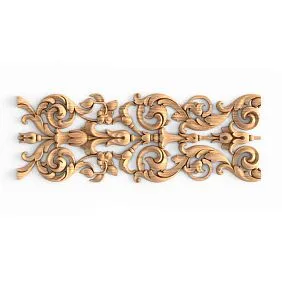
On top of the base profile, carved decoration can be applied. Botanical motifs — acanthus leaves, grapevines, oak branches. Geometric ornaments — meanders, palmettes, rosettes. Figurative elements — putti (chubby infant angels), mascaron (decorative masks), cartouches (shields with scrolls).
Carving can be relief (protruding above the surface) or intaglio (cut into the material's thickness). Relief carving is more expressive, reads better from a distance, plays more actively with light. Intaglio carving is subtler, more intimate, requires close examination.
The degree of carving detail varies from stylized, where forms are generalized and read as silhouettes, to naturalistic, where every leaf, every vein is worked with botanical precision. The choice depends on the interior style and room scale. In a large space, naturalistic, fine carving gets lost; large, generalized forms are needed. In an intimate space, detailed carving creates richness that unfolds upon close inspection.
Dimensions and Proportions
The width of the molding (distance from the wall to the projecting edge) varies from modest 20-30 millimeters to monumental 150-200 millimeters. The profile height (distance from the base plane to the most protruding point) also varies widely.
Proportions are critical. A narrow molding on a high wall gets lost, becomes unnoticeable. A wide, massive molding in a low room feels oppressive, visually lowers the ceiling even further. The golden rule: the higher the ceiling, the wider the molding can be. For a standard height of 2.7 meters, an optimal width is 60-80 millimeters. For high ceilings of 3.5-4 meters — 100-150 millimeters.
The thickness of the molding determines its structural strength and visual massiveness. Thin molding (10-15 mm) is elegant but fragile, suitable for decorative overlays. Thick molding (40-50 mm) is solid, can bear loads, and can be used not only decoratively but also functionally (e.g., as a shelf).
Materials: wood as a choice of reason and feeling
Moldings are made from various materials — plaster, polyurethane, polystyrene, MDF, solid wood. Each material has advantages and limitations. But when it comes tohigh-quality interior wall moldingthe choice is unequivocal — solid wood.
Why wood
Wood is a living material with a unique structure. Each board has an individual pattern of annual rings, an inimitable alternation of light and dark zones, and a texture that cannot be artificially reproduced. Even two moldings cut from the same trunk next to each other will differ in texture.
The tactility of wood is incomparable to plastics. Touching a wooden surface evokes warm sensations. Wood is slightly warm to the touch (unlike cold plastic or metal) and has a pleasant roughness (even after sanding, a soft fiber texture remains).
The smell of wood. Yes, after a few years of installation, the smell almost dissipates, but fresh wooden molding, especially from resinous coniferous species or aromatic hardwoods (oak, walnut), fills the room with a subtle natural aroma that creates an atmosphere of forest, nature, and connection to the earth.
The strength and durability of wood have been tested for centuries. Wooden moldings in European palaces serve for 200-300 years, retaining their shape and carving details. With proper treatment and protection from moisture, wood is practically eternal.
Eco-friendliness. Wood is a renewable resource (with responsible forestry), a biodegradable material that does not emit toxic substances. In the era of environmental consciousness, choosing wood is not just an aesthetic but also an ethical decision.
Wood species for molding
Beech — a light-colored species with a fine-grained texture. Color ranges from creamy white to pinkish-brown. High hardness allows for fine detailed carving with clear edges. Beech takes well to tinting, painting, and patination. Prone to geometric changes with humidity fluctuations, requires stable conditions.
Oak — a classic of woodworking. Dark, with a pronounced texture, hard, noble. Oak molding is massive, solid, suitable for interiors requiring a sense of solidity and connection to tradition. Oak is resistant to moisture, mechanical damage, and serves for decades. Price is higher than beech, but reputation and durability justify it.
Ash — a strong light-colored species. Texture is expressive, fibers are clearly visible. Color ranges from light gray to straw. Ash is harder than beech but lighter than oak, making it a compromise for those who want the strength of oak without its dark color. Handles loads well, suitable for functional elements.
Pine — a budget-friendly coniferous species. Soft, easy to work with, but also easily damaged. Texture is contrasting (alternation of light and dark zones, visible knots). Resinousness is a dual property: resin protects from moisture but can seep to the surface, requiring special treatment. Pine molding is suitable for projects with limited budgets or styles where deliberate material simplicity is part of the aesthetic (country, rustic).
Walnut — a premium species. Color ranges from light brown to chocolate with dark veins. Texture is luxurious, complex, deep. Walnut is hard, dense, holds carving excellently. Used for exclusive projects where visual luxury is important. Price is 3-5 times higher than pine.
Linden — a soft light-colored species, beloved by carvers. Easy to cut, allows for the finest, delicate carving. Linden molding is used for projects where carved decor is the main feature. Disadvantage — low hardness, sensitivity to mechanical damage.
Functionality of molding: what it's for besides beauty
The aesthetic role of molding is obvious. But functional aspects are often underestimated, even though they are what make molding not just decor but a useful element.
Visual proportion correction
Ceiling height is perceived not absolutely, but relatively. Ceiling molding, running along the room's perimeter at the wall-ceiling junction, visually marks the boundary. Wide molding, painted the color of the wall, 'eats up' several centimeters of height, making a high ceiling less overwhelming. Narrow molding, painted the color of the ceiling, visually extends the ceiling onto the wall, making a low ceiling appear higher.
Dividing the wall horizontally into zones using molding (high baseboard, molding at chair-back height, molding at two-thirds height) creates segmentation that makes the wall less monotonous, more interesting. In high-ceilinged rooms, this is especially important — a continuous tall wall feels imposing in scale, while a divided one becomes comfortable.
Masking defects and joints
Construction reality is rarely ideal. The wall-ceiling junction often has irregularities, cracks, gaps. Molding installed around the perimeter conceals these defects, creating a visually flawless boundary. The same applies to door and window openings — molding hides the joints between the frame and the wall, between reveals of different materials.
Irregularities of the wall itself (waves, bumps, depressions) become less noticeable when the wall is structured with moldings. The eye focuses on the clear lines of the moldings, and background defects fade into the background.
Protection of corners and edges
Wall corners, door openings, arches — the most vulnerable areas. That's where furniture hits during moving, vacuum cleaners bump during cleaning, children scratch with toys. Molding installed on a corner takes the impact, protecting the fragile paint and wall filler. Wooden molding withstands such impacts without damage or with minimal scratches that are easily painted over.
Lower wall zones especially need protection. A high wooden baseboard (which is essentially the same molding but installed at the bottom) protects the wall from dirt, impacts, moisture during floor washing. In children's rooms, hallways, kitchens, this function is critical.
Hiding utilities
Modern interiors are saturated with wires — electrical, internet, telephone, intercom, alarm systems. Laying these wires in chases (channels in the wall) is labor-intensive and expensive. An alternative is laying them in cable channels, but they look utilitarian. Wide molding with an internal channel allows hiding wires, combining decorativeness with functionality. Wires are placed in the channel on the back of the molding, the molding is installed on the wall — wires are hidden but accessible if needed.
LED lighting integrates into moldings. Special profiles with a niche for LED strips allow creating hidden lighting that illuminates the ceiling or wall, creating atmospheric soft light without visible fixtures.
Stylistic palette: molding in different interiors
The versatility of molding lies in its ability to adapt to any style. However, each style requires its own type of profile, its own size, and its own finish.
Classical interior: the language of orders
Classicism demands strict adherence to proportions and hierarchy.Picture frames — a special category of molding products, distinguished by complex profiles and rich decoration. If a molding is a functional element with decorative properties, a picture frame is primarily decorative, although it performs certain functions.In a classical interior, it is an element of the order system. The profile contains flutes, scotias, beads, alternating in a specific order. Carved decoration is restrained—acanthus leaves, palmettes, Ionic scrolls.
Color—white, cream, ivory. Sometimes gilding, but not solid, rather accent (only the protruding elements of the carving). The size of the profile is proportional to the ceiling height—at least 80-100 mm for standard 3 meters.
Symmetry is mandatory. If molding frames a wall panel, there must be an even number of such panels, symmetrically arranged relative to the central axis of the room. Asymmetry is unacceptable—it destroys classical order.
Baroque and Rococo: decorative abundance
Baroque molding is a celebration of carving. Floral motifs cover the entire surface, intertwine, creating a continuous ornamental flow. Putti, mascaron, cartouches add figurativeness. The profile is complex, multi-tiered, with deep scotias and protruding beads.
Color—white with abundant gilding. Gold is applied to the protruding parts of the carving, creating a jewel-like effect. Sometimes colored gold—red, green, creating iridescence.
Rococo is a lighter version of Baroque. Carving is more delicate, airier, motifs are smaller. Asymmetrical elements appear—characteristic rocaille (shell-shaped scroll), C-shaped and S-shaped curves. Colors are pastel—blue, pink, pistachio with white and gold.
Empire: imperial monumentality
Empire molding is massive but restrained in decoration. The profile is large, with clear edges. Carved decoration includes imperial symbols—eagles, wreaths, torches, military trophies. Geometric ornaments—meander, palmettes, rosettes.
Color—dark green, dark blue, burgundy with gold. Or white on dark walls. Contrast is mandatory—Empire loves dramatic combinations.
Horizontal orientation. Empire moldings are often wide but not tall, emphasizing horizontals, creating an impression of stability and power.
Art Nouveau: organic curves
Molding in the Art Nouveau style rejects straight lines and symmetry. The profile is wavy, flowing, reminiscent of plant stems, water waves, tongues of flame. Carved decoration—stylized flowers (irises, lilies), leaves, female heads with flowing hair.
Color—natural wood with transparent varnish, emphasizing the texture. Or painting in natural shades—ochre, terracotta, green, deep blue.
Asymmetry is welcome. Art Nouveau values organicity, naturalness, and in nature, perfect symmetry is rarely found.
Art Deco: geometric luxury
Art Deco combines classical proportions with geometric decoration. The molding profile is clear, angular, with alternating rectangular steps. Carved decoration—stylized geometric shapes: zigzags, chevrons, concentric circles, sun rays.
Color is contrasting—black and gold, white and black, dark blue and silver. Metallic paints create the effect of luxurious materials.
Vertical orientation. Art Deco loves upward-striving lines, creating dynamics, energy of movement.
Minimalism: invisible molding
Minimalist molding is so simple that it is almost unnoticeable. Thin (20-30 mm), flat or with a minimal profile (one rounded edge), without carving or ornaments. Color matches the wall or ceiling—the molding creates a subtle shadow, marking the boundary but not attracting attention.
Material—light wood species (beech, ash, birch) with natural finish or white paint. Matte surface without shine.
The function of minimalist molding is to structure space without visual noise. It is an architectural dotted line, readable but unobtrusive.
Loft and industrial style: roughness as aesthetics
Loft uses molding unexpectedly. Roughly processed wooden beams instead of an elegant profile. Visible knots, cracks, saw marks—everything that in classical molding is considered a defect becomes an advantage here. Thick (50-80 mm) massive molding made of dark wood (oak, walnut) with minimal processing.
Alternative—aged wood. Artificial aging (brushing, patination, creating wear) turns new molding into an element with history, as if taken from an old factory building.
Color—natural dark shades or painting in industrial colors (graphite, rust, concrete gray).
Scandinavian style: light simplicity
Scandinavian molding is light, simple, laconic. The profile is minimal, without carving. Material—light wood species (pine, birch) with white paint or natural finish with transparent oil.
Size is small (40-60 mm)—Scandinavian style avoids massiveness. The goal of the molding is to create a soft boundary without overloading the space.
Functionality is more important than decorativeness. Scandinavian molding can have an integrated shelf for candles, small items — practicality in every detail.
Application of molding: where and how
Ceiling molding: a classic solution
Molding around the perimeter of the ceiling is the most common application. It creates a visual boundary, masks the joint between the wall and ceiling, and can conceal a curtain rod or LED lighting.
Installation is performed with adhesive (liquid nails, special wood glue) with additional fixation using finishing nails or screws. The wall must be level and primed. Corners are cut at 45 degrees with a miter saw for a tight joint.
Painting is done after installation. Joints are filled with putty, sanded, then the entire molding is painted in the chosen color. An alternative is painting before installation, but then the joints require careful touch-up after installation.
Wall panels: an aristocratic tradition
Creating panels on walls using molding is a technique dating back to palace interiors.Interior wall moldingforms rectangular frames, inside which the wall is painted a different color, wallpapered, or covered with fabric.
The size of the panels depends on the height of the wall and the purpose of the room. For a living room, classic proportions are panels from the floor to half or two-thirds of the wall height. For a bedroom, panels behind the headboard of the bed, framing the sleeping area.
Symmetry and rhythm are important. Panels are arranged symmetrically relative to the central axis of the wall, with equal intervals between them. This creates order and harmony.
Trimming door and window openings
A door casing is essentially molding installed vertically on the sides and horizontally above the door.Wooden moldingsand moldings create an architectural portal, turning a simple opening into a significant element.
The width of casing made from molding is 80-120 mm for interior doors, 100-150 mm for entrance doors. The profile is coordinated with the overall interior style and ceiling molding — using the same profile for ceilings and doors creates unity.
Window reveals are also framed with molding. This is especially effective in rooms with deep reveals (thick walls). Molding running around the perimeter of the window creates a frame that emphasizes the opening, making the window an architectural element, not just a hole.
Frame for mirrors and paintings
A mirror in a wooden frame made of molding transforms from a utilitarian object into a decorative element. Wide molding with carving creates a luxurious frame worthy of an antique mirror. Simple, laconic molding creates a modern, restrained frame.
Paintings, photographs, and posters in frames made of wooden molding gain completeness. Molding is selected to match the style of the image. A classic landscape — wide carved molding with gilding. Modern graphics — narrow black or white molding. A family photo — light natural molding.
A gallery wall is a composition of many frames of different sizes, united by a common color or style of molding. Frames from the same profile, painted in one color but of different sizes, create ordered variety.
Decorative panels and compositions
Molding is used to create three-dimensional panels on walls. A combination of moldings of different profiles, installed at different levels, creates a complex relief. Such a panel becomes a self-sufficient art object.
A focal wall in a living room, bedroom, or study receives a panel made of moldings that attracts attention and creates a compositional center. Behind a sofa, behind a bed headboard, behind a desk — these areas are ideal for such accents.
Space division
In studios and open-plan apartments, molding is used for visual zoning. Different zones receive different molding treatments. Living room — classic panels, kitchen — horizontal stripes, sleeping area — headboard framing. Different applications of molding mark zone boundaries without physical partitions.
Color and finish: how to make molding resonate
Natural wood is beautiful in itself. But painting and special finishing techniques expand possibilities, allowing molding to be adapted to any color scheme.
Natural finish: transparent coatings
Oil, wax, varnish — coatings that protect wood without hiding its texture. Oil penetrates the wood, emphasizes the grain pattern, and gives a slight shine. Wax creates a matte silky surface. Varnish forms a protective film and can be matte, semi-matte, or glossy.
Tinting with oils changes the shade of the wood while preserving the visibility of the texture. Dark oils (walnut, wenge, mahogany) turn light wood into an imitation of dark species. Colored oils (white, gray, green) create unusual effects while preserving the wood grain.
Painting: an endless palette
Dense paint conceals the wood grain, creating a uniform color. Acrylic, alkyd, and oil-based paints are used. Matte paint creates a velvety surface without shine. Semi-matte provides a light satin sheen. Glossy offers a mirror-like shine suitable for Art Deco and glamorous interiors.
Color is selected according to several strategies:
Matching the wall or ceiling — the molding blends with the background, creating soft relief visible due to shadows.
Contrasting — white molding on a dark wall, black on a light one, creates graphic clarity.
Accent — the molding is painted in a bright color (red, blue, green), becoming a color accent.
Monochromatic — molding one shade lighter or darker than the wall, creates tonal contrast without color contrast.
Special techniques: patina, gilding, crackle
Patination — applying two layers of paint to carved molding: a base coat (usually light) and patina (dark paint rubbed into the carving recesses). After drying, the patina is partially wiped off the raised areas. The result is an aged effect, emphasizing the relief.
Gilding — applying ultra-thin sheets of gold leaf (or imitation — composition leaf) to the molding. The process is labor-intensive, requiring special skills, but the result is luxurious. Gilded molding signifies status, luxury, and connection to palace traditions. Used in classical, Baroque, and Empire interiors.
Silver plating — an analogue of gilding but using silver leaf. Creates a cold, noble shine, suitable for modern interiors where gold is too traditional.
Crackle — creating a network of fine cracks on a painted surface. A special varnish applied between paint layers cracks upon drying, revealing the underlying layer. The effect is of aged, cracked paint, a patina of time.
Brushing — mechanical treatment of the surface with a metal brush that removes soft fibers, leaving hard ones. Creates a textured relief that emphasizes the wood grain. Often combined with patination — patina is worked into the depressions created by the brush.
Installation: how molding becomes part of the wall
Surface preparation
The wall or ceiling must be even, clean, and primed. Uneven surfaces lead to gaps between the molding and the surface. Dirt and dust reduce adhesive adhesion. An unprimed surface absorbs the adhesive, weakening the bond.
Marking is a critical stage. The molding's position is marked with a pencil using a level, laser level, and tape measure. For ceiling molding, a horizontal line is marked on the wall at the desired height. For wall panels, the outlines of all rectangles are marked, checking symmetry and equal dimensions.
Trimming and jointing
Corner joints of the molding are made at a 45-degree angle. Precise cutting is critical — even a millimeter gap in the corner ruins the impression. A miter saw with a rotating platform allows for precise cuts. For complex profiles, a miter box or jigsaw with a guide is used.
Butt joints (where two molding strips meet lengthwise) are cut at a 90-degree angle. The ends must be perfectly perpendicular to the molding's longitudinal axis for a tight joint.
A dry fit before final installation is mandatory. The molding is placed without adhesive, checking joint tightness and alignment with markings. If needed, it is trimmed and adjusted.
Fastening
Adhesive is applied to the back of the molding in a zigzag line. Special wood adhesives, liquid nails, or construction adhesive are used. The molding is pressed against the wall, checked with a level, and secured.
For heavy, wide moldings, adhesive alone is insufficient. Additional fixation is done with finishing nails (small headless nails) or screws. Nails are driven through the molding into the wall slightly recessed; the hole is filled with putty and becomes invisible after painting.
Adhesive curing time is 24 hours. During this period, the molding should not bear any loads.
Final finishing
Molding joints are filled with acrylic wood putty. After drying, they are sanded with fine-grit sandpaper (180-220 grit) until smooth. The putty should be invisible, perfectly blending with the molding surface.
If the molding is supplied unfinished, painting is done after installation and joint filling. The surface is primed, then one or two coats of paint are applied with intermediate sanding. The final coat is a protective varnish (for natural finishes) or topcoat paint.
If the molding is supplied pre-finished, joints are carefully touched up with a brush to match the main color.
Trends 2026: where the world of interior molding is heading
The Return of Maximalism
After a decade of minimalism, the pendulum is swinging toward decorativeness. But this is not a blind return to excess. It is conscious maximalism, where every decorative element has meaning, history, and emotional value.Decorative interior moldingMolding becomes a tool for creating rich, layered interiors.
Carved molding is returning to fashion. But not universally, as in the 2000s when every inch was covered with moldings. Selectively, as an accent — one carved molding on a focal wall, the rest simple. This selectivity makes the decor more valuable.
Mixing styles: eclecticism as the norm
Pure styles are becoming a thing of the past. The modern interior is a mix. Classical molding in a loft space. Minimalist profiles in an apartment with vintage furniture. Baroque carving against a concrete wall. These combinations create tension, a dialogue between eras and aesthetics.
Molding becomes a tool of eclecticism. Different profiles in one room — classic on the ceiling, minimalist on the walls, carved around the mirror. This works if there is a unifying element — color, size, material.
Color boldness
White molding remains popular but no longer dominates. Dark moldings — black, graphite, dark blue — create dramatic contrasts. Colored moldings — terracotta, emerald, burgundy — become color accents.
Two-tone solutions: molding painted in two colors — the profile one color, carved elements another. Or the outer side one color, the inner side (facing the wall) another, creating a subtle color play.
Integration of technologies
Smart home penetrates moldings. Moldings with built-in LED lighting, controlled via smartphone, changing color and brightness. Moldings with integrated motion sensors that turn on lighting upon entering the room. Moldings with acoustic systems creating ambient sound.
These technologies require planning. Channels for wiring, niches for speakers and controllers are built into the molding during production or created during installation.
Environmental consciousness
Buyers ask: where is the wood from? Was the forest harvested responsibly? Were toxic coatings used? FSC certification (Forest Stewardship Council) becomes a competitive advantage. Water-based coatings, natural oils and waxes are preferred over chemical varnishes.
Secondary use of wood. Moldings made from reclaimed lumber — boards from old barns, factory buildings, railway sleepers. Such wood has history, a patina of time, a unique texture. The price is higher, but for environmentally conscious buyers this is justified.
Customization
Mass production gives way to individual solutions.Carved Trim%s is manufactured according to individual sketches. The client brings a drawing of an ornament, a photo of a historical molding, an idea from their head — the manufacturer implements it in wood.
3D modeling allows seeing the result before manufacturing. The client selects the profile, ornament, dimensions in a virtual model, makes changes, approves. Only after that does production begin. Errors are eliminated, the result is predictable.
Practical questions: what to know
How to calculate the quantity
For ceiling molding, measure the room's perimeter. Add 10% to the result for trimming and possible defects. For a room 4×5 meters, the perimeter is 18 meters, with a margin you need 20 meters of molding.
For wall panels, calculate the perimeter of each rectangle, sum the results, add a 10-15% margin.
Standard molding length is 2, 2.5, or 3 meters. You need to calculate how many planks will be required, minimizing joints in visible places (better in corners than in the middle of a wall).
How to choose a profile
Ceiling height determines the maximum molding width. For 2.7 m — up to 80 mm. For 3-3.5 m — up to 120 mm. For 4 m and above — up to 200 mm.
Interior style determines the profile type. Classic — complex profile with carving. Minimalism — simple flat. Loft — rough massive.
Function determines construction. Need lighting — profile with a niche for LED. Need to hide wires — profile with an internal channel.
How to choose a wood species
Budget determines the range. Pine — economy. Beech — mid-range. Oak, ash — premium. Walnut, exotics — luxury.
Operating conditions. Humid rooms — oak, ash (resistant to moisture). Dry heated rooms — any species. Areas with mechanical impact — hardwoods (oak, ash, beech).
Aesthetics. Want pronounced texture — oak, ash. Want uniformity — beech, linden. Want dark color — walnut, stained oak. Want light color — birch, ash.
How much does it cost
The price of wooden molding depends on the species, profile complexity, presence of carving, length.
Simple smooth pine molding — from 200-300 rubles per linear meter. Figured beech profile — 500-800 rubles. Carved oak molding — 1000-2000 rubles. Exclusive carved walnut molding — 3000-5000 rubles and above.
To the molding price, add the cost of installation (if not doing it yourself) — 200-500 rubles per linear meter depending on complexity. Painting, patination, gilding — additional cost.
How to care
Wooden molding is low-maintenance. Periodically wipe with a dry or slightly damp cloth to remove dust. Do not use aggressive cleaning agents with solvents — they may damage the finish.
If the molding is painted or varnished, the finish may need refreshing after 5-10 years. Light sanding with fine sandpaper and applying a new coat of paint or varnish will make the molding look like new again.
Mechanical damage (scratches, chips) can be repaired locally. A scratch is filled with putty, sanded, and painted to match. A chip is filled with wood epoxy putty, sanded, and tinted.
Frequently asked questions
Can interior molding be used in the bathroom?
Yes, but with caveats. Wood is sensitive to moisture, so protection is needed. Choose moisture-resistant species (oak, ash). Treatment with a moisture-protective coating is essential — yacht varnish, oil-wax, or special impregnation. In areas of direct water contact (above the bathtub, in the shower), wooden molding is best avoided — polyurethane is preferable there.
What makes wooden molding better than polyurethane?
Wood is a natural material with unique texture, tactile qualities, and eco-friendliness. Each wooden molding is unique. Polyurethane is lighter, cheaper, and moisture-resistant, but looks uniform, feels plastic-like, and yellows over time. The choice depends on priorities: quality and naturalness — wood; budget and practicality — polyurethane.
Can molding be installed independently?
Yes, with basic woodworking skills and tools. You'll need: a miter saw (or miter box with a handsaw), tape measure, level, glue, finishing nails or screws, putty, paint. The key is precise marking and careful corner cutting. If unsure, it's better to hire a professional, as installation mistakes are difficult to correct.
How does molding affect the perception of ceiling height?
A wide molding painted the same color as the wall visually 'eats up' height, making the ceiling appear lower. A narrow molding in the ceiling color visually extends the ceiling onto the wall, making it appear higher. If the ceiling is low, choose a narrow molding to match the ceiling. If it's high and you want coziness — a wide molding to match the walls.
Should molding be treated before or after installation?
Depends on the type of treatment. Painting is easier after installation — this covers the joints, making the entire molding uniform. But if the walls are already finished, there's a risk of staining them with paint. In this case, paint the molding before installation and carefully touch up the joints afterward. Oil, wax, and varnish are best applied before installation — less risk of staining the walls.
What glue should be used for wooden molding?
Special heavy-duty woodworking PVA glue. Or construction adhesive like 'Liquid Nails' (choose formulas for wood, not universal). Or two-component epoxy glue for maximum strength. Apply glue in a zigzag pattern to the back of the molding, press the molding to the wall, and secure with nails if necessary.
What to do if the wall is uneven?
Minor unevenness is compensated by the glue — it fills gaps. For significant unevenness, use flexible molding (thin profile that can bend slightly) or pre-level the wall with putty in the installation area. An alternative is installing the molding on a frame of thin battens, which compensates for unevenness.
Can wooden molding be painted a dark color?
Yes. Light wood can easily be painted any dark color with opaque paint. Prime the surface, then apply 2-3 coats of paint in the desired shade. This hides the wood grain. If you want to preserve the grain, use a dark oil stain — it darkens the wood but leaves the fibers visible.
How long does wooden molding last?
With proper installation and care — decades. Wooden moldings in European palaces and estates last 200-300 years, retaining their shape and carving details. Under modern conditions (heated rooms, stable humidity, no direct water contact), wooden molding lasts 50-100 years without losing its properties. After 10-15 years, the finish may need refreshing (repainting, applying a new coat of varnish), but the wood itself remains strong.
What molding to choose for high ceilings?
For ceilings above 3.5 meters, choose wide profiles — from 100 to 200 mm. Narrow molding gets lost at great height, becoming unnoticeable. The profile can be complex, multi-layered — the height allows appreciation of details. Carved decor should be large, relief-based, and legible from a distance. Fine, detailed carving is not visible at great height.
Can wooden molding be combined with polyurethane?
Technically — yes, visually — be cautious. Different materials look different: wood has texture, polyurethane is smooth. If both are painted with opaque paint, the difference is less noticeable. A practical solution: use wooden molding in prominent places (mirror frames, door casings, wall panels), and polyurethane on high ceilings where texture isn't visible, and in high-humidity rooms.
Does wooden molding need protection from the sun?
Direct sunlight fades painted surfaces and dries out natural wood. If molding is installed on the south side in direct sun, use paints with UV filters or varnishes with UV protection. Natural wood coated with oil develops a noble patina over time — this is normal and even desirable for vintage and classic interiors.
Can molding be used on arched openings?
Arches require flexible profiles or special segments. Thin wooden moldings (10-15 mm thick) can be slightly bent by pre-steaming or wetting with water. For complex radii, bent segments are manufactured or composite constructions of short pieces forming a curve are used.Wooden moldings and battensthinner and lighter, bending to smaller radii.
What about heating — doesn't the molding dry out?
Kiln drying brings wood to a moisture content of 8-12%, which corresponds to the equilibrium moisture content in heated rooms. Properly dried molding will not crack or warp from heating. Problems arise if under-dried wood was used (moisture content above 15%) — such molding will shrink and crack when heated. Therefore, it is critical to buy from manufacturers who control moisture content.
Can damaged molding be repaired?
Yes. Scratches are filled with wood putty to match the tone, sanded, and painted over. Chips are restored with epoxy putty, which is harder than wood after curing, then sanded and painted. If a carved section is damaged, it can be restored by a carver or the molding segment can be replaced (cut out the damaged piece, insert a new one, fill the joints with putty). Serious damage is easier to fix by replacing the entire molding strip.
Is wooden molding eco-friendly?
Absolutely. Wood is a renewable natural material, biodegradable, and does not release toxins. When choosing, pay attention to certification (FSC, PEFC) confirming responsible forestry. Choose eco-friendly finishes — natural oil and wax-based finishes, water-based paints and varnishes without volatile organic compounds (VOCs). Such molding is completely safe even for children's rooms and bedrooms.
Does molding affect room acoustics?
Slightly, but it does. The textured surface of the molding, especially with carving, scatters sound waves, reducing resonance and echo. In rooms with problematic acoustics (bare walls, high ceilings, many hard surfaces), moldings together with other decorative elements (textiles, furniture, carpets) improve sound, making the acoustics softer and more comfortable. This is not a replacement for acoustic treatment, but a useful bonus.
How does molding combine with stretch ceilings?
Perfectly.Picture frames — a special category of molding products, distinguished by complex profiles and rich decoration. If a molding is a functional element with decorative properties, a picture frame is primarily decorative, although it performs certain functions.It is installed on the wall under the stretch ceiling, covering the technical gap between the ceiling and the wall. This is more aesthetic than a plastic cover strip and creates an architectural frame. Installation is performed before mounting the stretch ceiling — the molding is attached to the wall, then the fabric is stretched flush with the lower edge of the molding.
Should molding be primed before painting?
Recommended. Primer evens out the wood's absorbency (dense and porous areas absorb paint differently), improves paint adhesion, and reduces its consumption. For light paints, use white primer; for dark paints, use gray. Primer is applied with a brush or sprayer, and after drying, the surface is lightly sanded with fine sandpaper to remove raised fibers.
Conclusion: When Details Create a Whole
An interior is not a set of furniture and wall colors. It is a complex composition where each element plays a role in creating a holistic impression.Picture frames — a special category of molding products, distinguished by complex profiles and rich decoration. If a molding is a functional element with decorative properties, a picture frame is primarily decorative, although it performs certain functions.Molding seems like a detail, but it is precisely the details that create a sense of completeness, thoughtfulness, and quality of space. A room without moldings is functional but impersonal. A room with properly chosen moldings gains character, style, and architectural expressiveness.
Choosing wooden molding is choosing quality over cheapness, natural over synthetic, durability over temporary. Wood serves for decades, ages beautifully, acquiring a patina of time, becoming part of the home's history. This is an investment not only in the interior but also in the quality of life — a space filled with natural materials is psychologically more comfortable, creating a sense of security and connection with nature.
The year 2026 returns to us the right to decorativeness, to beauty for beauty's sake, to the pleasure of contemplating thoughtful details. After long years of minimalist asceticism, we can once again afford carved molding, complex profiles, gilding — not for show, but out of a sincere love for beauty.Decorative interior moldingMolding becomes a tool for creating interiors that not only perform functions but also inspire, delight the eye, and create an emotional connection between a person and the space.
The future of interior design lies in thoughtfulness. Every element must have a reason for its presence, carry meaning, and play a role. In this paradigm, molding is not an excess but a necessity. It structures space, creates boundaries, denotes hierarchies, masks defects, protects corners, and conceals utilities. And with all this functionality, it remains beautiful, evoking a desire to touch, examine the carving details, and appreciate the play of light on the relief.
Your choice ofinterior wall moldingdetermines in what architectural language your space will speak. A classic carved oak profile will speak words of tradition, continuity, and respect for history. A concise modern profile of light ash will speak of functionality, clarity of thought, and aspiration for the future. A rough, brutal molding of aged wood will tell a story of strength, material honesty, and connection with an industrial past.
Why STAVROS is the right choice
When it comes to wooden molding, the choice of manufacturer is critical. The quality of wood, precision of processing, detailing of carving — these parameters determine whether the molding will become the pride of the interior or a source of disappointment. STAVROS is a manufacturer with a 23-year history, having evolved from a small workshop to a recognized market leader in decorative wood products.
Experience with wood is not a marketing phrase, but real expertise. STAVROS has participated in the restoration of historical sites — the Konstantinovsky Palace, the Hermitage, the Alexander Palace. Working with architectural monuments requires a deep understanding of historical technologies, the ability to reproduce 18th-19th century profiles with millimeter precision, and to execute carving indistinguishable from 200-year-old work. This experience is directly transferred to modern production.
Quality control at all stages — from raw material selection to final packaging. Wood is purchased only from certified suppliers with FSC certification. Kiln drying brings moisture content to a stable 8-10%. Milling is performed on modern CNC machines, guaranteeing the identity of all profiles. Hand sanding removes the smallest defects missed by mechanical processing.
A wide range covers all needs — from simple smooth profiles to complex carved ones. Dozens of molding models in the catalog, from budget pine to premium oak and walnut. Sections from 30 to 200 mm, standard and custom lengths on order. If the desired profile is not in the catalog — production capabilities allow for the manufacture of custom molding based on the customer's sketch.
3D milling and hand finishing — a technology combining machine precision and the soul of a master. The main shape is cut on a CNC machine from a 3D model — speed, repeatability, precision. But the final finishing, especially of carved elements, is done by hand by carvers. This removes technological mechanicity, adding liveliness and individuality to each product.
Stock program ensures promptness. Popular profiles are in stock in warehouses in Moscow and St. Petersburg — ordered today, received in 1-3 days. This is critical for projects with tight deadlines. Non-standard items are custom-made in 7-14 working days — not months of waiting, but a reasonable time.
Consultation support is not a formality, but real help. STAVROS managers are experts who know the products inside out. They will help you select a profile to match your interior style, calculate the required amount of material, and provide recommendations on installation, finishing, and care. If difficulties arise during installation — they will consult by phone and suggest a solution.
Delivery across all of Russia — from Kaliningrad to Vladivostok. The packaging protects the moldings during transport — each plank is wrapped in protective film and placed in a wooden crate. The moldings arrive in perfect condition, without chips, scratches, or deformations. Delivery cost is calculated individually depending on the region and volume.
Loyalty program for designers and manufacturers — special conditions for professionals who work with decor constantly. Volume discounts, priority production of custom orders, access to new models before they appear in open sale. STAVROS values partnership and builds long-term cooperation.
Environmental responsibility — not a fashionable trend, but a working principle. Wood from FSC-certified forests. Production waste is used to make fuel briquettes — zero goes to landfill. Water-based coatings, natural oils and waxes — no toxic varnishes or solvents.
ChoosingInterior wall moldingChoosing STAVROS, you get not just a material, but the result of 23 years of experience, refined technologies, love for wood, and respect for the customer. Every molding plank embodies quality standards that make interiors not just beautiful, but durable, eco-friendly, and worthy of living in.
Create spaces that inspire. Surround yourself with materials that delight not only the eye but also the touch. Choose details that turn a house into a place where you want to be, return to, and create memories. LetPicture frames — a special category of molding products, distinguished by complex profiles and rich decoration. If a molding is a functional element with decorative properties, a picture frame is primarily decorative, although it performs certain functions.STAVROS molding become that very detail which completes the composition of your perfect interior, turning a construction box into an architectural statement, and four walls into a home full of meaning, beauty, and dignity.