Article Contents:
- Hardware as the foundation of kitchen cabinet durability
- Why the quality of hardware is critically important
- Variety of kitchen hardware: from basic elements to innovative solutions
- Hinges: invisible guardians of reliability
- Pull-out systems: functionality in motion
- Lift mechanisms: the vertical dimension of the kitchen
- Handles and front hardware: aesthetics and ergonomics
- Where to buy kitchen hardware: criteria for choosing a reliable supplier
- Specialized stores vs. universal construction centers
- Online stores: convenience and risks
- Direct deliveries from manufacturers: advantages of working with the source
- Leading kitchen hardware manufacturers: who to pay attention to
- European leaders: traditions of quality and innovation
- Asian Manufacturers: Balance of Price and Quality
- Russian manufacturers: local solutions
- Technical aspects of choosing kitchen hardware
- Load characteristics: calculating optimal parameters
- Materials of manufacture: what ensures longevity
- Installation specifics: what to know before installation
- Innovative solutions in the world of kitchen hardware
- Electric and sensor systems: the kitchen of the future is already today
- Space organization systems: maximum functionality of every centimeter
- Eco-Friendly and Safe Solutions: Care for Health and the Planet
- Economic aspects of choosing kitchen hardware
- Price-to-Quality Ratio: What You Can and Cannot Save On
- Long-Term Savings: Investing in Quality
- Warranty Service and Post-Sale Support
- Practical tips for choosing and purchasing kitchen hardware
- Preparation: what to know before going to the store
- Testing before purchase: what to pay attention to
- Comprehensive approach: creating a harmonious system
- Conclusion: an investment in comfort and longevity

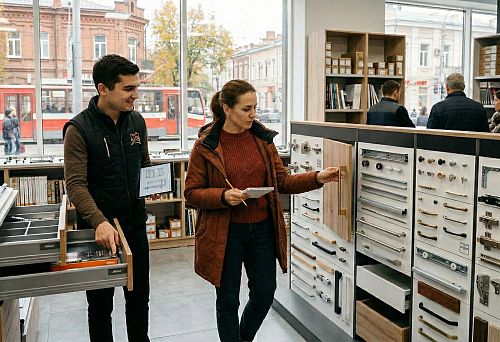
In the world of kitchen design, there are no small details. Every hinge, handle, lift mechanism, or pull-out system is not just a functional element, but also an important part of the aesthetics of your space. Today, we will dive into the fascinating world of kitchen hardware, explore the nuances of selection, and tell you, where to buy kitchen hardwarewhich will become a reliable helper for many years.

Hardware as the foundation of kitchen cabinet longevity
Imagine the kitchen as a complex mechanism, where each detail plays its role in the overall orchestra. Cabinet doors and bodies may be made from the most premium materials, but without quality hardware, they become immovable boxes. It is precisely the hardware that brings life to kitchen furniture, ensuring smooth movement, silent closing, and long-term durability.




Why hardware quality is critically important
The kitchen is a special space with extreme operating conditions. Temperature fluctuations, high humidity, constant use — all this creates tremendous stress on mechanisms. Kitchen cabinet doors open and close up to 50 times a day, which equals over 18,000 cycles per year! Drawers experience even greater stress, especially if they store heavy dishes or food supplies.
Poor-quality hardware begins to show signs of wear within a few months: hinges loosen, drawers become misaligned, and soft-close mechanisms stop working. As a result, not only functionality but also the overall appearance of the cabinet suffers. Doors hang unevenly, gaps between fronts become inconsistent, and silent closing becomes a thing of the past.
Industry professionals know: saving on hardware is the most expensive saving, which will result in constant repairs and premature replacement of the entire cabinet.
Our factory also produces:


Variety of kitchen hardware: from basic elements to innovative solutions
The modern market offers an impressive range of kitchen hardware, and sometimes it’s hard to navigate through all this variety. Let’s systematize our knowledge and consider the main categories.
Get Consultation
Hinges: invisible guardians of reliability
Hinges are, perhaps, the most underrated element of kitchen furniture. They are not visible when doors are closed, but it is precisely from them that the smoothness and quietness of opening and closing fronts depend.
Modern hinges are divided into several types:
- Surface-mounted – installed on the front side of the cabinet body
- Semi-surface-mounted – for doors that partially overlap the frame
- Inset – for doors installed inside the frame
- Special – for corner, diagonal, and other non-standard solutions
Key characteristics of quality hinges:
- Material of manufacture – high-quality steel with anti-corrosion coating
- Number of adjustments – at least three planes
- Opening angle – from 95° to 175° depending on type
- Presence of soft-close mechanism – ensures gentle and silent closing
- Testing for opening cycles – at least 80,000 cycles for household use
Innovative hinges are equipped with integrated soft-close mechanisms, push-to-open systems, and even electric motors for automatic opening.
Drawer systems: functionality in motion
Drawer systems are the heart of kitchen ergonomics. They provide convenient access to contents and allow maximum space efficiency.
Modern drawer systems include:
- Ball-bearing guides – budget solution with limited lifespan
- Ball-bearing guides – more reliable option with full extension
- Metal boxes – metal side rails with integrated guides
- Tandem boxes – premium systems with dual guides and high load capacity
What distinguishes quality drawer systems:
- Load capacity – from 30 to 80 kg depending on type and purpose
- Full extension – ensures access to all contents of the drawer
- Side stabilizers – prevent tilting under uneven load
- Soft-close mechanisms – ensure smooth and quiet closing
- Adjustments – allow perfect alignment of fronts
Innovative systems offer electric opening with a light touch, synchronizers for simultaneous drawer extension, and integrated waste sorting systems.
Lift mechanisms: vertical kitchen measurement
Lift mechanisms allow a new perspective on upper kitchen cabinets. Instead of traditional hinged opening, fronts can be lifted upward, saving space and providing unobstructed access to contents.
Main types of lift mechanisms:
- Swing (horizontal) – front lifts and locks in horizontal position
- Folding – front folds in half when opened
- Parallel lift – front lifts parallel to cabinet body
- Vertical – front lifts vertically upward
- Combined – combine different types of movement
Advantages of quality lift mechanisms:
- Smooth operation – ensured by gas or spring dampers
- Locking at any position – front can be stopped at any height
- Adjustable opening force – adapts to front weight
- Soft-close – ensures gentle closing
- Durability – at least 40,000 open/close cycles
Innovative lift mechanisms are equipped with electric drives, synchronization systems, and even smartphone control.
Handles and front hardware: aesthetics and ergonomics
Handles are not just a functional element, but also an important part of kitchen design. They can become a focal point or, conversely, subtly blend into the overall concept.
Handle variety is impressive:
- Latches – classic variant with two mounting points
- Buttons – compact handles with one mounting point
- Profiled – integrated into the front edge
- Inset – recessed into the front, creating a minimalist look
- Rail-style – elongated handles for wide fronts
- Push-to-open systems – allow complete elimination of visible handles
When choosing handles, it is important to consider:
- Material of manufacture – from metal and plastic to glass and ceramic
- Finish – must be resistant to wear and stains
- Ergonomics – ease of grip and use
- Stylistic compatibility – harmony with the overall kitchen design
- Mounting method – reliability and adjustability
Innovative solutions include handles with integrated lighting, antibacterial coating, and even touch control.
where to buy kitchen hardware: criteria for choosing a reliable supplier
Choosing where to purchase hardware is no less important than choosing the items themselves. The wrong decision may result in purchasing counterfeit products, lack of warranty, and technical support.
Specialized stores vs. universal construction centers
Many customers face the choice: to purchase hardware in a large construction hypermarket or to visit a specialized store. Each option has its pros and cons.
Advantages of specialized stores:
- Wide selection of kitchen hardware specifically
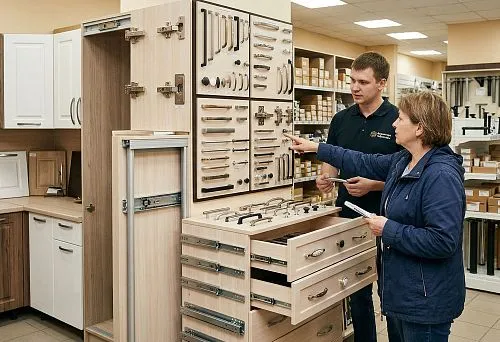
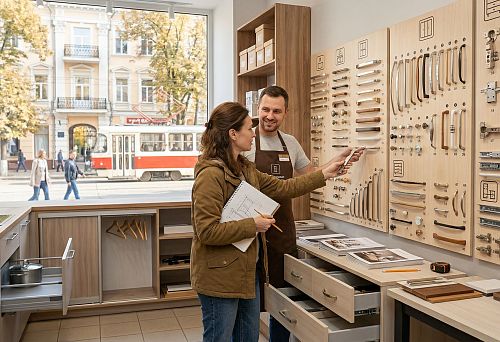
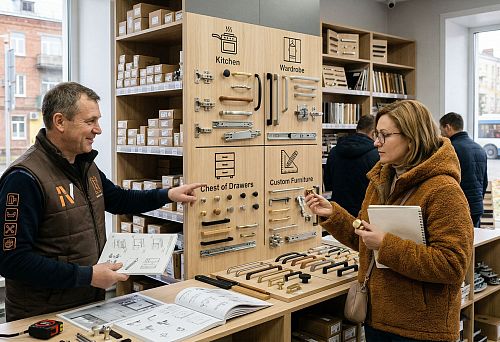
- Professional consultants who know all the nuances
- Availability of samples and demonstration stands
- Ability to order custom solutions
- Guarantee of product authenticity
Disadvantages of specialized stores:
- Often higher prices
- Less geographical accessibility
- Limited selection of complementary products
Advantages of construction hypermarkets:
- Convenience of "buying in one place"
- Often lower prices
- Wide network of stores
- Possibility to purchase all materials simultaneously
Disadvantages of construction hypermarkets:
- Limited selection of specialized hardware
- Consultants with superficial knowledge
- Risk of purchasing outdated models
- Fewer opportunities to demonstrate functionality
Online stores: convenience and risks
In the era of digital technology, more and more customers turn to online stores to purchase hardware. This channel has its own features.
Advantages of online purchases:
- Ability to compare prices and features
- Access to real customer reviews
- Convenience of ordering anytime
- Often lower prices due to absence of costs for maintaining retail spaces
- Delivery Direct to Your Home
Disadvantages of online purchases:
- Inability to physically assess the product quality
- Risk of purchasing counterfeit products
- Difficulties with returns in case of problems
- Absence of personal consultations
- Delivery delays
When choosing an online store, pay attention to:
- Presence of official dealer status – appropriate certificates required
- Detailed product descriptions – with technical specifications and instructions
- Presence of reviews and store ratings – on independent platforms
- Transparent return policy – clear conditions and deadlines
- Consultation support – ability to receive qualified assistance
Direct supplies from manufacturers: advantages of working with the source
Ideal option for those who value quality and authenticity – purchasing hardware directly from official manufacturer representatives or their branded stores.
Advantages of working with official representatives:
- Guarantee of product authenticity
- Complete assortment, including new arrivals
- Professional consultation from specialists trained by the manufacturer
- Official warranty and servicing
- Access to technical catalogs and instructions
- Ability to order custom solutions
One of such reliable suppliers – the company STAVROSwhich specializes in supplying high-quality hardware from leading global manufacturers.
Leading kitchen hardware manufacturers: who to pay attention to
There are many brands in the kitchen hardware market, but only some have earned an impeccable reputation due to long-standing experience, innovative developments, and uncompromising quality.
European leaders: traditions of quality and innovation
European manufacturers traditionally set the tone in the world of kitchen hardware, combining centuries-old quality traditions with cutting-edge technologies.
Blum (Austria)
Blum Company, founded in 1952, is a recognized leader in producing hinges, lifting mechanisms, and pull-out systems. Blum products are distinguished by:
- Exceptional smooth operation
- Innovative motion technologies (BLUMOTION, TIP-ON, SERVO-DRIVE)
- Minimalist design
- Durability (tested for over 100,000 cycles)
- Ease of installation and adjustment
Hettich (Germany)
A company with over 125 years of history, specializing in comprehensive furniture solutions:
- Wide range from basic to premium solutions
- Smooth Closing Systems Silent System
- Innovative solutions for compact kitchens
- Ecological production
- Availability for various price segments
Grass (Austria)
Company known for its innovative drawer systems:
- Unique synchronization mechanisms
- Minimalist design
- High load capacity
- Hidden mounting systems
- Premium quality materials
Hafele (Germany)
Global supplier of furniture hardware and architectural equipment:
- Comprehensive "turnkey" solutions
- Innovative storage systems
- Specialized solutions for small kitchens
- Lighting and electrical systems
- Wide price range
Asian manufacturers: price and quality balance
In the last decades, Asian manufacturers have made a qualitative leap and now offer products that, in many parameters, do not fall short of European counterparts, but often have a more attractive price.
FGV (China/Italy)
Italian company with manufacturing facilities in China:
- Optimal price-to-quality ratio
- Wide range of basic hardware
- Adaptation of European technologies
- Availability for mass segment
- Compliance with international quality standards
GTV (Poland/China)
Polish brand with global presence:
- Extensive product catalog
- Modern design
- Adaptation to various kitchen styles
- Affordable prices
- Increasing quality year by year
DTC (Taiwan)
Taiwanese manufacturer focused on innovative solutions:
- Specialization in hidden mounting systems
- High-tech solutions
- Compact mechanisms
- Adaptation to Asian compactness standards
- Growing presence in the global market
Russian manufacturers: local solutions
Domestic manufacturers are actively developing and offering increasingly high-quality solutions adapted to Russian realities.
Boyard
One of the largest Russian manufacturers of furniture hardware:
- Adaptation to Russian furniture standards
- Affordable prices
- Wide distribution network
- Growing product quality
- Localization of production
MacMart
Russian company with its own production and import:
- Wide assortment from basic to premium segment
- Combination of own production and import
- Adaptation to the needs of the Russian market
- Operational logistics
- Technical support in Russian
Technical aspects of choosing kitchen hardware
When choosing hardware, it is important to consider not only the brand, but also technical specifications that determine the durability and ease of use of your kitchen.
Load characteristics: calculation of optimal parameters
One of the key characteristics of any hardware is its ability to withstand load. Underestimating this parameter leads to premature failure and even hazardous situations.
For hinges, it is important to consider:
- Door panel weight – the heavier the door, the stronger the hinges must be
- Door panel size – high and wide doors require more hinges
- Door panel material – glass and stone panels require special hinges
- Usage intensity – frequently used cabinets require stronger hinges
- Presence of additional elements – built-in lighting, shelves on doors increase load
For pull-out systems, critical are:
- Maximum load – from 30 to 80 kg depending on purpose
- Guide rail length – the longer the drawer, the higher the requirements for rigidity
- Contents type – dishes, food, kitchen appliances create different loads
- Usage frequency – daily-use drawers require stronger systems
- Mounting method – side or bottom mounting have different load characteristics
For lift mechanisms, important is:
- Door panel weight – must match the recommended range
- Facade height – affects the choice of mechanism type
- Door panel material – aluminum frames, glass, solid wood require different settings
- Opening angle – from 75° to 107° depending on mechanism type
- Space above cabinet – necessary for unobstructed opening
Materials used: what ensures longevity
The quality of materials directly affects the lifespan of the hardware and its resistance to aggressive kitchen environments.
For hinges, optimal:
- Body – zinc alloy with nickel or chrome plating
- Mounting plate – steel at least 2 mm thick with anti-corrosion coating
- Spring mechanism – high-carbon steel with heat treatment
- Damping device – high-quality plastic with silicone dampers
- Fastening elements – galvanized steel or stainless steel alloys
For sliding systems, important:
- Guides – cold-rolled steel with galvanic coating
- Rollers/balls – hardened steel or high-strength polymers
- Sides – aluminum alloys or steel with powder coating
- Dampers – hydraulic or pneumatic systems with silicone components
- Fastening elements – galvanized steel with anti-loosening protection
For lifting mechanisms, critical are:
- Levers – aluminum alloys or high-strength steel
- Springs – high-carbon steel with protective coating
- Gas dampers – sealed systems with nitrogen filling
- Fastening elements – high-strength steel
- Plastic components – reinforced polymers with UV stabilizers
Installation features: what to know before installation
Even the highest-quality hardware will not function properly if installed incorrectly. It is important to consider installation specifics even during the selection phase.
For hinges, important is:
- Mounting type – recessed (requiring 35 mm hole drilling) or surface-mounted
- Distance from facade edge – usually 3-5 mm, but may vary
- Number of hinges per facade – depends on size and weight (usually 2-4 pcs)
- Presence of dampers – built-in or surface-mounted
- Adjustment capabilities – minimum in three planes
For pull-out systems, critical is:
- Type of installation – side, bottom, or combined
- Need for cabinet preparation – pre-drilling, milling
- Compatibility with facade type – surface-mounted, inset, integrated
- Requirements for cabinet assembly accuracy – allowable deviations
- Need for special tools – templates, guides, fixtures
For lift mechanisms, important is:
- Requirements for cabinet rigidity – reinforced sides for heavy facades
- Installation space required – some mechanisms require additional room
- Compatibility with facade type – especially for aluminum frames and glass facades
- Need for preliminary adjustment – adjustment for the weight of a specific facade
- Requirements for positioning accuracy – allowable deviations during installation
Innovative solutions in the world of kitchen hardware
Modern hardware is not just mechanical elements, but high-tech systems that make kitchen use more convenient and intuitive.
Electrical and touch systems: the kitchen of the future is already here today
Electrification of kitchen hardware is one of the most dynamically developing directions, transforming an ordinary kitchen into an intelligent space.
Electric opening systems:
- Servo-Drive from Blum – opening with a light touch on the facade
- E-Touch from Hettich – electromechanical opening of drawers
- Easys from Hettich – electric system for refrigerators and freezers
- MotionDrive from Grass – fully automated opening and closing
- Free from Hafele – contactless opening with a hand wave
Advantages of electric systems:
- Ease of use – especially with full hands or when handling products
- No visible handles – clean design lines
- Facade protection from fingerprints – especially relevant for glossy surfaces
- Smooth movement – ideal opening and closing trajectory
- Integration into "smart home" systems – voice control capability
Disadvantages of electric systems:
- Dependence on electrical power – need for wiring or regular battery replacement
- Higher cost – both for the mechanisms and installation
- Repair complexity – requires specialized service
- Sensitivity to voltage fluctuations – need for stabilization
- Limited supply of electronic components – compared to mechanical ones
Space organization systems: maximum functionality per centimeter
Modern kitchen hardware is not only opening mechanisms, but complex internal space organization systems that transform ordinary cabinets into highly functional storage zones.
Innovative storage systems:
- Magic Corner from Hafele – mechanism for corner cabinets with full access to contents
- LeMans from Kessebohmer – pull-out shelves for corner cabinets with ergonomic shape
- SpaceTower from Blum – tall pull-out systems for storage of reserves
- Convoy from Hafele – pull-out storage system for "pantry" type products
- iMove from Hafele – drop-down shelves for upper cabinets
Systems for organizing drawers:
- Orga-Line and Ambia-Line from Blum – modular divider systems
- Cuisio from Hettich – flexible organization systems with non-slip coating
- SmarTray from Hettich – built-in trays for storing small items
- Tavinea from Grass – adjustable dividers for drawers
- Fineline from Hafele – premium wooden organization systems
Specialized solutions:
- Pull-out systems for bottles and spices
- Built-in dividers for cutlery
- Cutting Board and Tray Storage Systems
- Pull-out Baskets for Fruits and Vegetables
- Integrated Waste Sorting Systems
Eco-friendly and safe solutions: care for health and the planet
Modern hardware manufacturers are increasingly focusing on the ecological nature of their products and their safety for users.
Eco-initiatives of leading manufacturers:
- Blum – Greenline Program Using Water-Soluble Coatings and Non-Toxic Materials
- Hettich – Blue Angel Certification for Eco-Friendly Products
- Hafele – GreenForce Program to Reduce Carbon Footprint
- Grass – Use of Recycled Materials and Zero-Waste Production
- FGV – Implementation of ISO 14001 Standards for Environmental Management
Safe materials and coatings:
- Elimination of heavy metals in coatings
- Antibacterial coatings for frequently used elements
- Hypoallergenic materials for contact surfaces
- Non-toxic lubricants for moving parts
- Safe dyes without volatile organic compounds
Innovations in safety:
- Finger-safety protection systems
- Child safety locking mechanisms
- Shock absorbers to prevent impacts and injuries
- Soft-close systems for all types of hardware
- Non-slip coatings for pull-out elements
Economic aspects of choosing kitchen hardware
Purchasing quality hardware is not just an expense, but a long-term investment in the comfort and durability of your kitchen.
Price-to-quality ratio: where you can and cannot save
With a limited budget, it is important to correctly prioritize and understand where savings are justified and where they may lead to additional expenses in the future.
Where saving is unacceptable:
- Pull-out systems for heavy drawers – cost-saving leads to rapid wear and misalignment
- Hinges for frequently used cabinets – cheap hinges quickly loosen
- Lift mechanisms – low-quality systems may be dangerous during operation
- Soft-close systems – cheap alternatives quickly lose functionality
- Fasteners – poor-quality fasteners may lead to structural collapse
Where you can save sensibly:
- Internal dividers – simpler systems can be chosen
- Decorative elements – functionality is more important than appearance
- Handles for rarely used cabinets – more affordable models can be selected
- Hardware for upper cabinets – they experience less load
- Organization systems for rarely used zones – basic solutions can be chosen
Budget optimization strategies:
- Combining brands – use premium solutions for critical elements and more affordable options for secondary ones
- Phased updates – start with basic hardware with potential for future modernization
- Purchasing during sales and promotions – many manufacturers regularly offer special deals
- Wholesale purchases – often discounts are provided for large orders
- Using loyalty programs – accumulated discounts and bonuses
Long-term savings: Investing in Quality
Quality hardware may cost more upfront, but it provides significant long-term savings.
Economic advantages of quality hardware:
- Extended service life – up to 15-20 years instead of 3-5 years for budget alternatives
- No need for replacement – savings on repeated purchases
- Maintaining functionality throughout the product’s lifespan – no gradual degradation of quality
- Protection of main furniture elements – prevents damage to casings and fronts
- Maintaining kitchen aesthetics – no need for cosmetic repairs due to hardware wear
Calculating long-term savings:
Let’s consider an example of a pull-out system for a kitchen drawer:
- Budget solution: 1500 rubles, service life 3–4 years
- Quality solution: 4500 rubles, service life 15+ years
Over 15 years of use:
- Budget option: 4–5 replacements × 1500 rubles = 6000–7500 rubles + cost of replacement work and possible cabinet repair
- Quality solution: 4500 rubles with no additional costs
Total savings: at least 1500–3000 rubles per drawer, not including labor costs and any additional repairs.
Warranty service and post-purchase support
An important economic aspect is the presence of warranty and the possibility of obtaining technical support after purchase.
Standard warranty terms of leading manufacturers:
- Blum – up to 25 years on mechanical components, 5 years on electrical
- Hettich – up to 15 years on mechanical components, 3 years on electrical
- Grass – up to 10 years on main systems
- Hafele – up to 10 years depending on product line
- FGV – up to 5 years on mechanical components
What warranty usually covers:
- Manufacturing defects – hidden flaws revealed during operation
- Premature wear – under normal operating conditions
- Mechanism failure – under normal use
- Corrosion and coating damage – in absence of mechanical damage
- Component deformation – under compliance with load characteristics
What warranty usually does not cover:
- Mechanical damage – chips, scratches, dents
- Incorrect installation – violation of manufacturer’s instructions
- Exceeding load characteristics – misuse
- Natural wear – for components with limited service life
- Damage due to aggressive environment – chemical exposure, extreme temperatures
Advantages of purchasing from official dealers:
- Full warranty service – without additional conditions
- Technical support – specialist consultations
- Availability of spare parts – possibility of quick component replacement
- Training on proper operation – instructions and recommendations
- Service maintenance – preventive maintenance and adjustments
Practical tips for choosing and purchasing kitchen hardware
The process of selecting and purchasing hardware can be complex, especially for an unprepared buyer. Here are several practical recommendations to help make the right choice.
Preparation: what to know before going to the store
To avoid being overwhelmed by the vast assortment and to make an informed choice, it is important to prepare in advance.
Required measurements and calculations:
- Exact dimensions of all fronts – height, width, thickness
- Front weight – especially important for lifting mechanisms
- Opening type – hinged, sliding, lifting
- Front material – solid wood, MDF, glass, composite
- Planned load – what will be stored in each cabinet/drawer
Pre-study of the product range:
- Manufacturer catalogs – familiarizing with product lines
- Online configurators – many manufacturers offer virtual selection
- Video reviews – demonstration of mechanisms in real conditions
- Forums and reviews – experience of real users
- Consultations with professionals – opinion of furniture makers and designers
Setting priorities:
- Functionality vs. aesthetics – what is more important in each specific case
- Durability vs. price – willingness to invest in quality
- Innovations vs. proven solutions – attitude toward new technologies
- Standardization vs. specialization – same hardware everywhere or special solutions for different zones
- Visible elements vs. hidden mechanisms – what to emphasize
Testing before purchase: what to pay attention to
Ideally, before purchasing hardware, it should be tested on demonstration stands or samples.
What to check when testing hinges:
- Smooth operation – absence of sticking or jerking
- Closer operation – even closing throughout the entire path
- Latching in open position – if provided
- Noise level – absence of squeaks and knocks
- Ease of adjustment – accessibility of adjustment screws
What to check when testing drawer systems:
- Ease of movement – force required to pull out
- Stability – absence of play or misalignment
- Full extension – access to all contents
- Closer operation – smooth closing without impacts
- Reliability of latching – absence of accidental opening
What to check when testing lifting mechanisms:
- Balance – smooth movement without jerking
- Latching in intermediate positions – if provided
- Opening force – comfortable for the user
- Closer operation – safe and smooth closing
- Reliability of latches – absence of accidental facade drop
Comprehensive approach: creating a harmonious system
Hardware should function as a unified system, where all elements harmoniously complement and enhance each other.
Principles of comprehensive approach:
- Stylistic unity – all visible elements must match
- Technological compatibility – all mechanisms must operate under a unified standard
- Ergonomic consistency – same principles of use
- Unified fastening – possibility of using one type of tools
- Unified operational logic – intuitive use of all elements
Advantages of using products from a single manufacturer:
- Guaranteed compatibility – all elements are designed as a system
- Unified design code – harmonious combination of all visible elements
- Unified installation – same principles of mounting
- Comprehensive warranty – simplified warranty service
- Modular expansion capability – adding new elements in the future
Conclusion: Investment in comfort and longevity
Choosing quality hardware for the kitchen is not just a technical solution, but an important investment in your daily comfort and the longevity of your interior.
The kitchen is a space where we spend a significant portion of our time, and every detail here matters. Quality hardware turns the process of cooking into a pleasure, eliminating annoying details: squeaky doors, sticking drawers, inconvenient storage systems.
When choosing where to buy kitchen hardwarePay attention to companies with an impeccable reputation and years of experience. One such reliable supplier is the company STAVROS, which specializes in supplying high-quality hardware from leading global manufacturers.
STAVROS offers not just products, but comprehensive solutions for your kitchen. Professional consultants will help you select the optimal hardware considering all aspects of your project, while a wide assortment will allow you to realize any design ideas – from classic to ultra-modern concepts.
Investing in quality hardware today ensures years of comfortable kitchen use without the need for constant repairs and replacements. This is not only economically beneficial in the long term, but also environmentally friendly – as durable solutions reduce waste and resource consumption.
Remember: in the world of kitchen hardware, there are no small details. Every detail matters and contributes to the overall impression of your kitchen. Choose quality, comfort, and reliability – choose proven solutions from STAVROS.