Article Contents:
- Why the query 'flexible wall panels' is not one product but an entire market
- Anatomy of flexibility: how different types of wall panels differ
- Flexible slatted panels on fabric backing
- Rigid slatted panels on MDF backing
- Flexible stone (flexible stone cladding)
- Flexible polyurethane 3D coatings
- Self-adhesive decorative panels
- Cork panels
- Why flexible slat panels are the leader in versatility
- Where flexible wall panels are used: specific scenarios
- Radius Walls
- Columns: From Problem to Architectural Accent
- Arches and Arch Openings
- Niches: Decorating Recesses
- Rounded corners and transitions
- Partitions with Curved Top Edge
- Furniture Fronts and Islands
- Materials for Flexible Slat Panels: MDF vs. Solid Oak
- MDF for painting
- Solid oak
- Semicircular Glazing Bead Profile
- How to Choose Flexible Wall Panels for a Specific Task
- Surface Flat or Curvilinear?
- What Bending Radius?
- Paint or natural texture?
- Residential or commercial property?
- Is acoustics needed?
- Step-by-step guide to installing flexible slat panels
- Step 1. Surface assessment
- Step 2. Base preparation
- Step 3. Marking
- Step 4. Fitting and cutting
- Step 5. Applying adhesive
- Step 6. Installation and bending
- Step 7. Joining and finishing
- Flexible wall panels in different interior styles
- Modern minimalism
- Scandinavian style and organic decor
- Neoclassicism and Modern Classicism
- Loft and Industrial Style
- Commercial spaces
- Flexible wall panels and acoustics: dual function
- What to check before buying: a practical checklist
- Typical mistakes when choosing and installing
- Buy a rigid panel for a curved surface
- Not clarifying the minimum radius
- Skipping priming
- Not securing with tape after installation
- Choosing based on photo without understanding the construction
- Overload a small room
- Ignore compatibility with other finishing materials
- FAQ: popular questions about flexible wall panels
- What are flexible wall panels?
- How do flexible slat panels differ from regular ones?
- What is the minimum radius flexible slat panels are designed for?
- How are flexible wall panels installed?
- Can flexible slat panels be painted?
- Are flexible panels suitable for commercial spaces?
- Is special installation equipment needed?
- How to calculate the number of panels for a column?
- Do flexible slat panels and acoustics really work?
- Where do flexible wall panels work best?
- About the Company STAVROS
Imagine: you're standing in front of a round column in the middle of a living room. Open floor plan, high ceilings, expensive finishes — and this concrete pillar sticking right in the center of the space, refusing to blend into the interior. Or a radius wall in a new building that the seller called an 'architectural highlight,' and now you're wondering — what to clad it with? Or a kitchen island with a rounded end that the veneer specialist called 'non-standard' and quoted triple the price.
It's precisely for such cases that flexible wall panels exist. Not as a universal answer to all questions — but as a precise tool for specific architectural tasks that rigid flat panels handle poorly or not at all.
But there's a nuance: under the query 'flexible wall panels,' the market today offers such a variety of materials, constructions, and applications that without guidance, it's easy to buy one thing and get something completely different. Let's break it down step by step.

Why the query 'flexible wall panels' is not one product, but an entire market
When someone searches for 'flexible panels for walls,' they land in a colorful search results page where completely different products coexist. Self-adhesive decorative tiles with brick imitation. Flexible artificial stone on a mesh. Soft three-dimensional polyurethane coverings. Cork sheets. And — as a separate category — flexible slat panels on a fabric base.
These are five different products with different constructions, different purposes, different prices, and different visual results. What unites them is one thing: the word 'flexible.' But 'flexible' here means different things.
For self-adhesive tiles — it means a thin material that doesn't break during installation. For flexible stone — a sheet matrix on a polymer base. For soft 3D panels — elastic polyurethane. For slat panels on a fabric base — the ability to wrap around curved surfaces while maintaining the rhythm of the slats and seamless joining.
That's why the first step before buying is not choosing a color or comparing prices, but understanding which type of flexible panel you really need. For most architectural tasks in residential and commercial interiors, the answer will beFlexible slatted panels— and here's why.




Anatomy of Flexibility: How Different Types of Wall Panels Differ
To make the right choice, you need to understand the construction. Let's break down the main types.
Our factory also produces:
Flexible Slat Panels on Fabric Backing
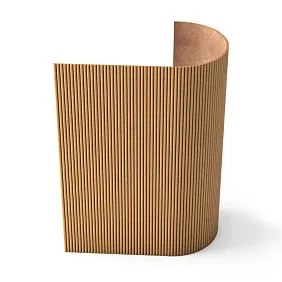
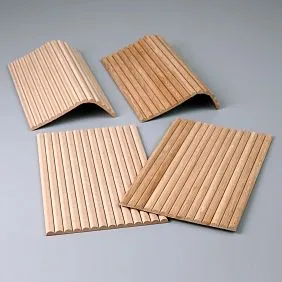
These are modular decorative elements where wooden or MDF battens are fixed at equal intervals on a reinforced fabric backing. The fabric provides flexibility: the panel bends along a radius without breaking the battens or disrupting their spacing. The result is a continuous slatted texture on any curved surface.
The panel works on both flat and curved surfaces. It is mounted with adhesive, cut with a knife, and joined seamlessly. The visual effect is a linear architectural surface with expressive chiaroscuro under side lighting.
Get Consultation
Rigid Slat Panels on MDF Backing
Structurally similar to flexible panels, but with a rigid MDF backing instead of fabric. They are used only on flat surfaces. They provide maximum geometric precision and perfectly even batten spacing. For straight walls, ceilings, and flat furniture fronts—this is the optimal solution. Not applicable for curved surfaces.
Flexible Stone (Flexible Stone Cladding)
A thin slice of natural or artificial stone glued onto a polymer mesh. It imitates stone texture. Suitable for flat and slightly curved surfaces. Heavier than slatted panels, requires special adhesive. The visual result is a stone texture, not a slatted rhythm.
Flexible Polyurethane 3D Coatings
Relief modules made of elastic polyurethane with geometric or ornamental patterns. Lightweight, bendable along a radius, mounted with adhesive. Create volumetric relief on the surface. Visually — a sculptural 3D coating, not a linear slat structure.
Self-adhesive decorative panels
PVC or foamed polyethylene with a self-adhesive base and imitation of wood, stone, brick, metal. A budget option for quick decoration. Minimal durability, weak adhesion with temperature fluctuations. Not recommended for serious projects.
Cork panels
Natural material with good acoustic and thermal insulation properties. Flexible, mounted with adhesive, suitable for flat and slightly curved surfaces. Visual texture — cork, not slats.
| Type | Flexibility | Visual effect | Application |
|---|---|---|---|
| Slat on fabric base | High | Linear rhythm of slats | Radius walls, columns, niches, furniture |
| Rigid slat | No | Linear rhythm of slats | Only flat surfaces |
| Flexible stone | Medium | Stone texture | Flat and slightly curved |
| 3D polyurethane | High | Volumetric relief | Flat and curved |
| Self-adhesive PVC | Medium | Various imitations | Budget decor |
| Cork | Medium | Cork texture | Flat, acoustic tasks |
Why flexible slat panels are the leader in versatility
Slatted surfaces hold a special place among all types of wall coverings—and the reason is not fashion, but physics.
Parallel slats with equal spacing create a rhythmic structure on the wall that interacts with light. With side lighting, each batten forms its own highlight and shadow on the next, turning a flat wall into a sculptural object. Change the angle of the light source—and the character of the surface changes. It looks different in the morning than in the evening. This is what designers call a 'living surface'—and it fundamentally distinguishes slat panels from any printed or painted coating.
On curved surfaces, this effect multiplies. The curvature of a wall or column changes the angle of light incidence along the entire surface, and the slatted texture gains a dynamism that a flat wall cannot reproduce. That is whyWall slatted panelsin architectural projects, they are used not only as a finishing material but also as a full-fledged design tool for working with form and light.
Where flexible wall panels are used: specific scenarios
Understanding scenarios is key to making the right choice. Let's examine each one.
Radius walls
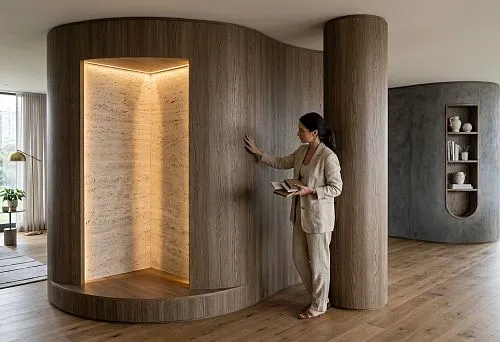
Rounded and curvilinear walls are much more common than one might think: bay windows, rounded piers, smooth transitions between zones, custom architecture with non-standard geometry. For such surfaces, traditional rigid panels are a headache: they require piece-by-piece fitting, custom curved cuts, and gaps still remain at the joints.
Flexible slatted panels solve this problem differently: the module is applied to the surface, the fabric base allows it to conform to the curve, and the adhesive secures it. The next module is joined edge-to-edge—and the slat pattern continues seamlessly across the entire seam. No fitting, no gaps. This isn't just convenience—it's a fundamentally different quality of result.
Columns: from problem to architectural accent
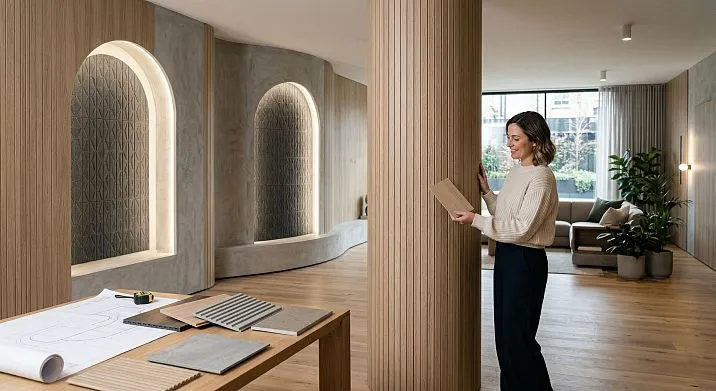
A round load-bearing column is a frequent feature in modern open-space layouts. In a good project, it's turned into a detail. In a bad one, it's left as is. There aren't many cladding options: plaster (unexpressive), tile (heavy and expensive), rigid panels (require precise fitting), or flexible slatted panels—which wrap around the circumference continuously.
For a column with a diameter of 30 cm, one standard-width module is needed; for a diameter of 50–60 cm, two. The slats run vertically around the entire perimeter, creating a unified slatted surface without visible technical seams. With proper lighting, such a column becomes a visual accent in the space—not an element one wants to hide.
Arches and arched openings
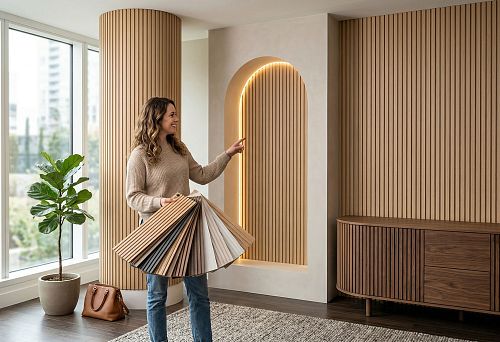
An arch is a curve that requires a solution for the opening's edge. When walls are finished with slatted panels and the arched reveal remains bare or painted, the transition reads as unfinished. Flexible slatted panels allow the slatted texture to continue right into the arch: the opening's edge is clad with a module that wraps around the curve, and the boundary between the wall and the arch disappears.
This is the kind of detail that isn't always consciously noticed—but it's precisely what creates the feeling of professionally executed design.
Niches: decorating recesses
A decorative niche is an extremely popular architectural technique. The back wall, finished withslatted panels in the interiortransforms a wall recess into a standalone visual object. For niches with right angles, both rigid and flexible panels are suitable. For niches with rounded transitions from the back wall to the sides, a flexible construction is necessary.
A combined technique is often used: the back wall of the niche is a dark slatted panel, while the sides and top are painted to match the overall finish. The depth of the slats creates an 'emerging from darkness' effect, especially with spot lighting from below or above the niche.
Rounded corners and transitions
A rounded corner between two walls is another scenario where a rigid panel requires complex fitting. A flexible panel wraps around the transition from one wall to another without breaks. This is critically important when slatted cladding must continue around a corner—in hallways, on accent walls spanning multiple planes.
Partitions with a curved top edge
Slatted partitions in open-plan layouts are an architectural technique that has remained relevant for several years. When a partition has a curved top edge or smoothly transitions into a ceiling element, a flexible panel allows the slatted texture to be preserved across the entire surface, including curved zones.
Furniture fronts and islands
Curved furniture fronts—ends of kitchen islands, rounded corner sections of cabinets, bar counters with curved fronts—traditionally required complex milling or expensive custom work. Flexible slatted panels change this calculation: they are mounted directly onto the front with adhesive, wrap around the curve without milling, and provide a continuous slatted texture across the entire front surface.
Decorative overlays for furniture and facadesorganically complement such a solution: the slats create a textured background, overlays serve as accent details on doors and fronts, and the entire furniture story comes together as a unified ensemble.
Materials for flexible slatted panels: MDF vs. solid oak
Choosing the material for a flexible slatted panel is not a secondary question. It is a decision that determines the final visual result, durability, and cost of the entire project.
MDF for painting
MDF with a density of 750–850 kg/m³ provides a precise, predictable surface free from natural defects. There are no knots, resin pockets, or uneven paint absorption. Sanded MDF accepts any paint finish: matte enamels, satin, semi-gloss, and with proper preparation—even gloss.
The main advantage of MDF in the context of flexible panels is absolute color control. A column clad with MDF slat panels and painted to match the wall color visually dissolves into the space—only the relief remains. The same column, painted in a contrasting color, becomes an architectural accent. The range of possibilities: from arctic white to anthracite charcoal, from dusty lavender to deep navy blue.
wood-look slatted panelsMDF panels painted with special decorative coatings that mimic wood grain are a separate story. But if you want real wood, the next option is more interesting.
Solid oak
Oak is a species with a density of 700–750 kg/m³ and high mechanical stability. Each slat features a unique natural grain pattern that cannot be reproduced by decorative film or printing. Under side lighting, the living texture of oak adds a tactile dimension to the surface—it makes you want to touch the wall.
Under clear oil, oak reveals a warm golden tone. Tinting oil produces a Scandinavian cool gray or rich wenge. Lacquer provides maximum protection against mechanical damage—critical for commercial spaces with high traffic.
For furniture fronts that are regularly opened and closed, oak is preferable to MDF in terms of resistance to wear on edges and surfaces.
Half-round bead profile
A separate parameter that influences the visual result no less than the material. A rectangular slat profile creates sharp geometric chiaroscuro—crisp edges, defined shadow lines. A half-round bead provides a soft, smooth play of highlights—each slat forms a light 'dome,' giving the surface a sculptural softness.
For modern minimalism and neoclassicism—rectangular profile. For more organic and natural interiors—half-round.
How to choose flexible wall panels for a specific task
The selection algorithm is not a linear list, but a decision tree. Let's go through the key forks.
Is the surface flat or curved?
This is the very first question. If the surface is flat — a rigid slatted panel on an MDF backing will provide maximum geometric accuracy and maintains a cleaner, even slat spacing. If the surface has a curve of any radius — only a flexible panel on a fabric base is suitable.
What is the radius of curvature?
For a gentle curve (radius over 80–100 cm) — most flexible models are suitable without restrictions. For a tight curve (radius less than 50 cm) — check the specific module's parameters with the manufacturer: a slat that is too thick may crack on a small radius.
Painted finish or natural texture?
If the goal is an exact color from the RAL palette, a monochrome accent surface, or painting to match the wall — choose MDF. If the goal is the natural texture of wood, the warm aesthetic of a natural material — choose solid oak.
Residential space or commercial project?
For commercial spaces with high traffic — lacquered oak or MDF with high-quality enamel: these are more wear-resistant surfaces. For residential interiors — both materials are equally suitable.
Is acoustics needed?
If a room suffers from echo and reverberation (open-plan living rooms, meeting rooms, restaurants) — acoustic material can be laid behind the slatted panel during frame installation. The slatted structure scatters sound waves, while the underlay of mineral wool or acoustic foam absorbs them. This is a dual function from one solution.
Step-by-step guide for installing flexible slatted panels
Installation does not require special equipment or professional training. But there are nuances that critically affect the result.
Stage 1. Surface assessment
Inspect the base: check for crumbling plaster, signs of moisture, grease stains. Tap the surface — a 'dull' sound indicates a detached layer that needs to be removed before installation.
For columns — measure the perimeter: this is needed to calculate the number of modules. For radius walls — determine the minimum radius of curvature.
Stage 2. Base preparation
The surface must be: clean (free of dust and dirt), dry (humidity no more than 8–10%), degreased, leveled (permissible deviations — no more than 2–3 mm per meter).
If there are serious irregularities — install on a metal frame made of profiles. The frame levels the plane, creates an air gap for acoustics, and allows easy bypassing of an uneven base. Primer is applied to the prepared surface — this improves adhesive bonding and reduces the risk of delamination.
Stage 3. Marking
Apply horizontal and vertical axes. For the column — mark the beginning and end of the module. Check the level: the slats must run strictly vertically (or strictly horizontally — depending on the task), without deviations. An error in marking is more costly than any minutes saved.
Stage 4. Fitting and Cutting
Place the module against the surface without adhesive. Check the fit. Mark the areas for trimming. Cutting — use a utility knife along a metal ruler. For curved shapes (arches, rounded edges) — draw the contour on the back side and cut along the marking. For flexible panels — no saw is needed, only a knife.
Stage 5. Applying Adhesive
Mounting adhesive is applied to the back surface of the module — in a zigzag or uniform horizontal stripes. For curved surfaces — additional adhesive along the edges: it is the edges that tend to lift during bending until the adhesive sets.
Stage 6. Installation and Bending
Press the module onto the surface from one edge to the other — gradually, ensuring full contact across the entire area. On a column — wrap around the circumference, pressing with your palm along the entire height. On a radius wall — monitor for uniform contact.
Secure with painter's tape along the edges until the adhesive fully sets (2–4 hours). Without this fixation, the edges may lift — especially on surfaces with a small radius.
Stage 7. Joining and Finishing
The next module — butted against the previous one, aligning the slat spacing. The seam is practically invisible with proper joining.
After the adhesive has fully cured — final finishing: painting with enamel (for MDF), applying oil or varnish (for oak).Decorative wall panels for apartment interiorsrequire two thin coats of paint — with intermediate drying — for even coverage without drips.
Flexible wall panels in various interior styles
Modern minimalism
Flexible slatted MDF panel painted to match the wall color — the perfect tool for a monochrome architectural interior. A column in the same tone as the space ceases to be an obstacle and becomes a sculptural element. An accent wall with slats in the same color — texture without color noise.
Scandinavian style and organic decor
Oak slats under clear oil or with a light gray tint — a precise hit on Scandinavian aesthetics. Natural texture, warm neutral tones, organic rhythm. A flexible oak panel on a column in a living room with white walls and linen textiles — this is a unified natural ensemble.
Neoclassicism and modern classicism
Slatted panels pair beautifully withmoldings and trimwithin a single interior design solution. A slatted panel creates a textured background, moldings frame zones. On columns — slats as cladding, topped with a decorative capital. This is a modern interpretation of classical architecture without heaviness.
Loft and industrial style
Gray slatted MDF panels against exposed concrete — a professional architectural contrast of textures. Round reinforced concrete columns with slatted cladding in anthracite or dark gray — they don't conceal the industrial character but enhance it through the rhythm of lines.
Commercial spaces
Restaurants, hotels, boutiques, offices — wherever architectural finishes need to last for years and look premium with moderate investment. Flexible slatted wall panels create a wear-resistant surface with high visual class. Lacquered oak options withstand high visitor traffic, maintaining their appearance for 5–7 years without renewal.
Flexible wall panels and acoustics: dual function
This aspect is often overlooked. A slatted surface is not just a visual tool. Parallel slats scatter sound waves, disrupting direct reflection from a flat wall. This reduces reverberation — echo in large spaces with high ceilings.
When installed on a frame with a 5–10 cm air gap, the effect is enhanced. If the gap is filled with acoustic material — mineral wool, acoustic foam — sound absorption increases significantly.
For flexible panels on columns, this effect is partial: acoustic backing behind a panel on a column is more difficult to install, but even without it, sound scattering is present. This is important for restaurant and office interiors, where columns are often located in acoustically problematic areas.
What to check before buying: a practical checklist
Before ordering flexible wall panels, go through this list.
Base type. Fabric (for curved surfaces) or rigid MDF (only for flat surfaces). This is the first and main question.
Minimum bending radius. Check with the manufacturer for the specific module. Not all flexible panels are equally flexible.
Slat material. MDF — for painting. Solid oak — for tinting and varnish. The choice depends on the design concept and wear-resistance requirements.
Slat profile. Rectangular — sharp chiaroscuro. Semicircular — soft, sculptural.
Slat spacing. Close spacing — dense, 'warm' surface. Wide spacing — light, airy. The scale of the spacing should match the scale of the surface.
Module format. Standard panel PAN-001 — 1010×8×950 mm. For a column — calculate the perimeter and the required number of modules. For a radius wall — the surface area.
Mounting method. Directly on the wall (adhesive) or on a frame (with leveling and acoustic capability). For columns — adhesive only.
Finish. MDF — primer + paint. Oak — oil or varnish. Is painting required after installation?
Junction with other materials. How will the panel meet the floor, ceiling, moldings, door slopes? Plan the abutment details in advance.
Typical Errors in Selection and Installation
Buy a rigid panel for a curved surface
Looks logical in the store — lower price, wider selection. But on a curved wall, a rigid panel either creates gaps or cracks. The result — a complete redo.
Not specifying the minimum radius
'Flexible' does not mean 'infinitely flexible'. Each module has a maximum bending radius, determined by the slat thickness. Purchasing without clarifying this parameter for highly curved surfaces is a risk of slat deformation.
Skip priming
Especially critical for columns: the panel experiences constant tensile load due to surface curvature. Without primer, the adhesive gains strength more slowly, and the panel edges may detach after several months.
Not securing with tape after installation
On curved surfaces — a mandatory step. Without fixation, the edges detach before the adhesive sets, and this cannot be corrected without dismantling.
Choose based on photo without understanding the construction
A beautiful render with a slatted wall says nothing about the panel type. 'The same slats' may turn out to be rigid — and won't fit on your curved wall.
Overload a small room
Frequent slat spacing + dark color + low ceiling = a room that feels oppressive. In small rooms — delicate spacing, light tones, vertical orientation for visual elongation.
Ignore compatibility with other finishing materials
A slatted panel is not an isolated element. It should rhyme with the floor, furniture, textiles, and lighting fixtures. Oak slats with a warm honey tone don't pair well with cold white gloss and chrome metal — and vice versa.
FAQ: Popular Questions About Flexible Wall Panels
What are flexible wall panels?
This is a broad category of decorative and finishing materials that can bend to the shape of a curved surface. It includes flexible slatted panels on a fabric base, flexible stone, 3D polyurethane coatings, self-adhesive panels, and cork solutions.
How do flexible slatted panels differ from regular ones?
Regular slatted panels have a rigid MDF backing and are only used on flat surfaces. Flexible ones—on a fabric base—are installed on any curved surfaces: columns, radius walls, arches, niches, curved furniture fronts.
What is the minimum radius a flexible slatted panel is designed for?
Depends on the specific model and slat thickness. For the standard STAVROS PAN-001 panel—check the page of slatted panels or with managers. For strong bends (radius less than 40–50 cm), be sure to confirm compatibility.
How are flexible wall panels installed?
With mounting adhesive. The surface is primed, adhesive is applied to the back of the panel, the module is pressed against the surface and secured with painter's tape until the adhesive sets. Cutting is done with a utility knife.
Can flexible slatted panels be painted?
Yes. MDF panels are primed and painted with any enamel. Oak panels are tinted with oil or varnish.
Are flexible panels suitable for commercial spaces?
Yes. Restaurants, hotels, offices, boutiques — anywhere with non-standard geometry requiring high-quality, durable finishes. Varnished oak panels withstand high traffic.
Is special tooling required for installation?
No. A utility knife, metal ruler, level, painter's tape, adhesive — that's the entire necessary set. No special preparation is required.
How to calculate the number of panels for a column?
Measure the column's perimeter (π × diameter). Divide by the width of one module. For example, a column with a diameter of 35 cm has a perimeter of about 110 cm. With a module width of 101 cm, you need 1–2 modules depending on the allowance for trimming.
Flexible slatted panels and acoustics — does this really work?
Yes. The slats scatter sound waves, reducing reverberation. The effect is enhanced when installed on a frame with acoustic filler in the gap.
Where do flexible wall panels work best?
On columns, radius walls, arches, rounded niches, and curved furniture fronts — anywhere rigid panels require complex fitting or are not applicable at all.
About the company STAVROS
When an architectural task requires a precise solution for non-standard geometry — professionals choose STAVROS. The company manufactures slatted panels from paintable MDF and solid oak in several structural formats: rigid modules for flat surfaces and flexible fabric-based panels for radius walls, columns, arches, niches, and curved furniture fronts.
The STAVROS production standard includes seamless module connection, precise slat spacing, readiness for finishing immediately after installation, and easy cutting without special tools.Full catalog of slatted panelsincludes models with rectangular and semicircular batten profiles, in MDF and solid oak finishes — for any design concept and any architectural task.
STAVROS is a laureate of the 'Industry Leader of Russia' title, a company with over twenty years of experience in producing wooden and polyurethane decor for interiors and facades. Nationwide delivery ensures the implementation of projects of any complexity and geography.
Flexible wall panels for the most non-standard surfaces are exactly what STAVROS manufactures and supplies to projects across Russia.